
Heather King's Blog, page 42
September 4, 2021
POULENC’S OPERA: “DIALOGUE OF THE CARMELITES”
Here’s how this week’s arts and culture piece begins:
Francis Poulenc’s “Dialogues of the Carmélites” is a 1957 opera based on the true story of the Martyrs of Compiègne, a community of 16 Carmelite nuns who were guillotined during the French Revolution’s virulently anti-Catholic Reign of Terror.
The libretto is by Georges Bernanos (1881-1948), Catholic novelist best known for “Diary of a Country Priest.”
I confess that opera (favorite arias aside) is not my first love. Enter “Dialogues of the Carmélites,” which I came across in the form of a high definition Metropolitan Opera broadcast, a series that brings opera performances live into movie theaters throughout the world, and then archives them.
SPOILER: Martyrs ahead!
READ THE WHOLE PIECE HERE.


September 2, 2021
THE FEMININE GENIUS
Here’s a podcast I did with the wonderful Simone Rizkallah of Endow.
The intro:
“Simone Rizkallah interviews Heather King on avoiding ideologies, the many aspects of the feminine genius, and how the spirituality of St. Thérèse of Lisieux is one response to our personal and cultural ills.
Heather is an ex-lawyer, a sober alcoholic of 33 years, a Catholic convert, and a lover of books, film, and art. She is an award-winning author, columnist and speaker. Her subjects include addiction, conversion, money, food, womanhood, annoying neighbors, prayer, gardening, and St. Thérèse of Lisieux.”
And here’s the PODCAST.
August 31, 2021
A SENSE OF HOME
“The sense of home is not the culture, not the food, not even the many relatives. It is the place: the look of early morning; the smell of juniper; the particular expected temperature for the kind of day it is, for the time of year it is; the mountains being in the right place.”
–Viola F. Cordova (1937-2002), Native American author and philosophy professor
I read that quote over the weekend in a collection of essays edited by Gary Paul Nabhan called The Nature of Desert Nature. It articulated perfectly what I’ve been “doing” these past four months since I moved to Tucson.
I usually rise around 5, in time for first light. I turn on the coffee and while it’s brewing, throw open all five doors: living room, bedroom, side ramada, door behind the kitchen to the back patio and yard, double French doors, with a decorate wrought iron gate, that lead from my office, also to the back patio.
What does the sky look like? What’s the humidity level and temperature? Is there a breeze? What are the smells? Did it rain during the night? Has the dawn chorus started?
If I had my way, all windows and all doors would be open to the outdoors at all times. That’s not a great idea when the temperature outside is 105. Also the monsoon rains have brought clouds of vicious mosquitoes. So a lot of my day consists in adjusting doors, blinds, curtains, peering out, checking the bird feeders, scanning for Gila woodpeckers or vermilion flycatchers (most of what I get are mourning doves and house finches, both of which I also love). Has the mailman come yet? The ancient casement windows in my adobe, with rectangular panes edged with metal, amazingly still crank out with a little coaxing. But September can still be hot, so though I use the A/C as little as possible, I’m not quite there yet.
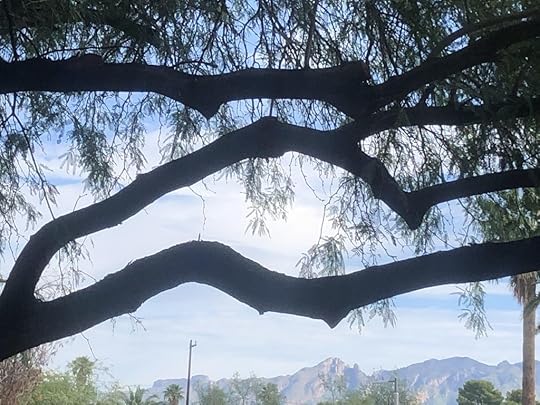
We had a real deluge a few nights ago, preceded by a wind that bent tree branches practically to the ground and one of those gray-yellow glowering skies against which the leaves look almost fluorescent.
Taking my walk the next morning, I reflected that the wind is a natural groomer. So many things are down after a vigorous rain. Palm tree fronds. Huge mesquite and palo verde branches. Cacti: a whole arm will have sheared off, or a sheaf of pads will be scattered around the base.
What are the different colors of the mesquite pods? They range from bone to ivory to streaked with rose-pink to deep blood-red and finally sepia.
In late August, certain bushes or stands of flowers—purple and red, mostly—are alive with flocks of small, madly fluttering, Monarch butterflies. Through the blooms of my neighbor’s crepe myrtle yesterday flitted a large black and pale yellow swallowtail.
What are the sounds as I walk? The low humming buzz of cicadas. Birds twittering. Motorcycles, huge 4 by 4s and souped-up cars roaring up and down Campbell, Speedway, and Country Club.
How is the afternoon light on my face different in September than in June?
Just on my daily walk around the neighborhood, I could make a whole study—and maybe will!—of each of the following:
Benches
Doors
Gates
Fences
Vintage lighting fixtures
Decorative tiles
Yard art
Birdfeeders
Seedpods on sidewalk
Trees that meet over the sidewalk to form a bower
At night—the string lights that drape patios, wrap the trunks of trees, garland corrugated tin gates.
Meanwhile, just for today—the mountains are in the right place.
August 27, 2021
OUR DAILY TSETSE FLIES
Here’s how this week’s arts and culture piece begins:
Desert People is an hour-long documentary shot in 1965 in the Gibson Desert of Australia’s Western Desert, Shot in black-and-white and produced by the National Film and Sound Archive of Australia, the film follows two families headed up, respectively, by Djagamara and Minma.
I happened upon the film on Kanopy (ten free monthly movies with your LA Public Library card!), watched a random sample, and ended up sitting through the whole thing, transfixed.
The Western Desert covers over half a million square miles and is one of the most arid regions in Australia. At the time, possibly three or four family groups still remained, making their way as nomadic hunger-gatherers in this remote expanse of land.
These people had nothing and I mean nothing! Not clothes, not shelter.
READ THE WHOLE PIECE HERE.
August 24, 2021
SEEKING WITH GROANS
“I condemn equally those who choose to praise men, those who choose to condemn him, and those who choose to divert themselves. And I can approve only those who seek with groans.”
–Blaise Pascal, “Pensées”
Welp, I have been privately praising certain men, condemning certain men, and choosing on many occasions to divert myself.
Then again, I have also been seeking, and definitely with groans.
Also, however, often with sardonic laughter, wonder, and joy.
I continue to settle into this new chapter of my life in Tucson.
Already the worst of the summer is over is my sense. The sun sets a little earlier, the mornings and evenings are generally a bit cooler, and even on 100-plus-degree days the harsh blistering edge of the June and early July heat has somehow softened.
In fact, the notoriously baking Arizona summer hasn’t been that hard to bear. This could be largely due to the fact that, as of three days ago, Tucson has received 11.86″ of rain this year. This ranks as the 3rd wettest monsoon ever recorded and puts the city in a legitimate position to take over the top spot before monsoon officially ends September 30th.
I dont’ want to say anything but–put it together. The state’s in a drought. I move to town. Wettest summer on record…You’re welcome!
The only bummer about the rain is…insects, specifically mosquitoes and flies. I have got me a giant spray bottle of Repel 100.
Other than that, I am pretty much so dazed by my good fortune that I stumble about my abode for much of the day murmuring, “I cannot BELIEVE I live here”…Almost every window gives onto a view of green–a huge agave, a mesquite tree, a stand of bamboo. The Mexican bird-of-paradise in the front yard, at least 8 feet tall, lends a protective, motherly air to the enclosure. There are birds galore, lizards scampering, and everything smells of a rich, deep desert humus.
I rise at 5, have my coffee with the birds, and pray. My walk usually comes late afternoon/early evening or if it’s really hot, more towards sunset. Any time of day, the smog-free sky, flora, shade trees, and light shimmering purple-blue over the mountains are all huge, unmerited gifts.
Today two University of Arizona museums re-open: The Center for Creative Photography and the Arizona State Musuem. The campus Newman Center, a 25-minute walk, switches also today from 11:30 to 5:15 Mass Tuesday-Friday.
A friend came over a couple of weeks ago and gave me a couple of used books, one a compilation of the writings of Christian mystics, one a dog-eared copy of a small volume called Out of Solitude by Henri Nouwen.
From a passage entitled “Expectation as Patience”:
“The mother of expectation is patience. The French author Simone Weil writes in her notebooks: ‘Waiting patiently in expectation is the foundation of the spiritual life.’ Without patience our expectation degenerates into wishful thinking. Patience comes from the word ‘patior’ which means to suffer. The first thing Jesus promises is suffering: ‘I tell you…you will be weeping and wailing…and you will be sorrowful.’ But he calls these pains birth pains. And so, what seems a hindrance becomes the way; what seems an obstacle becomes a door; what seems a misfit becomes a cornerstone. Jesus changes our history from a random series of sad incidents and accidents into a constant opportunity for a change of heart.”
I, too, am waiting–I’m not sure for what, or whom.
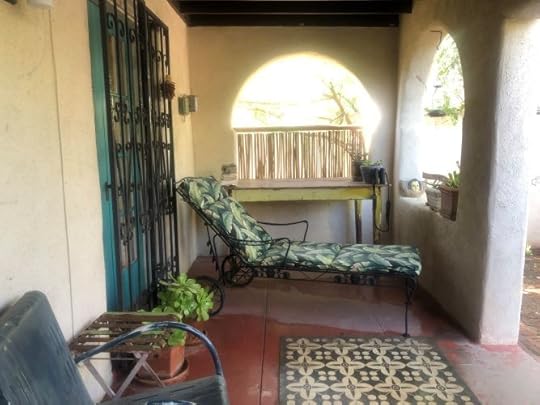 MY BACK PORCH, DETAIL.
TO CONSERVE ENERGY, I OFTEN DRAPE MY CLOTHES OVER THAT TABLE
OR HANG THEM FROM THE WINDOW GRILLS TO DRY.
August 20, 2021
IRREVERSIBLE DAMAGE: ABIGAIL SHRIER ON TEEN TRANSGENDERISM
Here’s how this week’s arts and culture column begins:
Wall Street Journal columnist Abigail Shrier has written a brave book: Irreversible Damage: The Transgender Craze Seducing Our Daughters.
A graduate of Columbia College, the University of Oxford, and Yale Law School, Shrier lives in LA and is a mother.
Supportive of those with transgenderism who transition as adults, she naturally decries anti-transgender discrimination of any kind. She writes here exclusively of the trans phenomenon of “rapid onset gender dysphoria” as it affects teenage girls.
The statistics are staggering. A decade ago, the Diagnostic and Statistical Manual (DSM-5) reported an expected incidence of gender dysphoria for natal females, based on those who sought medical intervention, at .002-.003 percent of the population.
In the last decade, the incidence has increased by 1000%. In Britain, the increase is 4000%. Puberty blockers, testosterone, and surgery—all with irreversible effects, are now routinely administered, based largely on the subjective feeling of the teen in question that she was born into the wrong body. “The children lead the way” is the ethos. Some teen girls threaten to commit suicide if their demands aren’t met and thus withholding of consent has come culturally to be considered an act of violence.
READ THE WHOLE PIECE HERE.
Here’s a recent piece from Commentary also reflecting on the question of whether pre-adolescents are equipped under the circumstances to give their informed consent.
August 18, 2021
WHY DO YOU STAND HERE IDLE ALL DAY?
Today marks 25 years since my Confirmation and First Communion.
I walked to Sts. Peter and Paul for 7 am Mass. Just an “ordinary” Mass. Kneeling in my pew for a moment beforehand, I thought, Thank God I am still here. And then I looked around at the usual ragtag crew, many of us on the final stretch or close to it, and thought, Thank God THEY are still here.
Eeryone loves to criticize the Church, but the Church is here: hidden, veiled, so humdrum and unremarkable as to be invisible not only to the world, but often to the Church itself. People who are aching and burdened and anxious unto death and who have brought themselves before the altar to say, among other things: I can’t endure the human condition alone–and thank you.
The Gospel today is one of my favorites: The Parable of the Workers in the Vineyard (Matthew 20:1-16), where the vineyard owner gives the same wages to the workers who came at 5 as he does to those who’ve been working at 9. And when the ones who’ve been working all day grouse, he says, You received the agreed-upon wages in full. What skin is it off your back if I’m generous?
Erasom Leiva-Kerikakis, (now Fr. Simeon and a Trappist monk), reflects on the parable in today’s Magnificat. He notes that before hiring the 5 o’clock guys, the landowner asks, “Why have you been stading here idling all day?” They say, “Because no-one has hired us.” Why did the landowner ask what at first glance seems a redundant question? “The master’s emphatic question, Why do you stand here idle all day?,” observes Leiva-Merikakis, “though perhaps uttered in an exasperated tone, contains a secret source of immense hope precisely because it takes for granted that there is always a place in the vineyard for anyone willing to work, no matter his origin, lack of previous experience, or the late hour of the day.”
(A similar situation/tone rose to mind: when Jesus asks the paralytic who’s been lying beside the healing pool for 40 years without ever once going in–“Do you want to be healed?”)
Then, in my trusty Oswald Chambers’ My Utmost for His Highest, the August 18 reflection was on Luke 18:23, from the Parable of the Rich Young Man: “When he heard this, he became very sorrowful, for her was very rich.”
Chambers wrote: ” ‘Sell all that you have….’ In other words, rid yourself before God of everything that might be considered a possession until you are a mere conscious human being standing before Him, and then give God that…I can be so rich in my own poverty, or in the awareness of the fact that I am nobody, that I will never be a disciple of Jesus. Or I can be so rich in the awareness that I am somebody that I will never be a disciple. Am I willing to be destitute and poor even in my sense of awareness of my destitution and poverty? If not, that is why I becoome discouraged. Discouragement is disillusioned self-love, and self-love may be love for my devotion to Jesus–not love for Jesus Himself.”
I thought about all that as I walked to Mass, of how proud I am of my “drivenness,” my “discipline,” my “will-power,” and how I’m just an old fraud. I’m not even that disciplined for starters–I’m driven to do the things I want to do and have to be dragged kicking and sreaming into providing the slightest service for others. And any drivenness, whatever that means, I do have obviously is through absolutely no virtue of my own.
Am I that frightened of standing “naked,” without possessions, gifts, virtues, before God? I was taught to be able to give a good account of myself at the end of the day, but giving a good account before God and before the world, it is ever more borne in, are two very different things.
Elbowing the world aside so I can check things off my to-do list doesn’t avail the world and it doesn’t even avail me. Do what, and for whom?
Walking home from Mass, I received a text from a friend asking me to please pray for his uncle, who is in a hospital with COVID and about to be put on a ventilator.
Here’s what 25 years have revealed: That is not a request that you check off a to-do list.
That is an honor that you receive with bowed head, on bended knee.
August 13, 2021
WE LIVE ON: STUDS TERKEL’S HARD TIMES REVISITED
Here’s how this week’s arts and culture piece begins:
The Actors’ Gang Theater is currently presenting “We Live On,” a three-part live virtual production based on the 1970 classic Hard Times by Studs Terkel.
Tim Robbins adds additional text and directs. The series runs through September 4 and is being offered to the public with a pay what you can admission.
Each of the three parts presents ten stories from the Great Depression and stands on its own. With music by Cameron Dye and David Robbins, this world premiere features stories by, among others, labor activists Dolores Huerta and Cesar Chavez, and Catholic Worker co-founder Dorothy Day.
Last year marked the 50th anniversary of the publication of Hard Times. Terkel, famously, travelled around the country talking to, among others, itinerant farmers, seamstresses, field workers, burlesque queens, con men, speculators, and union organizers.
What was their experience of the Great Depression? How did they make it through? What reserves of resilience, courage and integrity did they call upon? Terkel, who liked to call himself “a guerrilla journalist with a tape recorder,” asked questions. He listened. And he wrote down the stories of those who would otherwise have remained anonymous, overlooked and forgotten.
READ THE WHOLE PIECE HERE.
August 9, 2021
STAYING THE COURSE
“My fight for sculpture uses up all of my time and strength, and even then I lose.”
–Auguste Rodin
I often converse with people who are trying to bring God, for lack of a better term, into their money lives.
Most of these people were traumatized somehow as children. Many are so paralyzed by perfectionism that even well into their 40s, 50s and even 60s, their lives and capacity to earn have never quite gotten off the ground.
Sometimes they’ll say things with a refreshing take. “Do a B+ job.” “Mediocre makes money.” “Easy, fun and done!”
I got what those kinds of remarks are aiming at. Give yourself a break. Let go of the idea that your best isn’t good enough, that you have to earn love, that you’re never allowed to relax.
On the other hand–maybe it’s my Yankee unbringing, the fact that my roots are blue-collar, or (more likely) a vast overestimation of the amount of work I do myself, and the amount of effort I put into it.
But though I get doing a B+ (or worse) job for everything else, when it comes to art I do feel we’re conscience-bound to at least strive to do the very best job we can–whether we stand to make money from it or not.
That the results are almost invariably mediocre (I speak for myself) is part of the cross. But to be content with mediocre–that I can’t see.
“My yoke is easy, my burden light”–but take it up, though you’ll often look like an ass carrying it.
“I have fought the good fight, I have finished the race, I have kept the faith,” said St. Paul [2 Tim. 4:7].
Today is the memorial of St. Teresa Benedicta of the Cross (Edith Stein), who died August 9, 1942, in Auschwitz. Today also marks the death of Blessed Franz Jägerstätter, beheaded for his refusal–against the advice of fellow parishioners, parish priests and bishops– to serve in the Nazi army.
I can’t help thinking–hoping–that they both had this “slogan” in mind as they went to their deaths:
“Do not lay up for yourselves treasures on earth, where moth and rust destroy and where thieves break in and steal, but lay up for yourselves treasures in heaven, where neither moth nor rust destroys and where thieves do not break in and steal. For where your treasure is, there your heart will be also” [Matthew 6:19-21].
August 6, 2021
PAOLO VENEZIANO: ALTARPIECES AT THE GETTY
Here’s how this week’s arts and culture piece begins:
Paolo Veneziano (about 1295-1362) was the master of the premier workshop in mid-14th century Venice and is considered to be the father of Venetian painting.
“Paolo Veneziano: Art and Devotion in 14th-Century Venice,” at the Getty through October 3, 2021, is the first monographic exhibit on the artist ever mounted in the United States.
The Getty presents numerous paintings produced in Paolo’s workshop (including Michael the Archangel, Mary Magdalene, and St. Anthony), characterized by fine detail, beautifully expressive figures and extravagant color.
The cornerstone of the exhibit is a reassembled triptych of a kind popular at the time as a means of personal devotion. These small hinged pieces, generally depicting narrative scenes from the life of Jesus Christ and peopled liberally with saints, folded flat and opened with the two side panels like shutters.
The highly refined panels originally formed a larger ensemble but are now scattered across various collections: Annunciation at the Getty Museum, Crucifixion at the National Gallery of Art, Washington, and Seven Saints at the Worcester (Massachusetts) Museum of Art.
READ THE WHOLE PIECE HERE.


