
Heather King's Blog, page 33
July 10, 2022
CHAT ROOM
On another note, I learned this week that my Angelus column, which I excerpt here usually each Friday, was just awarded, for the third year in a row, First Place for Best Weekly column on Arts, Culture, Leisure and Food by the Catholic Media Association.
Of course I’m honored, humbled and thrilled–though I do get a laugh out of the fact that Arts and Culture is lumped with Leisure (!) and Food. That says a lot about the regard, or lack thereof, in which the American Church holds literature, music, painting, dance…and by extension, the vocation of the artist.
Here’s JPII’s 1999 “Letter to Artists”: well worth reading.
It begins:
The particular vocation of individual artists decides the arena in which they serve and points as well to the tasks they must assume, the hard work they must endure and the responsibility they must accept. Artists who are conscious of all this know too that they must labour without allowing themselves to be driven by the search for empty glory or the craving for cheap popularity, and still less by the calculation of some possible profit for themselves. There is therefore an ethic, even a “spirituality” of artistic service, which contributes in its way to the life and renewal of a people. It is precisely this to which Cyprian Norwid seems to allude in declaring that “beauty is to enthuse us for work, and work is to raise us up”.
I love that Pope John Paul II right off the bat referenced a Polish Romantic poet (1821-1883) (“The Sphinx,” “Narcissus,” “Chopin’s Piano,” “Tell Her–What?”)
I’d never heard of him. From wiki: “Norwid led a tragic and often poverty-stricken life (once he had to live in a cemetery crypt). He experienced increasing health problems, unrequited love, harsh critical reviews, and increasing social isolation. He lived abroad most of his life, especially in London and, in Paris where he died.”
A cemetery crypt? I would love to have chatted with him.


July 8, 2022
MARIPOSAS NOCTURNAS: THE SPLENDOR OF MOTHS
Here’s how this week’s arts and culture piece begins:
For fifteen years photographer Emmet Gowin (b. 1941) intermittently traveled to the forests of Central and South America in order to learn about, live with, and capture the mysterious essence of moths.
Mariposas Nocturnas: Moths of Central and South America (A Study in Beauty and Diversity) (2017) is the result.
In the course of his decades-long career Gowin has photographed his extended family, including his wife Edith, his children, and his aging parents. In the 1980s, his focus shifted to aerial landscapes of America and Europe, with a special interest in environmental degradation stemming from the effects of irrigation, mining, and military testing.
At seventy-five, he published his paean to moths.
READ THE WHOLE PIECE HERE.
July 4, 2022
OUT OF EGYPT
“Thus says the Lord: I will allure her; I will lead her into the desert and speak to her heart. She shall respond there as in the days of her youth, when she came up from the land of Egypt.”
–Hosea 2:13-14
I’ve been off-and-on obsessed the last few years with where and how I should be laid to rest when the time comes.
The whole funeral/burial industry seems so de-sacramentalized if that’s a word. Recently I read an interesting article about this mile-long island off NYC which for decades has been a kind of prison-run Potter’s Field and how more and more people are buried there, some not poor.
So I researched and found there is one here in Tucson, too–they call it Pauper’s Field, which I like even better. Anyway, I started thinking I wonder if you could PAY to be buried in Potter’s Field? I would much rather give say 5 or 10 thousand bucks (if I have that much left when I croak) to the county, to be used for operating costs and upkeep on behalf of others, and be buried amongst my nameless brothers and sisters with a simple cross.
As Thérèse of Lisieux said: “I don’t care where they bury me. “What does it matter where we are? There are missionaries who have ended up in the stomachs of cannibals, and the martyrs had the bodies of wild beasts for a cemetery.”
Of course I’d want a funeral Mass and for a priest to bless the site.
A listening tip: from a recent piece in the Times Literary Supplement:
“Music is also getting to grips with the climate crisis and the catastrophic loss of landscape and animal life it entails. Simmerdim: Curlew sounds is an album – and a project – brought together by Merlyn Driver, who grew up in the Orkney Islands, one of the curlew’s main breeding areas, with wide open moorlands where they can hide their nests on the ground.”
Viewing tips: If anyone else is a sucker for 40s and 50s films, the Criterion Channel is featuring a Technicolor Noir series this month. This has given me a chance to re-watch Leave Her to Heaven (1945) with Gene Tierney as a drop-dead gorgeous, deeply demented love addict, partly shot in what purported to be Taos, New Mexico.
Also featured is A Kiss Before Dying (1956) (Robert Wagner, Joanne Woodward) (demented gold-digger gigolo) which was actually shot entirely in Tucson, with a stunning hacienda-type home that apparently still stands and is now known as the Pond’s Mansion.
AND a film that was new to me: Desert Fury (1947) with the sublime Lizabeth Scott in fabulous outfits by Edith Head, Burt Lancaster in one of his earliest roles, here as a good cop, Mary Astor as the casino owner/madame of the Purple Sage Bar in Chuckawalla, Nevada, and John Hodiak and Wendell Corey in an unbelievably creepy/strange master-slave “friendship”…
The Technicolor, especially in the latter, is achingly lush. What’s weird is that at certain times of day and at certain times of the year, the light here in the desert really kind of does look like it does in these over-the-top movies.
What better time to watch them than during the fevered height of summer?
Finally–I don’t want to brag, but one of my fondest wishes has come true: I have the stigmata.
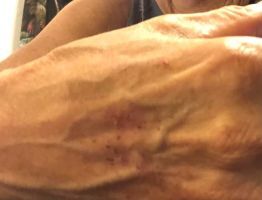 BOTH HANDS!
Another, less imaginative person might attribute the affliction to eczema, which for years has periodically flared up on various parts of my stress-riddled body. But I know better. The Lord is joining me to his Passion and if things don’t improve, I hope to start going about in a little pair of black cotton gloves like Padre Pio.
I even know the source of my terrrible suffering, so like Christ’s on the Cross. My beloved tennis heroine Garbiñe Muguruza, out in the second round of Wimbledon, has been in a terrible slump.
July 2, 2022
AFTERLIFE, INTERRUPTED
Here’s how this week’s arts and culture column begins:
Father Nathan Castle, OP, joined the Dominicans more than 40 years ago. For decades his focus has been campus ministry.
As he neared 60, he felt the urge to branch out in some new way. It was right around that time that he started having what he calls “night visitors.”
Between the hours of 2 and 4 a.m., people — most of whom had died violent or otherwise traumatic deaths — began appearing to him in dreams. He began writing the dreams down.
READ THE WHOLE PIECE HERE.
June 29, 2022
UPON THIS ROCK
Father John-Paul from Tucson’s Newman Center at last Sunday’s Mass:
“We’ve heard a lot of talk these last few days about ‘winning.’ We will have won when we’ve established a whole culture of life.”
Lots of loud voices lately. I think Father summed things up nicely. He didn’t elaborate and he didn’t have to.
I’ve been thinking a lot about Mary, who the whole Gospels said I think two things: “Do what [Christ] tells you,” at the Wedding at Cana and, on her way across the hill country to visit Elizabeth, “My soul proclaims the greatness of the Lord; my spirit rejoices in God, my Savior,” i.e. the Magnificat.
She “pondered these things”–all things–in her heart, starting with the angel Gabriel’s announcement/invitation (actually, Mary was probably a ponderer since birth), and then for the rest of her life. She stood silently at the foot of the Cross, still pondering, holding what must have been the unbearable tension, sorrow, anxiety, and horror of having watched her beloved Son tortured to death.
Then she kept on living. She believed. She prayed. She served those around her.
So did St. Thérèse of Lisieux, who’s also been much on my mind as I’ve been writing about her for the past few months. “May we become little, more and more,” was her thought.
Really, this attitude goes to the heart of our faith. “I will give you the keys to the kingdom,” Jesus says to Peter in today’s Gospel. What IS that kingdom, if not the blind faith and insane-for-the-light hope that our pondering, little acts of love, constant efforts to purify our intentions, words, actions, and heart go out to all the world, help alleviate the suffering of all the world, help spread the Gospel to the ends of the earth?
Was Jesus who he said he was, in other words–or not? Because if he was, is, and the reign of love has been established, and death has been vanquished–do we really need to go around calling each other names, shouting each other down, going to battle stations about every contemporary “issue,” whether large or small: lording it over when we “win,” calling foul when we “lose,” hating, excluding, condemning while also labeling everyone who disagrees with us a hater, or a pagan, or a fanatic…
I ever more believe the “small,” the silent, the ones who ponder go a very long way toward keeping the world spinning on its axis. The ones who quietly devote their lives to searching for beauty and making things beautiful, and by beauty I of course include moral beauty.
I just wrote a column, for example, on a sublime book of photographs by a guy who spent 15 years in the jungles of Central and South America exploring the world of moths. He was 75 by the time he finished.
There is a moral beauty there, to my mind–the working in relative obscurity, the attention to detail, the staying up all night to photograph creatures who are nocturnal. Just as there is a moral beauty in someone who faithfully cares for her aging mother, or practices the violin, or tends a garden: activities that are away from the eyes of the world in other words. It’s not to say those are the only places of moral beauty but as Christ said when you have the adulation of the world for what you’ve done, you’ve already received your reward…
Celebrating such people and such actions and such lives is itself not calculated to gain a whole lot of approval, attention or interest.
I still think it’s the best I can do. And the best of what I and a whole lot of other people I admire, revere and love do.
Blessed Solemnity of Sts. Peter and Paul. “Upon this rock will build my church, and the gates of hell shall not prevail against it.”
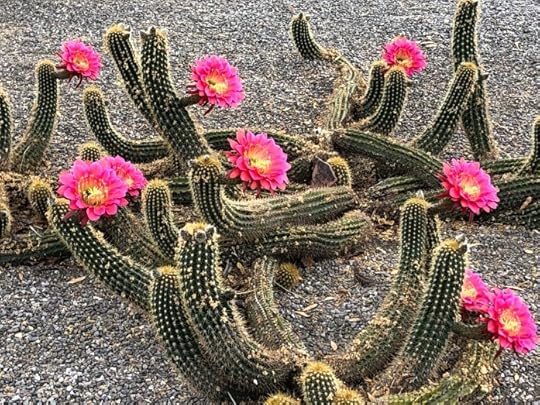 SPOTTED WHILST WALKING TO DENTIST EARLIER IN WEEK
June 26, 2022
FLESH AND BONES
Here’s how this week’s arts and culture piece begins:
“For you created my inmost being;
you knit me together in my mother’s womb.
I praise you because I am fearfully and wonderfully made;
your works are wonderful,
I know that full well.”
–Psalm 139:13-14
“Flesh and Bones: The Art of Anatomy” runs through July 10 at the Getty Museum. Presented in both English and Spanish, the exhibit explores depictions of the anatomy of the human body from the Renaissance through today.
Included are anatomical images in a wide range of media, from Renaissance illustrations featuring delicate paper flaps that could be lifted to reveal the body’s inner structure, to drawing, engravings, woodcuts, mezzotint, sculpture, painting, and neon.
For centuries, artists were expected to have a firm grounding in anatomy; the structure of the human body was of paramount importance in both science and art. In fact, anatomists often hired their own personal artists in order to sketch the body quickly before decomposition set in.
Such an artist might focus on a specific area of the body: say, the muscles of the neck or eyelid. An abdominal dissection might spotlight details of the gall bladder.
READ THE WHOLE PIECE HERE.
June 23, 2022
CHARITY, CARYLL HOUSELANDER STYLE
“November 26, 1941
I do not know how to thank you and Sheila enough for your wonderful kindness in offering me sanctuary in your flat…
I hope to solve the problem [of getting my writing done] by wresting one free day now, as, if I get into the Censorship, no one will know when that day is. It seems to me that somhow or other we ought to be strong-minded enough to work in one’s home unassailed, but it is a great problem. Actually, even if one can esacpe in body, one’s mind remains guilt-obsessed, accussing and restless, haunted by tottering old laides, subversice and oversensitive youths, frustrated geniuses, spineless adolescents, dying priests, doubting Anglican clergymen, repressed Catholic nuns, nearasthenic nurses, and the uncountable multitudes of weeping free-lance virgins. No four walls, alas, can remove their loneliness and restlessness and the monotony of their lives from the stricken conscience. Yet in truth, I think it is likelly that one does them more harm than good by sympathy, and that the right thing to do is to steel the heart.
I truly believe that the best way to benefit humanity is to make faces in the bus–slightly mad faces, or puttings out of the tongue suddenly at the person opposite. Think of the thrill that gives to countless uneventful lives to whom nothing ever happens. They can tell everyone for weeks that they saw a mad woman on the bus, and they can exaggerate this to almost any extent. This form of charity can be practiced on the way to work.”
—Caryll Houselander, in a letter to Archie Campbell Murdoch, a friend and potential convert.
From The Letters of Caryll Houselander: Her Spiritual Legacy, ed. by Maisie Ward (somewhat hard to find: I received my copy as a gift).
Caryll (1901-1954) is a dear, dear, Companion–a wonderful spiritual writer whom I urge you to read widely.
Yesterday I received another gift: a framed portrait of Caryll. I immediately hung it on a nail that mysteriously happened already to be stuck into the wall, as if awaiting this very appurtenance, above my desk.
A fellow informally consecrated laywoman, convert and childless writer who was known to take a glass of whiskey, swear, smoke, and make a snide comment or two, Caryll was deeply devoted to Christ, suffered greatly, and was beloved by traumatized children and the mentally unbalanced. My fondest wish is that someone open her cause for canonization.
I can hardly think of a better person, outside of Flannery O’Connor, to gaze down upon me as I work. I am going to pray that she effect a miracle in me–which at this point would be a decent night’s sleep.
Blessed Solemnity of St. John the Baptist! Christ must increase, and we must decrease.
Apologies for typos in original post and thanks to Nona for calling them to my attention. There may still be a few. Forgive me.
June 19, 2022
CORPUS CHRISTI
Greetings from the desk of Heather D. King which is at last more or less cleared of the stacks of St. T of Lisieux books that have claimed my head and heart for the last few months.
I am more convinced than ever (from writing a study guide) of Thérèse’s genius and companionship. More I’m sure on that later, and not that the project is quite complete.
But for the moment my fondest wish is to get back to sharing a little of my life, celebrating writers, artists, and musicians I admire, and more consciously exulting in the minute-to-minute weirdness, complexity, and paradox of life on earth.
Many reflections on recent Gospel readings:
“Store up your treasure in heaven, for where your treasure is, there also will your heart be.” Matthew 6:20.
I tend to think of the passage as referring to money. But really, our “treasure” is often approval, validation, attention, popularity. Let me go my own way, devoting my energy to the search for beauty, truth, love as I see it.
“But when you give alms, do not let your left hand know what your right is doing, so that your almsgiving may be secret. And your Father who sees in secret will repay you.” Matthew 6:3-4.
Here again, I tend to think of “giving alms” in terms of money. But–I don’t know about you–I’ve been noticing how when someone has annoyed or slighted or hurt me, I often start going over and over in my mind their defects, the many ways they are substandard, misguided, WRONG. And I’ve discovered I can kind of nip that in the bud.
The part of my psyche/brain that starts to go to criticism and judgment–say the “right hand”–I can choose not to “know”–to see, to notice. I can kind of refuse to let my “left hand”–the more evolved or loving part of me–see the mischief the right hand is heading toward. There’s absolutely no virtue involved–no credit to me. It’s more a surrender to God, an implicit asking for help, a more or less conscious willing NOT to indulge my lower self (while also knowing that, without supernatural help, I can’t will it).
“Do this in memory of me,” during the consecration at Mass. I’ve always thought of this in terms of an invitation to celebrate the sacrifice as often as possible. Meet me in the Eucharist in memory of me.
Lately though (probably everyone else realized this years ago, but I am always a bit slow on the uptake), I’ve been thinking how it also means, or could mean, Do this–as in the same thing I did, and continue to do for eternity–in memory of me. You, too, are called to lay down your life for your friends, and it’s going to look pretty much the same way it did for me. Some variation thereof.
It’s kind of beautiful that the moveable feast of Corpus Christi falls this year on Father’s Day. The two are so closely connected, speaking of laying down our lives for our friends, sons, and daughters.
I happen to have had the best father in the world, Allen K. King, Sr. who died on June 10, 1999, God rest his soul and we will meet in the sweet bye-and-bye, Daddy.
I hope you had the best father in the world, too.
Either way may all our wounds be healed, and may we all meet, in the Body and Blood of Christ.
For as the glow-worms, know, the light shines in darkness and the darkness has not overcome it.
June 17, 2022
KEEPING THE PATHS CLEAR
Here’s how this week’s arts and culture column begins:
A recent piece in The Tablet called “The Great Debasement” articulates a phenomenon that has spread like a fungus these past few years: namely, art and its almost complete appropriation by the ideology of “cultural studies analysis.”
“[T]he debasement is nearly complete,” writes Alice Gribbin. “The institutions tasked with the promotion and preservation of art have determined that the artwork is a message-delivery system.”
God forbid we should simply gaze upon, say, a painting that might otherwise expand our hearts, spur our imaginations, or make us weep. At every turn phrases like “the hierarchies of race,” “colonialist influences,” and “unequal impacts” turn us away from transcendence and toward identity politics.
The same creeping groupthink has bled into music and literature. Or as Gribbin puts it: “The figure of the contemporary artist we know today is an invention of the bureaucrats.”
I’m forever on the lookout for the artist who is not an invention of the bureaucrats. Recently I came across a small gem of a book originally published in 1964. Chantemesle: A Normandy Childhood, by Robin Fedden (1908-1977), an English writer, diplomat and mountaineer.
READ THE WHOLE PIECE HERE.
June 10, 2022
THE INNER LIFE OF AN LA STREET PAINTER
Here’s how this week’s arts and culture piece begins:
Davide Piubeni, LA street artist was born in Sarezzo, Brescia, close to Milan in northern Italy, and graduated from l’Accademia delle Belle Arti Brera in Milan.
He’s 52 now, living in Culver City with his wife and children.
But with the soul of a pilgrim, he took a circuitous route to get here.
After graduating from college, he ended up in a little fishing village in northern Brazil h called Viseu. He stayed six months and painted a three-panel mural in a local church.
Back in Italy, he painted little niches meant to hold a religious painting or sculpture for a time. Then the bishop in Brazil called him back to paint the Church of Nossa Senhora do Rosário e São Benedito in Paraty. “That was a big job. The fifteen Mysteries of the Rosary. 30 by 30 feet for each of 3 ½ walls.”
During that time, he met several practicing Catholic friends who asked: “Where do you come from? Where are you going?” He took the questions to heart.
READ THE WHOLE PIECE HERE.


