
Heather King's Blog, page 28
January 20, 2023
THE SPIRITUAL CASE FOR A DAILY WALK
Here’s how this week’s arts and culture column begins:
“It is solved by walking.” — St. Augustine
For decades I have considered a longish walk part of my daily routine. By “walk,” I don’t mean the fetishistic activity that involves a water bottle carrier, a backpack, and a Fitbit. I grab my sunglasses, walk out the door, and give myself over to the sheer, exuberant wonder of the enterprise.
In “A Philosophy of Walking” (Verso, $19.95), French professor of Philosophy Frédéric Gros reflects upon some of the many thinkers and writers throughout history who have also considered walking essential to their work: Nietzsche, Rimbaud, Jean-Jacques Rousseau, Thoreau.
READ THE WHOLE PIECE HERE.


January 15, 2023
THE BLEAK MIDWINTER
I’m thinking of all those, especially in my beloved California, who have been pounded these past weeks with storms. Tucson has been intermittently cold, wet, and drear, but we’ve not suffered anywhere near the damage and extremes of so much of the rest of the country.
What is it about January?…A month when I, for one, seem not to feel my best, look my best, or think my best. I am, however, trying to ACT my best.
News from the front: My cataract surgery is completed, both eyes. Having worked on many med mal (medical malpractice) cases in my time as a lawyer, my fondest, highest hope here was that “they” would not blind me. Which they didn’t! Everything’s a little brighter and a little clearer and my long-distance vision is vastly improved. Thank you.
Speaking of vision, sight, eyes and blindness…I recently re-read Flannery O’Connor’s Wise Blood, a work of utter genius. I’ve been reflecting upon it for days and hope to devote a column to it.
Other reading includes, but is not limited to, learning about two female artists, one Scoth, one Welsh. Joan Eardley (1921-1963) painted, inter alia, the street urchins of Glasgow and the wild coast of the fishing village of Catterline, Aberdeenshire on Scotland’s northeast coast. She lived there alone in a whitewashed cottage without electricity or running water and would go out in her oilskins in a roaring gale, set up her easel by the shore, and paint. She died far too young, at 42, of breast cancer.
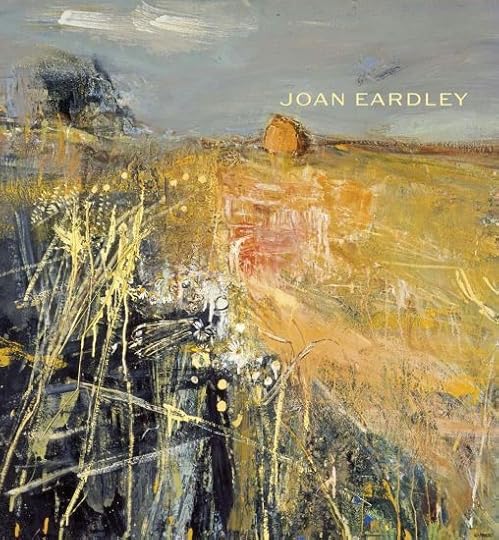 COVER OF A 2015 BOOK BY FIONA PEARSON ABOUT EARDLEY’S LIFE AND WORK.
THE PAINTING IS SUMMER FIELDS, 1961
My other find is Brenda Chamberlain (1912-1971), a painter, poet, and author who deserves homage if for no other reason than that she wrote a wondrous “memoir” (the book defies categorization) called Tide-Race, an impressionistic account of her time on Bardsey Island.
Bardsey is colloquially known as The Island of 20,000 Saints and has a rich history. It’s harsh, austere, isolated, hard-scrabble. When Chamberlain moved there with her then-husband in 1947, there were only a dozen or so full-time (extremely eccentric, apparently) inhabitants of the island. All supplies had to be brought in by boat, through a treacherous sound. The islanders lived on rabbit, gull’s eggs, sea birds, and home-grown vegetables. The men went to sea; the women waited.
A couple of excerpts:
“This is a land that hoards its past and merges all of time in the present. The cargo boat that was salvaged last year off Maen Bugail, whose coal cargo will keep the island in fuel for the next twenty years; the illicit sweet wine of France; the shipwreck of Arthur; are of equal importance and freshness. It might be said that what happened here yesterday has taken on the colour of a long-past event, so timeless do happenings appear to be; as if the drama had been written long ago, and we who come by chance to the island play our parts that were designed for us, walking on to the stage at the twitch of a string held in the firm hand of the master.”
“After the chill currents of the sea-way, the breast of the island gave off an intense heat. Everywhere, birth was taking place; chicks were breaking from speckled shells under the burning-glass of the sun. On every shelving ledge, on hard-baked pockets of earth, whole eggs and green fragments of shell lay beside blind creatures beating the dust with embryonic wings. The gull king, his head hawklike between his shoulder blades, was watchful from eyes of cold amber. He alighted on the cliff, sea-water dripping from his beak of lemon bone. Around him squatted his clumsy offspring.”
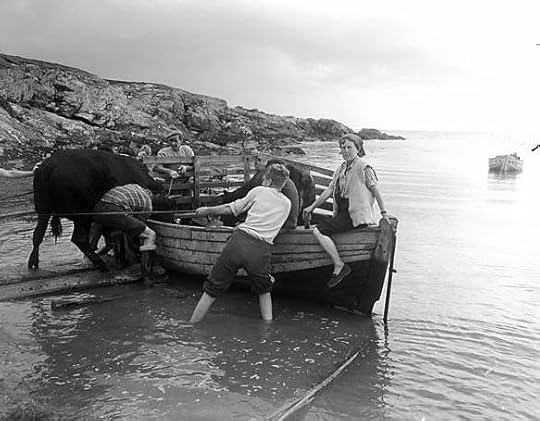 BRENDA CHAMBERLAIN ON BARDSEY, ON A BOAT TRANSPORTING CATTLE, 1950
It goes on and on like that, every paragraph a paean and often, too, a kind of dirge. Chamberlain also lived in a white-washed cottage, heated by peat, without electricity or running water. She had many romantic attachments, some requited, some not. She was passionate, intensely stimulated by landscape, a skirter of edges, a bohemian, a free spirit a little too drawn to death.
She was recognized for her poetry, broadsheets, paintings and plays but Tide-Race (1962) seems to have been her crowning achievement–and what an achievement, though her contemporaries felt she never quite attained the stature she might have. After 15 years or so she left the Bardsey and lived on another island, in Greece, was forced to flee after the 1967 coup, and returned to her home town of Bangor in Wales, aging, alone, and increasingly weighed down by sorrow and depression. She died of an overdose of sedatives at 59.
It’s no small feat for a woman to make her way as an artist. If she has a spouse, there’s always a tension between the vocation of marriage and the vocation of art. And if not, there’s the danger of frittering away creative energy on a series of romantic dramas. We have to find somewhere (as does every human being) to put all our love. So I’m fascinated by the lives of the female artists who have forged their own way and tried to do that.
January 13, 2023
NEW CAMALDOLI HERMITAGE
Here’s how this week’s arts and culture piece begins:
New Camaldoli Hermitage, a monastery of Camaldolese Benedictine monks, is located on 899 acres high above the Big Sur coast. It’s gorgeous. It’s serene. And best of all, it’s quiet.
Used to be you’d have to book months in advance, but I recently reserved a single-occupancy room for two nights ($145 including meals) a mere few weeks out. Other options include five private hermitages, three of which can accommodate couples; private cells (male retreatants only) within the monastic enclosure; and a guest house with two twin beds. No kids under 16 allowed—like I said, quiet.
Advent had just begun, and everything about the place was conducive to contemplating the birth of Christ and the coming of a new year.
READ THE WHOLE PIECE HERE.
January 6, 2023
RIP MSGR. TERRY RICHEY, APOSTLE TO THE ADDICTED
Here’s how this week’s arts and culture column begins:
When I came into the Church 26 years ago, I wasn’t friends with a single practicing Catholic, much less a Catholic who might understand that I’d been led to Christ through my recovery from alcoholism.
Then I met Msgr. Thomas Terrence Richey, known by recovering alcoholics and addicts throughout the archdiocese and beyond as Father Terry.
Anyone who knew Father Terry knew that he was the king of the one-liner.
“Drinking never made me happy — but it made me feel like I was going to be happy in 15 minutes.”
READ THE WHOLE PIECE HERE.
January 3, 2023
THE TWELVE DAYS OF CHRISTMAS
Well, this is kind of an interesting week, between January 1st and Epiphany. The magic seems to go out of things–the world goes back to its business. The lights and wreaths and candles start to come down.
We Catholics keep our decorations up, I’ve learned, till Epiphany (January 9th this year)–or depending on whom you consult, is it The Baptism, which this year falls the day after Epiphany (January 10th), or is it January 5th which is technically the twelfth day of Christmas, or is it January 6, which is the day the three wise men are supposed to have arrived in Bethlehem)?
In short, just leave them up for now. And maybe this week can give us a little breathing room to meditate upon, savor and incorporate the graces of the season.
Here’s a site I came upon with sacred music for the Twelve Days of Christmas. (Keep in mind it’s from 2021 so the days of Christmas don’t exactly correspond to the dates, but you’ll get the idea). For years I would play Bach’s Christmas Oratorio over and over again (along with “The Messiah”), but this year I’ve discovered Corelli’s Christmas Concerto and Saint-Saëns’ Christmas Oratorio. And obviously there’s way more!
Other things that have been roiling round:
Over Christmas, I heard from a friend with whom I once spent the better part of a day in Columbus, Ohio. I was in town to record a video interview and had booked a room for a few extra days in order to explore the area and to meet in person this friend I’d known up to then only from emails.
We started out by going to Mass, then she took me for a delicious breakfast at a homey, stylish cafe. And then we went to Boyer Preserve and the Glacial Kettle and I think another botanical garden. We walked, and observed, and admired the beauty. We didn’t do anything cataclysmically “exciting” or “interesting” and certainly not expensive. We were simply present to one another. We both went out of our way and beyond our comfort zones to meet. We were “in nature”…which works its own mystery.
And for both of us, our relatively short time together is firmly entrenched in memory. I find it interesting that even a single meeting with someone can form such an enduring and meaningful bond. Then again, are not these seemingly unremarkable yet deeply rich get-togethers–at which women, I must say, excel–really kind of the heart of the Eucharist, or the fruit of the Eucharist?…
Maybe as well they’re tied in with Matthew 25–when at the end of the age, Christ will say “I was naked and you clothed me; in prison and you visited me…and we will say, “We did? Really? When?”…Maybe at the end of the age all the things that are noteworthy to “the world”–board meetings, summits, treaties–will be revealed as essentially meaningless. At the end of the age, maybe we’ll learn that it was people taking time to have coffee and chat and take a walk in a garden that availed.
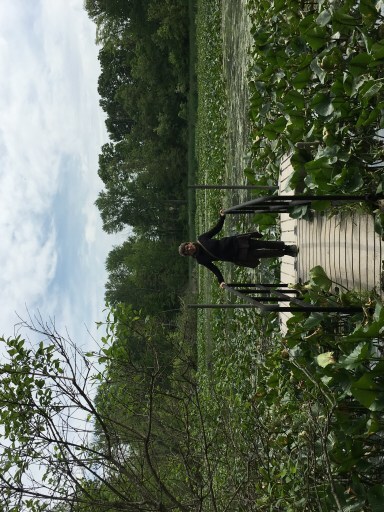 I DON’T MUCH LIKE TO HAVE MY PICTURE TAKEN BUT THIS IS ONE OF MY ALL-TIME FAVORITES:
AT THE GLACIAL KETTLE.
Simeon and Anna in the temple.
What struck me here was that Jesus chose OLD people to prepare, stand watch, hold his place, and welcome him to the temple. He was a newborn baby and he chose two elderly people, a man and a woman. Anna , a widow, was 84 and had been fasting and praying and hanging about the temple for years. Simeon was clearly ready to kick off, too.
The Parable of the Wise and Foolish Virgins rose to mind. These two had their lamps in oil, man! They were keeping watch and had been, patiently, steadfastly, for ages! Waiting for just this occasion. Waiting, longing, peering around every pillar…
And he came. HE CAME! What person past a certain age doesn’t tear up at Simeone’s response: Now you let your servant go in peace. The Nunc Dimittis: “Lord, now you let your servant go in peace; your word has been fulfilled: my own eyes have seen the salvation which you have prepared in the sight of every people: a light to reveal you to the nations and the glory of your people Israel” (Luke 2:29-32).
Simeon and Anna waited all their lives, and now they can die in peace. Jesus was destined to die young but he is in total solidarity with those of us who don’t, or haven’t. He loved us, he had profound compassion for us, and he trusted us. Look around at the average age of those who attend daily Mass. A lot of us, often most of us, are contemporary Annas and Simeons–waiting, peering around every pillar, still holding a place for him in the temple.
WHERE YOUR HEART IS, THERE WILL YOUR TREASURE BE ALSO
I had a nice reflection during Advent, per the Ignatian Exercises, imagining myself present and playing a role at the stable in Bethlehem. Specifically, I cast myself in the role of the servant girl who had accompanied Mary and Joseph from Nazareth, maybe leading the ox. As Mary gave birth, I thought about how I often feel incompetent at hands-on tasks: not good with children, not a bandager. And then I realized others do what I cannot do, and I do what others can’t. I go to Mass and write and visit and pray for those who can’t do those things. I bear fruit in my solitude and others bear fruit for me, raising kids, working in the medical field, organizing to encourage people to get out and vote.
What qualifies us for a place in the Kingdom isn’t competency: it’s our heart. My heart is (usually) oriented toward love: that not only counts; it’s all that counts. Just as the Sacraments act ex opere operato: i.e. automatically, assuming that we have the right intention and disposition–just so do our oriented-toward- love hearts automatically bear fruit, whether or not we can see, feel, or recognize the fruit. Thus, my spirit, body, and soul were wanted, needed, and in fact ESSENTIAL around the manger at Bethlehem. So there!
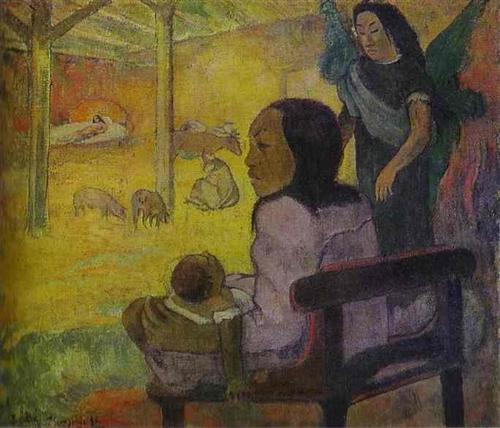 BABY (NATIVITY OF TAHITIAN CHRIST), PAUL GAUGUIN, 1896
December 31, 2022
THE AGONY AND THE ECSTASY
I refer, of course, to the month of December…
I have kept at least one candle burning, the clock round, from December 5 (the day I returned home from a road trip to California) till now…I have had indoor fairy lights, outside string lights, and plug-in Madonna-blue Japanese lanterns. I have cards GALORE, two Advent calendars, two creches, vintage ornaments strung on royal purple florist wire across the tops of all the doors, two balsam sprays, and one vintage gold metal Merry Christmas wreath.
I went to Mass almost every day during Advent, usually at Vespers. I said Morning and Evening Prayer. I continued with my Ignatian Exercises for an hour each early morning. It so happend that this week the readings were on the Incarnation, the Nativity, the shepherds, the wise men…
I spent quite a bit of time (for me) with people. A lot of recovery, a lot of socializing. The highlight was the Christmas Day zoom gathering I had with some members of my family. Some friends came to town from LA, and that, too, was lovely.
The result being, however, that I am way outside of my normal schedule and routine which at this point is kind of driving me nuts. I bought myself a ton of books for Christmas: Jed Perl’s Authority and Freedom; an essay collection called The Philosophy of Gardening; Born Under Saturn: The Character and Conduct of Artists; John Moriarty’s Dreamtime; Reveries of the Solitary Walker, by Jean-Jacques Rousseau; A 12-Step Approach to the Spiritual Exercises by Jim Harbaugh, SJ; The Great Hunger: Ireland 1845-1859; Tim Robinson’s Connemara.
Meanwhile I had cataract surgery on one eye, a dear friend died, I still have people with whom I want to have that once-a-year phone chat. It’s to start gathering the tax dox. I have a shingles shot, a teeth cleaning, and the other eye surgery coming up.
And all I want to do is curl up in bed and read!
Yesterday was cold and gray and in the afternoon I finally succumbed, crawled in, and watched The Conspirators (1944), a B-grade (at best) spy film with Hedy Lamarr and Paul Henreid that was kind of a pallid version of Casablanca, complete with Peter Lorre and Sidney Greenstreet. No matter: I relished every second. Nothing like a smoky nightclub scene, a casino peopled with Nazis, and a guy in a trenchcoat who knows how to light a lady’s cigarette.
Then I settled down to one of my favorite kind of afternoons: I started reading Heavy Light: A Journey through Madness, Mania & Healing by British writer Horatio Clare. H, as his friends (and now, I) call him, wrote a stellar memoir about growing up on a Wales sheep farm called Running for the Hills, and has written a bunch of travel and landscape type books since. He’s also possibly an alcoholic, and possibly bipolar, and suffers from Seasonal Affective Disorder, and really, really should not smoke pot.
He’s covered some of that in his previous books but this one is about a flat-out, rather flamboyant breakdown in which he took off all his clothes, for example, and rolled his car off a cliff. He was “sectioned” as they call it it England (we would say carted off to the psych ward). And I haven’t finished the book yet but I gather it’s about how we could possibly start thinking about and treating mental illness in ways that do not primarily involve prescribing incredibly strong drugs with severe, often irreversible, side effects. Even the doctors don’t understand how most of them work. And the patients, of course, are caught in a Catch-22 such that they can only be released from the nuthouse if they agree to take the horrible drugs. Not that the drugs don’t sometimes help, BUT.
Clare meanwhile has a long-term partner, Rebecca, a more or less stepson, 17, and another son with Rebecca, 6. Who are all deeply frightened, pissed, anxious, hopeful, loving, frightened, et cetera.
So the book is a great read, but even better, because Clare writes, reads, listens, travels and mingles, it’s the kind of book that had me reaching for my phone every five or ten pages to explore. I learned, for example, that a coracle is (especially in Wales and Ireland) a small round boat made of wickerwork covered with a watertight material, propelled with a paddle, and that is shaped like half a walnut shell.
That cheered me no end!
I learned about sculptor Barbara Hepworth and about the Hepworth Museum and Sculpture Garden (which H could walk to from “the facility” once he was allowed day passes). I learned about Bardsey Island (The island of 20,000 Saints), and I learned that you can stay there in a white-washed cottage with a stone wall and a red door and basically nothing around but a restaurant and the birds. I learned of the painter Brenda Chamberlian who lived on Bardsey in splendid isolation for many years, then moved to Greece, then moved back and died of a barbiturate OD (memoir-novel Tide-Race on order).
I learned of the Dylan Thomas poem, “In My Craft or Sullen Art.” I learned that H had visited an isolated former parish (and felt right at home) of Welsh poet R.S. Thomas, whose biography I just finished. I looked up the word “mordant” for about the tenth time in my life, and hope to use it in a sentence one day.
I put a used copy of a memoir called Madame Depardieu and the Beautiful Strangers that I gather from the reviews is a bit of an acquired taste (H adored it and once lived on the same canal as its author, Antonia Quirke) in my ebay cart. I learned that Clare walked the same 250 miles to Lübeck, Germany, that Bach walked in 1705 and wrote a book about that. (Which you can also listen to).
Through some other similar, recent follow-the-breadcrumbs trail, I have also happend upon the mostly unknown British painter Theodore Major (1908-1999). I won’t describe him now because I want to write a column, but suffice it to say that he shunned publicity, mostly refused to sell his paintings, lived in voluntary poverty, and adored children, beauty, truth, his wife, the gritty town of Wigan, and the hard-working, hard-scrabble, noble-in-spirit people of Lancashire (people who were thought unworthy of notice or admiration by most of the rest of the world, especially the art world). He was a recluse, a bit off-kilter himself…but really, who’s to say?
The point being that if you stray even a bit off the beaten path, there are all kinds of fascinating people out there who forged, or are forging, their own little path. And thereby provide some light to live by.
Speaking of which, I just learned of Daniel Brush, through his obit, unfortunately, but that’s another avenue worth exploring.
One very last thought, speaking of voluntary poverty (I got this reflection from my beloved Caryll Houselander, don’t ask me where). The wise men brought gold, frankincense and myrrh to the infant Jesus–but when the time came to present him at the temple (which was only 40 days later), Mary and Joseph only had enough money for the poor people’s offering: a couple of doves (rather than the lamb more well-off folk could afford).
The conclusion being that in the meantime they must have given the loot away. Let’s ponder that in our hearts as we celebrate Mary, the Mother of God on January 1.
HAPPY NEW YEAR!!!
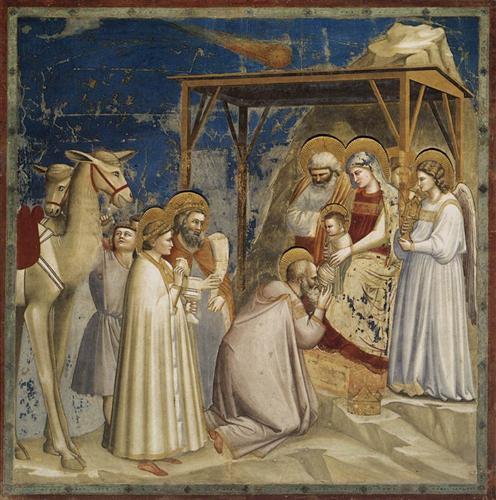 ADORATION OF THE MAGI, GIOTTO, c 1304-1306
December 24, 2022
NURSERY MAGIC: THE VELVETEEN RABBIT
Here’s how this week’s arts and culture column begins:
First published in 1922, Margery Williams’ The Velveteen Rabbit: How Toys Become Real is one of the most beloved children’s books of the 20th century. The story is also very much one of death and resurrection.
The book begins:
“There was once a velveteen rabbit, and in the beginning he was really splendid. He was fat and bunchy, as a rabbit should be; his coat was spotted brown and white, he had real thread whiskers, and his ears were lined with pink sateen. On Christmas morning, when he sat wedged in the top of the Boy’s stocking, with a sprig of holly between his paws. The effect was charming.”
READ THE WHOLE PIECE HERE.
AND A NOTE FROM YOUR SPONSOR:
December 22, 2022
“AND THE BABY?”
From War Is a Force that Gives Us Meaning, by journalist Chris Hedges : a story about new life and a lowly cow and an old man who sacrificed so that the light shine for someone else.
A story, in other words, about Christmas:
“I sat one afternoon with a Bosnain Serb couple, Rosa and Drago Sorak, outside of the Muslim enclave of Goražde where they had once lived. They poured out the usual scorn on the Muslims, but then stopped at the end of the rant and told me that not all Muslims were bad. This, they said, was their duty to admit.
During the fighting in the bleak, bombed-out shell of a city that was Goražde, where bands of children had become street urchins and hundreds of war-dead lay in hastily dug graves, a glimmer of humanity arrived for the Soraks in the shape of Fadil Fejzić’s cow. The cow forged an unusual bond between Fejzić, a Muslim and his Serbian neighbors, the Soraks.”
Hedges goes on to describe the internecine fighting. Muslim police took the Soraks oldest son, Zoran, away for questioning. Zoran never returned. Their next eldest son was struck by a car and killed.
“Five months after Zoran’s disappearance, his wife gave birth to a girl. The mother was unable to nurse the child. The city was being shelled continuously. There were severe food shortages. Infants, like the infirm and elderly, were dying in droves. The family gave the baby tea for five days, but she began to fade.
‘She was dying’ Rosa Sorak said. ‘It was breaking our hearts’…
‘On the fifth day, just before dawn, we heard someone at the door,’ said Rosa Sorak. ‘It was Fadil Fejzić in his black rubber boots. He handed up half a liter of milk. He came the next morning, and the morning after that, and after that. Other families on the street began to insult him. They told him to give his milk to Muslims, to let the Chetnik children die. He never said a word. He refused our money. He came for 442 days, until my daughter-in-law and granddaughter left Gorazde for Serbia.’
The Soraks eventually left and took over a house that once belonged to a Muslim family in the Serbian-held town of Kopaci, two miles to the east. They could no longer communicate with Fejzić.
The couple said they grieved daily for their sons. They missed their home. They said they could never forgive those who took Zoran from them. But they also said that despite their anger and loss, they could not listen to other Serbs talking about Muslims, or even recite their own sufferings, without telling of Fejzić and his cow. Here was the power of love. What this illiterate farmer did would color the life of another human being, who might never meet him, long after he was gone. In his act lay an ocean of hope.
‘It is our duty to always tell this story,’ Drago Sorak said. ‘Salt, in those days, cost $80 a kilo. The milk he had was precious, all the more so because it was hard to keep animals. He gave us 221 liters. And every year at this time, when it is cold and dark, when we close our eyes, we can hear the boom of the heavy guns and the sound of Fadil Fejzić’s footsteps on the stairs.’
Fejzić fell on hard times after the war. I found him selling small piles of worm-eaten apples picked from abandoned orchards outside the shattered remains of an apartment block. His apartment block had been destroyed by artillery shells, leaving him to share the floor of an unheated room with several other men. His great brown-and-white milk cow, the one the Soraks told me about, did not survive the war. It was slaughtered for the meat more than a year before as the Serbian forces tightened the siege. He had only a thin, worn coat to protect him from the winter cold. When we spoke he sat huddled in the corner of a dank, concrete-walled room rubbing his pathetic collection of small apples, many with brown holes in them, against his sleeve.
When I told him I had seen the Soraks, his eyes brightened.
‘And the baby’ he asked. ‘How is she?’ ”
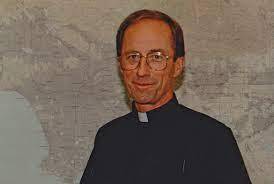 MONSIGNOR TERRY RICHEY,
 ARCHDIOCESE OF LA, RIP
A beloved friend, Monsignor Terry Richey, died yesterday morning, on the winter solstice, around 6 am. I was able to visit him over Thanksgiving, at the memory care facility in West Hollywood where he was staying.
Father Terry helped, shepherded, mentored, guided and sponsored thousands over the course of his vocation as priest and for many years as director of the Alcohol/Substance Abuse Ministry for the Archdiocese of Los Angeles.
One of his zinger lines: “The good news is God loves you. The bad news is He loves everyone else, too.”
I once asked him how I’d know if I was making spiritual progress. He thought for a minute. “If crazy people aren’t afraid to come up and talk to you,” he replied, “that’s a pretty good sign.”
His family and friends are grieving.
I said the Office of the Dead yesterday afternoon, lit a candle for him that burned and night, and this morning went to 9 am Mass. The kids from the St. Ambrose School were there and a girl named Adriana, around 8 years old, was being baptized.
One child of God dies; another is consecrated to new life.
What better place to be than at the center of that eternal cycle as Christmas, 2022, draws near?
December 19, 2022
METANOIA
One of the readings this week for my Ignatian Exercises is, fittingly, the Annunciation (Luke 1:26-38).
This is from my childhood Bible, Revised Standard Version:
26 In the sixth month the angel Gabriel was sent from God to a city of Galilee named Nazareth, 27 to a virgin betrothed to a man whose name was Joseph, of the house of David; and the virgin’s name was Mary. 28 And he came to her and said, “Hail, O favored one, the Lord is with you!”[a] 29 But she was greatly troubled at the saying, and considered in her mind what sort of greeting this might be. 30 And the angel said to her, “Do not be afraid, Mary, for you have found favor with God. 31 And behold, you will conceive in your womb and bear a son, and you shall call his name Jesus.
32 He will be great, and will be called the Son of the Most High; and the Lord God will give to him the throne of his father David,33 and he will reign over the house of Jacob for ever; and of his kingdom there will be no end.”
34 And Mary said to the angel, “How shall this be, since I have no husband?” 35 And the angel said to her,
“The Holy Spirit will come upon you, and the power of the Most High will overshadow you; therefore the child to be born[b] will be called holy, the Son of God.36 And behold, your kinswoman Elizabeth in her old age has also conceived a son; and this is the sixth month with her who was called barren. 37 For with God nothing will be impossible.” 38 And Mary said, “Behold, I am the handmaid of the Lord; let it be to me according to your word.” And the angel departed from her.”
We’ve all read it a thousand times. But yesterday morning I made some new discoveries.
Interestingly, the angel hasn’t even yet invited Mary to bear Christ into the world–he starts out by saying, Greetings, you have found favor with God!
And right away, she’s like What? Me? First off, we all know when someone finds favor with us, the next thing they’re going to do is make a pesky request. Also–but–this is an angel. She’s knocked off balance. And the first thing we do in such situations is start weighing things in our minds. What? Who? Where? Why? What do you want, and what do you want with me? Not suspicious exactly, because this is Mary, but sincerely perplexed as many other versions of the passage have it.
But then Gabriel lays it out–and, granted, there had to have been some pauses in there for her to take it all in, but still, almost on the instant–Mary moves from her mind to her heart. Without any idea of what her yes will mean, or what being overshadowed by the Holy Spirit might look or feel like, she gives a full-throated assent. From that point forward she moves from “considering in her mind” to pondering in her heart.
Isn’t that the movement we all long for? Isn’t that what we pray we’re moving-inching, most of us–toward?
I may have been particularly open to interpreting the story that way because Saturday I received a card and enclosures (the second such this season) from Fr. Paul Sauerbier, a Vincentian priest who for the last twenty years has taken it upon himself to correspond with and to travel about the country, on his dime, to visit at this point 45 or so fellow priests who are in prison for some kind of sexual abuse, usually of minors.
As he says–the lepers of the lepers–shunned and abandoned by friends, family, clergy, former parishioners and in large part, by the Church itself. But Paul has a light, light touch–no drama, no self-aggrandizement, no sentimentality. They’re in prison. Christ said, As you do to the least of these, so you do unto me. And Paul who, to put it mildly from what I can tell is a bit of an eccentric, is faithful to his calling. No social media profile whatsoever. No PR. Zero blowing his own horn. If you google him, this one 7-year-old article comes up.
Paul, who is now in his 80s, is known to walk long distances, is enamored of highly cornball jokes, and seems to have a thing for coins. We’ve neve met but he emailed me several years ago (as best I can remember) and has kept up with me since, often sending Xeroxes of jokes, Mad Magazine cartoons, a limited edition silver dollar or a $2 bill, a home-made card.
Yesterday’s envelope contained a copy of a letter he’d received from an imprisoned priest, a Xerox of an unfolded paper snowflake, sent by another inmate, and a folded card on a half-piece of 8 x 11 paper with a color picture of Mary, Joseph and the baby Jesus on the front–and inside, this:
“2nd Sunday of Advent Readings, Cycle A for 2022: Sword or Rod of his mouth–Call to Change of Life Isaiah 11:4 “He (the Lord) will strike the ruthless with rod of his mouth” which refers to the Lord’s Judgment through His spoken Word to change my life. (other places use “the sword of his mouth” and not “rod”) Matthew 3:8 “Give some evidence that you mean to reform” New American Bible. (Lectionary translation for Mass: “Produce good fruit as evidence of your repentance”
Metanoia, translated in Lectionary as repentance, is quite distinct from being sorry and making a firm purpose of amendment. Metonia is an exciting, life-giving shakeup and shift of outlook. John [the Baptist] summoned his people to metanoia, not because they are sinners but because the kingdom of heaven was at hand. Sorrowful repentance and metanoia propose quite different approaches to change. Repentance concentrates on self: myself as perpetrator and my offense. Metanoia is a response to an invitation that focuses on God’s promise that something new is in the offing. It is an invitation to a conversion of mindset. It is so radical that we don’t have an English word capable of communicating it. Nevertheless, practicing it will change our lives as our Real Christmas Gift!
Merry Christmas and Happy New Year of Life. Paul“
Check out that 7-year-old article if you want to get a glimpe of Fr. Paul’s own metanoia.
And let’s not forget that Elizabeth’s pregnancy–she who was barren, and old–shows that metanoia can occur at any age–maybe the older, in fact, the better.
December 16, 2022
“DRESS CODES” AT THE AUTRY
Here’s how this week’s arts and culture piece begins:
Advent is upon us—a wondrous liturgical season and, to many of us, the most magical time of the year.
Those of us who love Advent because of the liturgy, the crèches, the sacred music, the O antiphons, and the expectant hush as we await the birth of a child must nonetheless hear an incessant chorus of grumbling against the commercialization of Christmas. If the commercialization troubles you, don’t participate in it! I certainly don’t.
In fact, Advent is a penitential season, and to underscore the fact we’re encouraged to mingle this time of year with all manner of people: friends, family, visitors. So why not combine penance and the desire to enlarge our hearts with a little field trip?
Why not take your crew, for example, to the Autry Museum in Griffith Park for an exhibit (ending January 8), called “Dress Codes.”
READ THE WHOLE PIECE HERE.


