
THE BLEAK MIDWINTER
I’m thinking of all those, especially in my beloved California, who have been pounded these past weeks with storms. Tucson has been intermittently cold, wet, and drear, but we’ve not suffered anywhere near the damage and extremes of so much of the rest of the country.
What is it about January?…A month when I, for one, seem not to feel my best, look my best, or think my best. I am, however, trying to ACT my best.
News from the front: My cataract surgery is completed, both eyes. Having worked on many med mal (medical malpractice) cases in my time as a lawyer, my fondest, highest hope here was that “they” would not blind me. Which they didn’t! Everything’s a little brighter and a little clearer and my long-distance vision is vastly improved. Thank you.
Speaking of vision, sight, eyes and blindness…I recently re-read Flannery O’Connor’s Wise Blood, a work of utter genius. I’ve been reflecting upon it for days and hope to devote a column to it.
Other reading includes, but is not limited to, learning about two female artists, one Scoth, one Welsh. Joan Eardley (1921-1963) painted, inter alia, the street urchins of Glasgow and the wild coast of the fishing village of Catterline, Aberdeenshire on Scotland’s northeast coast. She lived there alone in a whitewashed cottage without electricity or running water and would go out in her oilskins in a roaring gale, set up her easel by the shore, and paint. She died far too young, at 42, of breast cancer.
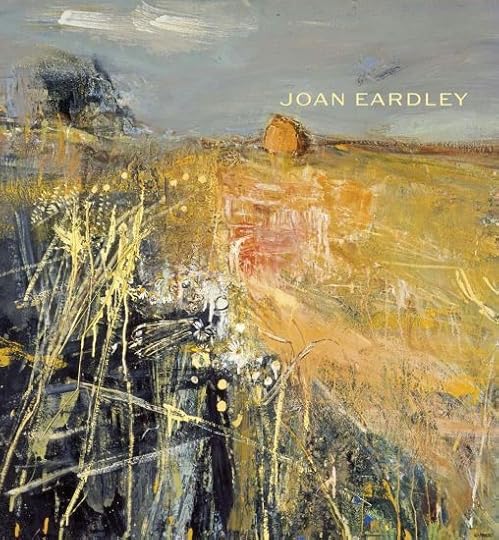 COVER OF A 2015 BOOK BY FIONA PEARSON ABOUT EARDLEY’S LIFE AND WORK.
THE PAINTING IS SUMMER FIELDS, 1961
My other find is Brenda Chamberlain (1912-1971), a painter, poet, and author who deserves homage if for no other reason than that she wrote a wondrous “memoir” (the book defies categorization) called Tide-Race, an impressionistic account of her time on Bardsey Island.
Bardsey is colloquially known as The Island of 20,000 Saints and has a rich history. It’s harsh, austere, isolated, hard-scrabble. When Chamberlain moved there with her then-husband in 1947, there were only a dozen or so full-time (extremely eccentric, apparently) inhabitants of the island. All supplies had to be brought in by boat, through a treacherous sound. The islanders lived on rabbit, gull’s eggs, sea birds, and home-grown vegetables. The men went to sea; the women waited.
A couple of excerpts:
“This is a land that hoards its past and merges all of time in the present. The cargo boat that was salvaged last year off Maen Bugail, whose coal cargo will keep the island in fuel for the next twenty years; the illicit sweet wine of France; the shipwreck of Arthur; are of equal importance and freshness. It might be said that what happened here yesterday has taken on the colour of a long-past event, so timeless do happenings appear to be; as if the drama had been written long ago, and we who come by chance to the island play our parts that were designed for us, walking on to the stage at the twitch of a string held in the firm hand of the master.”
“After the chill currents of the sea-way, the breast of the island gave off an intense heat. Everywhere, birth was taking place; chicks were breaking from speckled shells under the burning-glass of the sun. On every shelving ledge, on hard-baked pockets of earth, whole eggs and green fragments of shell lay beside blind creatures beating the dust with embryonic wings. The gull king, his head hawklike between his shoulder blades, was watchful from eyes of cold amber. He alighted on the cliff, sea-water dripping from his beak of lemon bone. Around him squatted his clumsy offspring.”
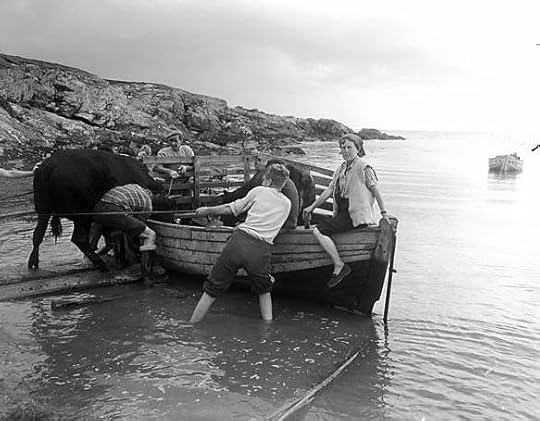 BRENDA CHAMBERLAIN ON BARDSEY, ON A BOAT TRANSPORTING CATTLE, 1950
It goes on and on like that, every paragraph a paean and often, too, a kind of dirge. Chamberlain also lived in a white-washed cottage, heated by peat, without electricity or running water. She had many romantic attachments, some requited, some not. She was passionate, intensely stimulated by landscape, a skirter of edges, a bohemian, a free spirit a little too drawn to death.
She was recognized for her poetry, broadsheets, paintings and plays but Tide-Race (1962) seems to have been her crowning achievement–and what an achievement, though her contemporaries felt she never quite attained the stature she might have. After 15 years or so she left the Bardsey and lived on another island, in Greece, was forced to flee after the 1967 coup, and returned to her home town of Bangor in Wales, aging, alone, and increasingly weighed down by sorrow and depression. She died of an overdose of sedatives at 59.
It’s no small feat for a woman to make her way as an artist. If she has a spouse, there’s always a tension between the vocation of marriage and the vocation of art. And if not, there’s the danger of frittering away creative energy on a series of romantic dramas. We have to find somewhere (as does every human being) to put all our love. So I’m fascinated by the lives of the female artists who have forged their own way and tried to do that.


