
Heather King's Blog, page 27
March 11, 2023
MONSIGNOR LORENZO ALBACETE’S CRY OF THE HEART
Hetre’s how this week’s arts and culture column begins:
Msgr. Lorenzo Albacete (1941-2014) was born in Puerto Rico, majored in physics and aerospace science, and was ordained in 1973. He was a New York City-based public intellectual and became close friends with both St. Pope John Paul II and Pope Benedict XVI.
Notoriously rumpled, perpetually late, he chain-smoked, loved food, drink, and good conversation, and had a wicked sense of humor.
I’ve written here of his 2021 book “The Relevance of the Stars: Christ, Culture, Destiny” (Slant Books, $19).
In February, Slant Books launched a new title from Msgr. Albacete: Cry of the Heart ($16), an extended meditation on the mystery of suffering.
READ THE WHOLE PIECE HERE.
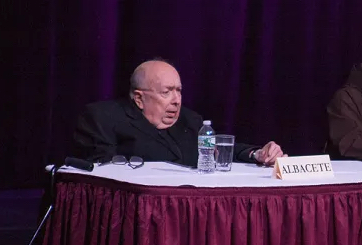 Msgr. Lorenzo Albacete. (Nicholas Erickson/New York Encounter, CC BY-NC-ND 2.0 via CNA)


March 8, 2023
LET’S BUILD A BOOTH
Here we are in Lent. These past weeks have been a rich time for me. Hard, but rich.
The 9-month Ignatian Exercises upon which I embarked last September—the extended period of prayer each morning—well, let’s just say—interesting!
My whole trip back East to the New York Encounter seemed to take up about a month of my life. I’d been invited to be on a(n unpaid) 3-person panel about a collection of essays by the late Monsignor Lorenzo Albacete on the mystery of suffering. I thought a moderator would ask questions and we’d have a bit of a discussion (i.e. relatively easy).
But a few weeks before I was told I was supposed to make a 15-20 minute presentation. So I spent really the better part of a week working up a paper, hunched and contorted over my laptop, sweating tears of blood, longing to do homage to the truly great Monsignor and his work.
Meanwhile—New York. Promised to be cold. I bought a hat. I wanted to look nice so I bought a new jacket. I wanted, again, to honor the spirit of Monsignor so I had a mani-pedi the day before I left. No-one’s gonna see my feet in a NY winter, but Jesus will know.
All of my efforts, I saw in retrospect, were the fruit of decades of prayer, of a life grounded in the Transubstantiation, of the belief in an unseen realm: a dimension of love, like yeast all through the loaf where more and more, I’m convinced, everything that’s important, that’s of value, happens. In a place that’s utterly unseen, unvalued, unnoticed by the world but that is shot through with joy, humor and light.
The trip was glorious and the trip was utterly draining. Getting up at the crack of dawn to fly—through Dallas/Fort Worth, as there are no nonstops to NYC from Tucson. Nonstop people, however, once I arrived. I met old friends, on four different occasions. I walked the High Line. I went to museums. I went to a dinner, a breakfast, a launch party, a stupendous Mass.
I participated in the Encounter itself, attending panels of friends. I of course showed up for my own panel. I’d also gotten an expensive haircut but my hair in the YouTube looked awful. Again, no matter. Not about me. I had given my all. I had tried my best.
Then as you know if you’ve been following along I left my laptop with a ton of unbacked-up work on it in the TSA bin at LaGuardia. No problem! They found my “item” (miracle) and a friend retrieved and sent it back (another miracle). I should have a backup laptop anyway so I also bought a new one and spent a couple of days setting that up.
All in all it seemed that what with travel plans and prep, the travel itself—a day on either end—and the “event”—I just couldn’t catch up. I gave it my all and when you give your all there’s nothing in reserve. I was exhilarated, I was joyous somehow. But I was also drained to the last drop.
In the midst of all that—it’s been an extremely unseasonably long, grim, cold winter here in Tucson (and apparently pretty much everywhere)—before I left, I was really thinking, Man, I don’t know if I want to stay here. I’d started thinking, I should move to New York! I’m really a big city person. I always have been. This place isn’t enough for me. It’s not really worthy of me. God forgive me. I actually thought that.
Anyway, for some bizarre reason when I returned—and this was before I even knew they’d found my laptop—this very strange and very welcome feeling came over me. And the feeling/thought was: Wow, I can’t believe how beautiful the sky is. I can’t believe how much I love my little adobe bungalow. Why not be 1000% HERE—where I actually live? Where all my stuff is and I actually live?
So I started to pray each morning to fall in love with Tucson and it’s happening! I am finally meeting people and feeling part of a community and internalizing what I know intellectually to be true: that it doesn’t really matter where we live. The Kingdom of God is a state of mind, of being.
Meanwhile, on March 5 we had the Gospel reading of the Transfiguration: Matthew 17:1-9. For the Ignatian Exercises, coincidentally, I’d just read the version at Mark 9:2-13.
What struck me about Mark’s account is that it’s preceded by this:
“For whoever wishes to save his life will lose it, but whoever loses his life for my sake and that of the gospel will save it.
What profit is there for one to gain the whole world and forfeit his life?
What could one give in exchange for his life?
Whoever is ashamed of me and of my words in this faithless and sinful generation, the Son of Man will be ashamed of when he comes in his Father’s glory with the holy angels” (Mark 8:35-38).
Whoever is ashamed of me and my words…whoever is scandalized, in other words, by the smallness, the last-placeness, the servanthood, the unlikeliness, the hiddenness, the utter lack of ‘triumph’ in the Way, the Truth and the Life is never going to be free from the bondage of self and of the world’s worship of power, property and prestige.
And right after that Jesus takes Peter and James and John up a high mountain and he’s transfigured. He appears snow-white, he’s covered in a cloud, the Father’s voice is heard: This is my son, in whom I’m well pleased: listen to him.
It’s like Jesus is demonstrating to the disciples—I am the realm where everything important and of value and of love take place. I am the Resurrection, as he tells Martha. The world not only can’t see this; the merest hint of the Kingdom of God and the way it works puts the world in a murderous mob-like rage.
It’s like before entering into his Passion Jesus is showing his friends—I am who I say I am. Fear not—only have faith. Because not to put too fine a point on it, things are about to get extremely grim. (Though as my friend the late Fr. Terry always said, “Jesus had a rich, full life—then three really bad days).
Anyway, in reflecting on the Transfiguration, I thought of my time in New York, of how I had brought everything I had and stretched myself to the limit: physically, emotionally, spiritually, intellectually, socially. I was 100% available and responsive to whoever and whatever came my way. I poured out my heart and my mind and my soul into my presentation. I stayed up late when I would have preferred to be in bed. And in giving my all—the giving itself at the urge and under the aegis of a power infinitely greater than myself—I entered for a time into that cloud that covered Jesus on Mount Tabor.
How could it be that I didn’t even freak out when I realized I’d lost my laptop? Why was it that I returned with a strange sense of peace and sort of decision to be and stay planted where I am without even consciously thinking about or agonizing over it?
I do realize that this kind of “giving of one’s all” is exercised every minute of the day, for years on end, a lifetime really, by say the average mother. But however and whenever we find we’ve tapped into it—that’s a grace, is all I’m saying.
Meanwhile I am fasting from, among other things, quordle, the NYT spelling bee, and Letter Boxed. Harsh, I know.
In fact, I really don’t even know how healthy that is. 
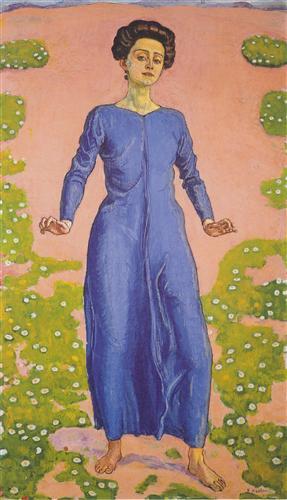 TRANSFIGURATION, FERDINAND HODLER,
 c. 1906
March 5, 2023
FIBER SCULPTOR JUDITH SCOTT
Here’s how this week’s arts and culture column begins:
Judith Scott (1943–2005), American fiber sculptor, was born in Columbus, Ohio, with Down syndrome. Her twin sister, Joyce, tells their joint story in the memoir “Entwined: Sisters and Secrets in the Silent World of Artist Judith Scott” (Beacon Press, $21.04).
For their first several years, the two were inseparable, playing in their backyard sandbox, collecting pebbles and leaves. But in those days, children with developmental disabilities — and their families — were stigmatized and often shunned.
One day Joyce woke, and Judith was gone, spirited away by her parents to a “home.” Unknown to her family, Judith was also deaf, a fact they did not learn until she had been institutionalized for many years.
READ THE WHOLE PIECE HERE.
March 2, 2023
AUTHORITY AND FREEDOM
I’ve been slightly incommunicado, having spent the better part of a week in Manhattan for the New York Encounter, upon which more later.
Then, upon returning home to my dear abode in Tucson, I realized with a start that I had left my laptop–with I’m sorry to say scads of unbacked-up work–in the TSA bin at LaGuardia!
So THAT’S been fun. I ordered a new laptop that very evening, Feburary 21. It was supposed to arrive in two days, but was eight days late and only arrived yesterday. So I had to compose and type my weekly column into, as well as kind of conduct a good part of life on, my phone.
Here’s the miracle: There is a very clear and fairly easy process whereby to file a claim for your lost-at-TSA goods, and by the very next morning I received an email saying “Good news! We have retrieved your item”…AND, they said, they would mail it to me.
The bad news is that I discovered after a few fruitless hours that it is apparently literally impossible for FedEx or UPS to print the necessary pre-paid mailing label from someone else to you. I could write an entire essay on the Kafkaesque morning I had at my local FedEx attempting to execute what seemed like this fairly straightforward transaction (Plus it would’ve cost something like $170 for a two-day delivery, not that I minded, but…really?)
The good news is that my dear friend Patrick, who lives in NYC, was coincidentally flying through LaGuardia on Monday and was able to pick up my precious (albeit totally battered) device. And he mailed it out USPS two-day yesterday for $17.10. I will hold off 1000% rejoicing till it’s delivered but all in all I would say St. Anthony is DEFINITELY ON MY SIDE.
Meanwhile, last week came and went but here is the way my arts and culture column began:
Jed Perl was The New Republic art critic for 20 years, writes frequently for The New York Review of Books, and has published, among other titles, a two-volume biography of the American sculptor Alexander Calder.
His newest book — Authority and Freedom: A Defense of the Arts (Knopf, $14.89) — is a cri de coeur against the notion that art is only useful insofar as it advances or promotes a particular ideology, political stance, or “clearly defined civic or community service.”
That arts have their own independent significance was an idea that Perl took for granted growing up in the ’50s and ’60s. Over time he came to realize that attitudes toward art are in fact cyclical. During the Depression, for example, more and more people, including artists themselves, “began to insist that their work be viewed and evaluated through a social or political lens.”
That’s happening again now, obviously.
READ THE WHOLE COLUMN HERE.
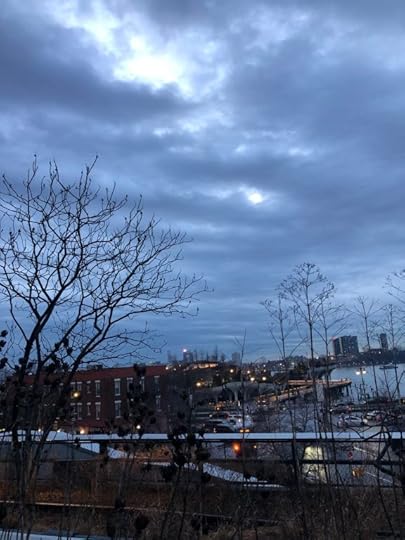 VIEW FROM THE HIGH LINE AT DUSK, DOWN TOWARD THE WHITNEY
February 17, 2023
AN INSPECTOR CALLS
Here’s how this week’s arts and culture column begins:
I’m a sucker for classic British films: black-and-white dramas from the ’40s and ’50s, with top-notch actors, sharp directors, and often a thorny moral dilemma.
One such gem, “An Inspector Calls” (1954), is based on the play by J.B. Priestley, and stars Alastair Sim (of Scrooge fame) as an otherworldly examiner of conscience.
You can stream it for free on Internet Archive or the Kanopy feature of your LA Public Library card.
The credits roll over a sumptuously laid dinner table. The Birling family is celebrating the engagement of their daughter Sheila to Gerald Croft, an upper-crust scion who is marrying ever-so-slightly down. Not to worry: Arthur Birling, the insufferably smug factory-owning patriarch, is up for a knighthood.
READ THE WHOLE PIECE HERE.
February 10, 2023
FLANNERY O’CONNOR’S WISE BLOOD
Here’s how this week’s arts and culture column begins:
“Fitness entrepreneurs” Julie Rice and Elizabeth Cutler co-founded Soulcycle, a chain of chi-chi Manhattan-based gyms whose aim is to sculpt spirits as well as bodies.
In their new venture, Peoplehood, members will pay to participate in 60-minute “gathers,” facilitated by influencer-type guides.
“Connection should be its own product,” Rice explains. “We are modern medicine for the loneliness epidemic.”
I sympathize completely with any and all real spiritual hunger.
But I couldn’t help but think of “Wise Blood,” the 1952 novel by Catholic writer Flannery O’Connor.
READ THE WHOLE PIECE HERE.
February 3, 2023
DR. MICHAEL JAMES SULLIVAN, GOD’S ANESTHESIOLOGIST
Here’s how this week’s arts and culture column begins:
Dr. Michael James Sullivan is Chair of the Department of Anesthesiology and Perioperative Medicine at the City of Hope National Medical Center in Duarte.
He’s also a friend who reminds me why we often consider a physician the next best thing to a priest.
Dr. Sullivan’s grandfather, father, and uncle were all physicians. He was born at the old San Bernardino County Hospital where his father was doing a residency.
His mother lost four other pregnancies. “Now the babies would have been premature and we probably would have saved them. That kind of cast a shadow. My parents healed from it, and went on to adopt two daughters, my sisters. But I always felt I had a purpose. Don’t get me wrong; we’re all special. But some specific duty to fulfill.”
READ THE WHOLE PIECE HERE.
January 29, 2023
TRAVELS WITH MYSELF
Welp, 2023 is shaping up as a year of adventure.
Next month I’ll be flying east to participate on a panel at the New York Encounter.
SAT, FEB 18, 2023
12:45 PM ET | FLOOR 2
(Nathaniel Hawthorne):
Testimonies to the mystery of suffering and its relief and redemption in light of the life and writings of Lorenzo Albacete.
March I’m visiting San Miguel de Allende for a week. This is supposedly “pleasure” but will be pocked by the ceaseless stream of…oh, you, know, the ceaseless stream. I’m very grateful. The place looks to be saturated with Catholic churches, colonial architecture, walking, gardens, and I’m sure tchotchkes of the Sorrowful Mother, Bleeding Heart of Christ et cetera. I am going to look for a really good crucifix whilst there..
April I have booked four nights at the Holy Cross Retreat Center Hermitage, Las Cruces, New Mexico. Here I plan to map out THE REST OF MY LIFE ONCE AND FOR ALL.
May I will give a couple of morning retreats on prayer to the Maryknoll missioners at their place in Los Altos, California, and have begged a few extra nights to explore the nearby nature preserve and if all goes, well, the Gardens of Alcatraz Prison.
First weekend in June I’ll be (once again, having visited over Thanksgiving) at New Camaldoli Hermitage in Big Sur, giving a writing workshop to the monks, oblates, and whoever else might want to attend. That will be available on zoom as well, flyer and links forthcoming.
Then I’m REALLY going to start traveling. Will spend from mid-July to mid-September in Oughterard, Ireland, just outside of Galway, then the last two weeks of September at Kylemore Abbey in Connemara.
My big dilemma is whether to head over to Europe even earlier so as to dip into Belgium and Scotland.
Be careful what you ask for! Obviously, an embarrassment of riches.
I just finished reading Martha Gellhorn’s very entertaining Travels With Myself and Another. But she mostly went solo, too.
January 27, 2023
MONICA AISSA MARTINEZ: NOTHING IN STATIS
Here’s how this week’s arts and culture column begins:
Phoenix-based artist Monica Aissa Martinez is fascinated by the intricacies of the human body. Her current project, “Nothing in Stasis,” comprises a series of large-scale paintings of family and friends that explore the confluence of body, mind and spirit.
If you happen to be in Arizona, the Tucson Museum of Art is hosting an eponymous exhibit through April 23, 2023. But not to worry: you can also view the “Nothing in Stasis” collection on her website (monicaaissamartinez.com).
At first glance, the paintings vaguely evoke those life-sized anatomical posters from high school biology class with the various systems–digestive, nervous, reproductive—mapped out. But there the resemblance stops.
READ THE WHOLE PIECE HERE.
January 25, 2023
THE CONVERSION OF ST. PAUL
I wrote this piece ten years ago for Magnificat. Apologies to those who have read it before, but it IS January 25th.
“Saul, Saul, why are you persecuting me?” [Acts 9:4] Authentic conversion always comes from realizing that we have been “persecuting” Christ.
In the fall of 1986, I spent thirty days at an addiction treatment center in rural Minnesota. Hiking trails meandered through the woods. The trees were turning color. One morning I crept out for a walk just past dawn. Not another soul stirred. I came upon a pond and, through the mist, saw a blue heron, standing stock still, noble head erect. I saw the heron and the heron saw me.
It was a moment from the Song of Songs, a moment of liminal space and time, an instant of such heart-stopping beauty that in my memory it has attained the level of myth. All those years while I’d been in the bars, this heron, or one like him, had been coming to the pond. All those years while I’d been drinking morning Sea Breezes at Boston’s Sullivan’s Tap, another parallel world had been breathing, suffering, praising God. Many years passed before I discovered Christ, and more years after that before I came into the Church. But in a way I can mark my conversion from that moment. In a way that heron was Christ, saying, “Heather, Heather, why are you persecuting me?”
St. Paul fell off his horse, but Christ comes in the form of a lamb, a dove, a heron. That’s not to say he’s always gentle. But he’s often gentlest when we’ve been doing terrible violence to ourselves and others. Christ never cuts us down with a gun or a sword. He looks at us with love. He says, Look at these blue-gray feathers. He says, Isn’t it lovely to be still and listen to the frogs? He looks us in the eye with love and says, “Why are you persecuting me?”
To be forgiven when we know we don’t “deserve” to be forgiven is radically transformative in a way violence can never be. To be forgiven does another kind of violence: to our whole tit-for-tat notion of crime and punishment. To be forgiven makes us realize that, unbelievable as it may seem, God needs us for something. We have a mission.
My experience with the heron wasn’t a white-light experience. It was a door opening onto what has proved to be a long and very slow spiritual awakening of, as William James put it, “the educational variety.” How often I’ve forgotten the heron. How often I’ve been harsh, rageful, importunate, intolerant, unfaithful, unkind, and just plain wrong.
When that happens I’m struck blind for a few hours or days or even months. Often a long time passes before I see that once again, I’ve been persecuting Christ.
Our offense doesn’t lie in breaking a rule. It lies in offending against love, against truth, against beauty.
What’s remarkable about St. Paul isn’t that he had a white light experience. What’s remarkable is that he retained his fervor for all the remaining years of his life.
Fyi, this and many other pieces I’ve written for Magnificat over the years have been collected into a little book called Holy Days and Gospel Reflections.


