
Heather King's Blog, page 23
August 10, 2023
THE SPIRIT JOURNEYS
3
As when silt drifts and sifts down through muddy pond-water,
Settling in small beads around weed and sunken branches,
And one crab, tentative, hunches himself before moving along the bottom,
Grotesque, awkward, his extended eyes looking at nothing in particular,
Only a few bubbles loosening from the ill-matched tentacles,
The tail and smaller legs slipping and sliding slowly backward—
So the spirit tries for another life,
Another way and place in which to continue;
Or a salmon tired, moving up a shallow stream,
Nudges into a back-eddy, a sandy inlet,
Bumping against sticks and bottom-stones, then swinging
Around, back into the tiny maincurrent, the rush of brownish-white water,
So, I suppose, the spirit journeys.
Ha ha, don’t worry, I have PLENTY of life left in me yet!
All my travel this year has put me in a state of cognitive dissonance. Just as I’m falling in love with Ireland, part of me is back in Tucson, a huge part of my heart is always in LA, the deepest part of my heart is forever on the coast of New Hampshire, and why didn’t I visit the Solanus Casey Center, I now wonder, when I was in Detroit (besides the fact that it didn’t come to my attention till the next-to-the-last day)?
A dear friend from the Central Coast mailed me a book last week called The Taste of Silence: How I Came to Be at Home with Myself, by Bieke Vandekerckhove, a Belgian woman who at 19 was diagnosed with Lou Gehrig’s disease and at the time of the book’s 2015 publication, had somewhat miraculously survived for 20 years.
Drawing from both Catholic monasticism and Zen Buddhism, Vandekerckhove explores many thinkers, writers, poets, and Eastern and Central European novelists (Karel Čapek; Imre Kertész).
This quote summed up my spiritual state at the moment:
“Compared with the smaller, fertile, and therefore also overpopulated, areas of our planet, deserts occupy a huge surface. They serve no good purpose, are a thorn in our side and a source of aggravation. They are as meaningless and offensive as the pure adoration, of which they are the outward manifestation. The desert shows us our fundamental powerlessness, and leaves us no choice but to look for strength in God.”
–René Voillaume (1905-2003), French Catholic priest, theologian and founder of the Little Brothers of Jesus in 1933, the Little Brothers of the Gospel in 1956, and the Little Sisters of the Gospel in 1963. His spirituality is inspired by the life and writings of St. Charles de Foucauld.
A lot of what I do is write about people; celebrate people, you could say. Every month I submit an essay to Magnificat for my Credible Witness column. A fair amount of my Angelus columns also profile someone I admire or about whom I’m curious.
I’ve been gathering some of the columns I like best to edit, with an eye toward including them in a book about the vocation of writing/the creative life (which has been in the back of my mind for years).
All of that makes for hard going. I can’t rush things. I can’t barge in to someone’s life and start scribbling away. I can’t jump from one person to another and back again.
Even editing a column or essay I wrote and (supposedly) finished years ago–I have to first stand on the threshold. I have to gather myself; prepare myself to receive, enlarge my heart, sharpen my focus, and disappear for a while.
For someone so self-absorbed, that’s a tall order!
But this morning I was thinking that to write about someone else’s work and life is to enter a sacred space.
No wonder I pause–and my breath catches.
“It’s love which justifies our actions; love must initiate all we do. Love is the fulfillment of the law.
If, out of love, Brother Paul [trained as an engineer] has chosen to die on a desert track, by this he is justified.
If, out of love, Don Bosco and Mother Seton built schools and hospitals, by this were they justified.
If, out of love, Thomas Aquinas spent his life among books, by this he was justified. The only problem is to put into their right perspective these different kinds of ‘love-in-action.’ And here Jesus himself teaches us in an uncompromising way:
‘The greatest among you must be as the least, the leader be as one who is a servant.’
And again, ‘A man can have no greater love than to lay down his life for his friends.’”
–Carlo Carretto, Letters from the Desert


August 7, 2023
SEASONS OF LIFE
“We have to renounce far more than we accomplish.”
–Paul Tournier, The Seasons of Life
“How can we possibly entertain the idea that we are different from other men, when we shout, cry, feel afraid, lack determination, and behave atrociously just like everybody else?”
–Carlo Carretto, Letters from the Desert
“When you have done something really healing, it happens so often that the only way you know it at first is by your own feeling of emptiness. Even Our Lord experienced this; when the woman who touched the hem of His garment was healed, He knew it by the sense of something having gone out of Him, an emptying ‘[power] has gone out of Me.’
It is the same for His followers—we know the moment of healing, not yet evident, not by exaltation and triumph but by emptiness and a sense of failure! That demands huge faith, but you have it!”
—Caryll Houselander (1901-1954), in a letter to a friend
“Let Mass be the center of your day. Everything must flow for you from your daily Mass, and everything must culminate in it. Your day, because you will have willed it, must be a thanksgiving for the Mass you attended that day and a preparation for the Mass you will attend the next day. That does not mean you should think all day about your morning Mass or that of the next day; it means that you will have said to Jesus, making these words the disposition of your soul , ‘I want all of my life to be centered on the altar of the Mass, to depend on it, and to culminate in it, to be a thanksgiving and a preparation for my daily Mass–all my life, all my days, all the beatings of my heart.'”
–Father Juan du Coeur de Jésus d’Elbée (from August 7, 2023, Magnificat reflection)
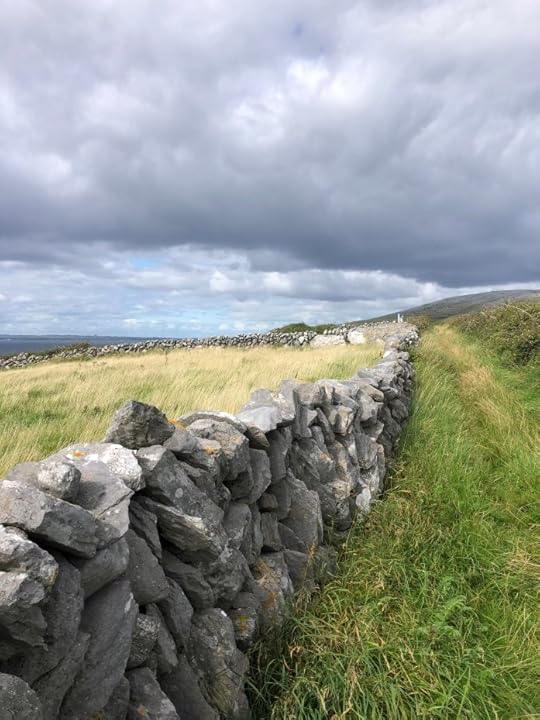
Always, I’m reflecting here in Ireland, I’ve been in the world but not of it. One foot in; one foot in heaven, or the world beyond. Always the divine restlessness. So this is just another little leg of the journey. I’m no closer to knowing where I belong, if anywhere, where I’ll end up, how or who will be with me, again if anybody, when I die. And I’m kind of at peace with it all, just for today. None of that really matters.
As Carlo Carretto says in Letters from the Desert, all that matters is our prayer. We in a sense are our prayer—nothing more, nothing less. And my life has been nothing but a huge, unending cry of the heart….Ireland is the cry of my child’s heart that never quite got answered or hushed–that never quite does for any of us–and that I’ve been crying all my life…
I’ve always thought Thomas Merton lacked humor but he did say one really funny thing:
“The man of solitude is happy, but he never has a good time.”
–Thomas Merton
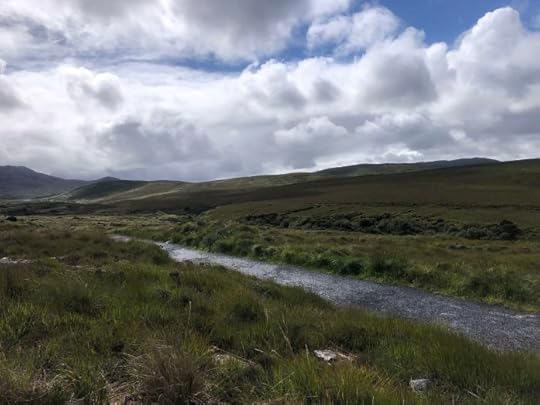 CONNEMARA NATIONAL PARK
“When will I come to the end of my pilgrimage,
and enter the presence of God?”
August 5, 2023
TAKASHI NAGAI, PROPHET OF NAGASAKI
Here’s how this week’s arts and column begins:
Aug. 6 and Aug. 9 mark the 78th anniversary of the dropping of atomic bombs on the Japanese cities of, respectively, Hiroshima and Nagasaki. Between 129,000 and 226,000 people, most of whom were civilians, were killed on those days in 1945. Both cities, within the limits of the bomb sites, were reduced to rubble.
Takashi Nagai (1908-1951), a Catholic convert, Japanese doctor, radiologist, and survivor of the bomb, wrote the popular post-World War II book, “The Bells of Nagasaki.”
In “A Song for Nagasaki,” biographer Paul Glynn, SM, charts Nagai’s spiritual evolution from atheist to ardent Catholic: a follower of Christ who came to believe that peace requires a radical turning of the other cheek.
READ THE WHOLE PIECE HERE.
July 30, 2023
WHY WE PRAY
“God’s call is mysterious; it comes in the darkness of faith. It is so fine, so subtle, that it is only with the deepest silence within us that we can hear it…
This call is uninterrupted: God is always calling us! But there are distinctive moments in this call of his, moments which leave a permanent mark on us—moments we never forget…
Prayer had become the most important thing. But it was still the hardest part of my daily life. Through my vocation to prayer I learned what is meant by ‘carrying other people’ in our prayer.
So after many years I can say that I have remained true to my vocation, and at the same time I am completely convinced that one never wastes time by praying; there is no more helpful way of helping those we love.”
–Carlo Carretto, Letters from the Desert
In The Shattering of Loneliness: On Christian Remembrance (2018), Norwegian bishop and monk Erik Varden mentions a memoir called The Woman Who Could Not Die. The author, Julia de Beausobre, was a survivor of the Stalinist labor camps.
I checked the book out of the LA Public Library years ago: buying a copy may be a bit pricey but well worth it. (Beausobre also wrote a biography of Russian hermit St. Serafim of Sarov called Flame in the Snow).
“While de Beausobre was engulfed in Stalin’s terror,” Varden writes, “she encountered an old nun who assured her she must one day leave Russia and convey a message to ‘our brethren beyond the border.’ She must make it clear to them, the nun said,
‘that they should keep burning on the altars of their hearts the flame that is tortured out of ours. If only some of them keep it burning, we will find it in our prayers, in our sleep and in our flight away from our tormented bodies. It will shine to us as a glowing beacon of light in the numbing darkness, and we shall be comforted and Christ shall rejoice.’”
As Carretto says, prayer is often the hardest part of our daily life. Aarrrgggh. I have things to do, I’m obsessiong about something, I want to distract myself and dull the pain with books, movies, or news.
Or I’m just hollowed out and exhausted. This is where a routine and ritual come in: going through the motions is way, way better than not praying at all. And prayer, as we know, has next to nothing to do with how we feel about prayer or during prayer or after prayer.
Ireland is growing on me, but Co Galway has had about four hours of sunlight total in the last few weeks. Mary M., a local villager who is 93, told me the other day, “The weather hasn’t been this bad in July in a long, long, long, LONG time!” Naturally, I laughed heartily.
Overcast skies, wind, and rain have their own charm and even allure. I am tramping about exploring the bog roads, lanes, and downtown in my escapee-from-German-asylum garb, praying for the poor souls in Purgatory. and I hope affording the locals a huge dose of comic relief.
We do what we can.
July 28, 2023
THE OTHER COACHELLA
Here’s how this week’s arts and culture column begins:
To the world, Coachella Valley is the site of the massive, internationally touted music and arts festival held each year in the desert outside Palm Springs.
But Coachella is an actual town. And along with the neighboring unincorporated community of Mecca, it’s home to tens of thousands of seasonal farm workers, cleaners, tree trimmers, garbage collectors, and hotel staff: the unseen army of people, most from Mexico and Central America, many undocumented, who provide the infrastructure that allows those who live in and visit the valley to eat, holiday, and earn.
Invisible Valley, a 2021 documentary directed by Aaron Maurer, profiles the Galilee Center, a Mecca-based nonprofit whose mission is to help provide the workers with food, shelter, clothing, and housewares.
READ THE WHOLE PIECE HERE.
July 22, 2023
HUNGER
I may have said that I now have Irish citizenship. My paternal grandmother was born and raised in Limavady, Co Derry, Northern Ireland, sailed for America in the early 1900s, married a bricklayer from Glasgow, and settled on the coast of Rye, New Hampshire.
The Irish climate, weather, topography, trees, flora and sky explain a lot of what I’ve observed of the Irish character (not least of all my own). They say that generational trauma extends seven generations, even with no additional trauma, and I’m convinced that I was born with traces of landlord- and famine-fear stamped into my own DNA.
Then again, I have known nothing of real want, material want.
The other day I was out walking, just exploring the lanes that surround the house where I’m staying, and came upon this plaque. There it sat, all by itself: humbly, mute, almost obscured by bracken and fern.
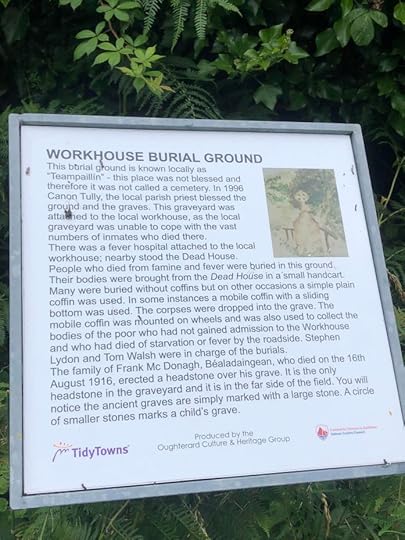
I was reminded of this poem by Wisława Szymborska.
Szebnie was a forced-labor camp established during World War II by Nazi in the south-eastern part of occupied Poland. It was located near the town of Szebnie approximately 6 miles east of Jaslo.
HUNGER CAMP AT JASLO
by Wisława Szymborska
Write it. Write. In ordinary ink
on ordinary paper: they were given no food,
they all died of hunger. “All. How many?
It’s a big meadow. How much grass
for each one?” Write: I don’t know.
History counts its skeletons in round numbers.
A thousand and one remains a thousand,
as though the one had never existed:
an imaginary embryo, an empty cradle,
an ABC never read,
air that laughs, cries, grows,
emptiness running down steps toward the garden,
nobody’s place in the line.
We stand in the meadow where it became flesh,
and the meadow is silent as a false witness.
Sunny. Green. Nearby, a forest
with wood for chewing and water under the bark-
every day a full ration of the view
until you go blind. Overhead, a bird-
the shadow of its life-giving wings
brushed their lips. Their jaws opened.
Teeth clacked against teeth.
At night, the sickle moon shone in the sky
and reaped wheat for their bread.
Hands came floating from blackened icons,
empty cups in their fingers.
On a spit of barbed wire,
a man was turning.
They sang with their mouths full of earth.
“A lovely song of how war strikes straight
at the heart.” Write: how silent.
“Yes.”
–Translated by Grazyna Drabik and Austin Flint
Let’s take extra care to give thanks for our food today, and all who grow, prepare, and make it possible through through their service and sacrifice.
July 21, 2023
THE HUCKLEBERRY EXPLORERS CLUB
Here’s how this week’s arts and culture column begins:
One perk of creative writing is that over time, if you’re lucky, you gather a far-flung, richly varied group of friends.
Many years ago, for example, I met Stefany Ann Golberg (better known as Shuffy) and Morgan Meis, a married couple who write, teach, and travel widely: Sri Lanka, Bulgaria, Honduras, LA, Italy, India, South Tyrol.
Morgan, an art theorist and critic, is working on the third of a trilogy of books, each centered upon a single painting.
Shuffy, also a multimedia artist and filmmaker, has published of creative nonfiction.
READ THE WHOLE PIECE HERE.
July 19, 2023
ON MY 71st BIRTHDAY
I am still alive but why
silvery grass that withers
at the touch of the snow
I’m in a village called Oughterard, 40 minutes or so outside Galway, and the weather is the opposite of Tucson–it’s in the low 60s every day, usually cloudy and very often raining or drizzling.
I hung a load of laundry on the line yesterday afternoon and it poured in the night. So you bring the clothes in and put them on this item called a hot press…it’s all very different from our Southern California and Southwest ways! But I at least escaped the extreme heat warning with which poor Tucson has been saddled for weeks now. I guess they got a monsoon earlier in the week, though, I heard from a friend. I kind of miss it. Whatever else, the weather there is dramatic (though it is here, too, in its way).
Anyway, I’m house-sitting for friends here who sold their house in the Hollywood Hills just before COVID hit and moved here–they’ve gone back to America, as the Irish call the States, to care for the guy’s elderly mother.
Apparently the peonies will be out here in a bit! Hydrangeas are huge–my friend Jamie has three or four different colors, and there are lilies, roses, a butterfly bush, a smoke tree, some iris and assorted wildflowers. Massively tall trees, including bay, horse chestnut and sweet chestnut. They have an orchard with lots of apple trees and a plum tree on which the fruit should be ripe next month. Blackberries abound on the “verges”…the area on either side of the lane that’s filled with ferns, bracken, and wildflowers. So all that rain gets put to good use.
The Church of the Immaculate Conception with Father Michael is right around the corner. 10 am Mass on Tuesdays and Fridays with Adoration after, and other Rosaries and night-time Masses and of course the Saturday Vigil and Sundays 8:30 and 11.
Sullivan’s, the greengrocer up the street, has delicious bread and pastries, plus cheese, farm produce, coffee etc. I was with my hosts, Jamie and Karl, for a week but they left Monday. I have a cat, Phinn, to keep my company, and the donkeys Bernie and Barry in the meadow down the lane.
I plan to do a lot of sitting and looking out the window.
Last week we were out to dinner with friends of my hosts and the guy, who has worked as a spiritual advisor and therapist, said that one of the questions he asks is, “How would I tell from the way you live that you know you’re going to die?”
Interesting, right?
Without even thinking, I said, “Maybe you wouldn’t travel at all any more, for one thing, but would just sit and look out the window.”
The punchline to the question, of course, no matter how you answer, is: “Then why aren’t you doing that now?”
So I thought of that later. Why am I not just sitting more and looking out the window? One answer is that I did spend about a week before I left for Ireland propped up in bed and gazing out the French door that leads from my Tucson bedroom to the mesquite-and-agave-shaded front yard. Gazing, pondering, not thinking of much of anything, praising.
But that’s the thing with life. There’s no formula. Would you blow all your money, for example, or conserve it in case you lingered on for many years BEFORE you died? Would you spend more time with people, because human connection is good and life-enriching; or would you spend more time alone, because some of us are meant for silence and solitude?
Would I spend more time writing, because my hope is that my writing is an offering to the world; or would I spend more time resting and rejuvenating, because I’m no good to anyone if I’m tired and wrung out?
Would I keep moving, or stay still?
The way someone would know from my life that I know I’m going to die, if they knew at all, would be from my inner life. My secret thoughts. No-one can really, tell–maybe we can hardly tell ourselves–what the guiding force is that drives us. Because I know I’m going to die I go to Mass. Because I know I’m going to die I pray. Because I know I’m going to die I weep.
Because I know I’m going to die I stay very close to Christ.
After 70, I find, you live with a kind of permanent sob in the throat. I don’t mean you’re always depressed. But there’s a shadow that is simply not there, is not meant to be there, when you’re young. No outward action can do one tiny thing to alleviate the knowledge that we’re going to die.
I like this reflection from John Henry Newman:
‘If you ask me what you are to do in order to be perfect, I say, first – Do not lie in bed beyond the due time of rising; give your first thoughts to God; make a good visit to the Blessed Sacrament; say the Angelus devoutly; eat and drink to God’s glory; say the Rosary well; be recollected; keep out bad thoughts; make your evening meditation well; examine yourself daily; go to bed in good time, and you are already perfect.’
Nothing heroic, but everything ordered. You can adhere to that order even if exhausted, upset, sorrowful, anxious.
Keeping out the bad thoughts is to my mind by far the most challenging part.
When I arrived in Ireland last week, I was just about dead. (What’s nice is that I’ve also met Dermot, the local undertaker). A lot of travel this year, a lot of doctor and dentist visits, a lot of mental and emotional energy expended. A lot of planning to be away from home for almost three months.
I feel my strength returning, though. Last night I went to bed early, woke at 12:30 am, and spent four hours lying in bed planning a trip the first two weeks of September to Edinburgh, Glasgow, Prague, and Budapest.
Who knows if it will come to pass but one way I show my knowledge that I’ll die is by trying fully to live (that’s the real question: what does “living” mean to each of us?) BEFORE I die.
a cicada shell
it sang itself
utterly away
—Bashō
July 14, 2023
BRING BACK MIRTH!
Here’s how this week’s arts and culture column begins:
For years I barely dipped into the news. Even now I’m pretty sure I’ve never heard Joe Biden’s voice, nor the voice of the three presidents before him. I’m a little more on top of things these days, but I’m not sure it’s done me much good.
As St. Paul observed, you can do all kinds of things — erect cities, amass money and power, develop huge military might — but without love, it all amounts to the noise of a hollow gong or clashing cymbal (1 Cor. 13:1).
You don’t have to know the particulars to grasp that we seem to be a civilization hitting bottom, much like an alcoholic in the late stage of her disease.
READ THE WHOLE PIECE HERE.
July 9, 2023
THE ONES WHO WALK AWAY FROM OMELAS
Here’s how this week’s arts and culture column begins:
“The Ones Who Walk Away from Omelas” is a dystopian short story by California native and celebrated “speculative fiction” author, Ursula K. Le Guin (1929-2018).
“Omelas” came to Le Guin when, on a road trip, she saw the words “Salem, Oregon” backward in her rearview mirror.
Published in 1973, the story begins as the people of the city of Omelas in a fictional country are celebrating the Festival of Summer. The sun is shining. There are sparkling flags, clamoring bells, and prancing horses whose manes are braided with streamers of silver, gold, and green. The procession is a dance, led by a “shimmering of gong and tambourine.”
READ THE WHOLE PIECE HERE.


