
Heather King's Blog, page 20
December 16, 2023
THE HOLLY AND THE IVY: A 50s CHRISTMAS MOVIE
Here’s how this week’s arts and culture column begins:
A new book, out this month from Foster Hirsch, is called “Hollywood and the Movies of the Fifties: The Collapse of the Studio System, the Thrill of Cinerama, and the Invasion of the Ultimate Body Snatcher — Television” (Knopf, $38.68).
Finally, finally: I’m ahead of the curve.
READ THE WHOLE PIECE HERE.


December 14, 2023
BEHOLD THE HANDMAID OF THE LORD
I recorded the below on the Feast of Our Lady of Guadalupe but it holds for the whole Advent and Christmas seasons, when the Blessed Virgin takes center stage in a special way. .
I’ve always been a little stymied by today’s Gospel (Matthew 11:11-15), the one from which Flannery O’Connor took the title of one of her novels: “From the days of John the Baptist until now, the kingdom of heaven suffereth violence, and the violent bear it away.”
Googling, I find “Taking the Kingdom by force refers to those who make a concerted effort to enter the kingdom in spite of violent opposition. This opposition comes in many forms including our carnal mind, which is enmity against God and the lust of our own human flesh.”
The lust of my own human flesh takes the form these days of allowing myself to be distracted by gossip, “news;” a desire to build up “security” for myself instead of sharing what I have with others; the tendency to see the glass as half empty instead of half full, the perennial craving for attention, approval, validation, love; and probably many others to which I’m blind…
Making a concerted effort to enter the kingdom is taking the form at the moment of a deep desire to connect with the people I love. My brother Joe called me back from the road at 10 pm last night which is way past my bedtime but we ended up gabbing for a couple of hours. I have a zoom scheduled with another beloved sibling next week. We’ll probably shoot for an online Holy Fam get-together as the 25th draws near. I’m reaching out to the friends who have sustained me for so long. Being in LA last week brought sharply home how everything passes…people, living situations, health, the old streets, whole neighborhoods…
Praying Psalm 23 last week, it occurred to me to ask, “What is the biblical difference between a rod and a staff?”
Answer: “The rod and staff can be broadly categorized as tools of protection and guidance, respectively. The rod warded off predators; the staff was a guiding tool with a hook on one end to secure a sheep around its chest. Only the two tools together provided comfort to the sheep.
A guiding tool, one end of which secures a sheep around its chest. That is SO what I need.
I always kick off Advent with Bach’s Christmas Oratorio, haul out my Victorian book of simple carols to play on the piano, line up a few playlists, and look forward to The Messiah.
But, possibly due to my Protestant upbringing, I’m a sucker for old-school hymns. This isn’t especially a Christmas song but then again–
“And on his shoulder gently laid
And home rejoicing brought me.”
December 10, 2023
ST. THÉRÈSE OF LISIEUX’S DESIRE TO BE A PRIEST
Here’s how this week’s arts and culture column begins:
Endow (Educating on the Nature and Dignity of Women) is a Catholic organization rooted in the teachings of St. Pope John Paul II.
Among other activities, study guides on Church teachings and notable female saints — Catherine of Siena, Edith Stein, Hildegard — are read aloud by small-group participants and discussed.
Last year I contributed a guide on St. Thérèse of Lisieux (1873-1897), called by many the greatest saint of modern times and recently honored by Pope Francis in the apostolic exhortation “C’est la Confiance” (“It is the Confidence”).
READ THE WHOLE PIECE HERE.
December 7, 2023
THE ROAD MORE-LESS TRAVELED
I’ve been in my beloved state of California since last Saturday. Boy, does absence make the heart grow fonder! There’s something huge to be said for leaving a place and coming back periodically to visit. Everything seems fresh, new, astonishing, delightful.
LAX, for example! Why what a huge wonderful airport with the sun shining, the runways happily busy, the lines moving nicely, the Thrifty car rental shuttle zipping promptly along. I’d never rented a car here and imagined that getting out to the 405 would be a nightmare, but no! Down La Tijera I went and next thing I knew was gliding past the Getty, merging on to the 101, and making my way smoothly up the coast.
At home I drive a 2013 Fiat 500 which I still think of as “new,” but again, was I in for a surprise. The Camry they gave me for one thing has about a thousand percent more pickup than my little vehicle plus it has a big touch-tone screen that–those of you who moved into the 21st century some time ago already know this–when I plugged in my phone automatically showed the map, played music off Spotify, showed lists of nearby Starbucks, enabled the making and answering of phone calls…
I have bluetooth in my Fiat which does enable me to make hands-free calls but that’s about it. I mean the car has a CD player (that requires the aid of a butter knife for ejection). I can’t simultaneously charge the phone and hear Siri or listen to music. If I want, say, Spotify I have to plug the phone into a separate CV or something like that cable. And when I put the car in reverse I don’t have a video screen that tells me if they’re something behind me I’m about to crash into. I crane my neck, old-school.
So a newer car alone was a pleasant revelation.
If anyone’s ever driven north on the 101 from LA to, say, Santa Barbara, you know there’s this one spot where I think it’s the 126 merges in and you go up and around a little rise and the first sign for San Francisco appears and on your left you suddenly see the Pacific. It’s absolutely thrilling, every time. It’s the California of John Steinbeck, Jack London, Lawrence Ferlinghetti, Jack Kerouac–or it is to me. For those of us who have come from another place, it’s a vision of the Promisesd Land. No matter how many times you’ve seen it, no matter how jaded you think you are.
Plus what follows is Ventura, which involves a 12-mile drive with bluffs on the right and the full-on gleaming ocean on the left, which happened I swear to be turquoise the day I was driving up, then Santa Barbara, Goleta, fields of yellow mustard flowers in the spring, rolling live oak-covered hills, the smell of eucalyptus, hidden beaches. All the people who love to hate California I feel so sorry for. There is a feeling of wide-openness and welcome and majestic beauty and life-giving energy that I haven’t experienced anywhere else on earth (not that I’ve traveled the earth, by any means).
I stopped this time in Solvang which is a dreadfully crowded fake Danish village on the far end of which is the beautiful Mission Santa Inés. I’d visited once before several years ago and it was lovely both times though probably a bit noisier and the gift shop wasn’t as good. No matter. The courtyard was full of roses, echeviera, sea lavendar…California flora that is so familiar and so dear and that you don’t see much of in Tucson.
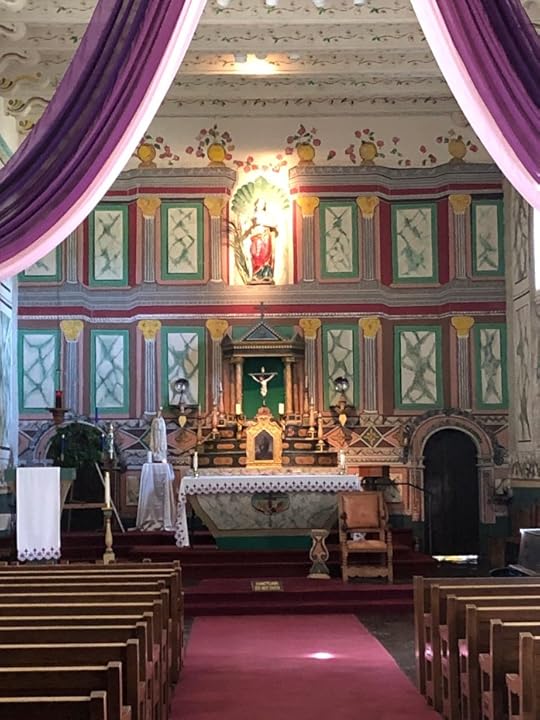
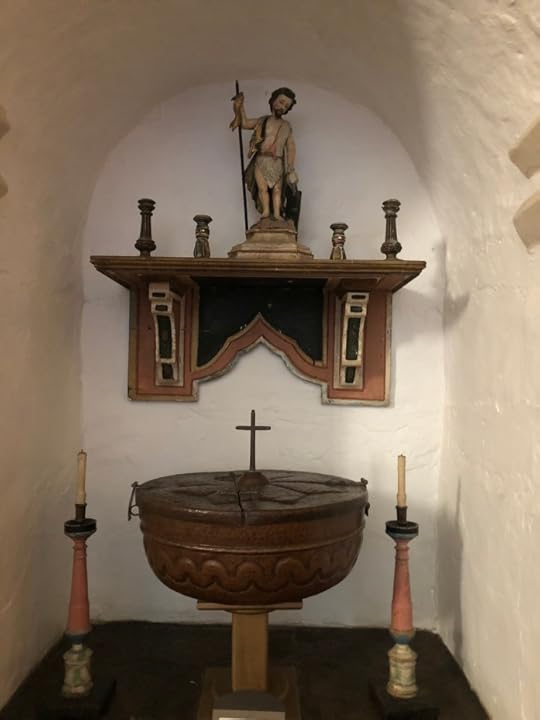
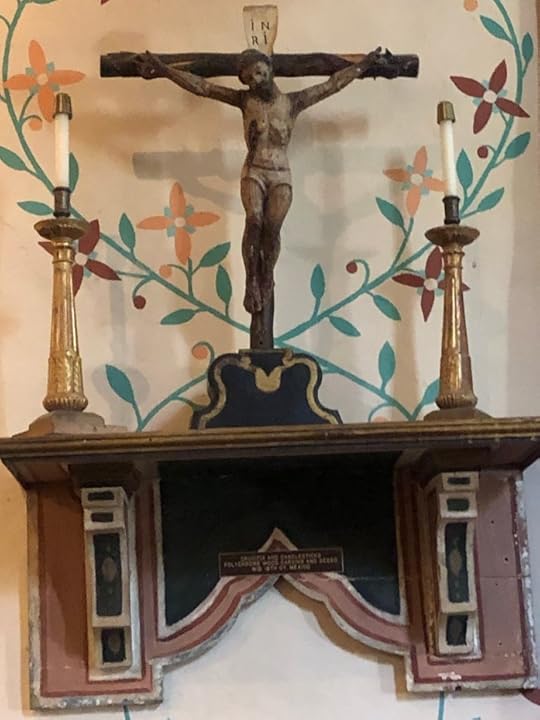
Also one of the best things about the Mission is the half-hour or so loop walk you can take below. Looks like more trails may tendril off but I didn’t have time to explore.
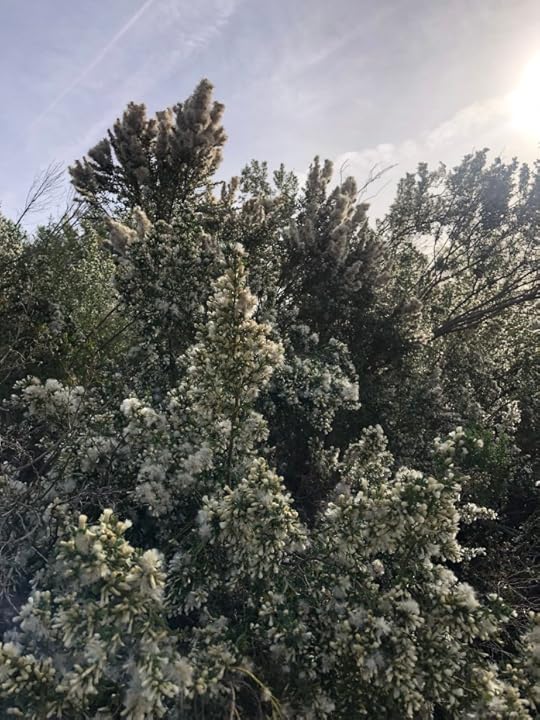
From there I made my way to Santa Maria and spent two nights with my dear dear friends Tensie and Dennis. I have my own little hermitage while there, the conversation is nonstop and superb, and the spirit of thier marriage, family, work, community, hearts, and shared table is beyond compare. Their friendship are an unmerited and mysterious gift before which I can only bow my head and say Thank you, Lord.
We all went to 7 am Mass at St. Mary’s for the First Sunday of Advent and partook during the day of not one but two blessings of the Advent wreath. That afternoon Tensie and I had a long walk on the Estero Bluffs above Cayucos.
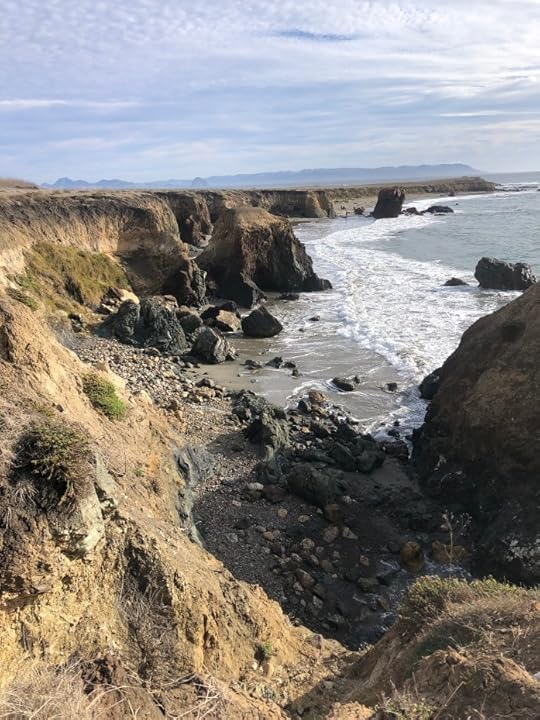
THEN, Monday, I drove to St. Andrew’s Abbey in Valyermo, an unincorporated community in the Mojave Desert. I’ve been on private retreat at this Benedictine monastery all week and it has been heaven.
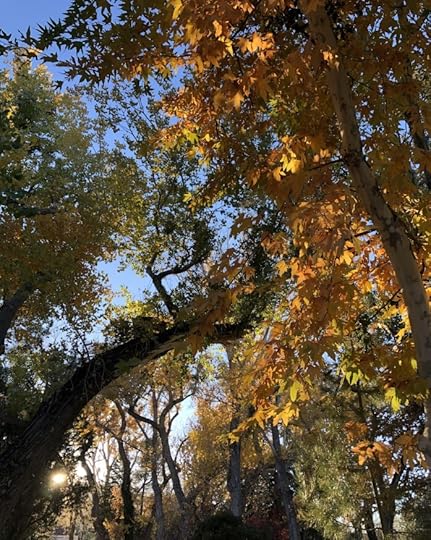
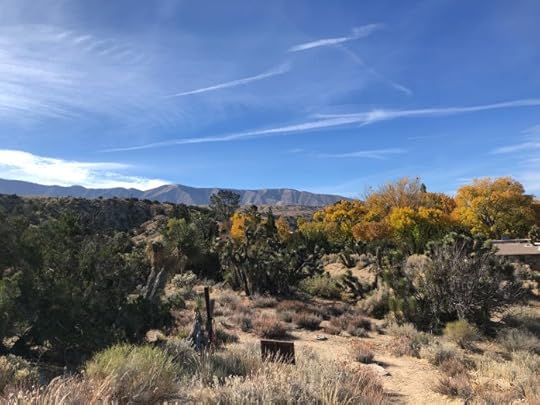
A deep desire of my heart is being fulfilled, upon which I’m sure I will write much more in the coming weeks, months and years.
“Your way of acting should be different from the world’s way; the love of Christ must come before all else” (Rule of Benedict 4.20, 21).
December 1, 2023
LOST IN THOUGHT
Here’s how this week’s arts and culture column begins:
Every so often I stumble upon a book that gives a name to a part of my life I didn’t even know had a name.
“Lost in Thought: The Hidden Pleasures of Intellectual Life” (Princeton University Press, $23.95) is a prime example.
Author Zena Hitz is a tutor in the great books program at St. John’s College, a secular “great books” school, in Annapolis, Maryland.
A Catholic convert, she explores such meaty topics as time, work, and rest.
“The leisure that is necessary for human beings,” she observed in a recent Plough essay, “is not just a break from real life, a place where we rest and restore ourselves in order to go back to work. What we are after is a state that looks like the culmination of a life.”
READ THE WHOLE PIECE HERE.
November 30, 2023
JAMES BOND, JOSEPH CORNELL, AND FR. WALTER CISZEK VS. GOD
I am flying into LAX Saturday, renting a car, driving up to the Central Coast for a couple of nights to visit dear friends, and then heading for St. Andrews’ Abbey in Valyermo for a first-week-of-Advent retreat.
I’m nervous and excited!
Meanwhile, my thoughts have turned to one of my all-time favorite saints or soon-to-be saints: Servant of God Walter Ciszek. I wrote about him in Magnificat years ago:
SERVANT OF GOD WALTER CISZEK
Fr. Walter Ciszek, S. J. (1904-1984) was born to a large Polish Catholic family in the mining town of Shenandoah, Pennsylvania. As a youth he headed up a street gang and proved so incorrigible that his father once went to the police and asked them to put him in reform school.
Instead, young Ciszek developed a private, secret desire to be a Jesuit priest. Mulishly stubborn, he was accepted into seminary, studied in Rome, and was ordained in 1937. He felt a passionate call to go to Russia, but was instead assigned to Albertin in eastern Poland. When the Russians invaded and closed the Jesuit mission down, Fr. Ciszek, with permission from his order, snuck across the Russian border. There, he worked in a lumber camp for a year: learning the language, quietly performing baptisms, absolutions, and anointings, and—some of the happiest moments of his life, he would later recall—celebrating clandestine Masses in the woods with a priest friend.
Arrested one night, he was sent to the notorious Lubianka Prison and charged with being a Vatican spy. Much of his five years there was spent in solitary confinement. In He Leadeth Me, a spiritual classic, he tells of praying that the Holy Spirit would provide a clever retort to put his interrogators smartly in their place. Instead, in one particularly grueling session, he finally broke and numbly signed page after page of trumped-up charges.
Back in his cell, he was devastated. He, who had prided himself on his strength, had been broken. It struck with the force of revelation: for all his prayer and self-discipline, he had still been relying largely on himself. The episode was a “purgatory” that “left me cleansed to the bone” and marked a turning point after which he abandoned himself completely to God’s will.
He was sentenced to fifteen years of hard labor at a Siberian work camp. Often in the sub-arctic cold during lunch break, he and his fellow believers secretly celebrated daily Mass: “[T]hese men would actually fast all day long and do exhausting physical labor without a bite to eat since dinner the evening before, just to be able to receive the Holy Eucharist—that was how much the Sacrament meant to them in this otherwise God-forsaken place.’
Released from Siberia in 1955, he worked as an auto mechanic and served as village priest. In 1963 he was exchanged for two Soviet spies and, after twenty-three years, Fr. Ciszek came home. The twinkle in his blue eyes was intact, yet “in many ways, I am almost a stranger.”
This mischievous Pole, tender of heart and tough as nails, evokes St. Thérèse of Lisieux. Both were fiercely sure of their vocations; both underwent a decisive second conversion; both suffered long, hard, and humbly for love of Christ.
In solitary confinement, in the labor camps, Fr. Ciszek learned at last what Thérèse did in her Carmelite cell: “Each of us has no need to wonder about what God’s will must be for us; his will for us is clearly revealed in every situation of every day.”
I’m re-reading He Leadeth Me and shared a few thoughts on this video:
November 25, 2023
LOVE ON THE STREETS OF LA FOR THE VIRGIN OF GUADALUPE
Here’s how this week’s arts and culture column begins:
LA is rich in museums. Here’s one you may have missed: the Forest Lawn Museum, billed as “a small museum at a cemetery featuring changing exhibits focused on religious & historical art.”
From Oct. 19 to Feb. 11, 2024, you can check out an exhibit there called “La Reina de Los Angeles.”
That the Queen of LA would be the Virgin of Guadalupe, patroness of the Americas and revered throughout the Mexican community and beyond, is only fitting.
The exhibit features the work of Nydya Mora, 34, a native Angelena and youth librarian with a background in urban planning who also possesses a fierce love for her family and her city.
READ THE WHOLE PIECE HERE.
November 23, 2023
A THANKSGIVING POEM
GRATITUDE
A tempest blew a rainbow in my face
so that I wanted to fall under the rain
to kiss the hands of the old woman to whom I gave my seat
to thank everyone for the fact that they exist
and at times even feel like smiling
I was grateful to young leaves that they were willing
to open up to the sun
to babies that they still
felt like coming into this world
to the old that they heroically
endure until the end
I was full of thanks
like a Sunday alms-box
I would have embraced death
if she’d stopped nearby
Gratitude is a scattered
homeless love
–ANNA KAMIEŃSKA, from Astonishments, Selected Poems, trans. Grażyna Drabik and David Curzon
A little Thanksgiving reflection–
November 15, 2023
WATCH, LOOK AND LISTEN
Here’s a little of what’s been going on in my world.
As mentioned, I’ve also been obsessed by the movie Shane (1953) with Alan Ladd. You can watch it for free on Kanopy.
Sidenote: Ladd’s mother was an alcoholic who, when he was in his early 20s, touched him for money one day. He assumed she needed it for booze but instead she bought a bottle of ant poison, drank it in the back seat of his car, and died in agony. He suffered low self-esteem all his life because he wasn’t tall like many other leading men. (Never mind that he was devastatingly handsome, easy to work with, and professional to the core).
It’s almost as if Ladd (who died at 50 more or less of an overdose) brings that inwardness and sorrow to his role as Shane. Many people besides me have seen him as a kind of sumarai, or medieval knight, or Christ figure.
Here’s a YouTube, for example (with spoilers) that has a little gratuitous vulgarity, but the guy makes some good points.
The movie raises all kinds of questions: Is a gun really just a tool? When, if ever, is violence and even killing permissible for the follower of Christ? Did Shane die at the end? (“Never’s a long time, Marian”…).
The director, George Stevens, was sickened by the brutalities he’d seen as head of the Signal Corps Special Motion Picture Unit in Europe during WWII and was in no way trying to glorify violence. And as the film points out, to perpetrate violence and especially to kill a man no matter which way you cut it leaves an ineradicable mark on the soul.
Anyway, I can’t remember when a movie touched me so deeply–and it’s a Western, no less!
Another exciting cultural tidbit:
I generally can’t abide podcasts as they’re too slow; I’ve never listened to audiobooks for the same reason. Also I’d way rather read the book than listen to it. However, I recently came across David Attenborough rendition of The Peregrine, J.A. Baker’s 1967 masterpiece of “nature writing” though it’s infinitely more and other and higher than mere nature writing.
I’ve never read the book, a fact that would ordinarily make me feel that listening to it first, or instead, was “cheating.”
But I am experiencing a newfound freedom! Plus I discovered that you can listen to Attenborough reading The Peregrine for free if you have Spotify Premium.
Check it out, as well as a bit of Baker’s backstory. Genuinely thrilling, all the way around.
November 10, 2023
ALL THE BEAUTY IN THE WORLD: THE MEMOIR OF A MET MUSEUM GUARD
Here’s how this week’s arts and culture column begins:
“All the Beauty in the World: A Museum Guard’s Adventures in Life, Loss and Art” (Simon & Schuster, $27.99) is Patrick Bringley’s best-selling memoir about the decade he spent working at New York City’s Metropolitan Museum of Art.
When the book begins, his beloved older brother has just died. Into the narrative Bringley weaves his grief, his wonder, his wide-ranging curiosity about art. The tone is hopeful, wryly self-reflective, and human in its widest range.
Bringley is well-educated, a voracious reader, and an indefatigable researcher.
Far from considering the work of a museum guard beneath him, however, he considers his job at the Met a great honor.
READ THE WHOLE PIECE HERE.


