
Heather King's Blog, page 18
February 23, 2024
THE CHURCH SUPPLIES
Here’s how this week’s arts and culture column begins:
A few years ago, a priest friend told me of the phrase ecclesia supplet: literally “the Church supplies.”
From “Adoremus,” an online publication of the Adoremus Society for the Renewal of the Sacred Liturgy:
“Ecclesia supplet is a canonical notion where, in certain situations, the Church herself supplies for a required grant of the power of jurisdiction or executive power of governance to a capable person to place an act (such as a sacramental act) validly where such a necessary grant is either missing or was granted defectively. Canon 144 of the 1983 Code of Canon Law (CIC) lists several situations where the “Church would supply” for a missing or defective necessary executive power of governance. …”
I, however, poetically extrapolated it to mean…
READ THE WHOLE PIECE HERE.
Also, here’s a Second Week of Lent reflection (more or less) with edifying reading and viewing tips.


February 20, 2024
BACK FROM GUATEMALA
I have returned from my Guatamalan triathlon.
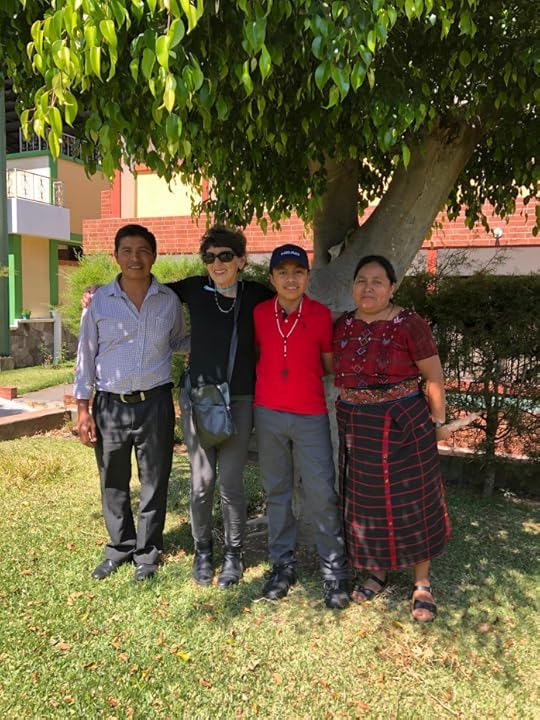
Josué, my “sponsored child,” was an unalloyed delight, as were his parents. Lovely, lovely people. We had an interpreter and a social worker, both of whom could not have been kinder or more helpful. We ate snacks, did a jigsaw puzzle together, the whole bunch of us, finishing literally as lunch was being put down on the table, and in general had a grand old time.
They (who have so so much less than me) bought gifts: a hand-woven mat, several little hand-woven baskets, a green tapestry and a beautiful embroidered red runner, now hanging on my wall, that reads: “Para Heather: Con carino [Love, fondness, tenderness, affection, kindness, concern] de Josue Su Ahijado [Godson].”
The schedule was as follows: up at 3 am to get to the airport on both the departure and return dates. The other days a gathering of some kind, usually a prayer type thing, at 7 am (we had no Ash Wednesday Mass but we did get ashes, distributed by a deacon who happened to be along on the trip), followed by breakfast, a bus ride, a presentation of some sort by the members of various communities (all embarrassingly grateful for our “largesse”) lunch (chicken, rice, tortilllas, beans), another bus ride, another activity, dinner, another gathering, and release by 8 or 9.
When deprived of time alone, my “inner alarm clock,” as I call it, simply wakes me a few hours early so I can gather myself. Which in spite of the attendant sleep deprivation, I appreciate.
We were not allowed under penalty of death to leave the Guatemala City hotel (first and last nights) or compound (in San Lucas Toliman the other four nights) to venture forth on our own.
Thus I learned, as prison inmates do, to “exercise” within the confines of my room. I don’t even do 10,000 steps at home but for some reason I became obsessed with getting them in on the trip. So every spare minute I was jogging in place, or pacing, or striding through the Guatemala City or DFW airport.
I actually like airports. Right away, I make a beeline for the farthest end of the terminal where you can often find an empty gate area or some weird tucked-away corner or a window through which you can hungrily gaze at the world outside.
Dallas/Fort Worth, through which you have to fly basically to get anywhere from Tucson, is so big it has its own zip code (75261), and a very efficient Sky Link train that whizzes you to Terminals A-D. But what I’ve learned is that you can also walk from one terminal to another, which I have come to thoroughly enjoy.
Doing so, this trip I stumbled upon an interfaith chapel at one end of Terminal D. It looks like the waiting room–heaven or hell?–in a science fiction movie with an anodyne “stained glass” window, beige carpet and a loudly ticking clock. I couldn’t have been more grateful or happier. The good folks who run it out of the kindness of their hearts have even installed a couple of free showers, just in case you need a shower.

I spent a good half-hour in there both ends of the trip, clutching my head in my hands and pleading for strength.
No seriously, the whole trip was “good” for me. I went down for the sole reason that Josué had asked in a letter if I would ever want to share a meal with him and his family, so–you bet!
It’s always interesting being in a random group of people as 85% of them consist of married couples with grandchildren. “So do you have children?” they invariably ask.
“Uh…no.”
“Oh! Well…what do you do?”
“Um…I’m a writer. I guess I’m kind of an introspective type. I pray, I walk”…I atone for my abortions…
To that end, what made the trip totally doable and even though I felt imprisoned and couldn’t think, write, take notes, read, walk, drink coffee, or make the mental, emotional and spiritual connections of which my life kind of consists, I conceived of the idea simply to make of my day a (at times, I’m ashamed to say, extremely half-hearted) prayer offering for the group itself, the sainted people who were running the trip, the also sainted mothers, fathers and children who we met each day, and in general the people of Guatemala.
Who, with the exception of a three-or-so year old kid who cornered me one afternoon, fixed me with an icy stare, thrust out his little hand, and said, “Da me el dinero,” were to a person welcoming and warm.
Actually, that kid totally made my day.
Let’s face it, it’s probably the silent plea of everyone in Central America upon seeing a well-nourished white person with a purse and sunglasses.
Also the other people on the trip (there were 25 or so of us, many of them older even than me) were unbelievable good sports. Bright-eyed, bushy-tailed, game for every activity, uncomplaining, cheerful. I am sure this comes from having selflessly raised families and now, caring for their grandchildren.
They were splendid models and, following their lead, I was able to complete the trip without mishap.
Gracias a Dios.
February 17, 2024
WHAT IS A MAN?: REMEMBERING MY FATHER
Here’s how this week’s arts and culture piece begins:
Culturally we’ve been pondering the question: What is a woman? Maybe it’s time to ask: What is a man?
My father — a bricklayer with eight kids — saw the world as a place of mystery and beauty, but that things could go so consistently, abysmally, wrong gnawed at him.
“Doesn’t that get my goat!” he’d rail in the parking lots of grocery stores, spotting a cart left by a careless shopper. “If that thing ever got rolling, it could pick up momentum, barrel right into a 3- or 4-year-old kid…” He shook his head, leaving us to imagine the twitching limbs, the tiny skull bleeding onto the asphalt.
What he was really thinking, I knew, was that the kid would have to be brought to the doctor — and doctors cost money.
READ THE WHOLE PIECE HERE.
WHAT IS IT TO BE A MAN?: REMEMBERING MY FATHER
Here’s how this week’s arts and culture piece begins:
Culturally we’ve been pondering the question: What is a woman? Maybe it’s time to ask: What is a man?
My father — a bricklayer with eight kids — saw the world as a place of mystery and beauty, but that things could go so consistently, abysmally, wrong gnawed at him.
“Doesn’t that get my goat!” he’d rail in the parking lots of grocery stores, spotting a cart left by a careless shopper. “If that thing ever got rolling, it could pick up momentum, barrel right into a 3- or 4-year-old kid…” He shook his head, leaving us to imagine the twitching limbs, the tiny skull bleeding onto the asphalt.
What he was really thinking, I knew, was that the kid would have to be brought to the doctor — and doctors cost money.
READ THE WHOLE PIECE HERE.
February 9, 2024
AMERICAN POET FRANZ WRIGHT
Here’s how this week’s arts and culture column begins:
Franz Wright (1953-2015), Pulitzer Prize-winning poet and Catholic convert, struggled with addiction and depression. He wrote movingly of isolation, illness, and religious transcendence.
His work includes the poetry collections “God’s Silence” (2006); “Wheeling Motel” (2009); “Kindertotenwald” (2011); and “F” (2013). He won the Pulitzer in 2004 for “Walking to Martha’s Vineyard” (2001).
Perhaps most movingly, he never left his watch. Fidelity to an artistic vocation, he demonstrated, is not for the faint of heart.
READ THE WHOLE PIECE HERE.
February 6, 2024
ART IS FOR INCREASING LIFE
From a recent essay in Salmagundi, a literary journal published at Skidmore College.
Thirteen Ways of Looking at ArtWILLIAM DERESIEWICZArt is for increasing life. That, I believe, after all the other purposes receive their due, is really what it’s for—why we revere it, why we give our hearts to it. What do I mean by increasing life? How can we live more, given that we can’t live longer? Through attention and intensity. Being fully present to the world, and feeling without reservation: the two things that making art requires and that experiencing it involves. “Being in love,” Tim Kreider writes, “is one of the only times when life is anything like art,” but the reverse is also true. Art is one of the only times when life is anything like being in love. Attention, intensity…I was listening to Abbey Road the other day. Somewhere between “You Never Give Me Your Money” and “Golden Slumbers,” I finally understood Nabokov’s definition of aesthetic bliss: “a sense of being somehow, somewhere, connected with other states of being where art (curiosity, tenderness, kindness, ecstasy) is the norm.” It is in this respect, and this one only, that art is utopian (and the reason that it gets dragooned for service to political utopias, which are a completely different kind of thing). Art connects us with another world, which has no place in ours. That world is, to use a term at which my reason recoils, the spirit world… Art is a fountain of spirit—that’s the closest I can come to it, though I’m thinking less of water than of magma. There is a crack, somewhere. Something flows, from somewhere. We gather around it; we build temples to it, which we call theaters and museums; we worship its earthly channels, whom we call geniuses; we talk about it endlessly. We may even posit that the thing that our existence is for is art.
Too bad that Deresiewicz recoils from the world of the spirit but, like many such people, he writes more lucidly and clearly of that world than many of us who claim not to recoil…
The whole essay is well worth reading.
Reading it myself, I thought back to Sunday afternoon when, propped up in bed with The Upside-Down World: Meeting with the Dutch Masters, by Benjamin Moser, both arms suddenly shot into the air and I exploded with an exultant “YES!”
Moser was writing of Adriaen Coorte (1665-1707), a Golden Age Dutch artist I’d only just discovered, in another book about the Dutch masters: Thunderclap: A Memoir of Life and Art and Sudden Death by Laura Cumming.
Little is known about many of the artists of this extraordinarily fecund era of Dutch art, and Coorte (1665-1707) is no exception. It’s known that he was poor. He painted “still-lifes”–though the term hardly does him justice–often postcard-sized, often on random pieces of paper (as he apparently couldn’t afford canvas) that, if in his mind passed muster, he might later glue to a piece of wood.
He often arranged a simple grouping of fruit or vegetables on the same stone plinth that, with a background of depthless black, appears in many of his works.
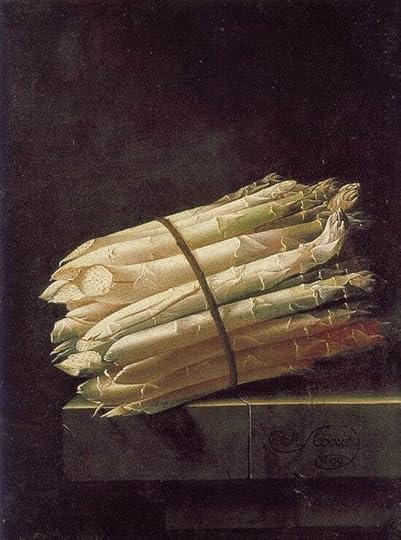 ADRIEAN COORTE, STILL LIFE WITH ASPARAGUS, 1699
This was the passage that caught my eye:
“Back in Zeeland, Coorte continued to sharpen his focus, tinkering with his still-lifes with a concentration bordering on the obsessive. He fiddled with what looks like the same bunch of asparagus–zooming in and out, toying with the lighting, addding, and then removing, a few currants; now trying them out in combination with an artichoke, now with a bowl of strawberries–for no less than eighteen years.”
Eighteen years!
(On a related note, I had to look up the meaning of “fl.”, given as a range of dates in the gooseberries painting above: “from Latin for ‘flourished): denotes a date or period during which a person was known to have been alive or active.” So who knows how long the painting took, or how long Coorte “fiddled” with this masterpiece).
He seemed hardly concerned, as Moser observes, with marketing. Rather, “His intense focus on the bunch of asparagus suggests that his paintings were primarily private attempts to solve aesthetic problems.”
Either you’re the kind of person who thinks that is an entirely worthy project to which to devote one’s life–or you’re not. If you are, you’re probably also the kind of person who, sensing intuitively that beauty and morality are linked, believes that learning how to love one’s neighbor is also a worthy life projecct.
Moser notes that like Bashō, the 17th-century haiku master (quoting Bashō’s translator), “‘sought a vision of eternity in the things that are, by their own very nature, destine to perish.’ Passing time, and therefore death, is the still-life painter’s real subject.”
February 1, 2024
SURRENDER, ON VARIOUS FRONTS
I have now got me a whole stack of Fr. Walter Ciszek prayer cards which I obtained by filling out a form and sending it through the mail with a check, old-school, to the Father Walter Ciszek Prayer League.
There were a few to choose from. I went from the image on the front which kind of doesn’t even look like the one in the photo but no matter. The surrender prayer on the back, especially considering what he went through, both broke and spoke deeply to my own heart. Even after they let him come home from Russia, Father wrote about how he felt a stranger.
THE PRAYER OF SURRENDER BY SERVANT OF GOD FATHER WALTER CISZEK, SJ
Lord, Jesus Christ, I ask the grace to accept the sadness in my heart, as your will for me, in this moment. I offer it up, in union with your sufferings, for those who are in deepest need of your redeeming grace. I surrender myself to your Father’s will and I ask you to help me to move on to the next task that you have set for me.
Spirit of Christ, help me to enter into a deeper union with you. Lead me away from dwelling on the hurt I feel:
to thoughts of charity for those who need my love,
to thoughts of compassion for those who need my care,
and to thoughts of giving to those who need my help.
As I give myself to you, help me to provide for the salvation of those who come to me in need. May I find my healing in this giving. May I always accept God’s will.
May I find my true self by living for others in a spirit of sacrifice and suffering. May I die more fully to myself, and live more fully in you. As I seek to surrender to the Father’s will, may I come to trust that he will do everything for me.
Reading the Rule of St. Benedict this morning, I came across a job that (with the exception of “sensible”), might be perfect for me: The Porter of the Monastery:
“At the door of the monastery, place a sensible old man who knows how to take a message and deliver a reply, and whose age keeps him from roaming about…Let the porter be given one of the younger brothers if he needs help.”
Actually, maybe not, as I’m also prone to roam…still, something to look forward to.
Speaking of old, later in the morning, I received a request for a photo and short bio from a retirement community outside Washington DC. They want to include me in their newsletter, as one of the residents appreciates my work!
I immediately wrote back and asked if they could take care of me when and if I get Alzheimer’s.
They said sure, and way apart from that…yesterday on my walk I was asking myself why on God’s green earth I even maintain this blog and my other stuff. Not to put too fine a point on it, but it’s a ton of work–whether to make myself feel useful or to plant a random give-glory-to-God seed or for my own bloated ego, I have never been able to figure out.
Every time I think of simply giving up and withdrawing to the secluded hermitage where I would not be intruded upon, feel embarassed or exposed or uncertain, and not be exhausted most of the time, a tiny letter from the world that never wrote to me (see the Emily Dickinson poem) floats in.
I think of my own mother, for whom I forever wish I had been more present, who was also in an assisted living facility, and died of Alzheimer’s.
And just for today I figure if one elderly-type person anywhere in the world is consoled by my words, I will keep going, and writing, as long as there is breath in my own increasingly decrepit body.
Check out Fr. Donald Haggerty’s series on contemplative prayer and St. John of the Cross on the podcast Discerning Hearts. I think it’s in this one, but just listen to them all, where he talks about how an abbot completely transformed his monastery by putting his monks under obedience to stop seven times during the day for one minute, and turn their hearts and minds to God.
A Holy Hour, of some kind, is even better–but if we can’t for whatever reason, swing that–anyone can stop for a minute every couple of hours. I think Fr. Haggerty is right that such a simple action would prove transformative.
Finally, God help me, I will be in Guatemala the First Week of Lent. Pray for me.
January 30, 2024
ÉLISABETH AND FÉLIX LESEUR
This week I read Salt and Light: The Spiritual Journey of Élisabeth and Félix Leseur by Bernadette Chovelon.
I wrote about Élisabeth for Magnificat several years ago:
“Élisabeth Leseur (1866-1914) was a married laywoman. Her husband, Félix, a doctor, lost his Catholic faith shortly before their 1889 wedding and became a publicly vocal atheist.
Ironically, the suffering she endured as a result invited her to a deeper exploration of her own, until that point rather conventional, faith. She came to see that enduring the anti-Catholic jibes of her husband, whom she loved deeply, and his friends, could be a hidden form of mortification. “Silence is sometimes an act of energy, and smiling, too.”
But Leseur was no retiring faux-martyr. A lively hostess, she carried out her social duties with grace and good humor. A loyal friend, she carried on a wide-ranging spiritual correspondence– mostly unbeknownst to her husband—for the duration of her marriage.
All the while, she continued to develop a rich and hidden interior life: her collected journals are now widely considered a spiritual classic. Her entry for May 3, 1904, is typical: “Has my life known any unhappier time than this?…And yet through all these trials and in spite of the lack of interior joy, there is a deep place that all these waves of sorrow cannot touch….[T]here I can feel how completely one with God I am, and I regain strength and serenity in the heart of Christ. My God, give health and happiness to those I love and give us all true light and charity.”
In frail health all her life, by July, 1913 she was bedridden by the breast cancer to which she would succumb the following year. In the silence of her heart, she made the decision to offer up all her sufferings for the conversion of her husband’s soul.
After she died, Félix found among her papers a letter she had written to him revealing her fervent prayers that he would turn to Christ and become a priest. Outraged, he set off for Lourdes in the hopes of debunking what he considered to be the crank miracles that occurred there. Instead, he had a conversion experience at the Lourdes Grotto.
Leseur is a powerful example as we walk through a world that so often despises Christ and his Church.
“We must never reject anyone who seeks to approach us spiritually; perhaps that person, consciously or unconsciously, is in quest of the “unknown God” (Acts 17: 23) and has sensed in us something that reveals his presence; perhaps he or she thirsts for truth and feels that we live by this truth.”
“Look around oneself for proud sufferers in need, find them, and give them the alms of our heart, of our time, and of our tender respect.”
“Suffering is the highest form of action, the highest expression of the wonderful Communion of Saints, and that in suffering one is sure not to make mistakes (as in action, sometimes) — sure to be useful to others and to the great causes that one longs to serve.”
As the French say, “Woman’s will, God’s will.” Félix was ordained a Dominican priest in 1923. He spent much of his last twenty-seven years promulgating the writings, and advancing the cause for beatification, of his cherished wife.”
Salt and Light brought out that Élisabeth had suffered almost from the beginning of her marriage from hepatitis and/or other ailments, i.e. she suffered a lot, both physically and spiritually. Still, the book was a little too hagiographic for my taste. I always feel someone is MORE, not less, of a saint if they have massive faults, neuroses, and personality disorders to overcome or, what’s more likely, simply live with till the bitter end. Also, I’m sorry to say that Félix sounded like a real ass. It was hard to imagine him becoming the kind of priest you’d actually like.
Nonetheless, Élisabeth’s insistence on soldiering on (another point her life makes is that you can still suffer with servants, summer homes, good medical care, and travel abroad), keeping her faith mostly to herself so as not to disturb or embarrass her husband, and trying to be loving every moment in the smallest of ways is well-taken.
Maybe I’ll try that last someday!
January 28, 2024
ALWAYS MERCY: A KENYAN HOSPICE
Here’s how this week’s arts and culture column begins:
Always Mercy, a nonprofit, Christ-centered organization dedicated to helping the poor and needy of Kenya, was founded in 2022 by Pamela Boehle-Silva, an RN and a Lutheran deaconess from Rocklin, California.
Rehema Open Door Hospice and Palliative Care Center: the first and only such facility serving 5 million people in the area of Kenya’s Homa Bay, is its main focus.
You can learn more, as well as about the organization’s history, mission, and other projects, at alwaysmercy.org.
It all started in 2006, when Pamela was invited to Africa by the Evangelical Lutheran Church of Kenya. At the time, the continent was in the grip of the HIV/AIDS epidemic.
READ THE WHOLE PIECE HERE.
January 25, 2024
THE CRUCIFIX REQUIRES NO GLOVE
I’ve been struck lately by the fact that Christ makes himself available to one and all. No need to schedule. No phalanx of receptionists, security guards and gates. No need for a resume, letter of recommendation, sterling employment history, or character reference.
There he is, morning, noon and night, in the tabernacle, or exposed–literally, the liturgical rite is called Exposition–in the monstrance.
Anyone can approach. Anyone can touch his wounds. Anyone can spit on him. Anyone can accept, reject, wonder, wrestle, doubt. Anyone can adore.


