
Heather King's Blog, page 15
May 16, 2024
OUR FRIENDS THE INSECTS, WOOLEN WHALERS’ CAPS, AND JAPANESE APPLIQUÉ
I’m going to start introducing some of my zillions of favorite artists (I use the term loosely) in my weekly YouTubes.
This one is on self-taught, 19th-century, deeply Catholic French entomologist Jean-Henri Fabré, who lived in relative poverty, would steal out in the dead of night with his little nets and boxes, collected some of his beloved friends, then spent hours and hours watching and studying them. He wrote a splendid, hightly fascinating book (not academic at all!) called Fabré’s Book of Insects.
While we’re on the subject, as we were last post, kind of, of fabric–
Check out these wonderful photos of Woollen [the British, who apparently translated the site, spell it woollen, while we generally use woolen] Caps Worn by Dutch Whalers at the Rijkmuseum (1650-1800):
From the museum’s website: “In 1980 archaeologists investigated the graves of 185 Dutchmen – whale hunters, and workers at whale oil refineries – who had died on or near Spitsbergen in the 17th century. Many skeletons were still wearing their knitted woollen head coverings. These caps were highly personal. The men were bundled up against the severe cold and could only be recognized by the colours and patterns of their caps. Presumably this is the reason why the caps went with them into their graves.”
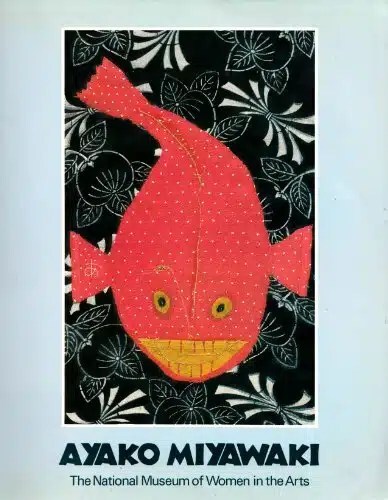
Here’s a Japanese appliqué artist I stumbled upon while searching for boxed notecards:
From the site Mutual Art:
“Ayako Miyawaki is a Japanese artist born in 1905 who lived in the city of Nagoya.
In the early part of her life, Ayako Miyawaki worked as a kimono seamstress. Thanks to this work, she collected many precious textiles, including traditional Japanese garments as well as those from India, China and other countries. Miyawaki began producing her appliqué work in 1945, at the age of 40, after the end of the Second World War. She then decided to do something for herself. Applied work” was the first thing that came to mind. Her husband, Haru Miyawaki, was a painter inspired by Western portrait artists. Common inspirations can be found in both works.
Completely self-taught, Ayako Miyawaki modeled her own creations on objects she observed in nature and at home, using raw textiles such as cotton, dyed with indigo. She used textiles to recreate the things that surrounded her in her daily life. In doing so, she established an original way of making applied art that was revolutionary at the time. She used Japanese patterns from worn-out fabrics, dyed them in bright colors and cut them boldly, without pattern. Her work was both innovative and an interpretation of tradition.”
I’m super wary of using copyrighted images as there are these horrible shyster companies who make their living scanning the internet and purporting to be preparing to sue you for copyright infringement even though they don’t even own the image. And yes, I know about fair use. But if you’re interested, just google Ayako Miyawaki and tons of her lovely work will appear.


May 14, 2024
BE PATIENCE
A month or so ago, realizing that the baking hot Tucson summer was around the corner, I conceived of the idea to purchase a garment or two that might be suitable for months during which the temperature reliably hits 110.
Though this will be my fourth summer here, I hadn’t quite gotten around to acquiring a suitable May-October wardrobe. I make do, to be sure. But my taste runs to monochrome–green-gray, smoke gray, ash gray, lichen, algae, black. I tend “always to be cold” and though, at my age diaphonous is hardly the look to strive for, even I could see I needed to lighten up somehow.
And so, momentarily buoyed by caffeine, I thought to buy a sort of dressing gown, something bright and gay, in which I pictured myself swanning about enjoying the morning sun, answering emails, and researching yet another artist who lived “outside the grid.”
The upshot was that I ordered I guess you’d call it a robe off Etsy from some guy in India. Purcahsed April 18, due to arrive between April 25 and 29. Great! No problem.
I ordered so many books in the meantime that I almost forgot about my exciting sartorial purchase. Suddenly, the other day, I thought, Hey where’s my DRESSING GOWN?? So I went online, tracked the package, and found it had been mailed but had also apparently been stuck somewhere above an ocean for three weeks.
So I messaged the guy, Zahir I’ll call him. “My item was supposed to be delivered by April 29: it’s now May 11 and it’s showing still in transit…somewhere. Is there a problem with the shipping?”
Zahir messaged back several hours later: “I’ll check.” “Thank you!” I messaged back (might as well stay on his good side). “Welcome,” wrote Zahir.
Then I didn’t hear anything for 48 hours. So I wrote back, “Hey there, asking for the second time, where is my item?”
Another day passed. No response.
Unh-oh, I thought, and requested a refund.
This morning two messages arrived. The first read, “Your Parcel Is On The Way Please Wait.” The second said, “Please Be Patience Your Parcel Is On The Way.”
Underneath was one of those little tracking timelines showing “Item shipped May 14!” followed by “Estimated Delivery April 25 to April 29” (i.e. the original estimated delivery dates)–which, if it comes to pass, will be a very interesting time-space inversion…
Be patience. I liked Zahir’s style! Keep your shirt on, girlfriend, I imagined him thinking, the thing’s coming, sooner or later.
Had he been lying on his hammock under his own broiling sun taking a nap all this time and finally realized it was time to shuffle over to his ancient sewing machine and get cracking? Was he taking the robe off his dead granny at that very moment and (I hope) giving it a bit of a wash? Was the poor man so inundated with orders he had difficulty keeping them straight? Did he run a sweatshop staffed by the underpaid and the overworked? (As you can see, I have read far too many subcontinent-based novels).
Was he just moving to a different time-table than me/the generally accepted mores of international commerce/the West?
Whatever the case, I love the idea of my colorful little robe coming all the way, God only knows how, from India to Tucson. I love imagining the life of the guy who’s sending (if not making) it.
Be patience. Your parcel has shipped. The Paraclete is on its way. Wait.
May 11, 2024
HAPPY MOTHER’S DAY: TO MINE AND TO YOURS
Here’s how this week’s arts and culture column begins:
For us solitary types whose lives — like Mary’s — consist largely in “pondering these things in our hearts,” there is seldom room at the inn.
The rest of the world, with its ceaseless activity, gear, heedless noise — all just as it should be — crowd us out, relegating us to some dingy corner where we huddle, fingers pressed to ears, desperately yearning for a moment of quiet where our discoveries and insights and love can give birth.
My own mother, I would guess, in a household of eight kids, was always looking in vain for an inn. I came across her once, sitting on the edge of her and my father’s bed, gazing out the window around twilight and crying. I must have been about 12. “Mummy! Are you all right?”
READ THE WHOLE PIECE HERE.
May 9, 2024
BEGGING PRAYERS FOR UKRAINE
A friend who wishes to remain anonymous periodically shares a newsletter she receives from two of her friends in Ukraine. I’ll call them Daryna and Ivan. The homely details of their lives brings the war there home in a way no news report could.
With permission, I share excerpts from their most recent letter:
Dearest ___, Thank you very much for your letters, congratulations on Easter and prayers to God for us, our cats and our country! We are always sincerely grateful for your love and all the good you do for us. Sorry for not writing for a long time. At the beginning of April, on the Orthodox holiday of the Annunciation, on the night of Saturday on Easter, a downed Russian Shahed drone fell and exploded near our house.
It fell in the yard of a private house, next to the entrance of our apartment building…A big fire started. The blast wave in our house from the side of the driveway knocked out all the windows and glazed balconies. Wooden doors were knocked out on the landings. Our apartment overlooks the opposite side of the house, which was almost unscathed, but the glass in the large three-leaf window in our bedroom was knocked out.
The first time the glass was broken in this window at the beginning of the war in April 2022…Thanks to God, no one was injured in the explosion, but a dog that lived in a private house in the same yard as the fire was killed. In many private houses located near the place where the drone fell, windows were broken, roofs were destroyed, and fences were knocked down. In our garage, which is located next to us, the door came off on one side.
[Humanitarian aid soon arrived, food distributed, re-glazing of windows began]…We thank God that everything worked out! But we don’t know if it won’t happen again…Our area is shelled almost every day…Bombs fall on houses, industrial buildings, near stadiums, parks, where ordinary peaceful people suffer…
The Ukrainian troops are fighting heroically, but one feels tired of the continuous war and the lack of weapons. No one knows what will happen tomorrow, everything is very worrying and dangerous. It has been real spring for more than a month, it is warm and sunny outside, and there is almost no rain. All around is already surrounded by greenery. Fruit trees – cherries and apricots – were blooming very beautifully. This year it was very early, compared to previous years…Pears, plums, and tulips have already bloomed. We also feed yard cats. The black cat survived the winter hard, lost weight. We take care of him as best we can, but every animal wants to have its own home…
Although it is warm outside, there is little joy in the soul, war is very scary. Before the war, we always rejoiced at this time of year, but now there is only anxiety and fear in our hearts…Thank you for the beautiful cards. We always watch and read them with great pleasure. Dear ____, how are you and your and our friends? How is your health? We are always very happy with your letters. Write to us. With gratitude and prayers to you, Daryna and Ivan
It’s almost impossible for a citizen of the U.S. to imagine being invaded by a foreign power; to picture years-long warfare taking place on our soil; to contemplate living in the constant, stomach-churning uncertainty and anxiety of not knowing when and whether a bomb will fall on your LIVING QUARTERS.
Kind of puts my own “problems” into perspective.
Daryna and Ivan are people of deep faith who ask, above all, for our prayers. Might be worth spending a little extra time before the tabernacle.
May 8, 2024
IN CONVERSATION WITH MY FRIEND, THE ACTOR PATRICK KERR
How seldom in this world do we get to “tell our stories!” (I of course have been telling mine for decades)…
Here’s part of the story of my friend Patrick, who has been a working actor all his life. I’ve seen him perform many times over the years, the first time being when I attended an episode of “Frasier” being filmed live in LA…
There’s more about him in the YouTube commentary beneath the video. So if you’re a fan of his, or just curious about the life of a performing artist, have a listen!
May 4, 2024
COME BACK, SHANE!
This week’s arts and culture column is about a movie upon which I reflected briefly several weeks ago. Here’s how it begins:
Based on the 1949 novel by Jack Schaefer, and directed by George Stevens, the Western technicolor “Shane” (1953) is considered a masterpiece by many.
Seventy years on, the movie is still written about, analyzed, and taught in film courses.
Shane (Alan Ladd) is the quintessential outsider: no family, no history, a man of action, and very few words.
He appears at the top of a hill in the wild, wild West, silhouetted against the purple mountains of Wyoming. Loyal Griggs’ cinematography won him an Oscar, while Victor Young’s score speaks of the pioneer spirit, our longing for home, our love for the land.
READ THE WHOLE PIECE HERE.
May 2, 2024
IRISH WRITERS CENTRE SEMINAR MAY 15, 10:30 PST!
Fun coming up!
Memoir Writing Masterclass with Heather KingREGISTER FOR FREE AND THEY’LL SEND A LINK. Q AND A TO FOLLOW. ALL ARE INVITED TO JOIN IN!
Seminar Details In this seminar, Heather King gives an insight into her writing process and practice as well as discussing the questions we may ask as we contemplate writing a memoir.
Heather will consider the following questions and provide you with the answers. How do I start? How do I organise my material? How do I overcome the voices in my head? How do I shape the events of my life into a story? Was I walking with God in those dark places? How do I make time for writing when I have so many other responsibilities?
This seminar is an introduction to Heather King’s Capture Your Life’s Fire memoir writing weeklong workshop at Kylemore Abbey 8-13 September 2024. Join in! There’ll be a Q and A after.
Also, this week’s video: Humorous (kind of) insights at Adoration, plus another favorite spiritual writer, Carlo Carretto…
April 27, 2024
SEEK YE FIRST THE KINGDOM OF GOD
Here’s how this week’s arts and culture column begins:
One of my favorite themes is the vocation of the artist. In fact, I’ve been working on a book about how my life came to be ordered to art: part memoir, part invitation, part supplication to up-and-coming writers.
In a nutshell, my message is this: Figure out a way to earn a humane living, write about what moves you, and pay no attention to passing trends.
Near the end of 2009, for example, I felt that my work was not bearing fruit. I felt like all my efforts to “get my work out there” had come to naught.
One morning, with very little conscious thought, I simply sat down, went to blogger.com, came up with a spur-of-the-moment title, for a header put up the photo of the Jesus statue from Elvis’ bedroom I’d snapped on my Motorola Razr a few years ago at Graceland, and started writing.
READ THE WHOLE PIECE HERE.
April 25, 2024
PASSION HIDING BEHIND ORDINARINESS
“Despite all that is recounted of them, the great truth of the saints was hidden from public view, a truth layered within clefts and crevices, a secret ultimately incommunicable and never fully uncovered. The essential truth of who they were remained enclosed in the silence of their private exchanges with God. Every saint was a contemplative, in other words, carrying on a secret, intensifying exchange of self-giving with God. We never see the fullness of this from the outside.”
“In their caves or cloisters or on noisy city streets, the contemplatives are a hiding place for God. He hollows out in them a secret refuge for his presence. By God’s designs they may often go through life unnoticed except by souls searching for God. It is indeed one of the finer triumphs of religious truth–the fervent desire for God in certain lives that may be largely unobserved, a great passion of soul hiding behind ordinariness.”
–Fr. Donald Haggerty, Contemplative Provocations, pp 166-167
That’s us, right!?
To that end…and under the heading of “Things I Need to Hear Myself”…
April 22, 2024
EXISTENTIAL MUSINGS
A few years ago, a friend turned me on to the satire Twitter account Titania McGrath, a perpetually-aggrieved rich white female (“Activist. Healer. Radical intersectionalist poet. Nonwhite. Ecosexual. Pronouns: variable. Selfless and brave. Buy my books”).
Titania is the creation of Andrew Doyle, a journalist, playwright and comic from Northern Ireland who holds a doctorate in early Renaissance poetry from the University of Oxford and now hosts a weekly show called “Free Speech Nation.”
For a while Titania, outraged as usual (and though white, somehow considering herself black), would have these hilarious posts entitled “Things That Are Racist”–Skyscrapers, Vacuum Cleaners, Knitting, Hair, for example–with links to mainstream publications that were actually spouting such folderol.
The posts were hilarious (and therefore consoling) because I, and probably many other people, were thinking Ha ha, soon these poor humorless souls will find their back to sanity, and we can all look back, together, at this fleeting moment of identity politics gone berserk, have a good laugh, and proceed onward in our collective search for an end to discrimination, goodness, beauty, fairness, decency and truth.
What happened instead is that such thought became institutionalized: baked-in to politics, culture, education, mainstream media, social media, sports, psychology, and health care. Those “Things That Are Racist” posts were no longer so funny because they had become the sea we swam in. Justice for the oppressed came to mean the privileged mouthing culturally-approved (i.e. approved by the elite) rhetoric and platitudes while virulently accusing everyone else of racism (and privilege).
Fast forward to last week’s appointment of Titania McGrath incarnate as CEO of NPR. I generally don’t listen to TV or radio, and have seldom listened to NPR other than a few episodes of “This American Life.
I was however, honored to write and record a few dozen slice-of-life commentaries for “All Things Considered” back in the early 2000s.
It seems unbelievable now but my first piece was about a retreat to a Catholic monastery. Another was about my car breaking down in the middle of the Sonoran desert (this time en route to a convent, for another retreat) and how I pondered St. Augustine’s concept of good vs. evil for three days. In another bit, I reflected on the seeming paradox of why we call the day Christ was crucified “Good” Friday.
I wasn’t ordering anyone to think, behave, speak, or vote a certain way. I was telling stories about my daily life in LA. I was pondering the questions of the human soul. But can anyone possibly imagine NPR running such pieces now?
I try to steer clear of politics but what is happening in our culture–what we are “allowed” to hear, what we are “allowed” to say–is not politics so much as an existential attack on reality, and as such on The Way, the Truth and the Life.
The Holy Father’s prayer intention this month: “In April, we pray with Pope Francis for the dignity and worth of women to be recognised in every culture, and for an end to the discrimination they face in various parts of the world.”
Another related, egregiously unfair, and sad turn of events: the re-writing of Title IX to include “gender identity,” adding biological males to what used to be a womens’ rights law.
Here’s an excerpt from my first book, Parched (2005):
“There were many options for extracurricular activities at Winnacunnet [my Hampton, New Hampshire high school, class of ’70, thank you]–Mathletes, the Winnacarnival Planning Committee–but I became a jock.
I played halfback in field hockey and second base in softball, but it was basketball I lived and breathed for. The names of my college professors, the hotel I stayed in on my honeymoon, the faces of my co-workers from five years ago all escape me, but I still remember the starting lineup from my freshman basketball team. They should have sent us to Vietnam; I’m pretty sure I would have died for those girls.
There’s a photo in my senior yearbook of the team in a huddle, my brow furrowed in such concentration I appear to be on the verge of tears. It was that important to me, the one sacred thing in an adolescence where I would turn out to be otherwise pretty much hell-bent on robbing myself of the capacity for meaning and joy.
Watching, say, the Sparks these days, in their perspiration-wicking miracle fabrics and Nike Airstreams, I see women’s basketball has changed a bit. In that quaintly bygone era, we wore dark blue skirted uniforms, made of a kind of cotton that had apparently been especially designed to trap and hold B.O., and black low-top Converse sneakers that must have weighed five pounds apiece.
Back then, a girl’s team consisted of six players: three each of forwards and guards–two stationary, one “roving.” The stationary guards couldn’t shoot, obviously; plus, you could only dribble three times before passing, which meant that the principal part of a game consisted of a girl pivoting uncertainly back and forth in her dowdy uniform while her teammates yelled, “Noreen! Over here!” or “Di! I’m wide open!”
Altogether, in fact, the game was so slow that a final score of over 20 was considered high (the year I got MVP my score for the whole season was only 99). But of course it didn’t seem slow then, and I was so proud of every one of those points I knew many of them by heart, and often replayed them in my memory as I lay in bed at night or otherwise needed cheering up.
I loved it all: the anticipation on the day of a game; the locker room beforehand, smelling of White Shoulders and Ban; the bus rides to and from away games, where [my best friend] Jill and I held court from the back seat. Basketball was one arena where we could really make our partnership shine.
Jill, a stationary forward, was short and sturdy, a scrapper with a nifty left-hand lay-up. I played roving forward: a ball stealer with quick reflexes and a halfway decent outside shot. Our coach, Miss Ball (not a made-up name), wasn’t one of those short-haired, dykey types. She had an auburn pageboy, smelled of baby powder, and wore cardigan sweaters, placketed with grosgrain ribbon, in soothing, big-sister shades of heather green and periwinkle blue.
Jill and I adored her–she was one of the few teachers who didn’t run the other way at the sight of the two of us together–and though her hair wasn’t even really red, Jill started calling her Carrot Top. We’d be at practice reviewing one of our “plays”–which consisted of, say, half a pass and a lay-up–and from the back of the court you’d hear, “Okay, Carrot Top.” “Get out there and fight, girls,” Miss Ball urged before the opening jump.” “We will, Carrot Top.” Naturally I egged things on by laughing like a hyena every time the words issued from Jill’s mouth.
The afternoon before the final game of the season Miss Ball took me and Jill aside. “You know darn well you two are the best players on the team, and I would have liked to nominate you for next year’s co-captains,” she told us. “I know you’re only fooling around, but the other girls…they have to have people they can look up to, leaders who’ll set an example for them.”
We looked down at the floor and shuffled our feet.
“You know we love basketball, and you’re a great coach…” I offered.
“I’m sorry,” Jill echoed.
“Okay then,” Miss Ball said, putting an arm around each of us. “Dianne and Cindy will be our co-captains. Now let’s all pull together and have a great game.”
“Thank you,” Jill said, and then, softly, “Carrot Top.”
Jill (a pseudonym) died a few months ago–glabioblastoma.
When we talked over the years, we always, always mentioned the halcyon days when we used to play basketball.
Can you imagine if we’d had to play against boys, and with boys? Have boys in the locker room, on the bus, in the huddle with Miss Ball?
It would have wrecked EVERYTHING.


