
Heather King's Blog, page 14
June 13, 2024
BRING ME THE SUNSET IN A CUP
I’ve been perusing my Emily Dickinson poems…
“Oh sacrament of summer days,
Oh Last Communion in the Haze–
Permit a child to join.
Thy sacred emblems to partake–
Thy consecrated bread to take
And thine immortal wine!”
–from Poem 23/130, c. 1859, beginning “These are the days when Birds come back–“
Summer is by far my favorite season. Don’t be alarmed by the breaking-all-heat-records news bulletins from Arizona. Granted, if “the grid” went down, things would get pretty hideous, but my birthday is in July and I’ve always felt most comfortable, most hopeful, most loved when surrounded by air the temperature of amniotic fluid.
Which I just learned is approximately 99.7 degrees.
I learn all kinds of things in fact during my daily siesta. Siestas are one of the real joys of summer in the desert.
After rising between 4 and 4:30 to swill my coffee, pray, sweep, and embark on my morning walk, which because of the heat needs ideally to be finished by 7, then doing housework, more yardwork, admin, 20 min yoga, shower, and writing/editing/making Power Points, answering comments and emails, my daily 15 min call with Blue Cross/Blue Shield (don’t get me started), travel itineraries, etc, and maybe a recovery meeting or a phone call with a friend, or an errand or two, by 1 or so when it’s, say, today for example, 106, believe me a siesta is the sanest, kindest, most sensible, most welcome practice imaginable!
I have my books, phone, snacks and home-made iced hibiscus tea. I have my NYT, Times Literary Supplement, New York Review of Books, Wall Street Journal, Racket News, and Arts and Letters Daily apps. I have Dante’s Inferno (reading a canto each day), a large picture book of Piero della Francesca, St. Exupery’s Wind, Sand and Stars, and critic Richard Deming’s This Exquisite Loneliness: What Loners, Outcasts and the Misunderstood Can Teach Us About Creativity.
I have these two dear Penguin 60s volumes that I found in a free library last week: Rudyard Kipling’s “Baa Baa, Black Sheep” and “The Gardener,” and “The Road Not Taken and Other Early Poems” by Robert Frost. I had never seen or known of this whole series, tiny paperbacks, maybe 4 by 5 inches with the familiar orange Penguin spine, 50-80 pages, of various noted and/or well-loved authors. Travel, poetry, fiction, essay.
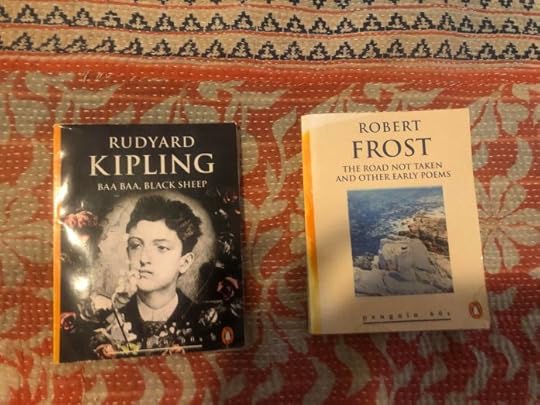
So now I’ve read “The Gardener” as well as several commentaries on it (as I didn’t quite understand the story), and a few wonderful Robert Frost poems, and looked up Rudyard Kipling about whom I really know very little (he lived in Vermont for a time!), and the film noir actress Ruth Roman, and the making of Bad Day at Black Rock (have been on a Robert Ryan kick), and reserved memoirs by Zora Neale Hurston and Stefan Zweig at the library, and figured out what museums I want to visit in Washington DC where I’m headed next week (“Death in Venice” (preparing for fall trip), a biog of Pablo Picasso by one of his many ex-lovers (not sure whether this one killed herself or not), and The Code of the Woosters–for no summer is complete without at least one P.G. Wodehouse–in tow).
Anyway after I catch up on and research and read for a bit, I usu fall asleep, then wake at 3 for my afternoon coffee, bask for a bit in incoherent gratitude, then drive to the Newman Center, install myself before the tabernacle in the Blessed Sacrament chapel for 30-40 min, attend Evening Prayer and Mass, drive home, play the piano for a while and, around 7 or 7:30 set out for a short vespers walk. (Driving to Mass in summer is a concession I have made this year–I used to walk as a kind of combined exercise/penance, but 4:30 pm is probably the vey hottest part of the day so…let’s not be any more insane than we have to be, I tell myself).
By this time, i.e. 7:30, it will have cooled down to the mid-90s with maybe even a slight breeze. The sun is preparing to set, the sky and mountains are achingly beautiful, and most everyone is indoors so this, too, is one of my favorite times of day.
People are always asking “Why don’t you wear a hat?” but NO! I don’t want a hat! I want to feel the sun, the breeze, the heat (or the coolness as the case may be) on my head, and shoulders, and arms. This is another reason I like to sweep and do yard work–I need to get dirty. I need to be embraced by the desert, and vice versa. My day’s never complete unless I’ve been stabbed in the thigh by an agave, extracted a cluster of cactus spines with tweezers from my fingers, or tracked mesquite leaves all through the house.
After that it’s maybe a movie, more reading, Compline, and early to bed (though never quite early enough) as my inner alarm clock will wake me the next morning again at 4 to 4:30.
All around are trees, rabbits, and birdsong.
Heaven. Love summer.


June 10, 2024
IN CONVERSATION WITH THE IRISH WRITERS CENTRE
Last month I had a lovely conversation with the Dublin-based Irish Writers Centre, followed by a Q and A. Here it is! Thank you, IWC! A huge honor.
A sampling of additional questions that participants submitted at the conclusion of the webinair:
Do you limit some of the content of your memoirs to protect yourself or to protect your vulnerability, how do you decide what NOT to put in. Are you ever scared what the people in your life will think of your honesty?
There’s all kinds of stuff I don’t put in—writing in a way is a process of discarding…my fear around writing is that I’m cutting corners or being emotionally dishonest….also, to be a practicing Catholic in a resolutely secular culture, and in which many if not most of my dear friends are resolutely secular, does bring up fear—of being cast out of the herd, marginalized, ostracized, misunderstood, exiled…
In the absence of religion, I think people tend to make politics or some kind of ideology their religion and that for the most part I decline to do this—in particular, to firmly align myself with the “progressive left” stances and causes to which many of my friends subscribe, which I think mystifies and scandalizes a few of them. On the other hand, nor do I align myself with many of the causes to which the Catholic right subscribes—however much I might be in sympathy with the underlying spirit behind causes on both sides of the political divide.
I think I used to try to sort of hide or minimize my faith, but it’s the ground of my life, and as I mentioned, I have come to see that I don’t answer to the world or to my friends (much as I love and admire them), or to the politics, whatever they might be, of my fellow parishioners, or to the world in general, but to Christ…who is a very different Master from the world.
How do you protect the identities of other important individuals in your life?
I guess I try not to write anything much that would need protecting…I have definitely used pseudonyms or tweaked the details of a story—time, place, identifying characteristics—so the person would be unrecognizable…
I am just wondering how one can manage to create an honest memoir without damaging/making angry other people who may be involved? ie, do you worry about the reception the work may receive among those who know you once you have let a work enter the world?
Yes, definitely, I do or have worried. A lot of what I do is celebrating the other person, whether it’s a family member, a friend, an artist…then again, people can even be bothered by that, I sense…believe themselves to be inaccurately portrayed. At some point, you have to let others have their feelings and allow yourself to have a clean conscience by knowing that you wrote from love and from the most truthful place you could get to in your own heart.
Thanks for sharing so openly. I wonder could you speak a little about how you handle deadlines and external pressures?
A life grounded in prayer and as I mentioned a sense of obedience—to the call of writing, to a sense of courtesy and respect for the people for whom I write. Also I’m just a driven, Type-A (in many ways) personality who cannot bear the anxiety of not honoring my commitments and agreements…
Another dicernment and fine-line question. How do we decide between what we wrote about and that which we ponder in our hearts. Do you feel like there are things too sacred to be shared or put into words?
Great question: Absolutely. In fact, what I write is about 2% of my true inner life. I would no sooner write about or expose that to light than I would describe what went on in my (ex-ha ha) marital bedroom. (If I could even reduce my inner life to writing, which is doubtful). From Fr. Donald Haggerty’s “The Contemplative Hunger:” “Only the beloved can know the passion of love that another soul possesses for it. When this love is a contemplative passion for God, it penetrates beyond the ordinary boundaries of separation between persons. The union has no limits, and this truth of endless encounter with God is the ongoing taste of the secret spoken to God by the soul.”
Certain people tend to think they “know” me because of the way I write and I always want to say, Oh you have no idea. Especially no idea how truly awful and crabby and impatient I can be.
What do you think of adding photographs to memoir?
Absolutely, all for it if you have pix that fit and will add to the story!
When you have “finished: “your memoir where/what do you do with it?
Publish or self-publish it!
I would like to write a memoir about illness, misdiagnosis and divorce and what I learned/experienced. There is some dark and light. I wonder does the reader have to learn something from the memoir or is the story about what happened enough?
I think what the reader “learns” is inherent in, baked into, the writing itself; into the way we tell our story. We don’t want to telegraph a platitude-like “message.” The way we write about our experience, no matter how dark, would ideally, to my mind, also have at least a pinprick of light….
I don’t agree with Heather that memoir is DARK… the act of writing is cathartic and healing, helpful to my acceptance of my very human life.
I don’t believe I said memoir is DARK; I said memoir often (but not always) stems from some kind of trauma. I hope my presence, the way I talk, write, express myself, gets across my essential gratitude and joy—I wouldn’t write at all, and would certainly have not stayed the course this long, if I did not believe writing to be essentially life-giving….and a great, great gift and grace.
Also I think I forgot to mention that I have a new book in the works: CONSUMED: The Joys, Sorrows and Débacles of the Writing Life. Most of the issues we discussed here are covered in the book, which also includes profiles of a number of my favorite artists.
Look for it late summer—and again, thanks to Betty, Claire and all of you so very much for having me.
June 7, 2024
THE UNCLAIMED: ABANDONMENT AND HOPE IN THE CITY OF ANGELS
Here’s how this week’s arts and culture column begins:
A few years ago, starting to contemplate my death and burial, I happened upon a cemetery in a small Central Coast town where I have friends. I called one day to inquire about the cost of a plot and the guy who answered could not get his mind around the fact that I didn’t live in the town, nor had I grown up in the town, nor did I have any particular ties with the town other than having visited it over the years. Finally he could no longer hold himself in. “Ain’tcha got no FAMILY?” he blurted.
Well, like many of us, yes and no. Let’s just say I read “The Unclaimed: Abandonment and Hope in the City of Angels” (Crown, $30), by Pamela Prickett and Stefan Timmermans, with special attention.
READ THE WHOLE PIECE HERE.
Also, here’s this week’s video: part of a new series on some of my favorite, often little-known, memoirs.
June 4, 2024
SO THAT YOUR JOY MIGHT BE COMPLETE
If there’s one overarching sign of our cultural spiritual bankruptcy, it has to be the complete lack of joy.
Joy, in fact, is now suspect. It indicates that you have in your head in the sand, that’s you’re not sufficiently aware; that you don’t see the world as a place of darkness, evil, and the good guys (you and your political allies) vs the bad guys (everyone else).
In a recent NYT op-ed, for example, Margaret Renkl describes reading Annie Dillard’s “Pilgrim at Tinker Creek” decades after its publication. She’d adored it the first time, but–
“The second time around, “Tinker Creek” raised some of the same issues for me. Reading it as a 62-year-old, it turns out, is entirely different from reading it as a language-besotted college student just learning that writing like Annie Dillard’s could exist in living time, as indelible as any line by Shakespeare or Keats or Dickinson.”
“The features of the book that make me cast a sideways glance today — the specific circumstances of privilege, or just the good luck, that make it possible for a young woman to feel confident wandering alone in even a suburb-skirting woodland, for instance — ought to have made me cast a sideways glance in 1980, too, though they did not. I was also a young woman who knew so little of the human world that I still felt safe walking alone in the wild one.”
Give me a pre-paid break. So Annie Dillard was supposed to preface her 1980 book with an apology for being white, a renunciation of her “privilege,” and a caveat that walking in a suburb-skirting woodland was a perilous undertaking for any young woman who didn’t happen to be young and blond? And in 1980 we, the readers, were suppposed to have noticed all that, begrudged her safety, and besmirched the book?
What world is this where we spend our time tearing down everything that is good and smearing every work of art with this bizarrely paranoid, revisionist overlay?
When did it become perilous (or when did we begin to perceive it as perilous) to walk in a suburb-skirting woodland, or an urban alley, or a trail through the desert anyway?
When did we go from willingly assuming a certain amount of risk as our joy-infused birthright–and then celebrating the walk, describing the walk, sharing the discoveries we made on the walk–to this outlandish claustrophobia?
What is Renkl’s point even? That only white people can take a walk without fear of danger? That “the human world” is such in such an apocalyptic state that no-one can? All I know is that the cultural elite can hardly read a freaking book any more without pursing their lips, applying the lens of identity politics, and decades or even centuries after the fact declaring the work (inevitably) unenlightened, racist and -phobic something or other.
I started to re-read “Tinker Creek” a year or so ago and found it kind of overblown (as did Renkl)–but to judge a piece on its merits vs. through an ideology are two very different things…
Lack of joy requires no work, no sacrifice, no creativity, no real thought. It’s like a virus that seems to infect through the news, social media, the general zeitgeist in which almost imperceptibly people becomes the enemy, the adversary, the other…
I am hardly a sunny type by nature but I have not (yet) become too paranoid to take a simple walk, nor so swayed by popular prejudice that I can’t enjoy a book of the time and place it was written, nor so suffused with guilt that I have to go about apologizing for existing. The Lord knows I have plenty else to apologize for, but my existence, again, I celebrate–in fear and trembling!
It’s a huge gift that the two places where I spend much of my time–church and recovery circles–are suffused with the Resurrection.
Daily I see light shining in the midst of darkness, broken lives beginning to be made whole, humor defeating despair, random acts of kindness, the fruit of humble, contrite hearts (usually with lots of swearing), prayer in action. We leave politics, ideology and outside issues at the door and deal, in the roughest, most seemingly ordinary, humdrum ways with our spirits, our consciences, our hearts and our souls.
We try to get rigorously honest, we make direct amends to the people we’ve harmed, we develop a relationship with a Power greater than ourselves.
And it’s all so interesting and ever-unfolding and absorbing that I’m often brought up short by the viewpoint of much of the rest of the world.
Then again, of course, I’m utterly blind to my own biases.
“What do you want from me?” Christ asked.
Help me to see.
Not through rose-colored glasses: Christ came to bring a sword.
But clearly. With eyes guided by love.
Because he also came so our joy might be complete (John 15:11).
June 1, 2024
THE LUMINESCENCE OF MEMORY: PHOTOGRAPHER BINH DANH
Here’s how this week’s arts and culture column begins:
“The landscape is what defines me. When I am somewhere new or familiar, I am constantly in dialogue with the past, present, and my future self. When I am thinking about landscape, I am thinking about those who had stood on this land before me. Whoever they are, hopefully, history recorded their markings on the land for us to study and contemplate” — Binh Danh, Vietnam-born American photographer
Born in a South Vietnamese village during the Vietnam War, Binh Danh has an MFA from Stanford and teaches at San Jose State University.
Saigon fell on April 30, 1975. In the wake of the Communist takeover, his family — mother, father, older brother, two older sisters, and assorted relatives on his mother’s side — fled Vietnam for a Malaysian refugee camp on the island of Pulau Bidong. There they stayed for nine months, a period of which Danh, a baby at the time, has little memory.
READ THE WHOLE PIECE HERE.
May 30, 2024
PERSECUTOR OR VICTIM?
One handy way to take my spiritual/emotional temperature is to ask: Who do I resent? Whether it’s people, places, or institutions–who or what do I resent?
I’ve been mulling this over a lot recently because, three years into this “new” leg of the journey in Tucson, I find that certain people still rise up in my consciousness, often many years after the fact, who I feel did me wrong over the 30 years I lived in LA.
I’ve been taking these people one by one, dedicating to each my prayers, works, joys and sufferings for a day. Really sitting with the person for a bit. Trying to “feel” him or her in a sense instead of myself.
And what’s been fantastic is that I see more and more clearly how very often I had placed myself in a position to be hurt. I was renting a place because it was cheap and I was afraid to pay more and inevitably there were landlord and/or neighbor problems. I was desperate for connection and love and I tried to insinutate myself into the lives of people who were clearly incapable of valuing me, just as I wasn’t truly valuing them. I showed up at places and to people from whom I could get a little bit of a free ride (totally of course hiding this from myself).
In fact, a lot of my stuff, historically, has to do with money fears–understandable, perhaps, as a single woman trying to make my way as a creative writer. But to understand isn’t to overlook or to refuse to see.
I took things personally. I had expectations. I was often blind to the fact that even when my motives are good, I often try to run the show.
I keep thinking of my late friend Dennis. Dennis had been shot in a convenience store holdup when he was 18 and lived in a wheelchair, a paraplegic in chronic pain, till he died at 64 or so. They never caught the guy who shot him.
I once asked him how he dealt with the resentment. He replied, “My body’s shit; I can’t afford to let that happen to my spirit. That guy was doing what he was supposed to be doing that day, and I was doing what I was supposed to be doing.”
And really, isn’t that just about always the case? People are just going about their business, doing the best they know how (just as I am), and it’s in the nature of the human condition that we step on each other’s toes now and then. Especially if you happen to have put yourself where you don’t belong.
Also I read an essay called “We Do Not Come in Peace” the other day by Cynthia L. Haven, who was a friend and is a scholar of René Girard, the late mimetic desire/scapegoat theory philosopher.
An excerpt:
“After [a talk Girard gave many years ago at Stanford], one man asked a provocative question: “Given that we can’t entirely trust the veracity of ancient writings, how would you measure the success of your theory?”
Girard’s answer was a thunderbolt in its directness and simplicity: ‘You will see the success of my theories when you recognize yourself as a persecutor.’
That is not where most people begin. Yet there is nowhere else to begin.”
You will see the success of my theories when you recognize yourself as a persecutor.
That is always where and when the welcome truth dawns. If I’m really honest: Who was the persecutor, and who was the victim? As I go about my day, in my thoughts, words, and actions–who is the persecutor and who is the victim?
Let’s just say it’s no accident we begin the Holy Sacrifice of the Mass with the Penitential Rite.
In fact, my worst resentments aren’t necessarily against those who did me the most harm (insofar as these things can be measured): they’re against people around whom I acted badly in response to the perceived harm. Any time (admittedly seldom) when I was able to turn the other cheek, or exercise restraint of tongue and pen, or just keep walking with a more or less unclouded heart–those resentments in my experience tend to dissolve over time fairly quickly.
The times I made myself look bad, or exposed my vulnerability, in other words, are what really rankle.
Anyway, food for thought. As G.K. Chesterton responded when asked, “What’s wrong with the world?”: I am.
So let’s let everyone off the hook, for a day at least.
Meanwhile, this week’s entry in my Personal Communion of Artist Saints: Donald Evans, the King of Postage Stamps.
May 27, 2024
CLIMBING MOUNT SISYPHUS
“If a man settles in a certain place and does not bring forth the fruit of that place, the place itself casts him out, as one who has not borne its fruit.”
–Anonymous 4th-century desert father
I’ve come to love Tucson and its somewhat extreme weather.
When it’s not either baking (June, July, August and September) or freezing (December, January and February), the wind blows.
Because the front yard, the back yard, the side cabana and the sidewalk median in front of my house are planted with old-growth mesquite trees, this means that I spend much of my life sweeping. In fall, the tiny oval leaves fall off: bushels accumulate. In spring, the catkins drop: bushels.
Sweeping and raking. Sweeping the front walkway, sweeping the sidewalk, sweeping the front patio, sweeping the back patio, sweeping the hallway because with all that sweeping, raking, and hauling to the trash, I also endlessly track minuscule bits of plant material all through the house.
No matter how much I sweep, every few months, two to three inches of tree detritus accumulates. The back yard has a kind of patio area of old brick, each of which has three holes in it that act as magnets for the maddening debris. BRISK sweeping is required there! I’ve tried vacuuming. I’ve tried hosing. Neither method works very well and both use natural resources I’d just as soon conserve.
I guess most people use leafblowers but a leafblower to me is a manifestation of the anti-Christ. I would never, ever impose that barbaric demonic noise on another human being. I’m surrounded by neighbors on all sides who think nothing of imposing it on me, but all rhe more reason to refrain myself.
I’m a renter and a species of yard guy comes with the place but to his and my landlady’s everlasting credit, they eschew leafblowers, too, and the tree debris removal in any event falls to me.
I don’t really mind except that this year the trees have been raining down their sloughed-off waste at such an unrelenting clip that I actually starting having anxiety dreams, as in will the task overtake me; come to dominate my life?
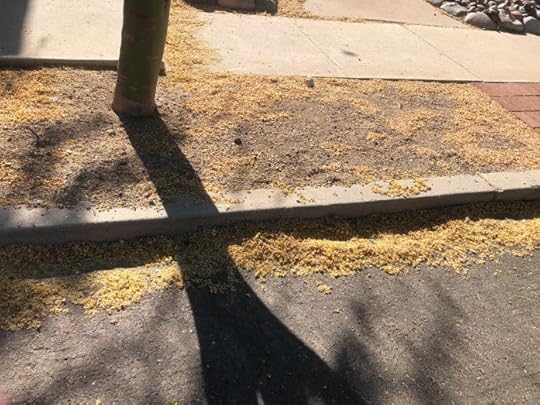 NIGHTMARE!
DID I MENTION I HAVE HAY FEVER?
Lately, though, I’ve been thinking about an artist whose obit I’d read a couple of years ago: Daniel Brush, a NYC jeweler/sculptor I will write more fully about at another time but who lived in a giant former sewing factory loft and spent up to five hours a day sweeping. (He also ate the exact same thing ever day: a bowl of Cheerios for breakfast and a bowl of pea soup in the afternoon).
I thought of him especially yesterday morning as I had gotten out front early to begin the day’s portion of my Sisyphean task. (My street is a direct and popular route to the nearby park where half of Tucson apparenty walks their dogs so the sidewalk needs tidying up every day even under the best of circumstances).
I’d decided to attend 5 pm Mass and I didn’t have anyplace to be till noon so I wasn’t rushed as I often am, or feel, when sweeping: trying to squeeze the task in so I can get to my desk. No, I took my time. The morning air was a caress. It was Sunday and people were sleeping in, so silence reigned.
And all of a sudden I realized how much I, too, LIKE sweeping. It’s only onerous when I think I should, or want to be, doing something else. It only seems like a Sisyphean task when I’m tired and in a hurry and thinking that the leaves and debris are my ENEMY.
I thought how lucky I am that I can even stand up straight, and walk, and bend down and that all that bending down to bag the stuff was actually good for my knees and back. I thought how lovely it was to clean leaves the old-school way, without the aid of a gasoline-powered device that fouled the birdsong and set my neighbors’ teeth on edge.
I took my time and after a while my mind started wandering to pleasant, interesting topics such as how to make a spicy peanut sauce, whether I should fly to NY for a week in August, and what to include in my upcoming talks on the Vocaton of the Artist.
The upshot was that I began wondering if I couldn’t work in a half-hour of sweeping as a kind of daily meditation, so that it would be something I look forward to instead of a pesky task. (I mean even now I kind of look forward to it but again, not if I’m trying to squeeze it in on my way to something else/better).
So that’s my little reflection on this day on which we remember all the fallen soldiers, and the family and friends they left behind.
I’m not sure if this short piece has a paywall, but it made me cry.
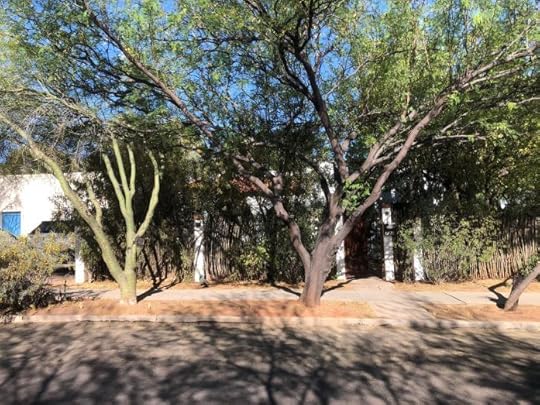 POST THIS MORNING’S SWEEP: LOOK AT THAT SHINING CURB! I DID MY NEIGHBOR’S TOO, AS HE AND HIS WIFE MUST SUFFER THE FALLOUT FROM MY MESQUITE TREES.
May 25, 2024
BISHOP ERIK VARDEN’S “CHASTITY”
Here’s how this week’s arts and culture column begins:
Erik Varden is a Norwegian Trappist monk and the bishop of Trondheim.
His newest book, “Chastity: Reconciliation of the Senses” (Bloomsbury Continuum, $22), came out earlier this year.
Varden has a doctorate in theology and religious studies from Cambridge and a licentiate of sacred theology from the Pontifical Oriental Institute in Rome. He speaks several languages.
“To do something beautiful for its own sake,” he writes, “for the intrinsic delight of it, without thought of gain: this, I’d say, is a way of beginning to live chastely in this world, poised to balance elegantly on whatever surging billow providence provides as a means to bear us homeward, towards the shore.”
“Surging billow,” in my own experience, might be pressing the point.
READ THE WHOLE PIECE HERE.
May 21, 2024
THE GLORY OF WORK IN DEATH VALLEY JUNCTION
“And I saw that there was nothing better for a man but to rejoice in his work; for this is his lot Who will let him see what is to come after him?”
–Ecclesiastes 3:22
I’ve written of Marta before and am thinking to introduce her to those who aren’t acquainted.
I am off to Santa Rita’s Abbey (cloistered Cistercian nuns) for a few days of silent reflection.
Blesssed Pentecost!
May 18, 2024
BAD THERAPY: WHY THE KIDS AREN’T GROWING UP
Here’s how this week’s arts and culture column begins:
“Bad Therapy: Why the Kids Aren’t Growing Up” (Penguin Random House, $30) has become an instant best-seller.
Author Abigail Shrier, an LA-based investigative journalist, also wrote “Irreversible Damage: The Transgender Craze Seducing Our Daughters” (Regnery, $26). Her new book promises to be equally controversial.
Basically, says Shrier, the kids aren’t growing up because — with urgent encouragement from the pharmaceutical and mental health industries — they’ve been hovered over, catered to, coddled, protected, consulted as to their preferences, accommodated to within an inch of their lives, shielded from all risk, and medicated to the gills since practically the moment they exited the womb.
READ THE WHOLE PIECE HERE.


