BRIGHT FIELD
My time at the Glendalough Hermitage has been rich. I’m surrounded by trees. The air is fresh and cool–balm after July in Tucson. The phenomenon at daybreak isn’t so much that the sun comes up as that the sky lightens–generally to atmospheric mist, fog, and gloom. Having grown up in New England, the whole setup feels utterly familiar and homey.
The one problem is that it’s hard to take a decent photo because the light’s always so low. One thing the West, Southern California in particular, has going for it is that the light is so gorgeously perfect that just about any image you capture looks gilded and radiant.
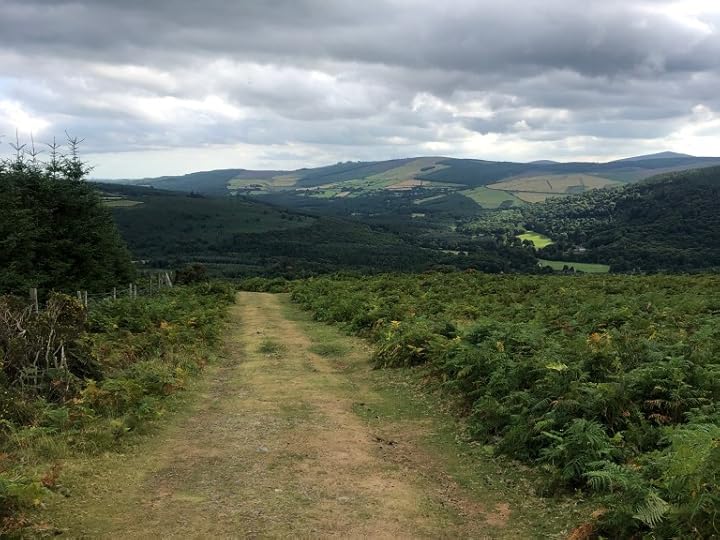
One day last week I tramped through a dark wood, up a very steep hill, and around a couple of bends and came out at the edge of meadows and meadows full of…could it be?…I was pretty sure…heather! I’ve never seen my namesake flower growing in the wild so this was a rare thrill.
The path continued on into an emerald green valley filled with grazing sheep. I mean the path went right through them! In fact, everywhere in Ireland, or this part of Ireland, are grazing, bleating, docile, dear sheep. They lend a whole aura of bucolic simplicity and tenderness to the place. (Though I did see a big sign the other day that said iI your dog “worries” my sheep, I think was the term, I will shoot the dog on sight. I was glad I didn’t have a dog).
Basically every one has been very nice. The Sisters of Mercy here at the Hermitage, bus drivers, store clerks. Some other locals clearly have adopted as a point of honor the overt snubbing of tourists, but such is life. As always, I find old men are THE kindest and most gallant.
Wifi and cell reception are spotty, even in the Coach House, where the wifi is supposedly centralized, but again so be it.
Yesterday I took a little field trip to Wicklow Town on the local bus link. There I visited among other things, the Wicklow Gaol
“The Gates of Hell” the interactive exhibit dubs the place, and that’s no exaggeration. The first prisoner was a 72-year-old Catholic priest, arrested for celebrating Mass, and many of the others were also there for the crime of “Pope-worship.” Other heinous trangressions included homelessness, petty thievery, and the inability to pay taxes.
The museum takes visitors through the 1798 Rebellion, through the 1820-1843 expansion of the prison, through the 1840s Famine, 1860s reform, the shipping off of convicts to Australia and “the Colonies,” eventual reform and the departure of the last prisoners in 1924.
After entering the low-ceilinged stone cells, tramping the bleak stairwells, and learning how the pre-reform prisoners were treated–branding, mutilation, flogging, solitary confinement, insane overcrowding, the (clearly sadistic) “traveling hangman”–you begin to wonder why the British during those times aren’t classed with the Germans during the Nazi regime.
When I got to the torture chambers, I had to bolt. So much suffering, so much evil. I just couldn’t take it.
Afterwards, though, sitting by the Leitrim River with a coffee and watching the seagulls, I thought of Mary at the foot of the Cross. She took it. She received it all. She watched her beloved son publicly scourged, spat upon, humiliated, tortured to death. I thought, too, of the Stations of the Cross and of how the Eighth Station is “Jesus Speaks to the Women.” Right before he falls for the third time, is stripped of his garments, and is nailed to the Cross, Jesus spoke to the women.
Womanhood is very much under siege these days, and in ways that are far more oppressive, darker, and chaotic than any ever imposed by the mere “patriarchy.” Woman…womb. And everything in us, on everly level, is ordered to this stupendous, glorious capacity to bring new life into the world. Part of our cross, our crown, our essence, it seems, is this very call to bear witness. To look reality in the eye. To absorb, receive, the darkness of what men will do to not just to women, but to each other.
I need to ponder this more.
Meanwhile I woke at 3:48 am this morning. After a couple of hours I could begin to make out the trees.
R.S. Thomas (1913-2000) was Welsh, not Irish. But I came across this poem in a book here and it summed up not just thist trip, but more and more I see, my life.
BRIGHT FIELD by
R.S. THOMAS
I have seen the sun break through
to illuminate a small field
for a while, and gone my way
and forgotten it. But that was the
pearl of great price, the one field that had
treasure in it. I realise now
that I must give all that I have
to possess it. Life is not hurrying
on to a receding future, nor hankering after
an imagined past. It is the turning
aside like Moses to the miracle
of the lit bush, to a brightness
that seemed as transitory as your youth
once, but is the eternity that awaits you.