
Kenneth C. Davis's Blog, page 67
June 12, 2016
Don’t Know Much About the Lovings
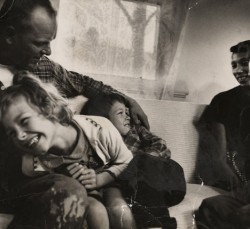
The Loving Story Photo by Gray Villet (Source: HBO)
[Revision of an earlier post]
Nearly one year ago, the Supreme Court made it historic ruling in two cases related to marriage equality (“Highlights from the Supreme Court Decisions on Same-Sex Marriage,” New York Times). But it is worth revisiting the facts in the case of Loving v Virginia –decided by the Supreme Court on June 12, 1967. The case involved the law in Virginia, and other states, which prohibited interracial marriage, or “miscegenation.”
Loving v. Virginia changed that. And America.
Richard Loving, a white man, married Mildred, a 18-year-old woman of African-American and Native American descent, in Washington, D.C. When they returned to their native Virginia, they were arrested in the middle of the night and the Lovings were forced to leave Virginia. A few years later, young Mildred asked Robert F. Kennedy, the new Attorney General, for help. He suggested the American Civil Liberties Union and she wrote to them. Two young lawyers decided to take the case. They brought suit which eventually found its way to the Supreme Court
The Court ruled that anti-miscegenation laws, such as those in Virginia, violated the “Due Process Clause” (“No person shall be … deprived of life, liberty, or property, without due process of law….” ) and the Equal Protection Clause of the Fourteenth Amendment (“nor shall any State deprive any person of life, liberty, or property, without due process of law …”). In the unanimous majority opinion, Chief Justice Earl Warren wrote:
“Marriage is one of the ‘basic civil rights of man,’ fundamental to our very existence and survival.”
Change in American history is often slow. And it usually comes from the bottom up –not the top down. Whether it was abolition, civil rights, or even independence itself, when it comes to most of the great social upheavals of our past, the politicians and “leaders” have generally had to be dragged kicking and screaming in the direction of change. It may be glacially slow, but it will happen, in part because there is a generational change that will someday make the existing same sex marriage prohibitions on the books seem as antiquated –and despicable—as the now-unconstitutional bans on interracial marriage.
Before her death in 2008, Mildred Loving, the woman of African-American and Native American descent who brought the suit against Virginia, issued a statement on the 40th anniversary of the decision. She wrote:
“Surrounded as I am now by wonderful children and grandchildren, not a day goes by that I don’t think of Richard and our love, our right to marry, and how much it meant to me to have that freedom to marry the person precious to me, even if others thought he was the ‘wrong kind of person’ for me to marry. I believe all Americans, no matter their race, no matter their sex, no matter their sexual orientation, should have that same freedom to marry. Government has no business imposing some people’s religious beliefs over others. I am still not a political person, but I am proud that Richard’s and my name is on a court case that can help reinforce the love, the commitment, the fairness, and the family that so many people, black or white, young or old, gay or straight seek in life. I support the freedom to marry for all. That’s what Loving, and loving, are all about.”
The January/February 2012 issue of Humanities magazine featured the Lovings as did a recent HBO documentary, The Loving Story.
There is a more complete discussion of the history of the Lovings, their case and its connection to the same sex marriage debate in the new, revised edition of Don’t Know Much About History: Anniversary Edition.
Don’t Know Much About® History: Anniversary Edition (Harper Perennial and Random House Audio)


June 9, 2016
“Top 10 Political Conventions that Mattered Most”
Most of the drama is already gone from both parties’ presidential nominating conventions. That could change. But here’s a quick history of some of the most dramatic and important political conventions of the past.

Meeting of the Southern seceders from the Democratic Convention at St. Andrew’s Hall, Charleston, South Carolina, April 30, 1860. Illus. in: Harper’s Weekly, (1860 May 12). (Library of Congress)
National conventions, once riveting political theater that held America in suspense for days, have been reduced to a made-for-television, political promo for the two parties. Since primary elections now routinely determine the candidates, this quadrennial dog-and-pony show offers a ho-hum pageant, in which windy speeches are delivered, party platforms hammered out and often ignored, and delegates don silly hats and hold up handmade signs extolling the virtues of candidates, causes and home states. Once the scene of bare-knuckle politicking and backroom deals, the modern conventions now provide comforting tableaus –full of sound and fury, but mostly signifying nothing.
–The Top 10 Political Conventions That Mattered Most
Excerpted from this 2012 article at Smithsonian.com
Read more: http://www.smithsonianmag.com/history...
Follow us: @SmithsonianMag on Twitter
May 26, 2016
Memorial Day, Poppies, and “In Flanders Fields”
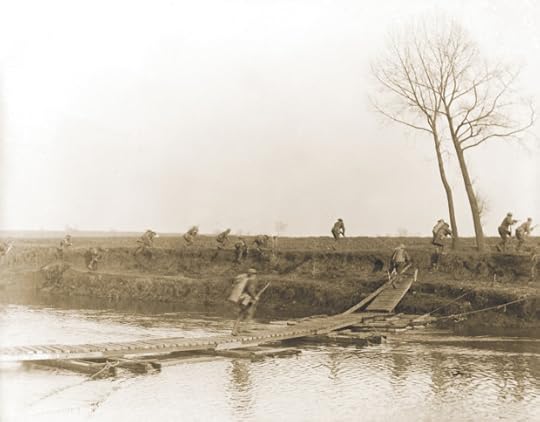
Soldiers of the 146th Infantry, 37th Division, crossing the Scheldt River at Nederzwalm under fire. Image courtesy of The National Archives.
One of the most famous symbols of the sacrifice and loss we mark on Memorial Day is the Poppy, inspired by this World War I poem, “In Flanders Fields,” written by John McCrae.

John McCrae, a Canadian doctor and teacher who is best known for his memorial poem “In Flanders Fields,”
In Flanders fields the poppies blow
Between the crosses, row on row,
That mark our place, and in the sky,
The larks, still bravely singing, fly,
Scarce heard amid the guns below.
We are the dead; short days ago
We lived, felt dawn, saw sunset glow,
Loved and were loved, and now we lie
In Flanders fields.
Take up our quarrel with the foe!
To you from failing hands we throw
The torch; be yours to hold it high!
If ye break faith with us who die
We shall not sleep, though poppies grow
In Flanders fields.
Source: The poem is in the public domain courtesy of Poets.org
“Soon after writing “In Flanders Field,” McCrae was transferred to a hospital in France, where he was named the chief of medical services. Saddened and disillusioned by the war, McCrae found respite in writing letters and poetry, and wrote his final poem, “The Anxious Dead.”
In the summer of 1917, McCrae’s health took a turn, and he began suffering from severe asthma attacks and bronchitis. McCrae died of pneumonia and meningitis on January 28, 1918.” (Poets.org)
Inspired by McCrae’s poem, an American woman, Moina Michael originated the idea of wearing red poppies to honor the war dead. She sold poppies with the money going to benefit servicemen, and the movement caught on, spreading to Europe as well. In 1948, Moina Michael was honored for founding the Poppy Movement with a red 3 cent postage stamp.
May 25, 2016
The Divisive & Partisan History of “Memorial Day”

(Revise of 2015 post)
It is a well-established fact that Americans like to argue. And we do. Mays or Mantle. A Caddy or a Lincoln. And, of course, abolition, abortion, and guns.
But a debate over Memorial Day –and more specifically where and how it began? America’s most solemn holiday should be free of rancor. But it never has been.
Born out of the Civil War’s catastrophic death toll as “Decoration Day,” Memorial Day is a day for honoring our nation’s war dead.
Waterloo, New York claimed that the holiday originated there with a parade and decoration of the graves of fallen soldiers in 1866. But according to the Veterans Administration, at least 25 places stake a claim to the birth of Memorial Day. Among the pack are Boalsburg, Pennsylvania, which says it was first in 1864.( “Many Claim to Be Memorial Day Birthplace” )
And Charleston, South Carolina, according to historian David Blight, points to a parade of emancipated children in May 1865 who decorated the graves of fallen Union soldiers whose remains were moved from a racetrack to a proper cemetery.
But the passions cut deeper than pride of place.
From its inception, Decoration Day (later Memorial Day) was linked to “Yankee” losses in the cause of emancipation.
Calling for the first formal Decoration Day, Union General John Logan wrote, “Their soldier lives were the reveille of freedom to a race in chains…”
Leader of the Grand Army of the Republic, Logan set the first somber commemoration on May 30, 1868, in Arlington Cemetery, the sacred space wrested from property once belonging to Robert E. Lee’s family.( When Memorial Day was No Picnic by James M. McPherson.)
In other words, Logan’s first Decoration Day was divisive— a partisan affair, organized by northerners.
In 1870, Frederick Douglass gave a Memorial Day speech in Arlington that focused on this division:
We are sometimes asked, in the name of patriotism, to forget the merits of this fearful struggle, and to remember with equal admiration those who struck at the nation’s life and those who struck to save it, those who fought for slavery and those who fought for liberty and justice.
I am no minister of malice. I would not strike the fallen. I would not repel the repentant; but may my “right hand forget her cunning and my tongue cleave to the roof of my mouth,” if I forget the difference between the parties to that terrible, protracted, and bloody conflict.
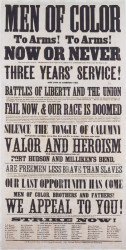
But the question remains: what inspired Logan to call for this rite of decorating soldier’s graves with fresh flowers?
The simple answer is—his wife.
While visiting Petersburg, Virginia – which fell to General Grant 150 years ago in 1865 after a year-long, deadly siege – Mary Logan learned about the city’s women who had formed a Ladies’ Memorial Association. Their aim was to show admiration “…for those who died defending homes and loved ones.”
Choosing June 9th, the anniversary of “The Battle of the Old Men and the Young Boys” in 1864, a teacher had taken her students to the city’s cemetery to decorate the graves of the fallen. General Logan’s wife wrote to him about the practice. Soon after, he ordered a day of remembrance.
The teacher and her students, it is worth noting, had placed flowers and flags on both Union and Confederate graves.
As America wages its partisan wars at full pitch, this may be a lesson for us all.
More resources at the New York Times Topics archive of Memorial Day articles
The story of “The Battle of the Old Men and the Young Boys” is told in THE HIDDEN HISTORY OF AMERICA AT WAR (Now in paperback)
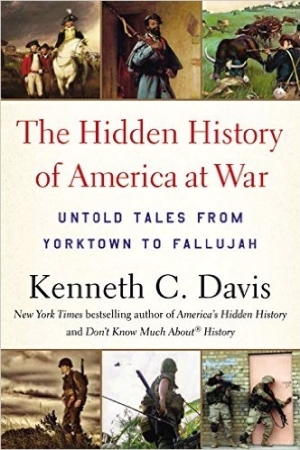
Now In paperback THE HIDDEN HISTORY OF AMERICA AT WAR: Untold Tales from Yorktown to Fallujah
May 19, 2016
Advance Praise for In the Shadow of Liberty
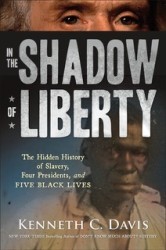
In the Shadow of Liberty: The Hidden History of Slavery, Four Presidents, and Five Black Lives (Holt Books, Penguin Random House Audio Sept. 2016)
Advance praise for In the Shadow of Liberty: The Hidden History of Slavery, Four Presidents, and Five Black Lives (Coming on September 20, 2016 from Holt Books and Penguin Random House Audio)
“By exploring the humanity of people held in bondage by early American presidents, Kenneth C. Davis once again turns American mythology into history. Read the book and be grateful.”
— Marcus Rediker, author of The Slave Ship: A Human History
“The young woman was enslaved, but also privileged. She was part of the household of the nation’s first president. This powerful book tells her story, and others, which are surprising and have been unknown to most of us. They will give you insights into our American heritage that you may not have considered before. I hope In the Shadow of Liberty will be widely read. It is important and timely.”
—Joy Hakim, author, A History of US (Oxford University Press), Freedom: A History of US (Social Studies School Service), and The Story of Science (Smithsonian Books).
May 18, 2016
In the Shadow of Liberty-First Advance Review Is In!
The first advance review of my forthcoming book IN THE SHADOW OF LIBERTY: The Hidden History of Slavery, Four Presidents, and Five Black Lives will appear in the June 1, 2016 issue of Book List, the journal of the American Library Association.
In the Shadow of Liberty: The Hidden History of Slavery, Four Presidents, and Five Black Lives (Holt Books-Sept. 2016)
BOOK LIST STARRED REVIEW Issue: June 1, 2016
In the Shadow of Liberty: The Hidden History of Slavery, Four Presidents, and Five Black Lives.
Davis, Kenneth C. (Author)
Sep 2016. 304 p. Holt, hardcover, $17.99. (9781627793117). 920.0092.
“This well-researched book offers a chronological history of slavery in America and features five enslaved people and the four U.S. presidents who owned them. George Washington’s trusted valet, Billy Lee, served at his side throughout the Revolutionary War and was freed at his death. Martha Washington’s personal maid and seamstress, Ona Judge, escaped and fled to New Hampshire. Born into slavery at Jefferson’s Monticello, Isaac Granger recalled life there in an oral account, later published. Similarly, Paul Jennings’ reminiscences provide insights into his life with the Madisons in the White House and at Montpelier. Alfred Jackson lived in slavery at Andrew Jackson’s the Hermitage.
Always referring to enslaved people rather than slaves, Davis organizes a great deal of factual material, personal accounts, and quotes into a very readable history book. Ties to familiar historical figures give the information about the five lesser known African Americans a greater sense of context. In turn, the book offers a particularly realistic and nuanced view of these presidents. The illustrations include black-and-white reproductions of paintings, prints, and photos of artifacts and historic sites. A valuable, broad perspective on slavery, paired with close-up views of individuals who benefited from it and those who endured it.”
— Carolyn Phelan
The book will be published by Holt Books for Young Reader on September 20, 2016.
May 8, 2016
Don’t Know Much About® Harry S. Truman
Harry Truman “Gave’ Em Hell.” I gave him a A. Born on May 8, 1884, the 33rd President of the United States.
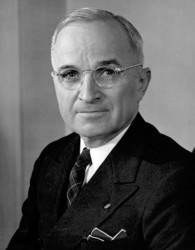
President Harry S. Truman
(Photo: Truman Library)
It was on his birthday in 1945 that Truman was able to tell Americans that the war in Europe was over with the surrender of Germany.
THIS IS a solemn but a glorious hour. I only wish that Franklin D. Roosevelt had lived to witness this day. General Eisenhower informs me that the forces of Germany have surrendered to the United Nations. The flags of freedom fly over all Europe. For this victory, we join in offering our thanks to the Providence which has guided and sustained us through the dark days of adversity.
Described as “a minor national figure with a pedestrian background,” Truman was a World War I veteran and a Senator from Missouri when Franklin D. Roosevelt chose him to become his running mate in the 1944 election. Truman became vice president when FDR won his fourth term and then took office on April 12, 1945 when FDR died.
When he took office, Truman had been largely left “out of the loop” by Roosevelt as World War II entered its final months. Truman did not know of the existence of the “Manhattan Project” and the development of the atomic bomb until he became president. Then he had to make the decision to use it against the Japanese.
Fast Facts
•Truman was a member of the Sons of the Revolution and the Sons of Confederate Veterans
•He wanted to attend West Point but poor eyesight kept him out. He enlisted in the Missouri National Guard and served as the commander of an artillery battery in World War I.
•Before entering politics, he was a farmer, bank clerk, insurance salesman and owner of a failed haberdashery store.
•As president he once threatened to punch the nose of a newspaper critic who had given his daughter a poor review after her debut singing recital. Margaret Truman went on to greater fame as a mystery novelist, beginning with Murder in the White House published in 1980.
•After Grover Cleveland, Truman is the only president who did not attend college. He attended law school briefly but dropped out.
After the end of World War II, Truman had to shift America’s attention to the new “Cold War” with the Soviet Union and his policies of “containment” and the Marshall Plan to rebuild war-torn Europe were hallmarks of his presidency.
Harry S. Truman died on December 26, 1972. This is his New York Times obituary. The Truman Library and Museum is located in Independence, Missouri
Read more about Truman, his life and administration in Don’t Know Much About® the American Presidents. Truman is also featured in the Berlin Battle chapter of The Hidden History of America at War. (In paperback this month)
In paperback May 2016 THE HIDDEN HISTORY OF AMERICA AT WAR: Untold Tales from Yorktown to Fallujah
Don’t Know Much About® the American Presidents (Hyperion paperback-April 15, 2014)
March 25, 2016
Don’t Know Much About® the Triangle Shirtwaist Fire

Triangle Shirtwaist Factory fire on March 25, 1911 from front page of The New York World (Source: Cornell University ILR School Kheel Center © 2011)
On this date, March 25, 1911, the Triangle Shirtwaist Factory in New York caught fire and 146 people died, most of them women between the ages of 16 and 23. [Post revised from original on 3/25/2011]
“Look for the union label.”
If you are of a certain generation, you may recognize those words instantly. They are the first line of a song that became a 1970s advertising icon.
Sung by a swelling chorus of lovely ladies (and a few men) of all colors, shapes and sizes, it was the anthem of the International Ladies Garment Workers Union.
Airing as American unions began to confront the long, steady drain of jobs to cheaper foreign labor markets, the song rousingly implored us to look for the union label when shopping for clothes (“When you are buying a coat, dress or blouse”).
Seeing these earnest women, thinking of them at their sewing machines, made us race to the closet and check our clothes for that ILGWU tag. (“It says we’re able to make it in the USA.”)
The International Ladies Garment Worker Union was born in 1900, in the midst of the often-violent period of early 20th century labor organizing when brutal working conditions and child labor were the norm in America’s mines and factories.
One of the companies the union attempted to organize was the Triangle Shirtwaist Factory at what is now Greene Street and Washington Place in New York’s Greenwich Village. It employed many poor and mostly immigrant women, most of them Jewish and Italian.
A walkout against the firm in 1909 helped strengthen the union’s rolls and led to a union victory in 1910. But the Triangle Shirtwaist Company –which would chain its doors shut to control its workers— earned infamy when a fire broke out on March 25, 1911 and 146 workers were trapped in the flaming building and died. Some jumped to their deaths.

A police officer and others with the broken bodies of Triangle fire victims at their feet, look up in shock at workers poised to jump from the upper floors of the burning Asch Building. (Credit: Cornell University ILR School Kheel Center ©2011)
The two owners of the factory were indicted but found not guilty. The tragedy helped galvanize the trade union movement and especially the ILGWU.
On the 105th anniversary of that dreadful event, it is worth remembering that American prosperity was built on the sweat, tears and blood of working men and women. Immigration and jobs are the issue again today, just as they were more than a century ago.
Cornell University’s Kheel Center for Labor-Management Documentation offers a web exhibit on the Triangle Factory Fire. The Library of Congress also offers resources on the tragedy.
On February 28, 2011, American Experience on PBS aired a documentary film about the tragedy and the period.
The site is part of New York University and a National Historic Landmark.
I also discuss labor history in Don’t Know Much About History.
Don’t Know Much About® History: Anniversary Edition
March 23, 2016
On this Date-Manzanar Internment Camp Opens
On March 23, 1942, the first Japanese-Americans evacuated by the U.S. Army during World War II arrived at the internment camp in Manzanar, Calif.
“We had about one week to dispose of what we owned, except what we could pack and carry for our departure by bus…for Manzanar.” William Hohri
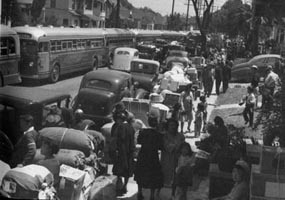
Buses line up on a Los Angeles street to take Japanese American evacuees to camp.
NPS Photo
Source: “Japanese Americans at Manzanar,” (National Park Service)
On February, 1942, President Franklin D. Roosevelt signed Executive Order 9066 authorizing the Secretary)of War to establish Military Areas and to remove from those areas anyone who might threaten the war effort. Without due process, the government gave everyone of Japanese ancestry living on the West Coast only days to decide what to do with their houses, farms, businesses, and other possessions.

Orphanage at Manzanar (Photo by Ansel Adams Courtesy of National Park Service
I have written several posts on this subject including these;
March 19, 2016
“Foreign Office” to Oval Office
Do the names James Blaine, William Jennings Bryan, and Charles Evan Hughes ring a bell?
Seal of the Department of State (Source: US. Dept. of State)
All three men had been Secretary of State. All three ran for president. All three lost.
Blaine (“the Man from Maine”) lost to Cleveland in 1884; Bryan lost three times, in 1896 and 1900 to McKinley and in 1908 to Taft; Hughes lost to Wilson in 1916 — the last time a Secretary of State was a presidential nominee.
If Hillary Clinton is nominated and wins, she will become the first former Secretary of State to become president since James Buchanan was elected the 15th president in 1856.
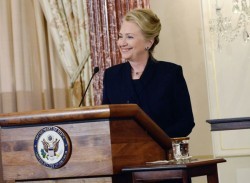
Secretary of State Hillary Clinton (Photo Source: State Dept.)
Once in American history, the office was seen as a stepping stone to the presidency. The post was once considered far more consequential than vice president, whose powers were largely limited to presiding over the Senate. In part, the vice president was also a political party choice but the Secretary of State was hand-picked by the president, sometimes with succession in mind.
Illustrating the prominence of the position, between 1789 and 1856, six of the first fifteen presidents were former Secretaries of State.
They include four of the first six presidents. In order, they are:
•Thomas Jefferson, the first Secretary of State, and the third president.
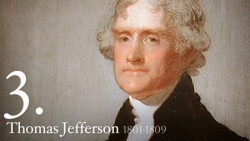
Thomas Jefferson, third president (Source: White House)
•James Madison, who served as Jefferson’s Secretary of State, and became fourth president.
•James Monroe, unique in that he served as War Secretary and Secretary of State simultaneously; that happened during the War of 1812 in the Madison administration. Monroe became the fifth president.
•John Quincy Adams, who was Monroe’s secretary of State and drafted the “Monroe Doctrine,” became sixth president.

John Quincy Adams. Copy of 1843 Daguerreotype by Philip Haas. (Courtesy Metropolitan Museum of Art/Public Domain)
•Martin Van Buren, was Secretary of State under Andrew Jackson before becoming his vice president. He was elected the eighth president.
•James Buchanan, Secretary of State under Polk, but later minister to Great Britain under Pierce, became the fifteenth president and is usually regarded among the worst American presidents.
Smithsonian magazine explored the history of the Secretary of State in August 2014: “Why Do Secretaries of State Make Such Terrible Presidential Candidates?”
Read more about each man in Don’t Know Much About® the American Presidents.
Don’t Know Much About® the American Presidents


