
Kenneth C. Davis's Blog, page 64
September 12, 2016
Who Said It? (9/12/16)
James Madison in an 1826 letter to the Marquis de Lafayette
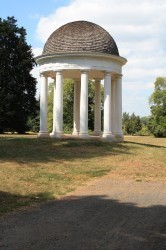
James Madison’s Montpelier
(Photo: Kenneth C. Davis)
“…the two races cannot co-exist, both being free & equal. The great sine qua non therefore is some external asylum for the colored race.”
Source: James Madison’s Montpelier, “Madison and Slavery”
James Madison is known as the “Father of the Constitution,” which was signed by the men who wrote it on September 17, 1787. September 17 is now marked as Constitution Day.
Madison believed that the solution to slavery was creation of a colony where emancipated African Americans could eventually be moved. He freed none of the enslaved people at Montpelier, his home, although one of them –Paul Jennings– later claimed that the dying President had pledged to emancipate Jennings. Eventually, Jennings was able to purchase his freedom from an ailing and destitute Dolley Madison.
Read more about Paul Jennings, his life, and times in IN THE SHADOW OF LIBERTY: The Hidden History of Slavery, Four Presidents, and Five Black Lives. (Holt/Penguin Random House Audio, September 20)

In the Shadow of Liberty (Available for pre-order and in stores on 9/20)


September 8, 2016
COMING ON SEPTEMBER 20, 2016: “In the Shadow of Liberty”
The first prepublication reviews are in for In the Shadow of Liberty: The Hidden History of Slavery. Four Presidents, and Five Black Lives. (Holt Books for Young Readers/Penguin Random House Audio, September 20, 2016)
UPDATED AUGUST 8, 2016
The latest advance review has come in from School Library Journal, which in a Starred Review called the book
Compulsively readable….
Read the complete School Library Journal review here.
In the Shadow of Liberty (Available for pre-order and in stores on 9/20)
In a *Starred Review, Booklist said,
“A valuable, broad perspective on slavery, paired with close-up views of individuals who benefited from it and those who endured it.” Booklist
And Kirkus has called the book,
“An important and timely corrective.” Kirkus
In the Nonfiction Book of the Week, Horn Books says,
“Davis’s solid research (there are source notes and bibliographies for each chapter), accessible prose, and determination to make these stories known give young readers an important alternative to textbook representations of colonial life.”
In the Shadow of Liberty will be published by Holt Books for Young Readers on Sept. 20, 2016.
September 5, 2016
Advance Praise for In the Shadow of Liberty
Advance praise for In the Shadow of Liberty: The Hidden History of Slavery, Four Presidents, and Five Black Lives (Coming on September 20, 2016 from Holt Books and Penguin Random House Audio)
“By exploring the humanity of people held in bondage by early American presidents, Kenneth C. Davis once again turns American mythology into history. Read the book and be grateful.”
— Marcus Rediker, author of The Slave Ship: A Human History
“The young woman was enslaved, but also privileged. She was part of the household of the nation’s first president. This powerful book tells her story, and others, which are surprising and have been unknown to most of us. They will give you insights into our American heritage that you may not have considered before. I hope In the Shadow of Liberty will be widely read. It is important and timely.”
—Joy Hakim, author, A History of US (Oxford University Press), Freedom: A History of US (Social Studies School Service), and The Story of Science (Smithsonian Books).

In the Shadow of Liberty (Available for pre-order and in stores on 9/20)
Who Said It? (9/5/2016)
President Theodore Roosevelt, “The New Nationalism” (August 31, 1910)

Now, this means that our government, National and State, must be freed from the sinister influence or control of special interests. Exactly as the special interests of cotton and slavery threatened our political integrity before the Civil War, so now the great special business interests too often control and corrupt the men and methods of government for their own profit. We must drive the special interests out of politics. That is one of our tasks to-day. Every special interest is entitled to justice–full, fair, and complete–and, now, mind you, if there were any attempt by mob-violence to plunder and work harm to the special interest, whatever it may be, that I most dislike, and the wealthy man, whomsoever he may be, for whom I have the greatest contempt, I would fight for him, and you would if you were worth your salt. He should have justice. For every special interest is entitled to justice, but not one is entitled to a vote in Congress, to a voice on the bench, or to representation in any public office. The Constitution guarantees protection to property, and we must make that promise good. But it does not give the right of suffrage to any corporation.
The true friend of property, the true conservative, is he who insists that property shall be the servant and not the master of the commonwealth; who insists that the creature of man’s making shall be the servant and not the master of the man who made it. The citizens of the United States must effectively control the mighty commercial forces which they have called into being.
There can be no effective control of corporations while their political activity remains. To put an end to it will be neither a short nor an easy task, but it can be done.
Source: From the White House Archives: Teddy Roosevelt’s New Nationalism Speech
COMING IN SEPTEMBER 2016: “In the Shadow of Liberty”
The first prepublication reviews are in for In the Shadow of Liberty: The Hidden History of Slavery. Four Presidents, and Five Black Lives. (Holt Books for Young Readers/Penguin Random House Audio, September 20, 2016)
UPDATED AUGUST 8, 2016
The latest advance review has come in from School Library Journal, which in a Starred Review called the book
Compulsively readable….
Read the complete School Library Journal review here.
In the Shadow of Liberty (Available for pre-order and in stores on 9/20)
In a *Starred Review, Booklist said,
“A valuable, broad perspective on slavery, paired with close-up views of individuals who benefited from it and those who endured it.” Booklist
And Kirkus has just called the book,
“An important and timely corrective.” Kirkus
In the Shadow of Liberty will be published by Holt Books for Young Readers on Sept. 20, 2016.
September 1, 2016
Did You Know: Washington bought teeth from enslaved people?
Did you know that George Washington bought teeth from some of the people enslaved at Mount Vernon? (1st in a series)
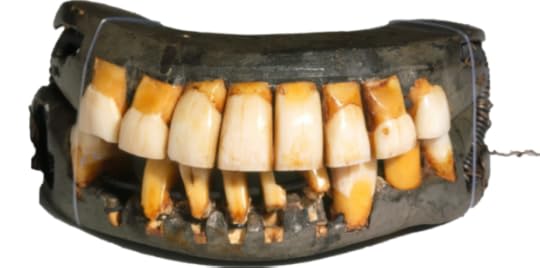
The only remaining full set of Washington’s dentures are displayed at George Washington’s Mount Vernon. (Photo Courtesy: Mount Vernon Ladies Association)
George Washington had terrible teeth. But his dentures were never made of wood. They were made of metal, bone, ivory –and human teeth. And yes, records show that he paid some of the enslaved African-American people at his plantation for their teeth. It is not known if these teeth were ever used.
Read more about Washington’s relationship with the enslaved people of Mount Vernon, and the role slavery played in his presidency: In the Shadow of Liberty. (Available for preorder in book and audio; in stores on 9/20)
In the Shadow of Liberty (Available for pre-order and in stores on 9/20)
August 30, 2016
Who Said It? (8/29/2016)
Frederick Douglass in Narrative of the Life of Frederick Douglass
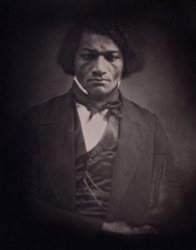
Frederick Douglass circa 1847, age approximately 29 years. Source National Portrait Gallery, Washington, D.C.
“Very soon after I went to live with Mr. and Mrs. Auld, she very kindly commenced to teach me the A, B, C. After I had learned this, she assisted me in learning to spell words of three or four letters. Just at this point of my progress, Mr. Auld found out what was going on, and at once forbade Mrs. Auld to instruct me further, telling her among other things, that it was unlawful as well as unsafe to teach a slave to read…. ‘A nigger should know nothing but to obey his master –to do as he is told to do. Learning would spoil the best nigger in the world.'”
“I now understood what had been to me a most perplexing difficulty –to wit, the white man’s power to enslave the black man.”
Narrative of the Life of Frederick Douglass (Yale University Press, 2001; pp. 31-32)
Frederick Douglass successfully escaped slavery on September 3, 1838.
Learn more about Douglass at the Frederick Douglass National Historic site (National Park Service).
Douglass’s life is also discussed in Don’t Know Much About History, Don’t Know Much About the Civil War, and In the Shadow of Liberty: The Hidden History of Slavery, Four Presidents, and Five Black Lives (available 9/20).

In the Shadow of Liberty: The Hidden History of Slavery, Four Presidents, and Five Black Lives (Book and Audio available on Sept, 20, 2016)
Don’t Know Much About the Civil War (Harper paperback, Random House Audio)
August 22, 2016
Who Said It (August 22, 2016)
Paul Jennings, an enslaved teenaged servant, working in the Madison White House when the British sacked Washington D.C. on August 24, 1814.
“…in the meantime, a rabble, taking advantage of the confusion, ran all over the White House and stole lots of silver and whatever they could lay there hands on.”
Born into slavery on James Madison’s Montpelier plantation, Paul Jennings was taken to the White House in 1809 at about age ten as a servant. He witnessed the burning of the White House by the British in 1814 and many other extraordinary events. He served as Madison’s enslaved valet until James Madison died in 1836. Long after Madison’s death, Paul Jennings gained his freedom and provided the first published account of a servant working in the White House, A Colored Man’s Reminiscences of James Madison (1865).
Read more about Paul Jennings and his life as the enslaved servant of James and Dolley Madison in the forthcoming book, IN THE SHADOW OF LIBERTY: The Hidden History of Slavery, Four Presidents, and Five Black Lives.
August 8, 2016
COMING IN SEPTEMBER 2016: “In the Shadow of Liberty”
The first prepublication reviews are in for In the Shadow of Liberty: The Hidden History of Slavery. Four Presidents, and Five Black Lives. (Holt Books for Young Readers/Penguin Random House Audio, September 20, 2016)
UPDATED AUGUST 8, 2016
The latest advance review has come in from School Library Journal, which in a Starred Review called the book
Compulsively readable….
Read the complete School Library Journal review here.

In the Shadow of Liberty: The Hidden History of Slavery, Four Presidents, and Five Black Lives (Holt Books & Random House Penguin Audio-Sept. 2016)
In a *Starred Review, Booklist said,
“A valuable, broad perspective on slavery, paired with close-up views of individuals who benefited from it and those who endured it.” Booklist
And Kirkus has just called the book,
“An important and timely corrective.” Kirkus
In the Shadow of Liberty will be published by Holt Books for Young Readers on Sept. 20, 2016.
August 7, 2016
Don’t Know Much About® the Tonkin Resolution
What was the Tonkin Resolution?
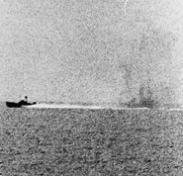
Photograph taken from USS Maddox (DD-731) during her engagement with three North Vietnamese motor torpedo boats in the Gulf of Tonkin, 2 August 1964. (Courtesy of the U.S. Naval Historical Cente)r
On August 7, 1964, Congress approved a resolution that soon became the legal foundation for Lyndon B. Johnson’s escalation of the Vietnam War. (New York Times story)
It came in August 1964 with a brief encounter in the Gulf of Tonkin, the waters off the coast of North Vietnam. where , the U.S. Navy posted warships loaded with electronic eavesdropping equipment enabling them to monitor North Vietnamese military operations and provide intelligence to CIA-trained South Vietnamese commandos. One of these ships, the U.S.S. Maddox was reportedly fired on by gunboats from North Vietnam.

Lyndon B. Johnson (March 1964)
(Photo: Arnold Newman, White House Press Office
Coming as it did in the midst of LBJ’s 1964 campaign against hawkish Republican Barry Goldwater, President Johnson felt the incident called for a tough response. Johnson had the Navy send the Maddox and a second destroyer, the Turner Joy, back into the Gulf of Tonkin. A radar man on the Turner Joy saw some blips, and that boat opened fire. On the Maddox, there were also reports of incoming torpedoes, and the Maddox began to fire. There was never any confirmation that either ship had actually been attacked. Later, the radar blips would be attributed to weather conditions and jittery nerves among the crew.
According to Stanley Karnow’s Vietnam: A History, “Even Johnson privately expressed doubts only a few days after the second attack supposedly took place, confiding to an aide, ‘Hell, those dumb stupid sailors were just shooting at flying fish.’”
Johnson ordered an air strike against North Vietnam and then called for passage of the Gulf of Tonkin Resolution. This legislation gave the president the authority to “take all necessary measures” to repel attacks against U.S. forces and to “prevent further aggression.” The resolution not only gave Johnson the powers he needed to increase American commitment to Vietnam, but allowed him to blunt Goldwater’s accusations that Johnson was “timid before Communism.”
The Gulf of Tonkin Resolution passed the House unanimously after only forty minutes of debate. In the Senate, there were only two voices in opposition. What Congress did not know was that the resolution had been drafted several months before the Tonkin incident took place. In June 1964, on LBJ’s orders, according to journalist-historian Tim Weiner,
“Bill Bundy, the assistant secretary of state for the Far East, brother of the national security adviser, and a veteran CIA analyst, had drawn up a war resolution to be sent to Congress when the moment was ripe.” (Legacy of Ashes: The History of the CIA, p. 280)
Congress, which has sole constitutional authority to declare war, had handed that power over to Johnson, who was not a bit reluctant to use it. One of the senators who voted against the Tonkin Resolution, Oregon’s Wayne Morse, later said,
“I believe that history will record that we have made a great mistake in subverting and circumventing the Constitution.”
After the vote, Walt Rostow, an adviser to Lyndon Johnson, remarked,
“We don’t know what happened, but it had the desired result.”
In January 1971, Congress repealed the Gulf of Tonkin resolution as popular opinion grew against a continued U.S. military involvement in Vietnam
Since Vietnam, United States military actions have taken place as part of United Nations’ actions, in the context of joint congressional resolutions, or within the confines of the War Powers Resolution (also known as the War Powers Act) that was passed in 1973, over the objections (and veto) of President Richard Nixon.”
The War Powers Resolution came as a direct reaction to the Gulf of Tonkin Resolution, as Congress sought to avoid another military conflict where it had little input.
“The Gulf of Tonkin Resolution and the Limits of Presidential Power” National Constitution Center
In 2005, the National Security Agency (NSA) issued a report reviewing the Tonkin incident in which it said “no attack had happened.” (Weiner, p. 280)
The National Endowment for the Humanities website Edsitement offers teaching resources on Tonkin and the escalation of the Vietnam War.
Read more about Vietnam, LBJ and his administration in Don’t Know Much About® History, Don’t Know Much About® the American Presidents. The Vietnam War and the Tonkin Resolution are also covered in a chapter on the Tet offensive of 1968 in THE HIDDEN HISTORY OF AMERICA AT WAR.
Don’t Know Much About® the American Presidents (Hyperion Paperback-April 15, 2014)
Don’t Know Much About® History: Anniversary Edition (Harper Perennial and Random House Audio)
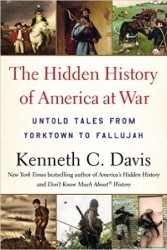
Now In paperback THE HIDDEN HISTORY OF AMERICA AT WAR: Untold Tales from Yorktown to Fallujah


