
Kenneth C. Davis's Blog, page 70
February 16, 2016
Marbury, Madison, Marshall, and McConnell

John Adams, Second POTUS , official portrit (Source: White House Historical Association)
Dust off your Civics books.
As the fight over Antonin Scalia’s replacement on the Supreme Court absorbs the country, and Senate Majority Leader Mitch McConnell has vowed to block any appointments by President Obama during his last year in office, it might help to look at history.
The simple fact is that the most consequential Supreme Court appointment in American history was made by a true “lame duck” President.
In its original sense, “lame duck” meant a president or other elected official whose successor had already been chosen.

John Marshall Chief Justice of the Supreme Court
(Reproduction courtesy of the Supreme Court Historical Society)
In 1801, after it was certain that president John Adams would not return for a second term, Adams nominated his Secretary of State, John Marshall, to the post to replace ailing Chief Justice Oliver Ellsworth.
At the time of this nomination, President Adams was a true “lame duck” president, soon to be replaced by Thomas Jefferson, following a drawn-out vote in the House of Representatives. It was clear that Jefferson’s party would control both the White House and the Senate. But Adams named Marshall, a staunch Federalist of his own party, who was confirmed despite only six-weeks of legal training.
One of Marshall’s first and most significant decisions came in the 1803 case of Marbury v. Madison which established the power of federal courts to void acts of Congress in conflict with the Constitution.
It is emphatically the province and duty of the judicial department to say what the law is. . . . Thus the particular phraseology of the constitution of the United States confirms and strengthens the principle, supposed to be essential to all written constitutions, that a law repugnant to the constitution is void. . . .
From Chief Justice Marshall’s decision in Marbury v. Madison
John Marshall went on to become the longest-serving and most influential chief justice in the history of the Supreme Court, hearing more than 1,000 cases and writing 519 decisions.
There have been more election year nominations, as discussed in this New York Times Op-Ed, “In Election Years, a History of Conforming Court Nominees.”
As John Adams himself said during the Boston Massacre Trial (1770)
“Facts are stubborn things.”
Read more about Marbury v Madison in Don’t Know Much About History
Don’t Know Much About® History: Anniversary Edition (Harper Perennial and Random House Audio)


“In the Shadow of Liberty”-Coming in September 2016
I am thrilled to introduce the Advance Reader’s Edition of my forthcoming book:
IN THE SHADOW OF LIBERTY — The Hidden History of Slavery, Four Presidents, and Five Black Lives
Set for release on September 20, 2016, the book will be published by Holt Books for Young Readers. The book offers narrative accounts of five enslaved people who were the legal property of George Washington, Thomas Jefferson, James Madison, and Andrew Jackson.
 Contact Holt Books for Young Readers for review copies and publicity requests.
Books for Young Readers
Henry Holt and Company
175 Fifth Avenue
New York, NY 10010
To request an author for an interview, please email: byrpublicity@hholt.com.
If you would like to receive a catalog or a review copy of a book, please fax the request on your letterhead to 646-307-5247.
February 15, 2016
Who Said It? (2/15/2016)
Franklin D. Roosevelt, “Executive Order 9066” (February 19, 1942). This wartime order, issued a few months after Pearl Harbor, led to the internment of more than 100,000 Japanese-Americans, as well as a number of Italian and Germans in America. The policy is considered one of the darkest stains on FDR’s legacy.

“Now, therefore, by virtue of the authority vested in me as President of the United States, and Commander in Chief of the Army and Navy, I hereby authorize and direct the Secretary of War, and the Military Commanders whom he may from time to time designate, whenever he or any designated Commander deems such action necessary or desirable, to prescribe military areas in such places and of such extent as he or the appropriate Military Commander may determine, from which any or all persons may be excluded, and with respect to which, the right of any person to enter, remain in, or leave shall be subject to whatever restrictions the Secretary of War or the appropriate Military Commander may impose in his discretion. The Secretary of War is hereby authorized to provide for residents of any such area who are excluded therefrom, such transportation, food, shelter, and other accommodations as may be necessary, in the judgment of the Secretary of War or the said Military Commander, and until other arrangements are made, to accomplish the purpose of this order. The designation of military areas in any region or locality shall supersede designations of prohibited and restricted areas by the Attorney General under the Proclamations of December 7 and 8, 1941, and shall supersede the responsibility and authority of the Attorney General under the said Proclamations in respect of such prohibited and restricted areas.”

Photo Source: National Archives
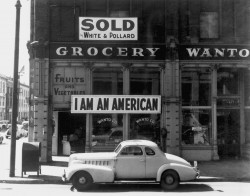
Photo by Dorothea Lange of Japanese-American grocery store on the day after Pearl Harbor National Archives
On February 19, 1942, President Roosevelt signed Executive Order 9066 granting the War Department broad powers to create military exclusion areas. Although the order did not identify any particular group, in practice it was used almost exclusively to intern Americans of Japanese descent. By 1943, more than 110,000 Japanese Americans had been forced from their homes and moved to camps in remote inland areas of the United States. (Source: FDR LIBRARY)
READ MORE IN DON’T KNOW MUCH ABOUT HISTORY and DON’T KNOW MUCH ABOUT THE AMERICAN PRESIDENTS
Don’t Know Much About® the American Presidents (Hyperion paperback-April 15, 2014)
Don’t Know Much About® History: Anniversary Edition (Harper Perennial and Random House Audio)
February 12, 2016
Pop Quiz: Who invented Lincoln Logs?
Answer: John Lloyd Wright, son of the famed architect Frank Lloyd Wright.
Learn more at the National Park Service Abraham Lincoln Birthplace National Historic Park
Read more about Lincoln in Don’t Know Much About History and Don’t Know Much About the American Presidents.
Don’t Know Much About® the American Presidents (Hyperion Paperback-April 15, 2014)
Don’t Know Much About® History: Anniversary Edition (Harper Perennial and Random House Audio)
February 11, 2016
Kenneth C. Davis-Speaking Calendar
List of Upcoming Speaking Engagements:
2016
•Friday April 29 Rutland Free Library 5 PM
10 Court Street Rutland, Vermont “Tables of Content”
•Tuesday May 3 Oregon Historical Society “Mark O. Hatfield Distinguished Historians Forum” 7 PM
First Congregational United Church of Christ, 1126 SW Park Avenue, Portland, Oregon
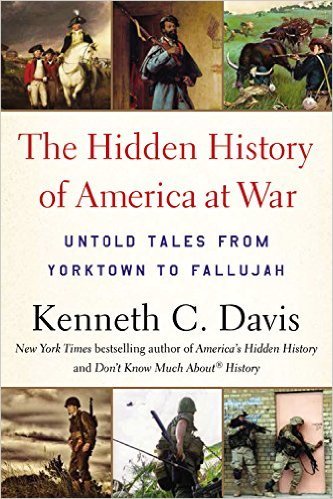
In paperback May 2016 THE HIDDEN HISTORY OF AMERICA AT WAR: Untold Tales from Yorktown to Fallujah
•Thursday September 22 Fraunces Tavern Museum (Time TBA)
54 Pearl Street New York City
•Thursday October 6 Northshire Bookstore (Saratoga Springs, NY) TIME TBA
424 Broadway, Saratoga Springs, NY 12866
•Friday October 7 Northshire Bookstore (Manchester, VT) TIME TBA
4869 Main ST, Manchester Center, VT 05255
THE HIDDEN HISTORY OF AMERICA AT WAR-In Paperback May 2016
Coming in paperback in May 2016
The Hidden History of America At War: Untold Tales From Yorktown To Fallujah
THE HIDDEN HISTORY OF AMERICA AT WAR: Untold Tales from Yorktown to Fallujah is a unique, myth-shattering, and insightful look at war—why we fight, who fights our wars and what we need to know but perhaps never learned about the growth and development of America’s military forces.Read more about the book and critical praise here
In paperback May 2016 THE HIDDEN HISTORY OF AMERICA AT WAR: Untold Tales from Yorktown to Fallujah
“Inventing the American Presidency” (A Ted Ed video)
It is George Washington’s birthday. In his honor, a brief, animated video explaining why and how we invented the office back in the summer of 1787.
Inventing the American Presidency via Ted Ed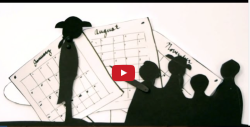
Read more about presidential history in Don’t Know Much About the American Presidents.
Don’t Know Much About® the American Presidents (Hyperion Paperback-April 15, 2014)
The Oddities of the First American Election (A Ted Ed Video)
In honor of Washington’s Birthday, which is February 22 but celebrated on February 15 this year, here is a brief animated video explaining just how George Washington became the first president of the United States in 1789.

The Oddities of the First American Election
Don’t Know Much About® the American Presidents (Hyperion Paperback-April 15, 2014)
Don’t Know Much About® Abraham Lincoln’s Birthday
February 12 used to mean something special — Abraham Lincoln’s Birthday. It was never a national holiday but it was pretty important when I was a kid and we got the day off from school in my hometown.
The Uniform Holidays Act in 1971 changed that by creating Washington’s Birthday as a federal holiday on the third Monday in February. It is NOT officially “Presidents Day.”
But it is still a good excuse to talk about Abraham Lincoln, especially since his real birthday is on the calendar.c
“Honest Abe.” “The Railsplitter.” “The Great Emancipator.” You know some of the basics and the legends. But check out this video to learn some of things you may not know, but should, about the 16th President.
Here’s a link to the Lincoln Birthplace National Park
This link is to the Emancipation Proclamation page at the National Archives.
And you can read much more about Lincoln in Don’t Know Much About the American Presidents,
Don’t Know Much About® the American Presidents (Hyperion paperback-April 15, 2014)
Don’t Know Much About History,
Don’t Know Much About® History: Anniversary Edition (Harper Perennial and Random House Audio)
Don’t Know Much About the Civil War
Don’t Know Much About the Civil War (Harper paperback, Random House Audio)
and The Hidden History of America At War.
In paperback May 2016 THE HIDDEN HISTORY OF AMERICA AT WAR: Untold Tales from Yorktown to Fallujah
February 10, 2016
It is NOT Presidents Day. Or President’s Day. Or Even Presidents’ Day.
So What Day Is it After All?
Okay. We all do it. It’s printed on calendars and posted in bank windows. We mistakenly call the third Monday in February Presidents Day, in part because of all those commercials in which George Washington swings his legendary ax and “Rail-splitter” Abe Lincoln hoists his ax to chop down prices on everything from mattresses and linens to SUVs.
But, it is officially still George Washington’s Birthday –federally speaking that is.
The official designation of the federal holiday observed on the third Monday of February was, and still is, Washington’s Birthday.

I wrote My Project About Presidents in 3rd Grade when I was 9. Even then I was asking questions about history and presidents
But Washington’s Birthday has become widely known as Presidents Day (or President’s Day, or Presidents’ Day). The popular usage and confusion resulted from the merging of what had been two widely celebrated Presidential birthdays in February —Lincoln’s on February 12th, which was never a federal holiday– and Washington’s on February 22, which was.
Created under the Uniform Holiday Act of 1968, which gave us three-day weekend Monday holidays, the federal holiday on the third Monday in February is technically still Washington’s Birthday. But here’s the rub: the holiday can never land on Washington’s true birthday because the latest date it can fall is February 21, as it did in 2011.
There is a wealth of information the First President at Mount Vernon.
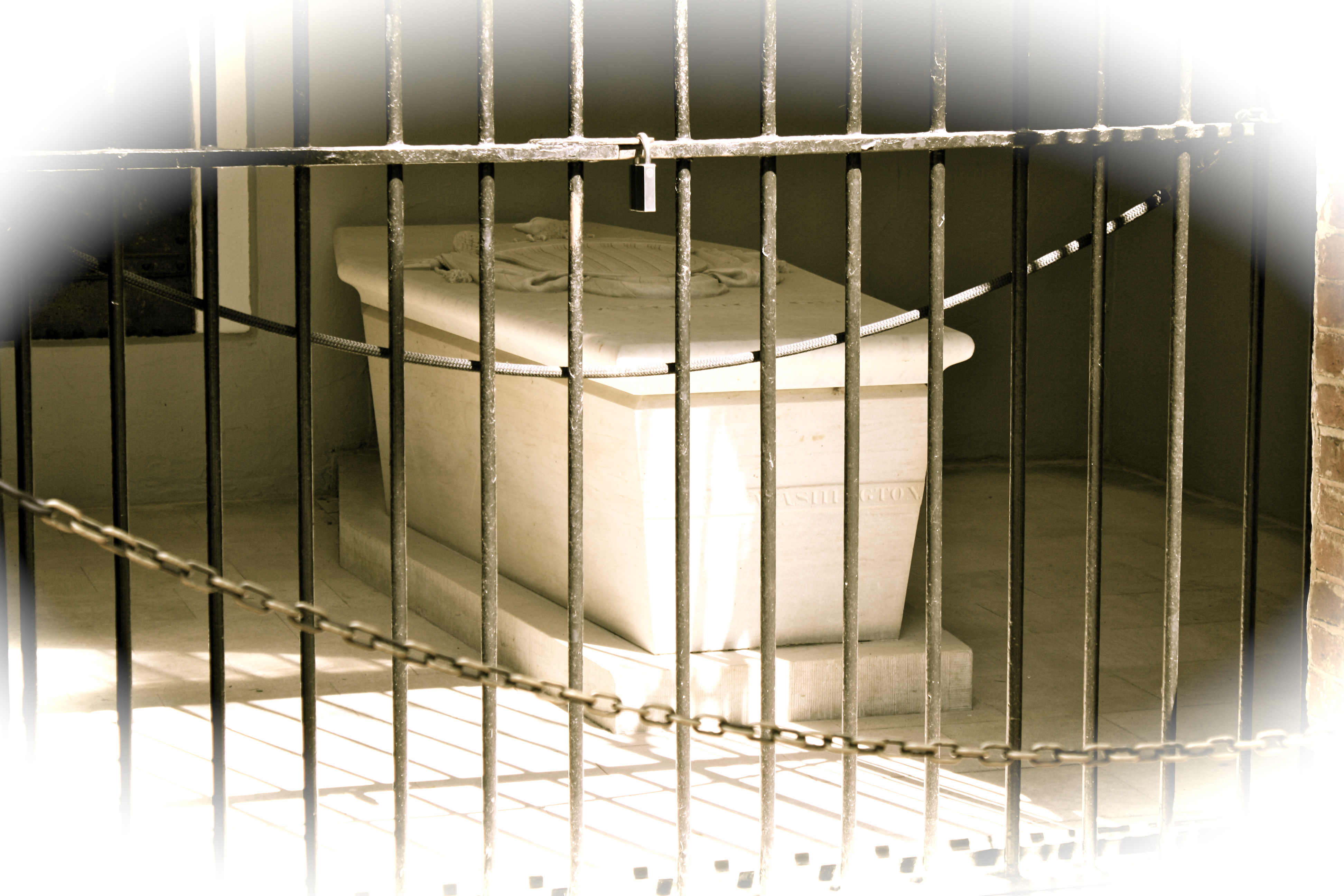
Washington’s Tomb — Mt. Vernon (Photo credit Kenneth C. Davis 2010)
Read More About the creation of the Presidency, Washington, his life and administration in DON’T KNOW MUCH ABOUT® THE AMERICAN PRESIDENTS. Washington’s role in the American Revolution is highlighted Chapter One of THE HIDDEN HISTORY OF AMERICA AT WAR.

The Hidden History of America At War (Hachette Books/Random House Audio)


