
Steve Hely's Blog, page 19
December 31, 2023
William Faulkner’s introduction to Sanctuary

The best character William Faulkner ever created was himself, William Faulkner. The flying injury, Rowan Oak, the photographs, the guest roles, the interviews, scraps of footage, the Nobel Prize speech. Perfect.
In 1929 William Faulkner, then age 31, wrote Sanctuary, which has one of the trashiest loglines ever: Ole Miss coed Temple Drake ends up the sex slave of a gangster named Popeye. Here at Helytimes we won’t go into detail of what exactly Popeye does, we leave that to lesser publications like The Washington Post:
what interested him chiefly about this horrific event was “how all this evil flowed off her like water off a duck’s back.” In his haste to make a best seller, he crammed in all he had seen and heard about whorehouses, rapes and kidnappings.
This was a ripped from the headlines story based on a true crime case. As a Mississippi crime book complete with courtroom scenes, it’s kind of a proto-Grisham.
Sanctuary was published by Jonathan Cape in 1931. Then in 1932 the Modern Library put out a new edition with a new introduction by Faulkner. Scholars since have apparently debunked everything Faulkner claimed in this introduction as fabulations and lies but so what? In a way that makes it even better. A work of autofiction.
We couldn’t find this introduction online so we got a used copy and scanned it in, it’s out of copyright (we believe?).
INTRODUCTION
THIS BOOK WAS WRITTEN THREE YEARS AGO. To me it is a cheap idea, because it was deliberately conceived to make money. I had been writing books for about five years, which got published and not bought. But that was all right. I was young then and hard-bellied. I had never lived among nor known people who wrote novels and stories and I suppose I did not know that people got money for them. I was not very much annoyed when publishers refused the mss. now and then. Because I was hard-gutted then. I could do a lot of things that could earn what little money I needed, thanks to my father’s un- failing kindness which supplied me with bread at need despite the outrage to his principles at having been of a bum progenitive.
Then I began to get a little soft. I could still paint houses and do carpenter work, but I got soft. I began to think about making money by writing. I began to be concerned when magazine editors turned down short stories, concerned enough to tell them that they would buy these stories later anyway, and hence why not now. Meanwhile, with one novel completed and consistently refused for two years, I had just written my guts into The Sound and the Fury though I was not aware until the book was pub- lished that I had done so, because I had done it for pleasure. I believed then that I would never be published again. I had stopped thinking of myself in publishing terms.
But when the third mss., Sartoris, was taken by a publisher and (he having refused The Sound and the Fury) it was taken by still another publisher, who warned me at the time that it would not sell, I began to think of myself again as a printed object. I began to think of books in terms of possible money. I decided I might just as well make some of it myself. I took a little time out, and speculated what a person in Mississippi would believe to be current trends, chose what I thought was the right answer and invented the most horrific tale I could imagine and wrote it in about three weeks and sent it to Smith, who had done The Sound and the Fury and who wrote me immediately. ”Good God, I can’t publish this. We’d both be in jail.” So I told Faulkner, “You’re damned. You’ll have to work now and then for the rest of your life.” That was in the summer of 1929. I got a job in the power plant, on the night shift, from 6 P.M. to 6 A.M., as a coal passer. I shoveled coal from the bunker into a wheel- barrow and wheeled it in and dumped it where the fireman could put it into the boiler. About 11 o’clock the people wuuld be going to bed, and so it did not take so much steam. Then we could rest, the fireman and I. He would sit in a chair and doze. I had invented a table out of a wheel- barrow in the coal bunker, just beyond a wall from where a dynamo ran. It made a deep, constant humming noise. There was no more work to do until about 4 A.M., when we would have to clean the fires and get up steam again. On these nights, between 12 and 4, I wrote As I Lay Dying in six weeks, without changing a word. I sent it to Smith and wrote him that by it I would stand or fall.
I think I had forgotten about Sanctuary, just as you might forget about anything made for an immediate purpose, which did not come off. As I Lay Dying was published and I didn’t remember the mss. of Sanctuary until Smith sent me the galieys. Then I saw that it was so terrible that there were but two things to do: tear it up or rewrite it. I thought again, “It might sell; maybe 10,000 of them will buy it.” So I tore the galleys down and rewrote the book. It had been already set up once, so I had to pay for the
privilege of rewriting it, trying to make out of it something which would not shame The Sound and the Fury and As I Lay Dying too much and I made a fair job and I hope you will buy it and tell your friends and I hope they will buy it too.
WILLIAM FAULKNER. New York, 1932.
Happy New Year to all 6,722 of our loyal readers, all over the globe.


December 30, 2023
Nineteen (or so) things I learned in 2023

I admire Tom Whitwell’s annual list of 52 things he learned in the year. Maybe most of what I learned this year were more emotional truths? I could only come up with twenty. You might know all these things, many of them have been known for some time, they’re just items that came across my transom and stuck with me this year.
one of many factors that hurt the Confederacy was their railroads had different gauges. It was President Abraham Lincoln who set the standard US railroad gauge (4 ft 8 1/2 in) when he made that standard for the Transcontinental Railroad. (do we buy the just-so story about Roman chariots?)during the decade ending in 2021 the US Treasury took in $32.3 trillion in taxes and spent $43.9 trillionthe so-called Russian-Urkanian hypothesis argues that fossil fuels like oil and natural gas aren’t generated from decaying organic matter, but from non-biological geology eventsthe USA detonated 35 nuclear weapons on itself between 1957 and 1977 to see if that would be a good way to drill for oil, construct canals, and do other peacetime projectsLouis B. Mayer used to don diving equipment to collect scrap metal in Boston Harborin 1000 AD, sugar was unknown in the UK. By 1900 it was supplying one fifth of the calories in the English diet.you’re probably eating wood pulp.the average Australian spends US $871 on horse racing a year. (Can this be true? My source is Harness Racing Update. It’s possible ADW computer teams are churning in ways that skew the figures. )
(that’s not a fact, just a memorable kind of statement I found on Brian Wilson’s Wikipedia page.)
Between 1640 and 1652, Ireland lost between 15% and 20% of her population due to war and war-related starvation. (Source.)Los Angeles is home to more Native Americans and Alaskan Natives than any other county in the USA. (Source.)Kenneth Adams 1934 murals for the University of New Mexico library are now covered because some find them offensive.the price paid to a winkte among the Sioux for naming a child was a horse. Dopaminergic medications for Parkinson’s disease have been associated with extreme risk taking, and pathological gambling. This is what Dick Cheney and his team thought they’d be working on when they went into work on 9/11/2001:
 In 2022 the murder rate in New Orleans was about 7x what it was in Los Angeles. (Source. The murder rate in New Orleans is off the charts. There were 280 murders in New Orleans in 2022, that’s more than in all of Germany.) after hearing Fleetwood Mac at the Democratic convention, James Baker warned George H. W. Bush, “they’re playing music we don’t know.“Abraham Lincoln frequently compared his situation as president to the tightrope walker Blondin crossing Niagara Falls.
 Actor James Marsden’s dad used to be head of food safety at Chipotle.JFK’s high school math teacher invented the point spread.
see you next year!

December 28, 2023
the urge

when looking at my 1969 UNP map I bought in a thrift store in Long Beach

to finally connect the line from Mina, NV to Laws, CA.

Can you imagine what that would do for the region??
December 17, 2023
Thad Cochran

Poking around the Edward Kennedy oral history project at The Miller Center I find this interview with former Mississippi senator Thad Cochran.
Cochran was a young Naval officer in Newport when he happened to get an invitation to the Kennedy compound from an Ole Miss coed friend who was working as cook there:
Heininger
What were your impressions of [Ted Kennedy] that very first time you met him in Hyannis Port?
Cochran
Very casual, easy to be with, approachable, good sense of humor, big appetite. He liked chocolate-chip cookies, I know that. He stood there and ate a whole fistful of chocolate-chip cookies, which my friend would make on request. She was apparently good at that.

As a young naval officer here’s what Cochran thought of the buildup to Vietnam:
But then the Vietnam thing came along, and it started getting worse and worse. I didn’t get called back in the Navy to serve in Vietnam, but I was teaching one summer in Newport when the Gulf of Tonkin incident occurred. Just trying to figure that one out and reading about what had happened and looking at a couple of television things of the bombing of the port at—where was it, Haiphong, something like that? I thought, I cannot believe this. What the heck is President Johnson thinking? What is he doing? How are we going to back away from that now, responding to this attack against a merchant ship, as I recall?
Anyway, I began worrying about it. I think, in one of my classes, I even asked the students, the officer candidates about to be officers in the U.S. Navy, would they like to go over to Vietnam and fight over this? Would they like to escalate this another notch? Is there something in our national interest? Of course they were scared to death of it. They didn’t want to say anything, but I think I expressed my view kind of gratuitously, and then later I worried that I was going to get reported for being a belligerent, anti-American Naval officer. I really became angry and frustrated and upset with the way this thing was going, and it just got worse, as everybody knows.
How did he end up in elected office?:
So then I went back to practicing law and just working and enjoying it. I forgot about politics, and then our Congressman unexpectedly announced that he was not going to seek re-election. His wife had some malady, some illness, and the truth was, he was just tired of being up here and wanted to come home. It took everybody by surprise. I’m minding my own business again one day at the house and the phone rings, and it’s the local Young Republican county chairman, Mike Allred, who called and said, You know, you may laugh but I’m going to ask you a serious question. This is serious. Have you thought about running for Congress to take Charlie Griffin’s place? And I said, Well, and I laughed because I said, You know, I have thought about it. I was surprised to hear that he wasn’t going to run, but I’ve thought about it, and I’ve decided that I’m not interested in running. I’ve got too much family obligation, financial opportunities, the law firm, etc.
I think Congressmen were making about $35,000 a year or something like that. There was a rumor it might go up to $40,000. I thought, Well, I have a wife and two young children, and there’s no way in the world I can manage all that, and in Washington, traveling back and forth, etc. But it would be interesting. It’s going to be wide open. It was an interesting political situation. Then he said, Well, let me ask you this: have you thought about running as a Republican? I laughed again and I said, No, I surely haven’t thought about that. I was just thinking about the context of running as a Democrat, and so I was still thinking of myself as a Democrat in ’72.
He said, Would you meet with the state finance chairman? We’ve been talking about who would be a good candidate for us to get behind and push, and we want to talk to you about it. We really think there’s an opportunity here for you and for our party and all this. I said, Well, Mike, I’ll be glad to meet and talk to you all, but look, don’t be encouraged that I’m going to do it. But I’m happy to listen to whatever you say. I’d like to know what you all are doing, as a matter of curiosity, how you got off under this and who your prospects are and that kind of thing. I’d like to know that.
So I met with them, and they started talking about the fact that they would clear the field. There would not be a chance for anybody to win the nomination if I said I would run. I thought, Golly, you all are really serious and think a lot of your own power. I started thinking about it some more, and I asked my wife what she would think about being married to a United States Congressman, and she said, I don’t know, which one? [laughs] And that is a true story. I said, Hello. Me.
Anyway, a lot of people had that reaction: What? Are you seriously thinking about this? But everybody that I asked—I started just asking family and close friends, law partners; I just bounced it off of them—I said, What’s your reaction that the Republicans are going to talk to me about running for Congress? I was just amazed at how excited most people got over the idea that I might run for Congress and run as a Republican. That’s unique, and they wouldn’t have thought it because they knew I was not a typical Republican. The whole thing worked out, and I did run, and I did win.
That was ’72. Interesting dynamic in Mississippi that year:
Knott
Were you helped by the fact that [George] McGovern was running as the Democratic nominee that year?Cochran
Yes, indeed. There was no doubt about it. I was also helped by the fact that some of the African-American activists in the district were out to prove to the Democrats that they couldn’t win elections without their support. Charles Evers was one of the most outspoken leaders and had that view. He was the mayor of Fayette, Mississippi, and that was in my Congressional district. He recruited a young minister from Vicksburg, which was the hometown of the Democratic nominee, to run as an Independent, and he ended up getting about 10,000 votes, just enough to deny the Democrat a majority. He had 46,000 or something like that, and I ended up with 48,000 or whatever. I’ve forgotten exactly what the numbers were. The Independent got the rest.
So the whole point was, I was elected, in part—I had to get what I got, and a lot of people who voted for me were Democrats, and some were African Americans who were friends and who thought I would be fair and be a new, fresh face in politics for our state and not be tied to any previous political decisions. I’d be free to vote like I thought I should in the interest of this district. It was about 38 percent black in population, maybe 40 percent, and not only did I win that, but then the challenge was to get re-elected after you’ve made everybody in the Democratic hierarchy mad. I knew they were going to come out with all guns blazing, and they did, but they couldn’t get a candidate. They couldn’t recruit a good candidate. They finally got a candidate but—
Knott
Seventy-four was a rough year for Republicans.
Cochran
It was and, of course, Republicans were getting beat right and left. So when we came back up here to organize after that election in ’74, there weren’t enough Republicans to count. But I was one of them who was here and who was back. Senator Lott, he and I both made it back okay. He was from a more-Republican area: fewer blacks and more supportive of traditional Republican issues.
His opinion on the state of affairs:
Serving in the Senate has gotten to be almost a contact sport, and that’s regrettable, in my view. I would like for it to be more like it was when I first came to the Senate. There was partisanship, right enough, and if you were in the majority, you got to be chairman of all the subcommittees, and none of the Republicans, in my first two years, were chairmen of anything, but that’s fine. That’s the way the House is operated. I’d seen that in the House, and that’s okay. Everybody understands it. But since it’s become so competitive—and the House has too—things are more sharply divided along partisan lines than they ever have been in my memory, and I think the process has suffered. The legislative work product has deteriorated to the point that legislation tends to serve the political interests of one party or the other, and that’s not the way it should be.
Who does he blame?:
I’ve been disappointed in the partisanship that has deteriorated to the point of pure partisanship in court selections, in my opinion, in the last few years, and [Ted Kennedy’s] been a part of that. I’m not fussing at him or complaining about it. It’s just something that has evolved, but all the Democrats seem to line up in unison to badger and embarrass and beat up Republican nominees for the Supreme Court in particular. But it’s extended to other courts, the court of appeals. They all lined up and went after Charles Pickering from my state unfairly, unjustly, without any real reason why he shouldn’t be confirmed to serve on the 5th Circuit Court of Appeals. He had run against me when I ran for the Senate, Pickering had. I defeated him in the Republican primary in 1978. So we haven’t been political allies, but I could see through a lot of the things.
I have a close personal friendship with Pat Leahy and Joe Biden, and I could probably name a few others. I’ve really been aggravated with them all for that reason, and I hope that we’ll see some modification of behavior patterns in the Judiciary Committee. Occasionally they’ll help me with somebody. I’m going to be presenting a candidate for a district court judgeship this afternoon in the committee, and yesterday Pat came up, put his arm around me, and said, I know you’re for this fellow, [Leslie] Southwick, who is going to be before the committee, and I want you to know you can count on me. Well, I’m glad to hear that. There’s nothing wrong with him. I mean, he’s a totally wonderful person in every way. He’ll be a wonderful district judge.
I’m not saying that they make a habit of it, but they’ve picked out some really fine, outstanding people to go after here recently, and there are probably going to be others down the line that they’ll do that. Ted’s part of that, and I think all the Democrats do it. I think that’s unfortunate.
Knott
Are they responding to interest group pressure? Is that your assessment?
Cochran
I think that has something to do with it, but I’m not going to suggest what the motives are or why they’re doing it, but it’s just a fact. It’s pure partisan politics, and it’s brutal, mean-spirited, and I don’t like it.
Heininger
What do you attribute the change to?
Cochran
I don’t know. I guess one reason is we’re so closely divided now. You know, just a few states can swing control of the Senate from one party to the next, and we have been such a closely divided Senate now for the last ten years or so. Everybody understands the power that comes with being in the majority, and I’m sure both parties have taken advantage of the situation and have maybe been unfair in the treatment of members of the minority party, denying them privileges and keeping their amendments from being brought up or trying to manage the schedule to the benefit of one side or the other.
Cochran died in 2019. In the Senate he used Jefferson Davis’s desk.
December 10, 2023
jet trucks for incinerating
a nice article in the Wall Street Journal about trucks rigged with jet engines to incinerate junk cars at racetrack shows:
A former Navy mechanic named Doug Rose helped to popularize meltdowns after he created a dragster using a jet engine from a scrapyard. According to his widow, Jeanne, he conducted his first fire show around 1968 with a car he named the Green Mamba. Over the years, he honed his craft until he could torch a half-dozen vehicles at once. “Doug’s objective was to please the people,” she said.
WSJ also has a photographic review of how McDonald’s is revamping her burgers.

We’re not convinced. Yesterday stopped at the Yucaipa In-N-Out. Two cheeseburgers, fries, medium soda, side of pickles and free hot peppers for $12.50. Is there a better deal in America? Of course when you drive by Harris Ranch you get a tough look and smell of the system that makes that possible.
December 9, 2023
Abraham Lincoln: An Oral History

T. Lyle Dickey said:


This is an interesting book. We’ve discussed how oral history as we know think of it didn’t seem to exist in the past, it didn’t occur to anyone (a search for “oral history” on Amazon reveals mostly books about music scenes and bands). John Nicolay, who’d been a secretary to Lincoln, worked with John Hay on a biography of Lincoln. They collected stories and reminiscences, but they concluded they couldn’t trust people’s memories. Prof. Burlingame dug through Nicolay’s notes and letters and put this book together.
One J. T. Stuart remembered that Lincoln was almost appointed territorial governor of Oregon during the Fillmore administration, but Mary Todd refused to go out there.
Robert Todd Lincoln remembers visiting his father after Gettsyburg, and finding him just after a cry:


how did he handle the dark days?:


December 2, 2023
goddamn lunatic
One last bit of Mungeriana, from the CNBC final interview:
BECKY QUICK: What kind of things would you recognize that they– that they were doing wrong?
CHARLIE MUNGER: Oh. They had some crazy idea. For instance, my Latin teacher was maladjusted, but one who was a devoted follower of Sigmund Freud. And I recognized that Sigmund Freud was –when I first read him when I was in high school. And, of course, it was an odd little boy whose Latin teacher is teaching him Freud. But that was – she was peculiar and so was I. And, of course, when I read – I bought the complete writings of Sigmund Freud from the area library. It was one big book. And I went through it very laboriously. And I realized he was a goddamn lunatic. And so I decided I wasn’t gonna learn that from my Latin teacher. I had some very unusual teachers. The best teacher I had in my life was Lon Fuller. Well, he was the best contracts teacher in any law school. And contracts is the best subject in every law school, at least I think it is. Because it integrates so beautifully with the new doctrine of an economics that came along with Adam Smith and all those people.
I had Dall-E generate some images of boy Charlie Munger reading the complete works of Sigmund Freud:


Horrifying.
December 1, 2023
Kissinger and Mao have a chat
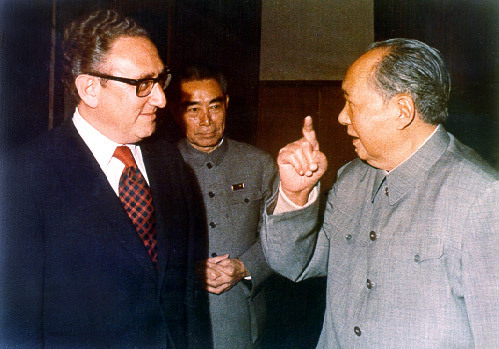
Chairman Mao: The trade between our two countries at present is very pitiful. It is gradually increasing. You know China is a very poor country. We don‘t have much. What we have in excess is women. (Laughter)
Dr. Kissinger: There are no quotas for those or tariffs.
Chairman Mao: So if you want them we can give a few of those to you, some tens of thousands. (Laughter)
Prime Minister Chou: Of course, on a voluntary basis.
Chairman Mao: Let them go to your place. They will create disasters. That way you can lessen our burdens. (Laughter)

from a transcript of a conversation, Feb. 17 1973. Although who can say what they really said? A few months later:
Chairman Mao: Let’s discuss the issue of Taiwan. The question of the U.S. relations with us should be separate from that of our relations with Taiwan.
The Secretary: In principle….
Chairman Mao: So long as you sever the diplomatic relations with Taiwan, then it is possible for our two countries to solve the issue of diplomatic relations. That is to say like we did with Japan. As for the question of our relations with Taiwan, that is quite complex. I do not believe in a peaceful transition. (To the Foreign Minister) Do you believe in it?
The Secretary: Do I? He asked the Foreign Minister.
Chairman Mao: I’m asking him (the Foreign Minister). (Prime Minister Chou said something that was not translated.)
They are a bunch of counterrevolutionaries. How could they cooperate with us? I say that we can do without Taiwan for the time being, and let’ it come after one hundred years. Do not take matters on this world so rapidly. Why is there need to be in such great haste? It is only such an island with a population of a dozen or more million.
Strange.
November 28, 2023
Charlie Munger, weatherman.

“Like Warren, I had a considerable passion to get rich,” Munger told Roger Lowenstein for Buffett: The Making of an American Capitalist, published in 1995. “Not because I wanted Ferraris — I wanted independence. I desperately wanted it. I thought it was undignified to have to send invoices to other people.”
from Bloomberg.
Munger never stopped preaching old-fashioned virtues. Two of his favorite words were assiduity and equanimity.
He liked the first, he said in a speech in 2007, because “it means sit down on your ass until you do it.” He often said that the key to investing success was doing nothing for years, even decades, waiting to buy with “aggression” when bargains finally materialized.
He liked the second because it reflected his philosophy of investing and of life. Every investor, Munger said frequently, should be able to react with equanimity to a 50% loss in the stock market every few decades.
The Financial Times has the best obituary, noting stuff others miss like Munger’s role in funding abortion rights, here’s a link that will work for the first three lucky readers.
Munger on horse race betting, from his most famous (or second most famous?) speech:
How do you get to be one of those who is a winner—in a relative sense—instead of a loser? Here again, look at the pari-mutuel system. I had dinner last night by absolute accident with the president of Santa Anita. He says that there are two or three betters who have a credit arrangement with them, now that they have off-track betting, who are actually beating the house. They’re sending money out net after the full handle—a lot of it to Las Vegas, by the way—to people who are actually winning slightly, net, after paying the full handle. They’re that shrewd about something with as much unpredictability as horse racing. And the one thing that all those winning betters in the whole history of people who’ve beaten the pari-mutuel system have is quite simple. They bet very seldom. It’s not given to human beings to have such talent that they can just know everything about everything all the time. But it is given to human beings who work hard at it—who look and sift the world for a mispriced bet—that they can occasionally find one. And the wise ones bet heavily when the world offers them that opportunity. They bet big when they have the odds. And the rest of the time, they don’t. It’s just that simple. That is a very simple concept. And to me it’s obviously right—based on experience not only from the pari-mutuel system, but everywhere else.”
One day Warren Buffett and Charlie Munger visited the set of The Office to film a comedy video for the Berkshire Hathaway annual meeting. Everyone swarmed around Buffett but nobody really knew Munger. When the lunch break came I had the opportunity to take my plate and sit right down across from him.
From reading his Wikipedia page that morning I’d learned that Charlie Munger had been a weatherman during World War II, so I asked him about that. “It was kind of a humdrum job,” he said, modest. “A lot of people had humdrum jobs in the war.” His job was hand-drawing weather maps to predict the best times to fly planes across the Bering Strait to our Soviet allies in such a way that the engines wouldn’t ice up and kill the pilots. It seems like that might teach you something about probability.
We talked about Clifton’s Cafeteria in downtown LA. He expressed admiration for that institution.
In 1931, Clinton leased a “distressed” cafeteria location at 618 South Olive Street in Los Angeles and founded what his customers referred to as “The Cafeteria of the Golden Rule”. Patrons were obliged to pay only what they felt was fair, according to a neon sign that flashed “PAY WHAT YOU WISH.” The cafeteria, at the western terminus of U.S. Route 66, was notable for serving people of all races, and was included in The Negro Motorist Green Book.
The conversation itself wasn’t that profound, but it launched me on a project of learning about more about Munger and his thinking that’s really changed my life.
“You don’t have a lot of envy.
You don’t have a lot of resentment.
You don’t overspend your income.
You stay cheerful in spite of your troubles.
(this from a guy whose first child died of leukemia).
You deal with reliable people.
And you do what you’re supposed to do.
And all these simple rules work so well to make your life better. And they’re so trite.”
His prescription is logical, he says.
“Staying cheerful” is “a wise thing to do,” Munger told Quick, adding that in order to do so, you have to let go of negative feelings.
“And can you be cheerful when you’re absolutely mired in deep hatred and resentment? Of course you can’t. So why would you take it on?” Munger said.
from 2019. (Struck by a resemblance to the mantra Liam Clancy gave Bob Dylan: “no fear, no meanness, no envy.”) He was committed to being rational, and he was witty, he expressed a lot of wisdom in a fast and punchy way. You could listen to him talk for a long time and not get bored. (And he could talk for a long time too.)
On getting the first $100,000, the hard part:
Munger on grubstake(not sure what year he said that, might be more like $1 million today)
Munger holding forth in February, 2022 with a rare stock pick:
But I would argue that if I was investing money for some sovereign wealth fund or some pension fund with a 30,40, 50-year time horizon I buy Costco at the current price.
Here’s Costco vs. S&P 500 over that timeline:

(although my guy was talking 30-50 years.)
Posting about Munger has led to some interesting real life connections. The Mungerheads search out every scrap on the man. They’re interesting people to talk to, and you usually learn something

pic from the Daily Journal Co. website.
In appreciation of Munger’s life and wisdom, here are references to the man over the years at Helytimes:
Munger Speaks, 2019. On stagnation, and some life advice.
Munger and Lee Kuan Yew. There was a Confucian streak in Munger, maybe a little anti-democratic.
Buffett Bits, and Munger, from the 2020 annual meeting.
Munger and Buffett highlights from the 2021 annual meeting.
Charlie Munger Deep Cuts, my most thorough look at the guy and his wisdom (some funny ones, too, see what he says about Al Gore.
Ominous Remark from Charlie Munger, 2018.
“I’ve mellowed because I consider it counterproductive to hate as much as both parties now hate, and I have disciplined myself,” Munger said. “I now regard all politicians higher than I used to. I did that as a matter of self-preservation.” He said that he had re-read “The Decline and Fall of the Roman Empire,” and it made him “feel a lot better about the current political scene. We’re way ahead of the Romans at the end.”
That’s a pretty low bar, I pointed out.
“It’s very helpful — I suggest you try it,” Munger replied. “Politicians are never so bad that you don’t live to want them back. There will come a time when the people who hate Trump will wish that he was back
Free Samples, from 2023, a look at a commonality in Buffett-Munger businesses.
I’m All Right on That One, a few quotes from the bros of Omaha, 2023:
CHARLIE MUNGER: I used to come to the Berkshire annual meetings on coach from Los Angeles. And it was full of rich stockholders. And they would clap when I came into the coach section. I really liked that. (LAUGHTER) (APPLAUSE)
How the Chevalier de Méré met Blaise Pascal, a look at the origins of probability theory.
Obviously, you’ve got to be able to handle numbers and quantities—basic arithmetic. And the great useful model, after compound interest, is the elementary math of permutations and combinations. And that was taught in my day in the sophomore year in high school. I suppose by now in great private schools, it’s probably down to the eighth grade or so.
It’s very simple algebra. It was all worked out in the course of about one year between Pascal and Fermat. They worked it out casually in a series of letters.
More.
You know what? I wish they’d build the giant near-windowless dorm he proposed for UC Santa Barbara.
November 26, 2023
Scialabba
George Scialabba is no wild man. A soft-spoken, introverted soul, he doesn’t drink or smoke; no alcohol, tobacco, or recreational drugs. Healthy, moderate eating (no red meat, and “a kind of cerebral Mediterranean diet”) keeps Scialabba, at age 67, lean to a degree that is downright un-American. He has never married nor fathered children, and lives alone in a one-bedroom condo he has occupied since 1980. He doesn’t play sports (“I don’t exercise — I fidget”). For 35 years, Scialabba, a Harvard College alumnus, held a low-level clerical job at his alma mater that suited his low-profile style. For the past decade, his desk has occupied a windowless basement in a large academic building.
from the Chronicle of Higher Education.
Scialabba toiled for thirty-five years at a desk job in the windowless basement of Harvard’s Center for Government and International Studies, writing book reviews in his spare time; he has much to say about the economic conditions that enable or disable the life of the mind. (A sufferer from chronic depression, Scialabba credits his union for enabling him to take several paid medical leaves. “This is one of many ways in which strong unions are a matter of life and death,” he writes in How To Be Depressed.) And yet, for Scialabba, the essence of intellectual and creative exchange remains a gift economy: “When we’re young, our souls are stirred, our spirits kindled, by a book or some other experience,” he once said, “and in time, when we’ve matured, we look to pay the debt, to pass the gift along.” Gratitude, deeply felt, enables generosity. And never has a writer of such enviable talents displayed such undiminishing patience for his reader, such evident and unpretentious pleasure in the pedagogical function of good prose.
Commentary on Scialabba often makes much of his marginal status in relation to the more glamorous—or, at least, more lucrative—centers of intellectual life. As Christopher Lydon once put it, he has “no tenure…no tank to think in, no social circle, no genius grant (yet), no seat in the opinion industry or on cable TV—‘no province, no clique, no church,’ as Whitman said of Emerson—not even a blog.” In this, there was always a note of condescension: the working-class boy from Sicilian East Boston made good (but not good enough for the academy).
That from Commonweal.
Both note that his office is “windowless.” Love that the interesting work at Harvard is coming not from a professor but from a guy who’s working as a building manager. Lee Sandlin vibes. We love an amateur.


