
Steve Hely's Blog, page 21
October 29, 2023
Two case studies in narrative shaping from Bill Clinton’s career

In 1990, Clinton has a very difficult primary. He’s clearly wanting to look toward running for the Presidency. He’s now been in office—I think it’s ten years. I can’t remember the exact number of years, but he was in the fifth term. Anyway, the justification for another term was hard to figure. He had a difficult primary and he was running against a former Democrat in the general. It was a real question as to whether he could, indeed, lose. Obviously, if he lost the Governor’s race, his presidential ambitions were done.
This is pollster Stanley Greenberg, remembering in the first of his two oral histories for UVA’s Miller Center. What can possibly be the case for a fifth term? Greenberg and Dick Morris run polling and focus groups:
I figured out a rationale that centered around not going back. It’s not important to your overall narrative, but it was focused on things he had done, including sex education, which surprised everybody, that sex education was popular in Arkansas. The Republican running was against all this and many of the education reforms.
Turn the clock back became the symbol, and it was all around the idea of, rather than him having a new agenda for his eleventh year in office—whatever it was—it was focused on not allowing the clock to be turned back on a modern Arkansas. It was effective and he won the election.
Cut to 1992, the New Hampshire primary. The Gennifer Flowers story breaks. Greenberg describes the situation:
It was James’ decision that everybody get to New Hampshire, and that we have to throw every resource—
Anyway, James at this point says, Everybody in New Hampshire.
Riley
Is that because you want to have resources to deploy there, or because there is an efficiency in having all the heads in one place to figure out how to deal with this?
Greenberg
There’s a sense that this entire candidacy could crash in a second. If we don’t do everything conceivable to save it, it’s gone. And so, enough of these conference calls all over America. Everybody get to New Hampshire.
Here’s James Carville describing the situation:
George Stephanopoulos called me. It was early in the morning and he said, “Why don’t you meet us? Why don’t you come to the airport? The governor wants you to come . . . thinks that something’s going to break today about some woman.” And I said, “Aw, shit, every day something’s going to break about some woman.” You know what I mean? I was not at all fired up about getting on a plane in January. And he said, “I think you’d better come.”
So I went. As the incoming started coming, they were out campaigning. I was in between. They were trying to tell Mrs. Clinton, who was in Georgia at the time, that the story was going to break. . . . From then until the primary, the dominant memory I have is fatigue–just being so tired and not sleeping. And the story broke, and of course they had the sort of press conference, the Gennifer Flowers press conference and the stuttering John thing. . . .
Right after that, we went on a tour down south. . . . My dominant memory in all of that is being tired. We had an event in Boston, Massachusetts. . . . I know what it feels like if you’re at a soccer game and you lose control. The media throng there was so intense that I got pinned. Maybe it was three seconds; I don’t want to exaggerate it. But I didn’t have any control. I thought I was going to be crushed. I was just sort of lifted off my feet. There was this radio guy with a little tape recorder and a mike, and he was screaming and he was crawling over the top of the crowd. And I was sitting there, and my arms were pinned, and I couldn’t move my legs. Like I said, for two or three seconds, I panicked that it was out of control–that I wasn’t just going to lose the election, but I was going to lose my life–as they say, I was going to be “taking a dirt nap” pretty soon.
The day that Mandy Grunwald went on Nightline, you had a strategy session. What was the strategy?
I think the “cash for trash,” was the sort of main thing. . . .
Who came up with the phrase “cash for trash?”
I wish I could say it was me, but I honestly don’t know.
In your book, you said it actually was Bill Clinton.
Okay, then it was. . . . The book supercedes my memory.
What was the strategy, and who came up with it?
The strategy was to say that there was a lot of money that was passing hands here. It was all odd that this was coming up around 10 days before the election. The strategy was pretty obvious, and I think the strategy worked pretty good.
When Mandy went on Nightline that night and you all were watching, what was the reaction in the campaign?
“Attagirl! Way to go!” It was good. We had pretty good points to make, and people really resent it. At one event in New Hampshire, someone there asked the question, and it was actually a journalist who sort of posed–they didn’t identify themselves — and there was a time when I thought the crowd could have turned physical.
Against the reporter?
Yes, against the reporter. If you did focus groups, if you did events, if you did anything, there was a real backlash to the whole thing
When Governor and Mrs. Clinton went on 60 Minutes, you had prepared an extensive memo for that interview. What were you trying to accomplish?
In that environment, if you let the story take its own course, it was going to be bad for you. You had to get in the middle of the story. Governor Clinton, myself, and most of the people in the campaign all shared this one thing — we were not just going to let people do what they wanted to do. If they were going to give us a chance to get on there, by God, we were going to get on there. We were going to get in the middle of it. There’s a lot of times when people have a strategy to say, “We’re just not going to participate in that sort of witch hunt here,” or something like that. That doesn’t work for very long in presidential races in the United States.
You have to fight back.
You’ve got to fight back. Yes, sir. And our strategy from day one was to contest it at every point, and to have them out there… The best person to explain what happened … was then-Governor Clinton and Mrs. Clinton. And that’s why we did the 60 Minutes thing, because it was the biggest deal out there. You had to show that you were out there, taking it on.


October 15, 2023
fine use for a Herend dish

Knott
You mentioned Jacques Chirac at lunch. I don’t know if you want to tell the story about that.
Kuhn
Oh yes. When Mitterrand was President, Chirac was Prime Minister. Prime Minister of France is a very limited role, but he was there for a meeting at the White House. It was a small plenary session in the Cabinet room. I recall afterwards that Chirac came into the Oval Office just to spend some brief time with the President alone. Photos were taken in the Oval Office and then it was just the two of them. I happened to be in there and was about to leave so they could spend some time together. And Chirac pulls a pack of cigarettes out of his pocket and just lights up a cigarette in the Oval Office like it’s an everyday thing. I had never seen anybody smoke in the Oval Office before. At that time I don’t even think people were smoking in the West Wing. I think they had stopped that, staff-wise.
President Reagan wasn’t at all upset that he lit up, he was fine with that. His big concern was, what do we do for an ashtray? Like, Jim, we’ve got to find—he’s looking frantically and I’m looking because we want to be hospitable. We couldn’t find anything. Finally we found, there was a nice Herend dish on the coffee table that was there and never got used for anything. I thought, well, why not? We’re going to make this a practical piece now, and gave it to him. That Herend dish just became an ashtray. But it was funny, he just fired that cigarette up like—he didn’t offer Reagan one because he knew he didn’t smoke. That was an old fashioned thing to do in the old days.
tales from the Reagan oral histories at UVA’s Miller Center, that is James Kuhn.
October 8, 2023
in good news
In good news, we saw Reba McEntire at Terroni
September 30, 2023
Boston as Mecca and Medina
Globe reporter and editor Martin Nolan, towards the end of his interview for the Miller Center on the life and career of Edward “Ted” Kennedy:
Knott
How would you explain to somebody reading this transcript, hopefully 100 years from now or so—that’s our goal here, to create an historical record that will last. How would you explain the hold of the Kennedys, particularly on the people in Massachusetts, that would allow somebody like Senator Kennedy to have a 44-year career in the United States Senate, as we speak today?
Nolan
In Massachusetts we do indeed revere the past. There’s nothing wrong with that. In the 1970s, during the great energy crisis, a guy I knew, Fred Dutton, was the lobbyist for the Royal Kingdom of Saudi Arabia. He had been another guy doing well by doing good. He came to work for Jack Kennedy in the White House as Assistant Secretary of State and worked for Bobby Kennedy and McGovern and all this. He landed on his Guccis with this job. He says, Look, there’s this Minister of Petroleum, Sheikh [Zaki] Yamani. Do you remember Sheikh Yamani? He says, He’s coming to town and I’d like him just to get a flavor. Would you like to get an exclusive? Yes, geez, he was the biggest guy going.
He takes me to lunch at the Watergate Hotel, just the two of us, wonderful, because I kind of knew the subject. Oil is very important for furnaces in New England. He’s talking about OPEC [Organization of the Petroleum Exporting Countries] and stuff like that. He’s giving me a big Churchill Havana cigar, sitting there like he’s got all day, and he said, You know, Mr. Nolan, we have oil running under the sands of Saudi Arabia. We have a lot of oil, but it is a finite resource. We all know that, he says. But we have Mecca and Medina and we will never run out of Mecca and Medina. I probably put it in at the bottom, if I put it in at all, because it didn’t relate to the price of oil.
But that’s what we have in Boston, Massachusetts. Yes, we’ve got hospitals and universities and all that, but we have history, and you never run out of history. That is the great contribution Jack Kennedy made with Profiles in Courage. He knew that the history he learned just by walking around—I used to take the Harvard fellows on a tour, my little walking political tour. You don’t have to go far; it’s all around the State House. I would show them the statue of William Lloyd Garrison, the liberator. Jack Kennedy had remembered the statue and sent a guy to take the—in his last speech in America he said he wanted to have this before he went on to see Nikita Khrushchev in Vienna. I was covering it at the Commonwealth Armory. It was a great time and he said, I take with me an inscription on a statue of a distinguished and vigorous New Englander, William Lloyd Garrison: ‘I am in earnest….I will not retreat a single inch and I will be heard.’
Another time, Kennedy was walking along—He’s got this apartment over there on Bowdoin Street. This is where Jack Kennedy’s mattress was, I mean, that’s his voting address. Right there at about Spruce Street, James Michael Curley, for the 300th anniversary of the founding of Boston, has this wonderful relief. It’s an Italian sculptor and a Yankee architect and an Irish mayor, and the words are from John Winthrop: For we must consider that we shall be as a city upon a hill. The eyes of all people are upon us.
Reagan took it, as you know. In fact, we were flying in over Dorchester Bay. The Reagan people are smart. You have the local guy go in with the candidate. He said, Now what is that? I said, Well that’s actually Dorchester Bay, but that’s where the Arbella lay anchored when John Winthrop, you know, the guy with the ‘city on a hill’? Kennedy used that in his speech to the Massachusetts Legislature long before you got it. He said, No kidding, really? I said, January 9, 1961, Governor, ‘For we must consider that we shall be as a city upon a hill. The eyes of all people are upon us.’ Kennedy took that and thought that sentiment should be spread to the Massachusetts Legislature. What he meant was, please don’t steal, or don’t steal as much as you have been doing, and they all thought, Ah, isn’t it great that Jack Kennedy was elected? The message went over their heads.
You see all that sense of history just living, going back to Honey Fitz and Curley, and these people all had it. He is the essence of a Boston politician. They’re all rooted and it’s a phenomenal thing to have this. We have the myth, Damon and Pythias. There was not a third guy in there, right? Just think of what Edith Hamilton could have done with this, you know? You’ve got one martyred guy and then another martyred guy, and then the third guy turns out to be the greatest United States Senator in history by a measuring of accomplishment, involvement, whatever—what Adam Clymer’s book said. It’s pretty much every issue except the environment, which is not a New England issue, in a way. But there’s no issue that it does not affect. I mean, civil rights, labor law, education, health—what are we missing? Foreign policy? Vietnam.
What a remarkable thing. There’s nothing like it in American history certainly and I’m unaware of another family like that—the primogeniture. One guy dies in the war, the other guy is kind of diffident and not too keen on running, but he runs. He gets killed and then the brother, not too keen on politics, but he runs and he gets killed, and then the guy who’s really good at politics survives.
September 24, 2023
Was the US Civil War fueled by lack of athletic contests?
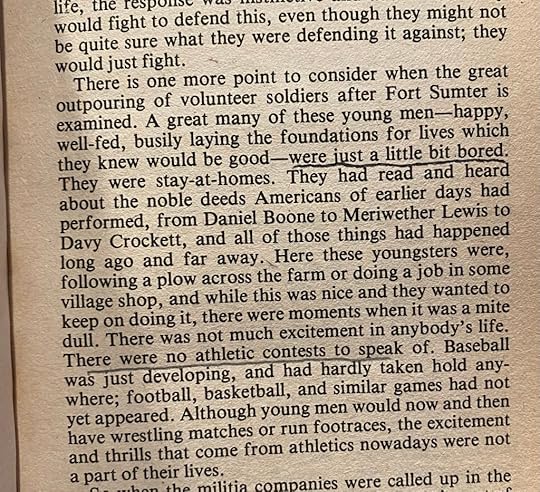
that from:
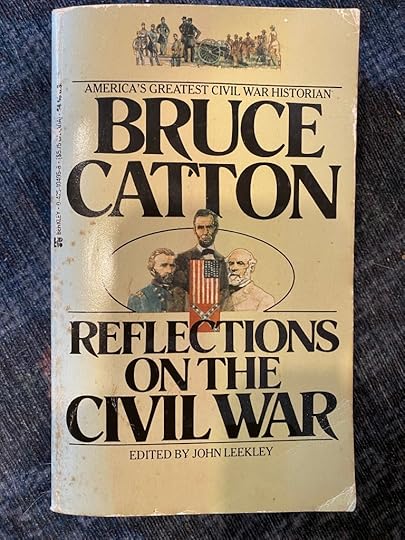
It sounds crazy but Bruce Catton knew Civil War veterans.
The big early Civil War battles were probably the largest gatherings in American history up to that time. The biggest tent revival meeting was probably 1/10 the size of Shiloh. Something big was finally happening. Shelby Foote speaks on this as well.
Is history driven as much as anything by the desire to “make history”?
September 17, 2023
Stone Town
An interview in the Financial Times with Nobel Prize winning novelist Abdulrazak Gurnah got me interested in the Stone Town area of Zanzibar.
I went for a walk around there via Google Maps and ended up tailing this guy:


Lost him somewhere around the Balinese Spa. I hope he had a great day!
September 16, 2023
Reno

Reno, Nevada named for Jesse Lee Reno:
He was brought by stretcher to Brigadier General Samuel D. Sturgis’s command post and said in a clear voice, “Hallo, Sam, I’m dead!” Sturgis, a long-time acquaintance and fellow member of the West Point Class of 1846, thought that he sounded so natural that he must be joking and told Reno that he hoped it was not as bad as all that. Reno repeated, “Yes, yes, I’m dead—good-by!”, dying a few minutes later.
Jesse Lee Reno made an impression at the time. There was a Fort Reno as well that turns up in reading on the Plains. Nothing suggests Jesse Lee was related to the unfortunate Marcus Reno of the Little Bighorn incident.
I learn in Tom Hanks interview on Rick Rubin’s podcast that Hanks spent some of his boyhood in Reno. In this interview I think Rick asks Tom about four questions, that’s enough to generate two hours of interesting content.
Trevor Bexon took that photo of Reno (the city) for Wikipedia. We were not enamored of Reno, the city on our visit there last summer. The best thing you can do in Reno is drive away to Lake Tahoe.
September 9, 2023
Acheson on Truman (and Lincoln)
WILSON: Well, I think the question that you’ve answered in great part in your book, that I would like to put a little differently. You indicated that you were working for a remarkable man, Harry Truman.
ACHESON: Oh, yes.
WILSON: And I wonder how much again the contrast between the previous man’s administrative efforts had to do with your obvious admiration and ability to work with Truman?
ACHESON: You mean FDR?
WILSON: Yes. It was so much better.
ACHESON: Truman was straight, above board, straight in line.
Two days ago, Monday, former President Sachar of Brandeis University was here and talked about President Truman. He started off by saying, “Let me read you two or three paragraphs here about Mr. Truman, criticize that.”
And I said, “All right.”
And he began about how with totally inadequate preparation, education, and everything else, Mr. Truman was turning out to be one of the best Presidents, and went on and said, “What do you think of this?”
I said, “I think it’s the goddamndest collection of cliches I ever heard in my life, and none of it is true.”
Well, he said, “You agree that he didn’t have any education.”
I said, “I don’t agree to that at all; he had a remarkable education.” My younger daughter had TB at 19, after she had been in college one month, and just been married and her husband went off to the war, and she spent five years in Saranac and lost her lung; and in the course of that time she spent in bed she read and read and read and talked to all kinds of people. And she’s far better educated than I am. I went to the best school, the best college, the best law school. That isn’t the way you get educated. The point is what enters into your innards.
Suppose somebody sits under John Kenneth Galbraith for three years to get an education; a hell of a waste of time. Mr. Truman read every book in the Independence library, which had about 3,500 to 5,000 volumes including three encyclopedias, and he read them all the way through. He took in a hell of a lot more out of that effort, which he took out of farming when he did it, than he would listening to all of this crap that goes on at Yale and Harvard, and perhaps in other places–Harvard Law School education.
I sit here and talk about his preparation. I would think he did more preparation by being on the County Court or whatever it was called in Jackson County, than he would have being a Justice of the Supreme Court, a hell of a lot more. See how people work, how the thing runs, what makes it tick, what are the important things, what are the unimportant things. And it’s sort of significant comparing to other Presidents. Well, I think I said Washington should have been President. Tom Jefferson I would give a very low rating, too; he was a man of words, and was a poor Governor, a poor Ambassador to France. The only thing as President that he really did that was really worth a damn was the Louisiana Purchase. And that was contrary to everything that he was . . .
MCKINZIE: That he believed in, yes.
ACHESON: Well, he said, “What do you think about Lincoln?”
I said, “The best thing that can be said about Lincoln are the Trumanesque qualities that he had.
“He said, “That’s the damndest thing I ever heard, you usually think it’s the other way, the thing that is good about Truman is the Lincolnesque.”
I said, “That isn’t what he had at all; he didn’t have Lincolnesque qualities. Lincoln had Trumanesque qualities. He did things that were contrary to the baloney that he talked; he didn’t believe his own book. A house divided against itself doesn’t fall if you stand up and fight, the house stands up, and he proved it. All these things–it isn’t true that a drop of blood drawn by the lash has got to be paid for by one drawn by the sword, or that the judgments of the Lord are true and righteous–poetic talk, that’s fool talk. Dr. Johnson said to Boswell, “You can talk foolishly, but don’t think foolishly.”
from Dean Acheson’s oral history at the Truman Library. I was looking for the source of Truman’s “cry-baby” remark re: Oppenheimer, as dramatized in the popular film. There were only three people at that meeting, so how do we know what happened? How does that story come down to us?

from American Prometheus.

The authors cite as their source a memo in the Truman Library:

If any of my readers pass through Independence, Missouri, grab me a photo of that memo in box 201, will ya?
September 6, 2023
Buffett on Buffett
Warren Buffett said in a written remembrance Tuesday:
Jimmy loved the audience just as much as they loved him. He never lost a fan. Music changed, performing styles changed, but if you liked Jimmy in 1983, you wanted to see him again in 2023. And you wanted to bring your kids.
I never heard him make an unkind remark – either publicly or privately – in the more than 35 years I knew him. He made everybody feel good, particularly me. We weren’t related but in his first call to me, he began with “Cousin Warren?” and I replied “Cousin Jimmy” and that’s the way it stayed.
from WSJ. You know we had to make the cheeseburger in paradise per lyrical recipe (only thing we didn’t have was draft beer but we managed):

We admire Jimmy as a writer and storyteller.
September 3, 2023
what causes US political polarization?
The jet airplane?
Smith: It’s interesting to hear Alan Greenspan talk about some of the factors that led to the change. He said one of them, he thinks, is the jet plane. Because now members from the West Coast, instead of bringing their families to live in D.C. – that’s something that you hear over and over again – that, in fact, families were brought to the District.
Rumsfeld: And much less so now. You try to have a gathering for an evening celebration for some purpose and to include members of the House or Senate on a Thursday or Friday or Saturday or Sunday, you don’t get anybody. They’re not here, the overwhelming majority. Unless they live in Virginia or Maryland, they’re not here. That’s one thing. The jet aircraft.
Another thing, I think, is the gerrymandering that has been developed to a fine art in our country. Today there are relatively few Congressional districts that are considered contestable. The threats that members feel tend to be in the Democratic Party from the left, and in the Republican Party the threat comes from the right. That tends to polarize the situation, and you don’t have this pressure, or natural political process that led people to work things out in the middle and to try to fashion compromises that would make sense for the country. So you end up electing people who tend to be most representative of their political party as opposed to their district. That’s, I think, maybe as or even possibly more important than the jet aircraft.
from Donald Rumsfeld’s oral history at the Gerald Ford Library.
Robert Gates offers different answers in his George W. Bush oral history:
Engel
As a person outside of politics through that interim largely, what did you ascribe that to?
Gates
It depends on whether you talk to Republicans or Democrats. [laughter] But it mostly happened in the House. Some people will say that it began with Newt Gingrich going after Jim Wright and the viciousness with which that took place. Others will say that it was the impeachment of Clinton. Others will say the cumulative effect of the Democrats controlling the House for 40-some years and the arrogance with which they did that and then the Republicans’ determination to take revenge when they finally got a majority.
But the thing that really began in the early ’90s was the steady erosion of the numbers—my best examples are in the Senate—of the people—center-left, center-right—that I regarded as bridge builders. David Boren called me in early ’94. He had been invited to become president of Oklahoma [University] and he was wrestling with it. He asked me to come down to his Senate office to talk about it. We talked for an hour. At the end I said, “David, there is an easy solution to your dilemma here. When you’re in your car or on an airplane and daydreaming, are you daydreaming about what you can accomplish at OU [Oklahoma University] or what you can accomplish in the Senate?” He just burst out laughing. He said, “That makes it easy.”
So you lost in fairly short order Bill Cohen, Sam Nunn, David Boren, Bill Bradley, and then over time Jack Danforth, Bob Dole, Nancy Kassebaum, a number of moderate Democrats, of additional Democrats. More and more from both parties, even in the Senate, which is less polarized than the House, all those guys from the center were disappearing. Olympia Snowe is the most recent. It’s not because any of them were in danger of not being reelected. They were just fed up; they were tired and frustrated because there was nothing happening.
Or maybe it all began with C-Span. Ari Fleischer in his W. Bush oral history, he’s talking about his time as a Congressional staffer:
Perry
Could I ask about reaching the public? You said you were learning so much about how it could be done in a noneffective way with the Republicans in the minority in the House. Can you talk about the role of C-SPAN during this time? I’m thinking particularly of Newt Gingrich’s use of that to foment the revolution of ’94.
Fleischer
What a great point. People forget, now with Facebook and Twitter, how revolutionary C-SPAN was and how, in the Senate particularly, it was controversial. “What? A camera in the Senate?”
A group of people in the House minority all of a sudden got this idea that if you delivered a one-minute speech, you could create an audience and you could market that speech. You could do things with the speech that the New York Times would never cover, that your normal mainstream media would never cover, so it became one of the first, if not the first, ways around the mainstream press corps to reach a targeted constituency. I think Republicans in the House came to it out of desperation and a lack of anywhere else to go, so it was good timing for them. If you remember, [Thomas P., Jr.] O’Neill ordered the cameras to pan the empty House chamber, showing that these are just speeches, there is nobody here, this is theater, which probably propelled it even more, because then people started paying attention. “Hey, it is theater; I want to see what the theater is about.”
It’s fascinating. In retrospect, if there is one thing I could change–and this genie is so far out of the bottle I don’t think you could, and I think Mike McCurry would agree with this too–I would no longer televise the White House press briefings. I would take C-SPAN off the air. There is a piece of me that is just–“haunted” goes too far, but if you think about the institutions in Washington that are held in the highest regard, with the most respect by the American people, it’s the Supreme Court, where their deliberations are entirely in secret, with no transparency, and up until 2008 at least, the Federal Reserve. Their deliberations are entirely secret. There is something about the massive exposure that also can coarsen democracy and that’s at work in the House, the Senate, and the White House. The genie is out of the bottle, but it did start with C-SPAN.


