
Michael Jecks's Blog, page 18
April 2, 2016
Blood and Steel
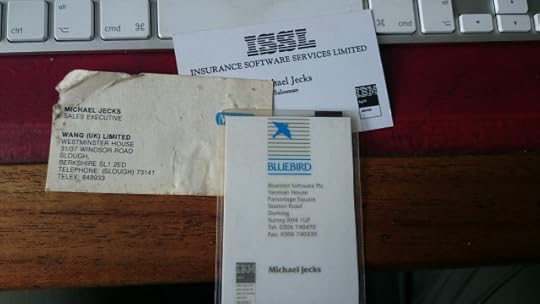
A few of the 13 jobs I had before writing.
Over the years I’ve worked with many firms that went bust, and it’s horrible, every time. For those who are in there, and feel the earth taken away from under their feet, who feel the embarrassment and fear as they tot up the monthly outgoings and look at the blank sheet of income, it’s much worse than horrible. It’s a catastrophe.
Occasionally it can be entire industries, such as the coal industry that was destroyed so unnecessarily in the 1980s. Some guys say it’s a shame, a disgrace, that the steel industry should be supported and maintained. Others say it’s a shame, so sad, but the industry cannot compete.
I have sympathy with the families of the workers. I think Tata have been a good employer for the last few years, but that won’t make life any easier for the people who are staring down the barrels of a payoff and no money.
When I was a computer salesman, I regularly had to accept redundancy. But never the megabucks redundancy of a banker or chief executive. The largest pay off I ever got was the statutory minimum.
I remember those days very clearly, the miserable feeling in the gut when you hear that yet again the employer is bust. I had a period of work when every company I joined soon went broke. My record was NBI, which headhunted me from a secure job, and two weeks later folded when the American owners decided to concentrate on the domestic market. They paid me a month in lieu, I think.
Another firm took me on, and although in the space of three months I made them some 70,000 pounds, yet they never paid me my salary, expenses, or commission. Basically the director was dealing fraudulently, and the court found in my favour to the tune of nearly eight thousand pounds. However I was advised by my lawyer to give it up. To get bailiffs involved would cost me even more. The man was so unreliable, his own lawyers were chasing him for their fees.
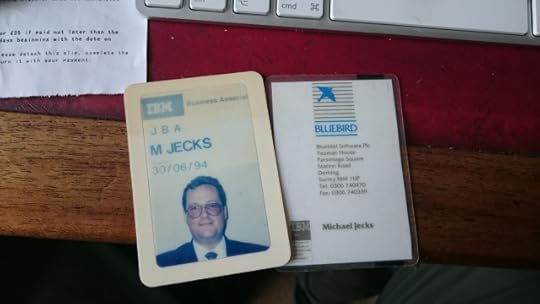
These two were competitors. Bluebird went first, so I went to JBA. Mistake!
Before that I had worked for Bluebird Software. It seemed a safe bet, since it was one of IBM’s biggest software houses in the UK. I sold a lot for them in a year, but even so, after twelve months the firm went bust. I was owed thousands in commission, in holiday time, and expenses. But weeks later, when I received a seven page summary of the money owed, the total at the bottom had a line through it. After paying off other creditors, which meant the banks and government, I was allowed the statutory minimum of some two weeks at the basic wage. I was owed thousands of pounds, but got only two hundred.
And that is my point. There are not going to be people winning a chunk of money that will pay off their mortgage and set them up to begin a new business. When an industry shuts down, people are likely to lose plenty. And that means not only Tata Steel, but all the little businesses that feed Tata too. If Tata closes without a buyer, the workers are likely to receive their own seven page summaries with a minimum amount at the bottom. So are those who depend on supplying Tata as well.
Does that mean that the government should buy the business and keep it going?
No. What would be the point? If the companies cannot sell steel when they are private, who would honestly think that they would survive better while owned by the government? What would the plants do, stockpile steel in rusting mountains in the fields outside Port Talbot and Llanwern? The simple fact is, that unless Britain imposes trade tariffs on Chinese imports of steel, so that the Chinese stop dumping cheap steel in our markets, the steel plants in this country, paying our inflated “green” electricity rates will remain uncompetitive. They cannot compete with Chinese prices. So they can keep on stocking steel as long as they want, but they won’t sell it.
And England cannot impose tariffs on China. That is an EU issue. We are not allowed to act unilaterally, apparently. America has imposed tariffs, I believe, of some 200%. The EU has agreed on 9%. That’ll work, then.
So what should the government do?
The main starting point should be to look at the people who really matter. Those who’re going to lose their jobs and their families. I know what it’s like to discover that there’s nothing for the next month, that the job is going, that there’s no money coming in. I had that all through my 20s and 30s, and I don’t wish it on anyone else. It’s miserable.
Maybe the state should set up a creative team to help the people, and rather than bringing in civil servants or consultants on high expense accounts, they should hire people from the area who worked in the industry. They need people who’ve been through job loss, people who have set up their own businesses, entrepreneurs and advisers who can motivate and enthuse the locals. But most of all, pick people from the communities. Men and women who are successful and know the area.
Is this a simple fix? No. The sad fact is, there isn’t one. No company is forever. It doesn’t matter how loyal the staff are, how enthusiastic they are, nor even how important a business is. If it’s not viable, it will be closed.
But the people need help, and their communities too, and they deserve all the help we can give them.
Tagged: computers, jobs, redundancy, solutions, steel, work


March 14, 2016
The Project
There are some years that start well, others that don’t start so well. This one’s not been good. We always knew that would start badly, though. I lost a very dear friend, Andy Setchell. What with that and my daughter going through the horrors of her mock GCSE exams, YouTube and my blogging activities have been pretty dramatically curtailed. Apologies for that.
However, now I’m back – and with a vengeance, as you might say.
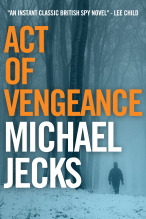
Now available as paperback too!
Act of Vengeance came out as an ebook a while ago, but I’ve reissued it through Endeavour Press this year, which means you can also acquire it as a paperback novel. Many people expressed an interest in this (and I did have all their emails, but sadly I’ve had three computer failures since then, and lost all of them) and I hope that this very late addition to the Jecks oeuvre will appeal still! Oh, and while I’m on the subject, if you liked the idea of my short stories, you can buy them repackaged now, too. No On Can Hear You Scream and For the Love of Old Bones are on Kindle and will shortly be available as paperbacks too. 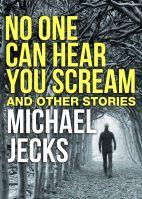
If not, you also have the excitement of Rebellion’s Message, my first Jack Blackjack book with Severn House, which is published in April, my parts in the Detection Club’s excellent The Sinking Admiral from HarperCollins in May, and the third of my Vintener Series, Blood of the Innocents, in August from Simon and Schuster. That’s not enough for you? Then you will be glad to hear that there are other books on their way, too.
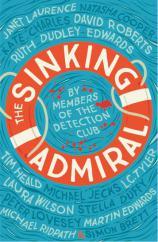
An excellent story from a selection of wonderful writers. And me!
However, this blog isn’t about any of them. This is about my method of writing.
Last year I had three major computer failures, as I’ve said, and they necessitated a degree of rethinking of how I work. I was careful always to back up my data, careful to store data off site, and basically just behaved like an OCD and paranoid author should. And I still lost tons of important data. Some were photos (important ones of the family), some were essential memos and emails from friends when I was the Chairman of the Crime Writers’ Association, and I also lost a lot of notes of old books. Luckily most of my most essential research and records of old books were held off-site in the cloud, but that didn’t protect me from headaches – such as, for example, trying to find the collections of short stories to make up No One Can Hear You Scream. They were all lost.
Back in the last century, I met with the great Laurence Block when he turned up unexpectedly at a CWA dinner in London. He was immediately wrestled to the floor and persuaded to join the Association. Later, over drinks, he told me that he had returned from a holiday only recently, during which he had written a book using an admirable tool known as a typewriter. He laughed about this machine, and I found myself screwing up my face in horror at the thought. The very idea of carrying paper, when a chap could be lugging a lightweight laptop struck me as crazy. He didn’t care. In fact he said he intended going back to real basics and using a pencil and paper for his next novel.
That memory came back to me last year. I contacted some people, and I was staggered to find that many people were prepared to help.
The first folks I spoke to were the wonderful guys at Cult Pens. These are a small company based in Devon (I like to support local businesses when possible). The Walkers, who own the business, were incredibly supportive and helpful, and they showed me a trio of superb manufacturers who might help.
Diamine, with incredible generosity, sent me one of each of their colours of ink. That may not sound much, but when I say that it involved 106 bottles of ink, you’ll get to appreciate their kindness. With these I thought I could write a book using a different colour every day. That way I can assess the way I am writing, I have a quick reference to show progress, and, more important, I keep my own interest going because of having all those luscious colours.
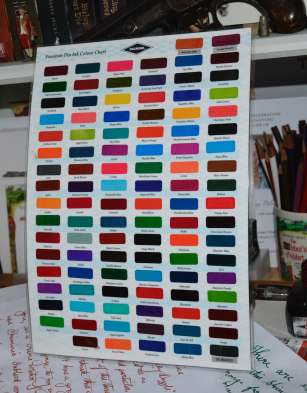
Full range of Diamine’s regular inks
I spoke to the wonderful firm Atoma next. Atoma is a Belgian company which makes superb stationery and pads. The pads have the brilliant advantage that each page is held in place by a ring, but there is no wire binding or clip, only a series of rings that hold the paper because of the fat rim, compared with the slim centre section. With this I can add pages in the middle, I can remove pages, replace them, insert smaller pages with notes – in short, use it as flexibly as I wish. Atoma not only gave me a gorgeous red leather A4 pad made by Ruitertassen for me to use as my main working file, they also gave me reams of paper to go with it.
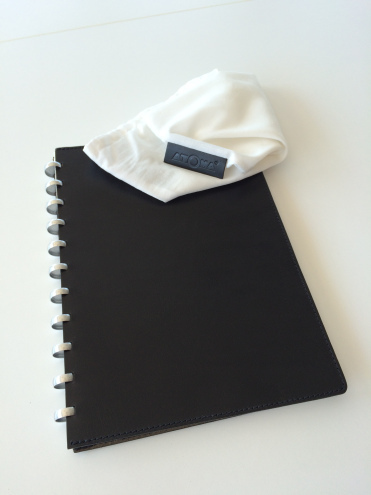
Black leather Atoma
Finally, I managed to speak to a new best friend. I’ve decided this because Dante del Vecchio, the owner of Visconti pens, is such an enthusiastic, keen proponent of writing and writing tools. I have used one of Dante’s pens for years now. It is a Homo Sapiens pen, made from lava from Mount Etna, with bronze fittings, and I’ve put a lot of ink through it. However, as I explained to Dante, if I were to write a book, I would have to have a window so that I could see the amount of ink left in it, and the lava leaves a lot to be desired in terms of visibility.
A short while later, I received a new pen. This one-off is a Homo Sapiens again, but instead of a metal ring, there is now a clear acrylic window. In the main barrel, there’s also a slot cut so that the user can see right through the pen and view exactly how much ink is left in it. However, there’s another twist to this beautiful pen. Instead of the standard “Powerfiller”, which is a vacuum system, this pen has Dante’s twin reservoir system. That means it will take a vast amount of ink. More than I can use in a day of solid writing (although I have got close to using it in one sitting). The main thing is, however, this pen has one of the Visconti fine Palladium nibs which write like an absolute dream.
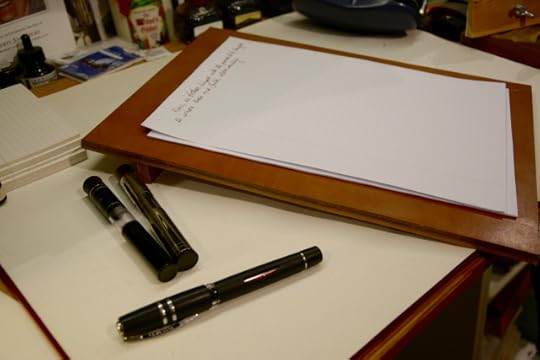
Lovely new Homo Sapiens and my leather writing desk
The only other item I need is the writing board. I do not want to be tied to a desk or table, so I decided I needed a solid surface a little larger than a A4 so that I could write in the garden, in the sitting room, anywhere. That, however, was my own invention. I spoke to a good friend in the village, Matthew Payne, who happens to be a leather working expert (he’s a master bridle maker), and he advised on making a leather board. It works superbly well for me.
So, there you are. My next book is being written in ink, using Diamine ink, a Visconti pen and Atoma’s excellent notepad systems. And so far, I’ve found it a wonderful experience. Without the computer to distract me, I’m writing more and faster. Without notifications and tweets, I’m finding my concentration is much better for longer periods, and the fact that I can pick up my leather lap-desk and move from one room to another as the mood takes me, means I am getting more writing done.
I hope to tweet daily, write blog updates weekly, and also film YouTube videos as I progress. I’ll be talking about developing the story, about my characters, about my locations, and how the story develops, as I get the chance. And then, with luck, I will be continuing to write using a pen and paper. After all, it is a great deal more attractive to have an actual manuscript rather than a printed sheaf of papers at the end of the project!
And apart from all this, what else is happening in the world of Jecks? Well, I’ve finished another manuscript that’s being read by the agent, I’m judging the Paddon Award for Exeter University this week (a very hard job, with a real variety of different writings and styles); I’m teaching at the Swanwick Literary Festival again in August, and in October I’ll be the chairman of judges for the excellent Impress Prize from Impress Books. That was very hard work last year, with an incredible standard. I look forward to headaches over that one again this year, desperately trying to pick the best work from a quality shortlist.
So, apologies for the delay in updating things, but I hope you’ll find the writing project to be interesting as I go through things. Meanwhile, here are some more photos, and I hope you have a great week.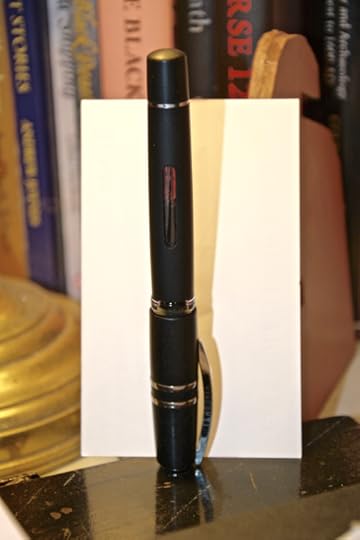
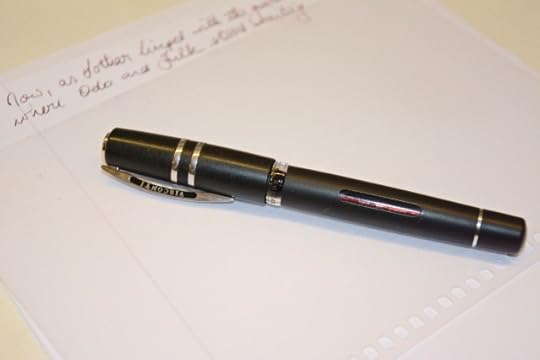
My lovely Homo Sapiens designed for writers – clear window in the barrel of the pen, and a clear section below the cap, so I can see how much ink there is left. Gorgeous balance and feel, and the material is about indestructible.
Tagged: amazon, Atoma, author, Dante del Vecchio, Diamine, Homo Sapiens, Ink, lap desk, new titles, novelist, Visconti, writing


February 22, 2016
Books, Reviews and Morris!
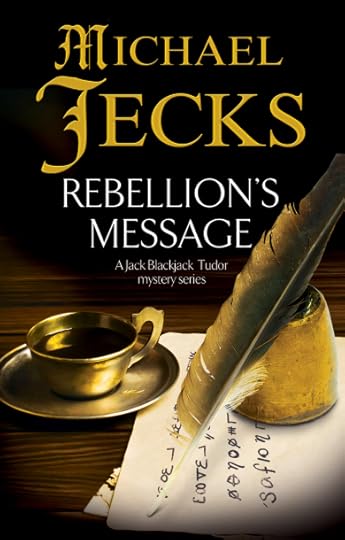
Order your copy now. It’ll be published in April by Severn House!
Look at that nice new cover. Beautiful, isn’t it? It will be the first of, I expect, a series of crime stories based around Jack Blackjack, with the first coming your way in late April from Severn House. Hope you will enjoy it!
Books. I have piles of books in my office. Piles and piles, in fact. The last time my father came to the house, he looked around at the shelves groaning under the weight of books, and shook his head. ‘Have you really read all these?’
That day, some eight or nine years ago, I could happily nod. But sadly he’s now so old that driving is not realistic (well, not without unrealistic danger to all other road users), and I can only imagine what he would think of the stacks of books on all surfaces that have not yet been read. There are rather a lot of them.
It’s not my fault. Writing is a demanding, time consuming job at the best of times, and it’s been some years since I had time to sit down and devote hours at a stretch to reading for pleasure. Children, deadlines and talks all get in the way. And it is not as though I spend my life collecting books. I tend only to buy research material. The books that are sitting haphazardly all over my office are the ones that publishers send to me.
There are historical romances, modern crime, medieval crime, modern spy stories, self improvement books … well I could do with reading some of them, to be honest, but the main thing is, there are just too many.
Some I will dip into, and generally try to read a little daily. It doesn’t really work. All too often you have to be in the right mood and ready and willing to devote a fair amount of time to a book. But I can’t. While writing I cannot other people’s books. Invariably, without intending it, I tend to find that I start copying the writer’s style, and that can be disastrous!
However, sometimes a book arrives that does demand attention. And after a while I’ll find time to actually read the darned things.
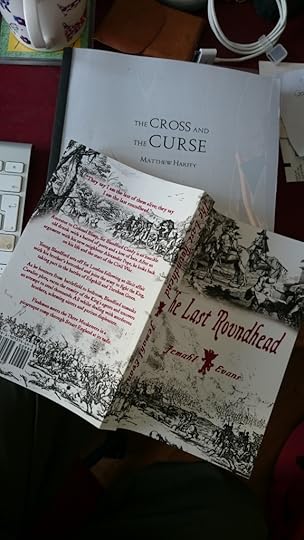 Last year I was fortunate to be given a proof copy of THE CROSS AND THE CURSE by Matthew Harffy.
This is a great read for those who enjoy dark age tales. It begins with a prologue in 619 AD, when Paulinus, a Christian missionary of a more masculine type, arrives in a new land to spread the word. The priestess of the area, Nelda, begins to bring down her curse on this unwanted newcomer, but when he prays for help, lightning strikes Nelda’s sacred tree and destroys it. Appalled, she accepts banishment from the village, but her son she tells to stay there.
However this is not their story. It is Beobrand’s. A warrior from an earlier book (I’m assuming – I haven’t read any others of Matthew’s) has joined a new war band. He’s bitter, he’s injured, but he’s young and he’s determined to carve out a future for himself. Not that he thinks he can succeed. It doesn’t seem likely, especially when his own lord is killed during an attack that Beobrand recommended, but hey – that can be life for a warrior. Luckily the attack succeeded, and he is rewarded. However, rivalries and danger are ever-present in this dark evocation.
I won’t go further. Suffice it to say that I’ll be hunting down copies of Matthew’s other work. I really enjoyed this.
But life cannot all be dark ages. And I had to try out a book I learned about on the internet. I was tweeting about various things and met a guy called Jemahl Evans in Wales. We had a brief conversation, and the upshot was that we swapped books. He got FIELDS OF GLORY, and I got THE LAST ROUNDHEAD.
This is, frankly, glorious. Blandford is an earlier version of Flashman from George MacDonald Fraser’s superb series, but leavened with a measure of Colonel Blimp. He is irascible and a drunk, which is why he finds himself in London at a bad time. He had to go: he’d been engaging in horizontal jogging with his brother’s fiancée, and it was because of that unfortunate liaison that he found himself engaged by the King to serve in the army. Not a good idea before Edgehill and Turnham Green.
The story is a romp that does not take itself too seriously (often a failing of more humorous stories), but instead bumbles and bounces from battlefield to battlefield, enjoying a little Tom Jones’ style of diversion along the way. It is thoroughly delightful, and I recommend it to all who enjoy Flashman, Tom Jones and similar period romps. The great thing is, I think I learned more about the English Civil War from this book than any other I’ve read – and it was all enjoyable!
What else? Well, I have to go to enjoy a meal on Wednesday, that will entail taking a load of work on a train for some hours. That will be good. It’s rare that I get to travel at all nowadays. I’m generally too busy. I have a novel and a short story to amend, and hopefully much of that will be done on the train. But I also have to finalise characters in the new book, and that will involve a lot of planning.
However the week is not all about enjoyment, sadly.
As readers of WriterlyWitterings will know, I was deeply saddened a couple of weeks ago by the death of my old mate Andy Setchell. I wrote about Andy in the last blog. When this is published, I will be sitting in the church with him to say goodbye. I miss him hugely.
So this week, I will be reminding myself that life is fleeting at best; it’s not a rehearsal, as my Canadian buddy likes to remind me. So as soon as I’ve got some work out of the way, I’ll be making sure that I get to see more old friends in the coming year.
Thinking of old friends, I have to put in a short plug here. Some of the best friends I’ve made are the guys who can laugh together, who have totally different backgrounds, different jobs, different attitudes to life, but who enjoy it to the full. These are the lads who make up the Tinners’ Morris band of brothers. I’ve been enormously fortunate to have made so many very good friends in this group of pub-crawling old devils. If you want to see more about us, please look at their page on Facebook for photos of a deeply embarrassing nature: https://www.facebook.com/Tinners-Morris-607356326084359/?fref=ts
Like that page, and you’ll see when we are dancing in your area, and with luck, you can come and see us!
Have a great week.

A rare sight. All feet simultaneously off the ground!
Tagged: friends, Jemahl Evans, Matthew Harffy, The Cross and the Curse, The Last Roundhead, Tinners' Morris


February 8, 2016
RIP, Andy, old mate
It is always the way. You prepare and plan and get ready to start a new book, and always, without fail, at the last minute another blasted editor’s commentary, copyedit or proof materialises. I have three books to write this year, and I’m dead keen to get started. But last week a copyedit came and I’m working my way through it.
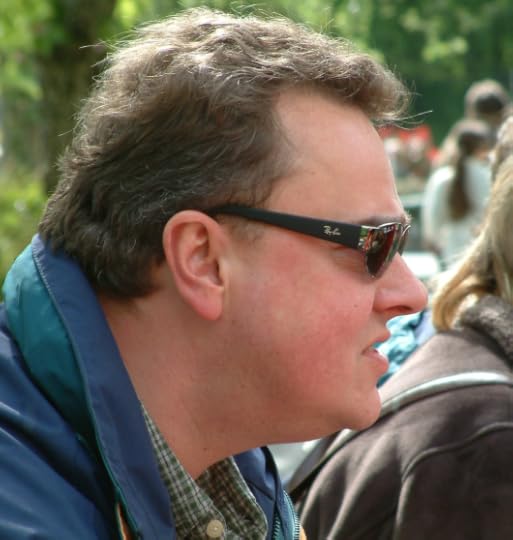 The last week has been particularly hard, and not because of work alone. My oldest friend from university days, Andy Setchell, died after a heroic struggle with cancer.
I can remember Setch from my first interview at City University. I was a cocky brat in those days. Dressed in my best (only) suit, I arrived at the university interview with the arrogance that my A levels justified. I sat in a fairly large room with various others. One I noticed in particular. He was tall, plump, and had hair that looked to me to be nearly vertical. He wore baseball shoes, jeans, and a bum-freezer jacket in a kind of tartan denim. I had no idea how close he and I would grow.
Andy (aka Big Boy) was a larger than life character. He was the first to throw himself into university life, ending up in charge of entertainments so that he could get himself known in the music industry. He helped bring a number of great acts to play. And he had a terrifying capacity for beers and wine. I blame many hangovers on trying to match him.
After he gained a degree (which somehow I failed to do!) in Actuarial Science, Setch moved on to greater things, working in a number of advertising agencies, first as an account manager, then as a planner. He travelled the world with the different clients, once calling me from Singapore on a stop-over. I asked where he was going, and he told me he’d been to Australia. He had a client meeting. He flew in, held the meeting, slept in his hotel room for an evening, and caught the next flight back. In Singapore he was stuck between two jet lags and trying to work out which time-zone his body thought it was in!
He married Mandy just before I married my wife, and I can still remember the look on his face when my wife-to-be and I asked him to be our best man. He was initially delighted. Then I explained that we wanted an entirely non-religious ceremony, and being best man meant being the celebrant, and his smile became somewhat glassy. However, being a good sport as always, he agreed and did a superb job.
I vividly remember when I was starting to write professionally. Many times he would call and invite himself down with Mandy, and when they arrived there was always a Red Cross parcel. He knew how hard up my wife and I were, so he invariably brought a case of wine with him. The case would be depleted after our meal, but there was always enough to tide me over until the next visit.
 Andy lived for children. He adored kids, and some of my fondest memories include the times I’d go to Andy and Mandy’s house with my two. The little devils would be spoiled to utter distraction. Andy would take us to his local parks and entertain them with his radio controlled boat (it sank), to the water park, or the recreation ground. With the passing of every new year he would invite us to his house and hold a Christmas feast (thanks to Mandy’s cooking skills) before presenting the children with gifts. The spare room was decorated with jungle, wild animals, and bunk beds suitable for children. There were toys, children’s books, games of all kinds; outside there were suitable diversions: water pistols, rifles and cannons.
Entertaining children aside, Andy wasn’t the most energetic fellow generally. Once he came on a walk with me over the moors – it did not help that the hound stood on his foot and almost crippled him, but it was a very slow Dartmoor ramble rather than the extensive march we had intended. He was incapable of cycling; he had never learned how to balance on a bike. The worst thing I can say about him was, he had an entirely irrational dislike of folk music and Morris dancing! Still, I’d forgive him that. He had enough good points.
Andy was a fiercely determined bloke. He had a brilliantly incisive mind, and when he set it to achieving something, he invariably succeeded. Realising one year that his levels of fitness left something to be desired, he started swimming. He participated soon afterwards in a “swimathon” to raise money for charity, and covered what seemed to this indolent author a huge distance. I’ve enough muscle power to survive two, perhaps three lengths. Andy did many times that. Last year, after two years of chemo, radio therapy and many operations, he phoned me to say he’d just completed thirty-five lengths at his local swimming pool. I can still remember the pride in his voice. He was so pleased, and he was desperately keen to take part in another swimathon in March this year to raise more money for his favourite charities. Sadly for all of us, he won’t be making that.
Andy Setchell helped keep my sanity when I was started out as a writer. He was always there to discuss problems, always loyal and generous. He was a guy who could be trusted and relied upon.
My sympathy to Mandy, his widow, his mother, and his brothers Alan and David.
All his family and friends will miss him enormously.
Tagged: Andy Setchell, City University, obituary, RIP


February 1, 2016
The week in view
The last week has been rather full of reading, just as the previous couple were.
It’s the interesting stage (for me) of writing a novel. First there is the initial idea, that soon develops into a basic plot. Then there is the development of characters that will work within the main plot, and bring their own little problems and foibles along with them. Finally, there is the research all around the story itself.
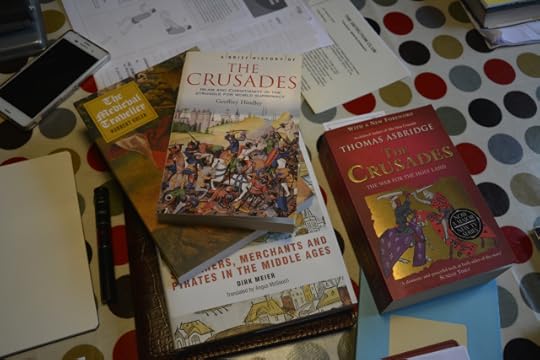
Books, glorious books!
This is, obviously, the thrilling part. If you are an author, you will like books. Being about to launch yourself into a new novel is brilliant because you’re allowed to read to your heart’s content. It’s a time of invention, of sparkling ideas that flash into being and weld themselves into the main theme. You go to bed thinking about a particular scene, and wake to an entire chapter (which will disappear if you don’t grab that blasted pen immediately and scribble it down). You worry at a problem and read more and more to try to tease out every ounce of excitement and information you can, only to discover a serious flaw that sends you back to the beginning again.
For authors, this is the hazardous stage.
Everyone knows what it’s like to be buried in a book that you cannot put down. That is why authors are absolute hell to live with. When they are writing, they will be impervious to all life around them. I know I am.
Wives can suggest going shopping. Forget it. The author can be informed that the washing needs doing. Tough. Husbands may point out that the child has just been dragged round the corner by “Kylie”, next-door’s Rottweiler, and be rewarded with a “Really, dear?”
In short, while an author is inventing a story, you can write them off.
But this is the dangerous stage not because of tension in a marriage, but more because the author can get so engrossed in making sure that all the details are right that they forget the minor detail of deadlines.
All authors get that. Students too. They work away reading more and more about their topic, looking for that essential new detail that will bring their work to life, only to realise, two days before the deadline, that they haven’t written a single paragraph yet.
I have. I’ve got the first five pages written. And they are all rubbish. I know that. Not one of them will make it to the final version of the book. But, and it’s a big “but”, I have actually started to write. That gets me over the first hurdle. And with three books to write this year, it’s a significant one.
The other significant feature for me this year is the fact that this is the first novel I’m writing using pen and paper, not a computer. It’s wonderful. I can write standing at my desk, and I can have my mind wander more freely. No longer am I stuck thinking about the next tweet, the next Facebook message, the next email. None of them is quite so urgent as this latest book. So messages will wait.
Meantime I am standing writing with (today) Syrah from Diamine, a lovely deep berry red. It’s gorgeous. I’m making lots more notes, finalising the main timeline, and writing character details: what each of them looks like, back story, character traits etc. I am hoping that having thought through this kind of detail will make the story flow more logically.
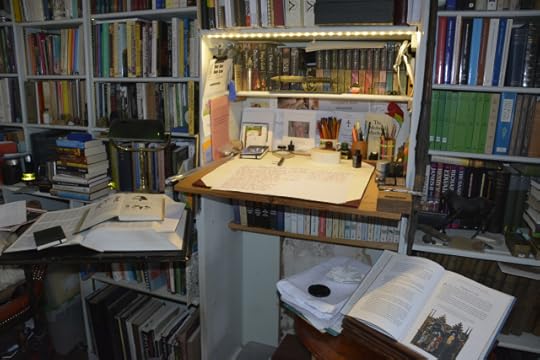
Standing desk with the first pages scribbled in Syrah from Diamine
Because of the way this book is developing, I’m using one large Atoma notepad to work on. I write on individual pages, and then set them into the Atoma rings sequentially. However, Atoma gives me the option of ripping pages out and moving them or replacing them as I need. It makes holding the story together much more easy. I suspect that before I’m done I’ll need several other Atoma pads, perhaps one per theme.The book itself will be far too thick to hold in any one pad.
I am also thinking of making a new desk. I have been dribbling over lap-desks for a while. I love Edwardian and Victorian writing slopes. If you haven’t seen one, they are wooden boxes, generally, that open up to create a sloping surface, usually leather or soft material, on which to write. Campaign models were rather heavier versions built to a robust standard. They are beautiful pieces of workmanship. However, I’m considering making a flat, leather surface on which to write so that I can sit at any chair and work. It will mean I can work in any room in the house, and also that I can go out and about. I hope to find some good leather from a local tannery that will more or less match my Midori Traveller’s Notebook. I’ll stitch that over a 4mm sheet of ply, I think, to give it good strength. My only issue is whether or not to build a support into it so that I can use it sloped, and whether I should build that like an iPad support with three sections that fold together. Lots of ideas to work on there!
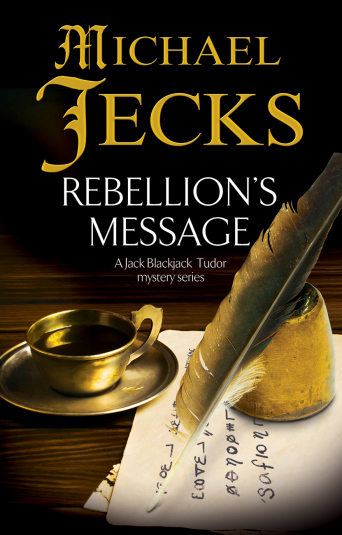 I cannot go without showing you a preview of the cover for the new title with Severn House. This will be out in April, and I’m really looking forward to it. Hopefully readers will enjoy it too!
And now a sad end to this week’s blog, I’m afraid.
Sadly real life impinges. The older I get, the more I appreciate friends, but it’s an inevitable fact that good friends will fall by the wayside.
This year our village has already lost two folks. Nationally we have lost several giants in the world of music. Over the last weekend the great actor Frank Finlay died, and so did Terry Wogan, a brilliant comedian, radio presenter and TV star. However, locally a more important man died: Tony Beard.
Tony was a presenter on Radio Devon for some thirty years. A true countryman, he was popular at events from the Okehampton Show to Widecombe Fair. A hilarious after-dinner speaker, he was also the compère for many years at the Dartmoor Folk Festival’s concert evening.
A thoroughgoing professional, and a really delightful character, he’ll be greatly missed.
Tagged: Atoma, Diamine Syrah, lap desk, standing desk, Terry Wogan, Tony Beard, Visconti Homo Sapiens, writing slope


January 20, 2016
Thank You, Public Lending Right!
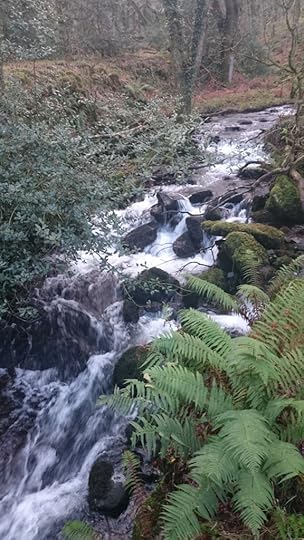
Cold and very wintry just now. Central heating is needed for freezing authors!
It’s at this time of year that authors all sit back and stare in horror at their bank accounts.
Christmas is past. Long past. The summer is a long way away. The heating has to be funded, food bought, children’s dance lessons, hockey lessons, rugby lessons all have to be paid for, as well as the clothes to go with them. And the last shot of income was back in September or October. The next income? Perhaps April. Authors get paid every six months for the sales their books achieved in the half year before that – so the income in April will be based on book sales from July to December the year before. And right now all the festivities have to be paid for, as well as the tax bill.
There is one bright light in all this. The Public Lending Right.
PLR was first introduced in Denmark in 1946. The other Scandinavian nations followed, and even England (after a lot of effort by British authors) agreed to have a PLR law that was eventually brought in in 1979. So what is it?
Well, PLR was designed as a way to reimburse authors for the sales they were losing because of Libraries lending books. It was considered that the access to knowledge and recreation was good, generally, for everyone. Thus people should be allowed to read the latest fiction and non-fiction in their public libraries. However it was accepted that authors who went to the effort of putting together those works should get compensation for the number of people reading their books. It was decided that there should be a fund, and that the fund should pay a reasonable amount for every book loan made. That money would be measured and paid direct to the authors.
At first, before mass computers, this wasn’t so easy. Libraries had to measure how many books were loaned. They had to note which version of the book, by Standard Book Number (SBN – later International SBN or ISBN), by author, by title, by edition (hardback or paperback). That data had to be collated and then the money paid to the authors. Authors had to register, naturally. However this was far too complex for every library to be involved, so a sample of libraries was nominated, and the data from those libraries extrapolated to cover the whole of the UK. Later, as computers became more prevalent, systems were designed, until now all libraries have their systems that can produce relevant totals for the workers beavering away at PLR headquarters.
At first it was books only. More recently, there have been moves to include other formats. Audio books and electronic books, for example – but there is a catch. With e-books, authors can register, and any books that are downloaded in a library with accrue PLR. Which is great except books downloaded at home are not eligible. Why? Because if it’s downloaded over the internet, it’s legally viewed as publicly available, so the download doesn’t earn money. That sort of sounds fair, but then when it is realised that there is not a single library in the country that has the facility to download books in the library itself, it makes a nonsense of the idea. Politicians made that law, naturally.
The scheme itself pays (currently) from a fund that permits £0.0767 per loan – which is not far short of what an author would earn for a book sold through Amazon, to put it into perspective (after discounts, agent fees, but before paying income tax about 11 pence). So that the richest authors who already earn megabucks don’t suck up all the money, it is capped at £6,600 per annum per author. Many of the very top authors refuse to accept their payment on the basis that their money stays in the fund, and more authors on lower incomes can therefore be paid a little for their efforts.
There are some exclusions. As I understand it, libraries which are run entirely by volunteers are not part of the scheme. This is becoming a problem, because since the disaster of 2008, many local authorities are cutting back library services drastically. To keep libraries running, many are being taken over by non-profit groups run entirely by volunteers. These do not participate in PLR. Many libraries are being closed, so that local folk don’t have access to books, and even those that are continuing are suffering from slashed budgets so that they cannot afford to buy new books.
Even so, libraries are a vital part of the publishing and reading world. They provide access to reading that would not otherwise be available – and every February they help keep many authors from bankruptcy.
I can remember with perfect clarity how grateful I was in my first year as an author, when I earned a few hundred pounds to supplement my very meagre annual income of £3,000! Now, thanks to 90,000 loans, I can survive until the next royalty cheque.
So thank you, PLR. You are a lifesaver.
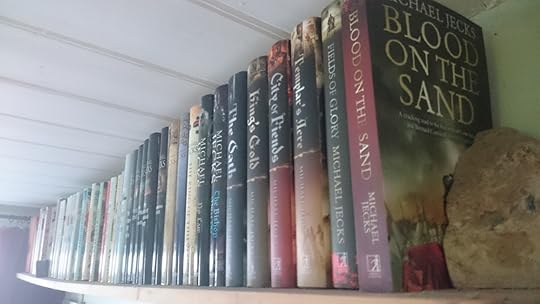
Look at that lovely row of Jecks titles!
Tagged: author, books, ebooks, ISBN, lifesaver, loans, PLR, public lending right, SBN


January 18, 2016
Weekly Update
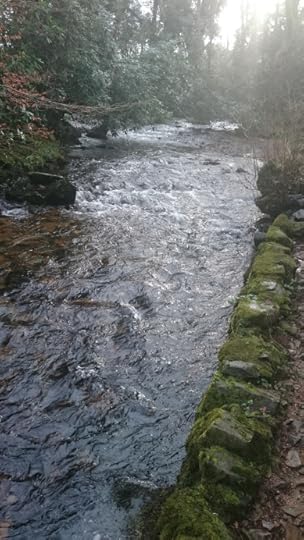
River Taw at Sticklepath – high and fast!
A short update this week.
I’m in the middle of rewriting the end of my latest modern crime story, but it’s not an easy one and it’s taking rather longer than I’d expected. However, with luck I’ll finish it today or tomorrow before sending it to Canada to my favourite copy editing expert (you know who you are, Cheryl!); meanwhile, Rebellion’s Message has just come back from the copy editor, and I’ve had warning that Blood of Innocence is coming back in a week. At some point The Sinking Admiral, a collaborative book from The Detection Club which I’ve participated in writing, must return, too, since that’s out in June. That means three books in the first six months of the year.
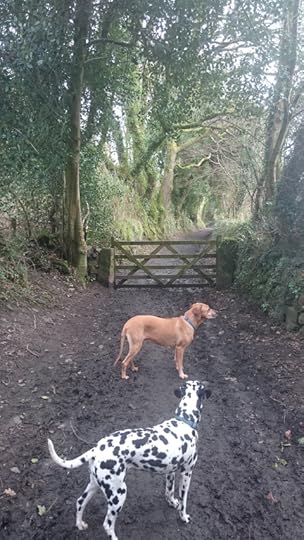
Happy hounds now I can walk (or hobble) them again!
At the same time, I have bitten the bullet on For the Love of Old Bones, No One Can Hear You Scream and Act of Vengeance. Rather than trying to write new books and market and publicise these three, I have worked with Endeavour Press. They will soon be relaunching all three, and taking over marketing responsibilities for me. That will be quite a big strain taken away so I can concentrate on writing again!
I’m also working with my indefatigable web site administrators, Jean and Roger, to redesign my ‘Landing Page’ on the website. Since I’ve now got so many YouTube videos (the latest is here), photos and different series, it makes sense to try to rationalise the way the website works. With that in mind, hopefully the new website will work better for new people who haven’t read my books before. It should also work better on tablets and mobile phones, too. I’m looking forward to being able to announce that launch soon.
My leg is still playing up. I fell on 20th December, in quite an impressive manner. My left foot was on what looked like a patch of grass, which soon showed itself to be disconnected with the rest of the planet. My foot turned 90 degrees, and I fell vertically, spraining both knee and ankle. Yes, it was painful! However, it is being a little slow to recover. Personally, I reckon largely because I am an old git now, and things do take that bit longer to mend. Be that as it may, Tom Bell, a good friend and expert doctor, has persuaded me to book myself into the nearest clinic to get myself checked over. Hey ho. Another day’s work lost!

That’s Alan second from the right. Get better soon!
Still, things could be a lot worse. My three brothers went on a skiing holiday last week. I was enormously jealous (since I haven’t been able to afford such luxuries for over 25 years), but my jealousy has been tempered by the news that my oldest brother, Alan, had a bad fall (while pretty much stationary) and has broken a vertebra in his spine. All seems well, with Italian doctors knowing what to do to brace and protect him, but he is in a lot of pain. I hope he soon recovers.
That’s all for now. I have to dip back into modern life now, finish this book, and then jump back into the reign of Bloody Mary and the copyedit.
Have a great week.
Tagged: Alan Jecks, author, Blood of Innocents, books, Rebellion's Message, Sinking Admiral, update, writing


January 11, 2016
Review of 2016 – Books and Tools
It’s always interesting to review a year that has just passed. 2015 was not a good year for me – with 14 friends and family dying, it was never going to be a happy year. However, at least there are people who help distract me. And first amongst these are authors, of course.
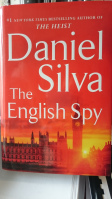 Last year was a good year for new books and new discoveries for me. With excellent stories from writers like William Ryan (they are immensely readable, and draw you into the grim harshness of Stalin’s Russia), from Daniel Silva’s superb THE ENGLISH SPY, to the late and hugely missed Terry Pratchett and his RAISING STEAM (a wonderful read).
Then there were some wonderful surprises. Simon Scarrow is known for his really brilliant series of Roman warrior stories, but his HEARTS OF STONE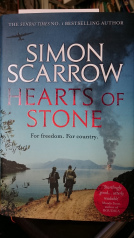 last year is a wonderful evocation of the impact of war on 1940s Greece which I would recommend to everyone, and I was deeply impressed by THE DEVIL’S SANCTUARY by Marie Hermanson. It is rare to find a book that has been translated and yet is so atmospheric and readable. This is superb.
Tom Harper’s latest, BLACK RIVER, 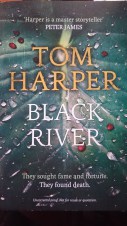 however, I think takes my personal prize for the best book of last year. It’s written with elegance, with enthusiasm, and with enormous verve. I feel almost as if I had travelled along the Amazon with Tom’s collection of misfits. If you buy nothing else from last year, do buy that.
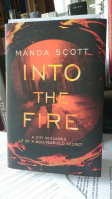 If you haven’t tried Manda Scott’s INTO THE FIRE, you have missed a fabulous treat. A story split between the life of Joan of Arc and a modern crime story based on arson and modern politics, this is one of my highest recommended books of the year.
Finally, Deon Meyer’s latest book, COBRA, I found an absolute joy to read. It’s a fast, action-packed thriller, but I loved the interplay between older, white police trying to work alongside their younger counterparts who are black and have only known independence. A wonderful story, but with fabulous back stories, this was a treat.
So, those are the highlights of my reading year.
2015 began badly in my household, because it started with my laptop having an unscheduled wash. That led to a replacement machine and for a while all seemed well. But then, as readers of this blog will know, I had another disaster when one of my back up disks developed a fault that ended up wiping my entire computer disk. That cost some weeks of effort, renewing software, reloading passwords and photos. It was very time-consuming and deeply irritating since the only issue was caused by my careful and meticulous back up routines to the local drive. Fortunately almost all my data could be recovered. Which was good. Until that computer suffered a catastrophic failure that meant my computer had to be replaced. So another computer was purchased, and I had to go through the process of reloading software and finding passwords again … And people ask why I will handwrite the next novel …
Of course my main work is not reading, but writing. I have been enormously fortunate to have made many new friends in the past year. Dante del Vecchio of Visconti has been enormously generous and he has made for me a special version of his amazing Homo Sapiens pen. This pen has a massive ink reservoir, and is all but indestructible, because it is made of lava from Mount Etna. It also happens to write like a dream, with its 23 carat Palladium nib. This pen will be used to write my next book (hopefully starting next week).
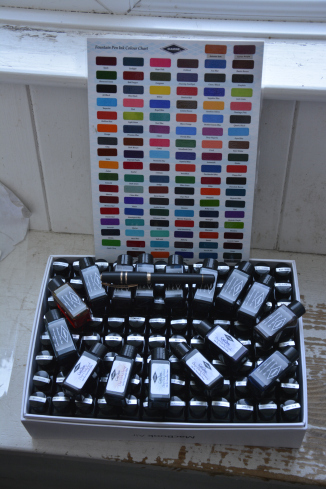
Look at all those luscious inks! 103 colours and shades of Diamine!
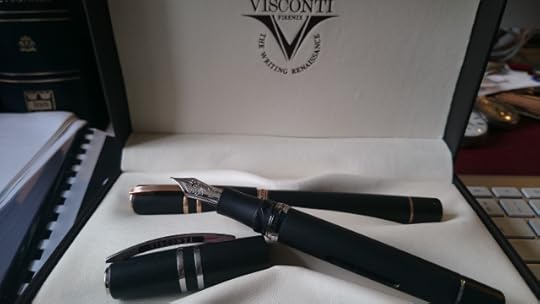
My new Homo Sapiens with my old one in Bronze. New viewing windows mean I can always see how much ink is left. Ideal!
A pen is little good without inks, of course. And there I have been fortunate too. Diamine inks heard that I was going to write a new book, and they have given me samples of all their main range of inks. That means 103 different shades and colours of all different types of ink. With that, I can write every day for three months and more, never using the same ink twice. I’m really looking forward to trying them all out. So far I’ve been very good and haven’t broken the seal on a single bottle!
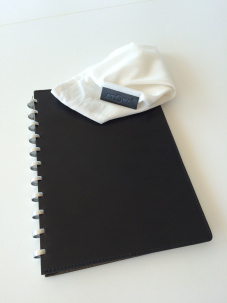
Black leather Atoma
Finally, Atoma have supplied me with hundreds of sheets of paper to write on, and one of their beautiful notepads in leather. These are made by Ruitertassen in Belgium. These pads are ideal for writers. The paper is held in place by a series of rings. Pages can be removed and reinserted elsewhere. It means that while working on a manuscript, I can write outlines of scenes, characters, plans, and then move them into the pad in which I am keeping the main story.
So, what will 2016 hold? Apart from writing a lot. What will I be writing?
Well, January has already seen the publication of BLOOD ON THE SAND in paperback. This is the follow up to FIELDS OF GLORY, and takes my Vintaine of disgruntled and complaining English archers from the victory at Crécy to the siege of Calais and beyond. in April my first book set in the reign of Bloody Mary, REBELLION’S MESSAGE, will come out. It’s a fun crime series, published by Severn House, which will hopefully make readers chuckle in the right places. Then, in May, there is the third in my Vintener trilogy, BLOOD OF THE INNOCENTS, which will round off the Hundred Years War for my characters by following the Poitiers campaign. It’s sad to lose my vintaine – I’ve enjoyed their company for the last few years – but I am already thinking about other projects. Oh, and in June HarperCollins will publish THE SINKING ADMIRAL from The Detection Club. This is a collaborative book ably edited by Simon Brett, and cowritten by me and a number of members of the club. It’s great fun, and I hope many people will want to buy a book that has been written by the top crime writers in the country.
In addition, many readers will be glad to hear that three books that were only available previously as ebooks are to be published by Endeavour Press. Endeavour are keen to publish books for the electronic market, but they are competent (unlike me) to move these books across different electronic platforms. The two collections of short stories will go live very soon, and in a month or so ACT OF VENGEANCE will join them. There is a good reason for moving these titles: the three books can also be printed on demand, which means that those readers who have been clamouring for ACT to be printed will, at last, be able to get a copy in non-electronic format!
But the main work this year will be the writing. First up is finishing a book I began writing a year ago. At last I will finish it. A modern crime story that is less dependent on research than most of my books, this is a pleasant diversion for me. I hope to find a home for it with a mainstream publisher. After that, I must start scribbling to write a new story set in the Crusades. This is looking to be a great start to a series that will look at the lives, loves, fears and deaths of families during that incredible period of religious expansion. I’m really looking forward to starting that one. Then I’ll have to write the next BLOODY MARY story, and after that I am desperate to start writing the follow up to ACT OF VENGEANCE.
So, this is to be another very busy year. I hope you enjoy the books I’ve recommended, and I hope that the new books appeal.
Finally, I hope that 2016 turns out to be a happier, more prosperous and exciting year for you (and me).
Best wishes
Mike Jecks
Tagged: Atoma, Black River, Diamine, Hearts of Stone, Homo Sapiens, Into The Fire, Ruitertassen, The English Spy, Visconti


Review: SPARE ME THE TRUTH
Tomorrow I’ll be putting up a review of my year for 2015, running through my favourite books of the year, but I have one problem. One of the books I read was stunning, was thrilling, and I should have mentioned it … except I couldn’t, really. The damn thing wasn’t published last year!
Caroline Carver is a writer of modern thrillers who has been quiet for a while. This book will change that, with luck.
SPARE ME THE TRUTH starts out with a short, brutal scene. We don’t know the reason, but a case is stolen from a man and two women. A shot is fired, there is a death. The writing is stark and precise, and you just have to read on.
From there we move to a pleasant domestic environment, a couple with their daughter in a supermarket. Gradually the reader learns that the family has a secret. A son has died in a horrific accident. As the father moves around the shop, he becomes aware of a woman watching him. He wonders who she could be, and as he leaves the shop, he becomes anxious when she introduces herself to him and his daughter. He is shocked, alarmed, and complains about her harassing him, eventually calling the police. He doesn’t know her. In fact, he knows very few people, because he suffers from amnesia. But the police can do nothing after the woman shows them her ID. She drives away, but she has given him her number and asked him to call her.
from there we move on to develop the story from the point of view of the woman, and there is (was for me, anyway) a sharp turn in the story from being a simple imitation of a Ludlum/Bourne story to being a much more involving, character-driven tale of modern espionage and medical science being used to develop arms. I want to tell more of the story, but I’m terrified to give away too much of the plot. So instead, let me just say that this is as good as Bourne or Baldacci. In fact, it’s a great deal better than Bourne, in my opinion.
The great thing about this story is, Caroline has taken a number of disparate characters and has tied them seamlessly into a plot that at first doesn’t seem credible, but by the time you reach the last chapters, it all makes perfect sense. It is like a crime book in which the author has set up a chain of events that are too outrageous to be believed, but which, by a simple change of perspective in the last pages, the author makes perfectly credible or, rather, utterly convincing. This book manages that trick with simplicity and, I would say, with real skill.
I have a problem. Because I am a writer, I tend to find that my reading is hugely restricted. I find spare moments to read for pleasure, and they are invariably just as I am dozing off, exhausted. Sometimes a book grabs me so strongly that I cannot put it down and have to defer my own work as a result. This is one of those books.
In short, I loved it. It works as a crime novel, as a thriller, and as a warning of medical advances and how they could be used by unscrupulous men and women. It is also a novel with great heart at its core. The depiction of the family in the middle is nothing short of brilliant. Caroline Carver has created a wonderful story here, sort of Jason Bourne meets Silence of the Lambs. I am already looking forward to the next book in this series. There had better be a next book in the series!
Highly recommended.
Tagged: book, CJ Carver, crime, SPARE ME THE TRUTH, spies


December 29, 2015
The Butcher Of St Peter’s by Michael Jecks
Another excellent review by the Puzzle Doctor! Many thanks, PD!
 In Search of the Classic Mystery Novel
 Exeter, August 1317, and Estmund Webber is grieving. His daughter has died and his wife has committed suicide. And an altercation as he tries to bury his wife not only cripples his friend but shatters his mind.
November 1323, and Estmund limps his way through life. But his nights are spent watching over the children of Exeter – creeping into their rooms and standing guard as they sleep. But one night, Daniel, sergeant of the city, confronts an intruder in his children’s bedroom and ends up dead. Has Estmund’s mind broken so far that he would resort to murder – or did another hand slay Daniel.
Sir Baldwin Furnshill, Keeper of the King’s Peace is still recuperating in the city and finds himself drawn into the investigation. But with the country about to tip into another civil war, tensions are running high, and one of the most dangerous men in…
View original post 287 more words


