
Michael Jecks's Blog, page 17
May 11, 2016
Fear, Uncertainty and Doubt – a Campaign of Dissimulation and Distortion
I think it’s time to poke my head over the parapet.
First, apologies if this comes across as a little rambling. It is a work in progress, as you will see.
First of all, I love Europe. I love France, Portugal, Italy, Germany, Greece, and would love to visit many other countries. I love them because of their individuality, the variety of foods, countrysides, cities, and peoples. However, in recent months I’ve suffered a certain number of insults from friends. Mind you, it’s nothing compared to what the politicians who “represent” me have said. To many of them, I’m a Little Englander, a Xenophobe or a fool, because I have the temerity not to immediately agree with europhiles who are keen to see Britain remain in Europe.
This is an understandable aspiration. They say we should remain in the world’s largest single market. It is one of the things Britain has fought for over centuries. For us, one of the oldest democracies, it makes sense for us to fight to remain inside this great project?
Perhaps. But for every world statesman, for every banker, for every business leader who tells us with contempt why we should stay in Europe, I feel my resentment growing, and with it a developing cynicism.
First of all, let me state: I have not decided whether to vote to stay in or to leave Europe. The reason why I have been condemned is because I have not wholeheartedly thrown my hat into either ring. The reason is simple: I am still considering how I should vote. However, I am not confrontational, and find debates (especially internet shouting matches) exceedingly tedious, so I’m not going to participate in disputes here.
However, I will say this: I won’t be persuaded by a country’s President, for whom I may not vote, who tells me with truly breathtaking hypocrisy how I should vote, especially since it means giving up the very system of democracy and law that his own country emulates. I will not be persuaded by the head of the IMF, whose background as a politician and banker does not inspire confidence, that she holds Britain’s best interests at heart; likewise when a number of past American world statesmen tell that they know what is best for me – well, at the nub of it, I smell self-interest. Not the interests of the British.
Why such suspicion?
Well, America is exceedingly good at looking after her own interests. She does not allow shared sovereignty. She will support free trade, come what may – until it affects domestic interests, at which point free trade ends. Canada and Mexico know this all too well.
So where do I think America’s interests lie? I believe that America would love to be able to reduce the cost of foreign negotiations. The State Department has expensive ambassadors to uphold the dignity of America in all European nations. I am sure that the Department looks at the savings involved in having one single point of contact with enormous enthusiasm. One contact to negotiate treaties, so one American contingent where currently there are twenty eight, a number that will grow as Europe expands. Likewise, Australia, New Zealand, and other foreign countries who will find access to European markets possibly affected if Britain were to leave Europe, also advise Britain to remain in the safe cocoon of Europe. It makes their lives easier.
Yet I doubt any of these democracies would agree to join a similar organisation.
So what are the choices in pro-Europe or pro-Brexit?
Many cogent arguments have been put forward as to why Britain should remain in Europe or come out. They include the prediction that family incomes may not grow so fast outside (although the numbers are nonsensical; the Treasury’s ability to forecast six months into the future is pathetic, and Osborne’s credibility predicting one or two years hence is, for me, vanishingly small); the pound may drop, so holidays abroad for the wealthier may grow more expensive, but exports will be cheaper and smaller businesses will flourish; foreign residents may be forced to return to England, which is unlikely, but let’s stick with it. There could be far-reaching consequences for big business, although the majority of Britons work for smaller firms which would likely benefit from greater flexibility. To every economic statement of disaster there is a logical counter.
So I don’t really care about the financial case. It has long been a rule of thumb for me that economists are proved wrong more often than they are proved right. It is not an exact science, as one economist told me.
However, Britain does stand at a cross roads. To one side there is the EU and greater European integration; to the other, British exit from Europe.
What does further integration mean? It means we agree wholeheartedly to the ambitions of the EU. Does that mean we allow free movement? Yup. We cannot control immigration from Europe any more than Alabama can control immigrants from Texas. That is one of the key principles of Europe, as Chancellor Merkel has reminded Call-Me-Dave. This is a problem. Down here in the west country our schools already suffer from too many languages, and we are having to expand our towns beyond the servicing capability of the water supply and treatment companies. Britain has a diminishing power capacity, yet we’re increasing our population and demands on the National Grid. Be that as it may, we need nurses, doctors, and other workers, so immigration will continue, whether from Europe or elsewhere. I would prefer to see immigration based on merit rather than residence in Europe, but we will have immigration.
However, the other implications of throwing ourselves headlong into Europe are more key. They are almost diametrically opposed to what we were told in our last referendum, which, we were told, was to join a common market and no more. The pound was safe, the pint and gallon secure, our legal system inviolate, we were told. This time, if we vote Remain, make no mistake, the British people must accept the end of much that makes their countries unique. The pound sterling will go. The British legal system of common law will go. The British army will go, and with it our independence. Perhaps these don’t matter in the 21st Century, but they have served Britain well. Our legal system now serves America, Canada, Australia and many other countries equally well. I would miss it. In its place we will have the Napoleonic system. It is no worse, probably, but it is different.
Next, there is the argument of “shared” sovereignty making Britain stronger, allowing her to “punch above her weight”. This is nothing more than fatuous dishonesty. It is a ridiculous invention. The idea that giving up our independence and allowing our views and national interests to be blocked by foreign nations in Europe somehow enhances our position in the world is a contemptible falsehood. The independence of Britain depends on her place in the Security Council of the UN, her large economy and power, both hard and soft. If we remain in Europe, our military will be subsumed by an ever-growing European government, our economy will, I think, probably reduce as more and more control is taken by Germany, and our permanent seat at the Security Council will go. We will be significantly diminished in the world.
Perhaps that would be good. We should accept that we are only a small territorial offshoot from a great continent, no longer an empire, and give up the remaining trappings of power: cancel Trident; reduce our army; stop supporting American policy as a matter of principle (the “Special Relationship” is a one-way street and only exists when America has a need for our military, generally); and throw our lot in as a senior, influential part of a new European state. There would be logic to that.
However, it does mean that we will be forced to support one of the great disasters of the Union: the Euro. There were clear rules of entry to the Euro, and it was stated that no country would be able to fudge them. Except they were fudged.
It was blatantly obvious that Greece did not meet the entry requirements, but as soon as the Euro was launched Greece was included, and German bankers flew to Greece waiving the strict German regulations on banking loans, lavishing money on clients who would never have been allowed such generosity in the days of the DMark. When the banking crisis hit, and Greece could not pay her debts, the EU put in an administration to guarantee that Greece paid German interest. The cradle of democracy taken over by bureaucracy. Greece might as well not have bothered with her battles for independence from the Ottomans.
If we stay, we will join the Euro and we will become jointly responsible for that currency.
What is the alternative option for Britain?
It would mean returning to the big, wide world, where we can decide to trade with America, India, China, or any other nation. Instead of being bound to a European Union that is declining, or at best growing only lethargically, we could deal with countries that are growing. And, like anyone who is self-employed, that means taking a punt. It means gambling. It is a big, unknown world out there. But a small, agile country can react to world trade faster than a bureaucratic monster.
So, that, for me, is the main implication of the referendum: we need to choose between full membership, which means engaging fully in Europe and not whinging about every decision we don’t like, or comi
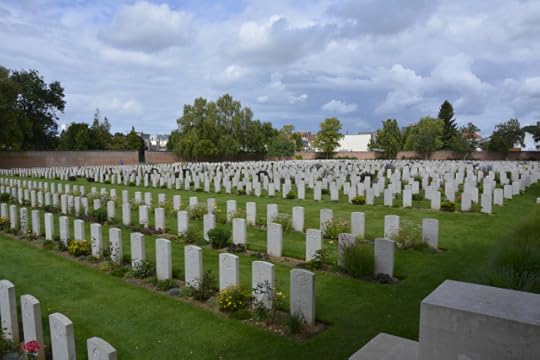
Many British are European – Arras
ng out completely and returning to independence, whatever the risks.
Would Britain outside Europe be immediately stronger and safer?
No. Outside Europe we may have more control over our destiny. We will be able to choose which markets which we wish to deal in. Would that make us stronger? No one knows. I may not be an economist, but I do know, as I said before, that economists are very often wrong, no matter what they argue.
I certainly do not believe the ever more panic-stricken campaign of terror being waged against Brexit. I most certainly do not believe the Cassandras warning that cataclysm and international collapse followed by World War Three will inevitably follow. The EU will not cut off its nose to spite its face. It will be irritated to see such a large amount of annual income disappearing, but Europeans are pragmatic. They won’t want to lose access to the fifth largest economy in the world. Nor will America, whether under Trump or Clinton.
If Britain votes against remaining in Europe, the first result will be that Europe will sneer that we are too ill-educated, that we didn’t understand what was at stake, and that we need to be asked to vote again, as were the French and Dutch when they rejected the new EU constitution in 2005, or the Irish when they rejected the Lisbon treaty in 2008, after suitable reeducation. Then, hopefully, they may renegotiate, and this time seriously (Call-Me-Dave’s pathetic chat earlier this year was embarrassing).
And that is the problem I have with Europe, I think. The patronising attitude towards their electorates. It is the nineteenth century conceit: the aristocrats knew best, the plebs are too uppity to know what’s in their own interests. I still remember my rage when I heard the patronising tones of the arch-europhile, Ken Clark, telling a reporter that he couldn’t imagine anyone bothering to read the Maastricht Treaty because it was so long and boring. He voted for it, which was surely an abdication of responsibility, if he spoke the truth.
In the Victorian era, the grand advances of empires meant statesmen looked for ever larger units of trade. The British Empire was superseded by the American, and European nations eyed their wealth jealously. After the two World Wars, Europeans looked to the model of larger, safer trading areas, and the idea of the European Coal and Steel Community was born. Later this became the European Economic Community.
This is a very European solution to a problem that existed over a century ago. Europeans, traumatised by two hideous wars, made a firm decision to avoid conflict. To do so they created a superstate run by a all-powerful bureaucracy of officials. But those officials are not held to account. Even when whistleblowers (Dorte Schmidt-Brown, Marthe Andreasson, Paul van Buitenen etc) highlight failings, fraud or corruption, they are as likely to be punished as those who were guilty.
Corruption is hardly new behaviour. Dishonesty and misbehaviour in public office are not new. God knows, Britain has its fair share of mendacious politicians and bureaucrats.
Still, my own tipping point is coming down to the politics. In essence, how much safer or less safe does Europe make us and the world?
Some years ago, Edwina Currie spoke about when she was an MP. There was a government policy at the time to close down lunatic asylums and introduce care in the community. These were good aspirations (and made a lot of money from sales of land, of course), but Edwina was surprised when she was met with a blank silence when she asked what was the minimum number of beds that were needed? Not all mentally ill patients could be safely thrown on the streets: how many would need to be kept incarcerated? No one could answer her.
Europe has at its heart the opposite problem: a determination to expand. But there has to be a limit. What is it? Has anyone actually thought of this? Should the limit be political, geographical, cultural?
And meanwhile this ambition, I believe, is making the world vastly less safe. Putin is keen to recover the national pride of Russia, and he has achieved a great deal. When Europe entered negotiations with satellite countries of the USSR and brought them into the EU trading zone, Russia was not happy. When Europe and Russia confirmed the territorial integrity of Ukraine in exchange for Ukraine giving up her remaining nuclear stockpile, that was before the EU started to bring the Ukraine into the EU’s sphere. Russia could not swallow that. Consequently we now have the disaster of an on-going war in eastern Ukraine and Russia’s theft of the Crimea. Russia will not accept being hemmed in by the EU.
Am I therefore convinced that we should pull out of the EU? No. I’m still weighing up the potential benefits of both options. But I’m not going to be swayed by the increasingly inflated, outrageous, facile or blatantly dishonest comments of politicians who are determined to fight a campaign based on Fear, Uncertainty and Doubt.
Tagged: Barack Obama, Brexit, Britain, David Owen, Europe, European Union, Neil Kinnock, UK, USA



May 1, 2016
Shared from WordPress – Excellent Reviews!
Please read this. An excellent review site where three of my books have been picked for this month, and two picked as winners!
The Puzzly – The ISOTCMN Book Of The Month – April 2016 – http://wp.me/p1fNuE-1vp


April 28, 2016
Chronodex from Scription
Yesterday I put up a blogpost that managed to garner some 500 hits in the afternoon, to my surprise. It seems that I’m not the only guy who likes to fiddle and have a new diary format.
I did not invent the Chronodex, and so I didn’t want to put up a downloadable version. However, Patrick Ng, the inventor and an all round delightful guy, has said that anyone is welcome to use it. I am putting this up for you to try out but, please, don’t abuse Patrick’s generosity. If you like it, that’s great, but don’t go and try to copy and sell it. Patrick has copyright. And if you get on with it, write to him. He is contactable at http://scription.typepad.com and if you go there, you will also find other goodies that he has designed. They are well worthwhile looking at, I promise. And he has one of the best jobs in the world, buying stationery products for a major department chain.
I hope you enjoy playing with this new system!
Tagged: Chronodex, creative, crime writing, Diary, hints and tips, journal, Patrick Ng, Scripting


Rebellion’s Message by Michael Jecks
Three excellent reviews in one month, with medieval – Death Ship of Dartmouth – to modern – Act of Vengeance – and now Rebellion’s Message. So grateful to the Puzzle Doctor and no, no money exchanged for three High Recommended book reviews!
 In Search of the Classic Mystery Novel
 January 1554 and London is in turmoil. Mary I has been on the throne for six months but there are others who wish for a different monarch, one of a less Catholic persuasion, one who isn’t planning on marrying Philip of Spain. Thomas Wyatt is one of those people, and has taken upon himself to raise an army and march on London… but Jack Blackjack, a member of a gang of thieves has other things on his mind.
Normally, those things, apart from the possibility of bedding the gang leader’s mistress, would revolve around who the next purse would be lifted from. But he’s more concerned by his most recent victim – because Jack has just woken up, after being bashed over the head, next to that victim. And his victim is considerably more dead than when Jack saw him last – and there’s blood on Jack’s knife…
View original post 320 more words
Tagged: crime, crime writing, Puzzle Doctor, Rebellion's Message, review, Severn House


April 27, 2016
Review: ALTAR OF BLOOD by Anthony Riches
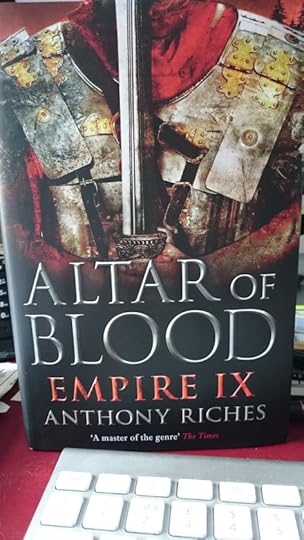 I have written before about books arriving when I really don’t need them. So often they are books that are entirely inappropriate. Say a book that is historical, and since I am known as a historical writer, they will send it to me. The trouble is, it’s historical romance, or it’s historical-ish, and has a blend of Dungeons and Dragons about it (or should I say Game of Thrones?). I am not a steam punk, sci-fi, or chick-lit expert, so why people will keep sending me that kind of book, I don’t know. Perhaps purely because the publisher has my name somewhere in the publicity department, and so they keep on sending out books to me, whether they’re relevant or not.
Rant over.
However, every so often I will get a book from an author I admire, whose work is always a joy. Anthony Riches is one of them.
I first met Tony when we were both on the committee of the Historical Writers’ Association. His dry sense of humour and insane sense of fun was infectious, but I was also hugely impressed by his dedication to supporting British troops and the army. He has walked with Ben Kane and Russ Witfield over Hadrian’s Wall, and along ancient Roman roads in Italy to raise funds for injured soldiers, and for that I admire him (and the others) hugely.
This book, Altar of Blood, is his ninth in the Empire series. It is a superb series (can you sense the jealous author, thinking “It should have been me”?), in which the first books traced the career of a Roman who came from a family that had been destroyed. I remember well talking with Karen Maitland about her approach to writing, which is to figure out what the characters really need, and then take it away from them. Anthony Riches has taken this concept further than any writer I know. In effect, the whole series up until this novel has been about the story of revenge of Marcus against the men who destroyed his family. But now more has been taken from him, and we enter the story as Marcus is attacked by footpads in Rome while women discuss the horror of what has happened to him. He is a man who’s life has lost all joy, and now seeks explosive, almost suicidal action. There’s nothing left for him.
Fortunately for his own good, he and some of his Tungrian soldiers are sent from Rome to Germany to capture a tribal priestess. However, on the banks of the Rhine, they meet with more danger. In Rome’s empire, politics are never far away. The Tungrians and Marcus are soon aware that there is no safe haven, even amongst their own countrymen. Whether they will be safe on returning from their dangerous mission is a moot point. But first there is the operation itself. They cross the Rhine, but only to find themselves hurled into more danger as they are chased across the wild badlands of Germany, with treachery and deceit on all sides.
This is a superbly crafted story, as always. It is muscular, it is fast, it is shocking and thrilling, it is a brilliant, exciting read, it is the latest book by the best chronicler of ancient Rome and the empire writing today. If you can put it down once you’ve read the first chapters, you’re a better person than me.
Thanks, Tony. Another excellent book that diverted me from my own work!
Tagged: Anthony Riches review, ebooks, Empire series, fiction writing, history, Rome


Amazon, you hit like a bitch.
One lady’s complaint. She won’t get anywhere, but she deserves to have her voice heard. It’s despicable for a company to ban people without explanation and without right of appeal. It shows what happens, I guess, when a firm gets to such a monopolistic position.

It’s taken me a bit of time to write this post, but I figured it’s about time to share the utter nonsense that’s happened between me and Amazon, and how a company that I once highly respected, has now become one that I have zero respect for.
I’ve thought about writing this post for weeks, what I would say and how I would capture everything that’s happened, and I’ll be honest with the fact that this post has taken on many forms, but finally I decided that it would just be easiest to state the facts.
So here it goes…
 This is the first email I got from Amazon. As some of you know, on February 24th I was sent an email from Amazon letting me know that I could no longer post reviews on their website, and that all of my previous reviews had been suppressed or removed…
View original post 2,034 more words


April 26, 2016
Chronodex
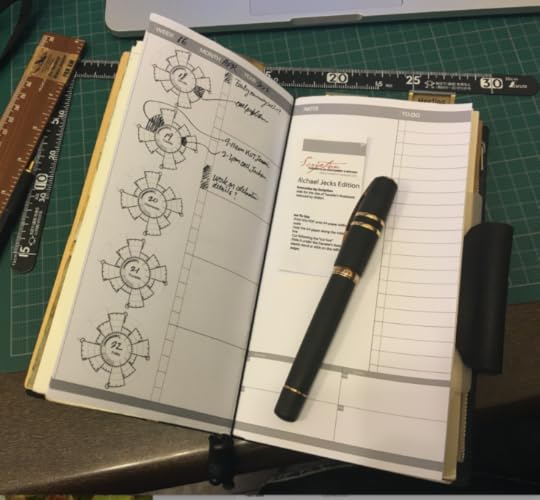
Patrick’s photo of the Jecks version – and his new Homo Sapiens from Visconti!
There are some tools which make sense to individuals but don’t for other people. I personally love my Apple computers (when they work) and my Nikon DSLR. I adore fountain pens and ink, and I love my Midori – oh, and my strange diary.
Years ago when I was a salesman, I used to have a diary. There was no such thing as a laptop computer when I started, only paper. I tried all kinds of diary. Yes, I did try the File-o-Fax, and found it hideously repetitive. I could not copy with planning a month in advance, then migrating events to weekly planners, then to day planners. I reckoned that the system looked lovely, and was crap in real life. To use it effectively I’d lose hours every day! Instead, I began to use other diary systems. The best, I always found was the Quo Vadis diary. This came in all sizes, but I found the A5 version suited me best. It had handy ideas, like a tear-off corner so you could flip to the right week, it had blocks for priorities and planning, but always weekly based, so your To Do list never looked too unachievable. And most of all, there was no need to repetitively copy things from one page to a daily page, or … well, I hate writing the same thing out. Let’s leave it at that.
However, as an author I’ve never needed much in the way of diaries and planners. I have certain dates which matter – publication dates, deadline dates, dates on which I am giving a talk or lecture – but most of my days stay empty because all I’m going to do is sit down and write. Who needs a diary for that?
When I started working for the Royal Literary Fund, that changed. Suddenly I had meetings booked for two days in which I would have a different student every hour or half hour. I had to remind myself what their discipline was, what year they were, and all kinds of other information. It was not easy, and I didn’t find that a sequential, line by line diary worked for me. There was not enough space in those restrictive little lines, and I couldn’t work on that basis. I tried various systems – and then I heard of Patrick Ng and his fabulous Chronodex system.
Patrick is a senior buyer for a chain of stores in Hong Kong, Taiwan and Shanghai. In 2010 he invented a new diary for himself, which he later named the Chronodex system and put out on the internet in 2012. He was like me, and had tried all kinds of different diary, and because he was the stationery buyer, he would review and test some 500 different formats: grid systems, blocks, all sorts. But like me, he just couldn’t get on with them. Unlike me, he was bright enough to analyse what he found so difficult with the existing systems, and decided that because he was a very visual person, perhaps it was the rigid blocks that gave him a headache. I know I used to find that I would write a meeting in for a morning, and when I looked at that page later, it looked as though I’d just wasted a load of time. There’s something about a rectangular gap that just looks wrong to me.
In place of blocks, Patrick designed a system based on clocks. His Chronodex pages are indicators of time. They represent a day based on a clock face, with 6-9.00 am in the very centre, 9-21.00 in the main ring, and 21-24.00 at the outer edge. The ring has the same layout as a standard clock face, and meetings can be blocked off easily by hatching or colouring each of the sections – 11-12.00, or 13.15-14.30 – with all the space around the clock face left free for notes and more detailed comments. This means that the page has a lot more space for notes while keeping the analogue clock face so I can see at a glance when I have free time. I know Patrick uses his with colour coding so he can see what is business, what is time for his family and so on, but for me that’s taking things too far. I only ever carry one pen or pencil with me!
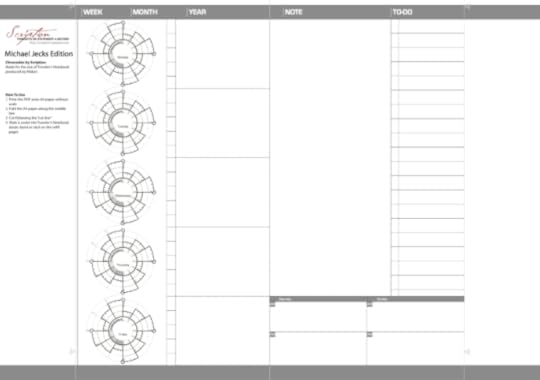
Here it is! The printout version of my new diary pages.
Not only does he have the basic format set up, he’s also created daily planners for those who have lots of meetings in a day. As I said, I don’t have to worry about that much, but every so often I have meetings in London when there are book launches and events, and I do need to organise my day more efficiently. On those days I use the “Getting Things Done” planner.
Well, a few weeks ago, Patrick asked me how I was getting on with things, and I mentioned a couple of things I was thinking of with the Chronodex. He was brilliant, and said he’d incorporate them. And now, I have a new Chronodex system designed especially for me!
This is not something that will work for everyone, any more than the Quo Vadis or the File-o-Fax would, but I can recommend it for those who are more visual; the sort of people who, like me, much prefer an analogue watch to a digital, or those more used to playing with a free-format mind map rather than a list.
Patrick is working now with a major stationery house to market and sell the scheme more widely. All I can say is, I wish him all the best of luck. It’s been a life-saver for me, and I’m sure it would help a lot of other people too.
I should apologise to him, though. He liked my comments on the Visconti Homo Sapiens so much, reader, he bought one!
Tagged: Chronodex, day planning, Diary, File-o-Fax, journal, Patrick Ng, planner, planning, Quo Vadis, writing


April 25, 2016
Act Of Vengeance by Michael Jecks
Many thanks for a review I wasn’t expecting!
In Search of the Classic Mystery Novel
 Jack Case. Scavenger.
When the Cold War ended, he was superfluous to the needs of British Intelligence, but post 9/11 the rapid need for new recruits led to mistakes being made by those new agents. And someone was needed to clear up after those mistakes – hence the need for Scavengers.
Jack thought he’d put all of that behind him – he was drummed out of the service in disgrace, a suspect in the murder of his wife’s lover. But he is drafted back for one last case (one of those) – an old colleague retired to Alaska, but then apparently killed himself. When Jack arrives though, he has a suspicion that the suicide was, in fact, murder. And when someone tries to kill him, that suspicion becomes a certainty…
View original post 382 more words


The Things That Get in the Way!

I forgot: wanting to dance, but not being allowed because of a bad ankle!
When the words are flying, writing novels is the best job in the world. Authors live other people’s lives for them. We imagine our own worlds, invent horrible situations and throw our characters (victims) into them. All just to entertain readers.
But sometimes the work doesn’t go so well. All writers have their own pet hates and annoyances, but let’s be sensible. It’s not all the noise of the guy down the road demolishing his wall, or the wailing cat in the yard that’s driving the dogs potty, or the fact that every time you sit down a deliveryman knocks to ask if you’ll take in these parcels for next door, because they’re out at work …
Pardon me?
I’m at work too, you know. Just because I happen to be staring out of the window doesn’t mean I’m not concentrating. Honest.
But what really is frustrating to me?
First it has to be the sudden arrival of a book I wrote a while ago, with a deadline of ten days, asking me to go through a line-by-line commentary by an editor who’s taken four months to look at it. Or it’s back from a copyeditor, or perhaps the arrival of a proof. All of them tend to land on my desk with (perhaps) one day’s warning. Very commonly they’ll materialise at the beginning of a holiday, as editors and others clear theirs for their own holidays, so that they can gallivant off to the Greek islands or Majorca with a clear mind.
The impact of that on the writer is devastating.
Writers tend not to sit at home and daydream without purpose. I write three books a year now, and as soon as one book is complete, I crack on with the next. All authors have other projects to work on. We aren’t on holiday, we’re self-employed.
Any interruption has a disproportionate effect on writers. For example a little while ago a man stopped outside, saw me through my window and asked for directions to a house up the road. I like helping people. I do, really. But he just cost me about forty five minutes. I had an entire scene in my head and was just starting it. I know what to put in, but the fine details are all gone. I have to start again.
In terms of publishing, I started writing my latest book in January. However, in the same month I had three books come back to be proofed, because each of them was being reissued (Act of Vengeance, No One Can Hear You Scream and For the Love of Old Bones). In February I had edits on a book which I’m collaborating on, plus the copyedit of the book for later in the year. In March I had the proofs of Rebellion’s Message (30th April – order your copy now), and for Easter I had the proofs of Blood of the Innocents. This is fine. But all I really, really want is peace to crack on with the next book.
That probably sums me up. I don’t want edits and comments, all I want is to do the fun part, writing new ideas, new people, new situations. The nitty-gritty of editing and correcting doesn’t do anything for me. Nor do the other things.
Writing is a job. That means coping with bureaucracy at all levels. But I detest forms. Tax Returns are a hateful invention of the devil, as far as I’m concerned. I have here an expense claim that I should have filled out weeks ago – but it’s so painful!
And yet chasing money is a constant preoccupation. Sometimes an author is asked to join in on a festival or give a talk. It’s good for an author to get out, but it is appalling to then spend weeks or months having to demand money (worst case took nearly six months). It’s bad enough going to an event and losing days of work because of writing the speech, travelling, and then having to try to get back into the same mindset as when writing the book before, but then to lose days of concentration because of chasing a bad payer is a dreadful pain. However, people baulk when they hear that an author needs to be paid.
Hearing from friends that I really should have been watching Game of Thrones, playing the latest computer game, or going out and seeing the latest film, rankles. I write three books a year, and the thought of getting involved in the latest preoccupation not only doesn’t appeal, there is also no time for it. My working day is split into chunks of time. I have them set into my day in the same way that a businessman will have his meeting agreed and fixed in his diary. My time blocks are allocated to writing, walking the dogs (which is when I read and reply to emails, organise my twitter messages, look at Facebook etc, as well as reading the books I have to review or check for research), preparing food for my family, and working again. There is no spare time.
But people turn up to chat, because they can see that I’m in (like the house-seeking delivery man). Some are good and ask if I have a moment. Well, yes, I do. But if people drop in, I am polite and will offer them a coffee or cup of tea. And that means I lose an hour or so. I may usher them through the door after twenty minutes, but it will still take over half an hour to read myself back into my scene and start writing productively again.
Deadlines. Yes, all writers hate deadlines. Yes, many, like me, quite like the fact that it means there is a date to aim for, but we all still hate them. (Yes, I’ve heard the Richard Adams quote about loving them and the whooshing sound they make as they shoot past, but that was a witty comment, not a true statement). Deadlines are terrifying, scary predictions of future failure.
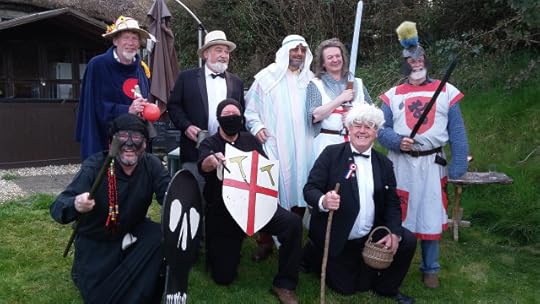
Fun at the Pace Egging Play. Another fun thing! Thanks to Shirley Denford for the photo
And that is the biggest horror of all, of course. The ever-present fear of an utter, abject failure. Everyone in creative arts is a salesman. We all have to work with the weight of potential failure dangling over us, waiting to fall. All authors are precisely as good as the last book, just as a salesman is only as good as his last month’s sales figures. I don’t deny that it’s a good incentive to produce the best work possible, but it is a heavy weight to bear all year.
Other pet hates?
Top is the appearance of a book that I haven’t heard of, by a writer I don’t know, on a subject I’m not interested in, from a publisher who just wants me to read it and review it.
It takes hours to read and review books. I have a horrible feeling of guilt when I don’t look through these books, because as a writer I know how hard it is to get any sort of mention by other authors or in the media, but then again, I don’t have the time to spend reading a book in detail, précis-ing it and writing a fair review. So lots of books stay on my guilty TBR pile.
Then there are coffee machines that break; computers that fail; cars that park outside my office and block my drive for no reason and without asking; cats using my garden as a toilet (usually owned by the most vocal complainers of dog owners who don’t clean up); I detest superb weather outside while I’m inside shivering in the cold; literary festivals, local groups and professional organisations who ask me to turn up to talk and then get grumpy when I mention expenses or a fee; garden walls that collapse into the road and having to hire dry-stone-wallers; sons who will kick a football around in their bedroom (over my head) while I’m trying to work … There are many more.
Fortunately, there are many upsides, too. The review books that arrive that I know will be a joy to read; the parcel of books from PostScript Books or Oxbow Books, which promise hours of joy and research; the invitations to lovely libraries where I can meet existing fans and chat to prospective fans; the walks with the dogs while I’m thinking up a new story or a new scene; the appearance of a new pen, dedicated to me (yes, I get smug); the collaboration with other writers – yes, there is a lot to be glad about. I could go on for a long time.
However I have a book to write.
Have a great week!
Tagged: academic writing, book writing, books, Devon, fiction, library, publishing, questions, writer, writing


April 22, 2016
Writing by talking
Occasionally I get requests for interviews and get books sent through to review. I’m delighted to have Altar of Blood by Anthony Riches, which I’ll have to review very soon. But before that, I managed to get a blog post from a rather remarkable writing duo, AJ MacKenzie. They are the husband and wife team of Marilyn Livingstone and Morgen Witzel. They are both successful non-fiction writers, but this is their first book written together. As you can see, there is a good justification for having them involved in my blog. They know Dartmoor!
I look forward to reading their book and getting a review up here soon.
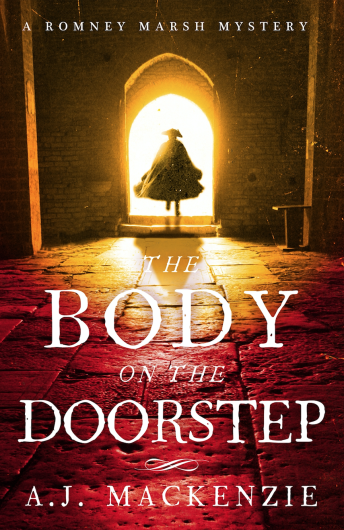
It’s probably the most frequently asked question we hear, from other writers as well as readers: how do we work together? It’s a fair question, and not an entirely easy one to answer. We’ve been writing together off and on for nearly forty years and no two projects have ever been the same. It seems to be an evolving process. It probably always will be.
In an interview before their film Hail Caesar was premiered, the brothers Joel and Ethan Coen were asked how they write together. ‘Basically’, said Joel, ‘it’s a conversation.’ We understood at once. That is exactly how we write: we talk to each other.
We play a kind of verbal ping-pong: one of us puts out an idea, the other considers it, reshapes it and bats it back, the first person does the same, and on it goes. Gradually, plot fleshes out, characters take shape and form and develop voices of their own, landscapes are developed and populated. It’s partly a process of creation, but there is a good deal of evolution going on as well.
Sometimes we sit down formally and discuss what we’re going to do. Our sitting room is always a good place to start. We live in a crumbling old cob house with rather shabby furniture, a fire, and usually a couple of kittens beating the daylights out of each other in a corner somewhere; a good place to work. We sit in comfy chairs opposite each other and talk, although Marilyn tends to wander about a bit when she gets excited by an idea.
The hour before dinner is another good time to get things done; we talk while preparing food, with a glass of wine to hand and the television going in the background, completely unheeded while we try to work out how Reverend Hardcastle and Mrs Chaytor are going to solve a knotty problem.
We don’t just work at home, though. We’re lucky to live in place with plenty of beautiful landscapes to inspire us. We’ve done some of our best work walking on the beach at Widemouth Bay, or out in the fresh air on Dartmoor (there is a lot of air on Dartmoor, and all of it is extremely fresh). Sometimes we talk while travelling. We worked out the general plot outline for one of the Romney Marsh mysteries while driving from Poole to Exeter late one night – largely as a means of keeping ourselves awake!
Of course, at some point the talking has to stop and we have to sit and write all this down. By and large, though, if we’ve talked enough about a story, the writing becomes the easy bit. We’ve done the hard work; the rest is detail.
Tagged: AJ MacKenzie, Blog, blog tour, crime, crime writing, The Body on the Doorstep, Zaffre


