
Michael Jecks's Blog, page 16
April 5, 2017
Review: When She Was Bad
Review: WHEN SHE WAS BAD, Tammy Cohen, published by Black Swan[image error]
There are many styles of crime books. I tend to write historical and spy thrillers, others write gritty, noir contemporary crime, some stick to psychological suspense, or to straightforward cosy stories. I am always keen to find a book that is a little different, one that has the ability to jerk me out of my normal reading rut.
Welcome to Tammy Cohen!
This is a thriller that has all the more punch because it’s set in such a parochial landscape: the office. It begins with the sacking of Gill, a popular manager, but one who’s been “coasting during the last couple of years.” The business has suffered, and the business owner wants to shake things up, bring in a new manager. The one he picks, Rachel Masters, is known to be very ambitious, and doesn’t suffer dead weight. She looks about the team and begins to review and assess all of them, feeding those who share ambition, making clear that time management is vital, and setting the team against one another.
The story is told from the perspective of the individual team members, each with their own fears and issues. Some are worried about money and the cost of the mortgage, while others are fretting over childcare and partners. All have their own little secrets, but someone has a larger one.
In America, a psychologist who had investigated a hideous case of child cruelty some years before, is told to turn on her TV. There has been a terrible killing in England. She knows that she holds the clue. She has expected this to happen.
This story is very familiar to anyone who has worked in a large company. The petty jealousies, the attempts to clamber up the greasy pole by standing on the heads of others, the little cruelties and jibes, all ring horribly true, and with the story told from the perspective of each of the members of the team, it’s all too easy to immerse yourself in the story. You will recognise the types, you will recognise the environment.
Hopefully you won’t recognise the ending!
This is a brilliantly well-crafted story, with beautifully observed scenes and characters. I found it utterly gripping in a way that few psychological books have achieved with me.
I’d give it five stars out of five and recommend it to anyone.
Tagged: office, psychological, review, Tammy Cohen, thriller, writer, writing


January 11, 2017
Review: THE DRY by Jane Harper, published by Little Brown
[image error]ISBN: 978 1408 708170
I’ve said it before, and I’ll probably say it again many more times, but it’s worth putting in as an introduction for the first review of every year:
I do not review books I don’t like.
It is not because I am a particularly kind reviewer. No, there are two reasons for my reluctance to write about books I can’t stand.
First, there are far too many damn good books to review to waste my time writing up bad reviews or, worse, puffing a book I think is dreadful. So I won’t. If I say I like a book, you can be sure I mean it. If I sit down at 21.00 hours on a cold Wednesday evening, unpaid, I will only write about a book if I like it.
Second, however, is the flip side of the coin. By that I mean that my tastes are not necessarily the same as yours, Dear Reader. Books that I abhor, detest, deplore may well be the sort of story that you have been waiting for all your life. We all have different tastes, after all. I know this because I personally cannot stand James Patterson’s books. He won’t be upset by my stating that. I am sure that he has more than enough avid fans already. In fact I know he has. The fact that I just do not get on with his books is a mark of my judgement and my taste, which is not the same as that of the majority of the thriller-buying public if his sales are anything to go by.
So, I do not review books that I dislike. Every week I am sent books to read and review. The only ones that make it here, onto my blog, are the ones I really, really like.
Like this one.
THE DRY
Now that I have got that out of the way, let’s look at this book.
This story begins with a preface, which is the aftermath of the murders. For the squeamish, let me just say that this author knows how to keep the reader involved without the need for descriptions of bodies destroyed. Which is good, because this is a story of a shocking, hideous killing; it involves the murder of almost an entire family, all slaughtered by one madman with a shotgun. Worst of all is the fact that the killer was known to be Luke Hadler, the father and husband, who blew his own brains out a few yards away from his dead wife and son. I don’t want to be grossed-out in the first couple of pages, thank you. Jane Harper gives you enough to feel the horror and devastation, but without getting pointlessly involved, thankfully.
From here we move to the funeral, and here we meet the main character who will be at our side through this story: Aaron Falk. Falk is an interesting character. He was very pale, with white-blond hair, and he has been scarred by events of many years before, when he was a teenager. At the time, he was a close friend of Luke Hadler and two girls, Gretchen and Ellie. All submitted to Luke’s leadership generally, but after a falling out, Ellie drowned in the river. After that, there was a lot of bad feeling in the town, and the three were shunned by many in the small community. It was not helped that Aaron and Luke invented their own alibis to save being suspects. Eventually Ellie’s death was put down to suicide, but many thought that Aaron or Luke could have been involved. Aaron and his father moved to the city, where eventually Aaron joined the police. He never went back.
Aaron is always aware of his surroundings, of the undercurrents of violence and hatred that lie just under the surface of this seemingly close-knit community. But he is bound to the place by birth and by association with Luke’s parents. They are desperate for any indication that their lovely boy was not guilty of murdering his wife and son before committing suicide. Their desperation is the spur to Aaron to spend a little time, a weekend, checking things out. He’s not sure what he can achieve, because he’s a fraud investigator, whose motto has always been ‘Follow the money’, and he doesn’t know what he can do that the local police haven’t already, but he feels he owes his friend’s parents.
When he meets the local police sergeant, he finds a young man who has the motivation and enthusiasm to investigate what appears to be an open-and-shut case, and because of a couple of small inconsistencies, the two begin a serious enquiry that leads to some shocking revelations.
I can’t really say much more about the story without giving away elements. So instead I’ll say a few words about the writer.
I’ve never met Jane Harper and do not know her from … well, anyone. However, she has (according to her bio on the flyleaf) been a journalist in the UK and Australia. It shows. Her writing is polished, refined and quite spare in places, but for me, it brought me straight to the hot, dry climate of Australia in the middle of a drought. For her to achieve that while I was sitting in a cold, damp house in Dartmoor, was spectacular.
She has some fabulous touches with her writing. In one scene she describes a riverbed Aaron remembered from his childhood. He thought of it as a great sweep of water in which a teenager could drown, but now he’s returned, he doesn’t recognise it for some time, because it is a dry, dusty, dead course, a mere scar in the land. The way that the author sets out Aaron’s feelings on finding this was enormously touching. Similarly I was impressed with her ability to depict a teenager’s thinking, how bitchy young females can be, how anxious and fretful boys can be around girls. She can delve into their minds and bring them to life on the page.
Jane writes with an outsider’s perspicacity. She knows the locations she writes about, but she sees it all as a foreigner. For the reader, it means a deeper understanding. Whether she’s talking about a small town’s viciousness and cruelty, or describing the landscape, the reader is right there with the protagonists.
So, having said all that, was the book good?
If I am picky, there was one failing (for me). Not in the actual story, not in the timeline, and certainly not in the writing, yet there are conventions in crime writing. The Detection Club has a series of important rules that authors should adhere to, and Jane did not. Did that spoil the story for me? Yes … a little. But it’s the sort of thing that is noticed by other crime writers, not by the general reader. If you spot where I had a problem with the story, feel free to write to me. If you want to know what it was that grated, I’ll be happy to tell you – but not in the comments section here, because it would give away a bit of the story, and I don’t want to do that.
Why? Because this is a damn good book. I was gripped and enthralled from the first page. It is so rare for me to have that kind of response to a new writer, that I was surprised by my own reaction. I really, really loved this story.
So this is not just a ‘Highly Recommended’ story, this is a ‘You really do need to go and get a copy’. I loved it and I’m looking forward to the follow-up.
[image error]
Tagged: Aaron Falk, Australia, crime, crime writing, Jane Harper, Little Brown, review, The Dry, writing


December 9, 2016
Christmas Giveaway!
This year has been busy, very busy. I’ve published Rebellion’s Message, and Blood of the Innocents, while also writing the first in a new Crusaders series, a second in the Blackjack, Bloody Mary series, and two other books that will hopefully hit a shelf near you in the coming year. Oh, and planning a new historical, a new modern police and modern spy story (follow up to Act of Vengeance). Yes, I’ve been busy.
However, that’s no excuse for being so inept at keeping my blog posts coming. The vlogs on YouTube are difficult, because they require my daughter to edit and make them look smart, which is not easy while she’s studying so hard for A levels. The blogs should be easier … but they’re not. When I’m fully immersed in a new story, it is hard to pull myself away in order to write a new blog post.
And so, in order to apologise, I thought I’d organise a give-away.
Last week I was involved in a short discussion with someone on Twitter who had not read any of my books. She asked where she should start, and it occurred to me that a really good place to begin would be with a wintry tale. And what could be better than The Merchant’s Partner or The Boy-Bishop’s Glovemaker?
So I thought: perhaps I should do my bit for Christmas by offering two signed copies of The Boy-Bishop’s Glovemaker to the person who can send me the best short summary of my books! Angus Donald came up with the superb: “Michael Jecks puts the Evil in Medieval”. What can you come up with?
The usual rules apply – it’s entirely at random. I’ll compile a list of names and select one. However, if you are on Twitter and Facebook and all those other good things, and you happen to share this competition, you may increase your chances, because you’ll get your name added once for every mention in each medium … if that makes sense!
I will try to post the books so that (UK) readers will receive before Christmas, so that means that the cut-off has to be 16th December. If a foreign name is picked, I will post as soon as possible, but obviously you may not receive it until the New Year.
Right. There you go. Feel free to mention me and my books as often as you like, and enhance your chances of a copy of The Boy-Bishop’s Glovemaker – what more could you want for Christmas, after all?
Here’s to a very Merry Christmas, and a Happy and Prosperous New Year!
Tagged: author, book, books, Christmas, crime, crime writing, free book, give away, giveaway, novelist, reader gifts, This, winter, writing


November 29, 2016
The Tuesday Night Bloggers – In Praise Of Michael Jecks
Huge thanks to @PuzzleDoctor for this brilliant comment. Feeling deeply honoured!
 In Search of the Classic Mystery Novel
 In my final contribution to the Tuesday Night Bloggers Mystery and History month, I thought I’d take the opportunity to sing the praises of one of the masters of the genre. An author whose every book sheds new light on the dim and distant past and captivates the reader from page one. And no, for once, I’m not talking about Paul Doherty…
Michael Jecks is an author who I first came across… well, I’m not sure when. It’s odd how the memory cheats, but I think it was about ten years ago. That’s based solely on which library I remember borrowing the books from, but the more I think about it, the more sure I am that I read some of his books before then. Whenever it was, I did make a dreadful mistake early on – one that I’ve thankfully rectified since, but more on that later.
View original post 792 more words


Dispensation Of Death by Michael Jecks
Thanks for a wonderful review! Hugely appreciated.
In Search of the Classic Mystery Novel
 Sir Baldwin de Furnshill has reluctantly accepted a position in Edward II’s Parliament and is heading to London with Simon Puttock, accompanying the Bishop of Exeter. But London is a dangerous place.
Sir Hugh le Despenser, lover and councillor of the King, is worried. As threats mount around him, with pressure coming from France for the King to relinquish his lands, he decides on a dangerous path – he hires an assassin to kill the Queen. But when one of the Queen’s handmaidens is slain instead and a body is found in the throne room, it seems that things did not go to plan – but who has upset Sir Hugh’s plans?
Baldwin finds himself enlisted to find the killer, but he has a dangerous enemy in Sir Hugh. He thwarted his plans once before in Devon, but Sir Hugh knows Baldwin’s secret – and if he reveals that…
View original post 300 more words


October 24, 2016
In Praise of Crime
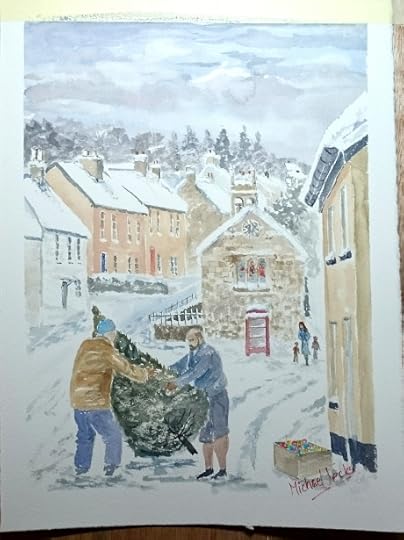
And between writings, every so often a quick painting. First attempt of a Christmas scene I can get printed for cards!
I’m in the middle of writing another book just now, the follow up to Rebellion’s Message, in which the often confused Jack Blackjack continues to try to escape a fresh series of tribulations in the early part of Bloody Mary’s reign.
It got me thinking about what it is that really appeals to me about writing crime.
I think that crime and thriller stories are about the most perfect ways to look at society. Often you will find ‘serious’ literary authors waxing lyrical about their works because they are looking at society and analysing it, so they say, through the prism of their characters’ eyes.
Well yes. That is the point of any kind of novel. However when you pick up a crime story, you will find characters living through the most extreme experiences any human can imagine. You will also be looking at things from many points of view. I’ve a love of the classic crime books of the 1920s and 30s, but I also like the Michael Connelly stories set in Las Vegas and Los Angeles. They give me a view of contemporary American life that I don’t find in many other books. Connelly can take the reader through to the millionaires’ mansions and back to the slums in a blink. In that he’s become a modern Chandler, showing the rich and the poor to best – and worst – effect.
But he is not alone, of course. My friends Quintin Jardine and Ian Rankin are masters when it comes to describing modern Scottish life – and violence. Then there are the satyrical writers like Ruth Dudley Edwards, who pricks the pomposity of the wealthiest in this country (and the US) with her ruthless wielding of a very blunt instrument in the shape of her character Baroness Troutbeck. Brilliant thriller writers like Caroline Carver (and you really should read her latest book, Spare Me The Truth) and the less well-known but superb Russell James, deserve much more recognition.
Especially too often neglected, I have to say (I would, wouldn’t I), is the small but growing cohort of historical writers. Susanna Gregory, Bernard Knight and Karen Maitland are all established authors, but there are many others who are competing for this market, from AJ MacKenzie to AL Berridge, Anthony Riches, Ben Kane and the others who are so steeped in the periods they depict that it is often difficult to find them without armour. When you read Ruth Downie, it is clear that she has a detailed understanding of life in Roman Britain, but also that she has studied how doctors worked, how cooks fared, how mixed marriages affected people and much more besides. Historical writers have so much to investigate, analyse, and absorb so as to give their works the immediacy that a thriller novel needs.
With all of these superb, imaginative, inventive authors, the reader will learn about history, how people viewed politics, politicians, businessmen, bankers and the poor. They’ll learn how the unwell were treated, how villains were caught, what the prisons were like (not nice) and much more besides. In my own books I’ve looked at rebellion, civil war, treatment of lepers, how people viewed bull bating and cruelty to women and children. In fact, I cannot think of any major modern issue that I haven’t covered, except perhaps people trafficking.
I suppose that all means, it’s less surprising that crime writing appeals to me; it’s much more surprising that more people don’t take it up!
Tagged: AJ MacKenzie, AL Berridge, Anthony Riches, Ben Kane, Bernard Knight, books, Caroline Carver, crime crime writing, Ian Morson, Ian Rankin, Karen Maitland, Michael Connelly, novels, Quintin Jardine, Russell Davies, Ruth Downie, Ruth Dudley Edwards, Susanna Gregory, writing


October 17, 2016
Nose to the Grindstone
Yes, I know I said I was going to be writing more regularly … but just now the main writing has to be the work on the next Jack Blackjack book, which has to be complete by end November.
It’s been a very bitty year, this. Little bits of work on so many different projects, and trying to keep my mind organised has been a little problematic. For example, there was the judging of the Impress Books prize at which I was the chairman of judges. That was tough. The short list was astonishingly strong, and choosing the actual winner was difficult. However, in the end it meant that one writer, Magdalena Maguire, won the prize, and a runner-up will receive help from the excellent folks at Unbound. But reading a load of stories and analysing them to select a winner was difficult, while trying to write as well!
Then there was the Man Booker debate at Yeovil. I’ve rarely been to a meeting about a short list of books at which there was so much hilarity as well as serious conversations about the merits of different titles. Sadly, I’m forced now to seek out several of them, but I won’t let myself open one until I’ve got some more time to read them.
The third distraction is the talk I’ll be giving at the How To Get Published day in Plymouth on 29th October. If you’re in the area, do come along. It promises to be a brilliant day, with authors, agents, publishers and many, many aspiring writers, because it’s organised by Writers’ & Artists’, the people who produce the yearbook every year. That is an event I’m looking forward to – but there is a lot to be done still.
Meanwhile, I still have to try to paint some more pictures for those who’ve commissioned them, as well as a painting of a Christmas scene so we can get cards printed. I have to go and visit my father, who is a very healthy 96 this year, and go to the Detection Club’s launch of Motives for Murder. This is the second book I’ve written with other members of the Detection Club this year. The first was The Sinking Admiral, which was a full collaboration, in which friends and I wrote sections of a novel. With Motives for Murder, we’re returning to a collection of short stories which have been written to celebrate the life of Peter Lovesey, a wonderful writer and delightful companion.
Of course the good thing is, that this is the last book launch of the year for me. After that, I’ll be disappearing into writers’ purdah for a while, writing a book or two, editing my book on the Crusades (first in a new series), and developing two other projects. I’m keen, if possible, to write another Templar series story. Perhaps that one will be written as a Kickstarter project. I’m not sure. What do you think about Kickstarter books? It seems fine to bring in money and only start to write it when I know that the money is committed, but it’s a long process to write, edit and proof a decent copy of a book. The only good side is, I have dealt with some excellent printing and binding companies, so at least I know the market a little. Let me know what you think.
And that is it. Back now to the main task of the day – 5,000 words on the new Blackjack mystery!
Have a good week!
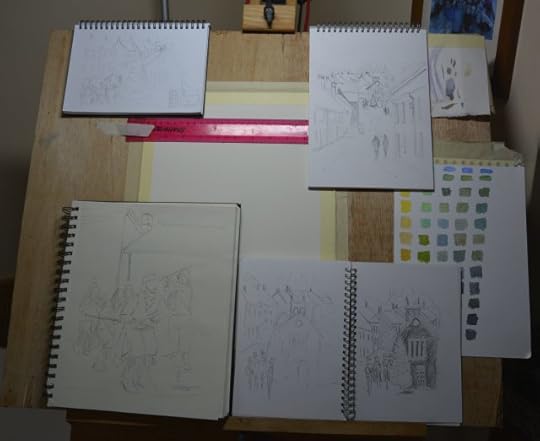
Planning Christmas card layout
Tagged: author, book writing, crime, crime writing, Dartmoor, hints and tips, publishing, writing


September 26, 2016
Beginning a New Story
This week I’m embarking on a new novel, and I’m going back to my roots. Yes, it’s a crime novel.
I’ve had a few people ask me how I actually get started with a book. The simple answer is, I don’t know. The ideas begin when I have a basic concept occur to. Sometimes that can come from getting a contract and having to flesh out a sketch of a story, and then fresh themes percolate through my mind over succeeding weeks as I finish off one book and edit another. When that book is set aside, the new novel is often already outlined in my mind.
Sometimes, of course, it isn’t that easy. With this current book, for example, although I know the locations for the book, I know that there is conflict around two leading characters, and I do know who the body belongs to, there is still a lot to be thought through logically.
In the past I have worked things out by making a basic flow chart. I don’t recommend this for new authors, though. As Stephen King has pointed out, it’s better for the author to learn about his/her characters while writing, rather than having a rigid plot and then making the characters turn somersaults to try to fit in with it. I like to think that my books grow organically while I’m writing, and that means that the characters are developing all the way through the story. They are thrown into all sorts of difficulty while I’m writing, and I never really know what is likely to happen to them in detail. It’s the later stages when they can be finessed and the plot tightened.
Very often my process will start with one simple thought. A boy dead on the moors; a skull washing from a hedge; a man ordered to commit murder, and then finds the victim ready prepared! From these, I start to develop characters, motives, scenes and locations.
Yes, a basic outline can be useful. I sometimes write them out with some detail. However that does not mean that I’ll stick rigidly to the outline. Usually by the time I’m halfway through I can rip up the outline and continue. The characters have started to take over by then, and the story is flowing serenely to a logical end.
At least, that’s my hope!
I’ve had a busy last week. Morris dancing at Castle Drogo on Sunday 18th, dancing again at Exeter Quay for the Dragon Boat Racing on 25th, and a number of different activities in between. I’m looking forward to a Booker discussion evening at Yeovil on 6th October, then I’m helping the Detection Club to launch a collection of short stories to celebrate Peter Lovesey’s birthday, which will be great fun, on November 10th. For news of these events and others, please register for my regular newsletters. You can find the link at my site at http://www.michaeljecks.co.uk.
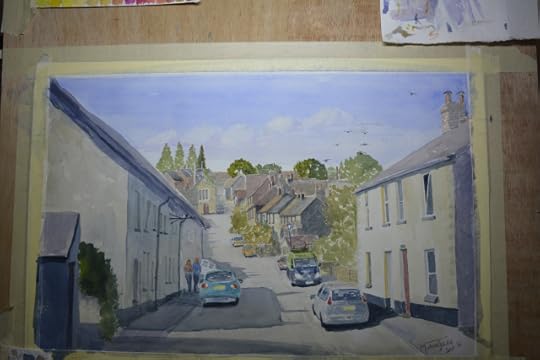
In my spare time, I’m spending more and more time painting. I had a good commission a month ago, which was a painting of our village, and since then I’ve been working on landscapes more. Some work, some don’t, but generally it’s good relaxation and I’m enjoying it enormously.
And don’t forget, if you want to know more about my work, you can follow my videos at writerlywitterings on YouTube, follow me on Twitter and Instagram, where I’m called @MichaelJecks, and also follow my Facebook page at Facebook.com/Michael.Jecks.author.
Tagged: author, blogs, book writing, creative, crime, crime writing, fiction, hints and tips, publishing, questions and answers, writing


September 19, 2016
Back at the Desk
I’m back!
Apologies for my radio silence. With the pressure of writing, as well as losing two good friends, the blog has had to take a back seat. I’ve been doing more painting than blogging.
However, it doesn’t mean I’ve been slowing down. In the first quarter I managed to republish Act of Vengeance, For the Love of Old Bones and No One can Hear You Scream, and then I published the first Jack Blackjack book, Rebellion’s Message. In May I contributed to the Detection Club’s latest collaborative novel The Sinking Admiral, and then the last of my Vintener trilogy, Blood of the Innocents, was published in August. Now I’m looking forward to seeing my story, Alive or Dead, in The Detection Club’s collection of short stories which will come out in November to celebrate the birthday of Peter Lovesey.
In the meantime, I’ll be at Yeovil on 6th October to speak at a Booker Prize event, and judging the Impress Books prize that week too. I’ve been invited to a panel at the Harrogate History Festival on 20th October, and also giving a talk at the Bloomsbury “How to get Published” event in Plymouth on 29th October. All of which are looking to be great fun, and I hope to meet a lot of readers at them.
And now I’m entering writer’s purdah again. I’ve a book to finish before the end of November (a deadline that is approaching with the speed and fearsome threat of a galloping water buffalo) and I have three other projects to work on. I need a story to follow up on Act of Vengeance, a second in my new Crusades series, and I’m working on ideas for another series, too. A writer’s life is not one involving lots of rest and dozing through the day, sadly!
So, apologies again for the delay, but the blog is now back with a vengeance!
Tagged: Blog, Bloomsbury, crime writing, Detection Club, Harrogate, Harrogate History Festival, historical, How to get Published, writing


June 29, 2016
Fields of Glory
Many thanks to Mr Turney for a very kind review. Next time I’ll try to make sure that the Crime books are more prominent, though!!

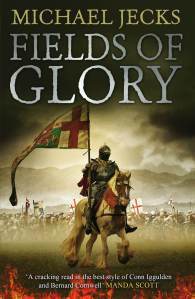
I’ve been meaning to read one of Jecks’ books for some time, given the high recommendations they seem to garner from my friends. I picked this one up for a read, knowing it was the first in a series. I was rather confused for a short while as I thought Michael wrote mysteries, and it turns out that this is not the first in that series, but the first in a new, recent series of more mainstream historical fiction.
Initially, I found things a touch hard work, due partially – I’ll admit – to this not being the book I thought it was! But partially due to the fact that there is quite a cast and most of the dramatis personnae get their own screen time, as it were. Each chapter seems to deal with the viewpoints of perhaps three or four of the characters. Oh, there’s a main…
View original post 340 more words


