
Michael Jecks's Blog, page 19
November 29, 2015
Diaries and Paper!
Apologies – this week I’m desperately working on an edit (again). This one is the last in my Vintener Trilogy about the Hundred Years War. A good series of books, and enthusiastically supported by an increasing readership. Thanks! I should have finished the edit in the next week, but with family coming to visit, time is getting restricted, so, as a result, here’s a short piece.
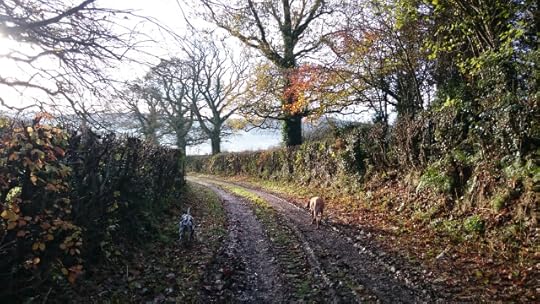
Lovely wintry morning!
I have two main issues with writing. First is finding paper that is good enough to write on, and second is getting paper that will go through an old printer so that I can print my own diaries. I’ve had issues with this for ages. I used to buy ready printed diaries when I was a salesman, and loved the French Quo Vadis formats. They gave brilliant A5 format diaries that allowed me to break up days, use “To Do” lists, and keep notes about clients. But as an author, I had to give up such frivolities. With fewer than two meetings in every six months, a diary seemed pointless. As my speaking engagements expanded, suddenly I needed a diary again, but after the famous time when I managed to triple book myself, my wife took over management of my time. A good idea!
But while working at Exeter University as a tutor with the Royal Literary Fund, I discovered that I needed to have a diary system that efficiently controlled my time on a fifteen minute rolling basis. As a result I started using the Chronodex time management system from Scription. It was invented by Patrick Ng, and he has provided it free of charge to anyone who wants to use it. I’ve been using it for four years now, and I find it ideal. I can see at a glance where I need to be, how long for etc. It works for me in the same way that an analog watch seems to function better than a digital one. I can understand a dial more quickly than I can a series of numbers.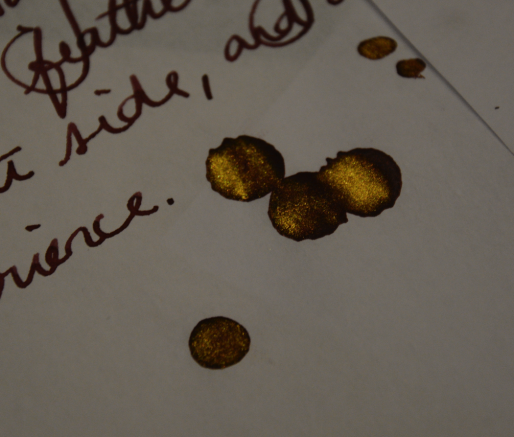
However, it suffered from the paper. I use a Midori Traveller’s Notebook as my daily carry note-taker. With this, I can work on stories, noting down conversations I hear, ideas for a character, ideas for a plot. And it also has my essential “Things to do” lists, too. But with ordinary paper, the MTN struggles. A full diary for a year with one week to view is impossible. Yet that is what I need. The answer? At last I’ve found it: Q-Connect paper.
It is 50 gsm, so incredibly light compared to my usual 80-90 gsm copier paper. However, normal copier paper often works as efficiently as blotting paper when I try to write on it. You can see “feathers” of ink spreading out as you write as ink soaks between the paper’s fibres; you can see it “bleeding” into the paper so that the ink shows all the way through to the other side. These are not minor issues with a diary. But with this new Q-Connect paper, I’ve been working with the incredible new inks in the Diamine “Shimmertastic” range, which are wet inks, and using a very wet, broad nib in my Conway Stewart Drake pen. None of the ink bled through, and the feathering was unnoticeable. Truly remarkable. So now I will be testing the paper going through my printer to see if it is as happy with toner as it is with ink. I will certainly be recommending the paper to all who like fountain pens and thinner paper.
However, since I’ve mentioned the inks, I may as well tell you about them as well.
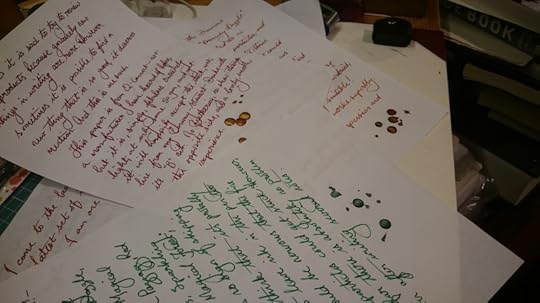
Magical Forest, sort of Kelly Green colour; Red Lustre with dark berry colour, and then Brandy Dazzle with an Oxblood shade of brown. Lovely!
I’ve been working with Diamine inks for years now. I love their greys, their blues, their greens and browns, and their inks are very good value, so I have a fair selection of different colours.
Oxblood regularly stains my fingers, as do Teal and Prussian and Chinese blues. Variety is key to enjoying writing, I find, and Diamine have 103 basic colours and shades in their range.
Last week they were kind enough to send me a trio of their Shimmertastic inks to test, and I’ll be putting up a video on them shortly. However, I don’t think it’ll be a surprise to hear that I loved them.
They sent me Brandy Dazzle, Red Lustre and Magical Forest. The first two are red inks (Brandy is more an Oxblood colour, Red the colour of a deep red) and Forest is a bright green. All give good shading and variety as you write, which is really nice to see, however the main thing is, they all have metal particles in them. The reds use a golden particulate, while the green uses a silvery metal. The particles themselves are quite keen on sedimenting out. Not only on the page, but in the bottle and in the pen, so when you load it, you do have to make sure that you have shaken the bottle intensely first. Also, occasional rotating of the pen is a good idea (um, no, don’t shake the pen. Not a good idea unless you want glittering blobs on the ceiling and everyone else in the room!) so that you keep the particles moving.
I’ve only used them in a dip pen and a cartridge converter pen. The dip did not work for me. The trouble is, you really need to agitate the bottle between dips. The particles did sink quite quickly. However, when I loaded my Conway Stewart, the story was different. The bits of metal moved much more happily, and the results were very pleasing.
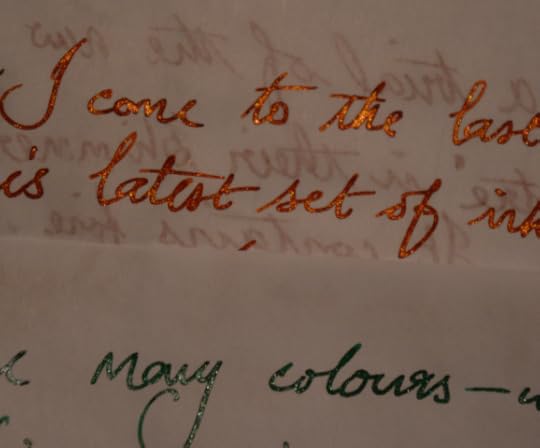
Red Lustre and Magical Forest here – love the sparkles in the red!
It is not the sort of ink you would fill with just before going into a meeting. Not in my case, anyway. The effort of keeping the particles moving would be a bit of a pain. However, if you’re writing Christmas notes, cards or present labels, it’s perfect. I love the deep glitter that you get, especially with the golden glow in the reds, and the silvery sheen in the green is lovely.
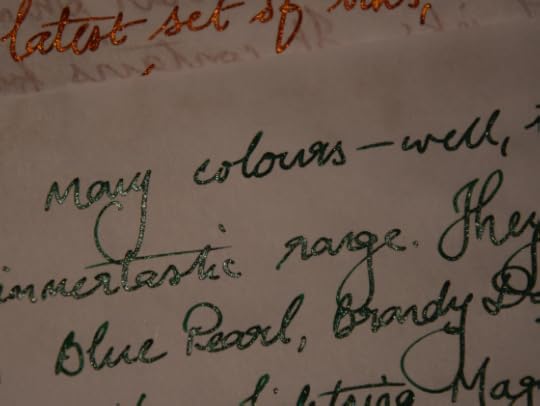
Magical Forest – look at that glitter!
My favourite? Personally, because it is so similar to Oxblood, I think that the Brandy Dazzle would get my personal vote. I really like the faintly clotted blood, glittering appearance. It makes me think of writing in fresh blood. Surely that is the right sort of colour for a crime writer, after all?
I do think that these inks will take a little more effort to use. I wouldn’t want to leave them in a pen for too long, and would flush and clean the pen more routinely, if using them, but for all that, I think they are a definite benefit to my writing, especially at this time of year. So, if you’re thinking of Christmas cards or writing thank you letters, I think your ink has been chosen for you!
Happy writing!
And now – back to the edit!
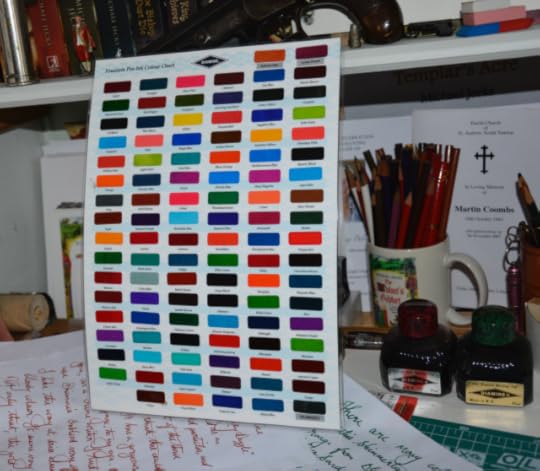
Full range of Diamine’s regular inks
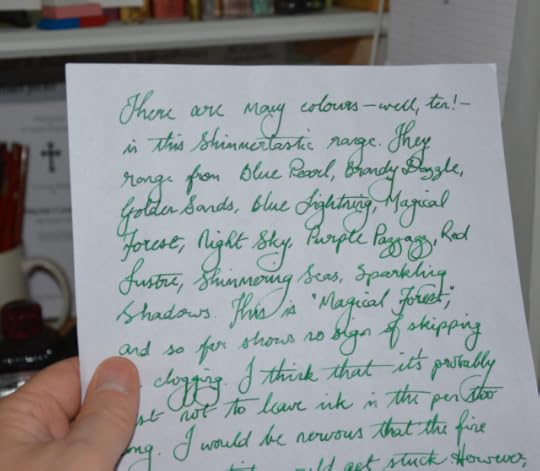
Magical Forest
Tagged: Diamine Ink, fountain pens, inks, paper, Q-Connect, Tomoe River


November 28, 2015
The Chapel Of Bones by Michael Jecks

Very glad for this excellent reviewer’s hard work! Thanks, Puzzle Doc!
 Originally posted on In Search of the Classic Mystery Novel:
 One dark night in 1283, Exeter Cathedral was stormed by a band of men and Walter de Lecchelade, the Chaunter, was brutally murdered. Many men paid for that night – either they were executed for crimes, either their’s or someone else’s, or else their sins have haunted them for the past forty years. Some left Exeter, some stayed, some profited, some suffered… but now, in 1323, some of the participants from that night have terror have returned to the city.
As construction continues to expand the cathedral, Saul, a mason, is crushed by a falling block of masonry. While that is surely an accident, the second death is undoubtedly murder. One of the participants of the night of terror lies dead, and Sir Baldwin Furnshill, plagued by his own guilt, and Simon Puttock need to find the killer before they strike again…
View original 501 more words


November 23, 2015
Another Week, Another Edit
Last week I was glad to finish one edit – this week I have another.
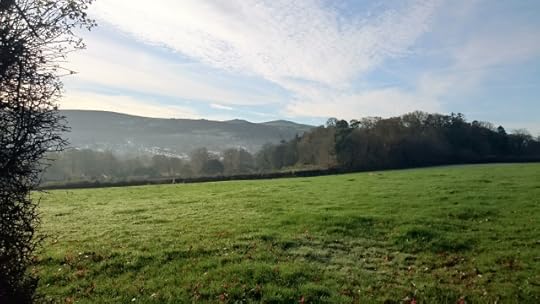
All I want to do is head off to the moors!
It’s one of the more accurate observations, the fact that all writing is rewriting. I estimated that my first novel was the result of reading and rereading my manuscript somewhere in the region of thirty five times. By the end of that marathon reading/editing session, it’s little surprise that I really didn’t want to read the book again! However, I am glad to say that when I reissued the novel with Simon and Schuster after some eighteen years, I was very pleased with it.
Last week I was lucky enough to have an evening away from my desk on Monday. I went with Karen Maitland to give a talk in Taunton at the excellent Brendon Bookshop. It was really enjoyable – a lively audience with plenty of questions.
One of the questions that people always tend to ask is, do you, as the author, have a favourite book of your own? Phew! That is like asking a parent which of the children is their favourite. It’s a horrible question. If there was a favourite, that must mean that there would be a less favourite, or even worse, among the rest of his or her works. Mind you, I have to admit that different books do appeal more or less over time. I cannot deny that I’ve always had a soft spot for the first because LAST TEMPLAR was my first. In the same way, I’ve always liked DEATH SHOP OF DARTMOUTH because that was my twenty first novel, and also because it was shortlisted for a major prize (the Theakston’s Old Peculier). But then I love MERCHANT’S PARTNER, and MOORLAND HANGING and all the others. Basically, I write in the hope that the books I’m working on are the kind of books that would appeal to me. That means that as my tastes change, so does my writing style, but it also means that I hope there is a continuing market for my type of work.
Talking of work, well, having completed one edit, now I’m on with the next. This is the third book in the Vintener trilogy, and covers the battle of Poitiers. A horrible battle, leading to the death of so many, and my vintaine suffered accordingly. If there is one fact that is never-changing, it is that the one book no author wants to work on, it is the one that is in front right now. I always want to be cracking on with the book I’ve got fixed in my head, which is the one I haven’t started yet! I’ve two weeks to finish this, and then, at last, I can refill my Visconti pen with Diamine inks, grab my Atoma notepad, and embark on the new novel. I’ll be looking forward to that!
However, it is coming close to Christmas now, so I’m preparing all my book stocks for sale. If you have any friends or family who deserve a good read, do please contact me here, and I’ll get back you you as soon as I can.
In the meantime, if you are bored and need a break, do go and check my latest YouTube video about my favourite pen!
Have a great week!
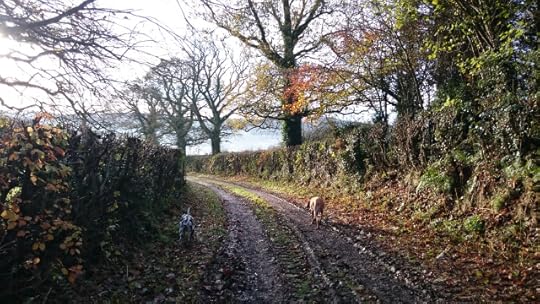
Walking a Devon lane
Tagged: author, book writing, books, creative, crime writing, Dartmoor, Devon, fiction writing, Homo Sapiens, medieval, novel, review, Visconti, Visconti Homo Sapiens, writer


November 16, 2015
NaNoWriMo and more…
There are plenty of people who’ve been trying desperately hard to write in the last few weeks since the start of NaNoWriMo ’15. I can all too easily empathise with their frustrations.
One thing that many people don’t realise, when they set out to write something, is that there are very few jobs quite so difficult and exhausting as writing a novel.
Yes, I know, it sounds pathetic, but I’m not whining. It’s just pointing something out. When you get up early in the morning to leave the house and go and work in, say, a school, or a factory or a retail store, you have reason to complain. You have long hours, often involving actual labour that is tiring, and the risk at all times that someone is going to shout and scream at you for some perceived insult that may or not have been intended, and you’ll have the same commute to get home. How can an author’s life compete with that?
Well, first off, an author has exactly the same financial worries as any other self-employed worker. Money, for most writers, is a constant trial. And yet we are expected to be inventive, creative, imaginative and dedicated at all times. Let alone the fact that we must give up evenings and weekends to go and talk about our books, usually at our own expense. And many have to try to hold down a real job at the same time, to try to make the finances work. Again, this is not a complaint, merely an observation.
London at Night. Nice.
For example, last week I had a series of meetings covering marketing; I had a formal dinner for crime writers; I had a meeting to discuss a series of short stories; I lost two evenings to meetings; and then on Saturday I had a great day with friends from Devon, talking to readers at Crediton Bookshop and the library. All of this was enormous fun – but at the same time I had to write and edit the current books I’m working on. Today I’ve had to go to the bank, write some private letters, catch up on emails, and later today I have to go to Taunton Literary Festival with my good friend Karen Maitland. But at the same time, I have books to write.
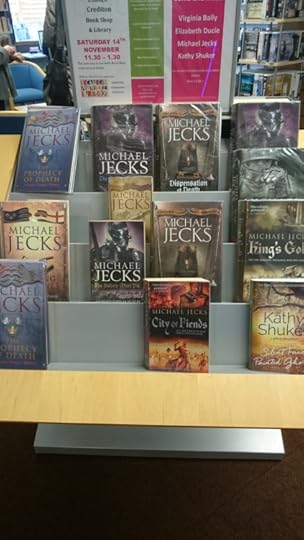
Great display at Crediton Library!
It is not only the act of writing that is tiring. It’s the constant competition of voices in your head. While writing I am living the lives of six or seven different people. All of them are individuals in their own right, they have interests and hobbies and jobs, and rarely do any of them match my own personal interests. That means every time I have a shift of point of view I have to change my own nature and look at things from this other person, my creation. That, I believe, is the most exhausting part of the job: it’s the constant attempt to live, think, breathe as another person.
At the end of every week I am aware that yet another week of my life has disappeared. I’m not strange, I think, in feeling that the passage of time is accelerating as I pass closer to sixty. My father was complaining recently, muttering that things don’t taste as strong, everything takes longer to do, and everything weighs more than it used to (he is 95 and complains rarely, I should add), and I can empathise with his views. I had a Morris dancing practise yesterday, which was not helped by a strained back and sore ankle. Neither is debilitating, but both are ruddy irritating!
The most frustrating thing is, however, the loss of time. The time lost to silly phone calls from cold calling salespeople, the time spent to wade through the junk mail delivered every day, the wasted time sitting waiting for a phone call that never comes, or waiting for the phone to be answered when it never is.
All of which pales into insignificance beside the miserable life of the partner of a writer. They sit at home trying to make plans for Christmas, trying to talk about the shopping, trying to discuss whether to go out to an evening’s theatre or just to the cinema, talking to their spouse or partner, only to realise too late that actually the author was trying to work a specific murder into his/her latest story. And before the long-suffering partner can blink, the author’s switched point of view and is the victim just before dying … and still hasn’t the faintest idea, fifteen minutes later, why saying “You never told me that!” leads to a saucepan being flung at his/her head.
Yes, life for the other party can be miserable. But the author is still trying to get ideas down on paper before they dissipate and fade to mere whimpers in the night.
Which is why, when I am trying to plan a week’s work on a Monday, I am always so grateful for people who contact me and ask for a specific topic to be covered. It saves me thinking about such things. And on YouTube this week I have to record a review of my wonderful Visconti Homo Sapiens fountain pen, because someone has asked for it. Thanks!
So, hats off to NaNoWriMo for attempting a novel while also holding down jobs, keeping the family happy, and hopefully remaining balanced and rational human beings. If you can do all that, you’re better than this author!
For those interested in my videos on YouTube, go and look at them here: https://youtu.be/XKK4UFSH4fc
Have a great week. And now, back to the desk …
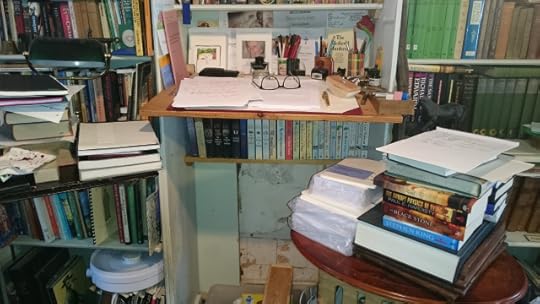
My standing desk
http://www.bloglovin.com/blog/11210859/?claim=ehnmunpbnkb”>Follow my blog with Bloglovin
Tagged: author, book writing, books, crime writer, crime writing, hints and tips, novelist, writing


November 4, 2015
Writing Discipline
As a follow-up to yesterday’s Top Ten Tips on NaNoWriMo, I thought I ought to add a response to two of the comments I’ve received. The two points that were raised both relate to discipline more than anything else.
First, another writer was a little concerned at my point 7. She pointed out, quite rightly, that she was an historical writer and had to get the facts right in her stories. Research was key, she pointed out.
I quite agree. I am very proud of the fact that my own books are used for teaching in a number of schools in the UK and US, because my attention to detail has been noted. However, I’d still defend point 7 relates to writing.
There comes a time when the author has to put away his or her research books and write. Yes, it’s important to get the facts straight, but not to the extent that they prevent writing the book. This is especially true for NaNoWriMo, which is a short, one month period in which the objective is to get words down on paper. Research for NaNo must be curtailed. If you haven’t researched adequately already, go to the default novelist’s position, and make it up! It is your prerogative, but more than that, it’s your job. If you, as a serious historian, want to clarify when and where you embellished, then do so in an Author’s Note (it’s what I do in my books), but don’t lose sight of the fact that you are primarily there, sitting or standing at your desk in order to put words on paper. Not to enjoy yourself delving further into the history of the period. If that is what you want, you’re doing the wrong job: you ought to be at university and studying for your doctorate! Sit down and write.
Second, Audrey wrote in to say that she wrote several novels before NaNo was thought of, but since receiving an internet connection in 2010, she hasn’t been able to write anything.
That is a horrible position to be in and Audrey has my most profound sympathy.
However, there are cures for such issues. For example, I discovered, soon after being told that I had to increase my Twitter and social media presence, that my productivity fell through the floor. There was an unfortunate concatenation of events in my case, with a new job as Fellow of the Royal Literary Fund, speaking engagements, and trying to help start a new literary festival, that all conspired to get in my way. That was no excuse, though. I am a professional writer. If I am not writing, I’m no longer a professional writer. So, in my case, I had to make the decision to rationalise my efforts. I hit upon the idea of writing Tweets in the morning, and then dipping in occasionally through the day. If you look at my timeline, I tend to write before 08.30 or while I’m walking the dogs, and then at about 11.00, about 13.00, and at two hour intervals basically until about 21.00, which is when I let myself off the leash more. My day is spent in one hour chunks of writing, during which I will write about 1,000 words. Only when I have written at least 5,000 words will I allow myself time to read the news, look at internet pages that are not related to work and other things.

To get to this you will need to be disciplined.
Many writers suffer from a lack of discipline. A lot attempt to write before they have worked at full time jobs, or before they have even left school. For them the discipline of a working day can be really tough. But if you want to get the words on paper, and that is essential if you want to call yourself a writer, author, or novelist, then you have to dedicate yourself to that task.
So, turn off email, the phone, Twitter, FaceBook, Tsu, Ello, Pinterest, and all the other distractions as well as the TV until you have achieved your daily count. It’s only for one month – but to finish that novel it’s essential. And creating a first novel is one of the most sublime experiences anyone will ever achieve.
Good luck!
Tagged: #NaNoWriMo, #NaNoWriMo2015, author, book, concentration, discipline, distractions, novel, work displacement, writing


November 3, 2015
NaNoWriMo – My Top Ten Tips!

My writing desk – pick somewhere comfortable where there are few distractions.
So here it is, another year, and already another NaNoWriMo. You’ve never heard of it? It’s the National Novel Writing Month, and it involves a vast number of aspiring authors getting together with professional writers, making a statement about their objective of writing a book in the month of November, and cracking on with it.
Does it work for everyone?
No, of course not. Because modern life is hectic and tiring, most people cannot face the thought of getting home after a long day working and then trying to work out the motivations of a character, the detail of a hazy subplot, and then put it all down on paper for the 2,000 words a day that is needed.
However, there are some professional hints that can help, if you’re into NaNoWriMo. These are my own top ten tips:
1. set a goal for the day. It doesn’t matter whether it’s 500 words or 2,000, but once you’ve set it, stick to it. Start in the morning before work, and type as many as you can, then finish off as soon as you get back after work. The main thing is, to be disciplined about it;
2. make sure your goals are realistic. Do not work to unattainable targets. For me, 10,000 words in a day is occasionally possible. It is not feasible routinely. My usual average is between 5 & 7,000. 5,000 is comfortable; 7,000 is challenging. However, if I set myself a target of 25,000 in a week, I know I can and will hit that every week. Make sure your goals are achievable. If in doubt, go with 750 and see how you get on;
3. plan what you will write. This doesn’t mean you will always sit down with an extensive flow chart before writing, but you should always take time to think about what the next scene is, why it’s in the book, whose point of view you’re using, and what the objective is. In other words, how does this next scene take the story forward. For me it takes ten minutes between scenes to plan the next one;
4. stop on a high. This is advice from the ever-delightful Terry Pratchett: always stop work knowing that the next scene is going to be a good, fun one. That way you sit at your desk the next morning knowing you’re about to enjoy yourself. It helps keep you motivated;
5. if you are working, no TV until you’re done. My writing career began when we threw out our TV. Still, when I am in a book (which is most of the time) I will not turn on the television. TV absorbs your energy and wastes your life. Once you sit in front of it, you’ve lost the evening. Planning your life around the next edition of “Breaking Bad” or “Downton Abbey” means, simply, that you will not achieve your goals. Turn off the TV and set up the recorder so you can catch up later, if you must. Better: get used to the idea you’re weaning yourself from TV forever. Also, turn off Facebook, Twitter, email etc. They all stop you working and notifications come through, invariably, just when you’re in the middle of a great scene. It’s the Kubla Khan syndrome;
6. don’t try to sit down and type up a whole book. I find that I can write 1,000 words in 50 minutes. I always try to work for one hour, then take a break. That is the planning stage for the following scene. While making a cup of tea or offloading the previous one, I am thinking about the last scene and where the story is going with the next. It keeps your writing fresh;
7. don’t persuade yourself that you need more research. The comfort blanket for many is the reading of research material. We sit and read, each new piece leading us to another with a glorious inevitability. And as December begins, we realise we’ve missed the basic element of the novel, which is writing the damned thing! Research is good. It is fine. It is helpful. It is destructive for writing. It is a work displacement activity for writers. Your job is to make things up;
8. don’t worry about what other people will make of your work. Write for yourself. Yes, people will be able to pick holes in it, but you are working on the first draft, not a final copy. For me, that means writing fast, keeping the mood going, and putting down words as quickly as possible. Later, when I edit, I’ll take out or replace a lot of them. That’s fine. That’s the next stage. Right now, you should be aiming to get the words down so that you have something to edit;
9. don’t think about emulating anyone else’s style. Your writing will be defined by all the books you have read, all the stories you have heard or told. It will come naturally, if you let it. And that is what you are looking to develop, your own narrative voice;
10. don’t think this book will ever be published. It is incredibly rare for a first novel to be published. My own book “The Last Templar” was my second attempt. Most people are lucky to get a third or fourth accepted by a publisher. NaNoWriMo is an opportunity for you to learn whether you can actually write a full-length novel, to see whether you have the stamina and excitement to tell a story. If it works, you may get the bug (or addiction) and discover that you are a writer, but it doesn’t work for everyone. Writing is a hard, lonely job. It isn’t for everyone. After all, watching “Breaking Bad” is a lot easier than working into the night.
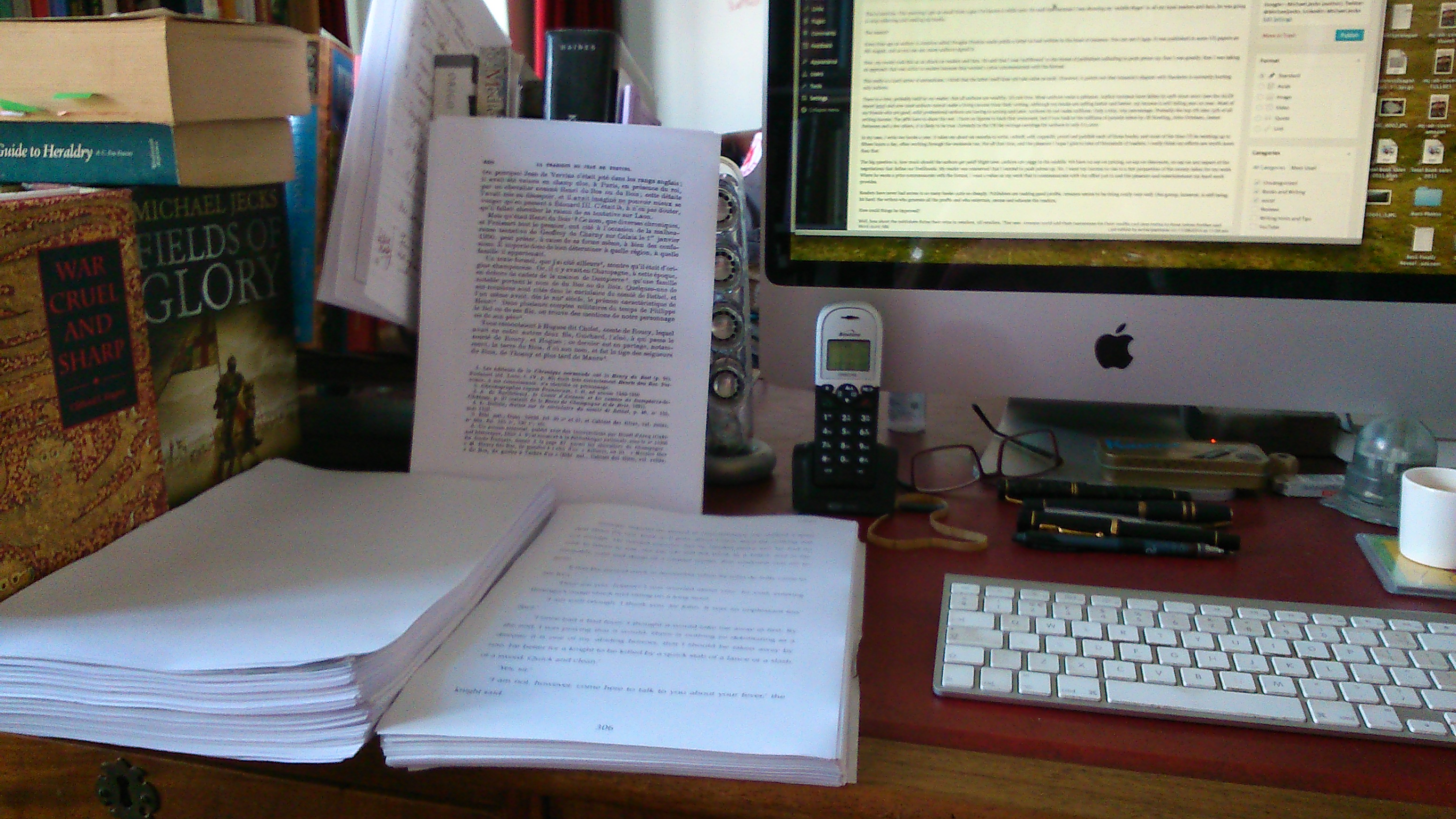
It takes time and hard slogging to finish a novel. There are lots of words in that pile of paper!
There you go. Which of these is the most important? I think they all are. They are the ten crucial rules of my writing life, but the absolute critical tip is the eleventh. It is the one that summarises all the others.
What is it? It is that, most of all, the key thing to remember at all stages of writing is: don’t prevaricate: just write!
Have fun in November, and I hope you discover how much fun writing can be. Best of luck with your writing project!
Tagged: #NaNoWriMo, achievements, author, displacement activities, goals, manuscript, novel, planning, plots, plotting, targets, top 10 tips, top ten tips, top tips, working, writing, writing desk


October 26, 2015
And so, back to work…
This has been a strange weekend. So full of fun and enjoyment, but all shot through with melancholy.
On the 4th of October, Beryl Joan Jecks, mother to four boys and foster-mother to Caroline, died. It was unpleasant seeing such a happy, vibrant lady fade away.
The funeral was held on Friday. It was hard, as you would expect, but more than a hundred people came to help celebrate her life, and that was a comfort. My father gave a typically up-beat and amusing eulogy for her, the wine flowed, and the family and all our friends enjoyed reminiscing.

Four sons and Dad
Saturday we had a special family meal. Sixteen of us met and enjoyed a meal, with a lot of laughter. We brothers told of our memories of an idyllic childhood and some of the injuries that were inflicted (on each other). Our eldest, Alan, was the recipient of much of the condemnation – with good reason! But then the next generation took command of the conversation, perhaps to save them the embarrassment of their elders (not betters), and we all had a wonderful evening.

Oldest brother reminded of his exploits with his air rifle
It was the perfect celebration of the woman who invested so much of her time and energy in making our family the strong and supportive clan that it has become!
However, now I am back at work. I have the last few bits and pieces of the latest book to complete. As soon as that’s finished I’ll have the editor’s comments on the book tentatively called POITIERS, and then the new book on Templars and the Crusades. Oh, yes, and two manuscripts that are screaming to be edited – and a new idea for a follow up to ACT OF VENGEANCE that I’m desperate to get to work on.
This next year isn’t going to be any less busy than past ones.
And now it is time to crack on with the book. Which is going to be interesting this week – half term for school means I have a little monster demanding attention and help!
Have a great week.

Dad, Oldest and Youngest Brother
Tagged: Beryl, funeral, wake


October 20, 2015
Review: HEARTS OF STONE by Simon Scarrow
 As I have said before, I will only review books I’ve enjoyed. Well …
I’m a novelist, and I’ve written enough books to cost half the Amazon rainforest. That, for me, means I’m pretty hard to please. Especially in my chosen specialist subject of the historical story.
Historicals for me create a number of problems. First is the age-old issue of historical accuracy. How far is a novelist allowed to bend dates and facts to suit a story? With Medieval novels all too often I will spot shocking inaccuracies, not the sort of thing that others would notice, but details that jarr for me and ruin a good read. Then there are the glitches caused by more recent books in which the author seriously screws up the simple facts, like what make of gun was used by which country, whether a machine gun is belt or box-fed, and similar issues that ruin a good read for me. And that’s all before the sense of terror that I always have, worrying that one day I’ll think up and write a story, only to be reminded that it’s the same book that was written years ago, and I had forgotten, thinking it was a new idea that had just come to me …
So, when Headline sent me Hearts of Stone to read before interviewing Simon Scarrow at the Plymouth International Book Festival, I treated it with trepidation. Scarrow? He’s a really good writer of Roman war books, I know. I love his Macro/Cato Eagle series, but this thing was twentieth century, set in Greece.
My apologies to Simon, but I did suspect that he’d sorted himself a nice little holiday, and paid for it by writing a book. It couldn’t be that serious.
How much more wrong could I have been?
It starts in 1938, in the period immediately pre-World War II, with an archaeological dig on the island of Lefkas. It’s run by a German, Muller, who is convinced he’s in the right place to make a discover that will rival the discovery of the city of Troy, and it is a horrible shock to him, his son Peter, his assistant Heinrich Steiner, Andreas Katarides and Eleni Thesskoudis, a rather gorgeous young Greek woman. Peter, Andreas and Eleni are sad to be separated, but the telegram from Germany was explicit: the international situation was deteriorating rapidly and Muller and his assistants must return to Berlin.
Next, we move forward to 2013 and the harassed life of an English history teacher, Anna, who is the grand-daughter of Eleni. She is contacted by a German called Muller, who is trying to find out more about his grandfather’s time in Lefkas during the war. Anna is reluctant to disturb her grandmother, but eventually she is intrigued enough to see what she can find out. She asks, and gradually Eleni tells her story …
There are not many writers who could pull off such an engaging, startling, exciting and enormously touching story. This book rockets along, telling this tale with simplicity, but never losing sight of the vast events that were affecting millions all over the world. Simon has got into the characters, into the period, and into the motivations – and by that I don’t simply mean he understood the two sides in the war, but that he can depict modern young folk, grandparents, and all ages between. This really is an enormously impressive piece of work. In many ways it is the story of modern Greece, explaining both the problems that caused the financial crisis, and the particular hatred held by many Greeks for the Germans and the strict financial constraints imposed by German banks. However, this is much more than that: it is a great war story, it is a love story of passion but subtlety, but most of all, I think it is a story about the generations, and how younger folk can learn much from the experiences of their elders.
Basically, this book has blown me away.
Without reservation, I give this book my highest possible recommendation. It is, frankly, superb. It was a delight to read, and it is a story that will stay with me for a long time. Stunning, superb, brilliant. If you don’t read another book this year, you should read this.

Dartmoor this morning
Tagged: Greece, Hearts of Stone, novel, Simon Scarrow, writer, WWII


October 19, 2015
Quickly!

My mother – always with at least one dog!
I’m in the middle of preparing for an interview with Simon Scarrow this evening at Plymouth International Book Festival. I’ve admired Simon’s work for years now, although I’ve never had a chance to meet him before, so this is going to be great fun, talking to him about his writing, his latest books, and anything else that takes our fancy. If you can get there, please join us.
The rest of the week … well, it’ll be less fun. I’m working flat out on one book to get it finished in good time, which is fine, but on Friday we have my mother’s funeral.
As you’d expect, it’s going to be a melancholy occasion. She was adored by all of us in her family, of course, but she had a wide circle of additional friends, too. Although it’ll be good to meet them again and reminisce, there will always be the hard truth that this is the first big family and friends gathering that I’ve ever been to where she won’t be joining in.
Still, she brought a lot of happiness, and it’ll be good to try to remember all the good times and allow memories of the last illness to fade a little.
Onwards, as they say.
Tagged: Beryl Joan Jecks, mother, writing


October 13, 2015
Harrogate and more

Beryl Joan Jecks, 1929-2015
I have been booked for most of this year to go to the Harrogate History Festival, and I was really looking forward to it, but I’ve had to cancel. My event was to be on the 23rd, and that is the day of my mother’s funeral. Apologies to anyone who was hoping to see me there.
Before continuing, I have to thank all those, and there were hundreds, who offered condolences on her death. It was wonderful to get so many kind thoughts from so many friends. I was really touched, and very grateful to all those who took the time. Thanks.
But life continues.
I am in the middle of a book now which is proving to be enormous fun. It’s quite a diversion from my usual novels. For one thing, it’s my first book written in the first person, which makes life (surprisingly) easy. Since I don’t have to explain from six viewpoints, select which is most relevant, then use that point of view to look at a specific scene, I am finding it really quite freeing. And since it’s crime, I know what I’m doing with the plot, which helps!
However, this book is soon to be finished, and from the middle of November, with luck, I’ll be launching on a new project. This is to be the first in a series again, but I’m returning to the medieval period and looking at the Crusades and Knights Templar. Although my main series was always the Templar Series in my own mind, it wasn’t really about the Templars. As all my readers will know, it was much more to do with the life of a man who had been a Templar, and how he found life after the destruction of his Order.
This new series is going to be much more about the Templars themselves. I want to look at the men who joined the various religious Orders, the type of men who went on Crusade to fight and die for their religion in the sand and heat, but also to consider the merchants, sailors, labourers, slaves and indigenous populations, and think about how they would have viewed this period. Perhaps it is to do with my own interest in medieval times, but it’s also, I am sure, a story that resonates today, especially now with the major powers fighting in and over Syria.

Look at all those luscious inks!
This year has been notable for the way that my work has been disrupted by catastrophe, however. I had a disaster in March when my computer failed – the back up drive I had been using overwrote my main disks with errors, causing the loss of the last fifteen years of work and photos. My secondary back ups on DVDs have not been entirely successful. Half of the disks have not worked, meaning that my local storage has failed. Fortunately I had also backed up to Flickr and the pictures I took in the past are mostly there, but some are lost forever. It took me three weeks to set up the computer again in the way I was used to, and a further week to read myself back into the story. Then, in the summer, my screen went peculiar and started presenting me with strings of Chinese or Japanese logograms in bright pink. This was interesting, and alarming. Especially when the screen went blank. I went to visit my friendly local Apple store, only to learn that on my ‘veteran’ machine (six years old) the blasted graphic card had blown. It was a dead machine. Another three weeks later, and another week to read my way into the book once more, and I had a new computer. But I had lost eight weeks of my book. I managed to catch up to an extent and presented the book only four weeks late after heroic typing, but it’s not something I want to do again.
So, as a result, and because I adore my fountain pens, I have decided that the next book will be written by hand. I’ll have to type it all up, of course, later, but the first draft will be briefer and written in ink on paper. That way the type up will become my first edit. Hopefully, by writing long hand, and then typing, I will be able to see the glitches more easily than by attempting to edit on screen alone. I tend to have to type the book, print it, edit it, and retype, so this is a different approach.
I have to thank three companies: Diamine Inks have been enormously helpful and have sponsored the idea by giving me one of each of their main ink colours and shades. That may not sound like much, unless you’re a fountain pen nerd like me, but it means that I’ve been presented with 103 inks. I will be writing the project with my Visconti Homo Sapiens, and Visconti are keen on the whole project and have given me their support as well, while Cult pens have been enormously helpful, providing me with Atoma notepads and paper – good quality paper and the ability to rip pages out and move them about is going to be esential.

My Visconti with the wonderful DreamTouch nib sitting on my Atoma pad
This is going to be a seriously interesting project for me. I will not have handled a pen in anger for such a protracted time since I was at school, I guess. However, I think it’s going to be good to try. I’ll not be interrupted by bleeps and whirring from the computer as someone comments on his dog’s ingrowing toenail on Facebook, for a start. I’ll instead be able to concentrate purely on plot and character.
However, I will be posting videos about my progress, writing about my experiences on this blog, and tweeting about my day in the morning, midday, supper time, and at the end of my day. I’ll allow myself my Twitter fixes at those periods. But not more. It’s going to be fun to see this one progress, although I confess it’ll be difficult to see how to film and photograph the project without actually giving away the whole story!
Finally, to return to my mother briefly: she was looked after wonderfully by the NHS staff at Guildford’s hospital, but more important than those were the staff of the Hospice that made her last weeks much more positive. We are so grateful to these people that we have set up a link so people can donate money in support of the hospice. After all, hospices are likely to be helping more and more of us as the population ages. If you want to give something for a marvellous organisation, please go to the link here. Any sum will be gratefully received, and put to good use.
Many thanks and have a great week.
Tagged: Apple, Atoma, Diamine, handwriting, Homo Sapiens, Ink, Knight Templar, novels, paper, pens, planning, Templar, Templar series, Visconti, writing


