
Michael Jecks's Blog, page 23
March 16, 2015
Author incomes – when does the money come in?
This is a quick post to answer the question I have been asked several times recently, which is: how soon are authors paid for their work?
Oh, boy, I remember the day Marion Donaldson called me to confirm that Headline wanted to buy my first book, and that she wanted another two titles in the series. I danced a jig in my hallway, so thrilled that at last all my money problems were over … yeah, right. Hindsight is a wonderful thing!
However, it was interesting later when I looked back on things, to consider that number. What would make the publisher think of a three book deal?
It was some years before that I’d been wandering around a bookshop, early for a client meeting, and happened to spot a book by some geezer I’d never heard of. The cover was interesting, the back intriguing, and I liked the writing style. It was enough to tempt me to part with some of my hard-earned cash. The book was The Colour of Magic by Terry Pratchett.
However, usually I would not buy books by people I’ve never heard of. I’m not silly, after all. If you see a book on the shelves and you’ve never heard of the author, what is the likelihood you’d buy it? In my case, I soon realised that I wouldn’t buy one if there was only the one title. One book does not prove a writer’s ability, I’m afraid. I’d be very unlikely to buy a hardback by an unknown author, just as I’d be extremely unlikely to buy a book by anyone unless I can see a track record. For me, that means at least three books on the shelves. Three means that they’ve established themselves with their publisher, and therefore they do have something worth looking at.
I knew all this when I wrote my first book. So I knew that I would be unlikely to see serious money until I had there books on the shelves ready to be bought. That meant a quick calculation:
1. I would not see decent royalties until three books were published;
2. I would not see the third book in print until middle of 1996;
3. Thus I would not see decent income until after June 1996.
However:
4. Royalties are paid only twice yearly, and then three months in arrears;
5. That means although I may make sales in June ’96, I’d not see real income until the next royalty run, which would be three months later, i.e. September ’96;
6. But – hardbacks don’t sell that well. I knew I had to wait for the mass-market paperbacks to hit the shelves before I could earn money. That would be nine months later – March ’97;
7. That meant I wouldn’t see a royalty payment realistically until at the earliest, September ’97.
8. Since an “advance” is only an interest free loan that must be repaid by royalties. So I would have to pay back the debt before I would see an income from my books.
9. That being so, I knew it would be probably the following run before I’d see any income. That means March ’98.
10. So, for the book that I wrote in March of 1994, I would see an income, with luck, four years later.
Some people make money faster. There are plenty of people who make very good money from their books. Some are fortunate and earn high incomes soon after publication. I’ve been enormously lucky and I am still making a living from my writing – that makes me a very rare animal. Most cannot afford to. However, for all new authors, I have to give the same warning my agent gave me all those years ago, in 1994 when she accepted my first book. She said, “It will take at least four years before you will have a living income. Not a good income or a comfortable income, but one on which you may be able to live.”
She was absolutely right, too!
Which all goes to explain why so many people go straight to ebooks now!

Painting of Nine Maidens near Belstone.
Tagged: author, blogger, book writing, Dartmoor, Devon, fiction, fiction writing, hints and tips, historian, history, Knight Templar, knights templar, medieval, medievalist, Michael Jecks, novelist, Q&A, questions, questions and answers, scribbler, Templar series, writer, writing


March 12, 2015
An Interview with Tom Harper
I have been a writer for over twenty years now. In that time I’ve been enormously fortunate to meet many great people who have become firm friends. Tom Harper is one of those. We don’t meet terribly often, sadly, but he is a lovely bloke. It was good to have a chance to chat to him about his new book, Zodiac Station.
It’s a bit of a shock to think that I first met you fifteen years ago. That was when I was the organiser of the Debut Dagger. Back then, I remember, you were involved in insurance.
My first job was working for an actuarial services company investigating pensions mis-selling. It was a boom industry: in three years the company went from about twenty employees to seven hundred, which was exciting to be part of. Then the company stopped growing, and I realised the actual work was deathly boring, so I decided to go back to my original dream of becoming a writer. I was encouraged to become a student actuary, but you needed Maths A-level to register, and I didn’t have that. If I had, life might have been very different…
You were born and lived in West Germany, and lived there then in Belgium and America while you were young. What did your parents do?
With that background, people often assume my father was in the military. In fact, he worked in insurance, for a big multi-national company; and he had itchy feet. I didn’t live permanently in the UK until I was 18, when I came back for university. It was a shock: I’d always thought of myself as British, because of my parents, but I came home and realised I was a stranger in my own country. I had none of the cultural reference points I’d have known if I’d grown up here. On the other hand, I think that outsider’s perspective has definitely helped as an author, observing things I wouldn’t notice if I’d always lived here. Most of my books have a travelling or chase element, covering a lot of ground. I suspect that comes from my itinerant childhood.
Where did you live when you finally moved back to the UK?
I lived in Oxford, then London, and now I’m in York. We came here when my wife got a job at the University of York; she accepted the job before I’d ever set foot in the city. I thought it was in Brontë country: when we drove up, I kept looking out the window waiting for the hills and the moors to start. In fact, the Vale of York is about the flattest part of the country outside East Anglia. We promised ourselves we’d stick it out for three years, five max, and then move on. We’ve now been here for ten.
Can you tell me what kind of education you had?
When we moved to America, I went to the local state middle school and had an absolutely miserable time. Ten years old, defiantly un-American, not fitting in and not at all street-wise. After a year of that, my parents moved me to a local private school, where I really flourished. I had some brilliant teachers, but the absolute best were in History and English. I suspect that’s why I ended up writing historical novels.
I always wanted to go to Oxford for university, even before I was old enough to understand what it was. I think, living abroad, it was one of those English touchstones I latched on to. Amazingly enough, I made it. I studied history, though in retrospect I could probably have studied it a bit harder. My tutors kept telling me that I wrote very well, but they marked me down because I tended to sacrifice the nitty-gritty historical argument in deference to the narrative. Plus ça change. I was still living in Oxford, post-University, when I wrote my novel about Byzantium, The Mosaic of Shadows. Each morning I’d go to the Bodleian library, digging up dusty old books, searching through footnotes for ever more obscure sources. At some point, the penny dropped: this was probably what I should have been doing as an undergraduate. But better late than never.
Okay, lets talk about your books, then. You started writing Blighted Cliffs in 1999 and entered the Debut Dagger in 2000 under your own name, but now all your books are branded as Tom Harper. How did that happen?
When Transworld bought my first book, written as Edwin Thomas, they told me there’d be an eighteen month delay before it was published, which is fairly standard in publishing, but feels like an eternity when all you want is to see your book in print. That effectively meant eighteen months before the second book was due, and I’d just written the first one in less than six months. I was on a roll and more than a little cocky, so I decided I could write two books in that time. Transworld didn’t want to publish another series by me until they’d seen how the first one did, so they passed on my proposal, but Arrow – who had been interested in The Blighted Cliffs – were keen. Both publishers felt the two series needed different names on the cover to differentiate them, so Tom Harper was born (derived from my real surname, Thomas, and Harper Lee). At the time, I joked that Tom Harper might end up eclipsing his creator, and that’s exactly what happened. The Transworld series didn’t sell well, and they dropped it after three books, but the Tom Harper books did better and Arrow were happy to continue. So I stuck with Tom.
You’ve said you moved to York with your wife – is she still working full time at university, and did you find it easy/hard/traumatic to look after your boys while trying to work?
She went down to three days a week when our first son was born, and went back to full time this past September, when our younger son started school. Before I became a father, I had visions of writing away while the baby lay gurgling happily in his moses basket; about a week in, I realised that would never happen. I do most of the after-school care now, which cuts into my working days, but otherwise is a real gift. Sometimes it’s hard, and occasionally it can be traumatic, but most of the time it’s good fun. I’m glad to have the chance to spend time with the boys in these formative years, which even today so many fathers don’t.
I know I appreciated the time with the kids too. It’s one of the biggest advantages of being an author, I reckon. And one of the worst problems. Trying to concentrate and work when children are awake is impossible, isn’t it?
When I’m looking after the boys, I don’t even try to work; it just makes us all cross!
You have clearly undertaken a great deal of research to write Zodiac Station.
I spent about ten days on Svalbard, the Norwegian archipelago (also known as Spitsbergen) that sits several hundred kilometres inside the Arctic circle, on roughly the same latitude as northern Greenland. I explored abandoned mine workings and ex-Soviet ghost towns, crawled through glacier caves, travelled huge distances on snowmobiles, got lost in a whiteout and drank very expensive beer.

Svalbard landscape
I’ve heard beers are hideously expensive! Was the cold very bad when you were up there?
I remember being out in the wilderness one day and my glasses started fogging up. I took off my glove to try and unfog them, and in less than a minute my hand was so numb I couldn’t move my fingers – not even to get the glove back on. At that point, the guide swooped down, made me do jumping jacks and force fed me tea and chocolate until I’d warmed up. I thought he was over-reacting; afterwards, I understood he was probably being very sensible. If you lose the use of your hands out there, you’re finished. It made me realise how quickly your situation can deteriorate when it’s -30 degrees.
Even here on Dartmoor people can be surprised by how fast the weather can change and endanger lives, even with much better temperatures. How about the technical subjects and science. You write very clearly about such matters. Did you find that easy?
My wife’s a scientist, so I’m sort of comfortable with having science around. I embraced it. Until Zodiac Station, my way of writing a book was to pick a historical period or event, research it like mad, and let story ideas emerge from the history. With this book, I didn’t have that crutch, so I let the science take the place of history. Reading about the people who drill two miles into the Arctic ice sheets, live alone in isolated huts through the Arctic winter to take measurements, and crawl through tunnels hundreds of feet inside glaciers to find out how they work, gave me plenty of inspiration.
Through my wife and her colleagues, I’ve also learned a lot about scientists’ professional environment, which was important for a book where almost all the characters are scientists. There are so many pressures on academics now to get grant money, publish papers and prove they’re being productive. They’re expected to be collegiate, but at the same time they’re all in competition with each other for the same shrinking pot of money, the same limited slots in prestigious journals. It makes for an interesting dynamic.
This book is a huge departure from your earlier novels which were historical based. Did you find it easy to move to this kind of genre?
I did it in little steps. My editor had been encouraging me to write a contemporary thriller for years. Part of his cunning plan was getting me to do timeslip books – half historical novel, half contemporary thriller – as a way of dipping my toe in the water. So by the time I came to my first ‘pure’ contemporary thriller, I’d already written four halves of one. I mostly find writing about the present easier than the past: much less worrying about how long it takes to get places on foot or on horseback, much less time taken up waiting for replies to hand-written messages. Your characters can just pick up the phone.

Tom Harper while researching his novel.
What would you say were the most rewarding aspects of changing to modern thrillers?
All my books are trying to say something about the world I live in. With the historical novels, I set myself a firm rule that the characters couldn’t be wise beyond their time: they couldn’t offer the reader an interpretation of what was happening based on events in the future. That meant I relied on the reader to make the connections between the past I was describing, and the contemporary issues I thought they addressed. In the present, you can actually dramatise the issues directly: Zodiac Station touches on global warming, the new cold war between Russia and America, the surveillance state and medical ethics. You can be much more direct.
What were the most daunting or difficult aspects of writing this book?
The hardest thing was actually knowing what to leave out. When you’re writing a historical novel, you’re dealing with a very limited world. Between the things you don’t know, and the things that didn’t exist at that time, it’s quite a sparse place you’re putting your characters in. The first time I wrote about the modern world, I found myself describing absolutely everything, just because I could see it all in my mind’s eye. It took me three pages to have the character cross the street. In terms of what I could imagine, it was as if I’d been sipping from a dripping tap, and suddenly someone had turned on the fire hose.
Most people who set out to write a book inevitably fail because they do not realise the dedication that is required to write 120-140,000 words. I had the easy incentive of no children and no TV when I started. Do you find the process of writing to be a pain, or a pleasure?
Dial-up internet – that was another gift to writers trying not to be distracted (younger readers: look it up on Wikipedia). Like anything you do over a period of months, there are good days and bad days. On the good days, it’s so satisfying it’s like a drug; on the bad days, I wonder if I’ll ever do it again. Every time I start a new book, I feel like I’m cranking up an old, rusty engine. After about four weeks, I hit my stride and it really flows; after eight, I begin to run out of puff. Unfortunately, that’s usually less than halfway through the book. From there on, it’s a slog, like a rugby player repeatedly running into tackles, until the final adrenaline rush when the end’s in sight.
You wrote BLIGHTED CLIFFS for the Debut Dagger. I don’t want to rake up old grief! But seriously, do you think that kickstarted your career, or was it a bit of an obstacle when you came second?
I’ve never been so happy to come second in my life. It got me an agent and a publisher, which was more than I ever dreamed I’d get. It was, no exaggeration, one of the great turning points of my life. I still shudder when I remember how I nearly recycled the newspaper where I saw the competition advertised. Plus, history’s not written in stone. I’ve lost count of the number of press releases my various publishers have put out claiming I ‘won’ the 2001 Debut Dagger. I do try to correct them.
Yeah, right!
Tell me, when my first novel was written, I had a hideous shock when the manuscript returned with pencil marks all over it. Do you still find that a shock you, and are there any other elements of the process of writing that irritate or grate?
You’re right about that initial hideous shock, but I’m well aware of my shortcomings. I actually get more worried if it doesn’t come back with pencil marks (or the digital equivalent) all over it. I’ve been known to complain to my editors that the edit’s too light. That doesn’t stop me getting moody and defensive about criticisms. What I’ve learned is you have to separate the diagnosis and the cure. Often the editor suggests a change, and I kick against it because it’s not right for the story, but the problem he’s trying to solve is a real one, and I have to find my own way of fixing it.
Like me, you were Chair of the CWA some time ago. What appealed to you most of all about that?
Getting out of the house! When you sit in a chair making things up all day, it’s so invigorating dealing with real people and real issues. The CWA really nurtured my career, first with the Debut Dagger and then making me feel very welcome when I was published. I’ve made some wonderful friends through it, so it was great to be able to give something back to the organisation. These are tough times for authors, and a group that helps us work together to support each other is more necessary than ever. I think, as Chair, I managed to put in place a few changes that made it more responsive to members’ needs.
Thinking about needs: when you sit down to write, do you have a set routine – a set number of hours per day, a set number of words, or something similar to aim for?
I start as soon as the boys have gone to school, and work straight through until three, when I do the school run most days. I’m still getting used to the shorter working day: I used to go until five or six. When I started writing, I could confidently target two thousand words a day, but the longer I do it, the slower I get. A good full day now would be 1500 words; for a school day, 1200. I’m definitely too obsessive about the word count, in a Micawberish way. Target 1200, result 1210: happiness. Target 1200, result 1190: misery.
My children (and hound) often feel orphaned when I’m in the middle of a book! My son in particular would be much happier if I was outside kicking a ball with him. What do you wife/sons think about you writing?
My wife’s always been very supportive, even when I announce I’m leaving her to mooch around the Arctic for the best part of two weeks. She encouraged me to leave the actuarial job all those years ago to follow my dream, and she hasn’t wavered since. For the boys, there are moments when they’re frustrated I have to work when they want to play, but most of the time, they think it’s brilliant having a daddy who’s an author. It’s a job they can understand and identify with, which wouldn’t be the case if I was still working for the actuaries. Both of them have already started writing stories, and talking about being writers when they grow up. If I ever stop doing this, I think the hardest part will be explaining it to them.
What would you say was, for you, the most rewarding aspect of writing this novel?
Going to the Arctic. I’ve always been infatuated with snow and mountains: Svalbard is 60,000 square kilometres of nothing else. My idea of heaven. For two weeks after I came back, I dreamed I was back there, and always woke up desperate for it to be true. If it wasn’t for my family, I’d move there in an instant.
The other rewarding aspect was the structure of the book. It’s told from the perspectives of four different characters, who all know pieces of the story. It took a long time for me to be confident I could pull it off, but I loved experimenting with the different voices, and constructing the narrative so that they could tell what they knew without repeating each other. One of my favourite novels is Iain Pears’ An Instance of the Fingerpost, and one of my favourite films is Rashomon: this is sort of my homage.
What would you say was the most useful piece of advice about writing that you have been given?
This goes back to one of your earlier questions, but I always quote Robert Louis Stevenson’s piece, My First Book. ‘Anybody can write a short story – a bad one, I mean – who has industry and paper and time enough; but not every one may hope to write even a bad novel. It is the length that kills.’ In that same essay, he says, ‘The author must know his countryside, whether real or imaginary, like his hand; the distances, the points of the compass, the place of the sun’s rising, the behaviour of the moon, should all be beyond cavil.’ Whether I’m writing about real places, or an imaginary island like Utgard in Zodiac Station, I start with a map. That’s the blueprint for the world I’m building, the world I’m going to populate with my characters and and animate with my story. Without a map, I’m lost.
I’ve also always followed Elmore Leonard’s rule: ‘Never open a book with weather.’
Yes, I think many writers would learn a lot by reading and absorbing Elmore Leonard’s rules. What advice would you give to someone about to try to write a novel for themselves?
If you possibly can, make a space that’s dedicated to writing. It’s so easy to not write. If you have to clear the kitchen table, drag out your books, set up your laptop every time you’re going to write, then tidy away at the end, that just creates one more barrier. The easier you make it to sit down and do it, the more likely you are to keep at it. Also, buy a good chair. It’s a worthwhile investment.
I’ve two chairs: the back of one I’ve just broken (but I did buy it thirty years ago, so it wasn’t a bad investment) and the other of which has lost its lifting mechanism, so I can entirely identify with and agree with that!
Tom, thanks very much for such full responses. I really appreciate your taking the time to take part in this. And I hope you’ll have huge success with Zodiac Station. It’s a great book and deserves massive sales.
Good luck!
Tagged: Arctic, author, Edwin Thomas, interview, review, Tom Harper, writing, Zodiac Station


January 12, 2015
Exciting Times!
There is always something happening when you have as many books published as I do. Last week Headline contacted me to let me know about two more little ideas they’ve had.
 First is a brilliant one, I have to admit. They are putting together THE MICHAEL JECKS COMPENDIUM. This is going to be a collection of all of the first chapters of all of my books, in one group. Obviously this isn’t something they’re doing entirely altruistically, they are hoping to sell a bunch of books as a result. Still, for readers who’ve not yet discovered me, this is a fabulous idea. People can at least get a feel for my writing and for my characters. I love it as a concept, and I’m hoping that the fact that the compendium will be free will entice more people to look and try my stories!
That will be out this week, so keep your eyes open if you want to take a squint
Later, for those who haven’t yet had the pleasure of reading THE MAD MONK OF GIDLEIGH, THE TEMPLAR’S PENANCE or THE OUTLAWS OF ENNOR, there is a special coming that will appeal, I hope. You’ll be able to buy THE KNIGHTS TEMPLAR COLLECTION from Headline for a ludicrously cheap £4.99. For those who already have the books – sorry! Hopefully it’ll tempt more folks to try them, though.
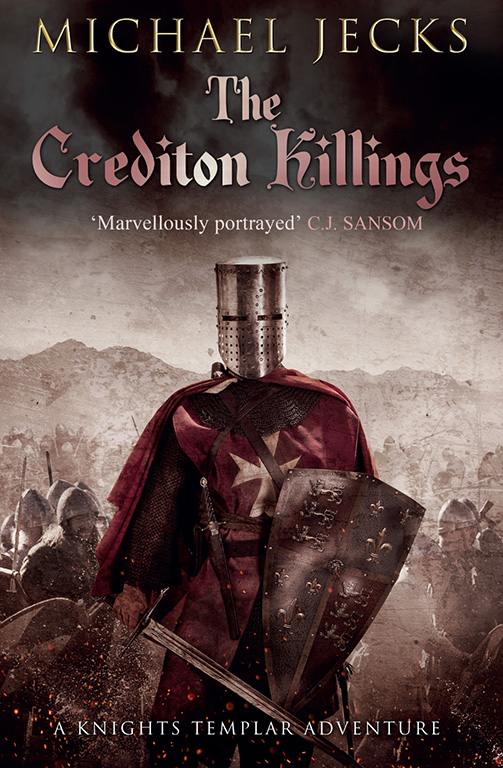
 As you’ll have noticed, hopefully, the whole of the Templar series has been rebranded now by both Headline and Simon and Schuster. They have these delicious new covers that really do appeal. Well, they appeal to me, anyway! The new covers will be available from both publishers as e-books, but for real books it’s going to be confusing. The simple fact is, none of the titles is out of print. Some haven’t sold so well, but there are stocks of all the titles and reprinting is quick and easy. Putting new covers on printed books is pretty expensive, I’m told, so Headline will wait until there is a massive influx of orders for older books before they’ll consider re-issuing the titles with the new covers.
And now the serious news.
I’ve had so many people asking for new books in the Puttock/Furnshill series, that I’ve decided I’m going to have to try to please people. So, with that in mind, I’m intending to try to write and publish my own follow-up story that will cover the death of Edward II – and what he did next. I have an outline idea for this already (plus six others) which I’m keen to write, so what I’m intending is to look into crowd funding for this story with a view to making sure I have some money coming in while I write it. Otherwise the project will fail while I try to get some cash working in a checkout line in Sainsbury’s. I don’t want that. I think I make a better author than shop assistant. So, keep your eyes pinned to this blog and hopefully as soon as I’ve finished this story, and then the book on Poitiers, there will be good news for all those who’re interested in the idea of more Templar series stories!
All best and happy reading!
NEW COVERS:
The first in the series from Simon and Schuster:


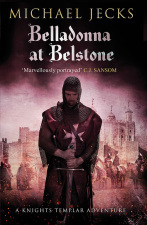

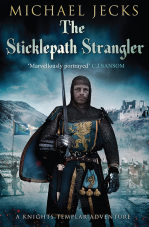
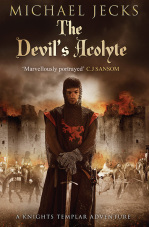
Then there were the Headline books:


And then from Simon and Schuster again:
And finally the last titles from Simon and Schuster again:
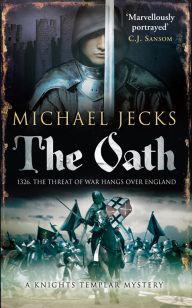
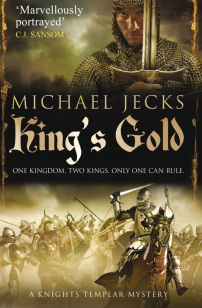

Not forgetting the prequel to the series!

Tagged: amazon, author, blogger, book writing, collections, creative, crime series, Dartmoor, Devon, ebook, ebooks, fiction, fiction writing, hints and tips, historian, history, Knight Templar, knights templar, library, medieval, medievalist, Michael Jecks, novelist, publishing, Q&A, questions, questions and answers, reviews, scribbler, series, stories, story, Templar series, The Knights Templar Collection, The Michael Jecks Compendium, writer, writing


January 5, 2015
Resolution
And a very warm Happy New Year to you all!
This year is the twentieth anniversary of the publication of my first book, THE LAST TEMPLAR.
The last few years have been hard, as readers of my blog will have noticed. I’ve droned on pretty often about the trials and troubles of being a mid-list author in the last year or so.
And so, because this is the time of year to do such things, I’ve made a new resolution or two.
Diversification is the way. Instead of worrying about the money I get in from writing, I will be seeking out new opportunities. It has already started.
First, I will be pushing my speaking work. Last year I had my first ever lecture at a university, which went down surprisingly well and brought many new friends (thanks, Connie). Later in the year I was the International Guest of Honour at the Crime Writers of Canada annual meeting in Toronto, and had to give an after-dinner speech that went fabulously well (thanks Cheryl). I enjoy after-dinner speeches, and seem to manage to do them rather well, so that is a line I intend to push.
I am also going to seek out different gigs. One idea that appeals to me is more talks to business, more talks in prisons (I’m setting up a couple now) as well as working on a couple of “An Evening With” events. I’ve been thinking about this for a while, along with my Medieval Murdering friend Ian Morson. Hopefully more on that soon.
Secondly, as I’ve mentioned elsewhere, I am keen to try to try alternatives to traditional publishing. I’m looking at working more with Kickstarter and similar projects to get books off the ground. I have too many ideas always floating around in my head, but publishers want authors either to remain boxed in on specific series, or want only one book a year. I have too many projects for that, and so I need an alternative route to mega sales!
Finally, I am working hard with a wonderful film and TV agent. Yes, there is a possibility that the series could end up on a screen near you.
So, thanks to all my readers for your interest, cheerful and motivational comments, as well as your support over the last twenty years.
Twenty years ago, I became a published author. The market has changed, but people still want books, and I am determined to continue to bring them to the audience that enjoys them.
So, in terms of news, here’s one snippet for you: I will write more Templar series and am planning a new Baldwin/Puttock story. It will be later in the year, because I have POITIERS to write, and a book based on a real event down here in Devon, first, but then I’ll be cracking on with 33. Hopefully you’ll see news of that in June/July.
And now, it’s time for me to disappear. However, before I go, do please check out my pages on the internet. For example, I have a new collection which includes three of the middle books in the series, and the mass-market paperback of FIELDS OF GLORY is out now. Then again there is my YouTube channel with comments on my books, on my writing, and how to help others with their writing. Oh, and this blog, of course.
So that’s it. More writing, more speaking, more work. Which is good. I think if I were to stop, I’d drown, like a shark!
All best wishes and may I wish all of you a very happy and prosperous New Year!
Tagged: amazon, author, blogger, book writing, creative, crime series, Dartmoor, Devon, ebook, ebooks, fiction, fiction writing, hints and tips, historian, history, Knight Templar, knights templar, library, medieval, medievalist, Michael Jecks, novelist, publishing, Q&A, questions, questions and answers, reviews, scribbler, series, stories, story, Templar series, writer, writing


December 30, 2014
The Puzzly – The ISOTCMN Book Of The Month – December 2014
 Originally posted on In Search of the Classic Mystery Novel:
December draws to a close and, as we need to squeeze in the review of the year as well, the Puzzly comes a little early this year. Christmas has come and gone – hope it all went well for you too. I’ve got a nice little haul of historical books, a little crime and some DVDs – reviews coming at some point, and, more importantly, discovered how to make perfect turkey gravy. Very happy about that last bit…
As for reading, just seven books this month. A combination of Christmas, video games and Ruth Rendell conspired to derail me somewhat, but what has emerged as the best read of the month?
View original 432 more words


December 11, 2014
Understanding Creative People

Couldn’t agree more! Mind you, a decent reward would help!
 Originally posted on billccastengera:
The deep, monotonous grind of daily life can sap the creative urge out of the best of us. We have a lot to do. And creating art can be viewed as wasting time, especially if you aren’t in it for monetary gain. And ultimately, none if us are. Sure, making money from the thing we create would be great, and some of us succeed at that, but we are in it for the enjoyment. We are in it for the art itself.
As a novelist, I can spend 6-8 hours a day writing. At the end of it, I’m closer to a finished product, but I didn’t finish anything. Nothing was completed. Novel writing is an endurance race, not a sprint, and I’m never really going for the finish line anyway. People–most people–can’t seem to wrap their minds around that. I’m in it for the run itself. I’m in it…
View original 330 more words


December 6, 2014
The Sticklepath Strangler by Michael Jecks
How could I not reblog this? Excellent review of Sticklepath Strangler!
Originally posted on In Search of the Classic Mystery Novel:
 Sticklepath, Devon, 1315. When a young girl is horribly murdered, with some of her flesh eaten, the village turns on Athelhard, dragging him from his house and executing him in front of his sister. He dies cursing the village and its inhabitants. And the curse appears to be coming true – as the years pass, more young girls die. It seems that the village is plagued by a sanguisugae – a vampire.
Summer, 1322, and when the body of ten-year-old Aline is discovered, the deaths become public knowledge and Sir Baldwin Furnshill and Simon Puttock are summoned to investigate. They soon find that more than just young girls have disappeared in the past few years… and the curse is still stalking the land. As the inhabitants of the village struggle to keep their secrets hidden, the killer strikes again. And again. And again…
View original 338 more words


December 2, 2014
Computers … Tools for the author
Sorry. There should have been a post yesterday. I try to post blogs on Mondays because – well, it’s my routine.
However …

How my desk looked yesterday!
I was thinking only the other day that I really ought to try using a typewriter again. There is something about the sight of the old keyboard, and the rhythmic rattle of the hammers striking the platen that really appeals to me still. Not the electric hum and clacking of the IBM golfball, or the whizz of the daisywheel (yes, I remember such things from when I was a salesman), but the lovely tick, click, patter of real mechanical keys. Of course the downside of the darned things is that an author has to keep going back and editing. And then, when the book’s written, has to retype the whole thing again. That is a big downside, but there is also a great upside: while retyping and working, you’re editing too, so the final result is invariably a ruddy sight better than most of my current first drafts.
I’ve sold two million books in my time. God only knows how many words I’ve typed in twenty years of writing professionally. I know that the best way to write is to sit at my desk and let my mind wander as my fingers play with the keys.
Many years ago (have I mentioned this recently?) I was at a very enjoyable Crime Writers’ Association meal in London, when a stranger and his wife walked in. He was a writer, he said, and was visiting on his way back from a holiday in Ireland. His name? Laurence Block. A thoroughly decent, lovely bloke. He told me that after many years of dedicated computer use for writing, he had gone to Ireland to a place where there was no electricity. As a result, he had typed the first draft of his latest on a manual typewriter, and found it a wonderfully freeing experience. Next time, he said, he planned to work with a pen and paper!
Jeffrey (or Geoffrey? I could look it up, but really can’t be bothered) Archer always uses a black tempo pen to write. He writes until the pen’s dead, chucks it away and starts another. Very wasteful. I don’t mind pencils or fountain pens, but I’d really get grumpy about landfill sites if I worked like that. And Jeffrey (or Geoffrey) makes more per book than I’ve earned in twenty years of writing, so I guess he can afford to be profligate with his pens, and to pay a secretary to retype all his words.
No, nowadays all authors (apart from him) write with computers. It’s faster (speed is of the essence), it’s easier and it’s less effort. More to the point, publishers demand electronic copy. Ye Gods, recently I heard of a publisher demanding that new authors should have at least 3,000 followers on Twitter. They expect the author to do all marketing and PR, all the selling and social media. When we’re supposed to write, God only knows.
However, yesterday I was confronted with the horrible experience of having to consider basics again.
It was only a little while ago I mused over the fact that modern people are really little different from our ancestors. I noted that, if you stripped away the thin veneer of civilisation, removed electricity, transport, abundant power, and therefore the reliability of food supply, of heating and all computer power, you would soon find that life would revert to its past, unpleasant, brutal brevity.
Yesterday, my computer ceased to function. For about eight hours my machine reverted to a spinning wheel of doom. I sat before it like a novice at an altar, praying the damn thing would get over its Monday morning blues, but it didn’t, and in the end I had to set up a complete disk check with virus-checking software, then look at the disk to verify the data etc. It took me over 15 hours, so I was up until gone one o’clock this morning. It has worked, I think.
And I am damn glad, too. Because if there is one thing I cannot even think of affording, it’s a new computer. In my career, I must have sold up to two million books worldwide (I cannot be sure – foreign countries don’t necessarily let me know how many they’ve got rid of) but that doesn’t make me wealthy. I do better than most writers, but that only means I’m earning a bit more than the minimum wage.

Yup. I’ve sold a few books in my time!
So that computer failure did make me appreciate my smooth-running, functioning computer when it is working well. I could easily write using a typewriter, or a fountain pen or two. Writing with any medium holds no terrors for me. Yet, the thought of being forced to retype everything is one additional hassle I cannot afford. I have to get books written fast and start earning from them as quickly as possible.
So the uncertainty yesterday, that really did give me a lot of grief.
Happy reading!
Tagged: amazon, author, blogger, book writing, Coroner, creative, Dartmoor, Dartmouth, Death Ship of Dartmouth, Devon, ebook, ebooks, fiction, fiction writing, hints and tips, historian, history, humour, Knight Templar, knights templar, library, medieval, medievalist, Michael Jecks, novelist, publishing, Q&A, questions, questions and answers, reviews, Richard de Welles, scribbler, stopicture scanry, stories, Templar series, writer, writing


November 24, 2014
Collaborative Writing
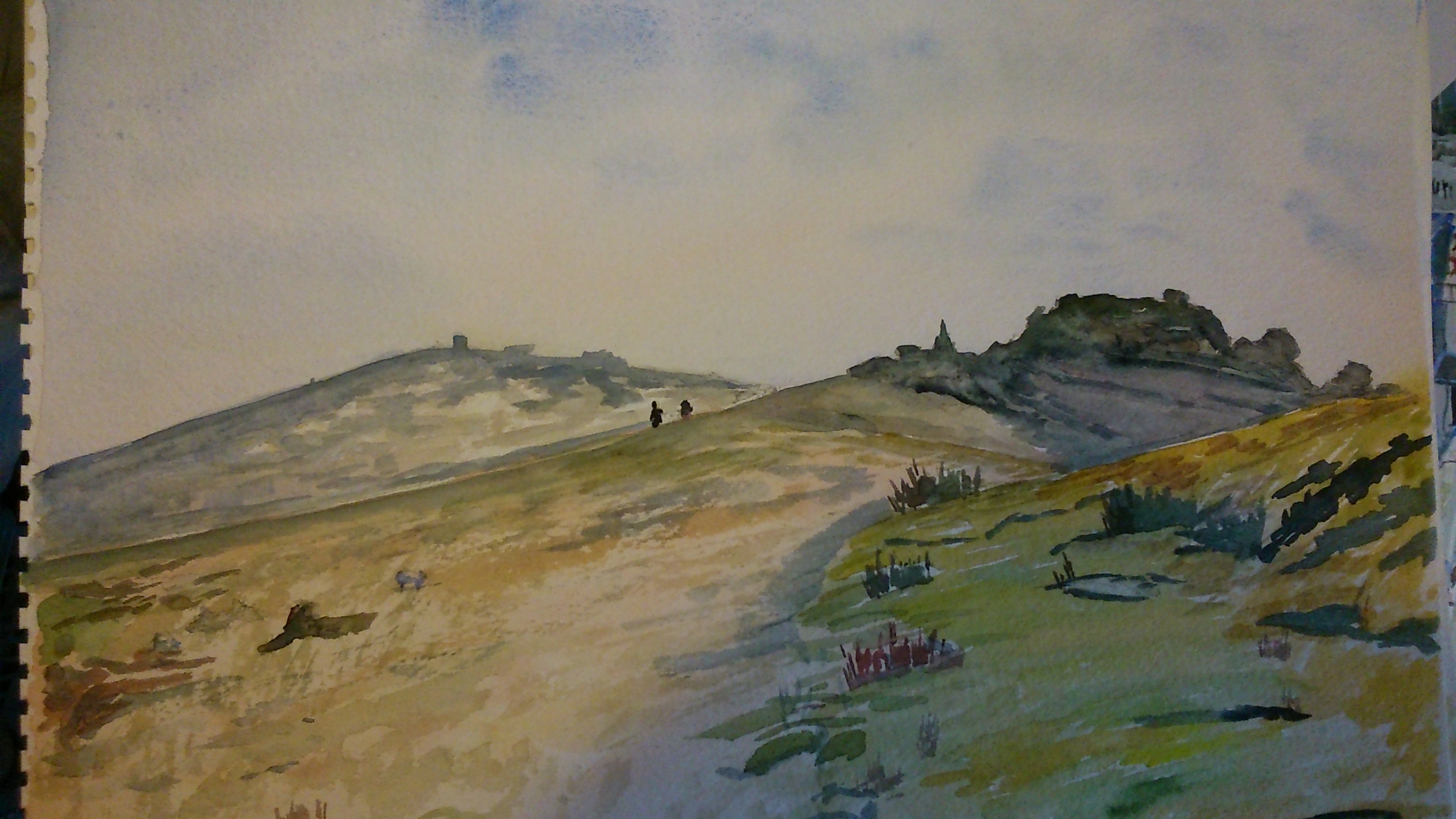
Up on the high moor near Belstone – where I walk for inspiration!
It’s a strange thing that nowadays it really is quite hard for a writer to go out on a limb and try something new.
Some years ago I was on a panel talking with a friend when a member of the audience asked “Is there a natural end point to a series?” Phil Gooden, with masterful understatement, said that he thought any series must end after eleven books. As he said, the author must grow bored with his own characters by then. Any series that long must be running out of steam. The books would be growing stale.
I had to lean over as he spoke and remind him that I’d just published my 21st.
The fact is, that each book and each series can exist in their own sweet world. My series was not one coherent whole. The series changed radically at least four times, running from straightforward cosy crime tales, migrating into books based on social studies, then into legends, and finally becoming political thrillers. My main concept from the earliest days was that each book should stand on its own, and that no consecutive books should be easy to predict. I had books that were largely humorous (The Death Ship of Dartmouth) to deeply black and grim (such as Sticklepath Strangler and Butcher of St Peter’s). A long series will change, but with luck the authors will be able to bring their readers with them.
But it is a sad fact that with the way publishing is being forced to change, there is no longer money to reward the poor authors who generate all the income for publishers, editors and retailers. Also, every book that is published needs to have as strong a business plan as possible. Without the business plan, authors will not get published.
Even the author needs to have good marketing now. I do not know how new authors win their publishing contracts now – I heard recently of one publisher that was demanding that all new writers should have at least 3,000 followers on Twitter.

West Henstill House – where I dreamed up Templar Series and which ended up as Simon’s home near Sandford
Why? There is no proven correlation between Twitter and sales that I have ever seen (if you have any, please let me know – it would help me justify my 30,000 followers!). From common sense and personal experience, Twitter is, at best, mediocre at generating actual sales. It is as unproductive as most literary festivals – I used to go to Harrogate and others, but the only purpose really was to enjoy the company of friends, not to sell books. In terms of books, if I were today to go to Harrogate and pay the travel expenses, the hotel bills, the costs of meals and the fees for registration, I would make a thumping loss. Paperbacks and hardbacks do not earn much money. Their sales at a festival certainly wouldn’t justify my investment of £500-£600 to be there. I have certainly sold many books over Twitter. However, how many were new, and therefore helping to pay my weekly bills, compared with the sales that were second hand, or heavily discounted? Not many. When a book is sold second hand, the author earns nothing; if it is sold at a large discount, the author’s income is cut. When you buy a book from, say, Amazon (who demand 80% discounts), the author’s income falls by 80% as well. Most paperbacks sold via Amazon will earn less than 10 pennies.
So there is more and more focus on making sure that the book that comes out at the far end of the meat grinder that is the publishing industry is going to be a success. This is good.
Very few authors can edit their own works. In fact there is a steady progression for many authors. Their early books read well and fluidly, and they make huge sales. They earn more as a result, and then they start to argue with their editors and copyeditors. The quality of their books falls off, and gradually sales reduce. It is in large part, I think, due to the lack of appreciation of the work done by their editors. Such authors begin to believe that they know the market better than the professionals in selling. Which is always a bad mistake.
Anyway, since my earliest days I have collaborated with editors with enthusiasm. When there have been suggestions, they have invariably been for damn good reasons. And that means that the books have done better. Everyone wins.
I have no doubt that there are some writers who can write superb, fluent stories without editors – but I’m equally certain that most of them would write better with an editor.
For me, after writing the first drafts it is essential to have someone else view my work. Many people now use a circle of Beta readers – groups of non-publishing professionals who will read and comment – but I’ve always been wary of this approach. I am happier to have an editor who sees the rougher outlines of the story and then works with me to hone it. Otherwise I’m introducing a new level of complexity. And I remember once giving a manuscript to a friend to read. She liked it, apart from one scene introducing some characters, which she insisted should be cut. It went to the editor. She couldn’t understand a chunk of the story and asked for a new scene to be added … yes, that very one. So I think it’s better to work with the people who’ll end up working on the story and owning a share of it.
Why these thoughts? Well, I’m embarking on a new idea – a modern day story again – with a view to a book based around international problems in the arms, drug and smuggling businesses. And I’m floating ideas in front of my agent to see which grabs him strongest.
In other words, wish me luck. I need it!

On with the next book!
Tagged: amazon, author, blogger, book writing, creative, Dartmoor, Devon, ebook, ebooks, fiction, fiction writing, hints and tips, historian, history, Knight Templar, knights templar, library, medieval, medievalist, Michael Jecks, novelist, publishing, Q&A, questions, questions and answers, reviews, scribbler, stories, story, Templar series, writer, writing


November 17, 2014
Reviews on Amazon
I had to put up the last blog repost on Amazon ( here if you’re wondering) by my friend Jack because it just tickled me.
I’ve had so many comments on books – it gets hard sometimes to keep a sense of humour. From the first “fan” letter that detailed 21 points of historical inaccuracy (he/she was wrong) to the commentator who told me I had no idea how far a horse could travel in a day (my figures came from recorded journeys by the King’s messengers), I’ve grown used to getting corrected quite regularly.
 The painful ones are the comments on Amazon, though, because people often put them up without considering the consequences. People put reviews up fairly quickly when they’re happy with whatever they’ve bought. If, however, they are angry or irritated, they will throw something at the internet much, much faster. So the two reviews I have for Fields of Glory that gave the book one star went up really swiftly. In fact, they were both posted two days before – yes, before – the book was available for purchase. Had either of the reviewers read the book? No. They both wanted to comment on the fact that they disliked the cover. They had no comment about the book itself, but they were very happy to trash the title because of their dislike of the picture.
There have been other cases. My friend Old Trooper told me about a delightful reviewer who gave a book one star because it arrived late. Yes, nothing whatsoever to do with the six or nine months the author spent inventing, plotting, typing, crossing out, rewriting, editing, suffering the cruel dissections of editors and copyeditors, nothing even about the harsh economic reality of the author waiting to see any sort of income. This was not a comment on the author, or even the publisher. No, he slated the book because it arrived too late for his holiday. The US Postal Service was late so the book was slammed by him.
I always used to have a firm policy of ignoring any negative comments. There are trolls and other appalling people on the web who will, after all, latch onto any poor sap and try to send them potty with rude, slanderous, threatening or just plain evil comments. Only this weekend I was asked by a Twitter friend to block and report a tweeter who had sunk his fangs into her and was writing crude, obscene messages in between threatening her and her family. I was happy to oblige (having checked what he was writing – I’m not generally a blocker for hire!). So I don’t think it’s a good idea always to get on the wrong side of these folks.
 However, when I see comments that are plain wrong, I do question the writer. For instance, I had one comment on THE LAST TEMPLAR that said it was only worth a one-star rate because the reviewer hated “first person narration”. Now, this is fine. I don’t have any axe to grind on that issue. Some first person stories I’ve loved, and others I’ve hated. But other people have their own foibles.
My own dislike of the comment came from the fact that LAST TEMPLAR has absolutely no first person narration in it. However, since there are some seven or eight books titled THE LAST TEMPLAR, I do rather think that the reviewer was writing about a different book. I was justified in trying to remove that review. It was wrong.
 I had another man who wrote bitterly about my Kindle book, ACT OF VENGEANCE to complain that it was appalling. He said that the grammar was awful, and I couldn’t spell the simplest of words. A kind friend (thanks, Old Trooper) appended his own comments to point out that the spelling was – ahem – English, rather than American English. Since I had invested almost a thousand pounds in getting the book professionally edited and copyedited, I thought it was only fair to raise that comment too.
Now, of course, this makes me sound like a rather vain, perhaps silly pedant. Naturally, authors would be well advised not to question reviewers, and merely accept that some people won’t like the books. We should accept the rough with the smooth.
However, there are good reasons why every poor comment should be queried.
Amazon will, as you know, present you with a series of titles based on the books you have bought or looked at recently. If you look at the recommendations, generally they’ll be of books that have massive sales and lots of good, high star ratings. The algorithms Amazon has set up are designed to make sure that you get popular offerings in the main. In the old retail market bookshops would be paid to put books into the window. There would be payments for the books to get “Recommended” stickers from the booksellers in the shop. There were endless ways in which the publishers were asked to pay to get books sold. Amazon has their own way of doing things, but I am pretty sure that money changes hands somewhere so that certain titles will be heavily promoted. Nothing wrong with that.
However, for most authors (those who don’t earn millions of dollars a year, and who have to get by on word of mouth recommendations), a bad rating can kill their titles. A one-star will pull down the four or five five star ratings, and if there are two or three one and two stars, the book will fall down the rankings. In the past, people walked along shelves in a bookshop and saw what there was to buy. No star ratings, just a series of covers that appealed or didn’t. The world is a much harsher place now.
It takes remarkably little for a book to die. In the new electronic world we inhabit, if a book is held up and not available for sale immediately, it will bomb. If a book has poor ratings, it will bomb. If a book doesn’t get to a certain level, publishers will drop the author. An author is only ever as good as his or her last novel. And with publishers refusing to market or publicise most titles – that’s up to the author as well now – there really is little hope for a book that gains a few single stars.
Some time ago I formed a firm policy of only ever giving high star ratings for any books. If I dislike books, I don’t review them. A book would have to be extraordinarily bad for me to review it and give it a poor ranking. After all, I can think of several books I didn’t like at first reading, but which grew on me when I tried them a second time. Reading is a difficult task. It is entirely subjective, and if the reader is in a bad mood, or simply the wrong mood, that particular book may not work for them. It is not, however, a reflection of the book itself. It’s only a reflection of the temperament of the reader at that moment.
So, when I get poor reviews, I have a policy to politely ask the reviewer why they felt that way. I’ve avoided it in the past, but this is now something that affects my income directly, so I do. I have done so twice in recent weeks. The result? Both times the reviewer has agreed to look at their reviews again. And I am very grateful for their kindness in agreeing to reconsider. With luck it’ll result in slightly better markings and therefore better rankings in future!

Looking past the Tor
Now, don’t forget that Christmas is coming. I have a series of books for sale. If you are interested in a book for a deserving relative, or a title for yourself, do please let me know. Each signed book will have a signed card and assorted bookmarks from past promotions, since it’s Christmas. So go on: treat yourself or your family!
Afterwards you can walk Dartmoor, too, if you want!
Right. That’s all for now. Just finished the editor’s comments on Blood on the Sand (out next June) and now this is complete, I have to write a synopsis for a new book. I’ll be meeting my friend Lillian Harry on Thursday for a coffee, and a general moan about publishing and author incomes, so I’ll have to crack on with work before then to justify the time off.
Happy reading!
Tagged: amazon, author, blogger, book writing, creative, Dartmoor, Devon, ebook, ebooks, fiction, fiction writing, hints and tips, historian, history, Knight Templar, knights templar, library, medieval, medievalist, Michael Jecks, novelist, publishing, Q&A, questions, questions and answers, reviews, scribbler, stories, story, Templar series, writer, writing


