
Collaborative Writing
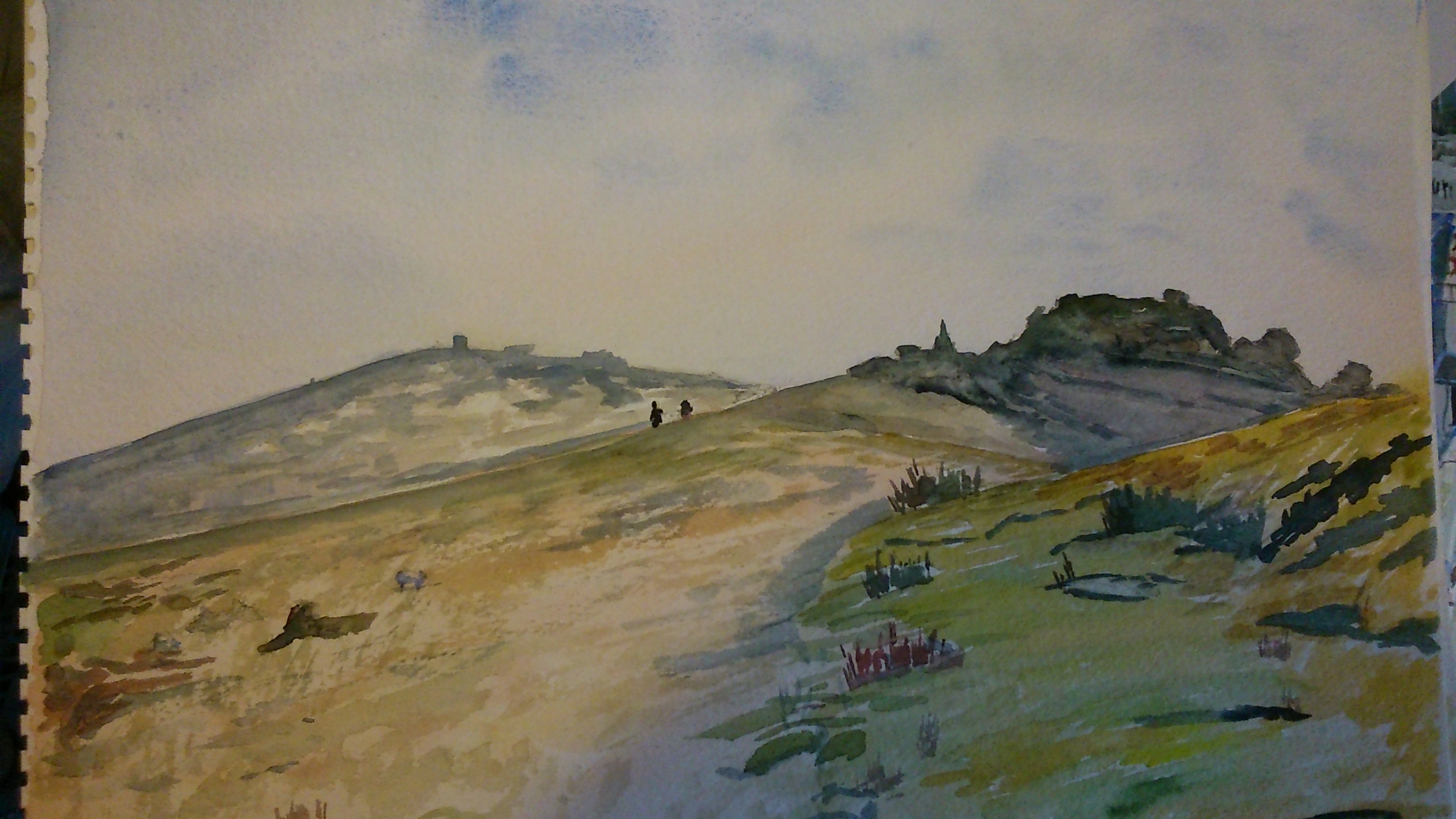
Up on the high moor near Belstone – where I walk for inspiration!
It’s a strange thing that nowadays it really is quite hard for a writer to go out on a limb and try something new.
Some years ago I was on a panel talking with a friend when a member of the audience asked “Is there a natural end point to a series?” Phil Gooden, with masterful understatement, said that he thought any series must end after eleven books. As he said, the author must grow bored with his own characters by then. Any series that long must be running out of steam. The books would be growing stale.
I had to lean over as he spoke and remind him that I’d just published my 21st.
The fact is, that each book and each series can exist in their own sweet world. My series was not one coherent whole. The series changed radically at least four times, running from straightforward cosy crime tales, migrating into books based on social studies, then into legends, and finally becoming political thrillers. My main concept from the earliest days was that each book should stand on its own, and that no consecutive books should be easy to predict. I had books that were largely humorous (The Death Ship of Dartmouth) to deeply black and grim (such as Sticklepath Strangler and Butcher of St Peter’s). A long series will change, but with luck the authors will be able to bring their readers with them.
But it is a sad fact that with the way publishing is being forced to change, there is no longer money to reward the poor authors who generate all the income for publishers, editors and retailers. Also, every book that is published needs to have as strong a business plan as possible. Without the business plan, authors will not get published.
Even the author needs to have good marketing now. I do not know how new authors win their publishing contracts now – I heard recently of one publisher that was demanding that all new writers should have at least 3,000 followers on Twitter.

West Henstill House – where I dreamed up Templar Series and which ended up as Simon’s home near Sandford
Why? There is no proven correlation between Twitter and sales that I have ever seen (if you have any, please let me know – it would help me justify my 30,000 followers!). From common sense and personal experience, Twitter is, at best, mediocre at generating actual sales. It is as unproductive as most literary festivals – I used to go to Harrogate and others, but the only purpose really was to enjoy the company of friends, not to sell books. In terms of books, if I were today to go to Harrogate and pay the travel expenses, the hotel bills, the costs of meals and the fees for registration, I would make a thumping loss. Paperbacks and hardbacks do not earn much money. Their sales at a festival certainly wouldn’t justify my investment of £500-£600 to be there. I have certainly sold many books over Twitter. However, how many were new, and therefore helping to pay my weekly bills, compared with the sales that were second hand, or heavily discounted? Not many. When a book is sold second hand, the author earns nothing; if it is sold at a large discount, the author’s income is cut. When you buy a book from, say, Amazon (who demand 80% discounts), the author’s income falls by 80% as well. Most paperbacks sold via Amazon will earn less than 10 pennies.
So there is more and more focus on making sure that the book that comes out at the far end of the meat grinder that is the publishing industry is going to be a success. This is good.
Very few authors can edit their own works. In fact there is a steady progression for many authors. Their early books read well and fluidly, and they make huge sales. They earn more as a result, and then they start to argue with their editors and copyeditors. The quality of their books falls off, and gradually sales reduce. It is in large part, I think, due to the lack of appreciation of the work done by their editors. Such authors begin to believe that they know the market better than the professionals in selling. Which is always a bad mistake.
Anyway, since my earliest days I have collaborated with editors with enthusiasm. When there have been suggestions, they have invariably been for damn good reasons. And that means that the books have done better. Everyone wins.
I have no doubt that there are some writers who can write superb, fluent stories without editors – but I’m equally certain that most of them would write better with an editor.
For me, after writing the first drafts it is essential to have someone else view my work. Many people now use a circle of Beta readers – groups of non-publishing professionals who will read and comment – but I’ve always been wary of this approach. I am happier to have an editor who sees the rougher outlines of the story and then works with me to hone it. Otherwise I’m introducing a new level of complexity. And I remember once giving a manuscript to a friend to read. She liked it, apart from one scene introducing some characters, which she insisted should be cut. It went to the editor. She couldn’t understand a chunk of the story and asked for a new scene to be added … yes, that very one. So I think it’s better to work with the people who’ll end up working on the story and owning a share of it.
Why these thoughts? Well, I’m embarking on a new idea – a modern day story again – with a view to a book based around international problems in the arms, drug and smuggling businesses. And I’m floating ideas in front of my agent to see which grabs him strongest.
In other words, wish me luck. I need it!

On with the next book!
Tagged: amazon, author, blogger, book writing, creative, Dartmoor, Devon, ebook, ebooks, fiction, fiction writing, hints and tips, historian, history, Knight Templar, knights templar, library, medieval, medievalist, Michael Jecks, novelist, publishing, Q&A, questions, questions and answers, reviews, scribbler, stories, story, Templar series, writer, writing


