
Michael Jecks's Blog, page 27
August 11, 2014
Today I Lost a Fan
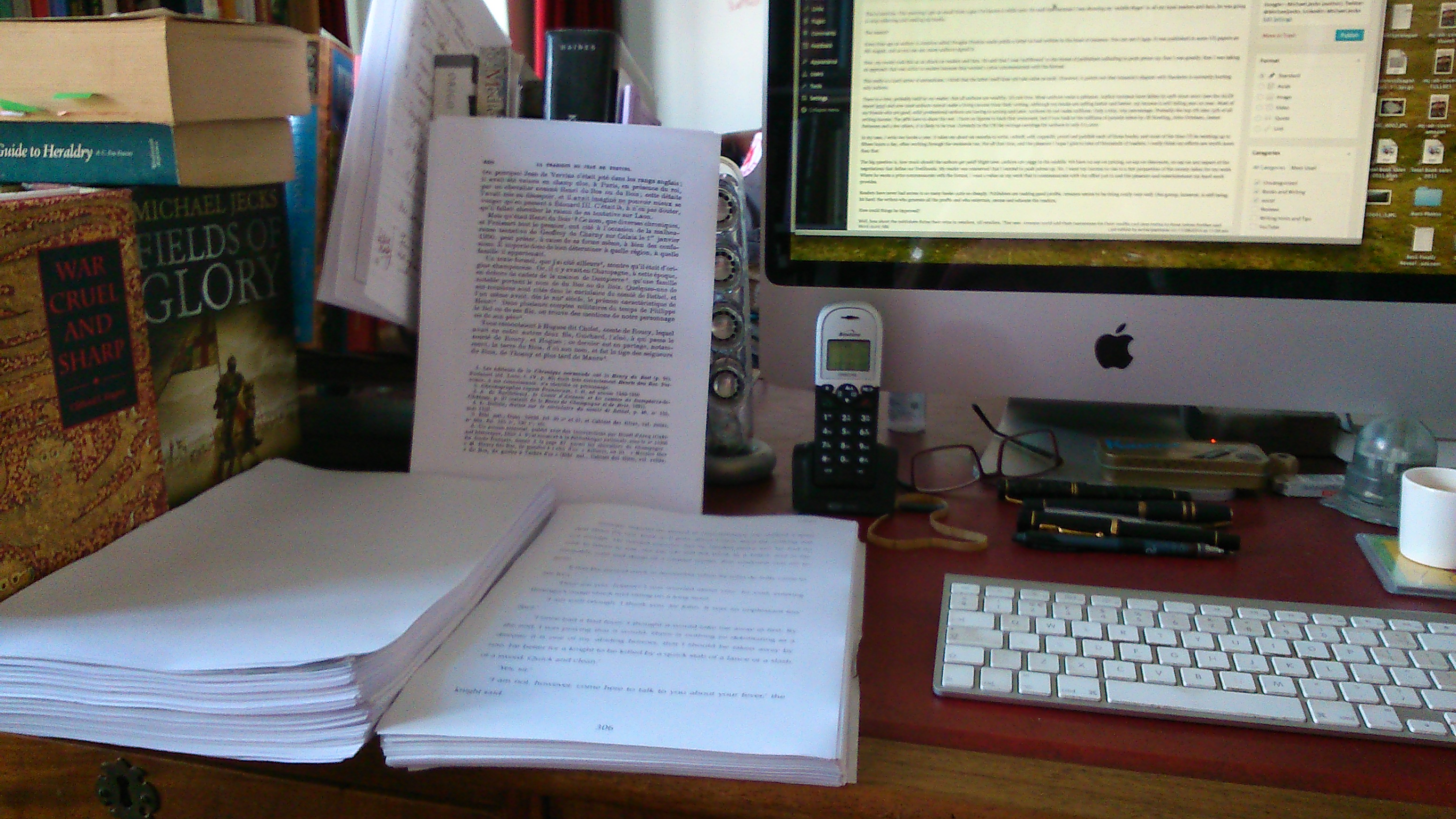
Working on the latest novel. Last week average: 14 hours each day.
This is horrible. This morning I got an email from a guy I’ve known a while now. He said that because I was showing my ‘middle finger’ to all my loyal readers and fans, he was going to stop collecting and reading my books.
The reason?
Some time ago an author in America called Douglas Preston made public a letter he had written to the head of Amazon. You can see it here. It was published in some US papers on 8th August, and as you can see, many authors signed it.
Now, my reader took this as an attack on readers and fans. He said that I was ‘indifferent’ to the threat of publishers colluding to push prices up; that I was greedy; that I was taking an approach that was unfair to readers because they wanted a price commensurate with the format.
This really is a hard series of accusations. I think that the letter itself does not take sides as such. However, it points out that Amazon’s dispute with Hachette is currently hurting only authors.
There is a view, probably held by my reader, that all authors are wealthy. It’s not true. Most authors make a pittance. Author incomes have fallen by 29% since 2007 (see the ALCS report here) and now most authors cannot make a living income from their writing. Although my books are selling better and better, my income is still falling year on year. Most of my friends who are good, solid professional authors are having to scrimp and save. Authors do not make millions. Only a tiny, tiny percentage. Probably the top 2% take 75% of all writing income. The 98% have to share the rest. I have no figures to back that statement, but if you look at the millions of pounds taken by JK Rowling, John Grisham, James Patterson and a few others, it is likely to be true. Certainly in the UK the average earnings for authors is only £11,000.
In my case, I write two books a year. It takes me about six months to write, redraft, edit, copyedit, proof and publish each of those books, and most of the time I’ll be working up to fifteen hours a day, often working through the weekends too. For all that time, and the pleasure I hope I give to tens of thousands of readers, I really think my efforts are worth more than that.
The big question is, how much should the authors get paid? Right now, authors are piggy in the middle. We have no say on pricing, no say on discounts, no say on any aspect of the negotiations that define our livelihoods. My reader was concerned that I wanted to push prices up. No. I want my income to rise to a fair proportion of the money taken for my work. Where he wants a price commensurate with the format, I want a value on my work that is commensurate with the effort put in and the pleasure and entertainment my hard work provides.
Readers have never had access to so many books quite so cheaply. Publishers are making good profits. Amazon seems to be doing really very well. One group, however, is still being hit hard: the writers who generate all the profits and who entertain, amuse and educate the readers.
How could things be improved?
Well, how about the publishers fixing their price to retailers. All retailers. That way, Amazon could add their percentage for their profits and stop trying to force prices further and further down. Publishers would have certainty and could afford to budget. They would know how much they should pay their authors, too, and that would take away the current horrible environment in which authors never know how much they have earned until the twice-yearly royalty payment. No author can budget or plan.
The only thing that is certain is, the current approach is not working for all stakeholders.
What do you think? What would you think would be a fair reward for an author? Help! The publishing industry needs input from anyone who can push them through this current car-crash!
Tagged: ALCS, amazon, artists, author, author incomes, authors, books, crime, crime writer, Hachette, history, incomes, medieval, novels, publisher, publishing, retailer, writer, writing



August 6, 2014
Compiling a Novel from Scrivener
Yesterday I had a question about Scrivener from Debby. She asked: “My concern is if I work in Scrivener, is there a way I can transfer my work back to Word where I’d like my final document for editing and track change purposes? Could this be done through compiling, or at least by copy and pasting each chapter?”
Of course, responding to a question like that is easy if you’re an ex-computer salesman with thirteen years experience of selling and another twenty years of practical use. You take a screenshot. Sadly this gormless author hasn’t the faintest idea how to insert a screenshot into a reply, though, so instead, here’s my reply.
Scrivener is very easy to play with. It provides the author with a clear, easily customised environment to work in. It gives, on one page, all your research material, all the scenes and chapters of your novel or thesis or dissertation, and gives you an environment where you can sit and write, solid, without distraction. It is, for me, easily the best computer equipment for writing books. I don’t use it for short texts, but for a novel of a hundred and forty, hundred and sixty thousand words, it is – well, for me it’s essential now.
However, when you’ve written the book, how do you output?
Simple. This screenshot shows the compile menu.

A screenshot of my latest novel with the compile sub menu displayed
As you can see from this, there are numerous outputs you can use. Naturally I haven’t used all of them (yet). I have worked with Scrivener to produce ebooks, novels, scripts, and I’ve output into RTF, PDF, Word, .mobi and other formats and so far have not had a single issue in (I think) seven years of solid use.
The only glitch I do have is that when I output into Word, I cannot check it. Why? My last version of Word ceased to function three years ago. I asked how much for a new copy and was less than impressed to be told that it was bundled in MS OFFICE, and thus I’d have to pay some £160 for it. Since I have no use for spreadsheets, presentational software, a new email system or any of the other crud that comes with OFFICE, I declined that kind offer. Instead, after some research, I moved to Nisus Writer Pro. This is a package designed from the bottom up to work really well on Apple computers, and not only is it cheaper than OFFICE (less than one quarter of the price), it is also much easier, more intuitive, and logical than Word in my experience.
I should say, I am one of those rare things, a connoisseur of WP. I started with Wordplex, selling computers and software, moved to Wang Laboratories, then to Xerox, and over my twenty years as a professional author I’ve worked with WordPerfect (loved it), Word, iA Writer, Nisus and … well, you get the message. If it’s there, I’ve used it. Nisus is best, in my own opinion. You will have your own opinion, no doubt!
So, Debby, in answer to your question, yes, you can compile. Personally I’d go to RTF Word compatible because that’s what Keith, the wonderful man who invented Scrivener recommends, and I’ve always followed his advice. However, it’s easy to use and it’s free for a month’s trial, I think, so I’d just get it and play.
The main thing is, don’t worry about the bells and whistles. Those you can learn about later, if you want. The key is, just get it and start using it to type. It is a wonderful environment to work in.
I sound like a salesman – I should just say, I get no commission or freebies. Consider me an evangelical proponent of Scrivener!
Tagged: @ScrivenerApp, author, blogger, book writing, creative, Dartmoor, Devon, fiction, fiction writing, hints and tips, historian, history, Knight Templar, knights templar, library, medieval, medievalist, Michael Jecks, Nisus Writer Pro, novelist, publishing, Q&A, questions, questions and answers, scribbler, Scrivener, stories, story, Templar series, writer, writing


August 5, 2014
Victim Law

The old prison at Lydford. Lydford Law: ‘Hang first, then sit in judgement after.’
Today there’s a lot of hoohah about a judge who, while thinking his microphone was off, made a comment.
It’s common enough. Comments are common. Especially when that microphone is supposed to be off. Ask any politician.
The case involved a family whose 21 year old son was murdered. The case isn’t disputed thus far. However, having served their time, the perpetrators are now eligible for parole.
The Parole Board invited the victim’s relatives in to give their views. They had to write up and then read their harrowing experiences, all of which meant reliving the traumatic events of their son’s death. When they finished, the judge said thank you, and turned off his line, as he thought. However, all he did was turn off the ‘receive’. He was still transmitting when he made a remark along the lines of: ‘I feel so very sorry for these families. They make these statements thinking they are going to make a difference, but they make no difference at all. Someone should tell them.’
A judge saying something very decent and showing he’s honourable. The family have not asked for him to be punished. He was being fair and reasonable, and he should be applauded.
However, is it fair in the first place?
The Labour Party is saying that they’ll bring in a law – I think Sadiq Khan today described it as ‘Victim Law’ – so that victims and their families can have a say in — what? Whether criminals get parole? How long their sentences should be?
NO!
Do we want our punishments based on retribution? Do we want prisoners to know that their sentence will depend on the comments of their victims’ parents? That won’t lead to more witness intimidation, will it!
The law should be – must be – above the feelings of parents or other relatives. If someone hurt one of my children, there is no punishment recognised under British law that would give me any satisfaction. Any parent who feels less isn’t really qualified to be a parent.
However, the law has to be independent and impartial. It must not allow itself to be swayed by some concept of retribution or vengeance. It should be rational, logical and unmoved by any person’s feelings of personal injury.
In other words, for God’s sake remove the whole idea of victims having any say in the law.
Their feelings are extreme. The law mustn’t be!

A past example of Victim Law: Sir Hugh Despenser. He was hanged, and while still alive had his penis cut off and burned before him, and then was disembowelled (still alive) and had his heart cut out, before being cut down and cut into quarters. The victim there had a say in the punishment. Not a good example to set.
Tagged: conviction, crime, judge, judicial comment, justice, law, parole, parole board, punishment, retribution, revenge, sentencing, vengeance, victim, victim law


August 4, 2014
Second Draft
A wiser guy than me once said that all writing is rewriting. I’m well into the second draft of my next book (working title “Calais”), and this is the stage I usually dread: rewriting every line.
I love the process of invention. I really, really like sitting down and just imagining a new series of characters, putting them into horrible situations and seeing how they could extricate themselves. Sometimes, poor devils, they don’t! Writing fresh, like that, is wonderful. It’s the stage when, for me, I am inventing a whole new world and lives, and living through their eyes.
The next stage is the painful one, usually. Going through, reading every sentence aloud, tweaking and improving, deleting and moving, all takes days of painstaking effort, and it’s hard. Because by that stage you know the story you’re trying to write. It’s done. And I’m not a details person. I like the broader brush!
I’ve learned something in recent years. That is, old ways are often the best.
When I started out, the internet was a distant dream for most people. I was working on machines that had floppy diskette drives and really slow daisywheel printers. Still, I’d print out my copies regularly and work on the printed text. I had to keep amending LAST TEMPLAR, page by page, until I had it how I wanted, and then took that copy to my agent, and then had to amend and revise again until she was happy. It was god-awfully slow.
More recently I had LED (Panasonic) printers and lasers, which made the process much faster. However, in the last few years I moved to use technology more effectively.
I bought an iPad. With that I could download the book in progress and read on a machine that would give me a more “book” type of reading experience. Also, I could add notes and comments as I went through the book, I thought. That would improve the quality and speed of my work, surely?
No. One book on, I sold the iPad. It was good for reading – but much better for playing games. I don’t need games.
Then I got my HTC Flyer, which was brilliant. At last I could read my novels on a tablet that would give me a true ebook experience. I read several books on it for competition judging, and then I worked on my own novel. It had a pen so I could append notes and everything.
I sold it.
The thing is, when you’re writing, you do not want to have anything come between you and your story. Paper works best for me. And there are several reasons why.
First is the important tactile nature of the work. It’s really important to me that I get to feel paper. Don’t ask me why. It just is, and while it still is, it’s not something I’ll give up. Then again, there was (I am told – I’ve never found the source of this) research conducted in the US that showed that students who edited and reviewed their work on screen would routinely miss most typos. They wanted to read what they had intended to write. All too often, their eyes glossed over the actual errors. The study suggested that this was because of interference with their reading caused by the back-lit screens. The fact of the screen having a light behind it, they thought, caused the reader to miss many errors. They showed this by putting the same documents in front of the students, but on paper. Their ability to spot mistakes was the result.
However, the very best approach was definitely that of reading every word aloud from a sheet of paper. There is some kind of mechanism whereby trying to use eyes, mouth and brain simultaneously makes errors leap out.
So, having gone through various methods of working in recent years, I have finally gone full circle. I am now back to working happily with paper, reading aloud like a lunatic in my chilly office, and hoping not too many people are listening!
Happy reading, folks!
Tagged: author, blogger, book writing, creative, Dartmoor, Devon, Editing, fiction, fiction writing, hints and tips, historian, history, Knight Templar, knights templar, library, medieval, medievalist, Michael Jecks, novelist, publishing, Q&A, questions, questions and answers, scribbler, stories, story, Templar series, writer, writing


July 28, 2014
Warning – More Writing Advice to Come!
As you can see, over half way through the first draft, tidying up and making it stronger.
This is a short blog this week. Two reasons, first, I’ve been inside working the whole time on the first draft of my next book; second, because I’m working on this novel, I don’t have much time to play with blogs!
However, I thought it was only fair to let people know what I’m going to be up to for the next few months.
First, rather than non-specific rants only on WriterlyWitterings.com, I’m going to become a little more organised. In effect, this means I’m going to rationalise what I blog about (at last, I hear you say?) and focus on fewer subjects.
First and foremost, I will be blogging about writing and giving a free resource about finishing your projects. Over the summer weeks I’ll be concentrating on helping people who are attempting creative writing, and giving my own perspectives on plots, characterisation, description of locations, and everything else. How do I introduce a new subplot or bring in a new character in my books? How do I pick a main theme for a story? How do I work out a better flow for my stories?
However, from October or so I will be introducing academic concepts into my work. I will talk a bit more about how to write essays, how to create an argument, how to develop it, how to reach a logical conclusion. All the same principles exist for the writer of academic works as for the creative writer.
I was shocked at Exeter to learn that Britain, in the whole of Europe, is about the only nation that expects students to be able to think creatively, and communicate their thinking and arguments in logically developed essays. In other nations, there is no need for students to attempt work of that nature until they are into postgraduate work. In Britain, however, it’s a standard academic approach. But not all students are shown how to develop their ideas. This is, hopefully, where I can help a bit.
Some of these will require YouTube videos with further explanation, such as I used last week and the week before. It makes sense to use both media to explain and expand on topics.
At the same time, however, I’ll be putting more videos about my books, and what influenced me at the time to write each of them.
I think that with these changes the two sites will work rather more efficiently, and with luck they’ll be more gratefully received by writers of all kinds and all ages.
Do please let me know what themes you would like me to cover. Anything that would help you with your writing and which should be of interest to other viewers or readers. All ideas are considered.
Many thanks, and sorry for such a brief blog post this week. However, all parents out there will understand that when there are deadlines and two children on holiday, something has to give!
Have a great week!
Tagged: academia, academic publishing, academic writing, author, blogger, book writing, creative, Dartmoor, Devon, fiction, fiction writing, hints and tips, historian, history, Knight Templar, knights templar, library, medieval, medievalist, Michael Jecks, novelist, publishing, Q&A, questions, questions and answers, scribbler, stories, story, Templar series, university, writer, writing


July 24, 2014
Additional Thoughts on Submitting Manuscripts
This post follows on from the video here. The post will make a bit more sense if you watch the video as well.
I am always adding the odd comment, but as you will tell from my video, my daughter was monitoring my wittering from behind the camera. She is very efficient (apart from when she kicks the tripod and stops our recording) and tries to keep me to a sensible time for each video (in other words, she tries – tries – to shut me up). However, there are always a few points I feel the need to expand upon. It’s a bit like my novels. I always like to have an Author’s Note because it’s there that I can throw all the useful and fascinating extra stuff I couldn’t put in the main story.
So these are the extra bits that didn’t fit into the time my daughter allowed me!
First, it is really important to bear in mind what an editor is. Think about your audience, in other words.
She (she will almost invariably be a “she”) is busy, harassed, anxious about her existing authors, worried about her job, and concerned that her boyfriend/husband/wife/alternative companion or lover is unwell, seeing someone else, or just plain the wrong one. She is basically an ordinary human being who has to take her knickers down to go to the toilet.

Roughly what an agent or editor will receive every day to read. Every day!
She will love books. You don’t get into publishing without a fervent desire to be involved with books, and if you’re on the publishing side, you love all books. Some authors (not you, of course, Dear Reader) actually only want to be published because published authors are all so rich. Cue hollow laughter from the writing fraternity. However, the perception is that all authors earn the same as JK Rowling, and thus are rich as Croesus. They want to write one book (they aren’t greedy) that will allow them to earn a few million, and then they’ll vacate the market, leaving it open for someone else to mine their seam. Many aspiring writers of that type don’t even like books very much.
Editors are different. They don’t become editors assuming that they’ll be able to retire at age 28. They are in the industry because they love the feel of a new story. But they are still human beings. If she tripped and broke her favourite shoe that morning, or scraped and laddered her tights, she’ll be in a shitty mood when she gets to work. And that attitude will affect how she reads your work. She will search for any reason to reject your carefully prepared typescript. Of course she will! She is looking for the one glowing, golden genius effort. If she doesn’t find your efforts engaging, she’ll move on to the next one.
When I started out, all those years ago, (20 years ago, for goodness’ sake!), editors had more authority. They could, and did, take a punt on an occasional author. They would bring in writers with very low advances, and see if these guys could be moulded. I was one example, and my writing was massively, wonderfully developed by a brilliant young commissioning editor, Marion Donaldson. The authors brought in would be cushioned for some years until their writing became noticed (like Ian Rankin), or didn’t. In which case the poor devil was allowed to slide into obscurity.

Edit, edit, edit, and edit again. Get it right!
That was good business practice. The cheap authors cost little, and could bring in a fortune in the future. Compare them with the occasional celeb or political author, who generally costs an absolute mint and never recoups the initial investment in advance payments. The publishers always used to make most of their money from the vast range of mid-list authors, the ones who cost not very much, but always sold reliably. The crime authors, the romance authors, the thriller authors. Sadly, publishers now look only for the blockbuster authors, not the mid-listers, which means that all authors have to generate much more money to justify their existence.
So, it is a hard business. The editor cannot take a simple, hopeful gamble on you or anyone else. She has to justify her own existence. That means standing in front of a commissioning meeting of her peers and her boss, many of whom may be glad to see her fall flat on her face in the meeting because politically it would help if her career were curtailed. She won’t want that to happen.
Second, then, is this hint. I spoke a bit about how to send your work in. Make sure it is as perfect as you can make it. Make each page gleam like polished silver; make every word count. If the word isn’t needed, take it out. Have an introductory letter of no more than three paragraphs. Then a synopsis or story summary that actually tells the story.
I once spoke to a senior editor who told me that a competition entry was rejected because the synopsis ended thus: “Like the story so far? Well, if you want to learn how it ends, you’ll need to buy the book!”
Now, it could be that the author didn’t actually know how to end the book, but I doubt that. No, I think he was treating this as a sales document: “if you want this, you have to buy”. The trouble is, that kind of approach doesn’t work. An editor is not going to take a punt on a book when the last chunk – how much? How could she guess? – is left effectively unfinished. It would be like a manufacturer paying thousands for a prototype car when there was no engine, on the off-chance that the writer would design it later.
If you’re serious about your writing, assume that the professionals in the business will be too. I mean it. They want a fully finished, well-polished piece of work, not a work in progress. Finish it and hone it before you even start to look for a publisher or agent.
Third, do remember that the book has to grab. It has to snare the imagination of the reader. Make it exciting, make it gripping. Make every single page end with a hook to take the reader on to the next page, make every chapter end with a cliff-hanger. I was reading a great book – only a novella – by a friend of mine, Vicky Delany, recently (there’s a link to my review here), and I was struck by how quickly she got down to brass tacks. The victim (who was blonde, but not beautiful and not well regarded by her peers, and so much more interesting) appeared on the first page as a corpse. That, I thought, is how to start a crime book.
Fourth, if you aren’t terribly good at grammar or punctuation, get someone who you know is good, and have them read it first. DO NOT post it until you’ve had it checked. Poor punctuation will get it rejected. I promise.
Finally: I once had a great lunch with four editors and agents, chatting about entries to a competition. All the editors and the agents admitted to their pet hates. The “feisty” female, in their view, is overused. They dislike intensely learning that the victim is, yawn, a gorgeous blonde; a stunning blonde; a vision with blonde hair … you get the picture. Bearing in mind that most editors (and agents) are women, it is probably best to try to avoid too many sexual stereotypes.
Especially in the first couple of pages.
Good luck and happy writing!
Tagged: agents, author, blogger, book writing, creative, Dartmoor, Devon, Editors, fiction, fiction writing, hints and tips, historian, history, Knight Templar, knights templar, library, medieval, medievalist, Michael Jecks, novelist, publishing, Q&A, questions, questions and answers, scribbler, stories, story, submissions, Templar series, writer, writing


July 22, 2014
Who is this guy Jecks?
I today have finally got off my bottom and put in an author bio with Amazon. It’s not something I’ve intentionally put off. It’s really just inefficiency. Today, needing to work flat out, clearly in the interests of work displacement, I had to do something.
And yet …
I’ve never bothered to read any other author’s bio. So, to make sure someone sees it, here it is. It’s a little bit flippant – but so am I!
Let me know what you think.
Who is this guy Jecks?
Michael was a moderate student and early on, being a callow youth, decided on a career as an actuary. This decision was based solely on the fact that he heard it was the highest paid profession. Well, he had a father who was one, and a brother, too, but the money certainly helped.
Not realizing that a standard definition of an actuary is “someone who finds accountancy too exciting”, he achieved the relevant grades at A level and wandered off to City University, London. There, he excelled – as bar chairman – but not at actuarial studies. Firmly convinced that his course was incomprehensible (Life & Other Contingencies? Advanced Statistics? Programming in Pascal?) and other parts were designed by knaves, cretins and the criminally insane (Economics), he left the course after failing every exam for two years.
With the glittering example of a second, unqualified, brother who earned very good money, had a bonus scheme, free car, free petrol, expense account and free holiday each year, Michael decided to follow this brother into computer sales.
Joining one company selling “office automation” from the back of Gray’s Inn Road (typewriters), he soon progressed to a company selling personal computers. Especially the ACT Sirius. He left and set up a division of PC sales for City of London Computer Services, only to lose his job when a second partner, who didn’t believe PCs would take off, returned from a long holiday.
Following that, Michael went to a new start-up to help form Electronic Office Services. When that firm collapsed (with one director disappearing, apparently to the Bahamas with all the company’s money), Michael was left without a job.
He saw an advert for an interview with a company called Wordplex, and went to see the company at an open day in a London hotel. After a lengthy interview process, which involved five formal meetings, he was accepted.
Later he heard he had been taken on because he was “the only twenty-one year old I’ve ever seen turn up to a job interview smoking a pipe, you berk” – (Dick Houghton, Regional Director, Wordplex, 1981).
For the next four years, Michael sold Wordplex systems as one of a hundred salesmen in the UK. He was consistently one of the top salespeople in the country, and as a result was headhunted to join Wang Laboratories in 1985.
Wang was a challenging company. All salespeople who did not achieve their monthly targets at least once in every three months were summarily dismissed. Michael survived until 1990, when Wang collapsed, and Michael took a job with Rank Xerox. This interesting job involved selling equipment that was roughly eight years out of date. There he lasted six months before being asked to join NBI, a Colorado-based firm created by ingesters of certain illegal substances, who (out of respect for the success of IBM, ICL, NCR and ACT) named their business: Nothing But Initials.
The company closed their international operations three months after Michael joined them.
At a loose end once more, Michael looked to a job with a more secure future. Thus it was that he entered the leasing business. At the time no leasing salesman could earn less than £100,000 per annum. Michael joined a new firm called Celsius Computer Services, and in the first three months sold £1.25 million of business. Then Atlantic Leasing crashed and the entire market fell with it. Michael was unemployed without redundancy – again.
Moving to safer shores with software sales, Michael joined IBM’s largest software supplier, Bluebird. They went bust a year later (owing him a lot).
Out of Computing, Into Writing
It was a while later, after 13 jobs in 13 years, that Michael finally took the hint. He found himself at the beginning of 1994 once more without a job, and so he sat down to decide on a new course. He had no qualifications, but he knew he loved reading. With that conviction, he began to write, becoming a full-time homeworker while his wife went to work and supported their (exorbitant) mortgage.
Those were interesting times.
In three months, Michael worked seven days a week, fourteen hours a day. In that time he wrote a modern day thriller, a management book on how to get work when made redundant (he had experience of that) and a historical crime novel that was to become The Last Templar.
The thriller was snapped up by Bantam over the phone – and rejected two days later in writing because it was all about the IRA, and they had just agreed their first ceasefire. The second book was rejected by his agent because her husband had recently left her for an IBM Systems Engineer. She wanted nothing to do with books about computers or computer people, and if Michael’s book could help them find contentment and employment, she was content to see it burned.
Since 1995 and the launch of The Last Templar, Michael has been a persistent and prolific author. City of Fiends was the 31st story in the series that follows the lives of Sir Baldwin de Furnshill, a renegade Templar, and his friend Bailiff Simon Puttock through the miserable period of famine, war and disease that was the first half of the fourteenth century.
The series is the first to tell the tale of that time.
It charts the incompetent reign of King Edward II, the appalling avarice and criminality of his chief advisers, Sir Hugh le Despenser and (sadly) Bishop Walter II of Exeter; then the war against France and the desertion of Edward by his wife Isabella, and her return with a small army to remove him from the throne.
However it is not merely a crime series. The whole of the Kingdom was changing: after fifty years the language of authority stopped being French and became English; the feudal system was broken; farming was becoming efficient and organised; new towns were springing up – and the king was losing control of law-making and even war-making. It was probably the period in which England changed the most, apart from perhaps the fifty years post World War II.
Over the years, the series has sold well in the UK and America, with translations into Dutch, German, Spanish, Portuguese, Greek, Italian, and many other countries.
In America it has been taken on by many schools as a means of imparting accurate social history. It has revived interest in Edward II’s reign, and has made Michael friends all across the globe.
With the publication of Templar’s Acre in 2013, which was a prequel to the series, Michael felt it was time to take a break. As a result, he wrote ACT OF VENGEANCE, a modern day spy thriller, which received the comment from Lee Child who said it was “An instant classic British spy novel – mature, thoughtful, and intelligent … but also raw enough for our modern times. Highly recommended.”
Michael has made many friends with authors in the medieval period. He founded Medieval Murderers as a performance group, and soon had the idea that the group should write a collaborative novel. This collection of linked novellas was published as Tainted Relic by Simon & Schuster. DEADLIEST SIN is the tenth anniversary edition, published in 2014
As well as the Templar Series and Medieval Murderers, Michael has compiled ebook collections of his short stories. FOR THE LOVE OF OLD BONES and NO ONE CAN HEAR YOU SCREAM have all the short stories previously published in collections from Maxim Jakubowski, Mike Ashley and the Crime Writers’ Association.
Michael is now writing a thrilling trilogy based on the lives of a vintaine (platoon) of archers during the early years of the Hundred Years War. FIELDS OF GLORY, the first, was published in 2014.
Michael has long had an interest in helping new writers, and for two years he organised the Debut Dagger for the Crime Writers’ Association, helping five authors win their first publishing contracts as a result.
In 2004 he was elected as Chairman of the CWA, and afterwards he accepted a post as judge on the CWA/Ian Fleming Steel Dagger award, on which he served for three years. More recently he has been working with the International Thriller Writers and in 2011 he helped create the Historical Writer’s Association, and remains on the organising committee.
In 2007 Michael was proud to be asked to collaborate with Conway Stewart to produce the Michael Jecks fountain pen. Other honours include being invited as the International Guest of Honour at the Bloody Words gala 2014, to being the Grand Master of the first parade of the 2014 Mardi Gras in New Orleans.
Michael is a regular speaker about the Knights Templar, the end of the Kingdom of Jerusalem, about writing and publishing, and about finding work. He is also keen to help those who are now going through the latest recession. He endured enough hardship, and lost all his savings, during the last recession, and understands what it means to risk losing everything.
An enthusiastic photographer and watercolourist, Michael can often be seen walking across Dartmoor where he lives, gaining inspiration into the lives of our ancestors for his stories. When relaxing he can usually be found clad in white in a pub near you before dancing mad stick Morris.
Tagged: author, blogger, book writing, creative, Dartmoor, Devon, fiction, fiction writing, hints and tips, historian, history, Knight Templar, knights templar, library, medieval, medievalist, Michael Jecks, novelist, publishing, Q&A, questions, questions and answers, scribbler, stories, story, Templar series, writer, writing


July 21, 2014
Videos – Update
Some months ago I warned all and sundry that I was going to be putting up some videos about my books. Back in those far-off days 15 weeks ago, all I intended was, to document all the titles in the Templar series with a view to giving people a bit of an insight into the characters, the scenes, the locations and the period. Not a lot. Rather too much for five minute snatches, but there you go. I only discovered that later!
I started out nervous. Well, it’s odd to have a camera fixed on your face, but infinitely more alarming to have your own daughter behind the camera and in charge of the edits!

Dangerous man: an author with a sword! Who’d want to see this guy in a film?
The trouble is, having started, I discovered that the project had a flaw or two. Hard to believe I could have any flaws, I know, but there you go.
First, I realised that the project really needed more on things like how I write, where I write and so on. That was interesting because the mere location hadn’t occurred to me as being of any interest to anyone! So instead of the concept of one book per week covered with a youtube video, which was challenging enough, for goodness sake: that mean reviewing books I wrote 20 years ago, and would almost take a year; I was gearing up to write a review every other week, and meantime insert little items on my writing. Which was fun.
However, as soon as I began to ask people what things they’d like to see in the videos, it began to grow again. One guy asked, for example, how I use whiteboards and the computer. What sort of software do I use? That led to a little video on Scrivener, which has quickly become my most viewed film to date. And now the book reviews, which were going to take 34 weeks to film, will now be overtaken by videos about writing.
Is that a problem? No (well, not once I’ve finished this draft of book two in the Hundred Years War trilogy). But it does mean that I’ll need to concentrate a little more on the type of filming I do.
It’s interesting, because generally I’d say there’s only so much information I can give about writing. The most obvious advice is, sit down and write. If you want to write, then actually trying to do the job really helps. You have an imaginative brain, but without exercise, it’s going to fail, like any muscle in the body. To reach peak ability, it has to be used. Ideally, the use will train it too. You gain experience and practice as you work, and that all helps your writing. From memory, I wrote the beginnings to about nine books before I hit the themes I enjoyed enough to want to complete the books. That was a long time and I was already in my early 30s by then, but it paid off. The practice and experience of sitting down and composing myself before trying to compose (neat, huh?) was invaluable for the day when I decided I had a story to tell.
So, for those who were expecting a review of each of my books every week, the good news is, we’ll be trying to achieve that. However, we’re also going to be using the Thursday video uploads for hints and tips on writing more regularly too. For the summer, these will cover such matters as planning, plotting, inventing scenes and characters, and all the other little details of how to write; from the end of the summer through into the autumn academic term, there will be more on writing essays, how to develop an argument, how to plan, how to edit, and how to complete an essay, dissertation, thesis or other piece of writing on time without grief. All of this is based on the work I was doing at the Royal Literary Fund for the last couple of years at Exeter University , teaching individuals.
So, hopefully this will be of interest to the highest number of people. I do hope so. In the meantime, if you have points you want to look at, or questions to ask of a professional writer, do please email me or leave a comment on my blog. I will pick them all up.
If you haven’t yet checked out my YouTube channel, please see the latest film here. There are many more films to watch, but this is as good a place to start as any, if you are interested in writing.
Keep those comments coming!
Cheers!
Tagged: author, blogger, book writing, creative, Dartmoor, Devon, fiction, fiction writing, film, hints and tips, historian, history, Knight Templar, knights templar, library, medieval, medievalist, Michael Jecks, novelist, publishing, Q&A, questions, questions and answers, scribbler, stories, story, Templar series, video, writer, writing, YouTube


A Winter Kill – Review

Vicki in an interview with Cheryl Freedman
One of the really great things about travelling to the US and Canada is having the chance to discover new writers I’d never usually meet. And the last trip to Canada was one of those opportunities I couldn’t miss. Although it’s not easy to carry home roughly twenty books, I did manage it.
I’ve already mentioned the excellent “Fire on the Runway” by Mel Bradshaw and Donald J Hauka’s brilliant “She Demons“. Today it’s the turn of a lady we don’t see in the UK too often -Vicki Delany.
Vicki (who is the current Chair of the Crime Writers of Canada) is one of Canda’s most prolific writers. She’s two main series on the go, and regularly writes one-off stories too. This book is not one of her series, but is a quick story written for Rapid Reads. Now, defining this kind of thing isn’t easy, but let’s just say I’d guess it’s about 15,000 words, with roughly 110 pages with largish print. That, to me, means a short novella, not a long short story!
A Winter Kill starts with the discovery of a young woman found murdered in the snow. The rookie constable, Nicole Patterson, is the discoverer of the body. The victim is a high school student who happens to have a dreadful reputation with her classmates. Her parents are poor and have less than glowing reputations too, and when added to that it’s learned that her father has a drink problem and issues with his temper, it’s easy to see why the girl has earned her reputation. But, although Nicole has no investigative role, and she is only a trainee, she is young enough to understand the kids at the school, and empathise with the victim. It leads her to explore different routes, and brings out a very effective resolution.
I can’t say too much, because that would give away the plot; however, this is a superb little read. It kept me going for quite a long while, during several short walks. What I really liked about this book was the perspective of the young cop. WE don’t often get to see the crime world through the eyes of someone who’s on the right side of the law, but who is this young and – perhaps a little naive – enthusiastic.
Whatever the reason was, I really enjoyed this little book. I’d define this as a good cosy. Not too violent, but with good characterisation and motivations. I’d happily recommend this to any crime reader, and I’ll be looking out for more of Vicki’s books in future!
Tagged: Canada, Cheryl Freedman, crime, Crime Writers of Canada, crime writing, CWA, Ontario, Ontario Police, review, rookie cop, Vicki Delany


July 17, 2014
Scrivener for Authors
This is a very short comment as an add-on to my video about writing with Scrivener. I’d recommend you take a few minutes to watch the video before reading on, because it’ll make more sense!
When I was talking about the way that Scrivener works for me, the main thing is, it’s entirely flexible. It doesn’t force the author to work in a specific way, it is intuitive and lets the user define how it’ll work.
Scrivener has three main areas: the ‘binder’ on the left; the workspace in the middle, and the information space on the right. These are my terms, incidentally, not Scrivener’s.
The binder is where all the documents you are working on are kept. They work as file boxes clipped into a large lever-arch file, each file box having one or a number of pages held within. Sometimes I use the files as simply a running timeline (I did that for Act of Vengeance). That way, the storyline is quite simple and the management of the plot is more looking at characterisation. For that book I had simple colour-coordination to show character point of view. Thus I could tell at a glance which character was taking over the plot, and could change the POV to balance the way I was telling the story.
In other books I’ve used a package called Aeon Timeline to control the timeline. This works well with books such as Fields of Glory, in which I had a simple timeline, and it made sense to have the timeline really clear before I started writing, because I had to be held to it rigidly. (I don’t like to change history!) What I really like here is the fact that Aeon and Scrivener are synched, so once I have the timeline sorted as I want it, I export that into Scrivener, and miraculously all my card headings, i.e. the scene headings in the binder, are imported for me.

An Aeon Timeline screenshot to show how a timeline develops. Simple but very effective!
In that book, I changed the colour coordination so that the scenes represented the levels of conflict or action. It was up to me: I define how I use Scrivener.
This is a standard Scrivener screen:

A standard screen to show how the record cards are displayed on the cork board.

Close up of right side with record card, pictures, web links, anything needed for research.
As you can see from this cork board display, Scrivener is displaying a simple summary set out on record cards. This is how many writers work, with record cards detailing each scene. I used to use a whole pile of strips of paper, stuck on my walls with half a ton of blutack. Now, all that is unnecessary. I go from a rough outline on a whiteboard or on several sheets of A4, to these record cards on Scrivener.
To flit to the right hand side for a moment: this is where all the notes and working information goes.
So, at the top there is a record card for the document – which for me equates to the scene. This has a title for the scene, and then a brief synopsis.
The synopsis and the title are entirely up to me, the writer. The main idea of the synopsis is, for me, to tell me what the narrative direction is for that scene. Is it going to be mainly dialogue, is it mainly action, is it a scene to link to the next one (I often write very quickly, and when linking scenes don’t occur to me I’ll get on with writing the next scene anyway, and sort out missing bits later, when I can sit back and add them in at edit).
Underneath the record card there’s the general stuff about the scene. Who’s POV am I using, what sort of action is needed: is it a first draft, final, revised, or what? After that there is when it was last modified, and some details on whether or not to use it on compile.
After that is the important section, for me. This is my reminder section.
Within Scrivener you have project notes and document notes. I tend to use project notes only. But these are the things you need to have in your book at all times. For me, these are the things for which I usually have a book open on my desk. They are the historical details, the pictures, the maps, the facts about the area – anything, in short, which could be of use to my story.
I will always have additional books open at a relevant page on my desk, but Scrivener allows me to plan things and put them here so that I need only scroll through the project notes to find the relevant item of information.
However, it’s not just things typed or scanned in. It allows me to draw in pictures from the internet, or to add weblinks. You can see here that much of the text is underlined. That is all a hyperlink.
Beneath that you can see some other symbols. These will change from notes to keywords etc. You can basically add and use any kind of information you want here. And again, it means that all the time you’re working, you are typing in the most effective manner. There’s no stopping to go and find the relevant section in a book, or to go and try to find again that one link you had to a website that had the perfect summary for you: it’s all there, on the screen in front of you.
To look at the left hand side, then: we have first the binder

Close up of the binder showing how to change POV colour, flags, etc.
This is effectively a series of folders all held in a binder. Of course, the folders can all be reordered. If you want, you can click, drag and drop any of the folders to reorder the whole story. If you decide that the book isn’t working this way, then change the flow of the story. No need to search through a 140,000 words book in Word to find the relevant section, just drag and drop in the binder.
At the side of each binder heading you will see that there are folder symbols. These are Apple symbols indicating that there are a number of files held within. For that reason I tend to think of each folder as a chapter in my book, even though I don’t stick to that. Each file within a folder becomes a scene.
But that’s not all. Within each folder, when you click on it, are all the scenes that make up that chapter or folder. So these too can be rearranged. And each can be flagged. For example, each can be colour-coordinated so that, as in this case, I can select which character is driving the scene. However, more than that, if you look at “Echelon” in the record card display above, or as the third heading in the binder here, you can see I’ve changed the document symbol for a warning. Two scenes above, “Prayer” has a red flag.
I use these all the time, both to remind me where I have more work to do, and to allow me to remember where the key action scenes are. If there is conflict, I mark it; if there is a fight, I mark it.
Scrivener has a huge amount of power – but the main thing for me is, its flexibility. I can use it however I want to. And the lovely, lovely part is, when I’m typing, all of this disappears. When I want to type, Scrivener brings up a white page with all distractions concealed. I can type for hours with only the pictures, the smells, the sounds playing in my mind.
I have spoken about Apple and Scrivener. Scrivener was originally designed and implemented only for Apple. However, now it has also been rewritten and implemented for Windows. Personally, I wouldn’t want to go that route, but it’s an option for all those who prefer their windows machines. For information on Scrivener, go and look at www.literatureandlatte.com. On the other hand, if you have any questions about how I use it, do please ask in the comments section below. I’ll be happy to help if I can!
Happy writing!
Tagged: author, blogger, book writing, creative, Dartmoor, Devon, fiction, fiction writing, hints and tips, historian, history, Knight Templar, knights templar, library, medieval, medievalist, Michael Jecks, novelist, publishing, Q&A, questions, questions and answers, scribbler, stories, story, Templar series, writer, writing


