
Michael Jecks's Blog, page 21
August 25, 2015
Review: The Girl Who Wasn’t There
 ISBN: 978 0 349 14046 9
Published by Abacus, an imprint of Little, Brown
There are some books that grip from the first page, some that intrigue and keep you reading. Of course there are the others that deserve the Dorothy Parker quote “This is not a book to be tossed aside lightly, it should be thrown with great force” – but in my experience, such books are thankfully rare.
It is a strange thing that, for the average reader, almost all crime writers are Anglo-Saxon. Few would be able to name too many authors of decent thrillers from, say, Germany or Italy. They are there, but British and American publishers dominate and they tend to look first for fresh English-speaking talent. Personally I think it’s also partly because French, Dutch and other nations value literature more highly, and that means they look for more solid fare. We Ango-Saxons are much more frivolous!
This book was a rather curious read, I think. I saw it in Waterstone’s at Exeter (@WaterstonesExRg if you’re on Twitter) and Clare had an easy sale to me. I read it quickly, hugely enjoyed it, and when I put it down, I was a bit bemused. The structure was rather odd.
The first two thirds, I would think, are an in-depth study of a character. This was interesting, but at all times I had the impression that the story was being told to me. It was as though the writer was deliberately putting himself just a bit aside. This could have been intentional. In fact, I think it must have been because the last third of the book was much more comfortable. Perhaps it is because the author, Ferdinand von Schirach, is a top defence lawyer in Germany, and he looks on his books as cases which he must depict for a jury or judge. Who am I to tell?
In any case, the first sections of the book go through the life of Sebastian von Eschburg, his early life, his father’s suicide, his mother’s breakdown and family’s collapse, and then the move into photography. Sebastian is a curious character, single-minded, and not particularly gregarious or attractive. However, he forms a relationship with a young woman who admires his work, and his international career takes off.
That’s the first third.
Then we have the investigation. He is accused of murder, but it’s a strange murder when no body is recovered.
There are usually rules in a crime story. My first agent always told me that the murder must occur in the first sixty pages, there should be roughly five suspects, each should have a strong motive and so on. This book does not fit the standard crime format.
So, here’s where I say, reader, I bought this book, it’s not a gift or a review copy, so I can be as rude as I like. However, readers of my pages here will know that I am not inclined to crucify any author or novel just because I dislike it. Other people may well like it. So this time, I am in the happy position of recommending a book even though I think it may drive dedicated crime readers potty! I am not over the moon with the writing style for the first sections. It did feel like reading evidence produced in court. However, as soon as the investigator – von Eschburg’s defence lawyer, Konrad Biegler – appeared, the book took off. Suddenly the language was looser, and much more natural. It was a joy to read about this large, overworked and stressed lawyer. It read pretty much like a Rumpole with fewer gags, but it was excellent. He travels through to von Eschburg’s past life to discover the truth in this case, and the result was a very satisfying read.
Would I recommend it? Difficult one. I did like it in the end, but this book is clunky at the beginning. It doesn’t fit easily into the crime model (not that that is a bad thing). However I think that the last pages bring the book (and the characters) to life. So yes, I do give it a high rating. However, I need to try his other books as well, I think, to get a better feel for his writing.
If you’ve read it too, what do you think? If you haven’t, go to your local bookshop and buy a copy to try it.
Tagged: crime, Ferdinand von Schirach, review, The Girl Who Wasn't There, writers, writing


August 18, 2015
Reviews: Deon Meyer: COBRA

Working hard with my new “tidy desk” policy …
Another day, another new book to read.
Writing reviews for books is growing to be rather more difficult. There are so many writers who have a reputation for ‘log rolling’, or puffing the books of their friends, that their words cannot be taken on face value.
I’ve always had it as a firm policy that I wouldn’t promote a book I hadn’t read and liked. I don’t think there’s any need for more reviews slagging off a book that I don’t like. If other people want to deride people’s work, that is fine. It’s just not for me. Usually it’s a proof of a writer’s urge to write something, and often it’s a sign of jealousy: ‘This author got published, but it should have been me!’ I’ve had my share of rubbish reviews (not only my famous ‘I won’t buy this because the cover’s bad’, but some stinkers).
The nastiest, I think, was the one that accused me of not being able to spell correctly. He (or she) was vile in the comments made about me, my command of English and ability to write. I, apparently, spelled ‘colour’ with a ‘u’, and compounded my crimes by writing ‘honour’ too. Then again, I spelled ‘traveller’ with the double ‘l’.
Several other reviewers (thanks, folks) put in their fourpence-ha’penny to point out I was writing correct English, not American English. I was too polite to comment.
Anyway, I don’t review books, pens, pencils, papers, or other items just because I happen to know the author, manufacturer etc. Usually I will write for the pleasure of helping a person or company that I like and respect or whose products I love. And I tend to do so here and on YouTube because I am a writer first and foremost, and because I can put together a video in about a half hour. It’s easy on the time.
Some years ago I began to comment about pens, and at the time I was most keen to shout out about Conway Stewart for the simple reason that they were based only a few miles from my home, and I always have liked the idea of promoting short product miles, or whatever you want to call it. Basically, I believe that we should cut the use of energy in shipping goods where possible. So to me it makes sense to buy from a local supplier. The fact that Conway Stewart used resins and metals from all over the world probably means my rationale was not too strong, but you have to start somewhere.
So, I bought a Conway Stewart and liked it so much I bought another. I even helped them create a new pen, which then was named after men. Nice – but as with all these things, I didn’t earn any money from the project. I was trying to help a small, local business.
I still do.
I really like Salt Rock, who make hoodies and sweatshirts. I like them so much that I have three of their jumpers and coats and I’m rarely seen out of them. I happen to like Cult Pens because I’ve been using them for years and I’ve found their range, their service and their pricing to be superb. I’ve met the two owners of the business, and their dog, and they like my books too, so there’s a little mutual admiration there, too.
Both of these are Devon firms, and I am keen to promote and help them – but neither pays me, other than occasionally letting me have a product to review. I talk about and promote them both because they are exceptional companies with reliable and efficient service.
Because I don’t get paid to review things, there’s no incentive to be dishonest. I rather like that.
Books are different from other things you may want to purchase.
The quality of a book is so subjective. The value of an author’s writing is very definitely formed as an opinion by the reader. One man’s red-meat reading is another’s poison. There are many books I do not like. I won’t tell you about them because there is no reason to. My reviews are just that: my personal reviews. You may have entirely different taste to me. And that is fine. Reading allows a writer to touch our minds more swiftly than a film. It is an entirely personal thing, to absorb a book. However, if there is something that particularly grabs me about a book, it may grab you too. And that makes it worth mentioning in case it’s something you’ll appreciate.
So, to the latest review.
This is a book called COBRA, by Deon Meyer, published by Hodder at £7.99, ISBN 978 1 444 72377 9. And it’s highly recommended.
I know of Deon Meyer. Some years ago I was given HEART OF THE HUNTER while I was in the US on a signing trip, but sadly didn’t have time to get into it. It’s actually here, now, in pristine condition, on my desk and I’m going to read it very soon, because I really loved COBRA.
It starts out as, I thought, a rather standard type of crime book. A crime scene, some police officers, interesting clues including spent ammunition cases with a set of special signs on them, and the obligatory policeman who’s suffering from alcoholic withdrawal, loss of his wife, and trying to cope with the twin strains of a difficult, highly pressured job and a new relationship he doesn’t want to see disappear. Yeah, yeah – read enough books like that before.
However, something kept me reading.
Right, now, set all that last paragraph aside. I have to analyse why I loved this story. I have to try to be objective.
Well, it has the delight of a new location. I love Africa. I used to go to Africa in the 70s and 80s, to Kenya, and grew to adore the country, the atmosphere, the history and everything else about it. But location isn’t enough to keep my interest going in a book.
This has, I think, all the interest and excitement of CHILD 44 mixed with DAY OF THE JACKAL. It is a good suspenseful thriller, in other words, but includes the fascination of a fractured police team in a malfunctioning society. The new South Africa is beginning to fail, because of corruption and ever more draconian restrictions on civil liberties. Some of these police officers saw the end of Apartheid and believed in a new system that would give all a better life – and have to come to terms with the fact that their hopes and aspirations are being dashed. The power of the security forces is curtailing the freedom of individuals. Although the idea of a crime that cannot exist – as in CHILD 44 – is not there, the same hideous dilemmas strike the police when they try to investigate and are told that the security services want them to stop. With the full weight of the State weighing in against them, how far should a police officer go to try to do his or her job and enforce the law? And what value is there in a broken-down, middle-aged policeman from a past era?
I found this book really superb. An excellent holiday read, but worth reading when you get back too!
I haven’t met Deon Meyer, but I’ll certainly be searching out his books in future. First I have to read the one I was given all those years ago.
And now, I have to get back to my own novel. This latest has another two weeks to go, with luck.
Then it’s on with the next project. A great Elizabethan spy thriller. I’m looking forward to that.
Happy reading.
Tagged: books, Cobra, crime writing, Cult, Cult Pens, Deon Meyer, Heart of the Hunter, hoodies, paper, pens, Salt Rock, SaltRock, thriller, writing


August 17, 2015
Last Week!

My writing desk – mainly for hand written notes just now
Last week was one of those exciting times when I was allowed out for a couple of days.
It’s not easy when you’re let off the leash. I was going to Swanwick Writers’ School, which was a first for me, to give two one-hour workshops to aspiring and existing writers, but all the time while I was there I was thinking of the next scenes I ought to have been writing for the current work in progress, or what on earth I should call it. I came away with a number of ideas that are now being put into action, and I do think (or hope) that the time away has brought me back refreshed and ready to complete the book in short order, but it’s always the case that an author doubts whether the trip away was a good idea. Invariably there is a sense of guilt at not sitting at the desk.
The worst aspect, I think, is always the fact that it takes so much time away. For example, to get to Swanwick I had to travel for some four and a half hours, on both Wednesday and Thursday. While this involved sitting on trains and being able to write a little, in fact I find trains difficult places in which to achieve much. And the coffee is undrinkable. So, to get there to give a couple of short talks, I lost two days of work.

Lovely old building at Swanwick
However, it doesn’t really matter. It was good to get away, it was very good to meet with such lovely folks at Swanwick (organisers, committee and attendees), and it was inspiring to talk through other peoples’ ideas and see how their own work was progressing. I’ve never been to a writing school, nor even participated in a writing course, but it was wonderful to be there and to see so many keen writers. It’s a really relaxed place, with a great atmosphere, but the keenness and enthusiasm of the people who trek to Swanwick cannot be overstated. They are determined to improve, and that in its own right makes it an inspiring place to go. Then again there are the fabulous grounds, with a lake, lovely gardens and plenty of space to wander off and find some peace away from other people to sit and sketch out ideas or fine-tune some writing.
I’ve never been to Swanwick before, but I will certainly go again if it’s feasible.
With that bit of work over, the next thing is to finish the current book. That’s going to involve my head being down all this week and next. It’s not easy: I have family over from New Zealand, I have more family visiting from up east, too. But I do have to finish this book.
It has been a dreadful year. So far we have lost six good friends, some appallingly young, I’ve suffered two catastrophic computer failures, both of which cost me three weeks of work, and all in a year when I have more work than ever before. So, I do have to finish this project as quickly as possible, crack on with the next, and then plan for the future too.
One of the questions I had last week was, whether I had a name for the new book. I had to explain that I have no trouble writing books (usually), but that I always have real trouble thinking of a decent title.
This book is currently ‘Untitled – Poitiers’. I think I need to work on that, too!
Tagged: author, book writing, creative, crime writing, Derby, fiction writing, history, Swanwick, workshops, writing, writing festival, writing school, writing workshops


August 10, 2015
The Week in View!
There are some times when, as a writer, all you can do is sit down and crack on with books. There are other times when all you want is a little time to be able to do just that!
This week is one of those weeks when what I really need is more time to sit down, but it ain’t going to happen. At least, not easily.
The thing is, this week I’m wandering off to the wilds. I’ve been asked to go to Swanwick, a brilliant charitable trust that exists to help writers. I’m going up there to run a couple of workshops on plotting murders. Not real ones, you understand, but the nice, friendly sort you have in books. That’s going to be fun, especially since I’ll be meeting old friends up there – especially Simon Brett – I haven’t seen him in a while. Wandering off to Swanwick will take some time, though. It’s a long way from Dartmoor. One good aspect is, that on the train I’ll be able to do more editing on the current book, which currently has the imaginative working title of “Poitiers”, but the downside is it’ll cost two days work at my desk. Ah, well. It’ll be fun, anyway!
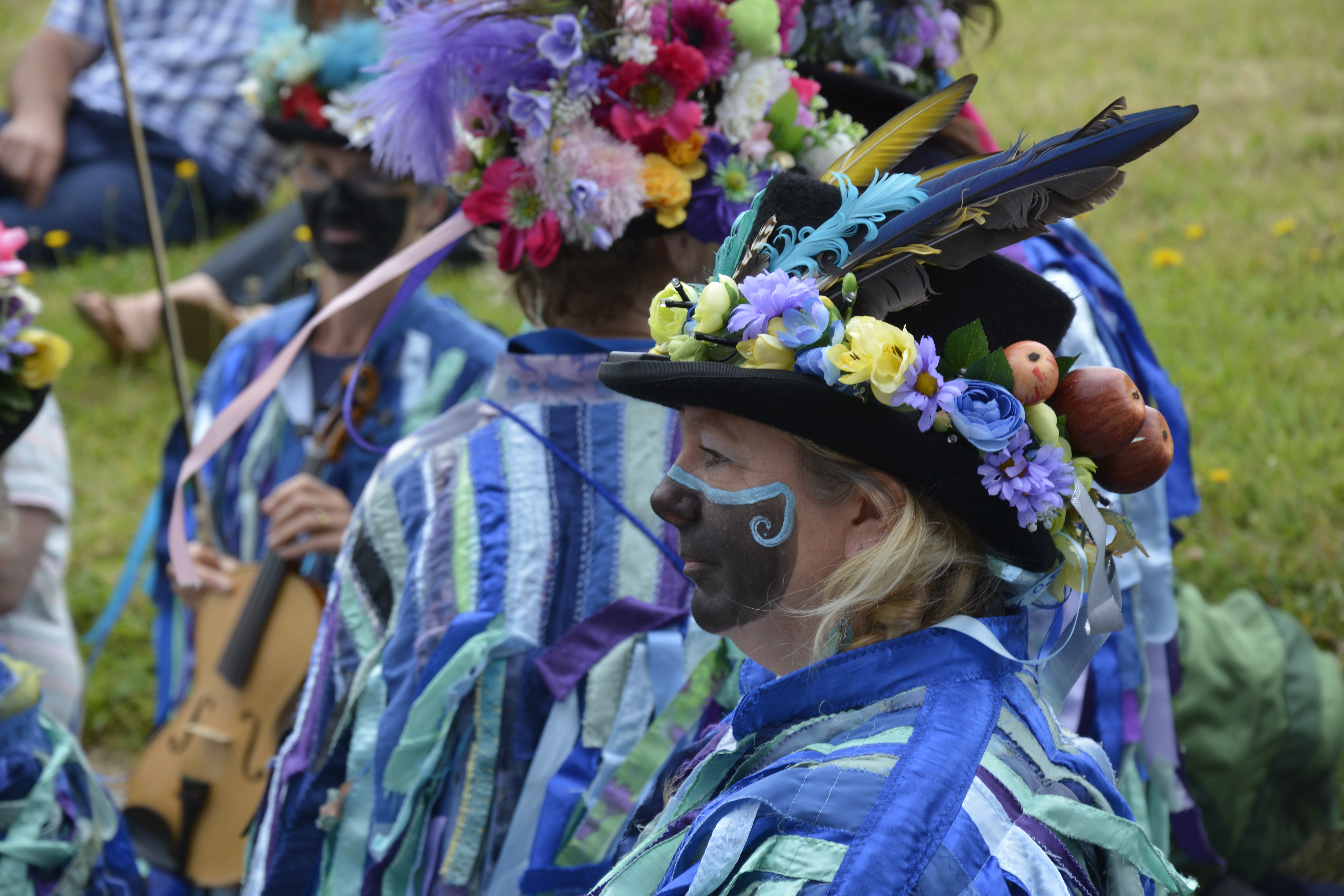
Not Tinners’ Morris!
This weekend I was at the Dartmoor Folk Festival, which is held in South Zeal every year. It’s always fun because I take out a table in the craft marquee and sell books all weekend (apart from when I’m dancing with Tinners’ Morris). Every year I have more new people appearing and looking bemused at my display and asking if I know the author … and all of them tend to come back year after year once they’ve started. A nice way to hook new readers!I managed to get a couple of dances in, too, and because the weather was absolutely fabulous, lots of people got burned, but no one minded. And the beer was excellent (as were the ice creams)!
The best point for me was, Tinners’ Morris and a few other select groups were invited to the Church at South Tawton by Rev Paul, and we processed in through the church and out to dance outside … before going to the pubs, naturally. And this time, I’m glad to report, I didn’t spontaneously combust while in the church. Last time I danced Morris in a church, my waistcoat caught fire. That could have been a hint from on high, or might just have been my gormless foolishness in standing too close to the candles!
I’ve started using a new pen this weekend.

Pelikan M805 Demonstrator
Hmm. How to explain this.
I’ve been looking at the idea of a new project for a while. Although it’s firmed up, I’m not going to talk about it yet (I have two projects to finish first). However, one thing that was clear was, I needed to have a new pen for it. Pelikan, who have a range of superb pens, have been good enough to provide me with one of their M805s for it. You can see them here.
It is gorgeous! I’ve never had a pen with an EF (extra fine) nib before, but I’m very pleased with this one. It’s not as smooth and soft as a medium (like the ones I have in my Visconti and Conway Stewarts), but it is by no means harsh. There’s a little line variation, although not too much, and I think this is going to be one of my most-used pens very soon. It has a really good balance, the thickness is ideal for me, and I think it looks gorgeous. I love being able to see exactly how much ink is left, and the silver/rhodium appeals to me much more than a gold equivalent.
I should just say, although I happily recommend books, pens, papers and other things on this website, I am not paid by any of the companies to do so. I do get review items occasionally, but it’s on the understanding that I will not say I like something when I don’t. In the same way that I won’t review a book just to put up a bad review, because many readers may well like a book that I detest, I won’t say I love something when I don’t. So, when I say I love this Pelikan, You can take it from me that I do actually like the pen!

Love the see through body and silvered nib. Just lovely!
There is one other piece of news.
I had an interview with the BBC recently and suggested to them that I could do some interviews with other authors. As a result I now have a delightful little digital recorder and several meetings set up with friends. I’ll be talking to Becky Tope this week, and Ian Mortimer as well, and while I’m up at Swanwick I’ll be interviewing Simon Brett over a glass or two. The idea is, that I’ll be getting them all to chat about the landscape and how it inspires them. It doesn’t matter whether it’s Ian Mortimer talking about his love of history from Crockern Tor, or Lilian Harry speaking about some of the villages that made her think of her fictional villages, or someone like me talking about seeing a place and imagining a dead body there! Hopefully these “Scenes of Crime” will be interesting to a wider audience. Equally hopefully, with luck I’ll be able to get links through to the BBC so that you can hear them via the miracle of the internet.
And that’s about it for now. Wish me luck with the busy week coming!
Tagged: crime writing, Cult, Dartmoor, Dartmoor Folk Festival, M805, Morris, novelist, Pelikan, writing


July 27, 2015
Holidays!
It is very hard to write when it is school holidays. Children on holiday have an ability to make noise and disrupt thought processes much more than children at other times of the year. It is particularly unpleasant to be attempting to live to the 5:2 diet when sadistic teenaged girls insist on wafting lemon and lime tarts nearby, just to be evil.
She will pay for that.
However, today I have not managed to write as much because I have been involved in preparing for a new project. No, not the ones I was talking about last week. This is another new one.
This year I have branched out in some new directions. Last week I had an article in a popular magazine; today the BBC very kindly presented me with a digital recorder and the opportunity to interview various friends. I already have four confirmed interviews with other authors, and I have to admit I am really looking forward to conducting them.
The idea is to talk about the Scene of Crime. Yes, you are quite right. I’m mainly talking to crime writers – not exclusively, though. I’m also speaking to non-fiction writers and authors of other genres. And that, for me, is part of the joy of the project. I’m really looking forward to walking around with other authors and getting a feel for their ways of working, learning what inspires them, what it is that they get from a particular street, or a specific river valley. I think it’s going to be fascinating!
As I mentioned last week, I have also been talking to different people about reviewing their products, and I am delighted to say that my YouTube channel will soon start to incorporate several new themes. First and foremost I’m going to talk a little about the pens and other tools which I use most of all, and then I’m going to be looking at and reviewing other products. All of this is more for fun than anything else – I’m not going to get paid for these reviews, other than getting the pleasure of using the items. And while I do it, I’m going to pick the same approach that I use when reviewing books. That is, I won’t put up negative reviews.
If I really, really don’t like a book or a pen, that won’t go up necessarily. What would be the point? The fact that, subjectively, I don’t like something is no reason to hurt an author, publisher or pen manufacturer. I don’t like some authors’ books – but I wouldn’t review them negatively. Other people may well love them. The same goes for a pen.
However, aspects will be discussed. So, if I find a pen too skinny for long periods of writing, I will say so – at the same time as pointing out that it’s probably ideal for making notes and carrying about most of the day; if a pen is too heavy, I’ll say I find it so, but the corollary to that would be that it may well be extraordinarily comfortable for some people. My solid silver Conway Stewart Drake is enormously heavy, but the ink flows so well that it’s a delight to use for hours at a stretch because it can rest on the paper and on my hand and I don’t need to grip it tightly, making it one of my most relaxing pens. My Visconti Homo Sapiens is similar. It’s very comfortable and writes wonderfully smoothly because of the nib.
So, there are two new projects. There are two others. One is a book I’ll be starting very soon. The other … well, you’ll have to wait and see on that. But for me it’s an exciting project, and one I cannot wait to get stuck into!
Don’t forget, if you have any ideas or items you’d like me to talk about, please get in touch. You can put a comment in the box below, and I will get back to you as soon as I can.

Another distraction!
Tagged: authors, BBC, interviews, radio, reviews, scene of crime, writing


July 13, 2015
New Moves!
I’ve been having a lot of fun recently and it’s getting better.
Some of you will have occasionally sprinted over to writerlywitterings on YouTube and seen some of my videos on my books and on writing. Not yet? Go and check it out.
The videos seem to have interested a lot of people, and because of that I’ve decided I’m going to do a bit more working with the channel.
I’ve finished my series of reviews about all my books, but there was one aspect missing. While I was talking about the books, I didn’t manage to go out and film locations. Not because I’m bone idle and welded to this desk (well, not only that), but because the microphones on the two cameras we were using just weren’t up to coping with the wind howling over the moors. The roaring sounded like a steam engine in terminal decline rushing at me. Not a good noise at all. So, as a result I’ve invested in a professional mic, which seems to have cured all those problems. It means I can return to some of the more atmospheric locations from the books. And you, dear reader, can help. Let me know which you’d most like to have filmed and I’ll go over and look at them.
 Second, I have been talking about more book reviews for a while now, and finally I’ve got an idea about video recording book interviews which I think will work. It’s going to involve YouTube videos where I talk about the books, and then Q&A sessions in writing here. The reason is, the interviews are easier to conduct over time via email, rather than me trying to sort out how to interview. And yes, while most of the problem is my own incompetence in sorting out how to use and record a two-way conversation on Skype, it’s also a fact that other writers are no better than me! Trying to get two authors to liaise, fix time in their diaries and then record a chat is going to be harder than herding frogs across a desert.
Third, I am looking at a series of videos that will be more focused on tools. Initially this will involve my own ancient tools: pens and pencils going back forty five years and more (which is terrifying!), then looking at more modern tools for writing. Why? Well, I’m fed up with seeing reports that suggest that handwriting is dead. I like handwriting, and I want to talk and show how pens and different inks can help people communicate and also how it can help organise their own thinking and their work. Yes, I will also talk about mind mapping software, the editors I use, the planning software and other things that really excite me about computers, but that won’t detract from my main focus: pens and handwriting. Hopefully I may inspire one or two people to look at picking up pens again.
Fourth, of course, I’ll still be planning and thinking about new issues that could help people who want to write for a living or merely for fun, whether it’s to do with planning a story, figuring out how to plot a murder, or what to do when preparing to go to speak publicly for the first time – there are so many aspects that I need to cover still.
Do please let me know what you would best like to see talked about either on YouTube or here on writerlywitterings. All ideas will be very gratefully received!
Don’t forget: if you want to pick up a free read, go to my The Boy’s Revenge and click on the link for a short story based on my Vintener series. Or go look at Amazon for Headline’s Michael Jecks Compendium!
Tagged: authors, books, Future, plans, reviews, talking, writing, YouTube


July 11, 2015
The Templar’s Penance by Michael Jecks

An excellent review as always from the master Crime reviewer! Many thanks.
 Originally posted on In Search of the Classic Mystery Novel:
 1323. Following the devastating events in The Mad Monk Of Gidleigh (not required reading, but it’s a great book, so why not?) Sir Baldwin Furnshill and Simon Puttock have chosen to leave their families in Devon and head to Santiago De Compostela on pilgrimage. And if the Are You Being Served? film has taught us anything, when us British go abroad, things never go well…
But Santiago De Compostela (in Galicia, North West Spain) is no Costa Plonka. The problem with people who head to a place on pilgrimage is that they invariably have done something very wrong in the past – and we all know the effect that past secrets can have in murder mysteries. It isn’t long before Simon and Baldwin find themselves involved in investigating a terrible crime – a young woman brutally raped and beaten to death. As the sun beats down on them, they struggle…
View original 367 more words


July 6, 2015
What a month June was!
I have been suffering recently from a series of disasters.
Early this year I had the horror of a computer failure. Before anyone says (again) that I ought to back up the damn thing, I do. I routinely back up to a local second disk, and to remote disks, and to the cloud. However, once in a while things go wrong. I clearly remember with horror the time some years ago when a backup failed. I saw that there was some kind of glitch, so I hurriedly backed up the disk to my Zip files (remember them?) and the result was, I copied the virus to all my back ups. That cost me about two months of work.
This year it was more disastrous. That failure cost me because it wiped out my current work in progress. This year was worse.

My “vintage” Apple and an old leather chair. Both defunct!
In February I saw that there was a minor problem with a mail file. I tried the usual, turn off, turn on again etc, but there was no joy. So I decided I’d use Apple’s backup. Every day for years I’ve used my Time Capsule with Time Machine to backup every keystroke. All one need do is recover to the most recent copy of the computer, and hey presto! Life can continue. However it didn’t for me. Time Machine works by overwriting the entire disk with the data it’s stored on the Time Capsule. I restored, and then lost everything – because my Time Capsule had a fault. It had nothing stored on the disk, and as a result when I restored it wiped my disk – completely.
It’s been much more catastrophic than the earlier failure, because not only was my WIP affected in February, I also lost all my photos. 13,000 of them. Now they mostly still exist. They are on Flickr. My work in progress tends to be safe on remote sites, too. But I did have plans, notes and essential records on the computer. They were all lost, and that cost me a month.
In June, however, things went much worse. Another glitch (pink squiggles all over the screen) and after getting the machine in to the menders, I was told that my machine was “vintage” at eight years old, and therefore there were no spare parts. My graphics card was blown, and that meant the computer was, basically, so much junk. But, at least I had the disks still. Helpfully the menders put the disks into a cabinet so I could use them again.
Except I can’t. The latest update of OS X means those disks don’t work with my new machine. So a bunch of work was again lost.
The worse thing about this second failure was really the lost time in setting it up. In the past, when I’ve bought a new Apple, I’ve stuck a wire between the two and left them to get on with things. Somehow, they chat for a while and then my new computer has all my settings there ready and waiting. With the new machine this time, there was nothing. It took me a total of two and a half weeks to get the new machine operating as I expected it. I still don’t have my mail folders working as they should – that’ll take a while to get fixed – but at least I now have all my essential software.
However, the first day I sat at my desk, the chair broke. Oh, it wasn’t a critical breakage, it was merely the blasted height adjuster. Since the chair was a rather special sort, there was no way to mend it. Perhaps it should also be called “vintage”! In any case, I suddenly had a need for a new chair. So off I toddled to the usual shops.
Now, here’s a thing. There are great chairs to be had. You can buy leather chairs for really very little. I was surprised to find really very good chairs for £70-80. I tried them, and some were very comfortable. I rocked (one essential for my chairs is that I can doze in them!), I swivelled, I twisted and raised and lowered the mechanism – and was very happy. Except, when I checked, the damn things weren’t leather.
This may sound daft, but if you’re sitting in a room for 14-16 hours in a day, plastic just doesn’t work. It may look, feel and sound like leather, but the smell and the overall experience are not right. They grow uncomfortable. So, after thinking about it for a while I went to first principles and figured out what I wanted.
I wanted a good tilting mechanism. I wanted it to be good and ergonomic. I needed an adjustable back, squab and arms. I needed a head rest. Oh, and I needed the lowest possible budget, especially having had to buy a new computer already.
The only ones I found were approaching £1,000. I couldn’t get close to that.
One salesman (?) wrote to me with the details of a couple of £500 chairs and when I asked if they had any seconds or slightly soiled models, got a sniffy response that if I wanted cheap chairs, many shops sold Chinese imports, but he personally wouldn’t touch them. A nice way to tell a prospective client that I was a fool for thinking about such chairs. He didn’t win my vote.

My new computer, new chair, new working environment!
However, a quick check led me to a Humanscale Freedom chair. It’s superbly comfortable, almost infinitely variable, and has all the flexibility I need. And I was fortunate enough to find one for only £160 second hand. Except that I had to drive to Oxford to collect it, a round trip of some six hours. It was worth the money. I can recommend them!
But it does mean I’m even further behind. My poor, long-suffering editor must be fed up with hearing my tales of woe. All in all, this year, because of computer failures, chair failures and other issues, I’ve lost about two and half months of work. It’s horrible.
So, if you’re wondering why I’ve been a little quiet for the last few weeks, now you know!
Hopefully normal service will return shortly.
Tagged: Apple iMac, author, chair, desk, ergonomics, Freedom, Humanscale, vintage, writing


June 27, 2015
Interview with MANDA SCOTT
This week I’m really proud to be talking to a writer I’ve admired for many years: Manda Scott, author of brilliant Roman stories, the re-inventor of Boudica, and now the writer of INTO THE FIRE, a retelling of the story of Joan of Arc (you can read my review here).
MJ – Manda, could you tell us a bit about your childhood? Where were you born?
MS – I was born and brought up in a tiny village south of Glasgow. It has an amazing history – the central village green is shaped as a letter A, with each side a quarter of a mile long, for the Alexanders of Eglington, and there’s a Covenanters’ hill just outside the village that we used to sledge down as kids. Now, there’s a massive wind farm, which isn’t as sightly, but I’d rather that than a nuclear power station.
I lived there all my childhood and my father’s still there, so we were about as rooted as it’s possible to get. I consider moving back home occasionally, but England has become home these past few decades and it would be hard now, to uproot from that.
MJ – What job(s) did your parents have – were they creatives or workers in business?
MS – My father was a mechanical engineer who taught at the University of Strathclyde – he became a Professor eventually, and was one of the first to set up a course in computer-aided machine tools. When I slip into my geek phase, it’s Dad I have to thank for that. My mother always wanted to be a vet, but didn’t have the Latin, so set up a raptor rehab center instead. My childhood was spent with a house full of kestrels, owls, buzzards, and the occasional litter of fox cubs, or RTA deer. And yes, I did become a vet before I became a writer. I’m not sure if I was simply living out my mother’s unfulfilled dreams, but I’m glad I did it.
MJ – What sort of education did you have?
MS – My parents were ardent believers in a private education, and much as it offends my politics, I am deeply grateful. I went to an all-girls private school that started when I was 4 years old and I left at 16 with 5 Highers (Scottish system they’re the equivalent to the first year of A levels) and went to Glasgow Vet School. I was a shy, introverted a-social child with no interest in the usual girlie fixations of boys, music, fashion. I still know nothing about any of those and I’d have been massacred in a state school. My small, not-very-pushy private school let me sit in a corner and read books and when I said I was going to be a vet, they helped me – or at least, they got me into Glasgow. I wanted to go to Edinburgh, but I wasn’t allowed to do three sciences at Higher – I had to have ‘a rounded education’ which meant Glasgow was my only option. I wasn’t a happy bunny about that, and learning German has not so far proved to be of any more use than learning Biology would have been, but I did love Glasgow Vet School and it set me up well for a career as a vet, so there was no long term damage done.
The veterinary training was 5 years and I loved every second of it. Even now, the training in how to use a library, how to research any topic in an efficient way, how to take information and make sense of it has been immensely useful. There’s a skill called, ‘Need for Cognition’ which it seems to me is absolutely required in any writer – and training to be a vet helped me hone it. ( http://www.theguardian.com/commentisfree/2015/jun/07/seek-and-you-will-find-curiosity-key-to-success)
MJ – After that you practised as a vet for some years, I know. Did you write in your spare time, or did you leap straight into writing after giving up on your career?
MS – I didn’t have any spare time to write, at least not for the first ten years. I was a surgical intern (aka dogsbody) at Cambridge and from there, after a brief stint in general practice, I took my anaesthesia exams and moved into specialist equine practice in Newmarket, where I focused on equine anaesthesia and neonatal intensive care, and from there to the vet school where I broadened out into all-species anaesthesia and intensive care. I was ten years into that arc, teaching students at Cambridge, before I went back to writing. ‘Back’ is all relative, though. When my mother died, I found amongst her ‘saved from childhood’ file, my first book – it was 10 pages written in feltpen from the perspective of one of the owls in the kitchen. It was early self-publishing, it had a copyright and a publisher’s marque and it was all bound up with blue ribbon. So yes, I always planned to write, but what I hadn’t planned was how much focus veterinary medicine was going to take to be any good. Then I had a 3 month gap between jobs and that let me start my first real book – a fiction set in a Vet School. I had, of course, read James Herriot and thought it would be possible to do the same in fiction. Nobody wanted to publish it, but it got me my first agent, and she was able to nudge me in the direction of more publishable work., so again, everything fitted together rather well. Or at least, it appears so with the perfect vision of hindsight.
MJ – When did you fall into writing professionally, then?
MS – I started my first published book on my 30th Birthday. I had been on a writing course with Fay Weldon as tutor and she’d told me I should be writing TV Scripts. So I started, and had a few things looked at, but never made, and then I got to my birthday and thought that if I didn’t knuckle down and write something soon, I’d be 40 and there’d still be no book. So I wrote Hen’s Teeth, and, amazingly, it was not only published, but was short listed for the Orange Prize, which was about the best boost into real grown-up writing that it’s possible to get.
MJ – Were you always attracted to crime? Did that come from your own reading preferences? Later you moved to historical (Boudica) – was that because you were weary of crime, or because you revelled in more bloodshed? Well, I had to ask…
MS – Definitely the early crime writing came from my own reading – but also because I had no time at all to do any research and so I had to follow the first rule of writing and write from what I knew – or in this case, from the various PhD topics I’d considered, but never quite got around to. Hen’s Teeth grew straight out of my first potential post-grad project, Night Mares was written while I was at Dublin Vet School, but was in fact a kind of hybrid of the worst of Glasgow and Cambridge combined, and Stronger than Death came from a newspaper article about a series of clinical trials that had gone horribly wrong. No Good Deed took it all a step further. It was more of a hard core thriller, largely because I’d joined the CWA by then and had an idea of what a thriller was.
The shift to historical writing came about solely because of my shamanic practice – I made a commitment in ceremony to write about our shamanic past and there came a moment when I needed to do that NOW, not whenever was convenient, which was always going to be at least a decade away. I have to say, I wasn’t at all sure I could do it – and if I hadn’t got an advance that let me give up the day job, I don’t think I could have done – the research was orders of magnitude harder than any I had done before, in any context. I had to get to grips with an entire historical period – and two sets of military standards – the Romans and the ancient Britons – it took many, many months and much reading and a whole slew of conferences attended, with learned people speaking. That was one of the many grand things about being in Cambridge – they had amazing libraries and I was free to attend conferences.
MJ – How do you work on characters? Do they come to you in a visual manner, or do you need to imagine their faces, their voices and verbal tics?
MS – That’s an interesting question.
I see/hear/feel the people in the ways I see/hear/feel in dreams and then slowly other things begin to evolve around them. All that I write is predicated on pushing people to the edges of their existence. I like exploring the edge places in myself and in others and it seems to me that if there is one real reason to write and to read, it’s to find out more about ourselves, personally and collectively – I wrote the Boudica books with the intention of showing ‘this is who we were, this is who we could be’ and so to find that, I had to be it, to live it, to explore the possibilities – I feel the people, get to know them from the inside out, before I start to write them. I feel the voices rather than see or hear, them, though – I’m not a great auditory thinker. I don’t listen to music and even birdsong sometimes is too much, so voices come as a felt sense, rather than a sound.
MJ – How important is location to you? I know many people who have a real affinity for a place and always felt you were one of those. Do you think that comes from your beliefs?
MS – I am certainly very involved in the gods of this land, and find it hard to imagine living anywhere else. But in writing terms, getting to grips with the feel of a place, with the sights/sounds/smells of it, and the people who lived there, always seems to be the final keystone in the arch of a book. The narrative has to build itself in my mind around a framework of the people and their emotional arcs, but then the place comes in and anchors everything. So it’s vital, but the rest comes first.
MJ – Knowing you, and knowing how empathetic you are, would you like to talk about your research – both the mundane reading, walking variety and your own very special shamanistic approach?
MS – Thank you, yes, I would…
So the easy bit is the mundane: I spend hours reading books first, and then get out and talk to people to fill in the gaps. With the Boudica series, because the pre-Roman era was in many ways so different, I had to do more ‘living archaeology’ – I spent a week sleeping in a roundhouse, I learned to make a sword, I drove a horse and explored how horse harness might have been made – and of course, I’d already done several years of battle re-enactment which, although it was a different era, was remarkably useful in understanding the dynamics of battle and the feelings on the front line.
MJ – That does sound fascinating. I’ve always wanted to work with metals myself, and I get into the atmosphere often by camping out on the moors. What about the shamanic research?
MS – The shamanic research fell into two camps, the academic and the experiential.
The academic part was the most straightforward, and easiest to explain. I worked from the premise that all shamanic cultures hold certain things in common – the concept that all things are imbued with spirit and that with training the shamanic practitioner can connect with/speak to/ask for help from, those spirits. Added to that, we know enough about the druids to know that, for instance, they wrote Greek and Latin, but didn’t write down their own ceremonies, that the training center on Mona (Anglesey) was renowned throughout the ancient world, and that both men and women went there to train for between 12 and 20 years. That last figure still pertains in modern shamanic cultures – I worked with a South American shaman who had trained with his grandfather from the age of 12 to 24 and back in the 90s, I was offered a 12 year apprenticeship with a central American shaman. (I didn’t take it – I wasn’t ready to move to Mexico…)
MJ – I can understand that!
MS – So I read as much as I could of the academic shamanic studies, mostly from anthropologists, and added the various more anecdotal ‘this is how I met the amazing grandmother/grandfather/teacher who changed my life’ kinds of books.
And then the rest was experiential. At this point we need to say that my spiritual path is shamanic and it has been so since I was about 10 (tho’ I was in my early twenties before I put a name to what was happening).
Apart from some years spent studying Buddhism in which I learned the standard western meditations, and then added to them some taught at Samye Ling in the borders of Scotland, I’ve been trying to learn the depths of shamanic practice for decades.
MJ – I remember sitting and discussing spirituality with you, especially the source of your shamanic beliefs after a festival a couple of years ago. Could you explain your main conviction?
MS – I believe that all true spiritual paths teach the same thing, namely how to live and to die with full awareness. All of the techniques boil down to this: human potential is to become pure awareness, but it takes discipline and training.
What sets the shamanic practitioner apart from the other disciplines (and we need to note that it is my belief that nobody in the west can ever be a shaman, but we can be astonishingly accomplished shamanic practitioners) is that we engage with the spirits of all life around us in all the realities, in order to ask for help in this reality, in order to become more clearly our authentic selves, and in order to become more clearly aware. Everything is about awareness. When time stands still, that’s when the boundaries of the realities melt away, not the other way around.
So: I teach the particular brand of shamanic practice that is called shamanic dreaming. Each culture has a different method of accessing the other realities. Most of them revolve around rhythms, either drums or rattles, some use endorphins, some use sound and dance. A few use drugs, although I am of the opinion that nobody in the west has the capacity really to understand the use of plants and they don’t help us either to become more authentic or to stop time and become balanced on the knife edge of the moment. Without these two, we’re just spacing out, which is not what life is for.
All of which means that I spent a lot of the time when I was writing the Boudica series dreaming with the fire. I got rid of the television, I had no sound system anyway, I lived alone in a cottage in Suffolk and I make my deepest and most profound connections with fire. I sat with the fire in the evening and the next day I wrote the results of the dreaming – which sounds simple, and wasn’t.
I was very, very lucky that my editor completely understood the process and was, I now realise, both careful and respectful of the way I worked, while at the same time being absolutely focused in her task as editor. I threw away 60,000 words from the first book because they didn’t drive the narrative forward at the right pace. I hated it at the time, but it was right.
MJ – The edits that go like that are the hardest parts of writing!
MS – When it came to INTO THE FIRE, I wasn’t trying to represent a shamanic worldview, but I was definitely trying to get into the head/mind/soul of a woman who has been so badly misrepresented, that all the current cultural expressions of her were (in my opinion) entirely wrong. I spent a long time dreaming into who the Maid might have been, how –and particularly why – she might have done what she did – that is, what she actually did, not what the mythology says of her.
MJ – That’s really fascinating. I guess it explains how you always seem to be able to immerse yourself in your story. Is it different with historical works compared with INTO THE FIRE, which has so much about modern politics?
MS – I think it comes naturally – which is to say, I don’t know any other way to write. I think writing is a bit like acting, except that the author has to take all of the parts – we have to be each of our characters, to live in her/his skin and feel what she or he feels until we know innately how each scene plays out. It’s a kind of alchemy, but I have no real idea of how or why it works.
MJ – Are you happy writing genre fiction? Are you happiest with series novels or stand-alones?
MS – Truly? I don’t care about the labels. Actually, I’d like them not to be there because they seem mostly to obscure what we’re doing. If you look at people like Andrew Taylor, who writes the most beautiful prose, and yet is lodged in the ‘genre’ category because his books have an actual narrative arc to them… it seems astonishingly unfair, not to say ridiculous.
And then there are people like Robert Harris who seem to be able to step outside of genre and I’m never very clear why that is – but would love to find out, because that’s what I’d like to do – to be able to step outside of genre so that it doesn’t matter if I write historical fiction or crime thrillers or (maybe) a bit in the future of where we’re going and where we might head to – and the readers would read them because they could trust that the power of the narrative would carry them through, whatever the setting.
As to series or stand alones – I like both. The joy of this work is the flexibility so the possibility of both is wonderful. That said, I do seem to be writing a lot of series just now – but I think that’s the nature of the current publishing scene. It might change.
MJ – These are very hard times for all authors. There are so many problems, especially financial; what would you say were the most rewarding aspects of writing?
MS – The freedom. Without question, the intellectual and emotional –and logistical – freedom to think/feel/do what I want when I want. I wake up when the sun rises – which means it’s 04:45 in the summer and about 08:30 in winter and I go to bed when I feel like it and in between I work from home and can walk the dog half a dozen times a day if she and I want to go out – and in between, I have made many outstanding writing friends who make up the various tribes of writers – it’s the perfect job.
MJ – Well, that brings me neatly to the life of a writer. Which are, for you, the most daunting or difficult aspects of writing?
MS – The gap between final draft and publication is full of arcane processes that I don’t really understand and which seem full of potential pitfalls that I can’t negotiate because I don’t know they’re there. I’m a control freak. This kind of thing presses all of my buttons.
MJ – Most people who set out to write a book will inevitably fail because they do not realise the dedication that is required to write 120-140,000 words. Did you ever find that a problem? Do you find the process of writing to be painful, or is it always a pleasure to dive into a new story?
MS – It’s always hard…it’s immensely hard… but never painful. It’s the difference, I think, between climbing an E1 and standing at the foot of an E6 knowing I’ll never get up it. And the thing about books is that they’re only as hard as you choose to make them. So if it’s becoming impossible, it’s because I’m taking it in an impossible direction and I need to rethink, rewind, rewrite…
MJ – Authors have appalling delays, they get rejection letters, they get brassed off with being ignored … Do you find the process painful?
MS – I was lucky in that the first full book – Hen’s Teeth – was written for a competition, so I had a deadline. And when the competition was cancelled, I still had an agent who said, ‘rewrite it and I can get it to the right editor.’ So I learned about editing (which is vital) and I didn’t have to write another book. I’d written part books before, and TV scripts, but that was the first one that I’d completed. I think if it hadn’t been published, I’d have stayed with the day job.
MJ – Talking of first attempts: when a first novel is written, there is invariably a hideous shock when the manuscript returns with pencil marks all over it. Do you find that to be a pain, and are there any other elements of the process of writing that irritate or grate on you?
MS – I hated that first edit. I still hate editing, although I’m learning slowly to let go and to accept that the editors know what they’re doing. My partner is primed to say ‘[my editor] is always right’ when I go downstairs with steam pouring out of my ears. I hate the copy editing and proof reading. I’m very bad at both and anyway, by the time they come along, I’m into the next book. So I have to take a deep breath, put it aside and remember that a book isn’t finished until it’s out and I need to focus on every part of the process.
MJ – I’m really glad it’s not only me! Have you ever tried publishing your own ebook or paper version without a publisher?
MS – No. And I can’t imagine it. I don’t have time just now, although I am doing some podcasts and can imagine doing some audio books, or at least, audio-shorts. That would be fun.
MJ – What is your impression of electronic formats compared with paper books?
MS – I am finding e-books increasingly useful. I can carry half a dozen on the train, I can buy 6 and read one and don’t have the other 5 hanging around unread and getting on my conscience. But when it comes to research, I hate them. There’s something about the three-dimensionality of my book shelves – I can remember where everything is and find a book if I need it. When it’s on the iPad, I can’t even remember what book a particular fact was in, and I certainly can’t find it. I know you can electronically turn down a corner, but it’s not nearly the same thing – I need to know how far through the book I was, and where on the page the fact was and I can do that with a dead tree book, but haven’t yet succeeded with an e-book. .
MJ – Yes. I’ve tried iPads and other ereaders with a view to researching, but I’ve always found it so much easier to work with paper books when writing. I invariably have six open on the desk before me and can grab the relevant one in a moment to check a fact. Anyway, this isn’t about me! When you sit down to write do you have a set routine – a set number of hours per day, a set number of words or something similar? What routines or good luck charms do you use?
MS – My only routine is that I need to walk the dog before I can sit down to write. And I need to have done the washing up. And have cleared all the HWA admin, which some days can take half the day. So actually, I have a lot of routines… but then I just write until I’m tired. I’ve tried the ‘number of words in a day’ or the ‘finish a scene’ or whatever and none of them really works. I write until I run out of ideas and then I take the dog out again. If it’s past 8 pm, I usually stop, but I often come back again just before I go to bed and tweak something of the day.
Generally speaking, I will edit the scene I’m on for the first half of the writing and then write something new for the next half, but it doesn’t always work like that.
MJ – My children (and hound) often feel orphaned when I’m in the middle of a book! What do your partner/pooches think about you writing?
MS – My dog is OK with the writing, but she grows very unhappy if I start playing Warcraft, largely because she knows that when I enter a battleground, there’s no chance of a walk until I come out again. I’ve given up recently, which keeps her a lot happier. My partner… I’m never not writing, so I’m not sure how we’d get on if I ever stopped. We both work from home, so we’d be on top of each other, I think, if I weren’t in my office most of the day.
MJ – How do you feel about giving talks and lectures? Is it a joy to be released from the office, or a duty that is imposed by publicists?
MS – Depends where I am in the book. I love them when I’m doing them, but there’s a part of me that’s always aching to get back to the keyboard.
MJ – Some years ago you had the brilliant idea for the Historical Writers’ Association. How has the experience of creating a professional body been?
MS – Amazing! It’s been nearly 5 years since we set it up and in October, I’ll hand over the Chair of the HWA to Imogen Robertson, who is an amazing writer of historical crime novels. At the same time I’ll hand over Chair of the Harrogate History Festival to Tom Harper and of the HWA Debut Crown to Andrew Taylor. My life will be transformed!
But seriously – I love the HWA and all that it has become. We have a tribe now, a clan, friends who otherwise would never have met but who share in common the griefs and joys of writing. It’s been life-changing in the best of sense and I love it. I feel immensely proud to have been involved and look forward to seeing it grow in the years ahead. I have no idea what I’ll do with all that time – I’m thinking of studying CranioSacral training, or perhaps Core Process Psychotherapy, both of which are taught near you in Devon, but we’ve sold the TV rights to Boudica and it may be that I can get involved in the production of that, so it might take up all the free time.
MJ – What would you say was the most useful piece of advice about writing that you have been given?
MS – Find your voice – that was Fay Weldon and when she said it, I didn’t even know what a voice was, but it’s been invaluable.
MJ – So you’d say the same to an aspiring author?
MS – Yes! Find your voice (!) but also, write clearly, from the heart. Know yourself first in order that you can come to know your characters. And read. Read everything. Read every day. Reading is the apprenticeship for writing, make it a broad one.
MJ – Is there anything else you’d say to someone about to try to write a novel for themselves?
MS – Go for it. But don’t give up the day job until you have a good contract!
MJ – Manda, thanks for the interview! I really appreciate your time and your detailed answers. All very best of luck with INTO THE FIRE, too. It deserves to be a huge hit for the summer! Good luck and thanks again.
Tagged: crime, historical, interview, Into The Fire, Joan of Arc, Manda Scott, thriller


Review: INTO THE FIRE, by Manda Scott, published in hardback by Transworld Books at £14.99
ISBN: 978 0 593 07247 9
I have to declare an interest here. Manda is a good friend. We first met as crime writers, and in more recent years we’ve worked together to take her vision of the Historical Writers’ Association and bring it to fruition. She has also generously given me a bunch of time to answer some questions on her writing which you can read here.
However, I have a firm policy on this blog: I will not puff books for no reason (or just because the writer’s a friend). There are plenty of sites where readers can go for such puffery and nonsense, but here on my website I will only review the books I’ve read and liked. Books I don’t like may well appeal to other people, so I won’t slate them.
Manda started out with crime, but achieved massive success with her Boudica series. More recently she has branched out into Roman stories, but this book is a new diversion for her.
So, what is this book about?
Many authors have tried to write contemporary fiction while also looking at historical events. To write in the two periods can be exciting, but it can also lead to a disjointed, disfunctional story. I’m glad to say this isn’t.
Taking the story of Joan of Arc, Manda has woven about it a tense psychological thriller set in modern day France. There have been a series of arson attacks. The leading investigator, Capitaine Inès Picault, has been given the task of hunting down the arsonist, a hunt that grows more urgent with the latest fire; a man’s corpse has been discovered in the ashes. And the only clue is the name of Saint Joan.
However, to tell the story of Joan we are taken back to the Hundred Years War and the English army at Orléans. The Maid is laying siege to Orléans, bringing dishonour and shame to the English when she succeeds. However, she doesn’t know that Tomas Rustbeard is actually an English agent. Tomas has sworn to expose her as a liar, to kill her reputation as much as her body.

The tension of the police investigation is maintained, and the taut battle-writing is deeply satisfying. Manda has thrown into this all her skills as one of the top novelists writing in English today. Her characters are all so precisely defined, I feel I could recognise them in the street. They are consistent and believable. When she writes about my own period of medieval history, there is a sympathy and compassion for the soldiery that is rare in any novel. And her research has been very thorough! Whether she is writing from the point of view of a weary policeman who resents his female boss, a smooth politician who suffers from lack of confidence, or a murderous double agent in the pay of the Duke of Bedford in the 1400s, all are equally set out.
All in all, this book is a must-read for anyone who likes crime or historical fiction.
I can very happily recommend this book!
NOTE: for today, Saturday 27th June, there is one free, signed copy of the book for one lucky reader. A name will be picked at random from twitter. All you have to do to win is retweet my tweet. You can even copy and paste from below. Couldn’t be easier, could it? So do please RT and have a chance of your own free copy of this excellent book!
TWEET: Today only: my review #INTOTHEFIRE by excellent #MandaScott, @hare_wood. http://wp.me/p1u0dV-o1 1 signed copy if you RT this! @LilyCapewell
Tagged: arson, Joan of Arc, Manda Scott, review


