
Michael Jecks's Blog, page 14
September 20, 2017
What’s in a Name?
It’s now a week and two days since I picked up our puppy.
When I was a youngster, my parents always had a lot of dogs. When I say a lot, I mean a pack. We had four or five all the time while I was at home. I think my mother counted once and found she had owned thirty-six dogs in her life. It was a source of pride to her.
In my time, I remember Cavalier King Charles Spaniels, Boxers, a Basset Hound, Collies, Black Labs, mongrels and Chihuahuas – and a Bernese Mountain Dog and two Rhodesian Ridgebacks. I loved them all, but especially the Ridges and the Bernese.
When I managed to persuade my wife that since I was living at home we could aspire to dogs, she was reluctant at first. She came from a family where a single cat was considered adequate as a pet. Strange household, clearly. Still, she was happy enough to consider dogs – on the proviso that one would be a Ridgeback. She, being new to the idea of dog ownership, and having had bad experiences (as so many do) with a German Shepherd, was only happy to think of a dog she had met and loved: our second Ridgeback.
Over time I’ve been immensely fortunate to have owned two more Bernese Mountain Dogs. They are adorable: big, fluffy bears who love their owners and children, but which are good guards. They will protect their family no matter what. I miss them hugely. However, I’ve been lucky enough to have a Ridgeback too. Our last was a wonderful lady, big, bold, calm enough, never got into a fight, and a lovely companion. Sadly she died last year, so what did we do?
Yes.
I’ve put comments up on Facebook and a few photos (go find me on FB or Twitter – or even Instagram if you want to see more) and I keep getting questions: “What is her name?”
I’m afraid I cannot put my pooch’s name on the web. There are several very good reasons for this. While I have a lot of very good friends out there in inter web space land, there are many more people who are not friends, who are people I will probably never meet, and who are not necessarily very pleasant people. Some of these folks have, in the past, made threats against me. No, not particularly imaginative threats, nor particularly believable. But it has happened.
Others, clearly the more deranged type, see my face and the words “Author” beside it, and assume that I must be a multi-millionaire by virtue of the fact that I have written several books. They assume that they could persuade me to share my money with them, if they were to give me the right incentive. Some could consider kidnapping as a viable means of persuasion.
Such people are, I am sure, few and far between. However, I used to work in the computer industry, I spend much of my life working with plots that involve the nastier aspects of human misbehaviour, and I keep abreast of the crimes and frauds committed.
For that reason I do not ever willingly give out the names of my children (until they’re of age) or dogs. It’s not because, dear Reader, I don’t trust you – but when information is uploaded to the web, you can never be sure where it’ll end up.
Someone who wanted to kidnap a puppy would find it easy to call out a pooch’s name and have the enthusiastic mutt run into their arms. They may regret capturing a hound that has more teeth than a ruddy alligator later, when the flesh is all but ripped from their hands, but I’d still have lost my dog.
So, please don’t ask what the pup’s name is. I hate to disappoint with a refusal!
Tagged: dog, home, hound, pup, puppy, Rhodesian Ridgeback, Ridgeback


September 8, 2017
Not All Keyboards Are Equal!
I am in the middle of an edit just now. I do not need distractions. I do not need disturbances. No, I need time to sit and concentrate on the flow of this story.
But I’ve just received something. The nice man from the delivery service came and handed me a heavy parcel. Not a toy, an essential part of my working environment: this is my first time typing on my new, Filco Tenkeyless keyboard, and I have to say, it is glorious. The keys feel just like those I used to adore on the old keyboards of the early 1980s: there is a slight click as the key is depressed, and the feel is light and easy on the fingers. Just like the IBM Displaywrite keys which were, I believe, buckling spring keys. Never heard of them? Why should you? We’re into keyboard geekdom here.
[image error]
This is a distraction
So, what am I typing on this for?
As some readers of WriterlyWitterings will know, I have been trying out different methods of getting my books down on paper. This year has been particularly hard, with too many deadlines charging at me like a herd of bulls. Usually I manage to write a couple or three books a year, but the last two years have been tough: my mother’s death in ’15, my best friend’s in ’16, and this year my father’s – have all conspired to assault my creativity.
At first I thought that the best way to get words down would be to change my methods. I picked up a pen and started to write longhand instead of typing straight to screen; however that was not effective. It was so much slower to get the words down that I was left even further behind. This year I decided to give it one last go, but it didn’t work for me and as soon as I could, I reverted to form and began typing. For the future, I will be working with pen and paper with the basics, determining the main flow of the story, writing down characterisations and that sort of thing, but not the main elements of the story. I have to type it up as the story develops.
[image error]
Apple is nice to look at
I began to get interested in different keyboards a little while ago. My Apple keyboards are good, but I tend to find that they last me about two years each. The recent metal versions with soft keys have lasted a little longer – but after a while they get to be hard work.
The reason is, that the keys are set out on top of a sheet of rubber or similar stretchy material. That is how most keyboards are made nowadays, with each key pressing down on the mat underneath, and making an electrical connection below. It’s brilliant for cheapness of manufacture, and it’s why keyboards generally cost so little, but it’s not good for the typing experience. Keys feel soggy and unresponsive. Also, over time the rubber mat becomes stiffer and the keys grow harder to type on. It’s a gradual effect, not instant, and the user often doesn’t notice until they get a new keyboard and there’s a sudden revelation about how bad the old one was. With mine, after typing on them consistently for two or three years, that means I’ve typed about nine novels (each of them between 70,000 and 120,000 words long). That means the keyboard looks rather naff, with each of the keys rubbed off. Usually, by the time I notice that the A, S, E and N keys have disappeared, I know it’s time to get a new input device.
Where do you go for a keyboard?
I started out looking at Amazon and eBay, of course. I don’t like either of them, but they do have a selection to look at. They have many models from all kinds of company. But if you’re like me, and will be typing for hours at a stretch, you don’t necessarily want the cheapest version. There are two things in my office that keep me sane. One is a good chair, the other is the keyboard. With both of them sorted, I’m fine to go. If either is poor, my working day won’t go well.
So I began to start looking, and I found a delightful firm called, oddly enough, the Keyboard Company.
It’s a great little outfit based in Stroud, I think, and all they do is keyboards. Small ones, large ones, ergonomic ones, Dvorak ones, ASCII, ISO … you name it, they’ll have it. And the guy who is Managing Director, Bruce, is an inspiring, evangelical salesman when it comes to the different types. I started chatting to him over the wires via email, and soon started thinking about different systems I could use.
I mentioned that I had been a computer salesman back in the 80s, and he immediately knew the type of device I would like. He mentioned the buckling spring IBM types, when I told him about the IBM Displaywrite keys that had a subtle little ‘click’ in the middle of their travel. Apparently that was caused by each key having a spring that, as the key was pressed, would buckle under the pressure, and bend sideways to tap the side of the key’s cylinder (this shows one in operation). But he had already mentioned Cherry MX Blue keys by then. And as I listened, I knew I was hearing my future!
Okay. Here’s the geeky bit.
[image error]
Two lovely Filco keyboards
The MX Blues are individually sprung, but they have a clever mechanism that has a sliding component before the key actuates (see here). When you press the key, the top part slides down until, after a couple of millimetres, it hits a second section. That is when the key registers and makes its connection, typing the letter. But the key continues down for another couple of millimetres, until it hits the buffers. This means that you have a fabulous experience, if you are a touch typist. The keys all feel the same, but they give you a distinct ‘rattle’ sound as you hit them, which in its own right is a kind of incentive to continue typing. The noise grows addictive. But so does the feel of the soft ‘click’ halfway down the travel of the keys. You can feel immediately when your fingers have activated the buttons.
Other Cherry MX switches operate slightly differently. The Blues are known as “Tactile” and “Clicky”; the Browns are “Tactile” and “Non-Clicky”, while the Black and Reds are “Linear”. For me, and for touch-typists generally, the Blues are best.
Filco, the keyboard maker, are a Japanese company who build their keyboards in Taiwan. They wanted to make stronger, more reliable and robust keyboards. Their interest was originally in the gaming market, I believe, but the popularity of their designs led to their rapid expansion.
[image error]
Goodies
In terms of design and quality, this certainly feels the part. The keyboard is a solid lump. It feels like you could use it as a cricket bat, should you be so inclined. There is no flex if you try to twist it, and when you pick it up, you know you have some serious working machinery in your hand.
One reason for this is the quality of the Cherry MX keys. They are designed to last for over 50,000,000 depressions. Each is a separate working machine. You can buy keyboards with different buttons as I mentioned above. I believe that gamers tend to prefer the quieter “Linear” types. Personally I love these Blues with their click and tactile bump in the middle of the operation. It is so easy to feel when your depression has been registered by the computer.
Now, I am an Apple user. So far I’ve not come across any issues with keyboard mapping. I did find some of the buttons have moved. Instead of the Command key next to the space bar operating the copy and paste functions, for example, it’s now the Windows key (which is set where the “Alt” key was on the Apple. I’m quite sure that I will get some issues after using this for a while – and I’ll update this review then. For now. the only problem I’ve found is that the volume controls don’t seem to work from my keyboard. Fine, I’ve migrated the volume controls to the screen’s top line, and can adjust that from my trackpad instead of the keyboard. Just now I don’t care. This is, for me, a crucial ingredient to my writing. It is a data-input device for words. And it feels wonderful!
[image error]
Gorgeous keyboard
The main difficulty I have so far is that it’s just so much fun typing on this thing! The sound, the feel, it’s just perfect. The keys are nothing special to look at, with simple white caps that will, I suspect, lose their writing within a couple of years, but the main thing is, that they work so smoothly. The only slight difficulty I’ve experienced has been that the right hand ‘Alt Gr’ key seems a little high, and occasionally I hit it with the palm of my hand, which brings up the “Spotlight” display. Not that it’s a real problem. I’m sure that I’ll soon get used to it. As matters stand, I’m back to enjoying typing again. I didn’t expect this to have such a dramatic impact on my typing quite so quickly!
All in all, a superb piece of kit.
I also have to commend Hugh and the team at Keyboard Company for the way that they send their products. I can quite understand why Terry Pratchett used to buy his from this same company.
First, the keyboard arrived superbly well packed. The keyboards (I had two delivered) arrived in their own boxes, sealed in another carton for safety. I ordered on the Wednesday, and they were with me on Thursday, for which many thanks, Keyboard Company.
The keyboards both arrived with a protective plastic cover. I don’t know whether these are intended to be used as travel protectors, but I’ll be keeping mine. They’re ideal as dust-covers when I knock off work, and seem robust enough that I can use them when I take the keyboards out (the second is a BlueTooth device which I can use with my iPad). The other things in the package were a pair of nail files, which personally I don’t use, but which I can easily imagine would be gratefully received by some customers, and a pair of table mats. The cable that came with it is a standard USB cable, and I was glad to see that it had a velcro strap to keep it tidy on the desk – it is a good metre and a half, I think, so untied it would soon get to be a pain. There was also a socket adapter to allow the keyboard to be plugged into a different computer – I haven’t bothered to look at this. I don’t need it!
My Tenkeyless keyboard is a full-sized keyboard less the numeric pad on the right (which I never use, and just takes up a lot of desk space). It has very effective rubber non-slip feet at the front, and two more that wrap-around legs that you can pop out at the back to raise the angle of the board. I always have to use these. There is no keyboard made that I can use comfortably without raising the back. This model is connected via wire to the Apple. The cable is a USB wire. I was a little disappointed to find that there was no USB connector on the keyboard. I’d have expected to be able to use it as a mini-hub like the old Apple clear plastic boards, but my iMac has enough USB ports to make it rather irrelevant. I just have to plug them into the back of my screen.
That, I think, is pretty much it. I can already tell that I’m going to love this keyboard. It is gorgeous, and has a fantastic action. I adore these keys with their little click and the rattle as I work. I’ll get a video together before too long, when I’ve been using it for a while and will let you know how it’s getting on.
Right. Now to get back to the next book. Wish me luck!
Tagged: Apple, Bruce, Cherry MX, Cherry MX Blue, crime writing, Filco, Keyboard Company, keyboards, keystrokes, Majestouch, novel writing, Terry Pratchett, touch-typing


August 31, 2017
A MURDER TOO SOON: A Jack Blackjack Tudor Mystery by Michael Jecks
Many thanks for an excellent review!


Jack Blackjack is ordered to eliminate a spy in Princess Elizabeth’s household in this engaging Tudor mystery.
June, 1554. Former cutpurse and now professional assassin Jack Blackjack has deep misgivings about his latest assignment. He has been despatched to the Palace of Woodstock, where Queen Mary’s half-sister Princess Elizabeth is being kept under close guard. Jack’s employer has reason to believe that a spy has been installed within the princess’s household, and Jack has been ordered to kill her.
Jack has no choice but to agree. But he arrives at Woodstock to discover that a murder has already been committed.
As he sets out to prove his innocence by uncovering the real killer, Jack finds the palace to be a place steeped in misery and deceit; a hotbed of illicit love affairs, seething resentments, clashing egos and bitter jealousies. But who among Woodstock’s residents is hiding a deadly secret…
View original post 155 more words


August 30, 2017
Keyboards and Tools of the Trade
It is a rare thing nowadays to find a specialist company that is, in the mind of the general population, taking a retrograde step but which serves a specialist market.
I was mentioning to my wife recently that I thought I needed a new keyboard. ’Oh, another gimmick,’ she said – somewhat unsympathetically, I have to say.
But the trouble is, when you are working in a specific profession, certain tools of your trade make sense instantly. As a practitioner of your business you can see the benefits of the tool you’re considering. A Makita drill is way out of my DIY league, but a carpenter or builder can see the benefit immediately.
For authors like me there are not that many brilliant or ingenious devices that make sense. A good chair is extremely important. So is a good computer and a functional printer (I don’t care for inkjets: all I want is something fast and cheap per page). But some aspects of my work require thought. One of them is a good keyboard.
I have known some brilliant keyboards in my time. There was the lovely Wordplex 80-series devices with a soft rattle. Then there was the DisplayWriter keyboards from the IBM wordprocessors. Wang Labs keyboards were good too.
What was so good about these? First and foremost, the travel of the keys. They could move up to about a half centimetre. Modern systems are designed to look good and be cheap to manufacture. After all a Wordplex 803G would cost £15,000 for what you could now buy for perhaps less than one tenth of that cost. Items were built to last in those days. Then again, there was a “feel” to them that made typing more pleasant. A subtle “click” as the switch activated, letting the operator know by feel and sound that the letter was acknowledged.
Keyboards have gone backwards, I think, since those happy days.
Take the keyboard I’m using now. It’s a good, lovely looking, Apple keyboard. It’s thin, has lovely brushed aluminium in its construction – and it’s gorgeous. I’ve had several different Apple keyboards over the years, and this is very good.
The problem is that it, like other modern keyboards, is designed to have key caps set over a strip of rubber. As you press the key, the rubber is pushed down onto a switch. You only have to press the key a tiny distance. Which should be quite good for the average typist, but when, like me, you type some 5,000 words or more every day, it starts to create a degree of tension in the tendons. It ain’t good.
There are many companies on Amazon and elsewhere who will happily sell you a keyboard, of course. And they’ll do it from a silly, cheap price, all the way up to an astronomical one, if you want to pay them. And it may say it’s made with individual, mechanical keys made in Germany, but all too often they have cheaper keys from China.
However, there is a company here in the UK which specialises in finding the right keyboard for users. It is called the Keyboard Company, imaginatively enough. They are experts in the field of communicating with computers, basically. What they don’t know about Cherry MX keys you can scribble in capitals on the back of a stamp.
But what I like is their attitude.
First: I used to be a salesman. I know how tempting it is to have a quick push to a prospect, trying to persuade him/her to buy today. This company doesn’t try that. Instead, they write or talk to you as though you are a human. They advise, based on your work. And it’s also good to be contacted by the man who owns the firm in person. That kind of service makes me feel wanted – as though they seriously want to help me, not just flog a piece of kit.
Second: it’s all too common to receive a missive from a firm saying that they’ll happily sell you something, but how often do they get a little sticky when there is a problem. With Keyboard Company, they have a strict 14 day rule. You can try their keyboard for that long, and if it’s not right, send it back. They’ll refund or send you another version that will hopefully suit you better.
I haven’t made up my mind yet. However, I feel really comfortable with this firm, and I reckon when I decide to change keyboards (probably when I’ve finished typing this book) I’ll be buying from them.
And the fact that Terry Pratchett, my hero, used to buy his from this company only serves to justify my decision!
So, many thanks to Bruce Whiting and his team.
You can find them here: http://www.keyboardco.com/about.asp – and find a new joy in typing!
Tagged: Apple, author, Bruce Whiting, Cherry MX, iMac, keyboard, Keyboard Company, Terry Pratchett, writing


August 29, 2017
‘The origins of The Vintener Trilogy’ – guest post by Michael Jecks
For those interested in the origins of my Vintener Series!
 For winter nights - A bookish blog
Last week, Simon and Schuster published Blood of the Innocents, the final part of Michael Jecks’ Vintener Trilogy, a series of books that takes us back in time to that most troublesome of centuries – the 14th – and the Hundred Years War. To celebrate the publication, I’m delighted to host a fascinating in-depth guest post from the author. In it, Michael looks at the origins of the trilogy, its historical inspiration and its growth into a series that is now complete.
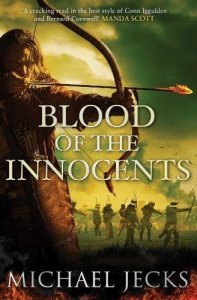 First, a little of what Blood of the Innocents is about
France, 1356: Ten years have passed since the battle of Crecy, and the English fighters are still abroad, laying siege to cities, towns and even small villages. Meanwhile the Prince of Wales raids across France to draw King John into a battle for sovereignty.
Berenger Fripper, having lost everything to the plague, is now captain of…
View original post 2,000 more words


August 24, 2017
Sean O’Callaghan – RIP
It was about twenty years ago that I attended a meeting of the Crime Writers’ Association in a rather run-down little club in West London.
At the time I had published, I think, five novels. My main stories were the Templar series, based on a renegade Templar who escapes after the destruction of his Order, and I was gaining a certain audience. Even so, I always considered myself first and foremost a thriller writer rather than historian. It was just that my books happened to be set a few years in the past.
My very first novel was a thrilling story named “The Sniper”. It was a brilliant concept, with plenty of bombs, bullets, sex and drugs – so what’s not to like?
It was the first story I had accepted by a publisher, too. I won a marvelous agent, who corrected my more wild grammatical errors, told me where to tone things down, and pushed me into rewriting sections. It was a perfect case study in how to write (I hadn’t ever written anything before this, after all, and any help was gratefully received).
The result was an offer for the book from Bantam Press. I was cock-a-hoop for precisely two days, because that was how long the rejection letter took to arrive. My book was all about the IRA, and they had just agreed a cease-fire. My book was dropped like a ticking backpack.
I retained an interest in Ireland. It was always in my mind that I should return to the Troubles or other modern-day subjects – but my editors had already decided that I was to be an historian, and I was dissuaded from attempting another series away from my Templar crime novels.
When I was told that I could meet an IRA gentleman with teh CWA, I jumped at the chance, though. It would be fascinating, I felt sure, and I wanted to get my facts right.
That was how I met Sean O’Callaghan.
What was he like? He was not terribly tall, an amiable-looking man, slim, with a shock of greying hair, a smoker’s pallor and a twinkle in his eye. He spoke at length, standing leaning at the mantlepiece, speaking of his past, of Ireland’s history, and his part in the fight against the British, but most of all, about the men who ran the IRA. A short while afterwards I was mocked by a friend when we were talking about the IRA. My friend derided my comment that there were never more than a couple of hundred IRA actives. Sure, there were many more who were involved as teenagers, throwing stones at soldiers or police, occasionally flinging firebombs, but of actual, armed militants making bombs and conducting assassinations, according to Sean, they were very few indeed.
I mentioned the twinkle in his eye. He was a man with a great propensity for humour. But after the meeting, there was more than one other crime writer who made a comment along the lines of, “He may have a twinkle in his eye, but he is a murderer.”
Yes, he was. And he did not try to hide the fact. As a teenager and youth he had been fired with a passion for Irish unification and hatred for the British. He saw the British as an imperialist nation that was determined to trample Irish ambitions for independence and keep the Irish a subject race.
However, as he grew older, he began to see a different side to things. He saw the cruelty and violence within the IRA: the punishment beatings, the knee-cappings; he saw the bank robberies, the drug-dealing, the gangster mentality. And he started to get appalled by the deaths. Once, he heard another IRA man make comment about getting “two with one”, when it was found that a murdered woman had been pregnant. Such callousness shocked him. He began to see that the fight was not a resistance movement, but a sectarian war, and one in which the leaders became very wealthy. It was an unnecessary conflict that hurt civilians more than anyone else, and he decided to try to stop the killings.
Sean spent four years in the IRA as a fighter against the British. But then he spent six more as an unpaid British agent inside the IRA, passing on essential intelligence that in the end helped stop the fighting. He was a murderer, and never tried to conceal his complicity in a number of killings. But he also tried to atone for those offences. In November 1988, he walked into the Police Station at Royal Tunbridge Wells and gave himself up, admitting to the murder of a police officer in the 1970s.
Years later, when I met him in the rather dingy club, he was living hand-to-mouth. He had spent several years in prison to pay for his murders, and was then in permanent hiding. He could not stay more than one night at a time at any address. He had lost his wife and contact with his family, but still he came to events to speak out against the IRA, and he published a book “The Informer”, which told the truth about his past, and about the men who remained.
Sean was an enormously brave man and, I felt, inspiring. I’m very sorry to hear that he has died.
I am grateful to Sean’s great friend and loyal supporter, Ruth Dudley-Edwards, for permission to quote the following:
“It’s beginning to hit the news that Sean O’Callaghan, the IRA killer who became an unpaid spy for the Gardai, has died. He drowned yesterday while swimming in a pool in Jamaica, where he was visiting his daughter. He was a man of exceptional ability and courage, and he spent most of his life finding ways of atoning for the crimes he had committed before at 20 he realised he was fighting in a squalid sectarian war rather than a resistance movement. He and I were very close friends for more than twenty years. And, like all his friends, I loved him very much and owe him a great deal for his insights, his wise advice, the depth of his knowledge of politics, history and the human condition.”
– Ruth Dudley-Edwards
Tagged: Informer, IRA, Ireland, Northern Ireland, RUC, Ruth Dudley Edwards, Sean O'Callaghan, Troubles


August 21, 2017
Distraction Free Writing
I have to be quick with this. I only have fifteen minutes.
Okay, for the last few days I’ve had a busy time of it. I’ve a friend who’s become ill at an inconvenient time for him. He has a job, you see: periodically he is asked by a local railway to help them by counting passengers. Since he’s unwell, I agreed to do it for him. It’s not the hardest job in the world. Easy, I thought. Not only easy, I can do it, and when I get home, carry on with my typing for the new book.
What could be easier?
The only problem is, that the first train is quite early. And I have to get to the station. So I have to get up at silly-o’clock (5.30 am) in order to get to the station in time for that train. And although I will be home soon after 2.00 pm, I’ll have done a reasonable day’s work. Standing on my legs all that while makes it quite tiring.
So when I get home and sit to type … guess what? There are emails, twitter messages, facebook messages and all the other social media interruptions you’d expect. How do I get around that?
I have an answer now. Not one I would have expected, either. But, bloody hell, does it ever work!
This review is being typed up by me on a ridiculously effective piece of software invented by the ingenious team at Astrohaus called “Sprinter”. It is a distraction-free piece of code that allows you to type – and type and type. There is a bar on the right, which you can set to a word count or to a timer (mine is a timer, as you can see), and there is a running commentary at the bottom which shows the words typed, characters typed, and how long it should take to “read” – I think. I don’t really care. Because this piece of software has allowed me, every day after counting people on the trains, to come home and type over 3,000 words quickly and without interruptions.
The idea of typing without distraction is not new. There are a number of apps which you can buy for Mac, Windows, Android and iOS. I personally use IA Writer quite often, as well as Nisus Writer Pro and Scrivener, which is, of course, superb and ideal for any novelist.
However, to be able to sit down and start typing with Sprinter, something else comes into play. I had expected to find that I was typing fairly quickly. I had expected to be able to put the words down and hurtle away with my story … but then I always do. I’m a fast touch-typist, and the sight of a keyboard doesn’t give me heart palpitations. Seeing an empty screen doesn’t worry me. So, generally, I am happy to write some 1,000 words an hour. I usually write 5,000 words a day when in first drafts.
But using Sprinter I have doubled my work throughput. Yes, I’m writing at up to 2,000 words an hour. And I think I know why.
[image error]
Typing window
It is not only the “no distractions” policy of the software, it’s the fact that while typing, the author cannot go back. Yes, you can backspace, as you once would with a typewriter, but that is all. This is not a word processor. It is a drafting tool. There is a big difference.
Any word processor will have arrow keys: up, down, left right. These allow you to go to a specific chunk of text and change it. You can highlight, usually, and block out a word or a paragraph, You can insert or remove a comma. Not so with Sprinter.
No, with Sprinter, all you can do is use the backspace key to remove a few words but, for the most part, the whole concept of editing is anathema to this. The author just writes. Any editing is for the future.
Do I like that?
You bet! I am coming to wonder whether the two functions: writing and editing, are using different parts of the brain. If so, that would explain my increased productivity. Because it is massively increased.
There are many reports that suggest that a creative worker, when distracted, will take more than 15-20 minutes to get back into the mood and swing of that they were writing. If my wife walks in asking something about the bank’s balance or an invoice, it’ll knock me back fifteen or so. if the children come in asking to help get the tennis ball from the shed’s roof, even if I just bark at them and don’t go out, the thread of the narrative has gone and it’ll take an age to get back to it. I might just as well go and help them!
[image error]Perhaps it is the same with editing. If you are typing at speed, and suddenly see a typo, you will go back and correct it if you can. But I find that finding one leads to my discovering others. If I see a grammatical infelicity, or a string if text that could be improved, I’ll go back and change them; I am the world’s expert at personal distraction. But all I really want to do is move forward, setting out the basic story. If I can concentrate on that, and lose the concept of editing on the fly as I go, I can write a huge amount more and better.
And then, maybe it’ll be more efficient when I come to editing, too. It would not surprise me if, knowing that the story is mostly set out, my ability to edit will become more efficient too. Surely that makes sense?
So, I hear some of you say, how much time will it take to edit? Not too long. So far I have been working on documents about 1,000 words long, and I’ve found that they are going down on the screen at the rate of one every half hour to forty minutes. Then I copy and paste into my word processor of choice (books to Scrivener, articles, short stories and other items to Nisus) where I can edit. The edits seem to go faster, too. So I’m typing up complete scenes, several at a time, and then editing.
Is there any way to improve on this brilliant software?
One thing could make it still better. If only there was a machine that I could use to type on, with a typist’s keyboard that gave more feedback than this Apple (very pretty) flat bluetooth keyboard. Ideally it would have a fair bit of memory on it, but beyond that, not much else. A simple, small screen would be ideal.
Oh – Astrohaus do make one. They call it the Freewrite. With luck I will get one to review in the next month or so. If it’s as good as Sprinter, I can see myself buying one for my next book.
For now, though, the main thing is it’s making me much more effective, and that makes me feel very happy!
NOTE: I have no involvement with Astrohaus, no fees, no free machine or anything else. However, to write this entire piece and edit took about forty minutes including taking screenshots. I can heartily recommend it.
Tagged: Astrohaus, author, creative, distraction-free typing, Freewrite, novel, novelist, Sprinter, word processor, wordprocessor, writer


August 7, 2017
The Prophecy Of Death by Michael Jecks
Another brilliant review from the Puzzle Doctor!
 In Search of the Classic Mystery Novel
 1325, and England is not the safest place to be. Edward II’s hold on the throne, and, in particular, his territories in France, is weakening and Sir Hugh Despenser, the power behind the throne, is becoming increasingly desperate. Edward turns towards a prophecy that just might save his reign – that of St Thomas’ Oil, which, if a king is anointed by it, he will become “a lion among men”. But it seems that his rivals have other plans.
Queen Isabella, Sir Roger Mortimer, Charles IV of France, all of them would benefit from gaining the oil. But all Sir Baldwin de Furnshill and Simon Puttock want to do is return home to Devon… Needless to say, they soon become involved in investigating the theft of the oil and the murder of its guardian, but they have more personal concerns. Despenser has finally had enough of Baldwin’s interference – and…
View original post 239 more words


Writing Methods
[image error]Many years ago I remember chatting with David Hewson about writing tools. Indeed, it was David who persuaded me that it would be a good idea for me to ditch Word and instead start to write using Scrivener. I have never regretted that move.
However other approaches always fascinate me. David at the time told me that he would experiment and try out as many different devices as possible, because if one saved him five percent of his working time, it was a worthwhile investment.
In those far-off days I had only recently migrated to a shiny new iMac, and I had reached the dizzying heights of efficiency, I reckoned.
Since then I have tried many other devices and tools for writing. I still love writing with fountain pens, and although I cannot justify the time involved in writing complete novels in pen, I do tend to write my longer drafts and synopses in pen and ink. It works well like that.
However, as soon as I have a major piece of work to write, I will revert to a keyboard. But which sort?
I love my iMac. It is huge, it is gleaming (just) and it has a brilliant screen. But it’s often a distraction. Just as I start typing, I get a notification that an email has arrived, or someone’s tweeted my name, or Facebook has an urgent need to have me consider advertising with them … these all need to be turned off, but it’s a pain having to think of admin like that when all I want to do is type!
Software like Scrivener is fabulous, especially the distraction-free typing environment they call the “composition mode”, but I’ll often revert to this: IA Writer Classic, as a clutter free place to type up shorter pieces like this – yes, I’m typing this in IA Writer. I love the simplicity of such a cut-back piece of software. Still, there could be improvements, no doubt.
Recently I was made aware of the FreeWrite device. In essence, it is a gorgeously manufactured retrograde device. It is a kind of typewriter, with old-fashioned keys from the 1980s; it has a small screen that is e-ink, and only the same size as a Kindle’s; the memory is brilliant, but there is no plug attachment to send your work to your computer, only a wifi up-link to the cloud. You cannot even retrieve work to edit from the cloud once you have sent it off! And what is this? There’s not even a set of arrow keys. If you make an error – guess what? You’ll have to backspace, deleting everything as you go, in order to be able to amend that misspelled work.
Sounds terrible.
And oddly attractive.
[image error]
Thanks to Adam Leeb and Astrohaus for the photo
I really like the sound of a machine that is there solely to allow me, as a professional writer, the opportunity of typing at speed on a really high-quality keyboard. That is the first crucial aspect. And then there is the notion that an author really craves peace and quiet to be able to type without thinking of the possible alterations to the existing work, but forever moving onwards, setting down the story. Yes, I do! And later, when it’s done, the book can be pulled back to my iMac and sucked into Scrivener, ready to be sternly knocked into shape.
The screen size is irrelevant to me for typing purposes. Most of the time (like now), I am more likely to be staring out through the window than glancing at the screen guessing what to put in next. But I am convinced that a nice, clacketty old keyboard would be a significant advantage over this (admittedly beautiful, minimalist) Apple wireless keyboard with keys that move only 1/16 of an inch, balanced on a sheet of silicon to give them their springiness.
Why?
Because if you type a lot, keys that have real ‘feel’ and move are much more comfortable to use. I’m a touch typist, but keys that move as little as my Apple ones are not as comfortable over time. Which is why I always used to replace my Apple keyboards with good, well-designed ones after two years or so, because by then the Apple keyboard was usually worn out, the key caps obliterated after being bashed so often. So I’m used to checking into better, more ergonomic keyboards. I really like the Kinesis keyboards (which use the same keys as the Freewrite). You know what? They cost some $350 each – so the Freewrite, at £384 currently, looks to be good value, I reckon. Yes, I used to be a salesman – I can convince myself into buying anything!
Some hate the idea. There’s a Mashable article that derides the whole concept. The authors (who appear never to have actually tested one of the Freewrites – perhaps their piece was written with their noses out of joint?) said that it was a pointless piece of kit because, like, it’s as expensive as a mobile phone, right? The article was written as a conversation between two millennials. They disliked the idea of the weight. They would prefer an iPad. Seriously? Anyone who thinks that an iPad is a good main drafting tool really is not a serious writer. The Mashable piece was not written by an author or someone who uses keyboards and computers for bashing out words day in, day out. Again, they never tried the device, so their ‘review’ was based on their subjective attitudes. If they were serious writers who regularly put down 5,000 words a day, they might find themselves more convinced. Interestingly, almost all the professional writers (journalists and novelists who earn their living by writing) seem to love the Freewrite. Not everyone, no. There is a review by a computer analyst who cannot comprehend the logic of restricted communications and is anxious about the risk of too many drafts leading to writing on the wrong version. Some people think that screen refresh is too slow, and … well, there are others who have reservations. One author, L Penelope, said that she just found it uncomfortable compared with her really cheap AlphaSmart Neo. But when you look at the majority of authors who have tested the Freewrite for extended periods, by which I mean, those who have drafted books on their own device, most sing its praises. It’s not, I imagine, a device for those who type 100-200 words a day. This is a serious tool for those who need to sit down and concentrate.
For me, if the keys work as well as an old Wang word processor, a Wordplex 80-series or a Displaywriter, I’d be all for it. If it tempts me to write more and faster, so much the better. Yup, I think it’ll be worth trying.
I have put in a request to the owners of Freewrite for a review model. Hopefully in six weeks or so I’ll know whether I can get my hands on one – and whether or not I’ll want to buy one too! If you’re interested, there’s a good little video here about them.
Meanwhile, here I am typing again. Today, as you can see from the picture, I had a brilliant quote from the Historical Novels Society: “A Murder Too Soon is pure entertainment. The novel is a fun and enjoyable romp, and I look forward to seeing what mishap next awaits the unlikely hero of Jack Blackjack.”
You know what that means, don’t you? Now I have to crack on with a decent synopsis for book 3!
Tagged: A Murder Too Soon, crime writing, Freewrite, Historical Novel Society, murder, Severn House, tools, Tudor, writing


August 4, 2017
“Vintener is Coming” – Fields of Glory review
A delightful review – many thanks!

When historical novelist Jemahl Evans recommended Michael Jecks’ Fields of Glory, the first in his Hundred Years War series, I knew there was a good chance I was in for a decent read. Moreover, having just launched a mediaeval novel myself (An Argument of Blood, co-written with J.A. Ironside, about the lead up to 1066), I was definitely up for a tale of the long and brutal history of war between England and France that in many ways started with the Norman Conquest of William I.
I was not disappointed. Fields of Glory depicts the campaign under Edward III starting less than a decade into the Hundred Years War, and the lead-up to the Battle of Crécy. This was not a phase of history I had studied in any detail and my prior knowledge went about as far as knowing of the battle and that the young Edward…
View original post 854 more words


