
Thank You, Public Lending Right!

Cold and very wintry just now. Central heating is needed for freezing authors!
It’s at this time of year that authors all sit back and stare in horror at their bank accounts.
Christmas is past. Long past. The summer is a long way away. The heating has to be funded, food bought, children’s dance lessons, hockey lessons, rugby lessons all have to be paid for, as well as the clothes to go with them. And the last shot of income was back in September or October. The next income? Perhaps April. Authors get paid every six months for the sales their books achieved in the half year before that – so the income in April will be based on book sales from July to December the year before. And right now all the festivities have to be paid for, as well as the tax bill.
There is one bright light in all this. The Public Lending Right.
PLR was first introduced in Denmark in 1946. The other Scandinavian nations followed, and even England (after a lot of effort by British authors) agreed to have a PLR law that was eventually brought in in 1979. So what is it?
Well, PLR was designed as a way to reimburse authors for the sales they were losing because of Libraries lending books. It was considered that the access to knowledge and recreation was good, generally, for everyone. Thus people should be allowed to read the latest fiction and non-fiction in their public libraries. However it was accepted that authors who went to the effort of putting together those works should get compensation for the number of people reading their books. It was decided that there should be a fund, and that the fund should pay a reasonable amount for every book loan made. That money would be measured and paid direct to the authors.
At first, before mass computers, this wasn’t so easy. Libraries had to measure how many books were loaned. They had to note which version of the book, by Standard Book Number (SBN – later International SBN or ISBN), by author, by title, by edition (hardback or paperback). That data had to be collated and then the money paid to the authors. Authors had to register, naturally. However this was far too complex for every library to be involved, so a sample of libraries was nominated, and the data from those libraries extrapolated to cover the whole of the UK. Later, as computers became more prevalent, systems were designed, until now all libraries have their systems that can produce relevant totals for the workers beavering away at PLR headquarters.
At first it was books only. More recently, there have been moves to include other formats. Audio books and electronic books, for example – but there is a catch. With e-books, authors can register, and any books that are downloaded in a library with accrue PLR. Which is great except books downloaded at home are not eligible. Why? Because if it’s downloaded over the internet, it’s legally viewed as publicly available, so the download doesn’t earn money. That sort of sounds fair, but then when it is realised that there is not a single library in the country that has the facility to download books in the library itself, it makes a nonsense of the idea. Politicians made that law, naturally.
The scheme itself pays (currently) from a fund that permits £0.0767 per loan – which is not far short of what an author would earn for a book sold through Amazon, to put it into perspective (after discounts, agent fees, but before paying income tax about 11 pence). So that the richest authors who already earn megabucks don’t suck up all the money, it is capped at £6,600 per annum per author. Many of the very top authors refuse to accept their payment on the basis that their money stays in the fund, and more authors on lower incomes can therefore be paid a little for their efforts.
There are some exclusions. As I understand it, libraries which are run entirely by volunteers are not part of the scheme. This is becoming a problem, because since the disaster of 2008, many local authorities are cutting back library services drastically. To keep libraries running, many are being taken over by non-profit groups run entirely by volunteers. These do not participate in PLR. Many libraries are being closed, so that local folk don’t have access to books, and even those that are continuing are suffering from slashed budgets so that they cannot afford to buy new books.
Even so, libraries are a vital part of the publishing and reading world. They provide access to reading that would not otherwise be available – and every February they help keep many authors from bankruptcy.
I can remember with perfect clarity how grateful I was in my first year as an author, when I earned a few hundred pounds to supplement my very meagre annual income of £3,000! Now, thanks to 90,000 loans, I can survive until the next royalty cheque.
So thank you, PLR. You are a lifesaver.
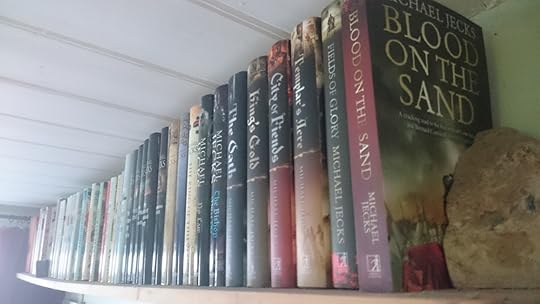
Look at that lovely row of Jecks titles!
Tagged: author, books, ebooks, ISBN, lifesaver, loans, PLR, public lending right, SBN


