Ray DelVecchio's Blog, page 5
October 10, 2020


September 17, 2020
September 14, 2020
How Much Money Can You Make Freelancing with Web Design?
Recurring vs. One-Time
Long-Term vs. Fast Results
Stay Small & Adapt
Learn with Client Projects
15 Tools to Start Your Web Design Business!
Web design is a crowded market nowadays, but as a freelancer, you’re not competing with the $10 million agencies. The same goes for the big DIY website builders.
All you’re trying to do is create a small business with website mastery to achieve a lifestyle where you enjoy your craft and have a stable working relationship with your clients.
The internet often creates a monopoly at the top of an industry where there are only one or two massive players (i.e., Squarespace).
The overlooked part is it enables the individual to act as a large corporation because you have all the productivity tools they use at your disposal. Many are freemium subscriptions or $99/year which you can stack together to form your ideal workflow as a web designer.
Here are my thoughts on how to shift the odds of success with web design freelancing in your favor to make money consistently.
15 Tools to Start Your Web Design Business
Your information will not be shared or sold, period.
Scarcity Mindset

The first hurdle you have to overcome to start freelancing is mastering your mindset. When you make zero money on your own, you think it’s hard to find people to pay you.
Now that’s partially true because you have to find the right match for your skills.
However, we underestimate the volume of commerce and transactions that are happening all around us every day.
Not to mention all the under the table cash transactions and bartering among local neighbors.
You tend to think that whatever skills you possess are commonplace in the market and, therefore, a commodity.
There are people already providing the solution, so why would somebody choose me?
If there’s one massive piece of knowledge that I’ve learned over the years of doing business, your skill level doesn’t matter nearly as much as the trust you have with the person on the other end of the transaction.
The first way this translates to you is through your network. Chances are even though there are numerous web design providers ready and willing to work for a small business, your local connection will entice them to give you a shot.
They’d rather be with someone who’s able to meet or jump on a call before partnering with a company that shuttles them to a generic customer service rep.
Businesses care less about discovering the best option and more about mitigating significant risks.
Then, outside of your network, you can separate yourself by becoming an expert in one specific web design area. The industry is so broad that if you try going after everything, you’re not going to be an expert anywhere.
Recurring vs. One-Time

One of the giant leaps that I made, which turned into one of the best decisions, was switching from one-time project work to fully managing everything for a monthly fee.
This business model made everything so clear.
My income became much steadier, and clients were happier because we were talking more.
Selling got more comfortable after I created monthly packages instead of wondering if a custom quote was high enough.
I wasn’t as worried about the legal side because they could cancel any time instead of avoiding pay on a large contract (which happened to me twice).
When you go all-in, you start the compound interest effect that comes with recurring income.
As time goes on, you develop new skills, and new tools come out that make your job easier.
That’s when you change up your monthly package offers to upsell your current clients, and that takes you off the hamster wheel of always needing to find new people to sustain your business.
Long-Term vs. Fast Results

How much money you can make with web design freelancing is often framed through the context of the short term future. You’ve probably seen a slogan like go from zero to $100,000 in six months (or sooner) and question whether it’s possible.
I’m here to tell you two things, yes it’s possible, but you have to be a hard salesman to reach those numbers, and I’m guessing 95% of the people who are reading this aren’t in that bucket.
The problem with following advice like this is when you don’t come close to that goal, you become dejected and give up after six months.
The better path is to pick a skill and give yourself at least 2-3 years to generate momentum freelancing.
Do you think you can get five clients in two years paying you between $100 – $500/month?
Seems incredibly reasonable to anybody who has a little skill with web design.
That’s how I earned over $20,000 from two separate clients over many years. I don’t think either has written a check to me for more than $500.
Monthly recurring revenue is so powerful to your freelancing business when you prioritize long-term relationships!
Stay Small & Adapt

One thing I can’t handle as an introvert is too much daily interaction with other humans.
It has put a limit on my earning potential since I have no interest in growing an agency. I’ve always seen myself as a solopreneur with a long-term vision of never having a team bigger than five people.
I’ve seen enough stories of million-dollar businesses that have a small team enabled by all of the advances in technology that we’ve had since the internet age has arrived.
I also see workaholics who believe a fulfilling life is 14 hours of staying busy. That’s not me.
I need to separate from both people and tech and spend time in nature every day to stay sane.
So in this regard, your primary limitation is how efficient you are with your processes, tools, and communication.
My best work is after I shut off my phone and sit down with a few ideas. That’s how I figured out the processes and tools I now use to build a client website.
When you have three or more client websites, you often need that time to keep everything maintainable and build a little organization around the mess of launching a client project.
The same goes for unnecessary features on your websites. They add complexity that requires fixing and time wrangling with tech or design instead of higher-level goals like marketing and branding.
I am a minimalist, so I often use rounds of updates to delete plug-ins, simplify code, and eliminate unnecessary graphics. I’m looking to improve anything that will make my future maintenance work more manageable, or even nonexistent.
Making recurring income requires a certain amount of overhead in staying in touch with clients and working with them to push their online business forward.
In my experience, this isn’t a massive time investment like some people think. Sending a monthly report and getting on a phone call every three months is good enough. You can review analytics and discuss ideas to implement in the future.
If you are more of an extrovert, you’ll do a better job all around when it comes to selling and building a team to handle an influx of new work.
Learn with Client Projects

You aren’t going to live off one skill like web design for the rest of your life.
Use client work to boost your knowledge in areas you’re not as experienced, and climb the ladder of success through freelancing.
There are plenty of potential outcomes from running a successful one-person operation, building a marketing agency, or launching your own business in another area altogether.
The worst outcome is you continue to think about it or give up after 3-6 months, resigning yourself to be an employee forever. If you stick through the hard times and keep moving forward, the universe has a way of rewarding you for the perseverance.
15 Tools to Start Your Business
The post How Much Money Can You Make Freelancing with Web Design? appeared first on Website Profit Course.
Web Design Freelancing: How Much Money Can You Make?
Recurring vs. One-Time
Long-Term vs. Fast Results
Stay Small & Adapt
Learn with Client Projects
15 Tools to Start Your Web Design Business!
Web design is a crowded market nowadays, but as a freelancer, you’re not competing with the $10 million agencies. The same goes for the big DIY website builders.
All you’re trying to do is create a small business with website mastery to achieve a lifestyle where you enjoy your craft and have a stable working relationship with your clients.
The internet often creates a monopoly at the top of an industry where there are only one or two massive players (i.e., Squarespace).
The overlooked part is it enables the individual to act as a large corporation because you have all the productivity tools they use at your disposal. Many are freemium subscriptions or $99/year which you can stack together to form your ideal workflow as a web designer.
Here are my thoughts on how to shift the odds of success with web design freelancing in your favor to make money consistently.
15 Tools to Start Your Web Design Business
Your information will not be shared or sold, period.
Scarcity Mindset
The first hurdle you have to overcome to start freelancing is mastering your mindset. When you make zero money on your own, you think it’s hard to find people to pay you.
Now that’s partially true because you have to find the right match for your skills.
However, we underestimate the volume of commerce and transactions that are happening all around us every day.
Not to mention all the under the table cash transactions and bartering among local neighbors.
You tend to think that whatever skills you possess are commonplace in the market and, therefore, a commodity.
There are people already providing the solution, so why would somebody choose me?
If there’s one massive piece of knowledge that I’ve learned over the years of doing business, your skill level doesn’t matter nearly as much as the trust you have with the person on the other end of the transaction.
The first way this translates to you is through your network. Chances are even though there are numerous web design providers ready and willing to work for a small business, your local connection will entice them to give you a shot.
They’d rather be with someone who’s able to meet or jump on a call before partnering with a company that shuttles them to a generic customer service rep.
Businesses care less about discovering the best option and more about mitigating significant risks.
Then, outside of your network, you can separate yourself by becoming an expert in one specific web design area. The industry is so broad that if you try going after everything, you’re not going to be an expert anywhere.
Recurring vs. One-Time
One of the giant leaps that I made, which turned into one of the best decisions, was switching from one-time project work to fully managing everything for a monthly fee.
This business model made everything so clear.
My income became much steadier, and clients were happier because we were talking more.
Selling got more comfortable after I created monthly packages instead of wondering if a custom quote was high enough.
I wasn’t as worried about the legal side because they could cancel any time instead of avoiding pay on a large contract (which happened to me twice).
When you go all-in, you start the compound interest effect that comes with recurring income.
As time goes on, you develop new skills, and new tools come out that make your job easier.
That’s when you change up your monthly package offers to upsell your current clients, and that takes you off the hamster wheel of always needing to find new people to sustain your business.
Long-Term vs. Fast Results
How much money you can make with web design freelancing is often framed through the context of the short term future. You’ve probably seen a slogan like go from zero to $100,000 in six months (or sooner) and question whether it’s possible.
I’m here to tell you two things, yes it’s possible, but you have to be a hard salesman to reach those numbers, and I’m guessing 95% of the people who are reading this aren’t in that bucket.
The problem with following advice like this is when you don’t come close to that goal, you become dejected and give up after six months.
The better path is to pick a skill and give yourself at least 2-3 years to generate momentum freelancing.
Do you think you can get five clients in two years paying you between $100 – $500/month?
Seems incredibly reasonable to anybody who has a little skill with web design.
That’s how I earned over $20,000 from two separate clients over many years. I don’t think either has written a check to me for more than $500.
Monthly recurring revenue is so powerful to your freelancing business when you prioritize long-term relationships!
Stay Small & Adapt
One thing I can’t handle as an introvert is too much daily interaction with other humans.
It has put a limit on my earning potential since I have no interest in growing an agency. I’ve always seen myself as a solopreneur with a long-term vision of never having a team bigger than five people.
I’ve seen enough stories of million-dollar businesses that have a small team enabled by all of the advances in technology that we’ve had since the internet age has arrived.
I also see workaholics who believe a fulfilling life is 14 hours of staying busy. That’s not me.
I need to separate from both people and tech and spend time in nature every day to stay sane.
So in this regard, your primary limitation is how efficient you are with your processes, tools, and communication.
My best work is after I shut off my phone and sit down with a few ideas. That’s how I figured out the processes and tools I now use to build a client website.
When you have three or more client websites, you often need that time to keep everything maintainable and build a little organization around the mess of launching a client project.
The same goes for unnecessary features on your websites. They add complexity that requires fixing and time wrangling with tech or design instead of higher-level goals like marketing and branding.
I am a minimalist, so I often use rounds of updates to delete plug-ins, simplify code, and eliminate unnecessary graphics. I’m looking to improve anything that will make my future maintenance work more manageable, or even nonexistent.
Making recurring income requires a certain amount of overhead in staying in touch with clients and working with them to push their online business forward.
In my experience, this isn’t a massive time investment like some people think. Sending a monthly report and getting on a phone call every three months is good enough. You can review analytics and discuss ideas to implement in the future.
If you are more of an extrovert, you’ll do a better job all around when it comes to selling and building a team to handle an influx of new work.
Learn with Client Projects
You aren’t going to live off one skill like web design for the rest of your life.
Use client work to boost your knowledge in areas you’re not as experienced, and climb the ladder of success through freelancing.
There are plenty of potential outcomes from running a successful one-person operation, building a marketing agency, or launching your own business in another area altogether.
The worst outcome is you continue to think about it or give up after 3-6 months, resigning yourself to be an employee forever. If you stick through the hard times and keep moving forward, the universe has a way of rewarding you for the perseverance.
15 Tools to Start Your Business
The post Web Design Freelancing: How Much Money Can You Make? appeared first on Website Profit Course.
July 21, 2020

June 24, 2020
What’s Your Learning Method: “Just in Time” or “Just in Case”?

Success often takes longer than it should when you look back at the years. I believe the reason why is directly related to this idea of “just in time” vs. “just in case” information.
I heard an internet mentor articulate this in a podcast recently, and it immediately resonated with how I acted at the beginning stages of building a business.
Let’s create a hypothetical situation and apply both methods of learning.
You are learning how to make websites
You are starting to get comfortable
You begin to think, “I bet someone will pay me to help them”
Then reality hits.
How do you find these people? What if they ask for something I’ve never done? How am I going to charge? What if there is a dispute during the process?
As questions arise, your instinct is to default to “just in case” information. So you research and research for every possible scenario. You continue to tinker with WordPress on your site. Maybe you start to learn code. You buy a design program. You watch more free tutorials.
Before you know it, 6 months are gone.
Are you any closer to your goal of making money from home?
The alternative is only seeking “just in time” information. Spend all your effort learning how to find ONE client to work with on their website. The cost is irrelevant until you have a conversation with this person. The tech requirements are unknown until you discuss it with them. They may not care about striking design; simple & functional is likely good enough.
The point here is all beginners worry about minor details they don’t know. And they use that lack of knowledge as an excuse to delay action.
Successful entrepreneurs find real people who experience real problems and only focus on those, not problems they think might happen.
The post What’s Your Learning Method: “Just in Time” or “Just in Case”? appeared first on Website Profit Course.
June 22, 2020
Read this Conversation with a Client About Past-Due Payments

I am in the middle of a classic freelancer-client issue right now.
No, it’s not about the work, it’s about paying on time!
The quick backstory is I built a WordPress website for this remodeling contractor at the end of 2015. Since then, we’ve renegotiated the monthly charge several times. He wasn’t getting results, mainly because during that period, he didn’t provide any new job photos or information to add to his website.
I felt guilty, knowing that he didn’t utilize the full value of what he was paying.
However, my feelings changed this year after he got a new credit card. Automatic payments stopped. Wouldn’t you know, he didn’t seem to be in any rush to respond to my emails or calls.
After about 4-6 weeks, he finally got in touch:
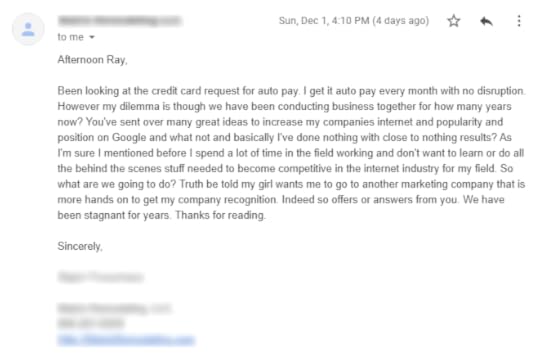
This guy is admitting to not putting in the effort on his end and not listening to my advice. And yet, he’s wondering why the results haven’t come.
As you’ll see in my response below, I have given him a simple framework for better results. We’ve had this same conversation at least 4-5x, yet nothing has come of it.
At this point in my life, I’m not chasing every dollar. I am OK with this guy moving on because the headache is beginning to outweigh the income.
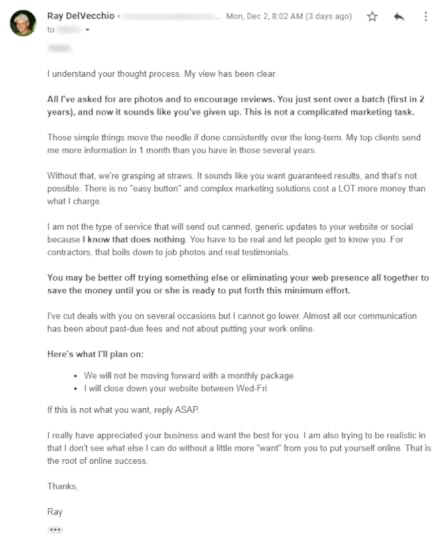
Once I laid out my thoughts (again) and gave him an ultimatum on shutting down his website, his view suddenly changed.
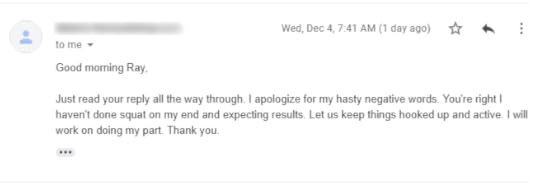
You’re probably wondering, are we squared up?
The answer is no. He is once again dodging me. He will get a final due date this week or else I’m cutting him loose regardless of whether he wants it or not. It’s a gut call. I don’t see this guy consistently sending me job photos or telling his customers to review him online.
The bottom line, dealing with clients is not always smooth. There is so much nuance in every situation.
However, is dealing with co-workers or a boss any better or easier?
You’ll only learn about business when you get real 1-on-1 experience working on someone else’s website project – so go find that person!
The post Read this Conversation with a Client About Past-Due Payments appeared first on Website Profit Course.
June 17, 2020
The Standard Pace is for Chumps

I love podcasts. My favorites are interviews with people who’ve created a business via the internet.
It feels like every podcast gives me “aha” moments and a different way to look at things.
One that sticks out is a conversation with Derek Sivers, an entrepreneur who created the website CDBaby.com, which he later sold for $22 million! CDBaby is a distributor for independent music creators.
One quote resonated with me.
He found a college professor to be his music mentor who encouraged him to graduate faster (2 years) because he saw the potential.
His advice was: “The standard pace is for chumps.”
The explanation is the speed high schools & colleges teach must be OK for the slowest learners in the class. Higher education doesn’t cater to high achievers.
He applied this philosophy after graduating to build his business.
Translating this to my own life, being passionate about a specific subject like WordPress websites means that you’ll learn faster than the average person. If you have that spark, you must go “all-in” to give yourself a fair shot.
15 Tools to Start Your Business
The post The Standard Pace is for Chumps appeared first on Website Profit Course.
June 15, 2020
The 4 Phases of Acquiring a New Skill (like WordPress)
Gaining experience in a new topic takes a while. That’s natural since humans absorb information at different rates. Not to mention, some people are visual learners, some prefer books, while others like personal guidance.
But how often is a delay in progress our fault?
Acquiring a skill can be broken down into four phases:
1) Learning – How to use WordPress
2) Planning – Idea for your business or blog
3) Overthinking – Are you good enough?
4) Doing – Acting on your plan with deliverables
The average person’s course over time might look something like this:

When you get stuck at 3, you revert to 1 & 2.
I know that was my path when I first learned HTML & WordPress. I spent days and weeks digging into code. I’d try to come up with the most efficient process to build a new website, as though I had ten clients – when I had none!
I didn’t have the confidence that I could deliver on a project for a client. Looking back, I know that mindset was wrong.
I didn’t start freelancing soon enough, to get the real-world experience, not just the hard web skills.
Here’s a better design for a successful campaign:

The main benefits of this approach are:
You work with another person
You get feedback first
You gather more data
You have a faster pace
You’re proactive vs. reactive
The only thing that builds your wisdom is producing something tangible with your skills.
Most web designers feel the need to take on any job that comes their way because they don’t look for work. The better approach is to seek opportunities actively and operate from a strategy that compounds each month.
The post The 4 Phases of Acquiring a New Skill (like WordPress) appeared first on Website Profit Course.
June 10, 2020
The #1 Thing You Need to Build a Successful Freelancing Business

Everyone gets intimidated when thinking about starting a business or personal project.
Just the other day, I had a conversation with a friend who has talked about creating a music blog for years. He was giving me idea after idea for potential topics.
He’s done plenty of freelance writing work elsewhere.
Then he admitted it…
“It’s a lot harder dedicating time to my projects when they don’t produce immediate income.”
He hit the nail on the head, and that was a massive block for me at the beginning. Success doesn’t require a brilliant mind.
What you need is an OK idea, a leap of faith, and speed-of-action.
How many times have you decided to learn a new code language or design technique instead of seeking new opportunities with your current skill set?
You can be successful beyond what you currently believe if you are moderately competent.
The sad reality is 98% of the population won’t make an attempt. The excellent business ideas will remain locked in their heads.
I hope that isn’t you.
Your chances of success will increase dramatically if you follow a fundamental strategy that I lay out for you below:
The post The #1 Thing You Need to Build a Successful Freelancing Business appeared first on Website Profit Course.