
Christopher Steiner's Blog, page 4
March 23, 2016
Pioneer Changes Skiing Again, This Time In Alaska
Avid skiers experience dozens of trips and hundreds of days on the snow during the course of their lives. The better days present themselves rather obviously: 12 inches on a Tuesday at Jackson Hole, 15 inches on a March day in Telluride or three feet at Alta, with the roads closed, all that powder and just a few skiers. But it’s hard for any skier to exclaim, even after skiing deep snow all day with few people and zero tracks, that any single day was the best day. Skiers are optimists, and optimists, by nature, operate with the understanding that something even better might await them on the next ski trip.
Skiing in Alaska, however, challenges these instincts. It’s hard to finish a bluebird day of skiing 2,000-foot, 50-degree slopes caked with maritime powder, the ocean still in sight, and not acknowledge: that just may have been the best day of skiing I’ll ever experience. That kind feeling doesn’t normally overwhelm a skier after a day in British Columbia.
Skiing Alaska—in particular, with a helicopter—has become the ultimate trophy pelt for skiers. The mountains are bigger, the terrain is steeper and the snow comes in such quantities that it’s incomparable with any other place that’s regularly skied by humans. One-thousand inches of snow, a seemingly impossible total for most mountain ranges, falls with regularity across many peaks in Alaska. The mountains here look like something Disney animators might have conjured in the 1930s: giant spires of purple and pure white, rising 6,000-feet straight from an ocean that at once seems out of place and perfectly natural. It’s a task simply to take in this fairy tale with the eyes. But as you kneel in the snow next to the retreating treads of a whumping helicopter, these mountains’ steep faces become very real—and even seasoned experts can become very timid.

The spines of Alaska offer a unique skiing experience. Skier: Christopher Steiner, Courtesy: Silverton Mountain Guides, Scott DW Smith
It’s this experience that has led to more and more heliskiing operations opening up in the 49th state. A movement that began with Doug Coombs and Dean Cummings, the latter of whom has been mining the slopes of Alaska with his H20 Guides for 21 years, has grown to the point where there are now at least 10 companies who offer to get skiers to AK snow via chopper. But it’s a relative newcomer to this scene who has been challenging the tried and true methods of Alaskan heliskiing operations.
That man is Aaron Brill, who, with his wife Jen, own Silverton Mountain Guides. Their Alaska operation draws its name from Silverton Mountain in Colorado, the Brills’ original foray into the skiing world, which they still operate.
Brill at this point has developed something of a history in tweaking ski industry paradigms. I happened to witness his unconventional approach first-hand during the planning stages for Silverton Mountain, more than 15 years ago.
At the time, I was 22 years old, a newly-hired engineer at a Park City, Utah planning and development company that specialized in ski resorts. One day a set of plans came in that detailed a proposal for constructing a ski lift up to a jagged ridge in the San Juan mountain range in Southwest Colorado. At the office, we analyzed the surrounding terrain for avalanche risk—it was high—and eyeballed the owner’s mining claim on which the whole proposal was built. The experienced engineers and developers in the office gave the project no chance of ever being approved or implemented. Our planners weren’t even sure if a mining claim could be used in such a way, for a ski mountain. Brill didn’t see a problem, however, and in the end, neither did the Federal Bureau of Land Management, which signed off a year later on the plans, and gave Brill permission to install an old lift , purchased from Mammoth Mountain, to the ridge line.
With that, Silverton became, and remains, the only ski resort on BLM land in the lower 48 states. Since then the place has become a fabled pilgrimage for ski purists from across the planet. So perhaps it’s unsurprising that the guy who took a near-worthless mining claim and turned it into legend has also taken a novel approach to skiing Alaska.
Brill’s non-standard methods to getting Silverton off the ground and operating on public lands traces to some of his libertarian sensibilities—if it’s there, why not ski it? So when it comes to permitting for skiing on state and federal lands, Brill sees the red tape and grumbles about it, just like everybody else, but he also sees the opportunity upon which he’s built his business. That approach has helped him quietly become the largest holder of permitted heliskiing acreage in Alaska, with more than 20 million acres, about the size of Maine.
“In Alaska,” Brill says, “it’s not easy to get a permit, but compared with the lower 48 it’s more straight-forward. And once you have it in Alaska, they don’t bother you.”
Brill brings a number of different tacts to the Alaska heliskiing ecosystem, but perhaps his most interesting tweak—and intuitively logical—is his willingness to move his base and his clients around within the largest state in the union, even during the same season. The snow and snowpack in Alaska can vary greatly, even within particular slices of the Chugach range. Regions that may have produced a steady stream of big storms and clear days one month can be socked in with clouds and possess less snow the next. Precipitation, fog and visibility problems generally are the biggest issues when heliskiing in Alaska, as the Chugach’s prolific snowfall usually keeps the mountains’ ski surfaces relatively fresh and soft. But weather systems can move in and not leave for days, as the nearby Pacific is a ready generator of low-level evaporation that can keep cloud banks tight to the coastal ranges.

Skiers prepare for a steep Alaska descent in January 2016, Silverton’s heli perched on the ridge. Photo: Christopher Steiner
It is possible to travel to Alaska for a week-long heli trip and not board the helicopter even once. It’s happened to me, in fact. That’s something that’s largely out of the operator’s control, but Brill alters the equation by maintaining more than one base. Silverton Mountain Guides, the Alaskan arm of Brill’s business, has a main base in the northern Chugach at Knik River Lodge, the place it calls home during the heart of the Alaskan season in March and April. This kind of setup is standard for an Alaska heli operator. But if the skiing in the northern Chugach goes sideways because of bad snow, lack of snow, or prolonged visibility issues, Brill has nine other lodges with whom he has formed agreements where he can move his operations if needed.
The winter of 2010, for instance, proved to be one of the least fruitful ever for Alaska-bound skiers. Winds in the Chugach regularly topped 100 m.p.h. for more than a month straight. It made flying helicopters impossible on many days. H2O Guides saw one of its helicopters destroyed by wind as it sat on the ramp at the airport. Even when the conditions calmed and skiers could get out, the snowpack had been so ravaged by winds that the skiing proved unenjoyable and even dangerous in many cases because of the the variable wind crust that had formed across much of the Chugach.
Brill simply moved his whole operations that winter to Juneau, about 500 miles southeast of Anchorage, where wind hadn’t affected the inland mountains and snowfields. There’s a cost in moving, one that Brill asks his clients to share. He pitches them on the pros, cons and the costs, and lets them decide. “When presented with an option of not skiing, or skiing hard windslab vs pow, people choose pow and moving,” he says.


December 8, 2015
The Right Way To Build A Tech City
Startups should know what differentiates their product from others. Building around an unique strength, a facet that’s difficult to emulate, offers small companies a chance to gain critical mass. New companies should focus on a strength and own one particular piece of their market. Startups that fail to do this can quickly become commodities.
The same can be said for cities and regions looking to make themselves into destinations for tech. Simply trying to emulate the Bay Area and its vast net of tech-related disciplines makes for an impossible task. As I wrote about Chicago and its tech ecosystem recently, there’s more to getting true traction than simply giving startups places to work. Just as a startup needs to do one thing exceedingly well before it tackles other missions, cities should take the same tack and concentrate on one sector of tech to make their own.
I recently was in St. Louis and, while there, I talked to some of its VCs, startups and people who run its incubator and accelerator spaces. Just like anywhere, there exist startups doing all sorts of things in the St. Louis area, but many of the most interesting companies have coalesced around the bioscience space. This isn’t by chance. The city’s tech players have seized on some of the area’s inherent strengths in healthcare and biotech. Washington University, which has one of the top medical schools in the country, is constantly throwing off ideas and graduates who have new ideas in the space. DuPont’s bioscience arm is based here, as is Monsanto, the king of engineered macro-crops. And perhaps most important in all of this, St. Louis was the site of a major set of layoffs by Pfizer in 2010.

St. Louis’ Biogenerator Labs and accelerator. Courtesy: Biogenerator.
While the prospect of one of the leading pharma companies in the world cutting 600 well-paying jobs—those belonging to Ph.D.s and researchers—might seem dismal, it proved to be a fire-starter for St. Louis. It’s rare that so much ready talent gets dumped into a single job market at once. Eric Gulve, the president of Biogenerator, a unique incubator focused on biotech in St. Louis, saw opportunity and hazard in Pfizer’s layoffs.
The hazard: If the St. Louis community couldn’t find jobs for these people, they would be forced to leave the area, depriving the metro of elite brains that Midwestern cities like St. Louis can sometimes struggle to attract. The opportunity, as Gulve saw it: “These people had been in biotech for years and had great ideas, far better than first-time entrepreneurs coming from outside the industry.”
Gulve asked Pfizer if, before the last day of work, he could come in and present to employees about what working a startup is like and what the landscape was like for funding and founders. Pfizer, which wanted to find new roles for its employees as much as Gulve did, said yes. Gulve came in and gave his presentation to Pfizer employees on-site, and then took five in-person meetings the same day. Biogenerator ended up funding four groups from those meetings, one of which turned into Confluence Life Sciences, which now employs 35 in St. Louis.
At the same time, Gulve was hustling to complete a new building and set of labs for Biogenerator. He wanted it ready to catch some fo the fallout of the Pfizer layoffs. A pilot set of labs opened in the fall of 2010, just a few months after Pfizer made its cuts. The 5,600-square-feet of space was filled within 18 months. Biogenerator used that success to raise a total of $145 million and fund 54 companies that have attracted another $250 million in outside capital. The incubator has also added another 12,400 square feet of lab space.
“If you have layoffs in a city and you don’t have this kind of infrastructure in place, you’re not able to take advantage,” explains David Smoller, a partner at St. Louis’ Cultivation Capital who holds a Ph.D. in molecular biology and has been part of several biotech exits. “A lot of the best intellect in the area is now at these biotech startups.”
The lab space is free for Biogenerator companies—and many of them stay there for years after their initial funding, even after finding traction and hiring a significant number of employees. Lab equipment—stuff like mass spectrometers and automated robotic arms for preparing large numbers of samples—is expensive. Small companies can’t afford to finance a lab all their own—but they also don’t need the lab every hour of the day. This allows several startups to easily share the same lab equipment. It’s a unique infrastructure for rearing biotech companies for which St. Louis has found a niche.
November 23, 2015
Cities Seeking Tech Success Need Cooperation From Local Big Companies
Earlier, I wrote about the challenges facing Chicago—or any other city outside of the Bay Area—when trying to become a place where tech has a critical mass of innovative companies and people. It’s process that takes decades; it took Silicon Valley/San Francisco that long. It’s incorrect to think that other places, with fewer natural advantages, can hack this natural evolution.
St. Louis has put an impressive amount of effort toward cultivating a tech scene in a town that, to outsiders, would seem an unlikely place for it. One example of an early success that I recently wrote about is Better Weekdays, a kind of CRM for universities seeking to track their alumni and where they’re employed.
St. Louis, unlike Chicago, is a small enough place that big companies and small companies tend to strike up relationships with less friction than in larger cities. “One of the things I hear continually from entrepreneurs who move here is about how accessible the CEOs of big companies are here,” says Jason Hall, vice president of entrepreneurship for the St. Louis Regional Chamber.
When I was in St. Louis several weeks ago, I attended an event called CEO2CEO, where a large company CEO and a startup CEO engage in an unscripted conversation for about 40 minutes. The audience can lob in questions, and a moderator keeps things snappy.
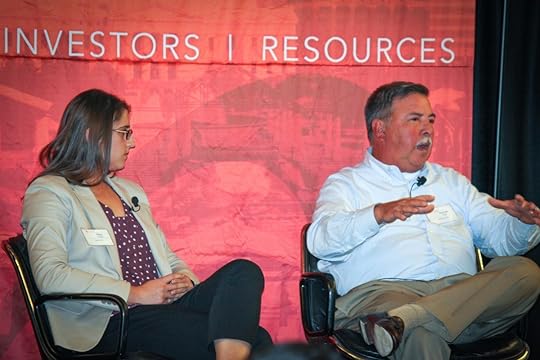
CEOs Abby Cohen and George Paz talk it out. Credit: Accelerate St. Louis
The CEOs in this instance were Abby Cohen from Sparo Labs and George Paz from Express Scripts. Sparo is a startup focused on delivering personalized solutions for Asthma patients, while Express Scripts is a multi-disciplined company in the healthcare space, with programs ranging from prescription delivery to employer pharmacy benefit management.
The two companies are far apart in their life cycles. Sparo recently raised $52,000 through direct-to-consumer campaigns on Indiegogo for its products that can warn asthma sufferers of attacks before they start. Express Scripts is a public company with a $58 billion market cap and George Paz has averaged more than $11 million in annual compensation during the last five years.
But the two found chemistry in their conversation. Cohen stated her company’s mission and challenge succinctly at one point: “How can you take these behaviors that the tech industry has made a science out of and apply them to the healthcare space?”
November 17, 2015
The Top 10 Ski Resorts In North America For 2016
[dam_gallery]
Does skiing change year to year? Of course it does. So, too, do the best ski resort rankings in the world. We’ve again worked most of the summer and fall to add information, statistics, formulas, programming, inputs and outputs to make our ski resort rankings even better. As always, the arbiter of the rankings is an algorithm that measures the one thing that matters most: awesomeness.
If you haven’t been here before, then you don’t know about PAF. A quick explanation: In the name of awesomeness, our algorithm assigns every ski resort a Pure Awesomeness Factor. This PAF decides what ski resorts gain entry to the hallowed Forbes Top 10 Ski Resorts. These resorts have reached for the mantle of awesomeness and found it. Recognize their feat, and bestow upon them the greatest honor you can: ski them hard.
There seem to exist many ski resort rankings these days, but, just like with resorts, there is only one set of ski resort rankings whose PAF dominates all others. During the past year, we’ve improved our datasets, broadened the factors we examine, and performed more in-person reporting with even more qualified people. For this season, we considered the best 220 North American resorts whose data and numbers were crunched by ZRankings. As always, the full rankings for all 220 ski mountains outside these Top 10 can be seen at ZRankings’s best ski resorts.
Our algorithm digests more than 30 categories of data for each ski resort, including inputs from our group of well-traveled experts. When it comes to snowfall, we recognize that not all snowflakes are created equal; some are wet, some are dry, some are mercurial, some are rarely seen. Tony Crocker has once again helped us parse the resorts for poor, good and great snowfall quantities and qualities. We not only consider the kind of snow that falls at a resort, we dissect how well the resort preserves that snow. Resorts with high altitudes and a large percentage of north-facing slopes do better, for instance, especially in the spring, when the sun’s angle becomes less oblique and the days warmer. Complete ski resort snow rankings and snow data for all 220 resorts, in their full ski nerd splendor, with as many geeky stats as can be consumed about ski resort snow, can be found here.
We believe our PAF ratings to be the best barometer of skiing awesomeness available. It is true, however, that every skier is different, and every skier places different priorities on each trip they take. One trip may be for charging hard, skiing steeps and logging vertical, while another might be with the family with a focus on travel ease and ski town ambience. Everybody has a different Pure Awesomeness Factor. To that end, we now allow people to place their own weights on the things that are most important to their trip. We call it the Perfect Resort Finder. See what it recommends for you.
This past off-season brought a lot of change to the ski resort industry. For this coming season, Canyons and Park City have merged into the largest ski resort in the United States, with terrain that will stretch from for five miles from the north edge of what was Canyons to the Town Lift at the south edge of Park City Mountain Resort. The new uber resort, which has taken the Park City name, encompasses 7,300 acres. As a former Park City resident, I find this development to be particularly ripe with narratives. What skiers need to know most is that it’s possible to ski Devil’s Friend—the finest bump run in Utah—and to drink a beer at O’Shucks on Park City’s Main Street with only the assistance of a chairlift and your own ski-booted feet.
Subscribe Now: Forbes Entrepreneurs Newsletter
All the trials and triumphs of building a business – delivered to your inbox.
There are more additions and changes at many resorts, including Jackson Hole (a brand new lift, two years in the making), Purgatory (another new lift), and the Yellowstone Club (yet another recipe for apres Manhattans). Ramping up summertime activities continues to be a focus for operations-minded resorts—Vail Resorts has been leading the way here. And despite many new challengers, Deer Valley‘s turkey chili remains the best on-mountain food.
On the subject of jackets: we again have produced the Forbes Top 5 Winter Gear list. Every year we select a small coterie of gear products that move their space ahead with innovation. This year, we have a new kind of entrant: true technology—code, people!—in the form of a mobile and web application that will help save lives in the backcountry. See the best gear for 2016 here.
There are new jackets, gear and new chairlifts every winter, of course, but it’s not every winter that we so desperately seek to emerge from the wreckage of the previous season. Skiers everywhere are demanding so much from the coming winter of 2016: more snow, more cold, more high-speed Doppelmayers, more everything. The winter of 2014-2015 left the entire ski establishment feeling hollow. With low snowfalls, especially on the West Coast, and near-record high temperatures across much of the West for most of the winter, there were no resorts that enjoyed a big year. ZRankings dubbed last season the worst winter ever. Mr. Crocker of Bestsnow.net, whose statistics on such things run back decades, says that 2014-2015 was the second worst winter for skiing behind 1976-1977.
And we grant you that the East had a good winter last year. But for these ultimate rankings we primarily discuss the destination resorts of the West, as even a bad year in Utah’s Wasatch will nearly always trump a good year in New England.
Skiers are like Cubs fans, however, and hope always leads us to dream of big dumps just around the corner. Reasons for optimism regarding the coming winter abound. The first thing to consider was that last winter’s poor conditions were far outside the standard deviation of weather patterns for the West. Last year’s weather has little to zero bearing on what will occur this winter. As Meteorologist Joel Gratz of OpenSnow said to us, “The major influence on western snowfall last season was the persistent ridge of high pressure over the northeast Pacific Ocean, near Washington State and British Columbia.” Gratz added that the phenomenon can’t be directly tied to any kind of global climate change. It was plain bad luck.
More important than all of that science and statistical melarkey, however: our old friend, El Nino, is back. He’s supposedly stronger than he’s ever been. Resorts have seized upon this mythical warm-water effect in the Pacific and knitted it straight into their marketing. Nearly every resort in the Sierra, some of which received less than 100 inches of snow last year, are touting El Nino’s coming effects. Even Colorado resorts, like Winter Park and Aspen Snowmass, are trumpeting El Nino. If you watch the social and advertising activity of the resorts—and we do—it seems as if El Nino has guaranteed a monster winter.
Early results, in fact, seem to bear this theory out. Snowfall has been strong out west so far. Many resorts—Whistler-Blackcomb (insanely prolific snowfall thus far), Vail, Steamboat, Taos—look more like their early January selves right now than their mid-November analogues. Bookings are up everywhere in the ski world, especially at Park City, says Dan Sherman, vice president of marketing at travel agency Ski.com. The new gondola and the vastness of the newly combined resort has put Park City high on people’s lists.
With that, we will stop dithering and do as we hope El Nino does: bring it. Here are The Top 10 Ski Resorts for 2016:
Jackson Hole, a perennial favorite of the PAF algorithm, celebrates its 50th anniversary this year by adding a lift that will grant easier access to its top ridge on the north end of the resort—and its high backcountry gate into Granite Canyon. Some people love this, some hate it. We will see how things turn out and report back. What’s not debatable, however, is that this lift opens up more continuous vertical for skiers who might prefer to stay off of Jackson Hole’s aerial tram (also known as the best lift in skiing).
There’s no inviting way down from the top of the tram for people who prefer predictable, groomed slopes. So this new lift, which will access all kinds of terrain, including the fabled Crags as well as a blue run, named, if you can believe it, Crags, is another cog in the successful effort to expand blue terrain at Jackson. The vistas off of this lift going north toward the Tetons may be tops in all of North America.
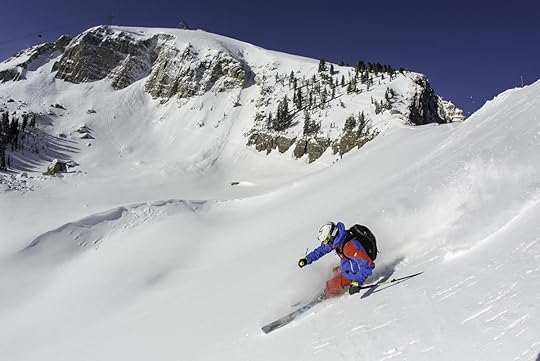
Jackson Hole: big mountain skiing. Courtesy of Jackson Hole Mountain Resort
Also new on the mountain for 2016 is the Piste Mountain Bistro, whose stylings mesh a high-end contemporary look with subtle hints of where you’re at (the No. 1 ski hill in North America). Bravo to Jackson for not serving up another banal take on logs and timbers. But we haven’t eaten there yet as it’s brand new, so we can’t comment on the fare. Another wrinkle for 2016: bring your season pass from that *other* resort (any resort) to Jackson from Jan. 11 to Jan. 31 and they’ll give you 50% off of your daily lift passes.
Last year, Jackson fared better than nearly all other areas in netting 316 inches of snow—pushing it ahead of most Colorado resorts by 100 inches, and giving it three times as much snowfall as some resorts in Tahoe. An unseasonably warm February and March in Jackson, however, meant that the mountain needed every inch of that snow to keep itself decent. El Niño typically pushes more weather south of Jackson, but the resort has had some absolute monster years during the last decade while other areas have floundered, so we’re not betting against Jackson.
We judge the terrain at Jackson Hole to be the best in North America. If you disagree, register your complaint in the comments section and we can brawl about it. Its lifts are the best, the snow is excellent and its dining and all around game continues to rise—things that are all reflected by the judgment of the PAF algorithm and its top status here.
Access to Jackson Hole continues to get better, too, further cementing its airport as one of the best in skiing, as United, American and Delta have all upped their focus on flying here. There are now 13 cities with some form of direct flight into Jackson during the ski season. American has restarted its legendary Chicago-to-Jackson route after several years of dormancy, and the airline also will begin flying a new route from Los Angeles. Delta is bringing service from JFK and United is adding more service from Newark.
The town of Jackson continues to tick up, as the eating scene is making quick work of the gap that once existed between this northwest corner of Wyoming and places like Aspen and Park City. Gavin Fine’s Fine Dining Restaurant Group has led the way, with Bin22, Q Roadhouse & Brewing Co., and, our personal favorite, The Kitchen. Get the Yunnan-style Striped Bass.
There’s even Whiskey brewed in these parts now—Wyoming Whiskey—we recommending grabbing a bottle when you’re in town (although it’s distilled closer to the Bighorn Mountains). Stash a little flask inside your Gore-Tex for that let’s-stand-around-and-act-hard moment at 4 p.m. And don’t forget for lunch to pack a Tram Bar, the best little energy package made in America that happens to derive its name from the most famous of lifts here.
We’d be remiss to not mention the brewing scene in Jackson, which has evolved to be one of the best in the Mountain West. There are only two beers you need in this world: a pilsner and a stout, and Snake River Brewing has excellent versions of both: Zonker Stout and Monarch Pilsner. Just leave some for us.
Like Snowbird, Alta and all four Aspen mountains, Jackson Hole is a member of the Mountain Collective, which gets you two lift passes at member resorts and 50% off all additional lift tickets. One of the better bargains in skiing, if not the best.
Where to eat: The Kitchen is the place you should be eating.
Where to stay: The Four Seasons at Jackson Hole – It’s impeccable in all ways, with good cheeseburgers, too.
This is the place where snow, luxury, travel ease and terrain come together in a harmony nearly unmatched anywhere else.
Much like Jackson Hole, all of Snowbird’s 3,240-foot vertical can be conquered in one lift ride via the resort’s aerial tram. And, much like Jackson, this lift does as much traveling up as it does laterally. Snowbird is a steep, relentlessly vertical place, and that’s apparent from the moment you see it from the road
Another thing that strikes skiers as they pull into Snowbird: an absence of cookie-cutter resort buildings. No faux monstrous Swiss chalets here. The banal, giant log cabin-style construction that has spread across the west isn’t on the palette at Snowbird.
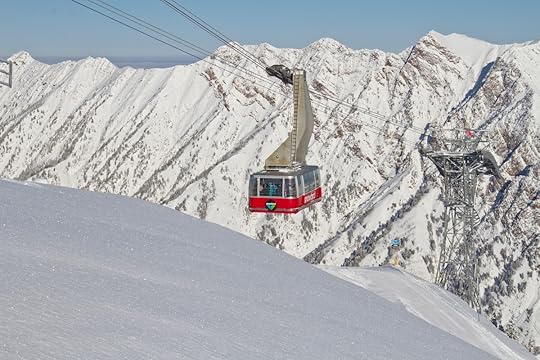
All aboard the Awesome express. Courtesy of Snowbird.
Rising up from the bottom of the resort is one of the finest hotels in skiing, the Cliff Lodge, whose rooms have been totally renovated and revamped for the upcoming season. This hotel will always be a classic, with its hulking concrete profile meeting the mass of the mountains head-on, and now it’s even better.
The upgrades are part of $35 million being spent at Snowbird on new or improved amenities for the coming season. Include that total with the $50 million that Vail Resorts is dumping into the newly merged megaresort of Park City, just over the ridge from Snowbird, and Utah has owned the industry’s greatest off-season momentum this year.
Further up the mountain, at the top of the tram, Snowbird has added a new lodge that will be amongst the most striking in skiing. The lodge, dubbed The Summit, will have views nearly 360 degrees from Snowbird’s apex, with a bare concrete construction that instantly evokes Snowbird’s base buildings, including the Cliff Lodge. No fancy logs here, thank you. Construction, which began in May 2014, should be done by Christmas. On days when it’s nice enough to be outside at 11,000 feet, there will be 10,000 square feet of outdoor seating. When it’s not nice, eaters can look outside through a wall of 7,600 square-feet of glass that encapsulates the main dining area.
The Summit will give skiers an oasis at the top of what can be a very windy peak, with a chance to warm up, power up, suit up and charge up. It will also lessen congestion at lower lodges during lunchtime on Saturdays and big travel weeks. Snowbird, long one of skiing’s royalty, has just gotten better, again.
This will be the third season of Snowbird running a cat operation out its backdoor of Mineral Basin for those who want to get into deeper snow in quiet nooks of Upper American Fork Canyon, including some areas with the fabulous monikers of Sinner’s Pass and Pagan Basin. It’ll cost you $350 for a five-hour tour, 7:30 a.m. to 12:30 p.m.—a very good rate when compared to other cat and heli operations. Obviously, you’ll be getting less vertical than with a heli trip, but the cat accesses glades and tree stands that helis typically won’t. You also get to go to Sinner’s Pass.
As always, traveling to Snowbird remains a snap. Fly into a major airport in Salt Lake City that has directs nearly everywhere, get in a car, drive for 40 minutes, done. We recommend stopping off at Loco Lizard in the Valley at some point. Get the shredded beef chimichanga, but skip the whole “smothered” thing.
Where to stay: The Cliff Lodge, of course.
Where to eat: We can’t get enough of The Aerie, sushi at the top of the Cliff.
The Top 5 Gear Pieces For Winter 2016
[dam_gallery]
Gear: everybody loves this stuff, even if they’ve little occasion, or no occasion, to ever use it. Part of the allure here is unalloyed materialism, of course, but there’s no doubt that a little piece of new bling, just one, can sweeten a season and give you a needed nudge to get out there. It doesn’t take much to motivate us; even a new beanie hat is reason enough to go outside and find something to do. A big item, like a new pair of skis, can refresh skills and restore vigor for the sport. On the other hand, many of us develop affection for pieces of gear that have been with us for many seasons. These inert objects made of petroleum and metal are no different than any of the other manufactured trinkets in our life. But our love for the outdoors, our love for sport, gives them a life and personality that a plastic spoon in your kitchen drawer can never have.
The number of gear makers and products continues to grow. Just when it seemed there couldn’t possibly be another manufacturer of three-layer jackets, another one emerges. When a Cloudveil disappears, a Stio appears. So many of these companies make fantastic stuff; the overall quality within the industry continues to rise. It’s become hard to sort through all of great gear that now exists and annually pick pieces that stand out from the others. We’ve taken our time, however, as the ZRankings crew has hit the tradeshows, talked to reps and vetted everybody’s latest stuff. The results include some familiar names, and some new ones, including a piece of software that’s so awesome that it demands inclusion in this year’s collection of Forbes Top 5 Gear for Winter (the list is seven this year, as we became undisciplined).
Subscribe Now: Forbes Entrepreneurs Newsletter
All the trials and triumphs of building a business – delivered to your inbox.
1. Arc’teryx Tantalus Jacket — $575
Gore-Tex jackets of all kinds are always awesome. They just are. Two-layer, three-layer, soft-shell, whatever—they’re awesome. Gore-Tex has gotten incredibly good at innovating and pushing its product to a new level every year. But the most bomber Gore-Tex shells tend to be stiff and rather noisy, as the stiff material can crinkle like a paper bag. The Arc’teryx Tantalus Jacket addresses some of those issues, as it takes a hybrid approach of using different gauges of Gore-Tex in different parts of the jacket. The piece’s shoulders, hood, lower back and forearms are constructed with N150p 3L Gore-Tex for super strength and abrasion resistance. The rest of the coat, including the back, body and upper arms are made with softer, quieter N70p 3L Gore-Tex with lo-loft soft shell backing, which also gives the garment warmth. It’s not unlike the Stingray, an Arc’teryx classic that started the trend of adhering lo-loft fleece like material to Gore-Tex.

The collection of awesomeness.
2. Giro Contact Goggle — $240
There have been attempts to create a goggle with a lens that is easily interchangeable. All of them have failed, until now. The Contact makes it work with some uncannily strong little magnets that effectively bolt the lens onto a substrate that well plays the role of contemporary, frameless, fancy-looking goggle. To release the lens from the goggle, Giro has built a button into the top right-side of the frame. The button pushes that edge of the lens off of the frame, disengaging the magnets. The adherence between the two units is good enough that, without the button, you may have to resort to prying the lens off with a screwdriver. And that really answers the biggest fear with this kind of product: will the lens stay on when you, me, whoever is wearing these things, inevitably biffs? We can say declaratively that any episode that separates this lens from the frame probably would have damaged any goggle. The lenses come in a variety of finishes, which is the point, of course, as they can be swapped out on the hill as the conditions go from sunny to flat. The optics are from Zeiss and provide a wide and sharp vista of terrain you’re about to shred.
3. Black Diamond Boundary 107 — $880
Black Diamond continues to stab into the apparel business, and has made some amazing pieces, but our focus here is the company’s new ski, the Boundary 107. This ski was designed with an eye toward some of the springy rockered skis that have infiltrated the market over the last several years. Why do people like them? Because they’re easy to ski. And their wide underfoot construction allows skiers to blow through all sorts of chaff and good without thinking twice about. The Boundary 107s do all of that. But they’re also light enough that they won’t weigh down those shouldering them up a boot-pack or skinning them up a ridge outside the resort. The name of the ski implies a flexibility of in-bounds and out-of-bounds skiing, and for that, the Boundary 107s deliver. Black Diamond’s engineers—and they’re a crack group, we’ve seen them in action up close—also installed some measures to dampen chatter and unruly feedback within the ski when traveling at high speeds or across the kinds of surfaces we’d all rather avoid. The sidewalls include rubber to absorb feedback from the tips and edges before it gets to the bindings and your feet and knees. Ski ‘em long, ski ‘em fast. For the 184 cm model: 138mm up front, 107 mm in the middle (hence the name) ,and 123 mm in the back.
November 12, 2015
This St. Louis Startup Helps Colleges Stay In Business
I recently wrote on some of the challenges facing Chicago in becoming a place of consequence in the tech world. The same challenges on different levels face all matters of cities across the United States, as metro areas look to tech to add vigor and jobs to their economies.
St. Louis is among this group, and, having recently visited there, I can attest to the startup culture having generated a substantial buzz in town. But just like anywhere, the leaders of this movement want their buzz and their place in tech to transcend the city’s limits. For that to happen here or anywhere, a city needs a record of success in the space, something that takes time, effort and luck. St. Louis seems to be putting a lot into that second item, as there is no doubting the effort. Now they need hits.
One candidate to fill that role is BetterWeekdays, which tackles several needs for the ever-burgeoning higher education system in the United States. The company connects the three-legged stool of college placement offices, companies with job openings, and university students and alumni who may be seeking jobs.
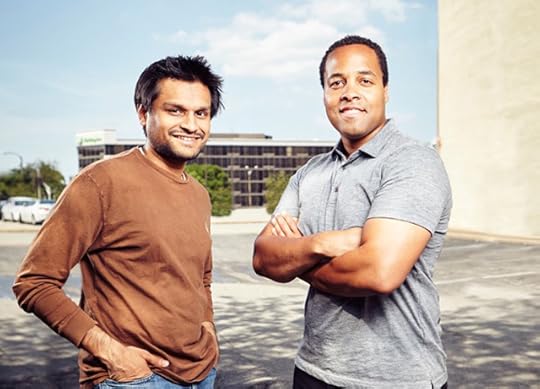
Better Weekdays cofounders, Parbadia and Motley. Credit: Wesley Law
As with other job matching platforms, employers pay a subscription ($300 to $2,500/month, depending on size) to market their jobs and target certain groups of students and graduates. If a company hires a person through the platform who possesses more than three years of experience (university alumni), Better Weekdays receives a fee equal to 10% of that person’s annual salary. In this mode, the company functions similarly to a traditional head hunter or job board.
“We’re the toll booth that every student goes through when looking for an internship or full-time job,” says CEO and cofounder Chris Motley, a former trader at Goldman Sachs.
But it’s on the universities-as-clients side where Better Weekdays stands out. Schools pay a subscription fee, usually $1 per year per student, often waived for the first year, to match students with job openings that Better Weekdays aggregates from not only its own system, but dozens of sources across the web—their system pulls in and updates more than 1 million job listings a day.
More interesting that that, however, is the emphasis that Better Weekdays has placed on a CRM it’s marketing to universities who want to keep track of their graduates and where they’re placed out of school and how these graduates’ careers progress. For this product, universities pay $1,000 a month for up to five seats. When put in the light of endowments and the increasingly crucial role that alumni contributions play for colleges, the product makes sense.
October 26, 2015
How To Fix Chicago’s Tech Industry
To be clear from the start, Chicago suffers from a strain of the same thing that affects most large metropolitan areas that, outwardly or not, lament their tech shortcomings. In short, Chicago is not the Bay Area. It doesn’t possess the inherent supply of technical and able-to-execute talent that exists in Northern California. Nowhere else does—and Chicago should hardly be wringing its hands about that fact.
The Chicago Tribune splashed a big story across its front page yesterday: “Why Chicago’s Tech Talent Grows Away.” The headline actually makes some sense, as it is the growing company, the one pushing past 100 employees, that needs to hire mid-level managers who know tech, be it consumer or business-facing, and know how to execute with an engineering team, that can be lacking in places like Chicago. This city also has a dearth of elite-level engineers who can run teams—but, again, there aren’t that many of those people anywhere outside of the Bay. Growing those people takes 15-20 years. Chicago is like anywhere else in that it doesn’t have many.
Subscribe Now: Forbes Entrepreneurs Newsletter
All the trials and triumphs of building a business – delivered to your inbox.
But underneath the headline the article uses for examples a bunch of businesses that, frankly, needed none of the things that make the Bay so unique. The reporter could have dug deeper, reported more, interviewed people other than those who are always interviewed. But instead the long front-page Sunday story only recounted the same critiques, from the same characters, that we’ve heard so many times before. The piece highlights four entrepreneurs whom Chicago lost to the Bay, one of whom is a mobile app contractor, of which there are plenty in Chicago and everywhere else.
I have a unique vantage point on this subject. Like two of the four entrepreneurs in the piece, Kurt Mackey and Brad Flora, I was part of the Y Combinator Summer 2011 class. But unlike Mackey and Flora, we moved our business, Aisle50, back to Chicago. We built it here, where it was eventually acquired by Groupon. We hired great engineers in Chicago—let me stress that: great. But we never grew to a size where Chicago’s shortcomings challenged us. And it’s also true that our largest investor, August Capital, was from Silicon Valley’s Sand Hill Road. But we had great Chicago investors, too, including the crew at Origin Ventures, who have led the way on Grubhub.
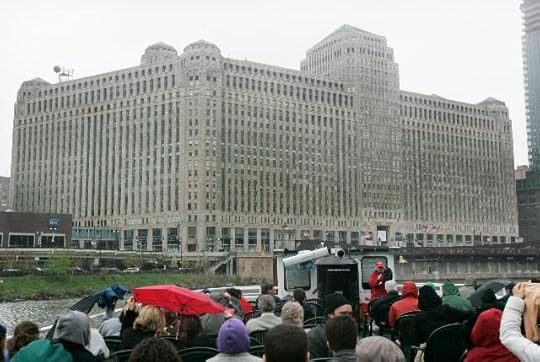
Chicago’s Merchandise Mart, home to tech accelerator 1871 and a hub of investing and startup activity. (AP Photo/Nam Y. Huh)
My own theory on what’s wrong with Chicago’s tech scene is pretty simple. Young engineers with technical talent and entrepreneurial vision—the combination of these traits at high levels is rarer than some think—want to emulate technical founders who have created giant, transcendent companies. They look to Mark Andreessen, Mark Zuckerberg, Larry Page, Max Levchin, Paul Graham, Steve Chen. Those people are their heroes. And they’re all in the Bay. Andreessen (Netscape), Chen (YouTube) and Levchin (PayPal) all flowed through the engineering school at the University of Illinois at Urbana-Champaign (as did I), which, to be clear, isn’t Chicago. So while U of I, with its track record, might attract the budding superstar at age 18, he or she has no reason to consider Chicago more strongly than anywhere else.
None of Chicago’s tech leaders are of this ilk. They’re not technical founders who created transcendent companies. Andrew Mason could have, even should have, been the guy (he was a music major at Northwestern, but he knew how to code and got his start in the space doing just that when creating what would become Groupon), but Groupon’s volatile trajectory—and the way in which Mason was shown the door—disallowed that.
The people who are, in-effect, the leaders of Chicago’s tech scene—1871 CEO Howard Tullman, billionaire investor J.B. Pritzker, Groupon CEO Eric Lefkofsky—are fine leaders who want the best for Chicago. But they’re unknown to 22-year-olds with burgeoning technical talent and an eye toward the next thing. To lure and keep the keystone founders of the future, Chicago needs people at the top who have done it the same way that a 22-year-old engineer envisions himself doing it.
June 19, 2015
Apple Should Never Stop Making Macs
Apple’s intangible connection to the creators of the digital age—the developers, the engineers, the artists—has played a unsung role its dominance in the consumer space. Apple’s Mac computers are the chosen tool of the builders who have conceived, constructed and improved upon the web and mobile applications that have changed the world during the last 10 years. Not understanding this relationship between company and industry could lead some investors, summoning guidance from a spreadsheet and banal business school tactics, to declare that Apple should kill off the Mac.
It’s true that consumption of digital content, of software, has been migrating to mobile. Everybody understands that this will continue. But that doesn’t mean that mobile applications, or those for televisions, cars, appliances or wherever software hops next will be built on phones with on-screen keyboards. As long as engineers use laptops and computers to build, then Apple should produce them.
Apple’s Macbook Pros, Macbook Airs, iMacs and other computers comprise only $6.9 billion, or 9% of the company’s total revenue. Their significance to Apple as the world’s tech mainstay, however, is far greater. Continuing to produce Macs isn’t about nostalgia or some mawkish lament of abandoning a connection to the past. Doing just that can be salvation for some companies. Apple’s computers, however, aren’t phonographs. They’re the utterly recognizable tools of the Web, of mobile, of an upwardly mobile class of creators.
Co-opting nearly the entire class of tech creatives as champion users, for Apple, is equivalent to Nike getting the best 50 players in the NBA to wear its sneakers for free. Many of those players do wear Nike, of course, but it costs the shoemaker hundreds of millions of dollars. Lebron James and Kobe Bryant get more than $30 million a year from Nike. This connection that Apple has built with tech’s vanguard should be cherished and nurtured. Microsoft knows well that this link to the creators is worth many times the value of the hardware that they actually purchase.

Apple’s Macs are worth far more than the sales they produce
Apple’s hegemony on the desks of Silicon Valley helps ensure developers will continue to favor all of its products, like iPhones over worthy challengers from Samsung and HTC. This, in turn, keeps Apple’s mobile app market more vibrant, refreshed and free of bugs when compared with the decidedly second-place effort from Android. There’s a reason apps show up first for iOS, despite Android’s larger overall user numbers.
The maniacal following the company has developed allows it the luxury of knowing that any new product it produces will be snapped up, on its first day of sales, in the millions of units, giving anything Apple makes an automatic headwind toward winning a market. That dominance in all devices, for Apple, begins with the machines on which most software for these devices is built. IPads, Apple Watches, iPhones, the coming Apple television product—these are all platforms whose software is created on Apple’s original product.
It wasn’t always this way. Many engineers in the late 1990s and early 2000s wouldn’t touch an Apple machine. Apples could be slow and their software didn’t give programmers the kind of flexibility they’re afforded now. At work, I had an iBook and an eMac and I hated both of them. I much preferred my personal Dell machine from the same era. But then came OS X and a superior generation of hardware, screens and overall flexibility.
March 16, 2015
Most Companies Don’t Email Their Employees — One App Fixes That
Email has become a source of gravity for most white collar workers. It grounds us, it hounds us, it busies us, keeping us tethered to our phones or desks as we sort, read and answer the messages that pour in by the dozens or hundreds each day. Communicating with email, for many, comprises most of the workday. How can a job exist—how can a company exist—withouth this backbone of email conversation?
Yet more than half of the jobs in the United States come without work email accounts. Jobs in restaurants, retail, manufacturing, hospice and health services: most of the people in these professions have little in the way of direct communication with their employers outside of the physical workplace. Shipping giant UPS, for instance, doesn’t email its drivers or even its pilots; GE doesn’t supply electronic inboxes to its factory employees; Pizza chain Papa John’s can’t email its 3,200 general managers around the country. Thousands of companies, many of them big, make announcements on the breakroom bulletin board, not through the web. Documents for employees must be disseminated in person rather than with a handy email attachment.
Jonathan Erwin’s Red e App aims to fix this communications gap present at so many companies with a mobile solution. The approach makes sense, given that 58% of Americans already own smart phones, including 83% of those 18-29 and 74% of those 30-49. Red e App allows employers to reach these mobile devices through a secure entreprise platform that comes with most of the advantages of an internal email system without some of its costs and risks.

Jonathan Erwin’s Red e App gives employees without work email accounts a way to stay connected to their employers.
Employees download Red e App to their phones and enter a code supplied by their employer. The app provides employees a message inbox and a way to answer coworkers’ queries and notes. It also allows employers to ping workers with with push notifications for important messages. Just like with an entreprise email platform, companies can add and remove employees in the system with ease. But unlike email, employees can’t use Red e App to communicate with anybody outside of the company. This removes risk for industries, like fast food, that may not vet employees with the same kind of intensity as that of a law firm or a tech company.
Red e App made sense to executives at GE, which rolled the product out for employees working in its appliance factories in Kentucky and Ohio in mid 2013. In addition to GE, Red e App has more than 30 other companies with 15,000 employee-users. Other big companies are taking notice. Starbucks called late last year, looking for a way to supply its baristas mobile schedules.
Many clients are tapping Red e App’s ability to serve as a mobile portal for HR documents and the other rigmarole related to employing people. Erwin charges clients $5 per employee per month, a model that has enticed investors, including Yearling Fund and Rockpoint Capital to give him $2 million. He’s looking to double the number of his employees—now 19—in the next year.
Before Red e App, Erwin was a sales and marketing executive at Hosting.com after it had scaled up and been sold to a private equity shop. So, not being an engineer nor, at the age of 48, a serial entrepreur, Erwin doesn’t fit the part of tech founder that we’ve come to expect.
Most Companies Don’t Email Their Employees. One App Fixes That.
Email has become a source of gravity for most white collar workers. It grounds us, it hounds us, it busies us, keeping us tethered to our phones or desks as we sort, read and answer the messages that pour in by the dozens or hundreds each day. Communicating with email, for many, comprises most of the workday. How can a job exist—how can a company exist—withouth this backbone of email conversation?
Yet more than half of the jobs in the United States come without work email accounts. Jobs in restaurants, retail, manufacturing, hospice and health services: most of the people in these professions have little in the way of direct communication with their employers outside of the physical workplace. Shipping giant UPS, for instance, doesn’t email its drivers or even its pilots; GE doesn’t supply electronic inboxes to its factory employees; Pizza chain Papa John’s can’t email its 3,200 general managers around the country. Thousands of companies, many of them big, make announcements on the breakroom bulletin board, not through the web. Documents for employees must be disseminated in person rather than with a handy email attachment.
Jonathan Erwin’s Red e App aims to fix this communications gap present at so many companies with a mobile solution. The approach makes sense, given that 58% of Americans already own smart phones, including 83% of those 18-29 and 74% of those 30-49. Red e App allows employers to reach these mobile devices through a secure entreprise platform that comes with most of the advantages of an internal email system without some of its costs and risks.
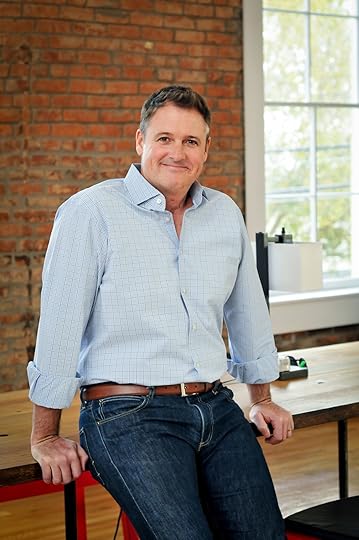
Jonathan Erwin’s Red e App gives employees without work email accounts a way to stay connected to their employers.
Employees download Red e App to their phones and enter a code supplied by their employer. The app provides employees a message inbox and a way to answer coworkers’ queries and notes. It also allows employers to ping workers with with push notifications for important messages. Just like with an entreprise email platform, companies can add and remove employees in the system with ease. But unlike email, employees can’t use Red e App to communicate with anybody outside of the company. This removes risk for industries, like fast food, that may not vet employees with the same kind of intensity as that of a law firm or a tech company.
Red e App made sense to executives at GE, which rolled the product out for employees working in its appliance factories in Kentucky and Ohio in mid 2013. In addition to GE, Red e App has more than 30 other companies with 15,000 employee-users. Other big companies are taking notice. Starbucks called late last year, looking for a way to supply its baristas mobile schedules.
Many clients are tapping Red e App’s ability to serve as a mobile portal for HR documents and the other rigmarole related to employing people. Erwin charges clients $5 per employee per month, a model that has enticed investors, including Yearling Fund and Rockpoint Capital to give him $2 million. He’s looking to double the number of his employees—now 19—in the next year.
Before Red e App, Erwin was a sales and marketing executive at Hosting.com after it had scaled up and been sold to a private equity shop. So, not being an engineer nor, at the age of 48, a serial entrepreur, Erwin doesn’t fit the part of tech founder that we’ve come to expect.
Christopher Steiner's Blog

- Christopher Steiner's profile
- 21 followers

