
Dmitry Orlov's Blog, page 34
March 31, 2011


March 24, 2011
Fleeing Vesuvius, the US Edition
 This hefty tome was published in Europe by Féasta, Ireland's Foundation for the Economics of Sustainability. It contains two articles by me: the first is a text version of the presentation I gave at the Féasta conference in Dublin two summers ago, which you can read right on this blog.
The US edition will be released on April 5, 2011. You can pre-order yours at a savings of $9.67. All the money will go to support Féasta.
My second article in this volume—Sailing craft for a post-collapse world—is a long piece that I wrote exclusively for this publication. It spells out the transportation options that will still exist once fossil fuels are no longer available, concentrating on sail transport. It pulls together pertinent information that is currently scattered across many academic disciplines, and is also informed by my personal experience as an ocean sailor and live-aboard who does all of his own maintenance.
The full table of contents can be found here. The book can be purchased through Amazon.
Fleeing Vesuvius draws together many of the ideas our members have developed over the years and applies them to a single question—how can we bring the world out of the mess in which it finds itself?
Fleeing Vesuvius confronts this mess squarely, analyzing its many aspects: the looming scarcity of essential resources such as fossil fuels—the lifeblood of the world economy; the financial crisis in Ireland and elsewhere; the collapse of the housing bubble; the urgent need for food security; and the enormous challenge of dealing with climate change.
The solutions it puts forward involve changes to our economy and financial system, but they go much further: this substantial, wide-ranging book also looks at the changes needed in how we think, how we use the land and how we relate to others, particularly those where we live. While it doesn't discount the complexity of the problems we face, Fleeing Vesuvius is practical and fundamentally optimistic. It will arm readers with the confidence and knowledge they need to develop new, workable alternatives to the old-style expanding economy and its supporting systems. It's a book that can be read all the way through or used as a resource to dip in and out of.

Fleeing Vesuius, the US Edition
This hefty tome was published in Europe by Féasta, Ireland's Foundation for the Economics of Sustainability. It contains two articles by me: the first is a text version of the presentation I gave at the Féasta conference in Dublin two summers ago, which you can read right on this blog.The US edition will be released on April 5, 2011. You can pre-order yours at a savings of $9.67. All the money will go to support Féasta.
My second article in this volume—Sailing craft for a post-collapse world—is a long piece that I wrote exclusively for this publication. It spells out the transportation options that will still exist once fossil fuels are no longer available, concentrating on sail transport. It pulls together pertinent information that is currently scattered across many academic disciplines, and is also informed by my personal experience as an ocean sailor and live-aboard who does all of his own maintenance.
The full table of contents can be found here. The book can be purchased through Amazon.
Fleeing Vesuvius draws together many of the ideas our members have developed over the years and applies them to a single question—how can we bring the world out of the mess in which it finds itself?
Fleeing Vesuvius confronts this mess squarely, analyzing its many aspects: the looming scarcity of essential resources such as fossil fuels—the lifeblood of the world economy; the financial crisis in Ireland and elsewhere; the collapse of the housing bubble; the urgent need for food security; and the enormous challenge of dealing with climate change.
The solutions it puts forward involve changes to our economy and financial system, but they go much further: this substantial, wide-ranging book also looks at the changes needed in how we think, how we use the land and how we relate to others, particularly those where we live. While it doesn't discount the complexity of the problems we face, Fleeing Vesuvius is practical and fundamentally optimistic. It will arm readers with the confidence and knowledge they need to develop new, workable alternatives to the old-style expanding economy and its supporting systems. It's a book that can be read all the way through or used as a resource to dip in and out of.
March 18, 2011
Nuclear Meltdowns 101
p { margin-bottom: 0.08in; }
 I am no nuclear expert, and that isprobably a good thing. I did do a lot of reading about Chernobyl back when it happened. And now I am, as I was then, and as I am sure many of you are,getting really fed up with incomplete, inaccurate, misleading andgenerally unsatisfactory explanations that are being offered for whatis going on at Fukushima. Either information is not available, or itis a flood of largely irrelevant technical minutia designed to thrill nuclear nerds butbound to bamboozle rather than inform the general reader. And so, forthe sake of all the other people who aren't nuclear experts and haveno ambition of ever becoming one, here's what I have been able to piecetogether.
What do they mean when they say"hydrogen explosions"? The hydrogen gas is being vented frominside the reactors and from spent fuel pools that are directly above them. Since it is very hot,it explodes as soon as it mixes with the outside air. It is formedfrom the rapid oxidation of the zirconium pipes that hold in thepellets of nuclear fuel. At Fukushima, some of the fuel pellets aremade with uranium, while others are made with plutonium fromreprocessed nuclear weapons. Zirconium is a metal which, likealuminum, instantly forms a thin, protective layer of oxide oncontact with air, but doesn't oxidize further—unless it is heatedup, that is. The zirconium-clad fuel rods must be kept submerged in water atall times, or they do heat up, and then the zirconium claddingoxidizes (burns) very rapidly and disintegrates into a powder. This isalready enough information to tell us that a lot of the "fuel rods"at Fukushima are no longer rod-shaped, because the zirconium claddinghas disintegrated, and that the fuel pellets must have fallen out and accumulated at thebottoms of the reactor vessels, where they are packed close together and heating up further.How much further they heat up will determine whether they will meltthrough the bottoms of the reactors. If they do, they would probablymelt into the ground below and form a large pancake of hot, moltenslag, which will slowly crumble into radioactive dust over manyyears, as has happened at Chernobyl. There is also a small chancethat the fuel pellets will "go critical," if the mass of thembecomes sufficiently compact to restart the nuclear chain reaction;if that happens, the telltale mushroom cloud should be easy to spotfrom as away as Tokyo. This seems unlikely, but then nobody seems tobe able to definitively rule it out either.
What do they mean when they say thatthey are cooling the reactor with seawater? Seawater iscorrosive, and is probably the worst coolant imaginable. Normally,nuclear reactors are cooled with fresh, filtered, deionized water.The crew at Fukushima used seawater because they had no other choice.When the cooling pumps failed because the tsunami caused a blackout,they called in the fire brigade, and the fire engines thereapparently use seawater. The reactor cooling systems are plumbed withstainless steel pipes, which degrade rather rapidly on contact withsea water because of the chlorine in it, especially if they are hot(which they are). At Fukushima, "containment" has already becomea relative term, since the reactors are vented to the outside air inany case to keep them from bursting, but once these pipesdisintegrate (a process that might take a few days to a few weeks)the containment vessels will become riddled with holes, letting inoutside air and, if by then there is any zirconium left to burn,possibly causing hydrogen explosions inside the reactors,compromising them further. Their radioactive contents will then becarried to the atmosphere in aerosol form. We will probably know whenthat happens because the Geiger counters in the area will peg out.Which brings us to a very general question:
What is the difference betweenradiation and radioactivity? This is a basic enoughdistinction, but, listening to the news coverage, I have observed agreat deal of confusion. (Some of it seems intentional, if not malicious: I heard some nuclear expert/twit (a retired Oxford don, I think) on NPR explain how "wadiation" can be "thewapeutic" and never once did he mention "wadioactivity," and it made me quite mad.) Both radiation and radioactivity are invisible and hard to measure, butthat's where the similarity ends. Radiation consists of subatomicparticles that generally go in straight lines at close to the speedof light. Given enough radiation, initially non-radioactive materialscan in turn become radioactive. Radioactivity, on the other hand, iscaused by radioactive materials, which decay into other materials, some also radioactive, some stable, plus some radiation, at somerate, either quickly or not so quickly. Uranium and plutonium hang around for many thousands of years. Radioactive substances canbe pulverized and carried up into the atmosphere by explosions (not necessarilynuclear ones) in which case they drift with the wind forthousands of kilometers and pollute huge stretches of land and ocean.Exposure to excessive levels of radiation causes radiation poisoning,from which people can fully recover, while the various radioactiveelements pollute the environment and are taken up by living organisms in a wide variety of ways,many of them not yet understood by science, poisoning them andcausing a wide assortment of cancers and genetic defects. Some may beflushed out, while others become lodged in the lungs or in the bonesfor the life of the individual, where they remain radioactive, weakening immune systems, causingcancers and birth defects and shortening lifespans. I once spent a few hoursat the airport in Minsk, waiting for a flight to Frankfurt with agroup of "Chernobyl children" being flown out for treatment. Theywere quite a sight!
What about these "spent fuelpools" that keep catching on fire? Well that's probably themost insane thing about the nuclear power industry. They haven'tfigured out what to do with the spent fuel rods, so they store themtightly packed in pools of water directly at the site, or, in thecase of Fukushima, since land in Japan is at such a premium, stackeddirectly on top of the reactor itself. The reactors at Fukushima arequite old, and so their spent fuel pools are packed full. The spentfuel rods, which accumulate over the entire lifetime of the powerplant, have to be kept submerged to keep them cool, or the zirconiumcladding burns away (causing hydrogen explosions) and the fuelpellets accumulate at the bottom of the pool, burning through it ifthe fuel is fresh enough (which, in some cases, it might be). Theresult is the same as with the fuel rods disintegrating inside thereactor itself, except that here there is no containment vessel tokeep (at least some of) the radioactive material out of theenvironment.
Why do we have nuclear energy in thefirst place? This all sounds completely insane, doesn't it? Well,if it weren't for the nuclear bomb, anyone who proposed building acommercial fission reactor would have been laughed out of the room.But having nuclear bombs (which are by far the scariest things on theplanet) makes nuclear fission reactors that much less scary,relatively speaking. And the reason we have nuclear bombs is becausethe only thing scarier than a nuclear bomb is not having one, sincethat opens you up the possibility of having one dropped on you by someone who does, such asthe USSR (in theory) or the USA (as an historical fact). Compared to nuclear bombs, nuclear reactors seem "peaceful," although this is clearly not the case. Compared to nuclear reactors, nuclear bombs are as safe as houses, because they don't start a chain reaction until somebody pulls the trigger, whereas nuclear reactors maintain a controlled chain reaction during most of their existences. It's like comparing having a gun safely in your possession to heating your house with ammo, in which case, surely enough, accidents will happen.
What do people mean when they saythat nuclear power is "safe" when compared to planes, trains andautomobiles? What they mean is that the nuclear power industryhas so far killed many fewer people per unit time. They haveno data on how many people it will kill eventually, although by nowthey know that, unlike planes, trains and automobiles, which do crashand burn with some regularity, but cause limited damage, nucleardisasters do not have any definable upper bound on their destructivepotential. I am pretty sure that there is enough above-groundradioactive material sitting in spent fuel pools and inside reactorsto kill just about everyone. It will stay dangerous for over amillion years, which is a lot longer than the expected lifetime ofthe nuclear power industry, or any industry, or any humancivilization, or perhaps even the human race. When nuclear expertssay that a nuclear reactor is safe, they can only mean that it issafe for the rest of the afternoon; beyond that they can't possiblyhave any actual data to support their claim. All they can do isextrapolate, given a rosy "everything will always remain undercontrol" scenario, and that is not a valid approach. When they saythat nuclear power is safe, what they are really saying is that it issafe given their perfect ability to accurately predict that theindefinite future will remain economically and socially stable, andwe already know this to not be the case.
If we give up on nuclear energy,what will replace it? Nothing, probably. Let me try an example:if your lucrative murder-for-hire business suddenly runs afoul of afew silly laws (even though it has so far killed many fewer peoplethan planes, trains or automobiles) that doesn't mean that you shouldkeep killing people until you find another source of income. Samething with electricity: if it turns out that the way you've beengenerating it happens to be criminally negligent, then you shut itall down. If you have less electricity, you will use lesselectricity. If this implies that economic growth is over and thatall of your financial institutions are insolvent and your countrybankrupt, then—I am sorry, but at this point in time that's noteven newsworthy. Don't worry about that; just keep the nuclearaccidents to a bare minimum, or you won't have anything else left toworry about.
 I am no nuclear expert, and that isprobably a good thing. I did do a lot of reading about Chernobyl back when it happened. And now I am, as I was then, and as I am sure many of you are,getting really fed up with incomplete, inaccurate, misleading andgenerally unsatisfactory explanations that are being offered for whatis going on at Fukushima. Either information is not available, or itis a flood of largely irrelevant technical minutia designed to thrill nuclear nerds butbound to bamboozle rather than inform the general reader. And so, forthe sake of all the other people who aren't nuclear experts and haveno ambition of ever becoming one, here's what I have been able to piecetogether.
What do they mean when they say"hydrogen explosions"? The hydrogen gas is being vented frominside the reactors and from spent fuel pools that are directly above them. Since it is very hot,it explodes as soon as it mixes with the outside air. It is formedfrom the rapid oxidation of the zirconium pipes that hold in thepellets of nuclear fuel. At Fukushima, some of the fuel pellets aremade with uranium, while others are made with plutonium fromreprocessed nuclear weapons. Zirconium is a metal which, likealuminum, instantly forms a thin, protective layer of oxide oncontact with air, but doesn't oxidize further—unless it is heatedup, that is. The zirconium-clad fuel rods must be kept submerged in water atall times, or they do heat up, and then the zirconium claddingoxidizes (burns) very rapidly and disintegrates into a powder. This isalready enough information to tell us that a lot of the "fuel rods"at Fukushima are no longer rod-shaped, because the zirconium claddinghas disintegrated, and that the fuel pellets must have fallen out and accumulated at thebottoms of the reactor vessels, where they are packed close together and heating up further.How much further they heat up will determine whether they will meltthrough the bottoms of the reactors. If they do, they would probablymelt into the ground below and form a large pancake of hot, moltenslag, which will slowly crumble into radioactive dust over manyyears, as has happened at Chernobyl. There is also a small chancethat the fuel pellets will "go critical," if the mass of thembecomes sufficiently compact to restart the nuclear chain reaction;if that happens, the telltale mushroom cloud should be easy to spotfrom as away as Tokyo. This seems unlikely, but then nobody seems tobe able to definitively rule it out either.
What do they mean when they say thatthey are cooling the reactor with seawater? Seawater iscorrosive, and is probably the worst coolant imaginable. Normally,nuclear reactors are cooled with fresh, filtered, deionized water.The crew at Fukushima used seawater because they had no other choice.When the cooling pumps failed because the tsunami caused a blackout,they called in the fire brigade, and the fire engines thereapparently use seawater. The reactor cooling systems are plumbed withstainless steel pipes, which degrade rather rapidly on contact withsea water because of the chlorine in it, especially if they are hot(which they are). At Fukushima, "containment" has already becomea relative term, since the reactors are vented to the outside air inany case to keep them from bursting, but once these pipesdisintegrate (a process that might take a few days to a few weeks)the containment vessels will become riddled with holes, letting inoutside air and, if by then there is any zirconium left to burn,possibly causing hydrogen explosions inside the reactors,compromising them further. Their radioactive contents will then becarried to the atmosphere in aerosol form. We will probably know whenthat happens because the Geiger counters in the area will peg out.Which brings us to a very general question:
What is the difference betweenradiation and radioactivity? This is a basic enoughdistinction, but, listening to the news coverage, I have observed agreat deal of confusion. (Some of it seems intentional, if not malicious: I heard some nuclear expert/twit (a retired Oxford don, I think) on NPR explain how "wadiation" can be "thewapeutic" and never once did he mention "wadioactivity," and it made me quite mad.) Both radiation and radioactivity are invisible and hard to measure, butthat's where the similarity ends. Radiation consists of subatomicparticles that generally go in straight lines at close to the speedof light. Given enough radiation, initially non-radioactive materialscan in turn become radioactive. Radioactivity, on the other hand, iscaused by radioactive materials, which decay into other materials, some also radioactive, some stable, plus some radiation, at somerate, either quickly or not so quickly. Uranium and plutonium hang around for many thousands of years. Radioactive substances canbe pulverized and carried up into the atmosphere by explosions (not necessarilynuclear ones) in which case they drift with the wind forthousands of kilometers and pollute huge stretches of land and ocean.Exposure to excessive levels of radiation causes radiation poisoning,from which people can fully recover, while the various radioactiveelements pollute the environment and are taken up by living organisms in a wide variety of ways,many of them not yet understood by science, poisoning them andcausing a wide assortment of cancers and genetic defects. Some may beflushed out, while others become lodged in the lungs or in the bonesfor the life of the individual, where they remain radioactive, weakening immune systems, causingcancers and birth defects and shortening lifespans. I once spent a few hoursat the airport in Minsk, waiting for a flight to Frankfurt with agroup of "Chernobyl children" being flown out for treatment. Theywere quite a sight!
What about these "spent fuelpools" that keep catching on fire? Well that's probably themost insane thing about the nuclear power industry. They haven'tfigured out what to do with the spent fuel rods, so they store themtightly packed in pools of water directly at the site, or, in thecase of Fukushima, since land in Japan is at such a premium, stackeddirectly on top of the reactor itself. The reactors at Fukushima arequite old, and so their spent fuel pools are packed full. The spentfuel rods, which accumulate over the entire lifetime of the powerplant, have to be kept submerged to keep them cool, or the zirconiumcladding burns away (causing hydrogen explosions) and the fuelpellets accumulate at the bottom of the pool, burning through it ifthe fuel is fresh enough (which, in some cases, it might be). Theresult is the same as with the fuel rods disintegrating inside thereactor itself, except that here there is no containment vessel tokeep (at least some of) the radioactive material out of theenvironment.
Why do we have nuclear energy in thefirst place? This all sounds completely insane, doesn't it? Well,if it weren't for the nuclear bomb, anyone who proposed building acommercial fission reactor would have been laughed out of the room.But having nuclear bombs (which are by far the scariest things on theplanet) makes nuclear fission reactors that much less scary,relatively speaking. And the reason we have nuclear bombs is becausethe only thing scarier than a nuclear bomb is not having one, sincethat opens you up the possibility of having one dropped on you by someone who does, such asthe USSR (in theory) or the USA (as an historical fact). Compared to nuclear bombs, nuclear reactors seem "peaceful," although this is clearly not the case. Compared to nuclear reactors, nuclear bombs are as safe as houses, because they don't start a chain reaction until somebody pulls the trigger, whereas nuclear reactors maintain a controlled chain reaction during most of their existences. It's like comparing having a gun safely in your possession to heating your house with ammo, in which case, surely enough, accidents will happen.
What do people mean when they saythat nuclear power is "safe" when compared to planes, trains andautomobiles? What they mean is that the nuclear power industryhas so far killed many fewer people per unit time. They haveno data on how many people it will kill eventually, although by nowthey know that, unlike planes, trains and automobiles, which do crashand burn with some regularity, but cause limited damage, nucleardisasters do not have any definable upper bound on their destructivepotential. I am pretty sure that there is enough above-groundradioactive material sitting in spent fuel pools and inside reactorsto kill just about everyone. It will stay dangerous for over amillion years, which is a lot longer than the expected lifetime ofthe nuclear power industry, or any industry, or any humancivilization, or perhaps even the human race. When nuclear expertssay that a nuclear reactor is safe, they can only mean that it issafe for the rest of the afternoon; beyond that they can't possiblyhave any actual data to support their claim. All they can do isextrapolate, given a rosy "everything will always remain undercontrol" scenario, and that is not a valid approach. When they saythat nuclear power is safe, what they are really saying is that it issafe given their perfect ability to accurately predict that theindefinite future will remain economically and socially stable, andwe already know this to not be the case.
If we give up on nuclear energy,what will replace it? Nothing, probably. Let me try an example:if your lucrative murder-for-hire business suddenly runs afoul of afew silly laws (even though it has so far killed many fewer peoplethan planes, trains or automobiles) that doesn't mean that you shouldkeep killing people until you find another source of income. Samething with electricity: if it turns out that the way you've beengenerating it happens to be criminally negligent, then you shut itall down. If you have less electricity, you will use lesselectricity. If this implies that economic growth is over and thatall of your financial institutions are insolvent and your countrybankrupt, then—I am sorry, but at this point in time that's noteven newsworthy. Don't worry about that; just keep the nuclearaccidents to a bare minimum, or you won't have anything else left toworry about.
Nothing Left to Steal
 Michael Betancourt is an intellectual: he uses words like semiosis and actually knows exactly what they mean. Speaking on The Keiser Report, he made some interesting points about the pile of digital ephemera that the global financial system, and much of the economy with it, has devolved into. From 20:52 on, Michael has this to say on the current action in the financial markets around the world:
I wouldn't necessarily say "steal" ... I just don't feel that "stealing" is necessarily the right verb for this. It's something else. Stealing [implies] that there is some kind of physical commodity that's being stolen... that the currency is being debased implies that if we didn't do this the currency would be solvent, and the whole problem here is that the currency itself is disconnected from any kind of physical value. It exists as a debt against future production rather than a store of value. And all of this comes down to the immaterial basis that we are now living in. So, yes, in a sense you could say that they are stealing, [but] in another sense you could say that they are not stealing because there is nothing to be stolen... The reality is that this is an unsustainable system, and that the inevitability of its collapse has been there almost from the beginning, because the entire system is based on a currency that is not based on anything—it exists only in relation to other currencies...On the protesters in Wisconsin and elsewhere:
What makes this even more perverse is that what they are fighting for is the continuation of their entrapment... The powers that are currently acting and that are causing these riots, protests, rebellions... are fighting for their own survival, and the shift that's happening is perverse because we are driving towards a collapse, and it is almost inevitable that we are going to have this collapse again at some point. To a certain extent I think it may have already started with the credit freeze in 2009. The attempt to print our way out of it isn't going to result in hyperinflation necessarily (although there are people who are saying that it will) so much as it will result in a complete revaluation of the system, in which we arrive at some other, new equilibrium. Part of the problem with getting there is that there are forces fighting over who has the largest number of these essentially immaterial objects, this immaterial currency. What will happen is that at some point they will have most of it (and we are moving towards that already, if you look at any of the various numbers on who has the wealth and who doesn't). What will happen when it gets concentrated enough is that the entire system will freeze up like it did in 2009. This is because the equilibrium and the maintenance and the survival of this system depends upon the circulation of these immaterial commodities. As soon as they start getting hoarded, or as soon as people who have them start cashing out and into some sort of physical commodity, both of these can trigger an imminent collapse, not necessarily in the sense of a bank run or a panic, but in the sense that the system can no longer feasibly maintain its own equilibrium... it drives towards ever greater disequilibrium, because that's the ground state for this sort of a situation, where you have vast immaterial production versus limited physical production.I would tend to agree. The value of financial assets rests on the promise of future industrial production, which will fail to materialize due to shortages of multiple key resources. In the updated edition of Reinventing Collapse (which is scheduled to go to press next week), I try to get at much the same thing as Michael, trying hard to avoid big words like "disequilibrium":
The extent to which we value money depends on our degree of confidence in the economy. At first, as the economy starts to collapse, we start to hoard money, to make sure that we don't run out. Then, as the economy continues to wither away, supply disruptions and price spikes cause some of us to suddenly realize that we might not be able to gain access to the things we need for much longer, never mind the cost, and that running out of money is not fatal whereas running out of food, fuel and other supplies certainly can be. And then we start cashing in our paper assets in exchange for physical commodities we think might be more useful. Shortly thereafter everyone realizes that the chips they are holding are not all that valuable any more. It is this realization, more than anything else, that renders the chips instantly worthless. [RC 2.0 p. 54-55]In recent months I have had many occasions to walk through Boston's financial district and look at all the suit-and-tie-wearing lab rats whose job is to push buttons to try to enervate the pleasure center of some wealthy person's brain. The vast majority of what they trade is derived from debt secured by future production that will not exist. At what point will their patron's pleasure cross the pain threshold? Will we see the über-wealthy immolating themselves on pyres of their now worthless money, just to escape the anguish of being disencumbered of their phantom possessions? I hope for everyone to survive with their precarious sanity intact, but I can't help but look forward to a Bonfire of the Vanities to put this lengthy episode of breathless financial self-digiting behind us.

March 16, 2011
VideoNation: The Lost Interview
 Something funny happened on the way to the management offices of The Nation, and Mike Ruppert's
interview
ended up in a different YouTube account than the other interviews in the series: ontheearthproduction instead of videonation (which is where the rest of the series can still be found). The internet works in mysterious ways. "Get Ruppert off our intertubes!" said The Nation; and so here we are, in an altogether different YouTube account. But let's not dwell on that.
Something funny happened on the way to the management offices of The Nation, and Mike Ruppert's
interview
ended up in a different YouTube account than the other interviews in the series: ontheearthproduction instead of videonation (which is where the rest of the series can still be found). The internet works in mysterious ways. "Get Ruppert off our intertubes!" said The Nation; and so here we are, in an altogether different YouTube account. But let's not dwell on that.Short summary:
It is happening.It will be happening for a while yet.To survive, you need to prepare and cover the basics. Be grateful for all the people (e.g., Mike) who have been sounding the alarm for a while now, long enough for you to (not) get your act together.Also be grateful for all the people who have been preparing, who are (somewhat) prepared, and who are (sometimes) willing to teach you. Stop hoping that status quo ante-collapsus will somehow be magically restored; that world is gone forever. The planet is finite, and we have reached its limits."Fracking"—the latest fossil fuel techno-fix, is nothing short of Earth-rape; not only that, but it is a net waste of energy. There is a global generational revolution underway. American baby-boomers with their depleted savings and worthless equity and looted entitlements are out; the rest of the planet, which they have short-changed, is taking over. We are all Egyptians now.
Bracing stuff, wouldn't you say?

March 14, 2011
Earth Shakes, Sea Surges, Nukes Blow
p { margin-bottom: 0.08in; }
Have you ever tried to recruit concertpianists? Rather a difficult job, wouldn't you say? Now, suppose youhad to tell them right away that concert pianos sometimes explode,and that when they do some part of the audience, there to listen to abit of Liszt, is burned to death on the spot, while most of the restsuffer a horrible death from radiation poisoning a while later? Oh,and the concert hall then becomes an off-limits radioactive crater,and anyone who was ever your fan would then look forward to bearingchildren who die of childhood leukemia or any number of birthdefects. Lovely!
The nuclear power supporters mightstill be able to recruit some knuckle-draggers to do their bidding,but what good would that do? They might very well detonate the oldgrand piano just by playing "Chopsticks" or "Three Blind Mice"during their very first recital. Supposing that the grand piano wasactually a water-cooled graphite-moderated uranium or recycledplutonium-fueled reactor, and that you were a knuckle-dragger, you'dcertainly summon a fire engine or two, and ask them to pump seawaterinto your grand piano, to cool it down. Not that the Japanese had any choiceat that point, but, speaking strictly as a lay plumber, I findseawater to be ever so slightly problematic when pumped through anoverheated boiler, never mind a nuclear reactor that's about to blow.I think I would rather moonlight as a lay electrician than listen toa nuclear engineer expound on the benefits of seawater in a nuclear reactor. Declare yourincompetence forthwith and fade away now, please, thank you!
Ultimately, the problem is with thepeople who designed and built these things, not with the people whohave to suffer horribly and die when they explode. You see, you haveto be a certain sort of person to say "Sure, using a precariously controlled subcriticalnuclear pile to boil water to run steam turbines to generateelectricity is a great idea!" That sort of person is called asociopath. Having worked with quite a few of them, I know a thing ortwo about sociopaths. They are always around to make ridiculousthings happen and take credit for them while they can, but whenthings go horribly wrong, as they inevitably do, they are nowhere to be found. They have this knack for promoting theknuckle-draggers just in time for them to take the fall for whatappears to be their own mistakes.
Three years ago I wrote this into theCollapse Party Platform:
Have you ever tried to recruit concertpianists? Rather a difficult job, wouldn't you say? Now, suppose youhad to tell them right away that concert pianos sometimes explode,and that when they do some part of the audience, there to listen to abit of Liszt, is burned to death on the spot, while most of the restsuffer a horrible death from radiation poisoning a while later? Oh,and the concert hall then becomes an off-limits radioactive crater,and anyone who was ever your fan would then look forward to bearingchildren who die of childhood leukemia or any number of birthdefects. Lovely!
The nuclear power supporters mightstill be able to recruit some knuckle-draggers to do their bidding,but what good would that do? They might very well detonate the oldgrand piano just by playing "Chopsticks" or "Three Blind Mice"during their very first recital. Supposing that the grand piano wasactually a water-cooled graphite-moderated uranium or recycledplutonium-fueled reactor, and that you were a knuckle-dragger, you'dcertainly summon a fire engine or two, and ask them to pump seawaterinto your grand piano, to cool it down. Not that the Japanese had any choiceat that point, but, speaking strictly as a lay plumber, I findseawater to be ever so slightly problematic when pumped through anoverheated boiler, never mind a nuclear reactor that's about to blow.I think I would rather moonlight as a lay electrician than listen toa nuclear engineer expound on the benefits of seawater in a nuclear reactor. Declare yourincompetence forthwith and fade away now, please, thank you!
Ultimately, the problem is with thepeople who designed and built these things, not with the people whohave to suffer horribly and die when they explode. You see, you haveto be a certain sort of person to say "Sure, using a precariously controlled subcriticalnuclear pile to boil water to run steam turbines to generateelectricity is a great idea!" That sort of person is called asociopath. Having worked with quite a few of them, I know a thing ortwo about sociopaths. They are always around to make ridiculousthings happen and take credit for them while they can, but whenthings go horribly wrong, as they inevitably do, they are nowhere to be found. They have this knack for promoting theknuckle-draggers just in time for them to take the fall for whatappears to be their own mistakes.
Three years ago I wrote this into theCollapse Party Platform:
I am particularly concerned about allthe radioactive and toxic installations, stockpiles and dumps. Futuregenerations are unlikely to be able to control them, especially ifglobal warming puts them underwater. There is enough of this mucksitting around to kill off most of us. There are abandoned mine sitesat which, soon after the bulldozers and the excavators stop running,toxic tailings and the contents of settling ponds will flow into andpoison the waters of major rivers, making their flood plains andestuaries uninhabitable for many centuries. Many nuclear power plantshave been built near coastlines, for access to ocean water forcooling. These will be at risk of inundation due to extreme weatherevents and rising sea levels caused by global warming. At manynuclear power stations, spent fuel rods are stored in a pool right atthe reactor site, because the search for a more permanent storageplace has been mired in politics. There are surely better places tostore them than next to population centers and bodies of water.Nuclear reservations — sites that have been permanentlycontaminated in the process of manufacturing nuclear weapons —should be marked with sufficiently large, durable and frighteningobelisks to warn off travelers long after all memory of theirbuilders has faded away.And now I will say it again: Shut itall down. All of it. Now. Please.
March 13, 2011
Fuel For The Year
p { margin-bottom: 0.08in; }
 I don't know if you've noticed, butduring the past few months oil prices have ramped up to levelswhich, as the financial crisis of 2008 had demonstrated, tend to crashthe global economy. Even the International Energy Agency has recentlypicked up on this fact and sounded an alarm. That was beforeLibya exploded, taking a couple of millions of barrels a day ofirreplaceable light sweet crude off the market. That was also beforeJapan was devastated by a major earthquake and tsunami, damaging oilrefineries and nuclear power plants. (Tokyo immediately started askingMoscow to start shipping more oil and coal right away.) Nobody knowshow many other disruptions such as these are going to occur thisyear, but that number is probably greater than zero, and it won'ttake too many more to cause the global petrochemical supplychain to snap, resulting in high prices, shortages and rationing.
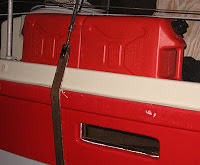
Desperate times call for desperatemeasures, and so I decided to pre-purchase all the gasoline we willneed for the entire year. I put my two 20-liter jerricans on the dockcart, and wheeled them out of the marina, across the parking lot,down the street, through the pretty little gas-lit park that theBoston Freedom Trail passes through on the way to the Bunker HillMonument, and to the filling station on the corner. I had to do thistrip three times; the first two loads I emptied into the on-boardtank, filling it. The remaining load will stay in the jerricans, ondeck, shown above.
Sixty liters is a truly astoundingamount of energy. At 9.7 kW·h/L,it's almost 600 kW·h. Rowing flat out, I can put out about 70 Watts,and so the energy I got from the gas station is equivalent to merowing continuously for an entire year, or about five years of merowing for five hours every day. Not only that, but at around US$1/L itis about the cheapest liquid available—cheaper than milk or bottledwater or apple cider, none of which get you very far. Not only that,but this amazing substance is conveniently dispensed around the clock by a computerized machine at a clean, brightly lit facilitythat is within easy walking distance. It just sounds too good to be true; I don't think it will last.
We don't use gasoline all that much. We have a 10-horsepower outboardthat sits in an inboard-outboard well under the transom and behavesmuch as an inboard engine would without the associated oil in thebilge, the diesel stink, the bother of seasonal commissioning/decomissioning or the expense. We use it to motor out of the marinaand, sometimes, partway out of the harbor, and back. We sometimesmotor slowly when becalmed, to maintain course and to avoid the unpleasantness of "lying ahull"—wherethe boat turns sideways to the swell and is rocked by it. And thenthere is Cape Hatteras, an evil place that, when heading south, is best circumvented bymotoring down canals. Even if we sail Abemarle and Pamlico Sounds, westill have to motor down canals from Norfolk, Virginia to reach AbemarleSound, and then again from Pamlico Sound to Beaufort, North Carolina.
This is why I decided to avoid running into any global geopolitical complications with the petroleum supply andstock up while things are still reasonable. I don't know that thiswas strictly necessary, but now my mind is at ease because we'll have enough gasoline for at least a year, maybe even two orthree if we time the tides better, motor slowly when we do have tomotor, and don't waste fuel motoring when we can just bob around untilthe wind picks up again. During these two years I might weld togethera digester and start running the engine on gas produced fromdriftwood we can pick up along the beach.
Andnow the really cheerful part: thanks to all of these globalpetrochemical difficulties, there will be few, if any, largeobnoxious motor boats on the water this season, just as there weren'tin 2008, and the few that remain will move very slowly,to conserve fuel—too slowly to produce large annoying wakes. Andthat is certainly something to look forward to.

 I don't know if you've noticed, butduring the past few months oil prices have ramped up to levelswhich, as the financial crisis of 2008 had demonstrated, tend to crashthe global economy. Even the International Energy Agency has recentlypicked up on this fact and sounded an alarm. That was beforeLibya exploded, taking a couple of millions of barrels a day ofirreplaceable light sweet crude off the market. That was also beforeJapan was devastated by a major earthquake and tsunami, damaging oilrefineries and nuclear power plants. (Tokyo immediately started askingMoscow to start shipping more oil and coal right away.) Nobody knowshow many other disruptions such as these are going to occur thisyear, but that number is probably greater than zero, and it won'ttake too many more to cause the global petrochemical supplychain to snap, resulting in high prices, shortages and rationing.
Desperate times call for desperatemeasures, and so I decided to pre-purchase all the gasoline we willneed for the entire year. I put my two 20-liter jerricans on the dockcart, and wheeled them out of the marina, across the parking lot,down the street, through the pretty little gas-lit park that theBoston Freedom Trail passes through on the way to the Bunker HillMonument, and to the filling station on the corner. I had to do thistrip three times; the first two loads I emptied into the on-boardtank, filling it. The remaining load will stay in the jerricans, ondeck, shown above.
Sixty liters is a truly astoundingamount of energy. At 9.7 kW·h/L,it's almost 600 kW·h. Rowing flat out, I can put out about 70 Watts,and so the energy I got from the gas station is equivalent to merowing continuously for an entire year, or about five years of merowing for five hours every day. Not only that, but at around US$1/L itis about the cheapest liquid available—cheaper than milk or bottledwater or apple cider, none of which get you very far. Not only that,but this amazing substance is conveniently dispensed around the clock by a computerized machine at a clean, brightly lit facilitythat is within easy walking distance. It just sounds too good to be true; I don't think it will last.
We don't use gasoline all that much. We have a 10-horsepower outboardthat sits in an inboard-outboard well under the transom and behavesmuch as an inboard engine would without the associated oil in thebilge, the diesel stink, the bother of seasonal commissioning/decomissioning or the expense. We use it to motor out of the marinaand, sometimes, partway out of the harbor, and back. We sometimesmotor slowly when becalmed, to maintain course and to avoid the unpleasantness of "lying ahull"—wherethe boat turns sideways to the swell and is rocked by it. And thenthere is Cape Hatteras, an evil place that, when heading south, is best circumvented bymotoring down canals. Even if we sail Abemarle and Pamlico Sounds, westill have to motor down canals from Norfolk, Virginia to reach AbemarleSound, and then again from Pamlico Sound to Beaufort, North Carolina.
This is why I decided to avoid running into any global geopolitical complications with the petroleum supply andstock up while things are still reasonable. I don't know that thiswas strictly necessary, but now my mind is at ease because we'll have enough gasoline for at least a year, maybe even two orthree if we time the tides better, motor slowly when we do have tomotor, and don't waste fuel motoring when we can just bob around untilthe wind picks up again. During these two years I might weld togethera digester and start running the engine on gas produced fromdriftwood we can pick up along the beach.
Andnow the really cheerful part: thanks to all of these globalpetrochemical difficulties, there will be few, if any, largeobnoxious motor boats on the water this season, just as there weren'tin 2008, and the few that remain will move very slowly,to conserve fuel—too slowly to produce large annoying wakes. Andthat is certainly something to look forward to.
March 10, 2011
Everyone Poops Debunked
 Humanity movesforward through the progress of ideas. The more dynamic societies arethose that are willing to adopt good new ideas and to test anddiscard faulty ideas, old or new. Stagnant societies are those thatrefuse to question old ideas and refuse to consider new ones, be itthrough entrenched conservatism, or a deficit of intellectualdevelopment, or some other developmental issue.
The United States was once a dynamicland, full of new ideas which were widely emulated around the world,but now it has become stagnant and mired in conservatism and internalcontradiction, unable to discard faulty ideas or to embrace new ones,while other countries race ahead. National dialogue in the US hasbecome not so much about ideas as about a mysterious substance calledbunk: a deliberate sort ofnonsense produced for the sake of public posturing. This profusion ofbunk in turn attracts much effort to the cause of debunkingit. However, unlike the bunk (or, more accurately bunkum)of yesteryear, which could be made to disappear when debunked, thisnew variety of American bunk only grows stronger and more rampant.
To better understand this magicalability of our contemporary bunk to withstand debunking, I decided todo an experiment. I deliberately chose what should be a very hardtarget: the little chidren's book by Tarō Gomi Everyone Poops .It tries to set the minds of the little anal retentive prats at easeby showing them that everybody but everybody poops: elephants makegigantic poops, mice little ones, little boys slightly smaller thangrown men. Debunking such a powerful conjecture is a tall order,you might think. Not so! It turns out that, like beauty, bunk is inthe eye of the beholder, and that it is possible to debunk anything(or fail trying; it doesn't matter which it is because theresults are all but indistinguishable).
So what is this mysterious mentalsubstance, bunk? It seems to me that bunk can be defined as pretenseof knowledge. In turn, knowledge, for purposes of defining bunk, is aset of ideas (facts, theories, views) held in common. This is not tosay that they are common knowledge. In fact, they might be virtuallyunknown outside of a select group of specialists, but in theoryanyone who is sufficiently well-schooled, talented, diligent and hasa library card could gain that same understanding given unlimitedtime and effort.
Human progress has to a large extentbeen mental progress. We have progressed from widespreadreliance on mystification, where we ascribed great magic powers toethereal, unobservable entities, and postulated a great many "facts"about the world which could be neither proved nor disproved. Now werequire that our facts have a basis in observable, measurablereality, that our hypotheses be testable by experiment, and that ourconclusions about causality be based on evidence (even if it is theiffy statistical evidence that is considered acceptable in medicine,economics and the social sciences). Say what you will about progressin politics or economics (or lack thereof) but humanity's progress inacquiring ever more powerful and detailed knowledge has been nothingshort of astounding. This is especially apparent in the sciences, buteven in the humanities it is possible to point to profound newinsights. Many things are still unknown to us—we still don't knowwhy aspirin works, and are continually astonished by the behavior ofmelting glaciers—but overall the realm of what is rationallyunderstood expands continually.
Let us try to be slightly more rigorousin defining common knowledge. In terms of epistemic logic, given somepiece of knowledge S, one could have private knowledge: KASexpresses that A knowsS. (Kis called the knowledge operator.)Now A walks up to B,and asks him whether he knows S.There are just two possibilities: either Bknows S (KBS)or he doesn't (~KBS).If he doesn't, then Aimparts Sto B, and the realm ofcommon knowledge expands: KASand KBS.Not only that, but Aknows that B knows S(KAKBS)and vice versa (KBKAS).Plus, each knows that the other knows that he knows, giving usKAKBKASand KBKAKBS.There are situations in life when knowing whether someone knows thatyou know is strategically important, and it is even possible to thinkof a situation in which your knowledge of whether someone knowswhether you know that he knows is somehow pregnant with thepossibility of hilarious shenanigans, but under less contrivedcircumstances it all short-circuits to common knowledge:KA,BS.
Inorder for the above scenario to lead to common knowledge, at theoutset our B must knowthat he doesn't know S:KB~KBS.There are just two valid states of B'smind: either he knows that he knows S(KBKBS),or he knows that he doesn't (KB~KBS).If B doesn't know whathe knows (~KBKBx)or if he doesn't know that he doesn't know (~KB~KBx)then B must be amentally challenged individual who is incapable of participating incommon knowledge. But Bcan still remain socially acceptable provided he humbly accepts hisignorance and agrees to defer to A'ssuperior knowledge of S:KBKAS.Thus the realm of common knowledge may have many adjuncts: people whoare aware of the existence of a certain domain without actuallyknowing it, or even pretending to. This is typically how we relate toall kinds of specialists, from brain surgeons to auto mechanics tofinancial advisors.
Iitalicized the word "imparts"two paragraphs ago because it is important: common knowledgepresupposes that the piece of knowledge is communicated accuratelyand entirely. But suppose that a mentally defective Breceives, through some accident, a damaged copy of S(which we will call S').Perhaps a word got substituted, such as "flat" for "round" inthe statement "The Earth is round." Or perhaps S'came to include a string of gibberish: "...because the Bible saysthat blah blah blah etc." Now Bthinks that he knows S,but in fact he knows S'(KBS').Epistemically speaking, Bnow inhabits an alternate universe in which S=S'.Our epistemically savvy and knowledgeable friend Arealizes this this (KA~KBS,KAKBS')but, being tactful, all he can do is cough politely and look forsomebody else to talk to, while Bgoes off and tells other mental defectives all about S',blithely calling it S,which, by the way, he just discussed with an expert. You see what atravesty this is?
This is the generalmechanism by which a piece of knowledge S generates itsfaulty, incomplete, mangled copy S' within the publicimagination. If S is the statement "Humans and otherprimates share a common genetic ancestor" then S' might be apiece of bunk such as "You are descended from a monkey!" Oftenthe very next move is to generate a piece of counter-bunk ~S'—something like "No, we were pooped out by a Giant Pixie near theend of a seven-day Poopathon!" And now we have two pieces ofbunk—S' and ~S', both of which require debunking.
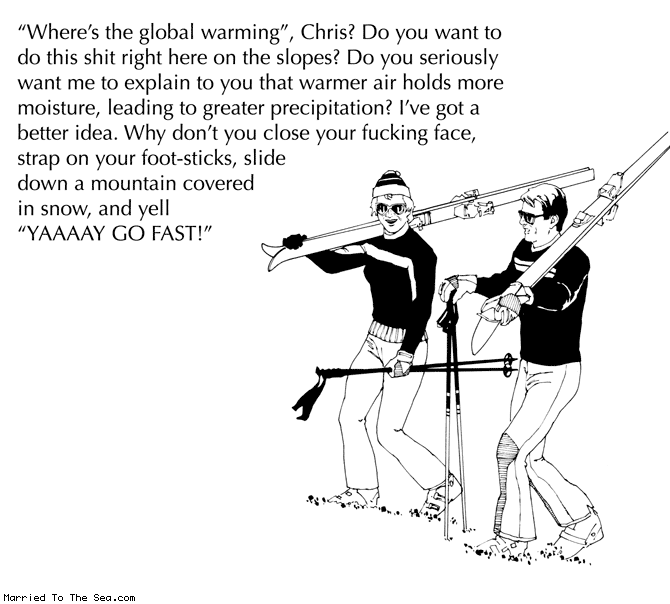
The very firstthing that you should do when debunking something is to statematter-of-factly that something is bunk; i.e., "Everybody Poopsis bunk." This is to indicate that you are not looking for a debateon the issue. You are not going to engage in a Socratic dialogue todiscover the truth, or to create a new synthesis from a thesis and anantithesis through the application of Hegelian dialectic. Instead,you are looking for a hostile co-dependent relationship with somebodywho wants to perpetually uphold the diametrically opposed piece ofbunk: "Of course everybody poops, don't be ridiculous!" Suchco-dependent relationships are to be found everywhere in the US, butperhaps the prime example is the Republicans and the Democrats, whoare always looking for a new piece of bunk about which they couldprofitably disagree. Somehow we have managed to generate theexpectation that where there is bunk there must be anti-bunk, andthat they should be served up as "alternative viewpoints" asopposed to diametrically opposed ways to exclude a common truth. Andso, whenever a climate scientist appears on television and tries toexplain global warming to the masses (being forced to dumb down thescience, to make it fit for television, until it becomes bunk) theremust also appear a climate anti-scientist and serve up some climateanti-bunk: "It's been a cold, snowy winter; therefore, the climatescience is wrong."
Thenext phase of a debunking onslaught is to declare your targeted pieceof bunk "completely wrong" based on a bona fide counterexample.It turns out that evidence can be gathered to contradict any theory.Such evidence may accumulate over time, and eventually give rise to anew theory which either replaces or extends the previous theory, butmostly it's just a minor annoyance. Now, "everybody poops" is aconjecture based on the rather shallow theory that everybody eats,and since what goes in must come out, everybody poops. So, what aboutthe male of the moth detailed in Dr.Tatiana's Sex Advice to All Creation: The Definitive Guide to theEvolutionary Biology of Sex by OliviaJudson? This moth lays its eggsin the ears of bats. When the eggs hatch, there is one male andseveral females. The male incestuously mates with his sisters, whothen fly away to find bats of their own, while the male stays behindand dies. Most interestingly, the male is born without mouth parts,and therefore cannot eat. To paraphrase St. Paul in 2 Thessalonians3:10, "If a man will not eat, he shall not poop." So much for thebrave conjecture.
Thenext phase of a debunking onslaught is an ad hominem attack. Whatsort of an expert would be qualified to discuss this subject? A"poopologist," perhaps? One immediately wonders whether thePoopology Department, where this supposed luminary learned his art,was the recipient of any public funding, funding that should perhapshave been better spent on a few widows the orphans or a teeny-tinycounterterrorism campaign. And one cannot but help wonder what hisfraternity brothers called him; "the poopmeister," perhaps? Ourpoopmeister must have known about the bat moth; why did he withholdsuch crucial anti-everybody-pooping evidence? Why should we listen tosuch a person? And so on and so forth.
Youmight think that my choice of debunking target is frivolous andwithout merit, but I believe that it fits right in with both thesubstance and the level of contemporary American public discourse.You may be blissfully unaware of this, but I regret to inform youthat there is in certain dimly lit corners of the US a war going on:a war on masturbation. During the last congressional elections oneChristine O'Donnell won the Republican nomination for Senator fromDelaware. O'Donnell is notorious for her anti-masturbationcampaign. Declaring masturbation to be a sin is a good wayto warp the minds of the post-pubescent, so that they might grow intothe sorts of sexually repressed adults who are fit to serve at thehead of the Department of Defense or on the US Supreme Court; butwhat about the pre-pubescent? Why not go after other bodily functions? Gluttony is already a sin (a mortal one); let us declare defecation a sin as well and goafter the anally retentive pre-pubescents? Are you pro-poop oranti-poop? Let's open up the phone lines! Or not.

Withthe nation's public discourse dominated by dueling bits of bunk, Isuggest that you limit your public pronouncements to nonsensicalutterances such as "Herp-derp-derp!" And if you feel like pickinga side, then order a side of bacon, because it is tasty. It mightclog your arteries, but at least it won't clog your mind with bunk.

March 7, 2011
The Empire Strikes Out
p { margin-bottom: 0.08in; }
 Ramon Tikaram in Gaddafi: A Living Myth Tunisia, Egypt, Libya... now, children,one of these things is not like the others. That's right, Libyawasn't, and to a considerable extent still isn't, run by a dictatorwho happens to be a Western stooge. Say what you want about him, Muammar Gaddafiis a phenomenon. Compared to his inimitable, flamboyant persona,Tunisia's unimpressive Zia El Abidine ben Ali and Egypt's viciouslythick Hosni Mubarak are ciphers. Yes they are all dictators, but lookat the region and ask yourself: Who isn't? Even the Roman Senate used to elect a dictator in times trouble; when isn't it a time of trouble in this region?
Gaddafi eschews the notions of thenation state, of Arab nationalism, and of electoral democracy. Heforbids political parties. He is tribal; he espouses Islamicsocialism, and his idea of democracy is one where tribal eldersbring requests and grievances to him, and he gets to dispenselargesse and pass judgment. He fancies himself a sort of king: a"king of kings." He likes all kinds of African tribes, not justArab ones; he is all about African unity in the face of Westernoppression. He probably wouldn't mind ruling them all. He is, unarguably, green.
 Hiding in front of the flag?While Western leaders were surprised bythe Tunisian revolt, and weren't at all sure about the Egyptian one (onlyeventually settling on the idea that Mubarak must go), theyabsolutely knew from the outset that leaving Gaddafi in power wouldtake the political and economic disaster that this revolutionarytrend already portends and raise it to the Nth power. Gaddafi had togo, and so vague noises were made about automatic support for anysort of disrespect the tribes that are not completely aligned withhim could muster. They seem to have miscalculated rather badly, andnow we are witnessing a series of embarrassing vignettes such asthe instantaneous leaking of Obama's "super-secret" request to the Saudis to help Libyanrebels, or the recent British diplomatic "mission" which invadedwith weapons and explosives and was apprehended by the rebels, whoare no doubt starting to feel that this particular revolutionaryexercise is not going too well for them. It was a mistake to treatLibya as a country, where protesters have rights. Libya is special.You have to go very far back in history to find something similar.Perhaps Carthage, which came quite close to sacking Rome andredirecting the flow of world history, is something of a North Africananalogy.
 Zia swears to stay in office foreverGaddafi's niche in the pantheon ofnational leaders who dared oppose the US—where he stands alongsideFidel Castro, Hugo Chavez, Kim Jong Il and Mahmud Ahmadinejad—isenough to warrant his removal and conversion of Libya into aNATO-bombed defunct narco-state like Kosovo or Afghanistan, but ontop of that his brand of political philosophy, which he termedjamāhīriyyah (translatedas "state of the masses") might actually stand a chance in manycollapsing nation states beyond Libya. The revolutions now spreadingaround the world are essentially bread riots: the disastrous harvestsdue to heat waves and floods around the world, caused by theaccelerating onset of global warming, have caused food prices tospike. It is rather unusual for democracy (of the legalistic Westernkind) to succeed where stomachs are empty. One normally expects abeer putsch or two, a Kristallnacht and perhaps a Reichstag on fire.Gaddafi's socialist islamic tribalism may succeed as more and morenation states turn into defunct states, as national borders dissolve, andinter-ethnic conflicts and makeshift allegiances erase all the nicestraight lines so carefully drawn on maps by colonizing Westerners.For all these reasons, Gaddafi must be deposed. The question is, canthe West still rise to the occasion, or is it too internallyconflicted, senile and broke? A little bit of time will tell.

 Ramon Tikaram in Gaddafi: A Living Myth Tunisia, Egypt, Libya... now, children,one of these things is not like the others. That's right, Libyawasn't, and to a considerable extent still isn't, run by a dictatorwho happens to be a Western stooge. Say what you want about him, Muammar Gaddafiis a phenomenon. Compared to his inimitable, flamboyant persona,Tunisia's unimpressive Zia El Abidine ben Ali and Egypt's viciouslythick Hosni Mubarak are ciphers. Yes they are all dictators, but lookat the region and ask yourself: Who isn't? Even the Roman Senate used to elect a dictator in times trouble; when isn't it a time of trouble in this region?
Gaddafi eschews the notions of thenation state, of Arab nationalism, and of electoral democracy. Heforbids political parties. He is tribal; he espouses Islamicsocialism, and his idea of democracy is one where tribal eldersbring requests and grievances to him, and he gets to dispenselargesse and pass judgment. He fancies himself a sort of king: a"king of kings." He likes all kinds of African tribes, not justArab ones; he is all about African unity in the face of Westernoppression. He probably wouldn't mind ruling them all. He is, unarguably, green.
 Hiding in front of the flag?While Western leaders were surprised bythe Tunisian revolt, and weren't at all sure about the Egyptian one (onlyeventually settling on the idea that Mubarak must go), theyabsolutely knew from the outset that leaving Gaddafi in power wouldtake the political and economic disaster that this revolutionarytrend already portends and raise it to the Nth power. Gaddafi had togo, and so vague noises were made about automatic support for anysort of disrespect the tribes that are not completely aligned withhim could muster. They seem to have miscalculated rather badly, andnow we are witnessing a series of embarrassing vignettes such asthe instantaneous leaking of Obama's "super-secret" request to the Saudis to help Libyanrebels, or the recent British diplomatic "mission" which invadedwith weapons and explosives and was apprehended by the rebels, whoare no doubt starting to feel that this particular revolutionaryexercise is not going too well for them. It was a mistake to treatLibya as a country, where protesters have rights. Libya is special.You have to go very far back in history to find something similar.Perhaps Carthage, which came quite close to sacking Rome andredirecting the flow of world history, is something of a North Africananalogy.
 Zia swears to stay in office foreverGaddafi's niche in the pantheon ofnational leaders who dared oppose the US—where he stands alongsideFidel Castro, Hugo Chavez, Kim Jong Il and Mahmud Ahmadinejad—isenough to warrant his removal and conversion of Libya into aNATO-bombed defunct narco-state like Kosovo or Afghanistan, but ontop of that his brand of political philosophy, which he termedjamāhīriyyah (translatedas "state of the masses") might actually stand a chance in manycollapsing nation states beyond Libya. The revolutions now spreadingaround the world are essentially bread riots: the disastrous harvestsdue to heat waves and floods around the world, caused by theaccelerating onset of global warming, have caused food prices tospike. It is rather unusual for democracy (of the legalistic Westernkind) to succeed where stomachs are empty. One normally expects abeer putsch or two, a Kristallnacht and perhaps a Reichstag on fire.Gaddafi's socialist islamic tribalism may succeed as more and morenation states turn into defunct states, as national borders dissolve, andinter-ethnic conflicts and makeshift allegiances erase all the nicestraight lines so carefully drawn on maps by colonizing Westerners.For all these reasons, Gaddafi must be deposed. The question is, canthe West still rise to the occasion, or is it too internallyconflicted, senile and broke? A little bit of time will tell.
Dmitry Orlov's Blog

- Dmitry Orlov's profile
- 48 followers
Dmitry Orlov isn't a Goodreads Author
(yet),
but they
do have a blog,
so here are some recent posts imported from
their feed.

