
Everyone Poops Debunked
 Humanity movesforward through the progress of ideas. The more dynamic societies arethose that are willing to adopt good new ideas and to test anddiscard faulty ideas, old or new. Stagnant societies are those thatrefuse to question old ideas and refuse to consider new ones, be itthrough entrenched conservatism, or a deficit of intellectualdevelopment, or some other developmental issue.
The United States was once a dynamicland, full of new ideas which were widely emulated around the world,but now it has become stagnant and mired in conservatism and internalcontradiction, unable to discard faulty ideas or to embrace new ones,while other countries race ahead. National dialogue in the US hasbecome not so much about ideas as about a mysterious substance calledbunk: a deliberate sort ofnonsense produced for the sake of public posturing. This profusion ofbunk in turn attracts much effort to the cause of debunkingit. However, unlike the bunk (or, more accurately bunkum)of yesteryear, which could be made to disappear when debunked, thisnew variety of American bunk only grows stronger and more rampant.
To better understand this magicalability of our contemporary bunk to withstand debunking, I decided todo an experiment. I deliberately chose what should be a very hardtarget: the little chidren's book by Tarō Gomi Everyone Poops .It tries to set the minds of the little anal retentive prats at easeby showing them that everybody but everybody poops: elephants makegigantic poops, mice little ones, little boys slightly smaller thangrown men. Debunking such a powerful conjecture is a tall order,you might think. Not so! It turns out that, like beauty, bunk is inthe eye of the beholder, and that it is possible to debunk anything(or fail trying; it doesn't matter which it is because theresults are all but indistinguishable).
So what is this mysterious mentalsubstance, bunk? It seems to me that bunk can be defined as pretenseof knowledge. In turn, knowledge, for purposes of defining bunk, is aset of ideas (facts, theories, views) held in common. This is not tosay that they are common knowledge. In fact, they might be virtuallyunknown outside of a select group of specialists, but in theoryanyone who is sufficiently well-schooled, talented, diligent and hasa library card could gain that same understanding given unlimitedtime and effort.
Human progress has to a large extentbeen mental progress. We have progressed from widespreadreliance on mystification, where we ascribed great magic powers toethereal, unobservable entities, and postulated a great many "facts"about the world which could be neither proved nor disproved. Now werequire that our facts have a basis in observable, measurablereality, that our hypotheses be testable by experiment, and that ourconclusions about causality be based on evidence (even if it is theiffy statistical evidence that is considered acceptable in medicine,economics and the social sciences). Say what you will about progressin politics or economics (or lack thereof) but humanity's progress inacquiring ever more powerful and detailed knowledge has been nothingshort of astounding. This is especially apparent in the sciences, buteven in the humanities it is possible to point to profound newinsights. Many things are still unknown to us—we still don't knowwhy aspirin works, and are continually astonished by the behavior ofmelting glaciers—but overall the realm of what is rationallyunderstood expands continually.
Let us try to be slightly more rigorousin defining common knowledge. In terms of epistemic logic, given somepiece of knowledge S, one could have private knowledge: KASexpresses that A knowsS. (Kis called the knowledge operator.)Now A walks up to B,and asks him whether he knows S.There are just two possibilities: either Bknows S (KBS)or he doesn't (~KBS).If he doesn't, then Aimparts Sto B, and the realm ofcommon knowledge expands: KASand KBS.Not only that, but Aknows that B knows S(KAKBS)and vice versa (KBKAS).Plus, each knows that the other knows that he knows, giving usKAKBKASand KBKAKBS.There are situations in life when knowing whether someone knows thatyou know is strategically important, and it is even possible to thinkof a situation in which your knowledge of whether someone knowswhether you know that he knows is somehow pregnant with thepossibility of hilarious shenanigans, but under less contrivedcircumstances it all short-circuits to common knowledge:KA,BS.
Inorder for the above scenario to lead to common knowledge, at theoutset our B must knowthat he doesn't know S:KB~KBS.There are just two valid states of B'smind: either he knows that he knows S(KBKBS),or he knows that he doesn't (KB~KBS).If B doesn't know whathe knows (~KBKBx)or if he doesn't know that he doesn't know (~KB~KBx)then B must be amentally challenged individual who is incapable of participating incommon knowledge. But Bcan still remain socially acceptable provided he humbly accepts hisignorance and agrees to defer to A'ssuperior knowledge of S:KBKAS.Thus the realm of common knowledge may have many adjuncts: people whoare aware of the existence of a certain domain without actuallyknowing it, or even pretending to. This is typically how we relate toall kinds of specialists, from brain surgeons to auto mechanics tofinancial advisors.
Iitalicized the word "imparts"two paragraphs ago because it is important: common knowledgepresupposes that the piece of knowledge is communicated accuratelyand entirely. But suppose that a mentally defective Breceives, through some accident, a damaged copy of S(which we will call S').Perhaps a word got substituted, such as "flat" for "round" inthe statement "The Earth is round." Or perhaps S'came to include a string of gibberish: "...because the Bible saysthat blah blah blah etc." Now Bthinks that he knows S,but in fact he knows S'(KBS').Epistemically speaking, Bnow inhabits an alternate universe in which S=S'.Our epistemically savvy and knowledgeable friend Arealizes this this (KA~KBS,KAKBS')but, being tactful, all he can do is cough politely and look forsomebody else to talk to, while Bgoes off and tells other mental defectives all about S',blithely calling it S,which, by the way, he just discussed with an expert. You see what atravesty this is?
This is the generalmechanism by which a piece of knowledge S generates itsfaulty, incomplete, mangled copy S' within the publicimagination. If S is the statement "Humans and otherprimates share a common genetic ancestor" then S' might be apiece of bunk such as "You are descended from a monkey!" Oftenthe very next move is to generate a piece of counter-bunk ~S'—something like "No, we were pooped out by a Giant Pixie near theend of a seven-day Poopathon!" And now we have two pieces ofbunk—S' and ~S', both of which require debunking.
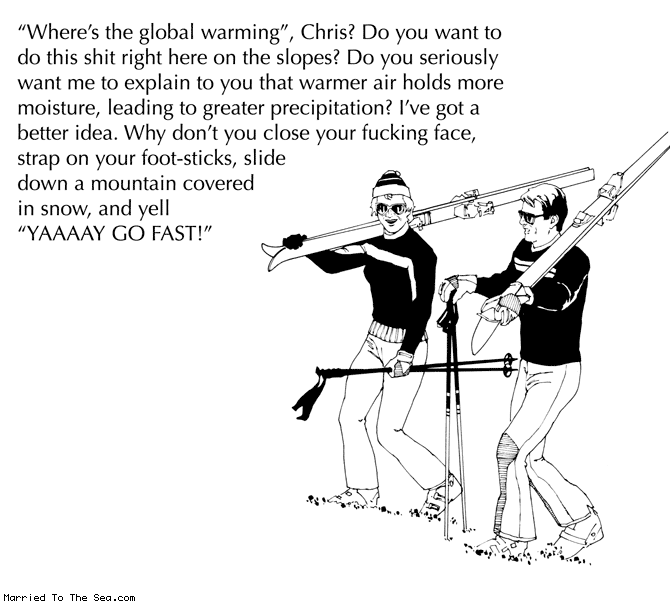
The very firstthing that you should do when debunking something is to statematter-of-factly that something is bunk; i.e., "Everybody Poopsis bunk." This is to indicate that you are not looking for a debateon the issue. You are not going to engage in a Socratic dialogue todiscover the truth, or to create a new synthesis from a thesis and anantithesis through the application of Hegelian dialectic. Instead,you are looking for a hostile co-dependent relationship with somebodywho wants to perpetually uphold the diametrically opposed piece ofbunk: "Of course everybody poops, don't be ridiculous!" Suchco-dependent relationships are to be found everywhere in the US, butperhaps the prime example is the Republicans and the Democrats, whoare always looking for a new piece of bunk about which they couldprofitably disagree. Somehow we have managed to generate theexpectation that where there is bunk there must be anti-bunk, andthat they should be served up as "alternative viewpoints" asopposed to diametrically opposed ways to exclude a common truth. Andso, whenever a climate scientist appears on television and tries toexplain global warming to the masses (being forced to dumb down thescience, to make it fit for television, until it becomes bunk) theremust also appear a climate anti-scientist and serve up some climateanti-bunk: "It's been a cold, snowy winter; therefore, the climatescience is wrong."
Thenext phase of a debunking onslaught is to declare your targeted pieceof bunk "completely wrong" based on a bona fide counterexample.It turns out that evidence can be gathered to contradict any theory.Such evidence may accumulate over time, and eventually give rise to anew theory which either replaces or extends the previous theory, butmostly it's just a minor annoyance. Now, "everybody poops" is aconjecture based on the rather shallow theory that everybody eats,and since what goes in must come out, everybody poops. So, what aboutthe male of the moth detailed in Dr.Tatiana's Sex Advice to All Creation: The Definitive Guide to theEvolutionary Biology of Sex by OliviaJudson? This moth lays its eggsin the ears of bats. When the eggs hatch, there is one male andseveral females. The male incestuously mates with his sisters, whothen fly away to find bats of their own, while the male stays behindand dies. Most interestingly, the male is born without mouth parts,and therefore cannot eat. To paraphrase St. Paul in 2 Thessalonians3:10, "If a man will not eat, he shall not poop." So much for thebrave conjecture.
Thenext phase of a debunking onslaught is an ad hominem attack. Whatsort of an expert would be qualified to discuss this subject? A"poopologist," perhaps? One immediately wonders whether thePoopology Department, where this supposed luminary learned his art,was the recipient of any public funding, funding that should perhapshave been better spent on a few widows the orphans or a teeny-tinycounterterrorism campaign. And one cannot but help wonder what hisfraternity brothers called him; "the poopmeister," perhaps? Ourpoopmeister must have known about the bat moth; why did he withholdsuch crucial anti-everybody-pooping evidence? Why should we listen tosuch a person? And so on and so forth.
Youmight think that my choice of debunking target is frivolous andwithout merit, but I believe that it fits right in with both thesubstance and the level of contemporary American public discourse.You may be blissfully unaware of this, but I regret to inform youthat there is in certain dimly lit corners of the US a war going on:a war on masturbation. During the last congressional elections oneChristine O'Donnell won the Republican nomination for Senator fromDelaware. O'Donnell is notorious for her anti-masturbationcampaign. Declaring masturbation to be a sin is a good wayto warp the minds of the post-pubescent, so that they might grow intothe sorts of sexually repressed adults who are fit to serve at thehead of the Department of Defense or on the US Supreme Court; butwhat about the pre-pubescent? Why not go after other bodily functions? Gluttony is already a sin (a mortal one); let us declare defecation a sin as well and goafter the anally retentive pre-pubescents? Are you pro-poop oranti-poop? Let's open up the phone lines! Or not.

Withthe nation's public discourse dominated by dueling bits of bunk, Isuggest that you limit your public pronouncements to nonsensicalutterances such as "Herp-derp-derp!" And if you feel like pickinga side, then order a side of bacon, because it is tasty. It mightclog your arteries, but at least it won't clog your mind with bunk.


No comments have been added yet.
Dmitry Orlov's Blog

- Dmitry Orlov's profile
- 48 followers
Dmitry Orlov isn't a Goodreads Author
(yet),
but they
do have a blog,
so here are some recent posts imported from
their feed.

