
Dmitry Orlov's Blog, page 35
March 6, 2011
Small Boat Ocean Voyaging for the Accident-Prone
p { margin-bottom: 0.08in; }
 The world is full of stories ofsuccess, mostly because successful people like to tell of theirvictories rather than expound on their defeats. This is self-servingof them and a loss to the rest of us, because we only learn frommistakes. The best kind are small, non-fatal mistakes; these are alsothe most common. Disastrous, fatal errors are rarely the first onesto be made, because it usually takes a compounding of errors to give rise toa fatal situation. And so here is a little object study of a seriesof small errors, the problems they caused, and the solutions theynecessitated.
Giving credit where credit is due, letme say right at the outset that the problems I will examine here arenot entirely of my own making: they were rather carefully set up forme by the person from whom I bought my boat. I do fault myself for my(initial) inexperience, my misplaced trust (I trusted that heknew what he was doing) and my inability to draw a conclusion and acton it (that the person in question was a dangerous incompetent andthat everything on the boat that he had touched should be becarefully examined, and, in some cases, cast overboard forthwith andreplaced).
I have a plethora of examples to choosefrom, but, for the sake of keeping the story short and focused, Iwill zero in on just one problem: autohelm mounting. Autopilots (andother self-steering devices such as windvanes) are essential forpeople who make ocean passages single-handed or without much crew. Mycrew is my wife; if we were to steer by hand, we'd each have to steerfor 12 hours out of every 24 (which we've done on occasion and didnot particularly care for). Needless to say, our tillerpilot is afavorite piece of equipment: with it, life is easy; without it, lifeis hard.
Our boat uses a Simrad Autohelm TP32,which is an amazing piece of equipment. Along with the GPS and theVHF radio, these are the only pieces of marine electronics on myboat, and are carefully chosen for being cheap, reliable, andindispensable. The boat came with a TP22 (TP32's smaller cousin)pre-installed by the boat's previous owner, which is where this storybegins.
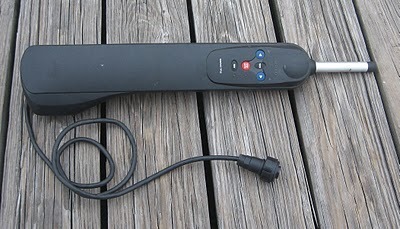 Simrad TP32 (highly recommended)
Tillerpilots are complicated on theinside (incorporating a fluxgate compass, a servo motor and a microcontroller) but simple on the outside. Clip them to a socketmounted in the cockpit and a pin mounted on the tiller, push the"Auto" button, and the boat will go in a straight line, for days.There are just three steps to the installation: mount the socket,mount the pin, and hook it up to 12 Volts. Now, what happens when one buys aboat where someone has screwed up all three? Answer: amazingadventure beyond your wildest dreams!
* * *
Having launched Hogfish, our boat, inBoston, our first voyage was north to Maine. The passage to Portlandwas uneventful. The wind was steady and the autohelm performedadmirably. On July 27, 2007 we left Portland around 13:30 and headedacross Casco Bay and up the coast. Around 17:30 the wind pickedup considerably and I took in a reef. Around 18:00 I made a note inthe log:
"18:00: Autohelm busted. Bracketfarigued. No more autohelm."
The broken bracket was a puny aluminumalloy stamping. It broke in half as I watched in dismay.
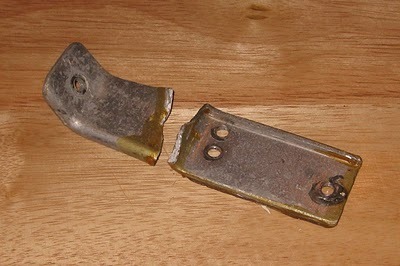 Pin bracket (not serviceable)
"18:16: Worked out a beam reach withtiller lashed."
In the intervening 15 minutes, I putaway the now useless tillerpilot and worked out a combination of sailtrim and rudder angle to keep the boat sailing along without beingactively steered. Now, Hogfish is a very good little boat that doessomething only some particularly well-designed boats do: itself-steers. That is, on most points of sail (anything from beamreach to close on the wind) it does not have to be steered at all tofollow a course. It hunts around a bit, and sometimes a big wave or abig gust will knock it off course, but mostly it takes care ofitself.
By 23:15 it was blowing half a gale inthe direction of some jagged rocks, which I knew to be lurkingominously on the horizon. I logged: "At this point, need toavoid land... New course 124°Mto avoid Manana Island." I pointed the boat at the open ocean andplayed with the tiller lashings and sail trim to keep it on course.By midnight I was mostly napping in the cockpit. Every 7 minutes aperiodic big wave would wake me up, and I would scan the dark horizonand adjust sail trim and tiller. By 3:21, based on dead reckoning, wewere close-reaching safely south of Monhegan Island. Around 5:00the wind died. I fired up the GPS and took a reading: 43°43.97'/69°09.35' whichput us ESE of Monhegan and nowhere near any dirt or rocks.
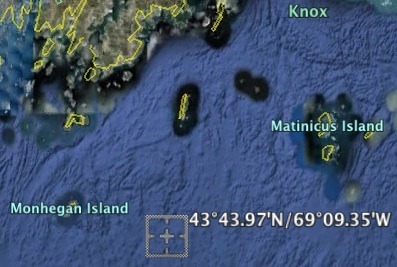
I measuredthe drift: 1 kt to 50°M—areasonable direction back toward mainland with sea room on all sides.Since the wind was dead, "heaving to" was not an option. Theremaining option was "lying ahull," so I took down the sails,turned on the anchor light, let the sea do what it will and and wentto sleep for real. I had to sleep on the settee in the cabin,stiff-arming the centerboard trunk to avoid rollng off, because mywife and the cat took up all of the V-berth, spread out as far aspossible, to avoid getting rolled over by the big 7-minute waves. Thecat seemed particularly well-anchored to the bedspread, with her pawsoutstretched and her claws out.
By dawn we had only drifted a fewmiles. It was windless and foggy. We motored to the tiny andpicturesque Isle Au Haut and by 16:00 were at a "rented" mooring(the rent being a $20 stuffed into a coke bottle attached to themooring buoy) in the island's snug and picture-perfect anchorage. Thenext day I built a new bracket out of scrap using hand tools onboard, and on the 29th we sailed on, to Blue Hill Bay.
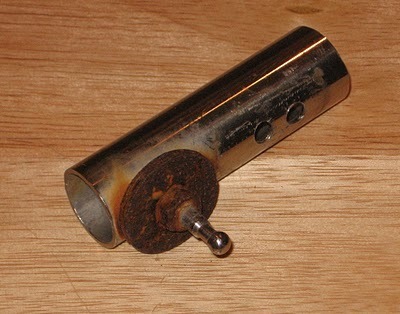 Replacement pin bracket (worked fine, eventually)
* * *
This repair stood us in good stead forquite a while, until the fateful morning of October 27, 2007, whenthe pin rocked loose while we were sailing down Long Island Sound atnight, toward New York City. I hand-steered the rest of the way, a good 6hours of hard work avoiding getting spun around by big followingseas that congregated at the narrow end of the Sound. While at 79th Street Marina I was able to fix theproblem by stacking up some washers (which are rusted in the photoabove because the hardware store on Broadway did not stock stainless steelhardware). But after that the pin, at least, held through all kindsof weather.
* * *
All was well with our autohelm hardwareuntil July 10th of 2008, when we were approachingBeaufort, North Carolina, having cast off at St. Augustine, Floridaon the 6th. Approaching Cape Hatteras (an evil spot from asailing point of view if there ever was one) we were caught up in oneof the outer arms of Hurricane Bertha, which whipped up gale forcewinds and 10-12 foot seas. In these conditions, the socket in theautohelm base worked loose and started rocking. I took all of this inand made a change of plan: we were going to make it to Beaufort Inletrunning under bare poles and then get a tow through the inlet. Thisplan worked well enough, except for one thing: after the tow boatcaptain passed me the towing line and I tied it to the Samson post inthe bow of the boat, a huge breaking wave swept through and tumbledthe towing line under the boat, looping it around the rudder, so thatwhen the tow boat captain throttled up, he put enough force on therudder to snap our autopilot in half. Since he was a BoatUS captain,and I carried BoatUS insurance, BoatUS paid for a replacementautopilot, giving me a chance to upgrade to a TP32 from a TP22, soall was well. (While installing the TP32, I couldn't help but noticethat the TP22 was wired up with the dinkiest of wires rather than therecommended 12-gauge, and this explained its sometimes erraticperformance.)
As an aside, sailing in a hurricane isprobably not everyone's cup of tea. Frankly, I don't care for it verymuch myself. It is unsettling to look up at your mast and see waterdirectly behind it, and it is strange to look at the horizon and seean ant's eye view of a broccoli patch. Also, I don't much like itwhen the wind is strong enough to pick up a neat coil of heavy dockline right off the deck and string it out into the sea, or when,while clambering around the deck in a harness, I have to pinch mynose shut and breathe through pursed lips because otherwise the windis strong enough to explode my lungs. At some point we declared thecabin unsafe because of all the loose cutlery flying around downthere and boarded it off, and my wife sat in the cockpit with me,holding the cat wrapped in a towel. We were all relatively calm andself-assured, but after it was all over and we were safely tied up atBeaufort Docks, the cat gave me the weirdest look I ever got from acat; a look that said something like "What in the wild world ofsports was all that about?" Enough said; sailing through ahurricane is not a recommended procedure as far as I am concerned.
While at Beaufort Docks I drilled a newhole for the autohelm socket and epoxied it it in place.
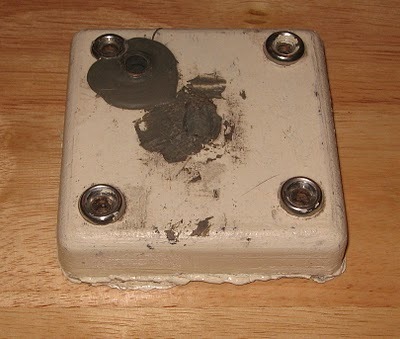 Socket base (with socket relocated)In theprocess, I discovered two things: first, the original socket positionwas misaligned, causing the autohelm to "hunt around" tocompensate for being rotated left while trying to turn right and viceversa, indicating that whosoever installed it was geometricallychallenged. Secondly, what looked like a solid piece of wood used tomount the socket turned out to be masonite, whichis an environmentally friendly product invented by one Mr. Mason andmade by pressing together wood chips without any sort of glue. (Theautohelm manufacturer's instructions specified hardwood.) Icompensated for the weakness of this material by oversizing the holeand slathering it with epoxy. It held for as long as it had to.
Whilehauled out for repairs in East Boston during the winter of 2009-2010I finally had a chance to address the problem of autohelm mountingonce and for all. The base now consists of two pieces of oaklag-bolted and glued together, mounted to the cockpit seat usingthrough-bolts.
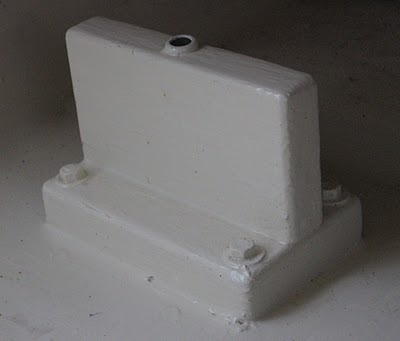 The final version (no issues at all)The pin is now pounded into a carved piece of oak thatis secured to the tiller by a U-bolt bolted through the rudder to abacking plate.
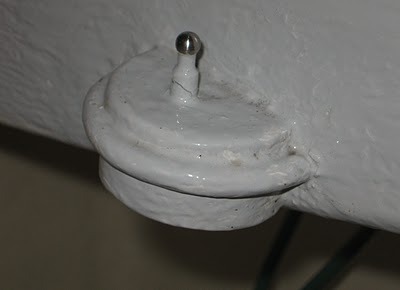 The final version (no issues at all)
All of the above are coated with epoxy and paintedwith two-part polyurethane primer, and a couple of coats of two-partpolyurethane paint. I suspect that this combination will outlast manythings, including me and the boat.

 The world is full of stories ofsuccess, mostly because successful people like to tell of theirvictories rather than expound on their defeats. This is self-servingof them and a loss to the rest of us, because we only learn frommistakes. The best kind are small, non-fatal mistakes; these are alsothe most common. Disastrous, fatal errors are rarely the first onesto be made, because it usually takes a compounding of errors to give rise toa fatal situation. And so here is a little object study of a seriesof small errors, the problems they caused, and the solutions theynecessitated.
Giving credit where credit is due, letme say right at the outset that the problems I will examine here arenot entirely of my own making: they were rather carefully set up forme by the person from whom I bought my boat. I do fault myself for my(initial) inexperience, my misplaced trust (I trusted that heknew what he was doing) and my inability to draw a conclusion and acton it (that the person in question was a dangerous incompetent andthat everything on the boat that he had touched should be becarefully examined, and, in some cases, cast overboard forthwith andreplaced).
I have a plethora of examples to choosefrom, but, for the sake of keeping the story short and focused, Iwill zero in on just one problem: autohelm mounting. Autopilots (andother self-steering devices such as windvanes) are essential forpeople who make ocean passages single-handed or without much crew. Mycrew is my wife; if we were to steer by hand, we'd each have to steerfor 12 hours out of every 24 (which we've done on occasion and didnot particularly care for). Needless to say, our tillerpilot is afavorite piece of equipment: with it, life is easy; without it, lifeis hard.
Our boat uses a Simrad Autohelm TP32,which is an amazing piece of equipment. Along with the GPS and theVHF radio, these are the only pieces of marine electronics on myboat, and are carefully chosen for being cheap, reliable, andindispensable. The boat came with a TP22 (TP32's smaller cousin)pre-installed by the boat's previous owner, which is where this storybegins.
 Simrad TP32 (highly recommended)
Tillerpilots are complicated on theinside (incorporating a fluxgate compass, a servo motor and a microcontroller) but simple on the outside. Clip them to a socketmounted in the cockpit and a pin mounted on the tiller, push the"Auto" button, and the boat will go in a straight line, for days.There are just three steps to the installation: mount the socket,mount the pin, and hook it up to 12 Volts. Now, what happens when one buys aboat where someone has screwed up all three? Answer: amazingadventure beyond your wildest dreams!
* * *
Having launched Hogfish, our boat, inBoston, our first voyage was north to Maine. The passage to Portlandwas uneventful. The wind was steady and the autohelm performedadmirably. On July 27, 2007 we left Portland around 13:30 and headedacross Casco Bay and up the coast. Around 17:30 the wind pickedup considerably and I took in a reef. Around 18:00 I made a note inthe log:
"18:00: Autohelm busted. Bracketfarigued. No more autohelm."
The broken bracket was a puny aluminumalloy stamping. It broke in half as I watched in dismay.
 Pin bracket (not serviceable)
"18:16: Worked out a beam reach withtiller lashed."
In the intervening 15 minutes, I putaway the now useless tillerpilot and worked out a combination of sailtrim and rudder angle to keep the boat sailing along without beingactively steered. Now, Hogfish is a very good little boat that doessomething only some particularly well-designed boats do: itself-steers. That is, on most points of sail (anything from beamreach to close on the wind) it does not have to be steered at all tofollow a course. It hunts around a bit, and sometimes a big wave or abig gust will knock it off course, but mostly it takes care ofitself.
By 23:15 it was blowing half a gale inthe direction of some jagged rocks, which I knew to be lurkingominously on the horizon. I logged: "At this point, need toavoid land... New course 124°Mto avoid Manana Island." I pointed the boat at the open ocean andplayed with the tiller lashings and sail trim to keep it on course.By midnight I was mostly napping in the cockpit. Every 7 minutes aperiodic big wave would wake me up, and I would scan the dark horizonand adjust sail trim and tiller. By 3:21, based on dead reckoning, wewere close-reaching safely south of Monhegan Island. Around 5:00the wind died. I fired up the GPS and took a reading: 43°43.97'/69°09.35' whichput us ESE of Monhegan and nowhere near any dirt or rocks.
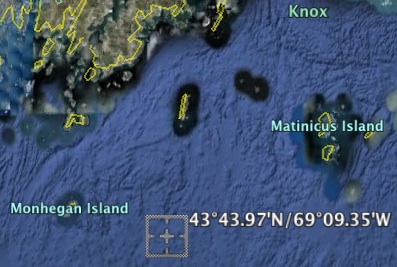
I measuredthe drift: 1 kt to 50°M—areasonable direction back toward mainland with sea room on all sides.Since the wind was dead, "heaving to" was not an option. Theremaining option was "lying ahull," so I took down the sails,turned on the anchor light, let the sea do what it will and and wentto sleep for real. I had to sleep on the settee in the cabin,stiff-arming the centerboard trunk to avoid rollng off, because mywife and the cat took up all of the V-berth, spread out as far aspossible, to avoid getting rolled over by the big 7-minute waves. Thecat seemed particularly well-anchored to the bedspread, with her pawsoutstretched and her claws out.
By dawn we had only drifted a fewmiles. It was windless and foggy. We motored to the tiny andpicturesque Isle Au Haut and by 16:00 were at a "rented" mooring(the rent being a $20 stuffed into a coke bottle attached to themooring buoy) in the island's snug and picture-perfect anchorage. Thenext day I built a new bracket out of scrap using hand tools onboard, and on the 29th we sailed on, to Blue Hill Bay.
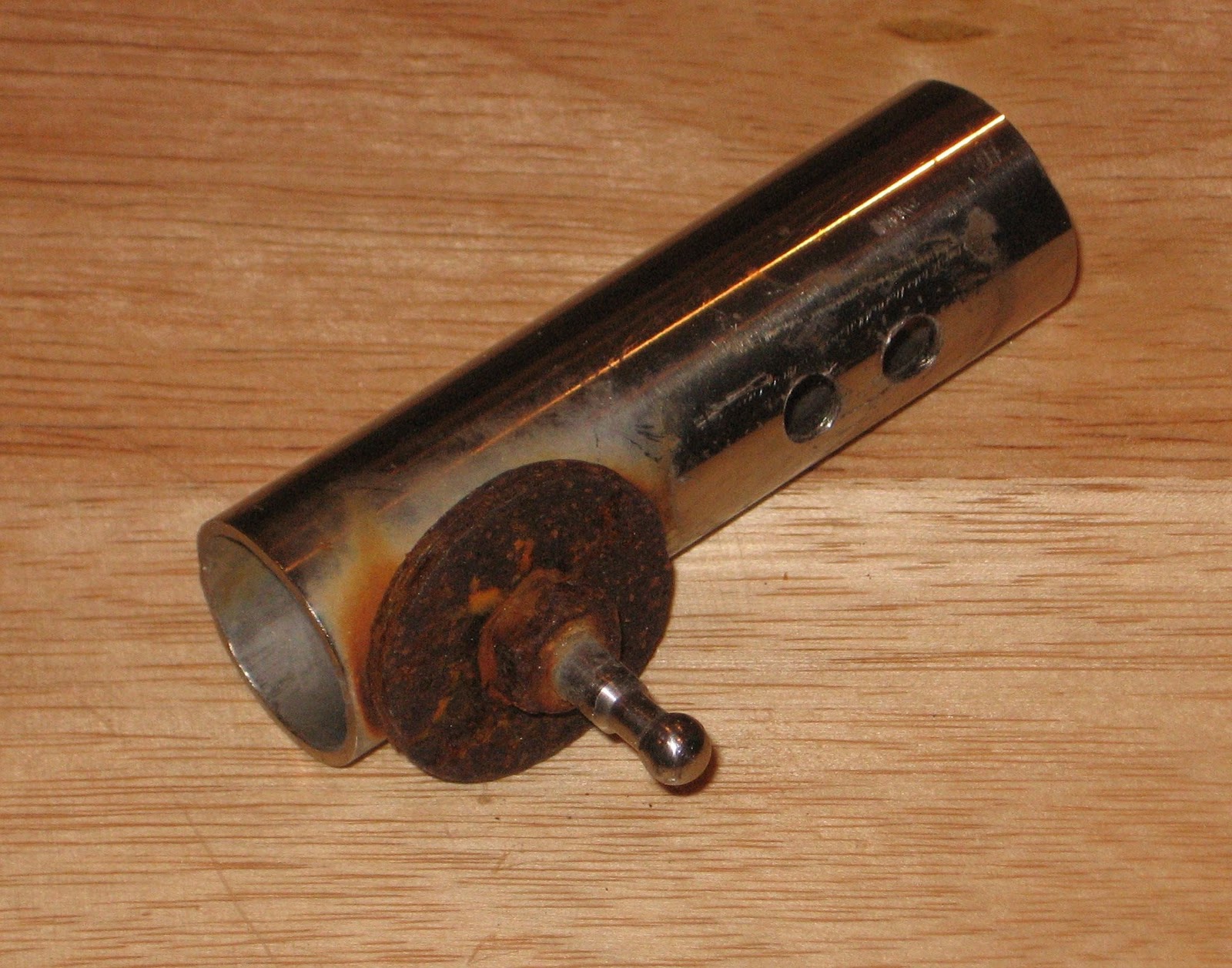 Replacement pin bracket (worked fine, eventually)
* * *
This repair stood us in good stead forquite a while, until the fateful morning of October 27, 2007, whenthe pin rocked loose while we were sailing down Long Island Sound atnight, toward New York City. I hand-steered the rest of the way, a good 6hours of hard work avoiding getting spun around by big followingseas that congregated at the narrow end of the Sound. While at 79th Street Marina I was able to fix theproblem by stacking up some washers (which are rusted in the photoabove because the hardware store on Broadway did not stock stainless steelhardware). But after that the pin, at least, held through all kindsof weather.
* * *
All was well with our autohelm hardwareuntil July 10th of 2008, when we were approachingBeaufort, North Carolina, having cast off at St. Augustine, Floridaon the 6th. Approaching Cape Hatteras (an evil spot from asailing point of view if there ever was one) we were caught up in oneof the outer arms of Hurricane Bertha, which whipped up gale forcewinds and 10-12 foot seas. In these conditions, the socket in theautohelm base worked loose and started rocking. I took all of this inand made a change of plan: we were going to make it to Beaufort Inletrunning under bare poles and then get a tow through the inlet. Thisplan worked well enough, except for one thing: after the tow boatcaptain passed me the towing line and I tied it to the Samson post inthe bow of the boat, a huge breaking wave swept through and tumbledthe towing line under the boat, looping it around the rudder, so thatwhen the tow boat captain throttled up, he put enough force on therudder to snap our autopilot in half. Since he was a BoatUS captain,and I carried BoatUS insurance, BoatUS paid for a replacementautopilot, giving me a chance to upgrade to a TP32 from a TP22, soall was well. (While installing the TP32, I couldn't help but noticethat the TP22 was wired up with the dinkiest of wires rather than therecommended 12-gauge, and this explained its sometimes erraticperformance.)
As an aside, sailing in a hurricane isprobably not everyone's cup of tea. Frankly, I don't care for it verymuch myself. It is unsettling to look up at your mast and see waterdirectly behind it, and it is strange to look at the horizon and seean ant's eye view of a broccoli patch. Also, I don't much like itwhen the wind is strong enough to pick up a neat coil of heavy dockline right off the deck and string it out into the sea, or when,while clambering around the deck in a harness, I have to pinch mynose shut and breathe through pursed lips because otherwise the windis strong enough to explode my lungs. At some point we declared thecabin unsafe because of all the loose cutlery flying around downthere and boarded it off, and my wife sat in the cockpit with me,holding the cat wrapped in a towel. We were all relatively calm andself-assured, but after it was all over and we were safely tied up atBeaufort Docks, the cat gave me the weirdest look I ever got from acat; a look that said something like "What in the wild world ofsports was all that about?" Enough said; sailing through ahurricane is not a recommended procedure as far as I am concerned.
While at Beaufort Docks I drilled a newhole for the autohelm socket and epoxied it it in place.
 Socket base (with socket relocated)In theprocess, I discovered two things: first, the original socket positionwas misaligned, causing the autohelm to "hunt around" tocompensate for being rotated left while trying to turn right and viceversa, indicating that whosoever installed it was geometricallychallenged. Secondly, what looked like a solid piece of wood used tomount the socket turned out to be masonite, whichis an environmentally friendly product invented by one Mr. Mason andmade by pressing together wood chips without any sort of glue. (Theautohelm manufacturer's instructions specified hardwood.) Icompensated for the weakness of this material by oversizing the holeand slathering it with epoxy. It held for as long as it had to.
Whilehauled out for repairs in East Boston during the winter of 2009-2010I finally had a chance to address the problem of autohelm mountingonce and for all. The base now consists of two pieces of oaklag-bolted and glued together, mounted to the cockpit seat usingthrough-bolts.
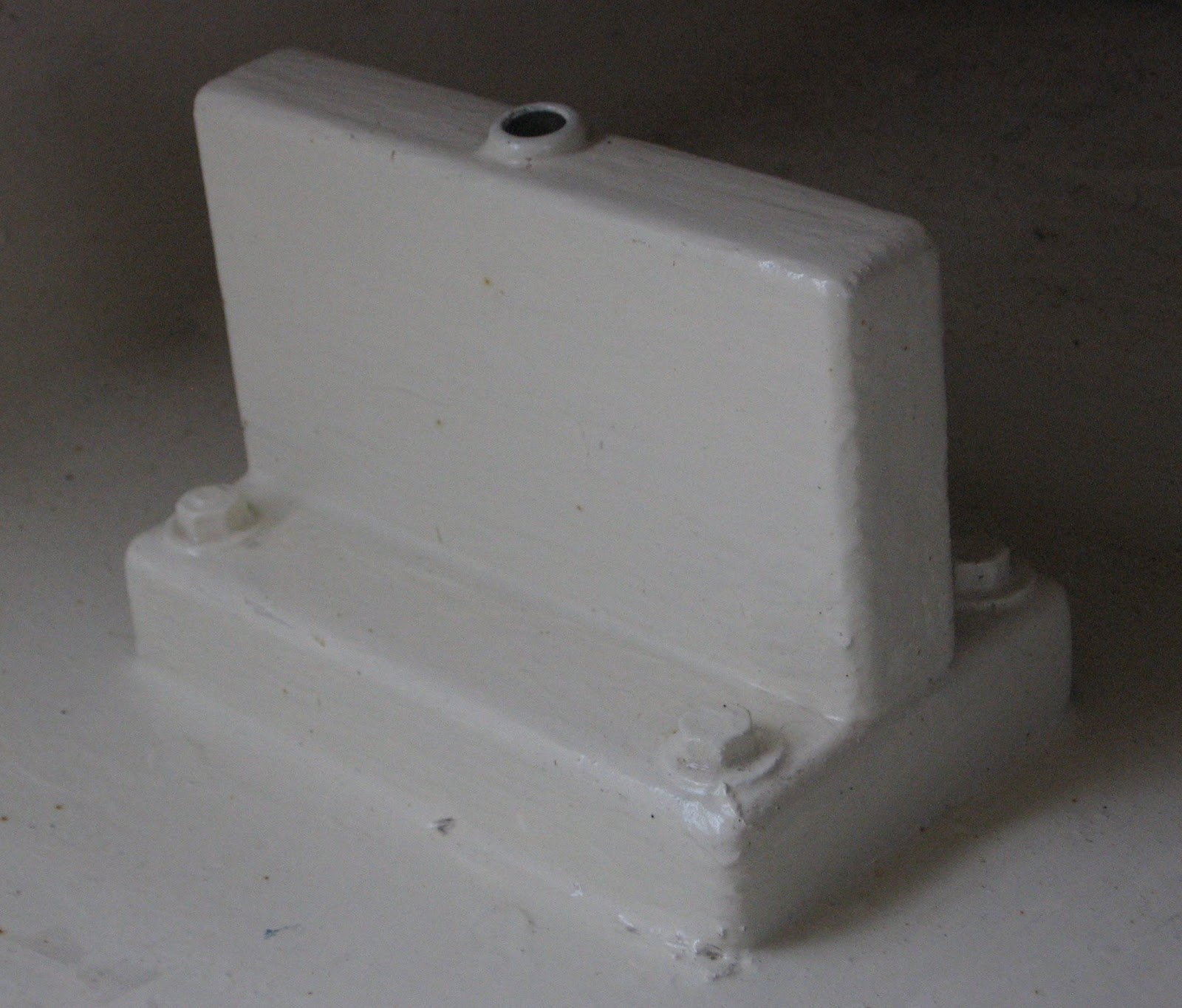 The final version (no issues at all)The pin is now pounded into a carved piece of oak thatis secured to the tiller by a U-bolt bolted through the rudder to abacking plate.
 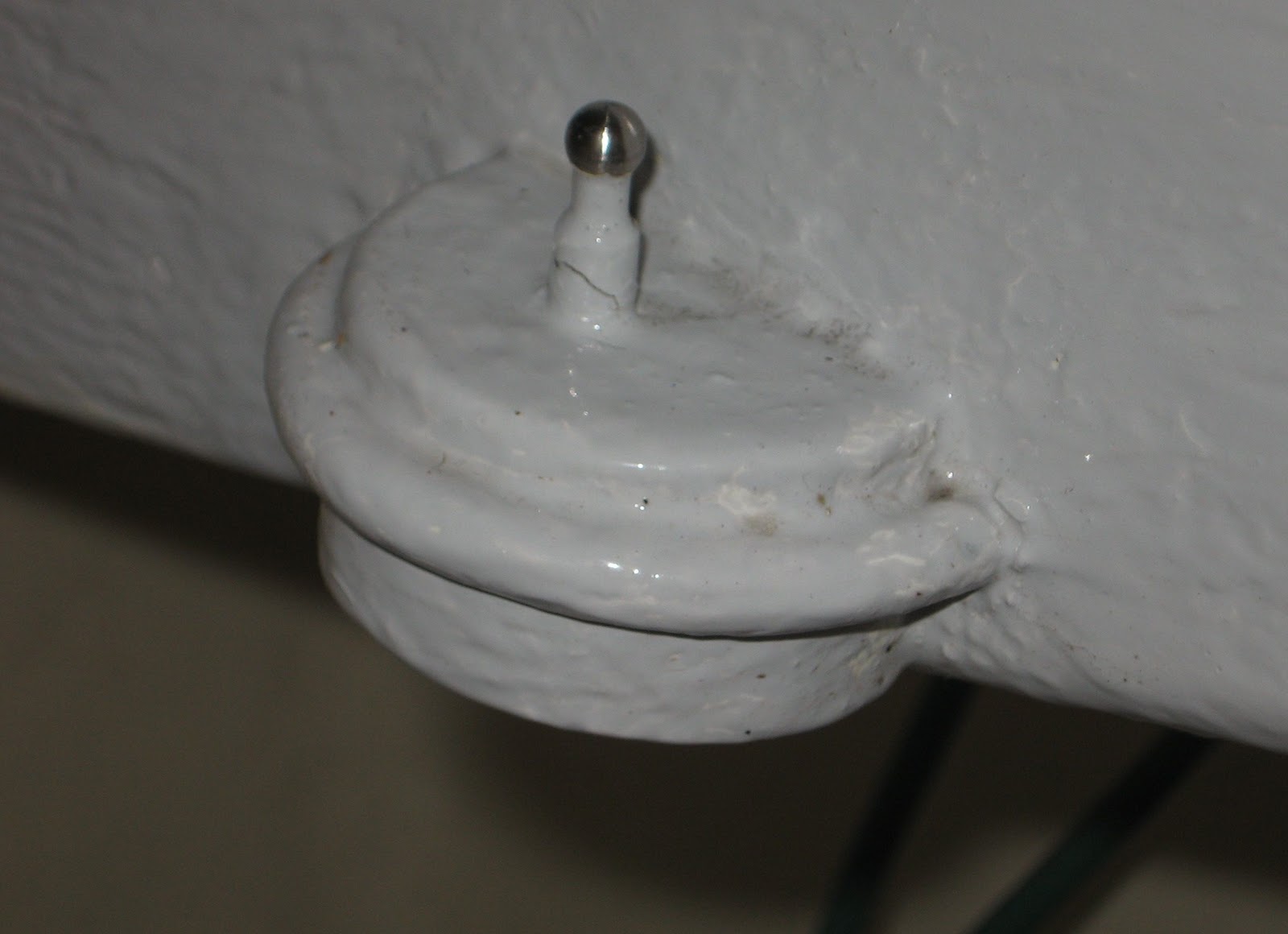 The final version (no issues at all)
All of the above are coated with epoxy and paintedwith two-part polyurethane primer, and a couple of coats of two-partpolyurethane paint. I suspect that this combination will outlast manythings, including me and the boat.


February 18, 2011
Ron Paul joins the Collapse Party
 Senator Ron Paul is sounding like quite the shoo-in for a leadership position within the Collapse Party, which I proposed over three years ago (and which is fast becoming a great success: without fielding a single candidate in any election, it is well on its way to successfully implementing the entire collapse agenda).
Lately, Ron has been heard saying things like this:
[The US] government is in the process of failing, and they can't deliver on the goods, just as the Soviets couldn't deliver the goods and maintain their own power... We will have those same problems domestically. We face serious economic problems as this dollar crisis evolves. ... We don't need to just change political parties. We need to change our philosophy about what this country is all about.So, Ron, what is the Soviet Union all about these days, other than staying dead?

February 3, 2011
Announcing: Reinventing Collapse 2.0
 The Soviet Experience and American Prospects – Revised & Updated
Pre-order this book direct from the publisher and get a 20% pre-publication discount, valid through April 15th, 2011.
While updating the text for the second edition, I have been careful not to add any new predictions, but I did take a few out because, as I now realize, energy and financial trends are too volatile to call over as short a term as the publication cycle of a book. But the longer-term trends, which I identified in the first edition over 3 years ago, are unmistakable. Global oil production has peaked for good, but is yet to start seriously declining, and this has produced a slow-motion crash rather than an outright collapse. Financially, the high volume of debts going bad has so far outpaced the government's printing presses, keeping inflation out of the picture, while creative accounting at the Federal Reserve has so far prevented a run on the US dollar, though how long this can continue is anyone's guess. Washington continues to set new records for political dysfunction, while the American empire is unraveling at an ever-increasing rate. We are in uncharted territory; all we know is that there is a cliff up ahead.
Here is what Michael Ruppert said about this book:
Reinventing Collapse in its original version has more than stood the test of time and events as a propphetic vision of the challenges that are being so clearly defined for us as a civilization today. The new and revised edition is priceless because it incorporates current events and emerging trends and views them through the eyes of this terrific writer and thinker. And Orlov's sense of humor always plants a minefield full of laugh bombs in the right places.

February 2, 2011
Video Interview: The Nation
Dmitry Orlov: Peak Oil Lessons From The Soviet UnionThe Nation and On The Earth Productions
Dmitry Orlov, engineer and author, warns that the US's reliance on diminishing fuel supplies might be sending it down the same path the Soviet Union took before it collapsed.
In this fifth video in the series "Peak Oil and a Changing Climate" from The Nation and On The Earth Productions, Orlov, who was an eyewitness to the collapse of the Soviet Union, asserts that as oil becomes more expensive and scarcer, the US will no longer be able to finance its oil addiction and the economy will hit a wall.
"Sixty percent of all of our transportation fuels are imported—a lot of that is on credit. A large chunk of the trade deficit is actually in transportation fuels. When those stop arriving because of our inability to borrow more money, then the economy is at a standstill," he says.
Go here to learn more about "Peak Oil and a Changing Climate," and to see the other videos in the series.Transcript
I witnessed the Sovietcollapse and then later on I couldn't help but noticing thatsomething very similar is happening to the United States. So as amatter of public service I've tried to warn people of what toexpect but I would just like to point out that I'm not any sort ofpolicy wonk or a wanna-be-politician or an activist. All of thosethings are sort of, very tangential to what I'm interested in whichis basically to warn people and equip them for what's coming up.
The way collapse unfoldsis actually very interesting because a lot of it has to do withpeople's faith in the status quo. As long as people think thatthere's something in it for them, they will cooperate. As soon asthey decide that there is nothing in it for them, they will cease tocooperate and the system starts to crumble, cave in on itself. Sowhat we saw in the Soviet Union was a political dysfunction wherebasically the communist regime was so endemically corrupt and so outto steal as much as they could at the very end that they reallydidn't even bother paying attention to whether they kept the systemgoing, the system was basically on autopilot until it crashed.Something similar is happening here where we have people in allbranches of government, both political parties, really trying to propup the financial industry which has really become completelyirrelevant to most people in the United States who don't havesavings and are not credit worthy. They're basically trying to useup people's savings and use up people's retirement to prop upthis set of institutions that only help the very rich people andthese very rich people are only rich on paper, they are long paper.All of them. What they own is pieces of paper with letters andnumbers on them, which will turn out to be worthless. So this is alljust basically musical chairs and something very similar washappening in the Soviet Union and something like that is happeninghere.
The reason I startedtalking about this is because I was frankly very worried about theUnited States because I saw the United States as not nearly as wellprepared for collapse as the Soviet Union. You see, the Russianpeople never had a great deal of faith in their government or in thesystem so they grew and gathered a lot of their own food, they reliedon private, personal connections, there was a very large grey orblack economy that provided most of what people needed. So when thesystem went away, people had something to hold onto, they had theirpersonal relationships. Also the country was set up in a way that wasmuch more stable with public transportation and with public housing.People were not stranded and people were not dispossessed and put outon the street and evicted. So all of those things allowed theRussians to survive collapse and all of those things are pretty muchmissing in this country. Most people in this country would prettymuch just be out on the street starving unless they have an income,unless they have credit cards or a bank account. They're justwoefully unprepared.
There's an element tomarket economics that is very hard edged and when it fails it hurtspeople whether they can afford to pay their way out of it or not. Ifthey can afford to pay their way out of it, it basically hurts theirsoul because they're just leaving everybody else behind and there'sa lot of fear with it because your umbilical is connected to yourbank account, once that goes away you're just completely lost. Nowa lot of the dislocation that went on in the Soviet Union really hadto do with people being sort of set adrift in the official economyand all they could fall back on was people they knew, people theycould trust who would help them. The whole mindset of what's mineand is mine and I get it by paying for it is really not very survivaloriented. One of the shocking things about Americans is that theyhave this innate faith that the rich people will abide, there willalways be rich people. And the rich people have bought into thisdream, this idea that the various symbols that they have that tellthem they're rich, pieces of paper and things will actually bemeaningful moving forward but it seems like the further you have tofall the harder you will fall. So I think, you know, the wealthypeople in the United States are in for a much ruder awakening thatthe people who are poor already. Really the most important thing toconsider is, who do you know and how will they help you even if youdon't give them any money for it. It's as basic as that. In thecase of the Russians it turned out that money was borderlineirrelevant for a lot of things that people needed to survive. That'swhat allowed them to survive. That's not the case here and its timeto get very worried about that.
The five stages ofcollapse is an essay that I published two and a half years ago whennobody was really talking about a financial collapse, people weretalking about a financial crisis. I decided to try to think of howthis proceeds in identifiable stages and I thought that basicallyit's sort of like the kubler-ross hierarchy relating to grief andhere it has to do with something similar which is psychologicalthresholds that are breached. Various bits of faith that we have inthe status quo and in society and the people around us, when they'reinvalidated the change can be rather sudden whereas changes in thephysical world take time to work out. So the stages were: financialcollapse where our assumptions about risk in the future areinvalidated and political collapse, which is basically ourassumptions that there is a political system that functions and canserve the interest of the people at some level, that is invalidated.Then there is commercial collapse, which is the idea that you can getwhatever you need by paying for it is invalidated because your moneyis worthless or you don't have any anymore. Then there is socialand cultural collapse which I got by reading some culturalanthropology. Basically social collapse is when the socialinfrastructure that people have be it charities or socialorganizations or community based groups cease to function becausethey're overwhelmed, they run out of resources and people can nolonger rely on them. Then cultural collapse, I got the idea fromreading Colin Turnbull who described a completely failed Africansociety of dispossessed hunter-gatherers where basically familystructure fell apart. Parents no longer brought up their children,they didn't take care of the old people, families didn't evenshare food. They basically got food and ate it by themselves and hidit from each other and that was the level at which humans stoppedresembling humans and people no longer recognized each other. At thatpoint you're almost talking about a different animal. Not what wehave evolved as, but something that we might devolve into.
I'm always asked thisquestion, where are we in the collapse scenario, the question is whoare we? I know a lot of people who are pretty far along in thecollapse scenario. I like to tell people that social and culturalcollapse has, in some places in this country, already run its course.Financial collapse, well it depends on whether you've beenbankrupted or foreclosed yet, it's a bit of, you could say that fora lot of people collapse has already arrived. It just hasn't beenwidely distributed and people don't actually share stories about itunless they actually know each other personally. So I would say thisis something that is proceeding, you could say that the United Statesis already bankrupt as a country. I don't think that you couldactually get a cogent argument against that from anyone who knowswhat they're talking about. It's just that the aftermath of thathasn't really completely arrived. We're not yet completelyimmersed in the consequences of that. Now, in terms of what could bedone to salvage the situation, well a lot of things would have tochange rather dramatically. Right now there's basically astranglehold on political power in this country by an elite thatdivides itself into two camps Republicans and Democrats and what haveyou, maybe even more, but its really the same bunch of people. Thissame bunch of people is almost militant in refusing to look atreality and it's almost a question of them at some point beingwheeled out of their offices along with the office furniture. Its notlike they can be really spoken to without it being one's completewaste of time. So I see that quite similar to what the old communistswent through. Basically they went from being in charge to beingcrazy, to being insane and being disregarded. I see something verysimilar happening here.
The question for whythere's so much denial is a really interesting one. Denial is alarge question in itself. There are certainly a few aspects to itthat are interesting. One is that it makes it possible for people tolead what amounts to a meaningless dead end existence because themoment they realize that its meaningless and its dead-end thenthey're forced to do something about it and if they can't thinkof anything useful to do about it then they're stuck, they'restuck with a mental difficulty. So denial is a way of avoiding mentaldifficulties. Another part of it is that if you actually have along-term perspective on the future that makes you very unpopular inany given group of people because the future, as it stands in amarket economy, is a faulty product. It cannot be sold for any price.No sane person would pay for it. So if we live in an environmentwhere we sell ourselves by putting things on our resumes andpromoting ourselves in various ways and thinking what we're worthin a market economy, actually being honest about what we're lookingforward to, all of us, makes us less successful as individuals and sothis is something that we avoid doing.
I think what's going tohappen is the dissolution of the United States as a political andeconomic entity. It will more or less fade from the world scene inthe same way that the Soviet Union faded from the world scene. Partsof it will later be reborn as something that we might have a lot moretrouble imagining because there isn't something called Russia thatpart of the Soviet Union. There isn't something similar to that inthe United States. It's really a bunch of territories, verydisjointed territories held together by Washington. So if Washingtonfails then it's not clear what is going to hold these territoriestogether.
The reason Washington islikely to fail is really the same reason that Moscow failed which isrunaway debt and national bankruptcy. It was not even the level ofdebt it was the fact that the debt could not be expanded or taken onat an ever-increasing rate with never any reason for anyone to expectthat the gap can ever be closed. So what happened in Moscow was thatMoscow could no longer finance the periphery and the peripherydecided to go its own way. We're something similar in this countrywhere California could do quite well if they stop paying the federaltax. So if they left the union their finances would be much betterand this is what happened in the Soviet Union. This is what we'rewitnessing right now in the United States. There are othersimilarities as well. One of the largest ones is, in the Soviet Unionthe armed forces more or less took on a life of their own, they atethe national budget, about a quarter of it, and also they couldn'tdeliver any results. So it's a striking similarity that the mightySoviet army lost in Afghanistan and now the mighty American army isdoing exactly the same thing. It amazes me that dying empires shootstraight for Afghanistan to have Afghanis deliver the coup de grasand this is what's happening to the United States as well.
Well the power vacuum thatwas left when the Soviet Empire collapsed was not a complete vacuum.There was a lot of black market economics active within the SovietUnion, there was a lot of what would be called corruption, but reallythey were workable ways of circumventing an unworkable system. Thereis some of that in this country as well. Strangely enough, the peoplewho are the best positioned to start a full-blown black marketeconomy in the United States are the narco-cartels. So they're thenext aristocracy as far as the Americans are concerned. They will bethe ones moving in and replacing the power vacuum. You already see ithappening in certain parts of the country close to the Mexicanborder. You can see that the local police and law enforcement are inno position to oppose them. They're much better organized andarmed. So this is what we can look forward to. A lot of that happenedin Russia as well there were a lot of ethnic mafias that moved in.The Chechens controlled a lot of the trade for quite a while, even inproduce and things like that. So we can look forward to quite a bitof that here as well.
There was a lot of whatyou could call "corporatocracy" in the Soviet Union as well.There were a lot of very large state-owned enterprises that went onexisting because they didn't really have a supply chain, they wereempires onto themselves. A place like Norilsk Nickel for instancethat makes a lot of the nickel in the world was pretty much a companytown. That was a standard thing in Russia. It's not just a factorybut also cafeterias and kindergartens, and hospitals, retirementhomes, and just about everything else. So these were economic empiresonto themselves that continued to function. A lot of them, once therewas no workable currency, they resorted to barter trade and theywould trade food for something that they made or stock they hadaccumulated over the years. The American "corporatocracy" is verymuch into just in time delivery and everything is network based andthat makes it extremely fragile and I don't see that patternholding. A while ago I thought that some large companies like Googlefor instance could take a lot of things in house and Google has beenmaking forays into energy and private currencies and all sorts ofthings. They have money to throw at experiments like that but they'renot about to achieve any sort of sustainability so when thesurrounding economy crumbles they will probably cease to function aswell.
People look at the shortterm. Energy availability in the short term. Basically the fact thatenergy demand shrank because of the recession/depression. That boughtus a little bit of time but its more or less inevitable that somekind of economic growth somewhere will resume at some point and thenwhatever part of the economy that tries to grow will hit a brick wallagain and the harder economies try to grow from this point on, theworse they will fail. The more growth dependent and growth addictedthey are the worse they will fail. Countries vary along a set ofparameters between how well they can absorb lack of economic growth;some can do it pretty well, some not at all. So this is really whatwe're looking at now. We could have a scenario where entire partsof the globe suddenly go dark. I think the United States is one ofthem because 60% of all of the transportation fuels are imported, alot of that is on credit. A large chunk of the trade deficit isactually transportation fuels, so when those stop arriving because ofinability to borrow more and more money then the economy is at astandstill and after a while the lights go out. Now, what that buysthe rest of the world is about 1/3 of all the energy consumed in theUnited States. The United States consumes about a third of the globalenergy supply. That suddenly becomes available to the rest of theworld. So you could theoretically have other countries grow foranother decade or more while the United States goes dark anddisappears, fades from the world scene much as the Soviet Union didafter it collapsed.
The important thing tounderstand about collapse is that it's brought on by overreach andoverstretch and people being zealous and trying too hard. Its notbrought on by people being laid back and doing the absolute minimum.Americans could very easily feed themselves and clothe themselves andhave a place to live working maybe a hundred days a year. You know,it's a rich country in terms of resources there's really noreason to work maybe more than a third of your time and that's sortof a standard pattern in the world. But if you want to build a hugeempire and have endless economic growth and have the largest numberof billionaires on the planet then you have to work over forty hoursa week all the time and if you don't then you're in danger ofgoing bankrupt. So that's the predicament that people have ended upin. Now the cure of course is not to do the same thing even harder,so what people have to get used to is the idea that most thingsaren't worth doing anyway and things really slow down when theeconomy goes away. The idea is to do the absolute bare minimum thatis essential and just find interesting ways to while away the timebecause not much is going to be happening. So walking down the roadis an all day affair whereas before it was a three-minute drive butnow you don't drive, you have to walk so it's an all day affair.People just have to learn to slow way down and have a lot morepatience, a lot more patience with each other. Those that don'twill probably end up killing each other in due course, that'sprobably a period of time that most people will want to sit out, waituntil the dust settles. A lot of people just don't have the rightcharacter to deal with collapse. They'll be running around tryingto fix things. That's the opposite of what they should be doing.
Peak oil is getting to bea really boring subject. Most people don't realize that yet. It'ssomething that becomes obvious after the fact, its something thatshows up in aggregate production statistics and those statistics tendto be retroactively adjusted as better numbers come in. So now we'repretty sure that it was in 2005-2006 for conventional oil, that isoil that comes out in oil form out of the ground on dry land, out ofconventional oil wells. All liquids, which includes tar sands andcoal to liquid conversion and corn based ethanol and just any othermuck that you could possibly get liquid fuels from, that peaked in2008. So it's all behind us.
The thing that's worthdiscussing now is what post peak production looks like. A lot ofpeople look at these charts that have a very smooth decline curvethat always looked a little strange to me. So I did a lot of researchinto trying to figure out what that meant and it turned out that itsjust sheer nonsense there's no reality behind it at all. I'veidentified many many factors that combine in various unpredictableways, its really too complicated to predict, but the chance of thisvery smooth decline, I would say, is zero. Its going to be astep-wise decline and various parts of the planet will be cut offfrom transportation fuel permanently at various times. There will bedisruptions and then it will be a permanent cut-off from that pointon. So what people should be planning on is not slightly moreexpensive gasoline, or slightly less gasoline or heating oil ordiesel fuel, but fuel that you might have for special occasions, sofor ambulances you might have it longer than for taxis, things likethat. What people should really be planning for is life withoutfossil fuels at all and that is actually a tall order. It takes a lotof thinking to prepare for that right now.
The whole question of dieoff produces very strong emotions in people, but to just lay it outin a non-emotional way. We had this thing called the greenrevolution, which is probably the worst misnomer we have because itwas basically the fossil fuel food revolution. It's growing food withfossil fuels that allowed the earth's population to go to 6 and ahalf billion and there's no reason to think that it can besustained through means other than fossil fuels inputs intoindustrial agriculture. So the question is what happens to all thesepeople when they can no longer be fed. Now, people think that this isin the future but its not. Russia is back to importing grain afterthe disastrous harvest of this year. That's a bad sign right there,Russia used to be a grain exporter until this year and so that ishappening in more and more parts of the world. Now, die-offs, peoplehave trouble imagining them. There was a bit of a die off in theSoviet Union after the Soviet Union collapsed. Life expectancyplummeted. The odd thing about it, I was there during that time, andit's not really noticeable unless you happen to be dropping by thehospitals and the morgues all the time and going to a lot offunerals. You just don't know that people are going away. Its morethat people look at their school photos and realize that half theirclass is dead. And that's a bit of a shock, but its more of a shockwhen you realize it than when its happening because you don'treally realize its happening. In fact human populations can shrinkquite dramatically without anyone even within those populationsreally noticing. People just accept whatever is happening, tune itout, stop paying attention or cope with it some way. With that said,ok we have 6 and a half billion people without fossil fuel inputsinto agriculture might sustain one billion but that's withoutclimate change. Now the reason we have agriculture is because we'vehad ten thousand years of stable climate, which seems to have ended.So that is something to take into consideration as well. Ashunter/gatherers as opposed to farmers we would not be one billionwithout fossil fuel input, we would be a lot smaller population thanthat even. So this is one of those things that people try not tothink about and the question that comes to my mind is why should weeven think about it? I mean, whatever happens, happens. We don'tget to decide how many people survive all we get to do is you know,try to survive, and find ways to do it. Thinking about mind numbingbillions of people that will no longer be around is not really aproductive activity given that there is nothing we can do about it.So I try to limit discussion of that because I just don't see itgoing anywhere useful.
Well the whole climatechange debate, it almost makes me laugh because people say things andthe words, if you look at it what do they mean, they don't meananything and the most important question is "what do we do?" Ihave a problem with defining we and I have a problem with defining"do" just on a semantic level, I think that that particularquestion is completely meaningless. "We" includes melting tundrawe don't actually tell it what to do it does whatever it wants to.And "do" involves people who are completely beyond our controlpolitically, economically, or otherwise. So it doesn't really evenmatter what we decide. People have this inflated picture of whatpolicy can achieve that is not based on what policy has achieved inthe past. There is one example of a great policy issue that Al Goretalks about which is limitations on refrigerants that were destroyingthe ozone layer. Well that was a bit of a success but it onlyinvolved a few chemical manufacturers around the planet. So thosecould be individually talked to and replacements could be found. Whatthey've achieved is that the ozone hole is now not growing anymorebut its not shrinking either so it's not really a complete successand that's really the only success story that they have. In termsof global warming it seems like we're in for a roller coaster ride.It's not even that we can predict what's happen, but we cancertainly predict that there will be a lot of upheaval. We don'tneed scientists to tell us that. I've been living in New Englandfor decades now and I'm used to the ocean being cold. So if in themiddle of the summer I jump in the ocean and its body temperature youdon't have to be a scientist to tell me that something is goingvery strangely here. You know, it's really quite obvious. Peoplewho are a little bit more in tune with the elements, people who havespent a lot of time outdoors, you can talk to them. Very few of themwill tell you that, oh this is nothing out of the ordinary, this isthe usual thing. So we're in for a great deal of climate upheaval.I would predict that when the industrial economies around the worldstart crashing there will be a huge amount of reforestation that willhappen. So then we might have a mini ice age because of that and thenthat might run its course and something else will happen. The kind ofgoldilocks climate that has allowed human populations to swell tobillions of individuals, that period of climatic history seems tohave ended already. We're in a different planet now; we're in adifferent world.p { margin-bottom: 0.08in; }

January 28, 2011
The Fix is Off
 Protest is sweeping through the Arab world. One corrupt and repressive regime, in Tunisia, has already been toppled, and now Hosni Mubarak Washington's man in Egypt, has been forced to deploy the army in an attempt to quell violent protests that have set the ruling party headquarters ablaze. Egypt, which is home to half of the world's Arabs, is the fulcrum on which the Arab world turns. What happens now in Egypt is bound to resonate throughout the Middle East and beyond.
Are we about to see something similar to the heady days of 1989, when Eastern Europe cast off Moscow's yoke? Is the Middle East going to turn out to be Washington's Eastern Europe? Will Wikileaks turn out to be Washington's equivalent of Gorbachev's Glasnost, cutting right through all the empty rhetoric about freedom and democracy, and showing the imperial regime to be repressive, craven, corrupt, foolish, weak and, ultimately, self-defeating?
American leaders appear to be following the Soviet playbook for the imperial end-game quite faithfully: cringing behind high walls and locked doors, looting the treasury like there's no tomorrow, and, of course, lying their heads off. There are a few moments each century when status quo suddenly becomes status quo ante. We may be living through just such a moment now.

January 27, 2011
Exclusive: US empire will fall due to lack of faith, not finances or war, author warns
 As many in the American empire longingly talk of "recovery" from the most devastating economic condition since the Great Depression, others have begun thinking in a very different direction, urging fellow citizens to prepare for the worst.
Dmitry Orlov, author of Reinventing Collapse: The Soviet Example and American Prospects , is one of the latter.
Soon, he told Raw Story in an exclusive interview, Americans will "stop expecting anything of Washington," turning the US into more of a "banana republic" than a superpower.
More...

January 7, 2011
Lifeboats: A Memoir
p { margin-bottom: 0.08in; }
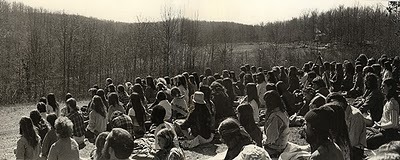
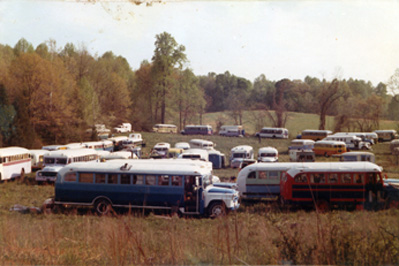
 [This is a guest post by Albert, whose amazing erudition and experience gives him the right to tell just about anyone to sit down, shut up and listen—although he is far too nice to actually say that. But I am not, so I will: sit down, shut up and listen.] During the early days of The Farm,1971-1973, we learned a number of lessons that will be useful againnow that a rapid petrocollapse scenario is likely to come to pass.The Farm spiritual community emerged from a 50-bus caravan of 320Haight-Ashbury refugees fleeing hard drugs, exploitation andcounterculture tourism. After a year on the road the gypsy vagabondspooled inheritances and purchased 1050 acres (450 hectares) of land80 miles (130 km) from Nashville. It was US$70 per acre.
The Farm grew to a standing populationof well over 1000, with 20 satellite centers, then, in the early1980s, declined and decollectivized, bringing its population to under200. Since then it has experienced something of a renaissance,finding new popularity amongst permaculturists, ecovillagers, androving students. But let's begin at the beginning, when our grouplanded in Tennessee.
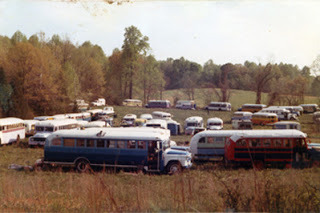
Living in remodeled school buses wasquite an adequate introduction to "roughing it," especially forthose of us who had never gone camping as children. The "honey pot"latrine bucket, mosquito-proof backpacker tents, canteens,flashlights, storm lanterns, and two-burner Coleman stoves werefamiliar to the pioneer settlers by the time they first stepped offthe bus.
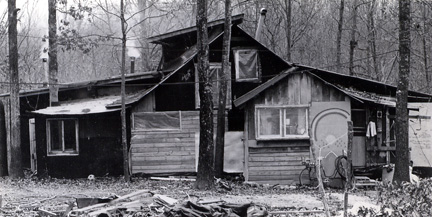
The land itself was barren of amenitiessave a small log cabin, a horse barn and a line shack, and so thefirst order of business was setting up facilities for bathing,sanitation, kitchen and sleeping. I'll skip over the organizationalaspects here because they would require a lengthier and more nuanceddiscussion; suffice it to say that circumnavigating North America ina 50-bus caravan required a degree of organization similar to runninga rock-and-roll band tour. That's enough organization to get youstarted in designing and constructing a settlement, although perhapsnot enough to keep it intact for very long.
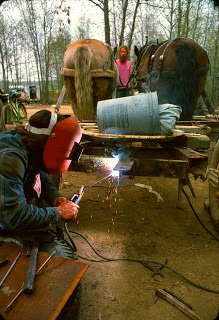
For pumped water, an engine was liftedfrom a Volkswagen Bug and set on blocks in a springhouse. A well-usedand rusting 5700 liter (1500 gallon) water tower was purchased forscrap value, repaired and erected atop a hill above the springhouse.This required minor welding and auto mechanics, as well as acontinuous supply of petrol. Some years later, when power lines camein, the VW engine and springhouse were replaced with a submersiblepump and well. Today it would have been built with photovoltaics orwind power, but such technology, while already available in the1970s, was well beyond the reach of a community that subsisted onaverage per capita cash income of US$1 per day for its first 13years.
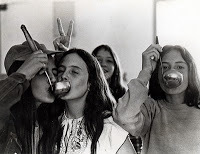 After the first winter, a second,larger water tower was erected near a 100 meter (300 foot) well withgood aquifer recharge. The tower was salvaged from a railroad companyfor a purchase price of US$1, but moving and erecting the tower andtank required a crane. From the towers, water was delivered to homesin 20 liter (5 gallon) jugs by horse wagon.
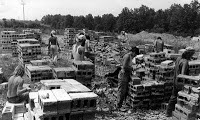
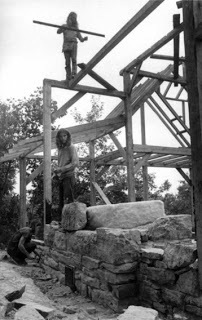
While the buses provided initialshelter, with more than 6 residents per bus on average, after 8 to 12months of living on the road most people wanted to get out intobetter housing, as quickly as possible. At the time, the governmentof the State of Tennessee held monthly auctions of surplus property,and Korean War vintage army tents could be bought for as little asUS$15. These formed the basis of our first foray into homeconstruction. With salvaged materials from construction sites anddumpsters, they morphed into "touses and hents." Going into apartnership with a nearby sawmill allowed us to add some beautifultimber-frame buildings and D-frames. Common buildings such as thecommunity kitchen, motor pool, canning & freezing, print shop,clinic and school sprang almost entirely from salvaged materials.Scraping mortar off cement blocks and straightening nails becomewell-practiced skills.
 There was limited electricity to thesite, and for an entire decade almost all of our electricity camefrom 12-volt DC systems powered by car batteries. Initially thebatteries were charged by switching them through vehicles every day,but full discharge cycles make for short battery life, so aftertrying novel methods of pedal power, bamboo wind generators and otherwacky ideas, most houses went to a "trickle charge" system — along copper cable run through the trees to a central power centerthat took its electrons from Tennessee Valley Authority (although wealways sent them back in the next nanosecond).
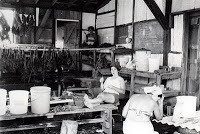 At one of these power centers, where wedid our canning and freezing, we erected walk-in coolers andfreezers. Refrigeration was a necessity that is as difficult to avoidas it is to achieve. A few of the buses came with propane-poweredfridges and they were a blessing. Most of the households relied on asystem of 5-gallon (20 liter) buckets that rotated to the walk-incoolers and freezers near the cannery. Buckets with tight lids wereobtained from dumpsters behind the McDonalds in town. The otheressential item was a Flexible Flyer wooden wagon with slatted sides.If you couldn't get your parents to give one of those to theirgrandchildren for Christmas, the next best thing was to weld a biketrailer or pushcart to get your buckets to the neighborhood cooler.
Buckets were also employed to carrydiapers and laundry to a communal laundromat, which was set up nearanother trickle-charge node. Salvaged coin-op equipment was purchasedin bulk, the coin slots replaced with toggle switches, and a largediaper rinse and centrifuge babe-manure extractor installed. Thegrey- and black-water flowed to a constructed wetlands and rainbird,creating what today, 40 years later, are some of the richest soils onthe property.
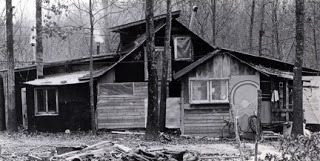
Communal unisex showering facilitieswere constructed in places with good supplies of water and a way toheat it: downhill from the original water tower; beside Canning &Freezing and the Farm Store; at the Farm School and print shop.
A flour mill took over the tack room inthe horse barn. Initially we used a small stone mill to grind cornmeal. Later we bought a larger, 3-break steel feed mill and set it upin the line shack, connected to 3-phase AC power. Arrayed around theroller mill were Clipper seed cleaners, sifters, a coffee roaster, anoat huller, and bagging racks. Within a year the mill was churningout a ton per day of wheat, corn, soy and buckwheat flours, pastryflours, corn meal, grits, groats, mixed cereals and porridges, horse feed, soy nuts, popcorn, coffee, and peanut butter.
 Transportation and communications werepriorities, because our sustainability depended on commerce, andwithout good transportation and communications any attempts to createa business would have been hampered. Bear in mind that for the first13 years the experiment was communal, meaning shared purse. Just asmany societies throughout history, we have found that in times ofdifficulty a reversion to communal economics provides greatersurvival advantages than the exercise of individuated privateproperty rights. After achieving stability, most drop the communalform in order to stimulate greater enterprise. This was the pathtaken by Amana, Oneida, many kibbutzim, The Farm, the People'sRepublic of China, and, now, Cuba.
Any group that can cross the country in30-year-old school buses will learn something about automotivemechanics. Our motor pool and junkyard became one of the technologyhubs for The Farm, a place where anything from a hay rake to a firetruck could be machined and rebuilt, nearly from scratch.
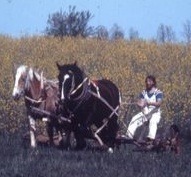
The first two teams of horses, blackBelgians and white Percherons, were acquired from neighboring OldOrder Amish. They laughed at our feeble attempts, as vegans, toreplace leather harness with more hippy-kosher canvas and Naugahide."How'd you raise that nauga?" they'd ask. Interesting koan!
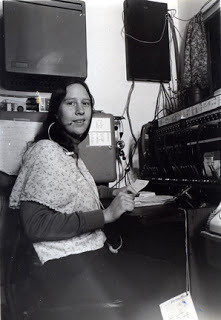
 Communication was accomplished througha rapid succession of home and business devices. The log cabin becamethe business center with two phone lines. On US$1 per person perday, personal long distance charges were unaffordable, but one of ourcaravaners was an Eagle Scout with a ham radio merit badge, and hemade a radio shack in the horse barn and began training ham radiooperators to staff an amateur band Farm Net. Before the Internet Iwas WB4LXJ.
A 12-volt telephone system wasinstalled to link every bus, tent, home and business. The dial tonewas replaced with a Grateful Dead or reggae melody or a publicservice announcement (1000 jars of catsup planned today, cannersneeded; line at the laundry is now 90 minutes; bean shucking andbanjo at horse barn 7 pm). The dial itself was replaced with apushbutton that you used for Morse code to signal where you werecalling. Four shorts meant "all points." It was a party line, butthere was a second carrier band, the "Hot Line," used foremergencies. A toggle switch flipped you over to that band where anoperator was always on call, sitting at a phone console to summonfire, police and ambulance and to assume management of the emergency.This pre-dated most emergency telephone services.
Emergencies were taken seriously, andfire marshals, gate and patrol security, and emergency medicalresponders were treated as actual jobs from the very beginning. Eachbecame more sophisticated as the body of experience grew. Naivehippies learned to adjust to the rigors of self-reliance, which couldsometimes be terrifying, such as when a kerosene lamp tips over in acanvas tent, the Ku-Klux-Klan rides up to the front gate or a deputysheriff wanders into the marijuana patch while hunting deer.
Finding additional uses for the copperwires we passed through the treetops, we sent a TV signal throughthe phone lines, and could download direct network feeds from a12-foot (3.7 meter) dish made of pine 2x4s and chicken wire. We watched theWatergate hearings that way. We produced our own shows, too, sentfrom the Bandland Studio tent to 12-volt TVs in tents and buses. Ifyou were within 30 feet of the phone line, you could pick up thesignal on channel 3. We watched Greenpeace work out its chess moveswith the Spanish Navy in real time, using a slo-scan ham TVtransmitter installed on the bridge of the Rainbow Warrior, sortof a proto-Animal-Planet pilot.
 Eventually, when CB radios becamepopular, we were able to install them in our vehicles and interfacethem with the ham radio and "Beatnik Bell" phone system. Freeinternational calls became possible. Our "Extra Class" hams grewin proficiency and could link to satellites, monitor police, militaryand secret service sidebands, and bounce audio, digital and TVsignals around the world to an expanding Farm Net.
A weekly newspaper, Amazing Tales ofReal Life, began coming out of the print shop, along with a hostof do-it-yourself books that turned into a brand. A brisk traffic indaily visitors, more than a hundred some days, required tour crewsand a large hostel tent, but also supplied nearly free labor for thefields.
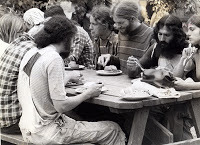 From the very first arrival of thebuses and through the first 5 years a community dining facility wasan essential efficiency, and one of the main reasons that livingcould be so cheap. Milk was made from soybeans, which became tofu,mayonnaise, yogurt, sour cream and ice cream. Soybeans were also madeinto coffee, tempeh, soysage (from okara), soyburgers andstroganoffs. A bushel of dry soybeans (35 liters) cost US$3 (US$7today). The protein needs (with all 8 essential amino acids in goodproportion) for a hard-laboring farm worker can be supplied on lessthan a pound (450 grams) per day, rehydrated and made into gourmetvegan cuisine. Thinking of storing food for emergencies? Includesoybeans.
Tracing back down memory lane to myexperience then: a young man of 25 arriving at The Farm in 1972 withjust a backpack; being greeted by the Night Sentry and shown a placeto sleep; going for a breakfast at the Community Kitchen, porridgeand sorghum molasses, soysage and corn biscuits; then to the field ina horse wagon; harvesting sorghum cane with a machete and piling itinto the wagon; at the end of the day returning to my assigned,dirt-floored army tent lit by candles; supper of bean soup andcornbread with pickled japapeños; guitars and song around a fireunder the canopy of stars; abiding sense of harmony in the world;community.

 [This is a guest post by Albert, whose amazing erudition and experience gives him the right to tell just about anyone to sit down, shut up and listen—although he is far too nice to actually say that. But I am not, so I will: sit down, shut up and listen.] During the early days of The Farm,1971-1973, we learned a number of lessons that will be useful againnow that a rapid petrocollapse scenario is likely to come to pass.The Farm spiritual community emerged from a 50-bus caravan of 320Haight-Ashbury refugees fleeing hard drugs, exploitation andcounterculture tourism. After a year on the road the gypsy vagabondspooled inheritances and purchased 1050 acres (450 hectares) of land80 miles (130 km) from Nashville. It was US$70 per acre.
The Farm grew to a standing populationof well over 1000, with 20 satellite centers, then, in the early1980s, declined and decollectivized, bringing its population to under200. Since then it has experienced something of a renaissance,finding new popularity amongst permaculturists, ecovillagers, androving students. But let's begin at the beginning, when our grouplanded in Tennessee.
Living in remodeled school buses wasquite an adequate introduction to "roughing it," especially forthose of us who had never gone camping as children. The "honey pot"latrine bucket, mosquito-proof backpacker tents, canteens,flashlights, storm lanterns, and two-burner Coleman stoves werefamiliar to the pioneer settlers by the time they first stepped offthe bus.
The land itself was barren of amenitiessave a small log cabin, a horse barn and a line shack, and so thefirst order of business was setting up facilities for bathing,sanitation, kitchen and sleeping. I'll skip over the organizationalaspects here because they would require a lengthier and more nuanceddiscussion; suffice it to say that circumnavigating North America ina 50-bus caravan required a degree of organization similar to runninga rock-and-roll band tour. That's enough organization to get youstarted in designing and constructing a settlement, although perhapsnot enough to keep it intact for very long.
For pumped water, an engine was liftedfrom a Volkswagen Bug and set on blocks in a springhouse. A well-usedand rusting 5700 liter (1500 gallon) water tower was purchased forscrap value, repaired and erected atop a hill above the springhouse.This required minor welding and auto mechanics, as well as acontinuous supply of petrol. Some years later, when power lines camein, the VW engine and springhouse were replaced with a submersiblepump and well. Today it would have been built with photovoltaics orwind power, but such technology, while already available in the1970s, was well beyond the reach of a community that subsisted onaverage per capita cash income of US$1 per day for its first 13years.
 After the first winter, a second,larger water tower was erected near a 100 meter (300 foot) well withgood aquifer recharge. The tower was salvaged from a railroad companyfor a purchase price of US$1, but moving and erecting the tower andtank required a crane. From the towers, water was delivered to homesin 20 liter (5 gallon) jugs by horse wagon.
While the buses provided initialshelter, with more than 6 residents per bus on average, after 8 to 12months of living on the road most people wanted to get out intobetter housing, as quickly as possible. At the time, the governmentof the State of Tennessee held monthly auctions of surplus property,and Korean War vintage army tents could be bought for as little asUS$15. These formed the basis of our first foray into homeconstruction. With salvaged materials from construction sites anddumpsters, they morphed into "touses and hents." Going into apartnership with a nearby sawmill allowed us to add some beautifultimber-frame buildings and D-frames. Common buildings such as thecommunity kitchen, motor pool, canning & freezing, print shop,clinic and school sprang almost entirely from salvaged materials.Scraping mortar off cement blocks and straightening nails becomewell-practiced skills.
 There was limited electricity to thesite, and for an entire decade almost all of our electricity camefrom 12-volt DC systems powered by car batteries. Initially thebatteries were charged by switching them through vehicles every day,but full discharge cycles make for short battery life, so aftertrying novel methods of pedal power, bamboo wind generators and otherwacky ideas, most houses went to a "trickle charge" system — along copper cable run through the trees to a central power centerthat took its electrons from Tennessee Valley Authority (although wealways sent them back in the next nanosecond).
  At one of these power centers, where wedid our canning and freezing, we erected walk-in coolers andfreezers. Refrigeration was a necessity that is as difficult to avoidas it is to achieve. A few of the buses came with propane-poweredfridges and they were a blessing. Most of the households relied on asystem of 5-gallon (20 liter) buckets that rotated to the walk-incoolers and freezers near the cannery. Buckets with tight lids wereobtained from dumpsters behind the McDonalds in town. The otheressential item was a Flexible Flyer wooden wagon with slatted sides.If you couldn't get your parents to give one of those to theirgrandchildren for Christmas, the next best thing was to weld a biketrailer or pushcart to get your buckets to the neighborhood cooler.
Buckets were also employed to carrydiapers and laundry to a communal laundromat, which was set up nearanother trickle-charge node. Salvaged coin-op equipment was purchasedin bulk, the coin slots replaced with toggle switches, and a largediaper rinse and centrifuge babe-manure extractor installed. Thegrey- and black-water flowed to a constructed wetlands and rainbird,creating what today, 40 years later, are some of the richest soils onthe property.
Communal unisex showering facilitieswere constructed in places with good supplies of water and a way toheat it: downhill from the original water tower; beside Canning &Freezing and the Farm Store; at the Farm School and print shop.
A flour mill took over the tack room inthe horse barn. Initially we used a small stone mill to grind cornmeal. Later we bought a larger, 3-break steel feed mill and set it upin the line shack, connected to 3-phase AC power. Arrayed around theroller mill were Clipper seed cleaners, sifters, a coffee roaster, anoat huller, and bagging racks. Within a year the mill was churningout a ton per day of wheat, corn, soy and buckwheat flours, pastryflours, corn meal, grits, groats, mixed cereals and porridges, horse feed, soy nuts, popcorn, coffee, and peanut butter.
 Transportation and communications werepriorities, because our sustainability depended on commerce, andwithout good transportation and communications any attempts to createa business would have been hampered. Bear in mind that for the first13 years the experiment was communal, meaning shared purse. Just asmany societies throughout history, we have found that in times ofdifficulty a reversion to communal economics provides greatersurvival advantages than the exercise of individuated privateproperty rights. After achieving stability, most drop the communalform in order to stimulate greater enterprise. This was the pathtaken by Amana, Oneida, many kibbutzim, The Farm, the People'sRepublic of China, and, now, Cuba.
Any group that can cross the country in30-year-old school buses will learn something about automotivemechanics. Our motor pool and junkyard became one of the technologyhubs for The Farm, a place where anything from a hay rake to a firetruck could be machined and rebuilt, nearly from scratch.
The first two teams of horses, blackBelgians and white Percherons, were acquired from neighboring OldOrder Amish. They laughed at our feeble attempts, as vegans, toreplace leather harness with more hippy-kosher canvas and Naugahide."How'd you raise that nauga?" they'd ask. Interesting koan!
 Communication was accomplished througha rapid succession of home and business devices. The log cabin becamethe business center with two phone lines. On US$1 per person perday, personal long distance charges were unaffordable, but one of ourcaravaners was an Eagle Scout with a ham radio merit badge, and hemade a radio shack in the horse barn and began training ham radiooperators to staff an amateur band Farm Net. Before the Internet Iwas WB4LXJ.
A 12-volt telephone system wasinstalled to link every bus, tent, home and business. The dial tonewas replaced with a Grateful Dead or reggae melody or a publicservice announcement (1000 jars of catsup planned today, cannersneeded; line at the laundry is now 90 minutes; bean shucking andbanjo at horse barn 7 pm). The dial itself was replaced with apushbutton that you used for Morse code to signal where you werecalling. Four shorts meant "all points." It was a party line, butthere was a second carrier band, the "Hot Line," used foremergencies. A toggle switch flipped you over to that band where anoperator was always on call, sitting at a phone console to summonfire, police and ambulance and to assume management of the emergency.This pre-dated most emergency telephone services.
Emergencies were taken seriously, andfire marshals, gate and patrol security, and emergency medicalresponders were treated as actual jobs from the very beginning. Eachbecame more sophisticated as the body of experience grew. Naivehippies learned to adjust to the rigors of self-reliance, which couldsometimes be terrifying, such as when a kerosene lamp tips over in acanvas tent, the Ku-Klux-Klan rides up to the front gate or a deputysheriff wanders into the marijuana patch while hunting deer.
Finding additional uses for the copperwires we passed through the treetops, we sent a TV signal throughthe phone lines, and could download direct network feeds from a12-foot (3.7 meter) dish made of pine 2x4s and chicken wire. We watched theWatergate hearings that way. We produced our own shows, too, sentfrom the Bandland Studio tent to 12-volt TVs in tents and buses. Ifyou were within 30 feet of the phone line, you could pick up thesignal on channel 3. We watched Greenpeace work out its chess moveswith the Spanish Navy in real time, using a slo-scan ham TVtransmitter installed on the bridge of the Rainbow Warrior, sortof a proto-Animal-Planet pilot.
 Eventually, when CB radios becamepopular, we were able to install them in our vehicles and interfacethem with the ham radio and "Beatnik Bell" phone system. Freeinternational calls became possible. Our "Extra Class" hams grewin proficiency and could link to satellites, monitor police, militaryand secret service sidebands, and bounce audio, digital and TVsignals around the world to an expanding Farm Net.
 A weekly newspaper, Amazing Tales ofReal Life, began coming out of the print shop, along with a hostof do-it-yourself books that turned into a brand. A brisk traffic indaily visitors, more than a hundred some days, required tour crewsand a large hostel tent, but also supplied nearly free labor for thefields.
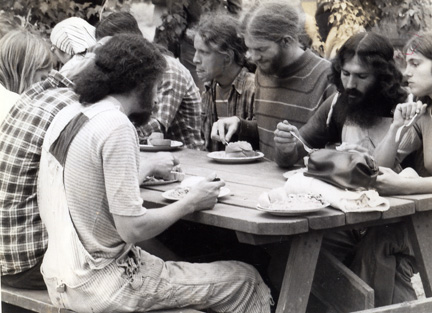 From the very first arrival of thebuses and through the first 5 years a community dining facility wasan essential efficiency, and one of the main reasons that livingcould be so cheap. Milk was made from soybeans, which became tofu,mayonnaise, yogurt, sour cream and ice cream. Soybeans were also madeinto coffee, tempeh, soysage (from okara), soyburgers andstroganoffs. A bushel of dry soybeans (35 liters) cost US$3 (US$7today). The protein needs (with all 8 essential amino acids in goodproportion) for a hard-laboring farm worker can be supplied on lessthan a pound (450 grams) per day, rehydrated and made into gourmetvegan cuisine. Thinking of storing food for emergencies? Includesoybeans.
Tracing back down memory lane to myexperience then: a young man of 25 arriving at The Farm in 1972 withjust a backpack; being greeted by the Night Sentry and shown a placeto sleep; going for a breakfast at the Community Kitchen, porridgeand sorghum molasses, soysage and corn biscuits; then to the field ina horse wagon; harvesting sorghum cane with a machete and piling itinto the wagon; at the end of the day returning to my assigned,dirt-floored army tent lit by candles; supper of bean soup andcornbread with pickled japapeños; guitars and song around a fireunder the canopy of stars; abiding sense of harmony in the world;community.

January 5, 2011
The Nation: Peak Oil and the Changing Climate
 Times are so bad that even an overtly political entity such as The Nation has been forced to start acknowledging reality. Thanks to Karen and Greg for rounding up the usual suspects (Richard Heinberg, Nicole Foss, Bill McKibben, James Kunstler and me) plus, for added gravitas, I suppose, Noam Chomsky. You might think that Peak Oil and climate change are liberal issues; that's like saying that death is a conservative issue. Here is the part of the series that's been released so far. But all the speakers on the video are great, especially my two minutes of it (one at 4:00, the other at 14:00). The full interview with me will be up in February.
December 24, 2010
Bright New Horizons
p { margin-bottom: 0.08in; }a:link { }
 As Gary pointed out—that I hadpointed out—in the previous post, "being a superpower collapsepredictor is not a good career choice." Since then, I have beentossing about in search of better career choice for myself. In thistime of high unemployment it is important to think out of the box andlook for opportunities to create a new market niche, preferably in ahigh-wage segment of the economy such as finance, medicine or law.
For a very short while I entertainedthe notion of establishing a new field of dentistry. Everybody knowsof endodontics, periodontics, orthodontics and so forth. I am not adentist; nevertheless, I thought that I might add one more:scrimshawdontics. I would serve people who desire to have a schoonerunder full sail scratched into the enamel of one of their uppercanines, a likeness of Herman Melville into the other, and, acrosstheir upper incisors, a majestic scene of a harpoon boat chasingafter a great big whale across storm-tossed seas, men straining atthe oars, and, in the bow, a prominent peg-legged figure wielding aharpoon! But I was forced to discard this idea as soon as I realizedjust how few people would want to spend countless hours in adentist's chair with their mouth open while I scratch away at theirteeth with an etching needle.
And so I have tried to think of anotherplan, and decided to borrow a page out of MattSavinar's book. After running a rather popular "doomer" sitefor some years (the term "doomer" is self-applied in Matt's case;he even referred to himself as a "Juris Doctor of Doom") Mattdecided switch gears and to devote himself entirely to astrology. Butthe field of astrology seems far too general to me; I want tospecialize further, and combine astrology with another discipline,preferably in a high-wage segment of the economy. I also want to usemy technical and scientific education and put astrology on a moresound scientific footing by informing it with certain key insightsfrom fields such as astrophysics and information theory. And so hereis my new profession: astroeconomist.I will join the ranks of those who profitably combine astrology andeconomics.
Astrology concernsitself with the relative positions of planets within our solar systemand their mysterious effect on the course of human events. But let meask: Why do planets in this solar system exert greater influence onthe course of human events than the planets that orbit all othercountless stars within the billions of galaxies that populate theuniverse? Why is proximity of stellar bodies to us a key factor? Thiswould plausibly be the case if the influence of planetary alignmentwere known to act through some known physical mechanism whose effectwere attenuated by distance, such as the spread of facts of some sort, ofthe general form "A causes B through mechanism X." But being unable toattest to the existence of any such X, we are forced to concede thatthe statement "A causes B" is not a piece of information but, ina strict epistemological sense, the absence of a fact—a statement of ignorance, of the general form "It is not known that A causes B." Now, while information requirestime and energy to propagate through space, and degrades in qualitylong before that energy becomes diffuse enough to be detectable assingle photons, as it does in the vastness of interstellar space,ignorance is not bound by any physical constraints and is in factinstantaneous at all points in the universe. Therefore, we couldjustifiably assume that it is not just the nearby planets that guideour destinies but all planets in all solar systems in all galaxies,in equal measure.
You are probably used to thinking thatthe universe is finite; very large, but not infinitely large.However, it may well be the case that theuniverse is infinitely large, extending infinitely in alldirections in both time and space. The leap from very, very big toinfinite may seem like a technicality, but it is really a quantumleap, because infinite things have some dramatically differentproperties from finite ones. For instance, the national debt is verylarge, but it is not infinite; if it were, the interest on it, forany non-zero rate of interest, would be infinite as well and nationaldefault would be instantaneous. Aside from their insidious bigness,infinite things also tend to be infinitely complex, and contain aninfinite amount of information. Take, for instance, thetranscendental constant π (3.14159265...). It is an infinitely longnon-repeating sequence of digits. When calculated with infiniteprecision, converted to binary and treated as digital data π isguaranteed contain an infinite number of each of the following:A high-quality video of you in flagrante delicto with every other person that ever livedAn infinite number of Wikileaks documents containing irrefutable proof that Senator Joseph Lieberman is a Mossad agent, Obama is from the vicinity of the star Betelgeuse, while Dick Cheney is, in some unfathomable fashion, not from but the Crab Nebula itselfAn infinite number of copies and variants of this very articleMoreto the point, an infinite universe contains an infinite number ofgalaxies, stars, and planets, and, it follows, an infinite number ofsimultaneous planetary alignments. If, as I argue above, all of thesealignments act together and concert irrespective of distance andtime, then the signal conveyed by astrological data is completelyrandomness: pure, high-grade noise. It is not just any old ignorancebut the purest, highest-grade, most reliably knowledge-free signalimaginable.
Andthis brings us to astrology's sister discipline, which likewisebenefits from purity of ignorance: economics. It is well-known thatstocks picked by expert money managers do slightly worse, overall,than stocks picked by monkeys throwing darts. (Good monkey! Here'syour bailout!) The reason for this should be obvious: monkeys producebetter results because of the superior quality of ignorance thatdrives their decision-making process. Similarly, economists whostruggle with econometric models and statistical data collected bygovernment and industry are sometimes accidentally correct in theirpredictions, raising expectations and creating false hopes. But ifinstead economists plugged in the pure nonsense of astrological dataaveraged across an infinite universe, they could easily achieve asix-sigma rating, being repeatably wrong 99.99966% of the time. Andwouldn't that be exciting!? Oh but wait a minute...
Cometo think of it, perhaps astroeconomics is not a promising careerchoice either. Back to square one, then...
 As Gary pointed out—that I hadpointed out—in the previous post, "being a superpower collapsepredictor is not a good career choice." Since then, I have beentossing about in search of better career choice for myself. In thistime of high unemployment it is important to think out of the box andlook for opportunities to create a new market niche, preferably in ahigh-wage segment of the economy such as finance, medicine or law.
For a very short while I entertainedthe notion of establishing a new field of dentistry. Everybody knowsof endodontics, periodontics, orthodontics and so forth. I am not adentist; nevertheless, I thought that I might add one more:scrimshawdontics. I would serve people who desire to have a schoonerunder full sail scratched into the enamel of one of their uppercanines, a likeness of Herman Melville into the other, and, acrosstheir upper incisors, a majestic scene of a harpoon boat chasingafter a great big whale across storm-tossed seas, men straining atthe oars, and, in the bow, a prominent peg-legged figure wielding aharpoon! But I was forced to discard this idea as soon as I realizedjust how few people would want to spend countless hours in adentist's chair with their mouth open while I scratch away at theirteeth with an etching needle.
And so I have tried to think of anotherplan, and decided to borrow a page out of MattSavinar's book. After running a rather popular "doomer" sitefor some years (the term "doomer" is self-applied in Matt's case;he even referred to himself as a "Juris Doctor of Doom") Mattdecided switch gears and to devote himself entirely to astrology. Butthe field of astrology seems far too general to me; I want tospecialize further, and combine astrology with another discipline,preferably in a high-wage segment of the economy. I also want to usemy technical and scientific education and put astrology on a moresound scientific footing by informing it with certain key insightsfrom fields such as astrophysics and information theory. And so hereis my new profession: astroeconomist.I will join the ranks of those who profitably combine astrology andeconomics.
Astrology concernsitself with the relative positions of planets within our solar systemand their mysterious effect on the course of human events. But let meask: Why do planets in this solar system exert greater influence onthe course of human events than the planets that orbit all othercountless stars within the billions of galaxies that populate theuniverse? Why is proximity of stellar bodies to us a key factor? Thiswould plausibly be the case if the influence of planetary alignmentwere known to act through some known physical mechanism whose effectwere attenuated by distance, such as the spread of facts of some sort, ofthe general form "A causes B through mechanism X." But being unable toattest to the existence of any such X, we are forced to concede thatthe statement "A causes B" is not a piece of information but, ina strict epistemological sense, the absence of a fact—a statement of ignorance, of the general form "It is not known that A causes B." Now, while information requirestime and energy to propagate through space, and degrades in qualitylong before that energy becomes diffuse enough to be detectable assingle photons, as it does in the vastness of interstellar space,ignorance is not bound by any physical constraints and is in factinstantaneous at all points in the universe. Therefore, we couldjustifiably assume that it is not just the nearby planets that guideour destinies but all planets in all solar systems in all galaxies,in equal measure.
You are probably used to thinking thatthe universe is finite; very large, but not infinitely large.However, it may well be the case that theuniverse is infinitely large, extending infinitely in alldirections in both time and space. The leap from very, very big toinfinite may seem like a technicality, but it is really a quantumleap, because infinite things have some dramatically differentproperties from finite ones. For instance, the national debt is verylarge, but it is not infinite; if it were, the interest on it, forany non-zero rate of interest, would be infinite as well and nationaldefault would be instantaneous. Aside from their insidious bigness,infinite things also tend to be infinitely complex, and contain aninfinite amount of information. Take, for instance, thetranscendental constant π (3.14159265...). It is an infinitely longnon-repeating sequence of digits. When calculated with infiniteprecision, converted to binary and treated as digital data π isguaranteed contain an infinite number of each of the following:A high-quality video of you in flagrante delicto with every other person that ever livedAn infinite number of Wikileaks documents containing irrefutable proof that Senator Joseph Lieberman is a Mossad agent, Obama is from the vicinity of the star Betelgeuse, while Dick Cheney is, in some unfathomable fashion, not from but the Crab Nebula itselfAn infinite number of copies and variants of this very articleMoreto the point, an infinite universe contains an infinite number ofgalaxies, stars, and planets, and, it follows, an infinite number ofsimultaneous planetary alignments. If, as I argue above, all of thesealignments act together and concert irrespective of distance andtime, then the signal conveyed by astrological data is completelyrandomness: pure, high-grade noise. It is not just any old ignorancebut the purest, highest-grade, most reliably knowledge-free signalimaginable.
Andthis brings us to astrology's sister discipline, which likewisebenefits from purity of ignorance: economics. It is well-known thatstocks picked by expert money managers do slightly worse, overall,than stocks picked by monkeys throwing darts. (Good monkey! Here'syour bailout!) The reason for this should be obvious: monkeys producebetter results because of the superior quality of ignorance thatdrives their decision-making process. Similarly, economists whostruggle with econometric models and statistical data collected bygovernment and industry are sometimes accidentally correct in theirpredictions, raising expectations and creating false hopes. But ifinstead economists plugged in the pure nonsense of astrological dataaveraged across an infinite universe, they could easily achieve asix-sigma rating, being repeatably wrong 99.99966% of the time. Andwouldn't that be exciting!? Oh but wait a minute...
Cometo think of it, perhaps astroeconomics is not a promising careerchoice either. Back to square one, then...
December 18, 2010
Peak Empire
 [This is a guest post from Gary, who presents data that indicate that the US military empire is already past its peak and may collapse suddenly. Gary uses a methodology for calculating peak empire that is similar to the Hubbert curve which successfully predicted Peak Oil for both the US and, more recently, the world.
It should be noted that the DOD base structure reports on which Gary's analysis is based don't include Iraq, Afghanistan, or any of the secret (black) installations all over the world, but it is unclear whether the inclusion of these data would change the picture materially.
As far as the speed of imperial collapse, it varies: Rome took five centuries to collapse but USSR took just a couple of years. Alfred W. McCoy, Professor of History at the University of Wisconsin-Madison, recently wrote: "empires regularly unravel with unholy speed: just a year for Portugal, two years for the Soviet Union, eight years for France, 11 years for the Ottomans, 17 years for Great Britain, and, in all likelihood, 22 years for the United States, counting from the crucial year 2003." My hunch is that McCoy's 22-year estimate is overly generous, and that the collapse of the USA will set a speed record, unfolding over just a handful of very strange days.]
Predicting Collapse
In February, 2009 Dmitry Orlov said the following about predicting the collapse of the US empire: "I have learned from experience – luckily, from other people's experience – that being a superpower collapse predictor is not a good career choice. I learned that by observing what happened to the people who successfully predicted the collapse of the USSR. Do you know who Andrei Amalrik is? See, my point exactly. He successfully predicted the collapse of the USSR. He was off by just half a decade. That was another valuable lesson for me, which is why I will not give you an exact date when USA will turn into FUSA ("F" is for "Former"). But even if someone could choreograph the whole event, it still wouldn't make for much of a career, because once it all starts falling apart, people have far more important things to attend to than marveling at the wonderful predictive abilities of some Cassandra-like person."
As far as predicting the collapse of the US empire, Russian academic Igor Panarin has been predicting it for 2010, and Johan Galtung has predicted it will collapse before 2020. Hubbert predicted in 1974 that global peak oil was incompatible with constantly growing money, triggering a cultural crisis (Exponential Growth as a Transient Phenomenon).
Andrei Amalrik died in a car crash in 1980 at the age of 42. Nevertheless, at the risk of making a poor career choice, I will attempt to offer a methodology for determining peak US empire, if not a prediction for its demise. Now that global peak oil is history perhaps it's time to work on predicting peak empire instead. If you followed the work of Joseph Tainter, he offered the theory of diminishing and eventually negative marginal return to territorial growth and complexity of societies. (See the Collapse of Complex Societies) He offered the following graph to illustrate:
[image error] As a result he expected complex societies to reach a peak in size and then begin to decline, similar to an oil peak.
[image error]
He offered the following examples to demonstrate the principle with historical examples of defunct empires:
[image error]
Shown above are the territorial areas of the Roman, Ottoman, Russian, and US Empires. The Russian Empire collapsed after the book was written, so that curve has also moved to the downside of the curve. The point being that empires follow a typical bell curve type of shape.
US Empire
In the case of the US empire, it has not continued to expand by territorial acquisition. The last territory acquired was the Marshall Islands in 1947, which then became a UN Trust Territory, followed by Independence in 1986. What has continued to expand is the presence of US military installations all over the world. As the recently deceased analyst Chalmers Johnson explained, the US is an "empire of bases", not an empire of colonies. The US has 800-1000 foreign military bases and 4-5000 bases in the US. Colonies are so passé these days. Why bother with colonies when you can impose your will with a few bases, and you don't have to manage the whole country. Besides you can outsource most everything to contractors, so you don't even need the consent of the governed. All you need is their tax money, which the sheeple continue to provide with barely a bleat.
Looking at the DOD Base Structure reports it is possible to graph the total acreage owned by the US military both in the US, in foreign countries, and in US foreign territories. Since both foreign countries and territories are occupied, I will lump them together. It is also valid to use total military acreage including the US, since the 50 states of the US are essentially occupied territory of the US military as well.
[image error]
I was unable to find data before 1957, but total acreage under management by the US military had a recent peak in 2007, while foreign acreage peaked in 2004. This data is from official US DOD base structure reports, which according to Chalmers Johnson leaves out quite a bit, but from a relative point of view over time, it is probably adequate. I have included the excel sheet data, and others are welcome to add to the data and do a more thorough job graphing this data.
Military spending Looking at US military spending below, it has continued to rise, despite the recent decline in acreage under management. This is entirely consistent with Tainter's theory of declining marginal utility to expanding empires, as imperial overstretch becomes more and more expensive, and returns to expenditures begins to decline, and even become negative. It would be entirely consistent for the expenditures to continue to rise as the empire attempts to hold onto its existing level of military acreage, until interest on the debt causes a default, and then expenditures also collapse.
[image error]
Imperial Reserves
Like oil, the empire has reserves to continue fueling the military machine. It has its AAA bond rating in order to continue deficit spending by selling Treasury bonds to foreign countries, although the rating agencies have taken somewhat of a hit on their credibility after the financial crisis. Foreign governments may also be thinking twice about the future viability of the dollar. It has the federal reserve to continue creating money out of thin air by key strokes on a computer, and engaging in open market operations like "quantitative easing" and purchasing existing treasuries, or even monetizing the debt by buying treasury bonds directly from the US government, giving them more money to play with. Finally they have the credulous and supplicant taxpayers who continue to fund their own demise by turning their tax dollars over to an empire, which throws it down three rat holes simultaneously: The $1 trillion dollar annual military budget, the Afghanistan War, and the bankster bailouts. Like the oil reserve/production ratio, the empire has a reserve/territorial expansion ratio which is declining rapidly. If interest rates increase adequately, the interest on the debt is going to swallow up all of tax revenues, such that a tax increase might be required. Will the sheeple rebel then? We'll see. In any case I welcome others to comment on the viability of military acreage as a measure of peak empire, and to expand on the analysis.

Dmitry Orlov's Blog

- Dmitry Orlov's profile
- 48 followers
Dmitry Orlov isn't a Goodreads Author
(yet),
but they
do have a blog,
so here are some recent posts imported from
their feed.


![[image error]](http://www.vtcommons.org/files/images/Tainter1.gif)
![[image error]](http://www.vtcommons.org/files/images/peak-complexity-tainter.preview.jpg)
![[image error]](http://www.vtcommons.org/files/images/Tainter-empires.png)
![[image error]](http://www.vtcommons.org/files/images/military-acreage.preview.jpg)
![[image error]](http://www.vtcommons.org/files/images/500px-InflationAdjustedDefenseSpending.PNG)