
Dmitry Orlov's Blog, page 36
December 9, 2010
Fleeing Vesuvius (by sea)
 This hefty tome was recently published by Féasta, Ireland's Foundation for the Economics of Sustainability. It contains two articles by me: the first is a text version of the presentation I gave at the Féasta conference in Dublin two summers ago, which you can read right on this blog.
My second article in this volume—Sailing craft for a post-collapse world—is a long piece that I wrote exclusively for this publication. It spells out the transportation options that will still exist once fossil fuels are no longer available, concentrating on sail transport. It pulls together pertinent information that is currently scattered across many academic disciplines, and is also informed by my personal experience as an ocean sailor and live-aboard who does all of his own maintenance.
The full table of contents can be found here. The book can be purchased through Amazon.
Fleeing Vesuvius draws together many of the ideas our members have developed over the years and applies them to a single question—how can we bring the world out of the mess in which it finds itself?
Fleeing Vesuvius confronts this mess squarely, analyzing its many aspects: the looming scarcity of essential resources such as fossil fuels—the lifeblood of the world economy; the financial crisis in Ireland and elsewhere; the collapse of the housing bubble; the urgent need for food security; and the enormous challenge of dealing with climate change.
The solutions it puts forward involve changes to our economy and financial system, but they go much further: this substantial, wide-ranging book also looks at the changes needed in how we think, how we use the land and how we relate to others, particularly those where we live. While it doesn't discount the complexity of the problems we face, Fleeing Vesuvius is practical and fundamentally optimistic. It will arm readers with the confidence and knowledge they need to develop new, workable alternatives to the old-style expanding economy and its supporting systems. It's a book that can be read all the way through or used as a resource to dip in and out of.


December 7, 2010
Space Enough and Time: An Expat's Siberian Experience
p { margin-bottom: 0.08in; }
 [Another guest post bySandy. There is something deliciously ironic in this story of aformer American corporate efficiency expert transplanting himself toa place where time never goes any place special and patience is toocheap to meter—and being happy there! Here's the executive summaryfor all you "TL;DR" hyper-efficient power web surfers: as youprepare to leave the US behind—whether physically (recommended) or justmentally—you should be ready to slough off you compulsively Americanold self and be prepared to grow yourselves a new, better-adapted,saner one.]
For the past five years Ihave made my home in Barnaul, a town in the Altai region of Siberia.Much about life here initially chafed against some deeply engrainedcultural assumptions that I carried around with me. No matter howhard I've tried, sometimes I just couldn't quite fathom thealienness of the Russian perspective.
I quickly became aware ofan almost palpable sentiment that here in Siberia there is spaceenough, and time, for anything to occur—and a certainresiliency to carry one through it. The immense distances and openexpanses provide spatial and temporal horizons that seem to recedeforever. The endless boreal forests of the Siberian taiga and thebarren steppes are not typical "environments" in the Westernsense. They are not places. They have no frames of reference. Theseenormous expanses seemed to set the rhythm for much of the daily lifehere, which is often spent waiting countless hours, or walkingendless kilometers, or just sitting there. Americans would never havethe patience for any of it.
Given this perspective, Ifound it curious that people here spent so much of their time crammedinto very close quarters in the bustling city of Barnaul, locatedbetween Novosibirsk and the point where the borders of China,Mongolia and Kazakhstan come together amid the snow-capped ridges ofthe Altai mountains.
How do you suppose peoplehere experience personal space and time in their daily life? I willalways remember my first of many trips around town in a publictransport van called "gazelle." Pleasantly named for its size,which is diminutive compared to a full-size city bus, "gazelle"accommodates as many as fourteen passengers, always uncomfortably. Although there are plenty of automobiles in town, the majority ofpeople do not own vehicles or drive. "Comfort" is a term thatSiberians do not appreciate as we do in America; it is not somethingthey expect or particularly seek. They accept certain things asgiven. They can be rather disparaging of our American habit ofwhining over the lack of comfort. They see it as a weakness in ournational character.
The first time I climbedaboard a "gazelle" with my wife Anna, I suddenly found myself invery close quarters with about a dozen complete strangers. Keepingour heads down to avoid bashing them into the low ceiling, we tookoff like a shot through traffic barely before the door was closed.The other passengers took no notice of our assault on their space aswe stumbled across their legs and packages to split between us thelast remaining seat in the back of the van. Here, the phrase "publicintimacy" takes on a new meaning: clearly, close physical proximityor bodily contact is not something Siberians shy away from—not inthe gazelle, or the tram, or the bus, or the theatre. Our fellowriders seemed unfazed by their close quarters during this gallopingride through town, maintaining a stoic and formal outward appearancein the midst of this forced intimacy.
I imagined this to be ahold-over from the Soviet era when there was little expectation ofprivacy. People seemed to understand the importance of keeping up adispassionate public appearance, especially in close quarters. Theywere unruffled by the physical proximity. But their complete lack ofemotional closeness or openness in such circumstances was a bit of asurprise. As an American, my first thought upon entering the womb ofthe gazelle was to introduce myself, and then to apologize forinterrupting their ride, but luckily Anna stopped me before I had achance to embarrass myself. The silence was deafening, with not aword exchanged among any of the accidental traveling companions. Evenspeaking with the person seated on your lap is kept to a minimumbecause others would be forced to listen to your conversation. Theerupting blast of a cell phone's ring tone made everyone reach fortheir purse or pocket. The unlucky recipient answered, trying tospeak softly and to end the conversation quickly.
This was my firstencounter with the different structure of personal space within thepublic domain of the city, and coping with the huge mismatch betweenit and my expectations became more and more difficult with eachpassing day. It wasn't just when taking public transportation that myconception of my personal space was being tested to destruction. Itseemed to be under assault in innumerable circumstances, butespecially when I found myself standing in a queue somewhere,waiting for service.
There is so much idlewaiting in Siberia that, as one Russian writer describes it, here theempty passage of time reveals its "authentic substance andduration." But all this waiting did not seem toinconvenience the local population as much as it bothered me. Itappeared as though our often frantic, Western sense of urgency wasrelatively absent here, and that enormous amounts of time wereregularly squandered without giving rise to frustration. If the busdid not come as scheduled we could idle away another thirty minutesanticipating the arrival of the next one, or just walk home. We couldeasily linger for forty-five minutes in line at the telecom office topay our monthly phone bill. If the hot water or heat in our apartmentbuilding shut off without warning (as it frequently did) we could dowithout it for several days or even a week until it would be equallyunexpectedly restored.
What I found most strikingwas that all this waiting apparently did not upset the locals as itwould Americans. Even as time seemed to nearly stand still, peoplewould just wait it out. Everything seemed to be taken in stride;things would work themselves out sooner or later. I observed thisattitude daily in the behavior of all those around me. There wasalmost never the need to rush; there was time enough for everythingto get done. "Everything will be fine" was Anna's constantrefrain in response to my endless anxiety and frustration.
I sensed an unusualattitude here for ignoring or perhaps for denying time's ploddingpassage, which became particularly apparent during the endlesswaiting in queues—at banks, ATMs, ticket counters, the phonecompany, the post office, the housing registration office, the taxoffice, medical clinics, and at the innumerable public notary officeswhich officially certify all documents. And I too waited, likeeveryone else, because almost everything here must be done in person,and almost nothing here can be accomplished by phone, or by mail, orvia the Internet. It was as if these modern efficiencies have notbeen invented yet, and perhaps never will be. Apparently, there doesnot seem to be any premium on "saving time." The massive statebureaucracies and even the commercial businesses here require thatyou physically present yourself and wait somewhere if you want to paybills or to conduct any other business; and make sure you can pay incash, because nobody accepts checks or credit cards.
Not only was such waiting an assault on my patience, but on my senseof personal space as well. People stand literally breathing down oneanother's necks, in such close physical proximity to each otherthat they are very often touching. Whenit is finally your turn to approach the service window, other peopleoften flank you on either side, watching everything that transpires.They might even interrupt your transaction, finding any opportunityto make contact with the person on the other side of the windowbefore their turn. This seeming impatience, or perhaps a lack ofconcern for others, seemed at odds with the general disinterestednessin time's passage that I witnessed daily, but it turns out to beanother thing entirely: it's just that your time at the counter isnot strictly delineated as yours exclusively but overlaps with thatof others around you.
There was seldom anylinearity to these queues, which look more like rugby scrums thanactual lines. There was certainly no queuing theory informingwaiting, as there is in America, no rope-barriers or otheraccoutrements of control. Something that looks like a queue oftenmaterializes spontaneously. As you approach a service window or entera waiting area, you find that people are not necessarily standing insingle file. Some of them might be sitting idly to the side, oroutside having a smoke, or leaning against a wall, or haphazardlymilling around. You have to inquire who is last in the queue, andoften find out that nobody really knows or cares, or that the personor persons in question just stepped out but will come back later. TheRussian queue is not so much a physical as a mental construct, itsdetails scattered across many distracted minds. When the officecloses for "dinner" for an hour or two in the middle of theworkday, the queue dissolves, then spontaneously reconstitutes itselfafter the dinner break is over.
Back in the USA I alwaysfelt that a queue, like time itself, has to be well-structured,arranged, managed, and always moving forward productively. Space andtime both have to be well organized for us, for we Americans, itseems, are incapable of enjoying so-called "free time." For us,free, unscheduled time is wasted time—time not filled withmeaningful content or purposeful activity. Even American vacationsare routinely crammed full of productive activities, and goodplanning is seen as a crucial element in recreating with efficiencyand purpose.
In America,time-consciousness is run strictly by the clock. Is Siberian time ourclock-time, or is it informed by natural and circadian rhythms ratherthan by a strictly linear, mechanical progression? I surmised thatthere are no unambiguous expectations of strict linear continuityhere. What at first appeared to me as interruptions in the queue, forexample, or a general disregard for overall time management, mightnot have been construed in this way at all by the locals. Was furtherconfirmed in other circumstances. For example, when speaking by phonewith Russian colleagues or friends about arranging a meeting orrendezvous, they would invariably suggest getting togetherimmediately rather than scheduling something for later. I found thisto be true even of busy executives. Trains and government officeshave schedules, and mostly run on schedule—except when they don't,but it doesn't occur to anyone that creating more schedules, and thenrunning on them, is something that they should be wanting to do.
People kept telling me:"Sandy, this is Siberia; you can't plan things here." It washard to absorb the message that the American control of time'spassage is illusory, that the flow of events from past to future cansuddenly be interrupted, come to a halt, or change direction. Afterall, the flow of heat, electricity, and water certainly can, andoften does. If Siberian experience of time is more naturally dynamicthan our artificial clock-time, this might explain their seeminglyparadoxical attitude toward time's passage.
Siberians seem to have asplit consciousness of time, as though there were two concurrentexperiences of temporal movement. One is an archaic, pastoral senseof timelessness, associated with a more feral existence in the taigaand the steppe, lived in close proximity to nature and its cycles.The other is a nascent and constraining sense of clock time, with afocus on punctuality and productivity that is finding a tentative andclumsy foothold in the complex framework of urban bureaucracies here.Is it just the nature of life in the city that creates such temporalincongruities and juxtapositions?
I began to see realchallenges to the deeper cultural transformation that Siberians haveembarked upon. Or was this transformation being thrust upon them,making the incongruities even more severe? Could Russia, couldSiberians, continue to survive in a world rife with suchcontradiction? Should we presumptuously drag them kicking andscreaming into our long-gone twentieth century?
For me this was not simplya rhetorical question. The steady gallop of Western-inspiredprogress is quietly overtaking Siberia, more rapidly each day. "Business lunches" are now advertised by new American-ownedcafes with the promise that they are "served in fifteen minutes."Credit cards are being offered more liberally by lending institutionsadvertising "quick financing." A pricey fitness club calledAurora is all the rage in Barnaul, claiming "fast results."(Of course, my friend Keith and I—the only two Americans intown—are both members.)
I feel that things arefast reaching critical mass here, with what remained of long-standingtraditions eroding while society moves chaotically into ourWestern historical present. What, if anything, could or should bedone to change the course of these events, or to circumvent such acultural transformation? I can hypothesize that the tensions createdby life in the increasingly anonymous urban sprawl of Barnaul, whichstill seemed in some respects so foreign to these people, isbeginning to create fissures between the generations and betweennewly emerging classes of citizens. But I can also imagine that thissense of "quickening" is just part of the ebb and flow—ofSiberia living through its own version of the 1950s, made possible byRussia's sudden prosperity, but that it is just a moment, and that,once it passes, Siberia will once again relapse into its age-oldtimelessness.
[Sandy's book, The Recovery of Ecstasy: Notebooks from Siberia, is available from Amazon.]

 [Another guest post bySandy. There is something deliciously ironic in this story of aformer American corporate efficiency expert transplanting himself toa place where time never goes any place special and patience is toocheap to meter—and being happy there! Here's the executive summaryfor all you "TL;DR" hyper-efficient power web surfers: as youprepare to leave the US behind—whether physically (recommended) or justmentally—you should be ready to slough off you compulsively Americanold self and be prepared to grow yourselves a new, better-adapted,saner one.]
For the past five years Ihave made my home in Barnaul, a town in the Altai region of Siberia.Much about life here initially chafed against some deeply engrainedcultural assumptions that I carried around with me. No matter howhard I've tried, sometimes I just couldn't quite fathom thealienness of the Russian perspective.
I quickly became aware ofan almost palpable sentiment that here in Siberia there is spaceenough, and time, for anything to occur—and a certainresiliency to carry one through it. The immense distances and openexpanses provide spatial and temporal horizons that seem to recedeforever. The endless boreal forests of the Siberian taiga and thebarren steppes are not typical "environments" in the Westernsense. They are not places. They have no frames of reference. Theseenormous expanses seemed to set the rhythm for much of the daily lifehere, which is often spent waiting countless hours, or walkingendless kilometers, or just sitting there. Americans would never havethe patience for any of it.
Given this perspective, Ifound it curious that people here spent so much of their time crammedinto very close quarters in the bustling city of Barnaul, locatedbetween Novosibirsk and the point where the borders of China,Mongolia and Kazakhstan come together amid the snow-capped ridges ofthe Altai mountains.
How do you suppose peoplehere experience personal space and time in their daily life? I willalways remember my first of many trips around town in a publictransport van called "gazelle." Pleasantly named for its size,which is diminutive compared to a full-size city bus, "gazelle"accommodates as many as fourteen passengers, always uncomfortably. Although there are plenty of automobiles in town, the majority ofpeople do not own vehicles or drive. "Comfort" is a term thatSiberians do not appreciate as we do in America; it is not somethingthey expect or particularly seek. They accept certain things asgiven. They can be rather disparaging of our American habit ofwhining over the lack of comfort. They see it as a weakness in ournational character.
The first time I climbedaboard a "gazelle" with my wife Anna, I suddenly found myself invery close quarters with about a dozen complete strangers. Keepingour heads down to avoid bashing them into the low ceiling, we tookoff like a shot through traffic barely before the door was closed.The other passengers took no notice of our assault on their space aswe stumbled across their legs and packages to split between us thelast remaining seat in the back of the van. Here, the phrase "publicintimacy" takes on a new meaning: clearly, close physical proximityor bodily contact is not something Siberians shy away from—not inthe gazelle, or the tram, or the bus, or the theatre. Our fellowriders seemed unfazed by their close quarters during this gallopingride through town, maintaining a stoic and formal outward appearancein the midst of this forced intimacy.
I imagined this to be ahold-over from the Soviet era when there was little expectation ofprivacy. People seemed to understand the importance of keeping up adispassionate public appearance, especially in close quarters. Theywere unruffled by the physical proximity. But their complete lack ofemotional closeness or openness in such circumstances was a bit of asurprise. As an American, my first thought upon entering the womb ofthe gazelle was to introduce myself, and then to apologize forinterrupting their ride, but luckily Anna stopped me before I had achance to embarrass myself. The silence was deafening, with not aword exchanged among any of the accidental traveling companions. Evenspeaking with the person seated on your lap is kept to a minimumbecause others would be forced to listen to your conversation. Theerupting blast of a cell phone's ring tone made everyone reach fortheir purse or pocket. The unlucky recipient answered, trying tospeak softly and to end the conversation quickly.
This was my firstencounter with the different structure of personal space within thepublic domain of the city, and coping with the huge mismatch betweenit and my expectations became more and more difficult with eachpassing day. It wasn't just when taking public transportation that myconception of my personal space was being tested to destruction. Itseemed to be under assault in innumerable circumstances, butespecially when I found myself standing in a queue somewhere,waiting for service.
There is so much idlewaiting in Siberia that, as one Russian writer describes it, here theempty passage of time reveals its "authentic substance andduration." But all this waiting did not seem toinconvenience the local population as much as it bothered me. Itappeared as though our often frantic, Western sense of urgency wasrelatively absent here, and that enormous amounts of time wereregularly squandered without giving rise to frustration. If the busdid not come as scheduled we could idle away another thirty minutesanticipating the arrival of the next one, or just walk home. We couldeasily linger for forty-five minutes in line at the telecom office topay our monthly phone bill. If the hot water or heat in our apartmentbuilding shut off without warning (as it frequently did) we could dowithout it for several days or even a week until it would be equallyunexpectedly restored.
What I found most strikingwas that all this waiting apparently did not upset the locals as itwould Americans. Even as time seemed to nearly stand still, peoplewould just wait it out. Everything seemed to be taken in stride;things would work themselves out sooner or later. I observed thisattitude daily in the behavior of all those around me. There wasalmost never the need to rush; there was time enough for everythingto get done. "Everything will be fine" was Anna's constantrefrain in response to my endless anxiety and frustration.
I sensed an unusualattitude here for ignoring or perhaps for denying time's ploddingpassage, which became particularly apparent during the endlesswaiting in queues—at banks, ATMs, ticket counters, the phonecompany, the post office, the housing registration office, the taxoffice, medical clinics, and at the innumerable public notary officeswhich officially certify all documents. And I too waited, likeeveryone else, because almost everything here must be done in person,and almost nothing here can be accomplished by phone, or by mail, orvia the Internet. It was as if these modern efficiencies have notbeen invented yet, and perhaps never will be. Apparently, there doesnot seem to be any premium on "saving time." The massive statebureaucracies and even the commercial businesses here require thatyou physically present yourself and wait somewhere if you want to paybills or to conduct any other business; and make sure you can pay incash, because nobody accepts checks or credit cards.
Not only was such waiting an assault on my patience, but on my senseof personal space as well. People stand literally breathing down oneanother's necks, in such close physical proximity to each otherthat they are very often touching. Whenit is finally your turn to approach the service window, other peopleoften flank you on either side, watching everything that transpires.They might even interrupt your transaction, finding any opportunityto make contact with the person on the other side of the windowbefore their turn. This seeming impatience, or perhaps a lack ofconcern for others, seemed at odds with the general disinterestednessin time's passage that I witnessed daily, but it turns out to beanother thing entirely: it's just that your time at the counter isnot strictly delineated as yours exclusively but overlaps with thatof others around you.
There was seldom anylinearity to these queues, which look more like rugby scrums thanactual lines. There was certainly no queuing theory informingwaiting, as there is in America, no rope-barriers or otheraccoutrements of control. Something that looks like a queue oftenmaterializes spontaneously. As you approach a service window or entera waiting area, you find that people are not necessarily standing insingle file. Some of them might be sitting idly to the side, oroutside having a smoke, or leaning against a wall, or haphazardlymilling around. You have to inquire who is last in the queue, andoften find out that nobody really knows or cares, or that the personor persons in question just stepped out but will come back later. TheRussian queue is not so much a physical as a mental construct, itsdetails scattered across many distracted minds. When the officecloses for "dinner" for an hour or two in the middle of theworkday, the queue dissolves, then spontaneously reconstitutes itselfafter the dinner break is over.
Back in the USA I alwaysfelt that a queue, like time itself, has to be well-structured,arranged, managed, and always moving forward productively. Space andtime both have to be well organized for us, for we Americans, itseems, are incapable of enjoying so-called "free time." For us,free, unscheduled time is wasted time—time not filled withmeaningful content or purposeful activity. Even American vacationsare routinely crammed full of productive activities, and goodplanning is seen as a crucial element in recreating with efficiencyand purpose.
In America,time-consciousness is run strictly by the clock. Is Siberian time ourclock-time, or is it informed by natural and circadian rhythms ratherthan by a strictly linear, mechanical progression? I surmised thatthere are no unambiguous expectations of strict linear continuityhere. What at first appeared to me as interruptions in the queue, forexample, or a general disregard for overall time management, mightnot have been construed in this way at all by the locals. Was furtherconfirmed in other circumstances. For example, when speaking by phonewith Russian colleagues or friends about arranging a meeting orrendezvous, they would invariably suggest getting togetherimmediately rather than scheduling something for later. I found thisto be true even of busy executives. Trains and government officeshave schedules, and mostly run on schedule—except when they don't,but it doesn't occur to anyone that creating more schedules, and thenrunning on them, is something that they should be wanting to do.
People kept telling me:"Sandy, this is Siberia; you can't plan things here." It washard to absorb the message that the American control of time'spassage is illusory, that the flow of events from past to future cansuddenly be interrupted, come to a halt, or change direction. Afterall, the flow of heat, electricity, and water certainly can, andoften does. If Siberian experience of time is more naturally dynamicthan our artificial clock-time, this might explain their seeminglyparadoxical attitude toward time's passage.
Siberians seem to have asplit consciousness of time, as though there were two concurrentexperiences of temporal movement. One is an archaic, pastoral senseof timelessness, associated with a more feral existence in the taigaand the steppe, lived in close proximity to nature and its cycles.The other is a nascent and constraining sense of clock time, with afocus on punctuality and productivity that is finding a tentative andclumsy foothold in the complex framework of urban bureaucracies here.Is it just the nature of life in the city that creates such temporalincongruities and juxtapositions?
I began to see realchallenges to the deeper cultural transformation that Siberians haveembarked upon. Or was this transformation being thrust upon them,making the incongruities even more severe? Could Russia, couldSiberians, continue to survive in a world rife with suchcontradiction? Should we presumptuously drag them kicking andscreaming into our long-gone twentieth century?
For me this was not simplya rhetorical question. The steady gallop of Western-inspiredprogress is quietly overtaking Siberia, more rapidly each day. "Business lunches" are now advertised by new American-ownedcafes with the promise that they are "served in fifteen minutes."Credit cards are being offered more liberally by lending institutionsadvertising "quick financing." A pricey fitness club calledAurora is all the rage in Barnaul, claiming "fast results."(Of course, my friend Keith and I—the only two Americans intown—are both members.)
I feel that things arefast reaching critical mass here, with what remained of long-standingtraditions eroding while society moves chaotically into ourWestern historical present. What, if anything, could or should bedone to change the course of these events, or to circumvent such acultural transformation? I can hypothesize that the tensions createdby life in the increasingly anonymous urban sprawl of Barnaul, whichstill seemed in some respects so foreign to these people, isbeginning to create fissures between the generations and betweennewly emerging classes of citizens. But I can also imagine that thissense of "quickening" is just part of the ebb and flow—ofSiberia living through its own version of the 1950s, made possible byRussia's sudden prosperity, but that it is just a moment, and that,once it passes, Siberia will once again relapse into its age-oldtimelessness.
[Sandy's book, The Recovery of Ecstasy: Notebooks from Siberia, is available from Amazon.]
November 28, 2010
Korea: The Fate of a Cold War Vestige
 [We are currently witnessing increasingly nasty displays of deadly force on both sides of the Korean divide. The North appears to be getting ready to call America's bluff. What will the South do, faced with growing belligerence from the North and progressive paralysis in the US? Our thoughts should be with the Korean people—both North and South. What follows is the introduction to the Korean edition of Reinventing Collapse which I wrote earlier this year.]
Over the course of the Cold War, the two superpowers—USA and USSR—built up an inventory of unresolved conflicts, which they, by tacit agreement, placed in deep freeze for the duration of their combined existence. In some cases, ethnically homogeneous entities were split up across artificial political boundaries, while in other cases disparate ethnic groups were held together by force within a single artificial political unit. Once the USSR collapsed, the multi-ethnic entities—Georgia, Moldova and Czechoslovakia—did their best to break apart, while the partitioned ones did their best to try to reunify. While some of these frozen conflicts—most notably Germany—needed both superpowers to remain refrigerated, one particular example—Korea—remained well-preserved even after the the collapse of the USSR, with the North providing its own, self-sufficient source of refrigeration.
For now, the US military continues to maintain over a thousand foreign military bases around the world, including South Korea. Most of these serve no real purpose. Even while it was still opposing the Soviets, the US military morphed into a sort of grand extortion scheme: the American intelligence community exaggerated global threats, and the military spent copious public funds pretending to counter them. To this day the military remains Washington's single most powerful political lobby (Israel is a distant second) and thanks to its efforts America spends more on defense than most of the other nations of the world combined. But what it gets for all this money is in fact quite meager. There are just two things that the US military can do well: it can shoot civilians and blow things up with wild abandon (as it has been doing in Iraq and Afghanistan); it can also hold a proud and purposeful pose while doing nothing (as in South Korea and many other countries around the world). There is not a single country that is sufficiently defenseless, defunct and impoverished—not Iraq, not Afghanistan, not even Somalia—so that the mighty US military can successfully conquer and control it. (Perhaps Haiti—but only just after a major earthquake.)
It is something of a law of history that sooner or later all empires must collapse. It is also something of a law of group psychology that people always underestimate the probability of large and sudden changes, and so are they are always taken by surprise when they occur. Nobody was more surprised by the collapse of the USSR than the professional sovietologists. As Reinventing Collapse explains in detail, the collapse of the United States of America is already a given. Only the timing of its collapse remains uncertain, because it can be triggered by any number of relatively minor, unexpected events. Inevitably, the US will be forced to repatriate its troops and to liquidate its overseas military bases, in order to concentrate its efforts on attempting to reign in the forces of chaos on its own territory. We can only hope that the unwinding and scrapping of the US military empire will proceed in a controlled manner. There are few countries in the world that have more of a reason to think forward to that day and to plan accordingly than South Korea, and so it is quite appropriate that Korean is the second language, after English, in which Reinventing Collapse has been published.
The collapse of the American empire is certain to be accompanied by a long cascade of global crises. International trade and finance are sure to be disrupted. Countries around the world will be subjected to an experience similar to what countries in the former Soviet sphere went through after the USSR collapsed. They are sure to experience economic dislocation, numerous bankruptcies, mass unemployment and impoverishment, political crises, and many lives will be cut short as a result. Some countries did better than others in adjusting to the new circumstances, and can offer useful lessons. For instance, when Cuba was cut off from the Soviet oil supply, it pioneered the use of organic urban agriculture, and it did succeed in feeding its population without the use of fossil fuel inputs. North Korea is generally not seen as a success story, but it too may be able to offer a few useful lessons on surviving superpower collapses. Moreover, it does have a population accustomed to extreme hardship, and that, in the new circumstances, may itself turn out to be an asset.
Over the course of my life I have known many Koreans, both in the US and in Russia. (There is one particular North Korean student of nuclear engineering I remember: a very serious and sober young man living quietly in a fraternity of hard-drinking Russian engineering students. "Our little Chernobyl" we called him.) From what I have been able to piece together based on what I've been able to observe, Koreans are quite patriotic, very resourceful, detest foreign meddling in their affairs, and are exactly like everyone else in wanting a peaceful and prosperous existence for themselves. It may very well be that Korea's 21st century will make up for the horrors of the 20th, while most of the former USA devolves into a collection of lawless, ungovernable, sparsely populated territories that, gradually or abruptly, fade from the world scene. But such a positive result for Korea is by no means automatic. Fierce beasts are at their most dangerous right after they have been fatally wounded, and it is hard to predict what sort of damage a fatally wounded America might cause in its agony. Korea will have to reinvent America's collapse to its own advantage. Being a foreigner, and not wishing to meddle in Korean affairs, all I can say is, think ahead, plan ahead, and may you have the best luck possible!

November 24, 2010
America—The Grim Truth
 [Guest post by Anonymous. I was planning to write something a bit like this, but found that someone has done some of my work for me. Please give it a read, while I concentrate on the part of the topic that interests me the most: "What's Keeping You Here?"]
Americans, I have some bad news for you:
You have the worst quality of life in the developed world—by a wide margin.
If you had any idea of how people really lived in Western Europe, Australia, New Zealand, Canada and many parts of Asia, you'd be rioting in the streets calling for a better life. In fact, the average Australian or Singaporean taxi driver has a much better standard of living than the typical American white-collar worker.
I know this because I am an American, and I escaped from the prison you call home.
I have lived all around the world, in wealthy countries and poor ones, and there is only one country I would never consider living in again: The United States of America. The mere thought of it fills me with dread.
Consider this: you are the only people in the developed world without a single-payer health system. Everyone in Western Europe, Japan, Canada, Australia, Singapore and New Zealand has a single-payer system. If they get sick, they can devote all their energies to getting well. If you get sick, you have to battle two things at once: your illness and the fear of financial ruin. Millions of Americans go bankrupt every year due to medical bills, and tens of thousands die each year because they have no insurance or insufficient insurance. And don't believe for a second that rot about America having the world's best medical care or the shortest waiting lists: I've been to hospitals in Australia, New Zealand, Europe, Singapore, and Thailand, and every one was better than the "good" hospital I used to go to back home. The waits were shorter, the facilities more comfortable, and the doctors just as good.
This is ironic, because you need a good health system more than anyone else in the world. Why? Because your lifestyle is almost designed to make you sick.
Let's start with your diet: Much of the beef you eat has been exposed to fecal matter in processing. Your chicken is contaminated with salmonella. Your stock animals and poultry are pumped full of growth hormones and antibiotics. In most other countries, the government would act to protect consumers from this sort of thing; in the United States, the government is bought off by industry to prevent any effective regulations or inspections. In a few years, the majority of all the produce for sale in the United States will be from genetically modified crops, thanks to the cozy relationship between Monsanto Corporation and the United States government. Worse still, due to the vast quantities of high-fructose corn syrup Americans consume, fully one-third of children born in the United States today will be diagnosed with Type 2 diabetes at some point in their lives.
Of course, it's not just the food that's killing you, it's the drugs. If you show any sign of life when you're young, they'll put you on Ritalin. Then, when you get old enough to take a good look around, you'll get depressed, so they'll give you Prozac. If you're a man, this will render you chemically impotent, so you'll need Viagra to get it up. Meanwhile, your steady diet of trans-fat-laden food is guaranteed to give you high cholesterol, so you'll get a prescription for Lipitor. Finally, at the end of the day, you'll lay awake at night worrying about losing your health plan, so you'll need Lunesta to go to sleep.
With a diet guaranteed to make you sick and a health system designed to make sure you stay that way, what you really need is a long vacation somewhere. Unfortunately, you probably can't take one. I'll let you in on little secret: if you go to the beaches of Thailand, the mountains of Nepal, or the coral reefs of Australia, you'll probably be the only American in sight. And you'll be surrounded crowds of happy Germans, French, Italians, Israelis, Scandinavians and wealthy Asians. Why? Because they're paid well enough to afford to visit these places AND they can take vacations long enough to do so. Even if you could scrape together enough money to go to one of these incredible places, by the time you recovered from your jetlag, it would time to get on a plane and rush back to your job.
If you think I'm making this up, check the stats on average annual vacation days by country:
Finland: 44
Italy: 42
France: 39
Germany: 35
UK: 25
Japan: 18
USA: 12
The fact is, they work you like dogs in the United States. This should come as no surprise: the United States never got away from the plantation/sweat shop labor model and any real labor movement was brutally suppressed. Unless you happen to be a member of the ownership class, your options are pretty much limited to barely surviving on service-sector wages or playing musical chairs for a spot in a cubicle (a spot that will be outsourced to India next week anyway). The very best you can hope for is to get a professional degree and then milk the system for a slice of the middle-class pie. And even those who claw their way into the middle class are but one illness or job loss away from poverty. Your jobs aren't secure. Your company has no loyalty to you. They'll play you off against your coworkers for as long as it suits them, then they'll get rid of you.
Of course, you don't have any choice in the matter: the system is designed this way. In most countries in the developed world, higher education is either free or heavily subsidized; in the United States, a university degree can set you back over US$100,000. Thus, you enter the working world with a crushing debt. Forget about taking a year off to travel the world and find yourself – you've got to start working or watch your credit rating plummet.
If you're "lucky," you might even land a job good enough to qualify you for a home loan. And then you'll spend half your working life just paying the interest on the loan – welcome to the world of American debt slavery. America has the illusion of great wealth because there's a lot of "stuff" around, but who really owns it? In real terms, the average American is poorer than the poorest ghetto dweller in Manila, because at least they have no debts. If they want to pack up and leave, they can; if you want to leave, you can't, because you've got debts to pay.
All this begs the question: Why would anyone put up with this? Ask any American and you'll get the same answer: because America is the freest country on earth. If you believe this, I've got some more bad news for you: America is actually among the least free countries on earth. Your piss is tested, your emails and phone calls are monitored, your medical records are gathered, and you are never more than one stray comment away from writhing on the ground with two Taser prongs in your ass.
And that's just physical freedom. Mentally, you are truly imprisoned. You don't even know the degree to which you are tormented by fears of medical bankruptcy, job loss, homelessness and violent crime because you've never lived in a country where there is no need to worry about such things.
But it goes much deeper than mere surveillance and anxiety. The fact is, you are not free because your country has been taken over and occupied by another government. Fully 70% of your tax dollars go to the Pentagon, and the Pentagon is the real government of the United States. You are required under pain of death to pay taxes to this occupying government. If you're from the less fortunate classes, you are also required to serve and die in their endless wars, or send your sons and daughters to do so. You have no choice in the matter: there is a socioeconomic draft system in the United States that provides a steady stream of cannon fodder for the military.
If you call a life of surveillance, anxiety and ceaseless toil in the service of a government you didn't elect "freedom," then you and I have a very different idea of what that word means.
If there was some chance that the country could be changed, there might be reason for hope. But can you honestly look around and conclude that anything is going to change? Where would the change come from? The people? Take a good look at your compatriots: the working class in the United States has been brutally propagandized by jackals like Rush Limbaugh, Bill O'Reilly and Sean Hannity. Members of the working class have been taught to lick the boots of their masters and then bend over for another kick in the ass. They've got these people so well trained that they'll take up arms against the other half of the working class as soon as their masters give the word.
If the people cannot make a change, how about the media? Not a chance. From Fox News to the New York Times, the mass media in the United States is nothing but the public relations wing of the corporatocracy, primarily the military industrial complex. At least the citizens of the former Soviet Union knew that their news was bullshit. In America, you grow up thinking you've got a free media, which makes the propaganda doubly effective. If you don't think American media is mere corporate propaganda, ask yourself the following question: have you ever heard a major American news outlet suggest that the country could fund a single-payer health system by cutting military spending?
If change can't come from the people or the media, the only other potential source of change would be the politicians. Unfortunately, the American political process is among the most corrupt in the world. In every country on earth, one expects politicians to take bribes from the rich. But this generally happens in secret, behind the closed doors of their elite clubs. In the United States, this sort of political corruption is done in broad daylight, as part of legal, accepted, standard operating procedure. In the United States, they merely call these bribes campaign donations, political action committees and lobbyists. One can no more expect the politicians to change this system than one can expect a man to take an axe and chop his own legs out from underneath him.
No, the United States of America is not going to change for the better. The only change will be for the worse. And when I say worse, I mean much worse. As we speak, the economic system that sustained the country during the post-war years is collapsing. The United States maxed out its "credit card" sometime in 2008 and now its lenders, starting with China, are in the process of laying the foundations for a new monetary system to replace the Anglo-American "petro-dollar" system. As soon as there is a viable alternative to the US dollar, the greenback will sink like a stone.
While the United States was running up crushing levels of debt, it was also busy shipping its manufacturing jobs and white-collar jobs overseas, and letting its infrastructure fall to pieces. Meanwhile, Asian and European countries were investing in education, infrastructure and raw materials. Even if the United States tried to rebuild a real economy (as opposed to a service/financial economy) do think American workers would ever be able to compete with the workers of China or Europe? Have you ever seen a Japanese or German factory? Have you ever met a Singaporean or Chinese worker?
There are only two possible futures facing the United States, and neither one is pretty. The best case is a slow but orderly decline – essentially a continuation of what's been happening for the last two decades. Wages will drop, unemployment will rise, Medicare and Social Security benefits will be slashed, the currency will decline in value, and the disparity of wealth will spiral out of control until the United States starts to resemble Mexico or the Philippines – tiny islands of wealth surrounded by great poverty (the country is already halfway there).
Equally likely is a sudden collapse, perhaps brought about by a rapid flight from the US dollar by creditor nations like China, Japan, Korea and the OPEC nations. A related possibility would be a default by the United States government on its vast debt. One look at the financial balance sheet of the US government should convince you how likely this is: governmental spending is skyrocketing and tax receipts are plummeting – something has to give. If either of these scenarios plays out, the resulting depression will make the present recession look like a walk in the park.
Whether the collapse is gradual or gut-wrenchingly sudden, the results will be chaos, civil strife and fascism. Let's face it: the United States is like the former Yugoslavia – a collection of mutually antagonistic cultures united in name only. You've got your own version of the Taliban: right-wing Christian fundamentalists who actively loathe the idea of secular Constitutional government. You've got a vast intellectual underclass that has spent the last few decades soaking up Fox News and talk radio propaganda, eager to blame the collapse on Democrats, gays and immigrants. You've got a ruthless ownership class that will use all the means at its disposal to protect its wealth from the starving masses.
On top of all that you've got vast factory farms, sprawling suburbs and a truck-based shipping system, all of it entirely dependent on oil that is about to become completely unaffordable. And you've got guns. Lots of guns. In short: the United States is about to become a very unwholesome place to be.
Right now, the government is building fences and walls along its northern and southern borders. Right now, the government is working on a national ID system (soon to be fitted with biometric features). Right now, the government is building a surveillance state so extensive that they will be able to follow your every move, online, in the street and across borders. If you think this is just to protect you from "terrorists," then you're sadly mistaken. Once the shit really hits the fan, do you really think you'll just be able to jump into the old station wagon, drive across the Canadian border and spend the rest of your days fishing and drinking Molson? No, the government is going to lock the place down. They don't want their tax base escaping. They don't want their "recruits" escaping. They don't want YOU escaping.
I am not writing this to scare you. I write this to you as a friend. If you are able to read and understand what I've written here, then you are a member of a small minority in the United States. You are a minority in a country that has no place for you.
So what should you do?
You should leave the United States of America.
If you're young, you've got plenty of choices: you can teach English in the Middle East, Asia or Europe. Or you can go to university or graduate school abroad and start building skills that will qualify you for a work visa. If you've already got some real work skills, you can apply to emigrate to any number of countries as a skilled immigrant. If you are older and you've got some savings, you can retire to a place like Costa Rica or the Philippines. If you can't qualify for a work, student or retirement visa, don't let that stop you – travel on a tourist visa to a country that appeals to you and talk to the expats you meet there. Whatever you do, go speak to an immigration lawyer as soon as you can. Find out exactly how to get on a path that will lead to permanent residence and eventually citizenship in the country of your choice.
You will not be alone. There are millions of Americans just like me living outside the United States. Living lives much more fulfilling, peaceful, free and abundant than we ever could have attained back home. Some of us happened upon these lives by accident – we tried a year abroad and found that we liked it – others made a conscious decision to pack up and leave for good. You'll find us in Canada, all over Europe, in many parts of Asia, in Australia and New Zealand, and in most other countries of the globe. Do we miss our friends and family? Yes. Do we occasionally miss aspects of our former country? Yes. Do we plan on ever living again in the United States? Never. And those of us with permanent residence or citizenship can sponsor family members from back home for long-term visas in our adopted countries.
In closing, I want to remind you of something: unless you are an American Indian or a descendant of slaves, at some point your ancestors chose to leave their homeland in search of a better life. They weren't traitors and they weren't bad people, they just wanted a better life for themselves and their families. Isn't it time that you continue their journey?

November 21, 2010
But what is "Community"?
p { margin-bottom: 0.08in; }
 I read your articleabout differences in "komyooniti." Let me ask you as a linguist,what's the most adequate Russian word for it?
It's been hammeredinto my head that the most important things are food, a roof overyour head, security and mobility—the first two especially, and everything else is just there to tempt you. And it seems that the best way to procurefood is not to take it away or steal it or buy it, but to grow it andto guard it, because there are always people to guard it from. Thatis, to be close to food. And when the local industrial agriculturekicks the bucket and the food will stop being delivered to thecities, won't the residents of backward little villages be thewinners? You can imagine gangster raids into rural places, riflingthrough barns and fields, and forcing people to pay a tribute, as infeudal times—but that's only if they find enough fuel to get thereand back.
I know that no matterwhat economic or political regime prevails, my Russian village kinwill survive, provided they hold on to their land and providedclimate change doesn't kill off all the flora and fauna around them.I believe that the Russian, conditioned by centuries of serfdom, theGULAG and the entire Soviet experience, is a very hardy beast, inspite of alcoholism, drug abuse and moral decay. Also, as a child ofthe industrial ghetto, I entirely agree that the underclass isbetter-prepared. Our city is a smelly, dusty port city,industrialized in the extreme. It is inhabited by exasperated,embittered, bloody-minded people. Mothers often have to bring upchildren by themselves because the husbands spend half the year outon the sea. The merchant marine offers about the only way to riseabove poverty. The criminal element is prosperous and well-organized,just as it should be in a port city. Every child knows the names ofthe celebrated local criminals (the so-called "authorities"),including the legendary ones, who perished in the maelstrom of the1990s. The little children play at Cosa Nostra and go around muggingpeople. Every one of them belongs to a neighborhood or even aspecific courtyard. Sometimes there are wars between kids fromdifferent apartment buildings. The most important question in anymeeting, during any time of day or night, is "What neighborhood areyou from?" If you are unlucky enough to be from the wrongneighborhood, you might still have a straw to grasp if you know oneof the local criminal "authorities." If you decide to get thepolice involved, then you are in for some additional, official abuse.Smart people don't stray outside their territory in places where theydon't know anyone. Children know who lives where and who would mugthem, and keep out. The parents aren't particularly concerned aboutthe safety of their children, and the children are quick enough tolearn what they need: how to break noses, how to be on guard, how totalk like a gangster, how to spot easy marks for grabbing a cellphone or a wallet, how to be a street-fighter. They start from aboutage seven, as soon as they start going to school. This all happensquite spontaneously, without any conspiracy. This is how it willalways be in my city. It's not a pleasant way to live, but it issurvivable.
I have already livedthrough some of the experiences mentioned in ReinventingCollapse. Some of my friends took thecrooked path in childhood, some have done time, some more than once.But I was certain that they won't touch me, or let anyone else touchme. On quite a few occasions they saved my skin and even helped meout with money. Some have lived with me, some I've sheltered frompolice: they are "our people" and the police are "theenemy"—along with the rest of the government, and we must defend"our people" from them.
None of this was thecase in my father's village. There were plenty of alcoholics and drugaddicts, but everyone was "our people," and so there was no-oneto fight. If any one of them got assaulted, the entire village wouldbe out looking for the offender. Theoretically, a misbehavingstranger could get his comeuppance right there and then, but in factstreet crime was all but nonexistent. Bicycles would get stolen, butthat is about it.
The people there are agregarious lot. At all the weddings, funerals, army send-offs,birthdays, anniversaries the house is full of people, there is a tonof food, and plenty of singing and dancing. Everybody has their owndomestic food source, and, of course, everyone brews their ownalcohol. All passers-by say hello to each other, even if they don'tknow each other. Friends and neighbors are treated as part of thefamily. Russians don't use the word "cousin"—everybody is justa brother or a sister—and that says a lot about our culture. Inthat village, I have so many brothers, sisters, nieces and nephews,uncles and aunts, grandfathers and grandmothers that in every tenthhouse they are happy to receive me. Growing up, I was bored there,and was attracted by the excitement of the concrete jungle in thecity. But village was real life, the way life should be.
My father's family didnot live on this land for centuries. They migrated from the hungryUrals to the fertile Kuban in the 1940s. But nothing held them backfrom becoming "our people" in just one generation. My grandfatherhad so many brothers and sisters that the village was a sort ofclan—a very large family. Everybody was either related, or friends,or friends of friends, and so everybody could always find asympathetic policeman, inspector, doctor, teacher, social worker,military representative and so on. All business was transacted inthis way only: through acquaintances, which is the one and onlyguarantee of helpful and excellent service.
The black marketflourished to such an extent that nobody depended on officialemployment or deliveries to stores. Many men fished illegally, andhaving connections at the Fisheries Service helped a lot. Everyonehad kitchen gardens, chicken coops, cattle, pigs. We bought salt atthe government store, and bread, although my grandmother could bakethe bread just as well herself. But the most pleasant part of theblack market is, of course, controlled substances. Dear reader, whydo you think it is that Russia lags behind Luxembourg, Switzerlandand the Czech Republic in per capita consumption of alcohol? Well,that's because actual alcohol consumption in Russia is incalculable.To say that not all of what Russians drink is purchased at a store isto say nothing. Black market alcohol manufacturing and distributionthrives in Russia as nowhere else. Superpower politiciansseem to have poor memory for history. Everyone knows how theProhibition in the USA gave rise to powerful criminal syndicates andenriched the Kennedy clan. Well, on May 17, 1985 Gorbachev passed a"dry law" which proved catastrophic for the Soviet economy. Blackmarket production blossomed and thrived right through the 1990s.Before that law, profits from the sale of alcohol made up 25-30% ofthe state budget of the USSR, and so Gorbachev's decision was quitepossibly the last nail in the Soviet regime's coffin.
As far astransportation, the busiest street in the village saw maybe one car aminute during the busiest part of the day, and so the air was veryclean. At night the village and the surrounding farms turned dark andquiet. But even this small village was served by buses from differentdirections, and the drivers of these buses could be asked to stop atany house. My uncle drove one such bus, and so on special occasionsour family had the bus to ourselves, to go on a mass excursionsomewhere—at government expense, of course! (Everyone knew of this,and nobody was opposed.)
The level of povertysometimes looked quite frightening, but there was something about itthat provided a sense of safety and security. I remember watchingnews reports of street demonstrations in Moscow in 1991: a crowdchanting "Yeltsin is a traitor" marches menacingly toward a lineof riot police, and a melée ensues. But we couldn't care less,because none of this had any effect on us. We were poor under theSoviets, and we were poor afterward, but we stuck together. Wheneverwe need to marry one of us, bury one of us, get one of us agovernment job, a solution always presented itself. Familycelebrations never involve just the nuclear family. The house isalways open, the food is brought in by the guests, and there isalways a musician or two present, because after eating and drinkingRussians like to sing. At moments like this you can forget that youare living in a third world country and that life is really hard.Saturday is sauna day—another excuse to receive guests, since asauna relaxes and predisposes to conversation. These are the simpleingredients that make up a real society: Family, Clan, Home—whereyou feel safe in any situation.
It seems to me thatRussia and other former Eastern Block countries have already gonethrough hell and are now on the way to recovery, while the USA andother formerly rich countries are yet to go through this hell, andnobody knows what it will look like. The take-home point is simple:to survive in a third world country, you have to know who your peopleare, and who are the strangers. The more of your people there are,the better, but it is absolutely unacceptable if everyone beyond theconfines of your family nest is a stranger. Then there is simply nochance that you will survive.

 I read your articleabout differences in "komyooniti." Let me ask you as a linguist,what's the most adequate Russian word for it?
It's been hammeredinto my head that the most important things are food, a roof overyour head, security and mobility—the first two especially, and everything else is just there to tempt you. And it seems that the best way to procurefood is not to take it away or steal it or buy it, but to grow it andto guard it, because there are always people to guard it from. Thatis, to be close to food. And when the local industrial agriculturekicks the bucket and the food will stop being delivered to thecities, won't the residents of backward little villages be thewinners? You can imagine gangster raids into rural places, riflingthrough barns and fields, and forcing people to pay a tribute, as infeudal times—but that's only if they find enough fuel to get thereand back.
I know that no matterwhat economic or political regime prevails, my Russian village kinwill survive, provided they hold on to their land and providedclimate change doesn't kill off all the flora and fauna around them.I believe that the Russian, conditioned by centuries of serfdom, theGULAG and the entire Soviet experience, is a very hardy beast, inspite of alcoholism, drug abuse and moral decay. Also, as a child ofthe industrial ghetto, I entirely agree that the underclass isbetter-prepared. Our city is a smelly, dusty port city,industrialized in the extreme. It is inhabited by exasperated,embittered, bloody-minded people. Mothers often have to bring upchildren by themselves because the husbands spend half the year outon the sea. The merchant marine offers about the only way to riseabove poverty. The criminal element is prosperous and well-organized,just as it should be in a port city. Every child knows the names ofthe celebrated local criminals (the so-called "authorities"),including the legendary ones, who perished in the maelstrom of the1990s. The little children play at Cosa Nostra and go around muggingpeople. Every one of them belongs to a neighborhood or even aspecific courtyard. Sometimes there are wars between kids fromdifferent apartment buildings. The most important question in anymeeting, during any time of day or night, is "What neighborhood areyou from?" If you are unlucky enough to be from the wrongneighborhood, you might still have a straw to grasp if you know oneof the local criminal "authorities." If you decide to get thepolice involved, then you are in for some additional, official abuse.Smart people don't stray outside their territory in places where theydon't know anyone. Children know who lives where and who would mugthem, and keep out. The parents aren't particularly concerned aboutthe safety of their children, and the children are quick enough tolearn what they need: how to break noses, how to be on guard, how totalk like a gangster, how to spot easy marks for grabbing a cellphone or a wallet, how to be a street-fighter. They start from aboutage seven, as soon as they start going to school. This all happensquite spontaneously, without any conspiracy. This is how it willalways be in my city. It's not a pleasant way to live, but it issurvivable.
I have already livedthrough some of the experiences mentioned in ReinventingCollapse. Some of my friends took thecrooked path in childhood, some have done time, some more than once.But I was certain that they won't touch me, or let anyone else touchme. On quite a few occasions they saved my skin and even helped meout with money. Some have lived with me, some I've sheltered frompolice: they are "our people" and the police are "theenemy"—along with the rest of the government, and we must defend"our people" from them.
None of this was thecase in my father's village. There were plenty of alcoholics and drugaddicts, but everyone was "our people," and so there was no-oneto fight. If any one of them got assaulted, the entire village wouldbe out looking for the offender. Theoretically, a misbehavingstranger could get his comeuppance right there and then, but in factstreet crime was all but nonexistent. Bicycles would get stolen, butthat is about it.
The people there are agregarious lot. At all the weddings, funerals, army send-offs,birthdays, anniversaries the house is full of people, there is a tonof food, and plenty of singing and dancing. Everybody has their owndomestic food source, and, of course, everyone brews their ownalcohol. All passers-by say hello to each other, even if they don'tknow each other. Friends and neighbors are treated as part of thefamily. Russians don't use the word "cousin"—everybody is justa brother or a sister—and that says a lot about our culture. Inthat village, I have so many brothers, sisters, nieces and nephews,uncles and aunts, grandfathers and grandmothers that in every tenthhouse they are happy to receive me. Growing up, I was bored there,and was attracted by the excitement of the concrete jungle in thecity. But village was real life, the way life should be.
My father's family didnot live on this land for centuries. They migrated from the hungryUrals to the fertile Kuban in the 1940s. But nothing held them backfrom becoming "our people" in just one generation. My grandfatherhad so many brothers and sisters that the village was a sort ofclan—a very large family. Everybody was either related, or friends,or friends of friends, and so everybody could always find asympathetic policeman, inspector, doctor, teacher, social worker,military representative and so on. All business was transacted inthis way only: through acquaintances, which is the one and onlyguarantee of helpful and excellent service.
The black marketflourished to such an extent that nobody depended on officialemployment or deliveries to stores. Many men fished illegally, andhaving connections at the Fisheries Service helped a lot. Everyonehad kitchen gardens, chicken coops, cattle, pigs. We bought salt atthe government store, and bread, although my grandmother could bakethe bread just as well herself. But the most pleasant part of theblack market is, of course, controlled substances. Dear reader, whydo you think it is that Russia lags behind Luxembourg, Switzerlandand the Czech Republic in per capita consumption of alcohol? Well,that's because actual alcohol consumption in Russia is incalculable.To say that not all of what Russians drink is purchased at a store isto say nothing. Black market alcohol manufacturing and distributionthrives in Russia as nowhere else. Superpower politiciansseem to have poor memory for history. Everyone knows how theProhibition in the USA gave rise to powerful criminal syndicates andenriched the Kennedy clan. Well, on May 17, 1985 Gorbachev passed a"dry law" which proved catastrophic for the Soviet economy. Blackmarket production blossomed and thrived right through the 1990s.Before that law, profits from the sale of alcohol made up 25-30% ofthe state budget of the USSR, and so Gorbachev's decision was quitepossibly the last nail in the Soviet regime's coffin.
As far astransportation, the busiest street in the village saw maybe one car aminute during the busiest part of the day, and so the air was veryclean. At night the village and the surrounding farms turned dark andquiet. But even this small village was served by buses from differentdirections, and the drivers of these buses could be asked to stop atany house. My uncle drove one such bus, and so on special occasionsour family had the bus to ourselves, to go on a mass excursionsomewhere—at government expense, of course! (Everyone knew of this,and nobody was opposed.)
The level of povertysometimes looked quite frightening, but there was something about itthat provided a sense of safety and security. I remember watchingnews reports of street demonstrations in Moscow in 1991: a crowdchanting "Yeltsin is a traitor" marches menacingly toward a lineof riot police, and a melée ensues. But we couldn't care less,because none of this had any effect on us. We were poor under theSoviets, and we were poor afterward, but we stuck together. Wheneverwe need to marry one of us, bury one of us, get one of us agovernment job, a solution always presented itself. Familycelebrations never involve just the nuclear family. The house isalways open, the food is brought in by the guests, and there isalways a musician or two present, because after eating and drinkingRussians like to sing. At moments like this you can forget that youare living in a third world country and that life is really hard.Saturday is sauna day—another excuse to receive guests, since asauna relaxes and predisposes to conversation. These are the simpleingredients that make up a real society: Family, Clan, Home—whereyou feel safe in any situation.
It seems to me thatRussia and other former Eastern Block countries have already gonethrough hell and are now on the way to recovery, while the USA andother formerly rich countries are yet to go through this hell, andnobody knows what it will look like. The take-home point is simple:to survive in a third world country, you have to know who your peopleare, and who are the strangers. The more of your people there are,the better, but it is absolutely unacceptable if everyone beyond theconfines of your family nest is a stranger. Then there is simply nochance that you will survive.
November 14, 2010
The Limits of Incompetence
 Our social instincts compel us to thinkwell of our fellow man. In spite of much evidence to the contrary, wethink him competent to cast votes, to decide how to spend and borrowmoney, and how to bring up his own children. We persist in this conviction even as the manifest lack of competence at every level ofAmerican society causes it to careen toward ruin. We recoil at thethought of government bureaucrats separating the competent from theincompetent, making those who are incompetent, along with theirchildren, wards of the state, remedying their incompetence throughstrict discipline when possible, and consigning the rest to alifetime of manual labor in service of society. Many of us quitejustifiably think that the government bureaucrats are themselvesincompetent, or worse. Those who no longer trust the competence ofeither the government or our fellow man instead put their faith incorporations or in churches or even in bloggers and internetnewsgroups (pathetic, I know). They may preserve their sanity bydoing so, but it does nothing to change the big picture. Presumably,it is better to be a competent observer of collapse than anincompetent one.
Of course, the label of generalizedAmerican incompetence seems to cast too wide a net. After all, mostof us have the competence to not starve when provided with cans ofbaked beans and a can opener. But it seems that each and every one ofus is forced to plead incompetence when presented with the task ofjudging the value of various figments of financial imagination whichcomprise fully half of the increasingly fictional US economy, for thedepths of incompetence on which this crumbling edifice floats aretruly unfathomable. It started with incompetent public officials whoblithered on about "ownership society," which is a boneheadedidea. This, in turn, empowered individuals who were incompetent tomake financial decisions to borrow vasts sums of money, with theloans backed by an implicit government guarantee. It proceeded toincompetent appraisers, who inflated the value of the collateralbased on circular reasoning (value = price = value), and toincompetent bankers, who improperly documented, resold and bundledthe loans into unfathomably faulty Collateralized Debt Obligations.It proceeded to incompetent government officials who treated thesefaulty documents as valuable and backed up their value with publicmoney which they are yet to collect in taxes. It proceeded toincompetent judges who rush through foreclosures and throw people outof their homes based on faulty or nonexistent documentation ofownership.
Some people express umbrage at allthis, harrumphing about this and that technical defect in thepaperwork, throwing around big words like "personal responsibility"and "fraud." Some of them claim that a concerted effort bybrilliant legal and financial minds must be made, to flush all ofthis illegality out of the system, to determine what all of thissoiled paper is really worth, to punish the guilty and to restoredignity to the innocent who were harmed along the way. In this theyhave so far been quite incompetent: they have vociferously yetimpotently complained about a matter over which not a single one ofthem is competent to exercise any degree of control. An attempt to unscramble all of the faulty financial paperwork is bound to lead to a ridiculous death by a thousand paper cuts. About half ofthe US economy consists of financial froth that is floating above anunfathomable abyss of incompetence, and once that froth blows away,what will remain of the US economy will turn out to look like adeflated, shriveled little thing, at a standstill because it will beunable to borrow internationally to finance fuel imports, full ofdefunct financial institutions right up to and including the FederalReserve, with a worthless currency that nobody is willing to acceptas payment, and full of people furiously shaking their tiny fists,hurling their impotent rage at an indifferent sky.
How does a "can do" nationdegenerate to such depths of incompetence? A key insight is offeredby the Dunning-Krueger effect, defined and experimentally tested byJustin Kruger and David Dunning at Cornell University. Kruger andDunning proposed that, "for a given skill, incompetent people will:tend to overestimate their own level of skill; fail to recognize genuine skill in others; fail to recognize the extremity of their inadequacy; recognize and acknowledge their own previous lack of skill, if they can be trained to substantially improve."
Krueger and Dunning, and other experimenters, have shown thiseffect to be quite pronounced. Competent people initially assumedthat others were competent as well, and were able to correct theirmisperception once they were allowed to examine the work of others.Incompetent people, on the other hand, were only able to recognizecompetence in others after being taught to recognize their ownincompetence. Thus, a weaker version of point 4 above suffices:incompetent people do not need to become competent, but to able tojudge the superior competence of others they do have to gain someinsight into their own incompetence.
But now comes an embarrassing fact: Krueger and Dunning carriedout their initial research on American subjects, and their resultssquared well with their hypothesis, but when their experiments wererepeated with Europeans and East Asians, a different picture emerged.With Europeans, the effect seemed barely measurable, while with EastAsians the exact opposite picture emerges: Dr. Steven Heine of theUniversity of British Columbia has found that East Asians tend tounderestimate their abilities, focusing on self-improvement and groupcohesion. I have come across examples of such a systematic errorbefore. I recall listening to a certain researcher of human behaviorat Yale, who was discussing the results he got by doing experimentson his students, which he blithely extrapolated to all of humanity.But I suspected that an error had crept into his experiments, due tohis unstated and unquestioned assumption that his little sample ofYalies was representative of the inhabitants of Planet Earth ratherthan Planet Yale (which is what I walked away thinking).
And so it turns out that this blind faith in everyone and sundry'scompetence is quite specifically an American trait. I invite culturalanthropologists to concentrate their efforts on finding out how thiscultural trait could have ever evolved, seeing as it is quite obviouslymaladaptive. I would venture to guess that it will come down to afalse incentive for fostering "inclusive fitness" rather thanfitness per se: one's ability to work and play well with others beingemphasized and rewarded over and above one's ability to work and playwell, others be damned if they can't keep up. A certain vital part ofhumanity has been bred out of us. How many of you Americans have satthrough endless meetings, listening dutifully (or pretending to whiledoodling on a pad or daydreaming) whereas what you really wanted todo is to stand up, extend the accusatory finger and say: "This isbullshit. You, Sir, are an idiot. How dare you waste our time withthis nonsense? Shut up and get out." Were you to do this, you wouldhave found your American colleagues cringing pathetically and tryingdesperately to smooth things over while avoiding your eyes likewhipped puppies, while your foreign colleagues would be doing theirbest to stifle their guffaws while looking at you with newfoundrespect.
Now, if you have ever worked for aChinese, a Russian, or especially an Israeli company, chances are youhave been witness to a few variants of the scene described above, allaccompanied by easy laughter and cheers, and a general sigh ofrelief: idiot expelled, sanity restored. But here in America we arenow a bunch of pathetic cringing ninnies branded with a peace signand mooing dolefully. Some Mr. Gnang-Gnang or other from Planet 10can get up in front of us and tell us that printing half a trilliondollars will create jobs, and not a single person jumps up an screams"WHAT? WHAT?" No, we don't do that here, plus it's almost lunch,so let's just chew our cud until somebody comes and feeds us. Here'sa prime example: just a week ago Germany's Finance Minister WolfgangSchäuble called US policy "ratlos," which translates intothe local vernacular as "clueless." Immediately some apologistspopped up, saying that "clueless" is too harsh a translation.Well, here is "ratlos" done unto English via Russian,thanks to Google Translate: "ignorant, embarrassed,helpless, indecisive." Does that work for everyone?
To recap, we have three categories of incompetent people, whosedefinitions at this point in our exposition should seemuncontroversial. First, we have the proud, the few—the competent.They are becoming rather thin on the ground in the US, becauseAmericans have largely forgotten how to make new ones, and the onesthat exist are getting a bit long in the tooth. Their main problem isthat they have been conditioned to think the best of others; inessence, to suffer fools gladly. They can be turned around simply bysetting the right incentives.
Second, we have the incompetents who know the limits of theircompetence. These are potentially useful: they just have to bematched up with tasks at which they can become competent. They areless likely to have inflated expectations for what they can expect toachieve through their labors, and although their lavish habits maynot be in line with what their increasingly impoverished country canprovide, they can be brought around.
Third, we have the vast army of the deeply incompetent, some ofwhom look upon themselves as paragons of home-spun self-reliance,have a "who the hell do you think you are to tell me anything"attitude toward their betters, and with their clueless bungling posea grave danger to themselves and to everyone else. They are aproblem, but many of them can be rehabilitated. You see, beingpointed and laughed at when you do something stupid is something of ahuman universal, and most people are wired to accept that message,remember it as a formative experience, and struggle to avoid it inthe future.
But there is also a fourth category of incompetent people: thosewho are so deeply incompetent that nobody can assess theircompetence, or lack thereof, because they cleverly shy away from allforms of productive activity, thus making their competence, or lackthereof, impossible to assess. Wouldn't it be nice if they displayedsome telltale physiological trait, such as tufts of hair on theearlobes or the nose? Or if some genius were to devise a hand-heldsensor that, when pointed at them, would blink a red light and soundan alarm? Alas, nothing of the sort exists. What's more, pointing atthem and laughing serves no purpose, for they inhabit a rarefiedbureaucratic realm where human cultural universals do not apply, andwhere anyone who calls them incompetent can be treated as a securityrisk, to be handled by those who are competent at just one thing:dispensing violence.
The final refuge of the deeply incompetent is in economics andfinance. It is easy to see why this is so. Think of any very usefulobject you happen to own, and think of its value. Do you know how touse it well? Do other people? (The fewer the better, of course.) Isit ruggedly built, to last a long time, or is it flimsy? If itbreaks, do you know how to repair it? Can you live without it, or areyou hopelessly dependent on it? Is it a popular item, and therefore athief magnet, or is it sufficiently unusual to be passed over by thecasual thief despite of its usefulness to you? Does anyone know thatyou have it? (The fewer know, the safer it will be.) Do you know oneor two people who like it as much as you do, in case you have to sellit? And so on. Now usher in a bunch of financial incompetents. Whatcan they tell about the value of your very useful object? Just itsprice. How can they tell? By asking other incompetents how much theywould pay for it. To this bunch, value equals price equals valueequals price, at various times and in different places, until thewhole thing crashes and burns because nobody actually knows the valueof anything to them.
What empowers these people is our love of money. The last vestigeof sanity an American seems to be able to cling on to is in hisability to count his money. While he still has some money, he adds uphis "net worth," and the higher the number, the better he feelsabout himself. Once all he has left is debt, he adds up the money hedoesn't have, and the more "credit" he has, the better he feelsabout himself, because of all the things he can still "afford."And once he finally defaults on his loans and no longer has anycredit, it is as if, in his own minds, he ceases to exist. "I losteverything," he is apt to say, as if his earthly existence amountedto a number written on a piece of paper. A population that is inthrall to arbitrary numbers written on bits of paper is what makes itpossible for the financial incompetents to remain undetected,practicing their sort of low-grade magic. It is as if everyone isblindly in love with them and thus unable to see their faults. Butthis spell can and will be broken, because the rest of the world isnow quite ill-disposed to tolerating any more of this financialnonsense. A day will arrive when America's sages and high priests offinance, together with their wealthy clients, will suddenly turn outto be, for all to see, what they have been all along: cluelessincompetents unsuitable for any task that is worth doing.

November 7, 2010
Happy November Seventh


November 2, 2010
A Survey of Unlikely Voters
 It is election season in the UnitedStates, and if you tune in to any of the local news programs/comedyshows you are likely to get an earful of commentary, opinion,conjecture and wild speculation on what the "likely voters" arelikely to do. Allow me to save you the trouble: they are likely to goand vote. Who they are going to vote for doesn't matter: withoutexception they are going to vote for an American politician: a lawyeror a businessman, someone belongs to one of a few available politicalcategories, all of them misnomers designed to confuse the public.There are those who call themselves conservatives, and who are infact not conservatives at all but free market liberals. There arethose who call themselves libertarians, but who have somehowforgotten their anarchist-socialist roots and are in fact also freemarket liberals. Then there are the "liberals," who are also freemarket liberals but aspire to being nice, whereas the rest of thefree market liberals are nasty. But nobody here wants to be called a"liberal," because in this topsy-turvy political universe it hasbecome little more than a term of abuse. It takes a long time toexplain this nonsense to visitors from abroad, and when you round outthe explanation by saying that these distinctions don't actuallymatter—because no matter what these politicians call themselvesthey are all state-capitalists who have been exhibiting quite a fewfascist tendencies of late—the visitors inevitably feel that youhave wasted their time.
But if you try to explain this nonsenseto a domestic audience, it will be you who will feel that your timehas been wasted. US voters are easy marks for political tricksters,and it is probably something that just can't be helped. The neatesttrick is getting them to vote against their class interest. A fewgenerations ago we had the "Reagan democrats": working classpeople who voted—not once but twice!—for someone who wasanti-union and generally anti-labor. And now, a few decades ofpolitical progress later, we have the "Teabaggers": middle-agedobese and sickly white people who are about to cast their vote forsomeone who will take away their government-provided electrifiedtricycles and their very expensive medical care. When the politicaltricksters fail and the voting public actually gets a little bitupset, it is time to send in the clowns, and so most recently acouple of late-night TV comedians have joined the fray, holding amassive rally to "restore sanity." This new sanity is epitomizedby the following family portrait: daddy is a "ConservativeRepublican" mommy is an "Obama Liberal," the son is a"Libertarian," the daughter is a "Green," and the dog (theonly one of them who is sane) is trying to run away. Meet the Losers:they are the ones who have no idea what class their family is in, orwhat their class interest is, and as far as their chances of makingsuccessful use of democratic politics to collectively defend andadvance their class interest, well... they are the Losers—that saysit all, doesn't it? All that blood spilled in the name of liberty anddemocracy, and to show for it we have a country of insane Losers andthe odd sane stray dog, free to a good home.
But it is all a waste of time: theLosers may vote or not vote, they may flap their gums at thebreakfast table or twinkle their toes up and down the street holdingsigns, where they may take part in peaceful protest or get teargassedand shot with rubber bullets—the result will be exactly the same.No matter who US politicians claim to be, all of them exhibit twopowerful but conflicting tendencies: to bureaucratize and toprivatize. The bureaucratizers among them wants to grow publicbureaucracies, creating political machines and systems of patronage,and providing ample scope for pork barrel politics. The privatizersamong them want to dismantle public institutions and privatizeeverything under the sun in order to shrink the public realm and toenhance the concentration of private wealth. These two imperativesare at odds, not for any ideological reason, but simply because thereis an inevitable tug of war between them: big public bureaucraciesexpand the public realm, but privatizing the public realm shrinks it.All American politicians find it in their interest to both expandgovernment and to privatize its functions. When the US economy isgrowing nicely, the two factions find that their wishes are granted,and they go merrily along enlarging federal and local bureaucracieswhile assisting in the concentration of wealth, making everyone theycare about happy—everyone except the the population, which isbeing steadily driven into bankruptcy and destitution, but that's just a problem ofperception, easily remedied by an army of political consultants comeelection time.
This public-private feeding frenzy iscalled "bipartisanship." When the economy isn't growing, the twofactions are forced to square off against each other in what amountsto a zero-sum game. This is called "gridlock." Currently the USeconomy is growing at such an anemic rate that unemployment (definedas "percentage of working-age able-bodied people without a job"—notthe fake "official" number) is continuing to increase. Even thisanemic growth is likely to be corrected down in the coming months.The future glows even dimmer: a good leading indicator of economicgrowth happens to be "discretionary consumer durable goodsspending," and the good people who have had their eye on it tell usthat it has been trending downward for a few months now, and portendsa GDP growth rate of around negative six percent, which, if it holdsat that level and does not deteriorate further, gives the US economya half-life of just under a dozen years. A continuously shrinkingeconomy assures continuous gridlock.
Although most if not all politicalcommentators are on record saying that gridlock a bad thing, it ishard to find a reason to agree with them. Given the country'spredicament, which of the two fruits would we wish this putativelybeneficial bipartisanship to yield: the gift of more federal andlocal bureaucracy or the gift of more privatization and concentrationof private wealth in fewer and fewer hands? Let us suppose that youare a big fan of government bureaucracy; how, then, do you expect thecountry to be able to afford to feed all these bureaucrats when theeconomy—and therefore the tax base— is shrinking? And supposingthat you idolize the ultra-rich and expect to become one yourself assoon as you win the lottery; how, then, do you expect your riches toamount to anything, seeing as the vast majority of this privatewealth is positioned "long paper"—currency, stocks, bonds,intellectual property or some more exotic or even toxic pieces ofpaper with letters and numbers printed on them. All of thesefinancial instruments are bets on the future good performance of theUS economy, which, by the way, is shrinking. A continuously shrinkingeconomy is a large incinerator of paper wealth, and all these paperinstruments are in the end just ephemera or memorabilia, like ticketsto a show that's been cancelled. The bureaucratic contingent and thewealthy-on-paper contingent have enough paper between the two of themto feed the fire for a little while longer, but does the countryreally need a bipartisan effort increase this rate of combustion? Ifyou enjoy being part of this system, and want to show yourappreciation for it by casting a vote, you might as well vote forgridlock, because doing so is more likely to prolong your pleasure.
Cast your vote for gridlock, if youwish; your time is yours to waste. But what of all those who aren'tparticularly interested in voting? My informal survey of unlikelyvoters indicates that a surprisingly large number of them is thinkingof leaving the country. Some days it seems like anybody who has abrainwave is thinking about running away. This is especially true ofdual citizens who hold a US passport as a passport of convenience (itis one of the easiest in the world to get). For them it is more aquestion of "When?" It is also true of those born elsewhere, orhave a foreign-born parent, or some other tenuous connection withanother country. But there are many among those who are thinking ofleaving who have lived in the US their entire lives, have barely everventured abroad, and are not proficient in a single foreign language! They don'tknow how to fit in anywhere but here, but they do know that they can't stay wherethey are. Finding these people a good new home seems like a bit of achallenge.
It seems that many of those who areclever enough to realize that voting here is a fool's errand alsowant to leave this country. But how many of them are actuallysuccessfully leaving? The answer (again, based on my decidedlyinformal and limited survey of unlikely voters) is that the vastmajority of those who are thinking of leaving are failing to do so.This is rather unfortunate, because the planet can absorb only somany US expatriates. Should you decide to become one yourself, it would makesense for you to try to find yourself a chair to sit down on before the music stops.Even now the mood in many countries is turning anti-immigrant. Thelonger you wait, the higher your risk of becoming stranded in whatremains of the US.
I will certainly have more to say onthis topic—once the election fever has abated, Washington is safely gridlocked, and the bonfires of bureaucratic grandiosity and paperwealth are burning bright.

November 1, 2010
Peak Oil is History
p { margin-bottom: 0.08in; }
 The marketing blurb on the back cover of the first edition of myfirst book, Reinventing Collapse, described me as "aleading Peak Oil theorist." When I first saw it, my jaw dropped—and remained hanging. You see, if you run through a list of bonafide leading Peak Oil theorists—your Hubberts, your Campbells,Laherrères, Heinbergs, Simmonses and a few others worth mentioning,you will not find a single Orlov among them. In vain would you searchthe annals and conference proceedings of the Association for theStudy of Peak Oil for any trace of your humble author. But now thatthis howler is in print and circulated in so many copies, I suppose Ihave no choice but to try to live up to the expectation it set.
My disqualifications aside, now does seem to be an auspiciousmoment to hold forth with a new piece of Peak Oil theory, becausethis is the year when, for the first time, just about everyone isready to admit that Peak Oil is real, in essence, though some are notquite ready to call it by that name. Just five years ago everyonefrom government officials to oil company executives treated Peak Oiltheory as the work of a lunatic fringe, but now that conventionalworld oil production peaked in 2005, and all liquids world productionpeaked in 2008, everyone is ready to concede that there are seriousproblems with growing the global oil supply. And although some peoplestill feel skittish about using the term Peak Oil (and a few expertsstill insist that the peak must be referred to as "an undulatingplateau," which, if anything, is a graceful turn of phrase) thedifferences of opinion now largely stem from a refusal to accept theterminology of Peak Oil rather than the substance of peaking globaloil production. This is, of course, quite understandable: it isawkward to suddenly jump from shouting "Peak Oil is bunk!"to shouting "Peak Oil is history!" in a single bound. Suchacrobatics are only safe if you happen to be a politician or aneconomist.
Now that the matter has been largely settled, I feel that the timeis ripe for me to weigh in on the subject and declare, unequivocally,that Peak Oil is indeed bunk. Not the part about global oilproduction reaching a peak sometime right around now then declininginexorably: that part seems true enough. Nor the part about oilproduction in any given province becoming constrained by geology andtechnology once the peak is reached: that part, under properlydesigned experimental conditions, seems predictive as well. In fact,the depletion model has been confirmed beautifully by the example ofthe continental United States minus Alaska since 1970. But the ideathat this same depletion model can be applied to the planet as awhole, is, I feel, something that must be rejected as utterly andcompletely bogus. To see what I mean, look at a typical Peak Oilchart (Fig. 1) that shows global oil production climbing up to a peakand then declining.
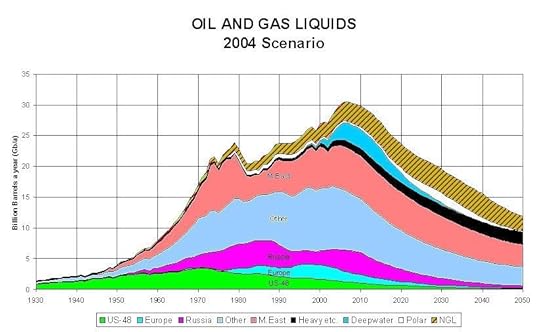
Observe that the upward slope has a lot of interesting structureto it. There are world wars, depressions, imperial collapses, oilembargoes, discoveries of giant oil fields, not to mention the uglyboom and bust cycles that are the bane of capitalist economies(whereas socialist ones have sometimes been able to grow, stagnateand eventually collapse far more gracefully). It is a rugged slope,with cliffs and crevasses, craggy outcrops and steep inclines. Nowlook at the downward slope: is it not shockingly smooth? Its geologicorigin must be completely different from that of the upward slope. Itappears to be made up of a single giant moraine, piled to the angleof repose near the top, with some spreading at the base, no doubt dueto erosion, with a gradual transition into what appears to be agently sloping alluvial plain no doubt composed of silt from therunoff, which is then followed by a vast perfectly flat area, whichmight have been the bottom of an ancient sea. If climbing up to thepeak must have required mountaineering techniques, the downward slopelooks like it could be negotiated in bathroom slippers. One could docartwheels all the way down, and be sure of not hitting anythingsharp before gently rolling to a stop sometime around 2100.Mathematically, the upward slope would have to be characterized bysome high-order polynomial, whereas the downward slope is just e-twith a little bit of statistical noise. This, you must agree, isextremely suspicious: a natural phenomenon of great complexity that,just when it is forced to stop growing, turns around and becomes assimple as a pile of dirt. Where else have we observed this sort ofspontaneous and sudden simplification of a complex, dynamic process?Physical death is sometimes preceded by slow decay, but sooner orlater most living things go from living to dead in an abrupttransition. They don't shrivel continuously for decades on end,eventually becoming too small to be observable. And so I like to callthis generic and widely accepted Peak Oil case the Rosy Scenario.It's the one in which industrial civilization, instead of keelingover promptly, joins an imaginary retirement community and spends itsgolden years tethered to a phantom oxygen tank and a phantomcolostomy bag.
The really odd thing is that the Rosy Scenario can be quiteaccurate, under ideal circumstances, when applied to individualcountries and oil-producing regions. For instance, suppose one of theworld's largest oil producers, which started out with more oil thanSaudi Arabia, reaches Peak Oil in, say, 1970, but then promptly goesoff the gold standard, foists its paper currency on the rest of theworld by backing it up with the threat of force including thepossibility of a nuclear first strike, eventually comes to importover 60% of its petroleum, much of it on credit, and, a few decadeslater, goes bankrupt. Then, over the intervening decades, itsdomestic oil production would indeed exhibit this wonderfully gentlegeologically and technologically constrained curve—up to the pointof national bankruptcy.
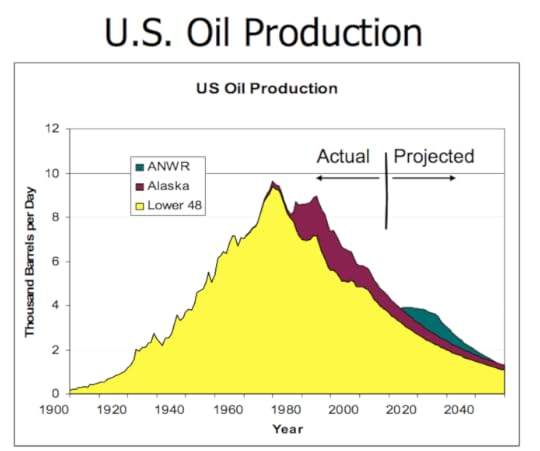
Past the point of national bankruptcy circumstances are bound tobecome decidedly non-ideal, but the implications of this remainunclear. Will that hapless country still be able continue borrowingmoney internationally in order to import enough oil to keep itseconomy functioning, and, if so, under what terms, and for how muchlonger? It would be nice to know how this story ends ahead of time,but unfortunately all we can do is wait and see.
But we do have another example (Fig. 3), which may offer someinsights into what we mean when we say that circumstances will be"non-ideal." The country that is currently the world's largestoil producer reached Peak Oil around 1987. Its sclerotic, geriatric,ideologically hidebound, systemically corrupt leadership was unableto grasp the importance of this fact, and just three years later thecountry was bankrupt and, shortly thereafter, it dissolvedpolitically. In this case, plummeting oil production became thecountry's leading economic indicator: it plummeted, then the GDPplummeted, then coal and natural gas production plummeted, and adecade later the economy was down 40%. Behind these numbers was aprecipitous drop in life expectancy and a pervasive atmosphere ofdespair in which many lives were either lost or ruined.
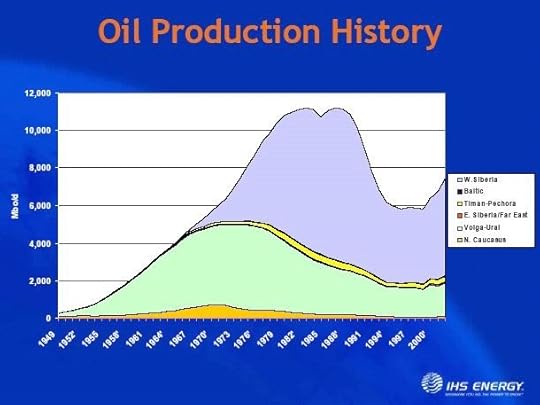
But as long as no messy internal or external political or economicfactors interfere with the natural depletion curve, the après-Peakpredictions of Peak Oil theory do seem to hold. (When I say "idealcircumstances," I suppose that I must mean circumstances that areideal from the point of view of sentient though irrationalhydrocarbon molecules, whose desire is to be pumped out of the groundand burned up as quickly and efficiently as possible, because it isunclear who else ultimately benefits, but let's not quibble.) Sincethe problem of not having enough oil to go around is known to causeall sorts of nasty political and economic problems, and since this isexactly the problem we should expect to encounter soon after theworld reaches Peak Oil, the base assumption on which the predictionsof Peak Oil theory for global oil production rest is not realistic.The specialists who are in a position to predict Peak Oil are notable to gauge its economic and political effects, and so all they cando is give us the Rosy Scenario as an ultimate upper bound. However,this caveat is not spelled out as clearly as it should be. The resultis that we might as well be working with a theory which predictsthat, once global Peak Oil is reached, delicious chocolate petitsfours will spontaneously bake themselves into existence and flyinto our mouths on dainty gossamer wings of marzipan.
The Peak Oil theory-based explanation is that while the upwardslope is economically constrained, the downward slope is onlyconstrained by the geology of depleting oil reservoirs and by oilextraction technology, which is subject to thermodynamic limits andcannot improve forever without encountering diminishing, thennegative, returns. While the oil supply is growing, oil demandfluctuates, resulting in numerous ups and downs in productionsuperimposed on the overall upward trend as production tries to matchdemand. But on the downward side, demand permanently exceeds supply,and so every barrel of oil that can be produced at each instant willbe produced.
When extrapolating the aftermath of local oil production declinesto global Peak Oil, the unstated assumption is that the globaleconomy will continue to function with uncanny smoothness at thelevel of demand that can be met, while unmet demand will be cleanlywashed off into the gutter by a strong, steady stream of economic andpolitical nonsense. This will all sort itself out spontaneously withrational market participants responding to price signals and decidingat each instant whether they should:
A. continue consuming oil in the manner to which they have becomeaccustomed, or
B. quietly wander off and die without calling attention tothemselves or making a fuss.
Where else have we seen such flawless organization, in situationswhere a key commodity—like, say, food, or drinking water—becomes critically scarce? Anywhere? Anywhere at all?
And I suppose a further unstated assumption is that a shrinkingeconomy (what with all this unmet demand and resulting attritionamong market participants) can function much as a growing one does,without suffering a financial collapse. Special financial instrumentscalled credit-default swaps can be used as a hedge against increasedcounterparty risk from your counterparties dying in droves fromself-inflicted wounds, although after a while these instruments wouldbecome a bit too expensive. But I don't suppose that much of anythingcan be done about the economic growth projections baked into everysingle financial plan at every level. Once these turn out to beunfounded, then all the debt pyramids will come tumbling down. Andsince a fiat currency (such as the US Dollar) is composed of debt—credit advanced based on a promise of future growth—it is unclearhow and with what the remaining oil will continue to be purchased.The end of growth is an imponderable; start talking about it, andeveryone suddenly decides that it's lunchtime and starts orderingdrinks. At least the French have a proper word for it: décroissance(literally, "de-growth"); here in the anglophone world all we cando is gibber and mumble about "double-dips." Perhaps Geithner andBernanke can come up with a dance number to illustrate.
Let us look at it another way. As I mentioned, Peak Oil theory hasbeen quite good at predicting the depletion profile of certain stableand prosperous countries and provinces. But these predictions becomemeaningless when extrapolated to the world as a whole, for one veryobvious reason: the world cannot import oil. Let me say it again,this time in title-case, bolded and centered, to emphasize thesignificance of this statement:
Planet Earth Can't Import Oil
When faced with insufficient domestic oil production, anindustrialized country has but two choices:
1. Import oil
2. Collapse
But when faced with insufficient global oil production, anindustrialized planet has just one choice: Choice Number 2.
Some might argue that there is a third choice: start using lessoil right away. However, in practice this turns out to be equivalentto Choice Number 2. Using less oil involves making some radical,often technologically challenging, politically unpopular, andtherefore expensive and time-consuming changes. These may be astechnologically advanced (and unrealistic) as replacing the currentmotor vehicle fleet with electric battery-powered vehicles and alarge number of nuclear power plants to recharge their batteries, oras simple (and quite realistic) as moving to a place that is withinwalking or bicycling distance from your work, growing most of yourown food in a kitchen garden and a chicken coop, and so on. Butwhatever these steps are, they all require a certain amount ofpreparation and expense, and a time of crisis (such as when oilsupplies suddenly run short) is a notoriously difficult time tolaunch into long-range planning activities. By the time the crisisarrives, either a country has already prepared as much as it could orwanted to (thereby delaying the onset of collapse) or it has not,bringing the crisis on sooner, and making it more severe. Theoft-cited Hirsch Report states that it would take twenty years toprepare for Peak Oil in order to avoid a severe and prolongedshortage of transportation fuels, and so, given that the peak wasback in 2005, we now have minus five years left to lollygag before wehave to start preparing. According to Hirsch et al., we havefailed to prepare already.
Some might also wonder why a shortage of oil should automaticallytrigger a collapse. It turns out that, in an industrialized economy,a drop in oil consumption precipitates a proportional drop in overalleconomic activity. Oil is the feedstock used to make the vastmajority of transportation fuels—which are used to move productsand deliver services throughout the economy. In the US in particular,there is a very strong correlation between GDP and motor vehiclemiles traveled. Thus, the US economy can be said to run on oil, in arather direct and immediate way: less oil implies a smaller economy.At what point does the economy shrink so much that it can no longermeet its own maintenance requirements? In order to continuefunctioning, all sorts of infrastructure, plant and equipment must bemaintained and replaced in a timely manner, or it stops functioning.Once that point is reached, economic activity becomes constrained notjust by the availability of transportation fuels, but also by theavailability of serviceable equipment. At some point the economyshrinks so much as to invalidate the financial assumptions on whichit is based, making it impossible to continue importing oil oncredit. Once that point is reached, the amount of transportationfuels available is no longer limited just by the availability of oil,but also constrained by the inability to finance oil imports.
The initial shortage of transportation fuels need not be large inorder to trigger this entire cascade of events, because even a smallshortage triggers a number of economically destructive feedbackloops. A lot of fuel is wasted by idling in line at the few gasstations that remain open. More fuel is wasted by topping off—keeping the tank as full as possible, not knowing when and where youwill be able to fill it again. Even more fuel disappears from themarket because people are hoarding it in jerrycans and improvisedcontainers. As the shortages drag on and spread, fuel is hoarded, anda black market for it develops: fuel diverted from official deliverychannels and siphoned from gas tanks becomes available on the blackmarket at inflated prices. And so the effect of even a minor initialshortage can easily snowball into an economic disruption sufficientto push the economy over physical and financial thresholds and towardcollapse.
If at this point you are starting to feel despondent, then—I amsorry to have to say this, but you must be a lightweight, becausethere is more—lots more to consider. Peak Oil's Rosy Scenario maylook pretty, but even a rose has its thorns. And there are a numberof other issues which need to be considered and taken into accountwithin a single, integrated view.
First, the rosy post-Peak Oil global production profile is basedon reserve numbers which have been overstated. Much of the remainingoil is in the Middle East, in OPEC countries, and these countriesoverstated their reserves by various large amounts during OPEC's"quota wars" back in the 1980s. While other OPEC memberssheepishly cooked up bogus numbers that looked vaguely real, SaddamHussein, who was always a bit of a showboat, rounded up Iraq'sreserve numbers up to a nice round number: 100 billion barrels. Andso OPEC reserves turn out to have been inflated by some large amount—about a third at a minimum. Nor is OPEC unique in overstatingtheir reserve numbers. Energy companies in the US play much the samegame in order to please Wall Street. Set your bathroom slippersaside; to negotiate Peak Oil's downward slope you will need goodmountaineering equipment.
Second, there is a phenomenon called Export Land Effect:oil-exporting countries, when their production starts to falter, havea strong tendency to cut exports before cutting into domesticconsumption. To be sure, there are some countries that havesurrendered their resource sovereignty to international energycompanies and have lost control over their export policies. There arealso some despotic regimes that starve their domestic consumers butto continue to earn the export revenue needed to prop up the regime.But most countries will only export their surplus production. Thismeans that it will become impossible to buy oil internationally longbefore all the wells run dry, leaving oil importing countries out inthe cold. Thus, if you live in an oil-importing country and thoughtyou could negotiate the downward slope of Peak Oil in your hikingboots, put them aside. You will need a parachute.
Third, although total quantities of oil produced throughout theworld were increasing up until 2005, the amounts of oil-basedproducts (gasoline, diesel, etc.) delivered to their points of usepeaked years earlier, in terms of usable energy derived. This wasbecause more and more energy has been required to get a barrel of oilout of the ground and to refine it. Supplies of available crude oilhave tended to become harder to extract, heavier, and more sulfurladen, plus the demand for more gasoline (as opposed to distillatesor bunker fuels) with less lead for boosting octane add up to moreenergy being wasted. Energy Returned on Energy Invested (EROEI) wentfrom 100:1 at the dawn of the oil age, when some strong-backed ladscould dig you an oil well using picks and shovels, to an average of10:1, now that oil production requires deepwater platforms (thatsometimes blow up and poison entire ecosystems), horizontal drillingand fracturing technology, secondary and tertiary recovery usingwater and nitrogen injection, oil/water separation plants, and allsorts of other technical complexities which consume more and more ofthe energy they produce. As EROEI decreases from 10:1 toward 1:1, theoil industry comes to resemble an obese but famished wet-nurseravenously sucking her own breast at the crib of a starving infant.At some point it will no longer be economically possible to deliverdiesel or gasoline to a gas station. When that point comes is notcertain, but there are some indications that 3:1 is the minimum EROEIthat the oil industry requires in order to sustain itself. The effectof decreasing EROEI is to make the gentle slope of the Rosy Scenariomuch steeper. The slope no longer looks like a mound of pebbles—more like lava flowing into the sea and solidifying in a cloud ofsteam. There may be plenty of energy left, but much of it is going togo by the wayside, and you might not be able to get close enough toit to roast your marshmallows.
Fourth, we must consider the fact that our modern global oilindustry is highly integrated. If you need a certain specialty partfor your drilling operation, chances are it can be sourced from justone or two global companies. Chances are this company has some veryimportant, highly technical operations in a country that just happensto be an oil importer. The significance of this becomes clear whenone considers what happens to that company's operations once ExportLand Effect becomes felt. Suppose you are a national oil company inan oil-rich nation that still has enough oil left for domesticconsumption, although it was recently forced to fire all of itsinternational customers. Your oil fields are huge but mature, and youcan only keep them in production by continuously drilling newhorizontal wells just above the ever-rising water cut and maintainingwell pressure by injecting seawater underneath. If you stop or evenpause this activity, then your oil, at the wellhead, will quicklychange in composition from slightly watery oil to slightly oilywater, which you might as well just pump back underground. And now itturns out that the equipment you need to keep drilling horizontalwells comes from one of these unlucky countries that used to importyour oil but now cannot, and the technicians who used to build yourequipment have given up trying to find enough black-market gasolineto drive to work and are busy digging up their suburban backyards togrow potatoes. A short while later your drilling operations run outof spare parts, your oil production crashes, and most of yourremaining reserves are left underground, contributing to anincreasingly important reserve category: never-to-be-producedreserves.
When these four factors are considered together, it becomesdifficult to imagine that global oil production could gently waftdown from lofty heights in a graceful smooth and continuous curvespanning decades. Rather, the picture that presents itself is one ofstepwise declines happening in more and more places, and eventuallyencompassing the entire planet. Whoever you are, and wherever youare, you are likely to experience this as a three-stage process:
Stage 1: You have your current level access to transportationfuels and services
Stage 2: You have severely limited access to transportation fuelsand services
Stage 3: You have no access to transportation fuels and severelyrestricted transportation options
How long Stage 2 will last will vary from one place to another.Some places may go directly to Stage 3: gasoline tankers stop comingto your town, all the local gas stations close, and that is that. Inother places, a thriving black market may give you some access togasoline for a few years longer, at prices that will allow some uses,such as running an electrical generator at an emergency center. Butyour ability to successfully cope with Stage 2, and to survive Stage3, will be determined largely by the changes and preparations you areable to make during Stage 1.
It should be expected that the vast majority of people will havedone nothing to prepare, remaining quite unaware of the fact thatthis is something they should have been doing. Quite a few people canbe expected to take a few small steps in a sensible direction, suchas installing a wood stove, or insulating their home, or in aseemingly sensible but ultimately unhelpful direction, such aswasting their money on a new hybrid car or wasting their energies ontrying to form a new political party or to lobby one of the existingones. Some will buy a homestead, equip it for life off the grid,start growing all their own food (perhaps transporting theirperishable surplus to a nearby farmer's market by cargo bicycle or byboat), and home-school their children, putting an emphasis on theclassics and on agriculture, animal husbandry and other perenniallyuseful knowledge. Some will flee to a place where transportationfuels are scarce already, and where a moped is considered alabor-saving device—for your donkey or camel.
Unfortunately, it is hard to foresee which changes and adaptationswill succeed and which will fail, because so much depends on thecircumstances, which are sure to be unpredictable and vary from placeto place, and on the person or persons involved: the uncertainty isjust too great. But there is one thing of which we can be quite sure:that Peak Oil's Rosy Scenario, which projects a long and gradualglobal oil production decline, is bunk. Knowing this fact shouldimpart a sense of urgency. Whether we use that sense of urgencyfoolishly or wisely is up to us, and our success may be a matter ofluck, but having a sense of urgency is not at all bad. If we wish toprepare, we most likely have a few months, we may have a few years,but we certainly do not have a few decades. Let those who would haveyou believe otherwise first consider the issues I have raised in thisarticle.

 The marketing blurb on the back cover of the first edition of myfirst book, Reinventing Collapse, described me as "aleading Peak Oil theorist." When I first saw it, my jaw dropped—and remained hanging. You see, if you run through a list of bonafide leading Peak Oil theorists—your Hubberts, your Campbells,Laherrères, Heinbergs, Simmonses and a few others worth mentioning,you will not find a single Orlov among them. In vain would you searchthe annals and conference proceedings of the Association for theStudy of Peak Oil for any trace of your humble author. But now thatthis howler is in print and circulated in so many copies, I suppose Ihave no choice but to try to live up to the expectation it set.
My disqualifications aside, now does seem to be an auspiciousmoment to hold forth with a new piece of Peak Oil theory, becausethis is the year when, for the first time, just about everyone isready to admit that Peak Oil is real, in essence, though some are notquite ready to call it by that name. Just five years ago everyonefrom government officials to oil company executives treated Peak Oiltheory as the work of a lunatic fringe, but now that conventionalworld oil production peaked in 2005, and all liquids world productionpeaked in 2008, everyone is ready to concede that there are seriousproblems with growing the global oil supply. And although some peoplestill feel skittish about using the term Peak Oil (and a few expertsstill insist that the peak must be referred to as "an undulatingplateau," which, if anything, is a graceful turn of phrase) thedifferences of opinion now largely stem from a refusal to accept theterminology of Peak Oil rather than the substance of peaking globaloil production. This is, of course, quite understandable: it isawkward to suddenly jump from shouting "Peak Oil is bunk!"to shouting "Peak Oil is history!" in a single bound. Suchacrobatics are only safe if you happen to be a politician or aneconomist.
Now that the matter has been largely settled, I feel that the timeis ripe for me to weigh in on the subject and declare, unequivocally,that Peak Oil is indeed bunk. Not the part about global oilproduction reaching a peak sometime right around now then declininginexorably: that part seems true enough. Nor the part about oilproduction in any given province becoming constrained by geology andtechnology once the peak is reached: that part, under properlydesigned experimental conditions, seems predictive as well. In fact,the depletion model has been confirmed beautifully by the example ofthe continental United States minus Alaska since 1970. But the ideathat this same depletion model can be applied to the planet as awhole, is, I feel, something that must be rejected as utterly andcompletely bogus. To see what I mean, look at a typical Peak Oilchart (Fig. 1) that shows global oil production climbing up to a peakand then declining.
Observe that the upward slope has a lot of interesting structureto it. There are world wars, depressions, imperial collapses, oilembargoes, discoveries of giant oil fields, not to mention the uglyboom and bust cycles that are the bane of capitalist economies(whereas socialist ones have sometimes been able to grow, stagnateand eventually collapse far more gracefully). It is a rugged slope,with cliffs and crevasses, craggy outcrops and steep inclines. Nowlook at the downward slope: is it not shockingly smooth? Its geologicorigin must be completely different from that of the upward slope. Itappears to be made up of a single giant moraine, piled to the angleof repose near the top, with some spreading at the base, no doubt dueto erosion, with a gradual transition into what appears to be agently sloping alluvial plain no doubt composed of silt from therunoff, which is then followed by a vast perfectly flat area, whichmight have been the bottom of an ancient sea. If climbing up to thepeak must have required mountaineering techniques, the downward slopelooks like it could be negotiated in bathroom slippers. One could docartwheels all the way down, and be sure of not hitting anythingsharp before gently rolling to a stop sometime around 2100.Mathematically, the upward slope would have to be characterized bysome high-order polynomial, whereas the downward slope is just e-twith a little bit of statistical noise. This, you must agree, isextremely suspicious: a natural phenomenon of great complexity that,just when it is forced to stop growing, turns around and becomes assimple as a pile of dirt. Where else have we observed this sort ofspontaneous and sudden simplification of a complex, dynamic process?Physical death is sometimes preceded by slow decay, but sooner orlater most living things go from living to dead in an abrupttransition. They don't shrivel continuously for decades on end,eventually becoming too small to be observable. And so I like to callthis generic and widely accepted Peak Oil case the Rosy Scenario.It's the one in which industrial civilization, instead of keelingover promptly, joins an imaginary retirement community and spends itsgolden years tethered to a phantom oxygen tank and a phantomcolostomy bag.
The really odd thing is that the Rosy Scenario can be quiteaccurate, under ideal circumstances, when applied to individualcountries and oil-producing regions. For instance, suppose one of theworld's largest oil producers, which started out with more oil thanSaudi Arabia, reaches Peak Oil in, say, 1970, but then promptly goesoff the gold standard, foists its paper currency on the rest of theworld by backing it up with the threat of force including thepossibility of a nuclear first strike, eventually comes to importover 60% of its petroleum, much of it on credit, and, a few decadeslater, goes bankrupt. Then, over the intervening decades, itsdomestic oil production would indeed exhibit this wonderfully gentlegeologically and technologically constrained curve—up to the pointof national bankruptcy.
Past the point of national bankruptcy circumstances are bound tobecome decidedly non-ideal, but the implications of this remainunclear. Will that hapless country still be able continue borrowingmoney internationally in order to import enough oil to keep itseconomy functioning, and, if so, under what terms, and for how muchlonger? It would be nice to know how this story ends ahead of time,but unfortunately all we can do is wait and see.
But we do have another example (Fig. 3), which may offer someinsights into what we mean when we say that circumstances will be"non-ideal." The country that is currently the world's largestoil producer reached Peak Oil around 1987. Its sclerotic, geriatric,ideologically hidebound, systemically corrupt leadership was unableto grasp the importance of this fact, and just three years later thecountry was bankrupt and, shortly thereafter, it dissolvedpolitically. In this case, plummeting oil production became thecountry's leading economic indicator: it plummeted, then the GDPplummeted, then coal and natural gas production plummeted, and adecade later the economy was down 40%. Behind these numbers was aprecipitous drop in life expectancy and a pervasive atmosphere ofdespair in which many lives were either lost or ruined.
But as long as no messy internal or external political or economicfactors interfere with the natural depletion curve, the après-Peakpredictions of Peak Oil theory do seem to hold. (When I say "idealcircumstances," I suppose that I must mean circumstances that areideal from the point of view of sentient though irrationalhydrocarbon molecules, whose desire is to be pumped out of the groundand burned up as quickly and efficiently as possible, because it isunclear who else ultimately benefits, but let's not quibble.) Sincethe problem of not having enough oil to go around is known to causeall sorts of nasty political and economic problems, and since this isexactly the problem we should expect to encounter soon after theworld reaches Peak Oil, the base assumption on which the predictionsof Peak Oil theory for global oil production rest is not realistic.The specialists who are in a position to predict Peak Oil are notable to gauge its economic and political effects, and so all they cando is give us the Rosy Scenario as an ultimate upper bound. However,this caveat is not spelled out as clearly as it should be. The resultis that we might as well be working with a theory which predictsthat, once global Peak Oil is reached, delicious chocolate petitsfours will spontaneously bake themselves into existence and flyinto our mouths on dainty gossamer wings of marzipan.
The Peak Oil theory-based explanation is that while the upwardslope is economically constrained, the downward slope is onlyconstrained by the geology of depleting oil reservoirs and by oilextraction technology, which is subject to thermodynamic limits andcannot improve forever without encountering diminishing, thennegative, returns. While the oil supply is growing, oil demandfluctuates, resulting in numerous ups and downs in productionsuperimposed on the overall upward trend as production tries to matchdemand. But on the downward side, demand permanently exceeds supply,and so every barrel of oil that can be produced at each instant willbe produced.
When extrapolating the aftermath of local oil production declinesto global Peak Oil, the unstated assumption is that the globaleconomy will continue to function with uncanny smoothness at thelevel of demand that can be met, while unmet demand will be cleanlywashed off into the gutter by a strong, steady stream of economic andpolitical nonsense. This will all sort itself out spontaneously withrational market participants responding to price signals and decidingat each instant whether they should:
A. continue consuming oil in the manner to which they have becomeaccustomed, or
B. quietly wander off and die without calling attention tothemselves or making a fuss.
Where else have we seen such flawless organization, in situationswhere a key commodity—like, say, food, or drinking water—becomes critically scarce? Anywhere? Anywhere at all?
And I suppose a further unstated assumption is that a shrinkingeconomy (what with all this unmet demand and resulting attritionamong market participants) can function much as a growing one does,without suffering a financial collapse. Special financial instrumentscalled credit-default swaps can be used as a hedge against increasedcounterparty risk from your counterparties dying in droves fromself-inflicted wounds, although after a while these instruments wouldbecome a bit too expensive. But I don't suppose that much of anythingcan be done about the economic growth projections baked into everysingle financial plan at every level. Once these turn out to beunfounded, then all the debt pyramids will come tumbling down. Andsince a fiat currency (such as the US Dollar) is composed of debt—credit advanced based on a promise of future growth—it is unclearhow and with what the remaining oil will continue to be purchased.The end of growth is an imponderable; start talking about it, andeveryone suddenly decides that it's lunchtime and starts orderingdrinks. At least the French have a proper word for it: décroissance(literally, "de-growth"); here in the anglophone world all we cando is gibber and mumble about "double-dips." Perhaps Geithner andBernanke can come up with a dance number to illustrate.
Let us look at it another way. As I mentioned, Peak Oil theory hasbeen quite good at predicting the depletion profile of certain stableand prosperous countries and provinces. But these predictions becomemeaningless when extrapolated to the world as a whole, for one veryobvious reason: the world cannot import oil. Let me say it again,this time in title-case, bolded and centered, to emphasize thesignificance of this statement:
Planet Earth Can't Import Oil
When faced with insufficient domestic oil production, anindustrialized country has but two choices:
1. Import oil
2. Collapse
But when faced with insufficient global oil production, anindustrialized planet has just one choice: Choice Number 2.
Some might argue that there is a third choice: start using lessoil right away. However, in practice this turns out to be equivalentto Choice Number 2. Using less oil involves making some radical,often technologically challenging, politically unpopular, andtherefore expensive and time-consuming changes. These may be astechnologically advanced (and unrealistic) as replacing the currentmotor vehicle fleet with electric battery-powered vehicles and alarge number of nuclear power plants to recharge their batteries, oras simple (and quite realistic) as moving to a place that is withinwalking or bicycling distance from your work, growing most of yourown food in a kitchen garden and a chicken coop, and so on. Butwhatever these steps are, they all require a certain amount ofpreparation and expense, and a time of crisis (such as when oilsupplies suddenly run short) is a notoriously difficult time tolaunch into long-range planning activities. By the time the crisisarrives, either a country has already prepared as much as it could orwanted to (thereby delaying the onset of collapse) or it has not,bringing the crisis on sooner, and making it more severe. Theoft-cited Hirsch Report states that it would take twenty years toprepare for Peak Oil in order to avoid a severe and prolongedshortage of transportation fuels, and so, given that the peak wasback in 2005, we now have minus five years left to lollygag before wehave to start preparing. According to Hirsch et al., we havefailed to prepare already.
Some might also wonder why a shortage of oil should automaticallytrigger a collapse. It turns out that, in an industrialized economy,a drop in oil consumption precipitates a proportional drop in overalleconomic activity. Oil is the feedstock used to make the vastmajority of transportation fuels—which are used to move productsand deliver services throughout the economy. In the US in particular,there is a very strong correlation between GDP and motor vehiclemiles traveled. Thus, the US economy can be said to run on oil, in arather direct and immediate way: less oil implies a smaller economy.At what point does the economy shrink so much that it can no longermeet its own maintenance requirements? In order to continuefunctioning, all sorts of infrastructure, plant and equipment must bemaintained and replaced in a timely manner, or it stops functioning.Once that point is reached, economic activity becomes constrained notjust by the availability of transportation fuels, but also by theavailability of serviceable equipment. At some point the economyshrinks so much as to invalidate the financial assumptions on whichit is based, making it impossible to continue importing oil oncredit. Once that point is reached, the amount of transportationfuels available is no longer limited just by the availability of oil,but also constrained by the inability to finance oil imports.
The initial shortage of transportation fuels need not be large inorder to trigger this entire cascade of events, because even a smallshortage triggers a number of economically destructive feedbackloops. A lot of fuel is wasted by idling in line at the few gasstations that remain open. More fuel is wasted by topping off—keeping the tank as full as possible, not knowing when and where youwill be able to fill it again. Even more fuel disappears from themarket because people are hoarding it in jerrycans and improvisedcontainers. As the shortages drag on and spread, fuel is hoarded, anda black market for it develops: fuel diverted from official deliverychannels and siphoned from gas tanks becomes available on the blackmarket at inflated prices. And so the effect of even a minor initialshortage can easily snowball into an economic disruption sufficientto push the economy over physical and financial thresholds and towardcollapse.
If at this point you are starting to feel despondent, then—I amsorry to have to say this, but you must be a lightweight, becausethere is more—lots more to consider. Peak Oil's Rosy Scenario maylook pretty, but even a rose has its thorns. And there are a numberof other issues which need to be considered and taken into accountwithin a single, integrated view.
First, the rosy post-Peak Oil global production profile is basedon reserve numbers which have been overstated. Much of the remainingoil is in the Middle East, in OPEC countries, and these countriesoverstated their reserves by various large amounts during OPEC's"quota wars" back in the 1980s. While other OPEC memberssheepishly cooked up bogus numbers that looked vaguely real, SaddamHussein, who was always a bit of a showboat, rounded up Iraq'sreserve numbers up to a nice round number: 100 billion barrels. Andso OPEC reserves turn out to have been inflated by some large amount—about a third at a minimum. Nor is OPEC unique in overstatingtheir reserve numbers. Energy companies in the US play much the samegame in order to please Wall Street. Set your bathroom slippersaside; to negotiate Peak Oil's downward slope you will need goodmountaineering equipment.
Second, there is a phenomenon called Export Land Effect:oil-exporting countries, when their production starts to falter, havea strong tendency to cut exports before cutting into domesticconsumption. To be sure, there are some countries that havesurrendered their resource sovereignty to international energycompanies and have lost control over their export policies. There arealso some despotic regimes that starve their domestic consumers butto continue to earn the export revenue needed to prop up the regime.But most countries will only export their surplus production. Thismeans that it will become impossible to buy oil internationally longbefore all the wells run dry, leaving oil importing countries out inthe cold. Thus, if you live in an oil-importing country and thoughtyou could negotiate the downward slope of Peak Oil in your hikingboots, put them aside. You will need a parachute.
Third, although total quantities of oil produced throughout theworld were increasing up until 2005, the amounts of oil-basedproducts (gasoline, diesel, etc.) delivered to their points of usepeaked years earlier, in terms of usable energy derived. This wasbecause more and more energy has been required to get a barrel of oilout of the ground and to refine it. Supplies of available crude oilhave tended to become harder to extract, heavier, and more sulfurladen, plus the demand for more gasoline (as opposed to distillatesor bunker fuels) with less lead for boosting octane add up to moreenergy being wasted. Energy Returned on Energy Invested (EROEI) wentfrom 100:1 at the dawn of the oil age, when some strong-backed ladscould dig you an oil well using picks and shovels, to an average of10:1, now that oil production requires deepwater platforms (thatsometimes blow up and poison entire ecosystems), horizontal drillingand fracturing technology, secondary and tertiary recovery usingwater and nitrogen injection, oil/water separation plants, and allsorts of other technical complexities which consume more and more ofthe energy they produce. As EROEI decreases from 10:1 toward 1:1, theoil industry comes to resemble an obese but famished wet-nurseravenously sucking her own breast at the crib of a starving infant.At some point it will no longer be economically possible to deliverdiesel or gasoline to a gas station. When that point comes is notcertain, but there are some indications that 3:1 is the minimum EROEIthat the oil industry requires in order to sustain itself. The effectof decreasing EROEI is to make the gentle slope of the Rosy Scenariomuch steeper. The slope no longer looks like a mound of pebbles—more like lava flowing into the sea and solidifying in a cloud ofsteam. There may be plenty of energy left, but much of it is going togo by the wayside, and you might not be able to get close enough toit to roast your marshmallows.
Fourth, we must consider the fact that our modern global oilindustry is highly integrated. If you need a certain specialty partfor your drilling operation, chances are it can be sourced from justone or two global companies. Chances are this company has some veryimportant, highly technical operations in a country that just happensto be an oil importer. The significance of this becomes clear whenone considers what happens to that company's operations once ExportLand Effect becomes felt. Suppose you are a national oil company inan oil-rich nation that still has enough oil left for domesticconsumption, although it was recently forced to fire all of itsinternational customers. Your oil fields are huge but mature, and youcan only keep them in production by continuously drilling newhorizontal wells just above the ever-rising water cut and maintainingwell pressure by injecting seawater underneath. If you stop or evenpause this activity, then your oil, at the wellhead, will quicklychange in composition from slightly watery oil to slightly oilywater, which you might as well just pump back underground. And now itturns out that the equipment you need to keep drilling horizontalwells comes from one of these unlucky countries that used to importyour oil but now cannot, and the technicians who used to build yourequipment have given up trying to find enough black-market gasolineto drive to work and are busy digging up their suburban backyards togrow potatoes. A short while later your drilling operations run outof spare parts, your oil production crashes, and most of yourremaining reserves are left underground, contributing to anincreasingly important reserve category: never-to-be-producedreserves.
When these four factors are considered together, it becomesdifficult to imagine that global oil production could gently waftdown from lofty heights in a graceful smooth and continuous curvespanning decades. Rather, the picture that presents itself is one ofstepwise declines happening in more and more places, and eventuallyencompassing the entire planet. Whoever you are, and wherever youare, you are likely to experience this as a three-stage process:
Stage 1: You have your current level access to transportationfuels and services
Stage 2: You have severely limited access to transportation fuelsand services
Stage 3: You have no access to transportation fuels and severelyrestricted transportation options
How long Stage 2 will last will vary from one place to another.Some places may go directly to Stage 3: gasoline tankers stop comingto your town, all the local gas stations close, and that is that. Inother places, a thriving black market may give you some access togasoline for a few years longer, at prices that will allow some uses,such as running an electrical generator at an emergency center. Butyour ability to successfully cope with Stage 2, and to survive Stage3, will be determined largely by the changes and preparations you areable to make during Stage 1.
It should be expected that the vast majority of people will havedone nothing to prepare, remaining quite unaware of the fact thatthis is something they should have been doing. Quite a few people canbe expected to take a few small steps in a sensible direction, suchas installing a wood stove, or insulating their home, or in aseemingly sensible but ultimately unhelpful direction, such aswasting their money on a new hybrid car or wasting their energies ontrying to form a new political party or to lobby one of the existingones. Some will buy a homestead, equip it for life off the grid,start growing all their own food (perhaps transporting theirperishable surplus to a nearby farmer's market by cargo bicycle or byboat), and home-school their children, putting an emphasis on theclassics and on agriculture, animal husbandry and other perenniallyuseful knowledge. Some will flee to a place where transportationfuels are scarce already, and where a moped is considered alabor-saving device—for your donkey or camel.
Unfortunately, it is hard to foresee which changes and adaptationswill succeed and which will fail, because so much depends on thecircumstances, which are sure to be unpredictable and vary from placeto place, and on the person or persons involved: the uncertainty isjust too great. But there is one thing of which we can be quite sure:that Peak Oil's Rosy Scenario, which projects a long and gradualglobal oil production decline, is bunk. Knowing this fact shouldimpart a sense of urgency. Whether we use that sense of urgencyfoolishly or wisely is up to us, and our success may be a matter ofluck, but having a sense of urgency is not at all bad. If we wish toprepare, we most likely have a few months, we may have a few years,but we certainly do not have a few decades. Let those who would haveyou believe otherwise first consider the issues I have raised in thisarticle.
October 27, 2010
A Specter Is Haunting America
p { margin-bottom: 0.08in; }
 [This is a guest post by Sandy, who escaped from New York and is now happily living in Barnaul, in the beautiful and majestic Altai Region of Russia.]
"A specter is hauntingEurope," Karl Marx once wrote. He wrote these words on the eve ofrevolutionary outbreaks that began in Italy and France in 1848 andsoon engulfed much of the Continent. Unbeknownst to most Americans,Europe is again engulfed in revolt, which threatens to spread. Thefinancial crisis that started in the USA and swept the globe, alongwith the sovereign debt crisis that was inflicted upon the EuropeanUnion as a result, has ignited the passions of strangled and enslavedmasses everywhere. People have recognized their enslavement and haveput a finger on their slave-masters. The largely capitalist regimesare no less affected than are the socialist, communist, or theocraticones, for they all have the same owner.
On the heels of 2009 civilunrest that had swept through Latvia, Lithuania, Ukraine, Bulgaria,Montenegro, Poland, Germany, Hungary, Greece, Portugal, Russia andthe Czech Republic in response to diverse austerity measuresimplemented by the ruling elites, a full-force revolt has broken outin France. Much like the political protests following the Iranianelections in 2009, months of protests and street demonstrationsacross France have taken a more violent turn, and signs of an armedinsurrection continue to mount. Across the Atlantic, even theCanadians have taken their eyes off the puck long enough to becomeenraged, staging protests at the G-20 meeting in Toronto that wouldmake a Frenchman proud, protests that have prompted one of the tamestlooking of political beasts to bare its tyrannical fangs.
The American middle/workingclass is still preoccupied with gazing at the shadows cast upon thewalls of its cave/prison, preferring to go on believing what they aretold by their owners and handlers: that all will be right with theirlittle world, provided they keep their head down and work hard (attrying to find a job). Political hucksters like Obama reassuringlytell us that "Yes We Can" survive this crisis and go on beggingfor a piece of the American Dream. The man behind the curtain isimploring them to go on ignoring what is before their eyes. He tellsus that their world is intact and will continue to prosper. And theydutifully listen, and willfully refuse to see. But the disillusionedamong us can no longer ignore the mountain of evidence to thecontrary that is before us. This show is coming to an end, and itpromises to be an inglorious one. The wave of extinction, peak oil,peak water, economic and financial crises worldwide, political unrestabroad that is about to spread to the homeland—are these not signsof imminent collapse?
But even our Europeanbrothers do not understand the magnitude of this seismic event. It isneither a fiscal nor an economic problem. It is not a matter ofhaving the wrong political leadership, nor is it the result ofconfused or misguided personal priorities. It is a crack in the domeof the theater of the Spectacle that began with the advent of humanhistory, of civilization itself. It is the endgameof the human evolutionary dead end that has pathologically soughtartifices of manipulation and control at all costs.
As Thomas Hobbesproleptically though unwittingly stated centuries ago, this will be a"Warre of all against all." But this will not be the war that hemistakenly assumed would have occurred among our pre-civilizedancestors had it not been for our constituting the social contract.Rather, it is a war resulting from that very contract, grounded incold and calculating thinking, and from the momentum it imparted tocivilization for these last six thousand years of recorded history.
The specter Marx wasreferring to was Communism: his contention was that it would andshould be the final stage in the dialectical movement of history to acivil but classless society. He was mistaken: the communistexperiment failed. The real ghostlyapparition that is haunting us now is a natural reflection ofthe fundamental lethality of industrial civilization itself and thesystems of hierarchy and domination it has devised and perfected, allbased upon the power of the syllogism. This is the logic of objectivescience, the principle of our legal systems, the rationality behindour social contracts, the anonymity of our civil politics, and thenarrative framework of history itself. It is this logic that binds usto the hierarchies that have worked to empty the world of all itsresources and life, of all its significance,replacing them with impersonal systems that vainly attemptto control and manage all affairs, human or natural.
It is the inevitableculmination of six thousand years of unnatural, human history thatbegan with the first urban empires emerging in and aroundMesopotamia's once fertile Fertile Crescent. People can still perceive this basiclethality, though many ofthem have become empty parts of emptying hierarchical institutions—anemptiness expressed most baldly in the following formulation: If A isa B, and B is a C, then A must be a C. Whether to control nature orour fellow humans, in this view we are all interchangeablecommodities within a single logic of control, a composite of testscores, job functions, marketable fashions and other objectivecriteria. Herein lies the reason for our emptiness and our sense ofalienation from one another, from nature and from our own natures.In seeking to compensate for this emptiness, we have sought toacquire other commodities to make us feel whole again—televisions,cars, laptops and other gadgets. But flashy cars and widescreentelevisions will not save us.
America is the mostrationally conceived of all modern, civilized societies. We have morescience and technology, more lawyers and laws, more prisons andprisoners, more military bases—in short, more and larger systems ofdomination than any other country on the planet. We also have morelawyers, more money managers and swindlers, more rat race, moremental illness and more lone gunmen acting out against whatever theyperceive as an injustice in their world. And yet we keep marchingstraight ahead to the precipice. We are a nation of rule-followers,not a community of free persons—and we are committed to thesyllogism as no other. There is no dignity in our enslavement; wehave become the emptiest of souls.
What is haunting the globetoday is the specter of primitive anarchy, a feral tendency burieddeep within the marrow and musculature of every animal. The humanspecies is no exception, and it too possesses a powerful instinct toescape death. We have an irrepressible will to survive the artfully,coldly created hierarchical systems of domination that are nowfailing. It is anarchic in the truest sense of the word: it seeks tobe leaderless not merely in a political sense, but to be free fromthe tyrannical hegemony imposed by the civilizing logic ofsyllogistic reasoning itself. It seeks to make each person, eachinteraction, each moment unique, unclassifiable, open to will andchance. It seeks freedom inthe polysemy of the senses, of the physical body—not the bodypolitic. This specter is not imaginary: it is real, and it is uponus. It is now everywhere and has a will of its own. It can no longerbe brought under control, through force or through reason, and therewill be no escaping it. It is not interested in you; it is comingafter who you think you are.
[Sandy's book, The Recovery of Ecstasy: Notebooks from Siberia, is available from Amazon.]

 [This is a guest post by Sandy, who escaped from New York and is now happily living in Barnaul, in the beautiful and majestic Altai Region of Russia.]
"A specter is hauntingEurope," Karl Marx once wrote. He wrote these words on the eve ofrevolutionary outbreaks that began in Italy and France in 1848 andsoon engulfed much of the Continent. Unbeknownst to most Americans,Europe is again engulfed in revolt, which threatens to spread. Thefinancial crisis that started in the USA and swept the globe, alongwith the sovereign debt crisis that was inflicted upon the EuropeanUnion as a result, has ignited the passions of strangled and enslavedmasses everywhere. People have recognized their enslavement and haveput a finger on their slave-masters. The largely capitalist regimesare no less affected than are the socialist, communist, or theocraticones, for they all have the same owner.
On the heels of 2009 civilunrest that had swept through Latvia, Lithuania, Ukraine, Bulgaria,Montenegro, Poland, Germany, Hungary, Greece, Portugal, Russia andthe Czech Republic in response to diverse austerity measuresimplemented by the ruling elites, a full-force revolt has broken outin France. Much like the political protests following the Iranianelections in 2009, months of protests and street demonstrationsacross France have taken a more violent turn, and signs of an armedinsurrection continue to mount. Across the Atlantic, even theCanadians have taken their eyes off the puck long enough to becomeenraged, staging protests at the G-20 meeting in Toronto that wouldmake a Frenchman proud, protests that have prompted one of the tamestlooking of political beasts to bare its tyrannical fangs.
The American middle/workingclass is still preoccupied with gazing at the shadows cast upon thewalls of its cave/prison, preferring to go on believing what they aretold by their owners and handlers: that all will be right with theirlittle world, provided they keep their head down and work hard (attrying to find a job). Political hucksters like Obama reassuringlytell us that "Yes We Can" survive this crisis and go on beggingfor a piece of the American Dream. The man behind the curtain isimploring them to go on ignoring what is before their eyes. He tellsus that their world is intact and will continue to prosper. And theydutifully listen, and willfully refuse to see. But the disillusionedamong us can no longer ignore the mountain of evidence to thecontrary that is before us. This show is coming to an end, and itpromises to be an inglorious one. The wave of extinction, peak oil,peak water, economic and financial crises worldwide, political unrestabroad that is about to spread to the homeland—are these not signsof imminent collapse?
But even our Europeanbrothers do not understand the magnitude of this seismic event. It isneither a fiscal nor an economic problem. It is not a matter ofhaving the wrong political leadership, nor is it the result ofconfused or misguided personal priorities. It is a crack in the domeof the theater of the Spectacle that began with the advent of humanhistory, of civilization itself. It is the endgameof the human evolutionary dead end that has pathologically soughtartifices of manipulation and control at all costs.
As Thomas Hobbesproleptically though unwittingly stated centuries ago, this will be a"Warre of all against all." But this will not be the war that hemistakenly assumed would have occurred among our pre-civilizedancestors had it not been for our constituting the social contract.Rather, it is a war resulting from that very contract, grounded incold and calculating thinking, and from the momentum it imparted tocivilization for these last six thousand years of recorded history.
The specter Marx wasreferring to was Communism: his contention was that it would andshould be the final stage in the dialectical movement of history to acivil but classless society. He was mistaken: the communistexperiment failed. The real ghostlyapparition that is haunting us now is a natural reflection ofthe fundamental lethality of industrial civilization itself and thesystems of hierarchy and domination it has devised and perfected, allbased upon the power of the syllogism. This is the logic of objectivescience, the principle of our legal systems, the rationality behindour social contracts, the anonymity of our civil politics, and thenarrative framework of history itself. It is this logic that binds usto the hierarchies that have worked to empty the world of all itsresources and life, of all its significance,replacing them with impersonal systems that vainly attemptto control and manage all affairs, human or natural.
It is the inevitableculmination of six thousand years of unnatural, human history thatbegan with the first urban empires emerging in and aroundMesopotamia's once fertile Fertile Crescent. People can still perceive this basiclethality, though many ofthem have become empty parts of emptying hierarchical institutions—anemptiness expressed most baldly in the following formulation: If A isa B, and B is a C, then A must be a C. Whether to control nature orour fellow humans, in this view we are all interchangeablecommodities within a single logic of control, a composite of testscores, job functions, marketable fashions and other objectivecriteria. Herein lies the reason for our emptiness and our sense ofalienation from one another, from nature and from our own natures.In seeking to compensate for this emptiness, we have sought toacquire other commodities to make us feel whole again—televisions,cars, laptops and other gadgets. But flashy cars and widescreentelevisions will not save us.
America is the mostrationally conceived of all modern, civilized societies. We have morescience and technology, more lawyers and laws, more prisons andprisoners, more military bases—in short, more and larger systems ofdomination than any other country on the planet. We also have morelawyers, more money managers and swindlers, more rat race, moremental illness and more lone gunmen acting out against whatever theyperceive as an injustice in their world. And yet we keep marchingstraight ahead to the precipice. We are a nation of rule-followers,not a community of free persons—and we are committed to thesyllogism as no other. There is no dignity in our enslavement; wehave become the emptiest of souls.
What is haunting the globetoday is the specter of primitive anarchy, a feral tendency burieddeep within the marrow and musculature of every animal. The humanspecies is no exception, and it too possesses a powerful instinct toescape death. We have an irrepressible will to survive the artfully,coldly created hierarchical systems of domination that are nowfailing. It is anarchic in the truest sense of the word: it seeks tobe leaderless not merely in a political sense, but to be free fromthe tyrannical hegemony imposed by the civilizing logic ofsyllogistic reasoning itself. It seeks to make each person, eachinteraction, each moment unique, unclassifiable, open to will andchance. It seeks freedom inthe polysemy of the senses, of the physical body—not the bodypolitic. This specter is not imaginary: it is real, and it is uponus. It is now everywhere and has a will of its own. It can no longerbe brought under control, through force or through reason, and therewill be no escaping it. It is not interested in you; it is comingafter who you think you are.
[Sandy's book, The Recovery of Ecstasy: Notebooks from Siberia, is available from Amazon.]
Dmitry Orlov's Blog

- Dmitry Orlov's profile
- 48 followers
Dmitry Orlov isn't a Goodreads Author
(yet),
but they
do have a blog,
so here are some recent posts imported from
their feed.


