
Dmitry Orlov's Blog, page 29
January 8, 2012
Dance of the Marionettes
 It's election season in the US, whichmeans that I have the unwelcome task of wading throughwell-intentioned though off-topic comments devoted to thingspolitical: who might be the next president, and whether or not itmatters who the next president is (it doesn't). And rather than bearit quietly, I thought I'd say something about it.
Electioneering in the US is steadilyexpanding to fill more and more time and space even as it providesworse and worse results with each election cycle. The Congress ismade of some of the least popular people on earth, who are manifestlyincapable of achieving anything useful. They do seem quite ready andwilling to pass laws that erode human rights and enhance the powersof the police state, but this is because they are paranoid. Perhapstheir one point of consensus is that sooner or later theirconstituents will want to open fire on them.
Still, the elections provide aspectacle, the media are conditioned to lavish attention on thecandidates, and the people, being weak-willed, are once againbeguiled into thinking that it matters who gets elected. A few yearsof Obama impersonating Bush should have taught them that it doesn'tmatter who the Prisoner of the White House is. Likewise, watching thesad spectacle of Congress trying to raise the debt limit or to reignin runaway deficit spending should have taught them that thisinstitution is no longer functional. (The US is about to bump upagainst the debt limit again; does anyone even care?) All of thisshould have been enough to make it clear to just about everyone thatwondering what might be different if, say, Ron Paul got electedpresident, is like wondering what might be different if the moon weremade of a different kind of cheese—your favorite kind, of course.
Leaving aside the meaningless questionof who the next Figurehead in Chief might be, let's look briefly atwhat is perhaps the most corrupt institution the US has: the USSenate. Everyone knows that senate seats are for sale: as soon as asenator gets elected, he starts fund-raising, to finance hisreelection campaign. Since each state, whether huge or puny, gets twoseats, these are variously priced: the two seats for a large, populousstate, like California or Texas, are very expensive, while the two seatsfor the puny State of Potatoho or some such, with its zero millioninhabitants, are more reasonably priced. Since the senatorsthemselves decide nothing and are simply mouthpieces to the moneyedinterests which buy their seats, and since this is a very dividedcountry, they are unable to achieve compromise, making the Senatecompletely useless as a deliberative body.
Let's face it: the senators are justmarionettes controlled by giant bags of money. Their seats aredefinitely for sale, all of them, all the time. But then an odd thinghappened about a month ago: the ousted Illinois Governor Rod Blagojevichwas sentenced to 14 years in prison for allegedly attempting to sellthe senate seat that was vacated when Obama was elected president. Itseems like a stiff penalty for something that is a routine, dailyoccurrence, does it not? It is especially odd since other miscreantswho actually caused serious damage, like former senator Jon Corzine,who looted investors' accounts to cover his gambling debts in thefutures market, are still at large. What set Blagojevich apart is that heviolated a taboo. Just like any normal criminal syndicate, the USSenate has rules by which the members preserve their positions andkeep each other in check. As with a criminal syndicate, these ruleshave nothing to do with serving the public interest. One of theserules is that it is not allowed to sell a senate seat if it isunoccupied. Essentially, senators get to sell senate seats, governorsdon't. It is a tribal taboo: "Of course we can have sex with ourunderage daughters—we all do it—but not when they aremenstruating! We are all good decent God-fearing Troglodytes!" Rod Blagojevichis the exception that proves the rule: senate seats are for sale.
It stands to reason, then, that the wayto influence this political system, in its current advanced state ofdegeneracy, is not through the political process, which is just a proforma activity that determines nothing. Armed with the understandingthat it doesn't matter who gets elected, we should ignore theelections altogether. To get the government to respond, it is far more effective to organizearound issues, pool resources, and hire lobbyists.
As for the rest of us, who do not havethe means to hire lobbyists, there are still a few things we can do:we can starve the system by withholding resources from it, and we canbleed the system by extracting payments from it. If we are clever, wecan also find ways to frustrate the system by artificially generatingcomplexity. The system has been gamed to our disadvantage. We are notgoing to win by playing along. But we all win whenever we refuse toplay the game.
 If you simply can't resist thetemptation to play the game, don't play it to win. Play it strictlyfor the entertainment value. Ignore the front-runners and focus onall the amusing types that have zero probability of being elected.Encourage them, give them airtime and attention. And if anybodywonders why their candidacy matters, use the opportunity to explainto them why none of these political marionettes matter at all.


January 6, 2012
Where did the money go?
 [A timely guest post from Gary, with all the anti-Iranian sabre-rattling going on. Spurred on by its political parasitic twin Israel, Washington seems poised to shoot itself right in the wallet. I believe that's called a "beauty shot."]
 The lesson that the United States desperately needs to learn is that their trillion-dollar-a-year military is nothing more than a gigantic public money sponge that provokes outrage among friends and enemies alike and puts the country in ill repute. It is useless against its enemies, because they know better than to engage it directly. It can never be used to defeat any of the major nuclear powers, because sufficient deterrence against it can be maintained for relatively little money. It can never defuse a popular insurgency, because that takes political and diplomatic finesse, not a compulsion to bomb faraway places. Political and diplomatic finesse cannot be procured, even for a trillion dollars, even in a country that believes in extreme makeovers. As Vladimir Putin put it, "If grandmother had testicles, she'd be a grandfather."
Reinventing Collapse, 2nd ed., p. 41
Military Keynesianism and America's Declining Infrastructure
In August 2007, the nation was stunned by the collapse of a major Minneapolis bridge, killing thirteen. The bridge had been rated structurally deficient by the U.S. government as far back as 1990, and it was only one of 72,868 bridges (12.1%) across the country with that rating. They also rated 89.024 bridges (14.8%) as functionally obsolete. Here closer to my home the eighty year old Champlain Bridge, also known as the Crown Point Bridge, was closed in October 2009 due to extensive corrosion of two structural piers. At least it was condemned before it fell down. Two years later a replacement bridge has been completed, but not without substantial inconvenience and economic loss to business and workers on both sides of the bridge. People were forced to take a ferry during reconstruction. The DOT states the average design life of US bridges is 50 years with an average current age of 43. The American Society of Civil Engineers estimates that it would take nearly $930 billion to fix the country's failing bridges and roads over the next five years (www.infrastructurereportcard.org/fact-sheet/bridges). With estimated spending of $380.5 billion, they predict a shortfall of $549.5 billion.
Where did all the money go? The recently deceased Chalmers Johnson called it "Military Keynesianism". For those who don't follow arcane economics lingo, Keynes was a British economist who said that in a period of slow or declining economic growth (recession or depression), that government spending was needed to "prime the pump" of the economy. The US recovery from the Great Depression with help from WWII military spending gave credence to this analysis. Except now we have permanent Military Keynesianism.
Johnson cites an incredible statistic from the late Seymour Melman, the Columbia University advocate of military conversion, and the "peace dividend". "By 1990, the value of the weapons, equipment, and factories devoted to the military was 83% of the value of all plants and equipment in American Manufacturing. From 1947-1990 the combined US military budget amounted to $8.7 trillion...Military industries crowd out the civilian economy (ed-and other government spending like bridges) and lead to severe economic weakness." Consider that the US military is now spending over $1 trillion per year including all black and related expenses, which is more than the entire rest of the world combined. The next biggest spender is China at $91.5 billion according to Chinese figures. Johnson summarizes, "Devotion to military Keynesianism is, in fact, a form of slow economic suicide."
But isn't war good for the economy as former President George W. Bush told Argentine President Kirchner in Oliver Stone's recent movie "South of the Border?" Johnson quotes historian Thomas Woods, "According to the US DOD, during the four decades from 1947 through 1987 it used (in 1982 dollars) $7.62 trillion in capital resources. In 1985 the Dept of Commerce estimated the value of the nation's plant and equipment and infrastructure at just over $7.29 trillion. In other words, the amount spent over that period could have doubled the American capital stock or modernized and replaced its existing stock."
Johnson cites a study by economist Dean Baker of CEPR in 2007 that concludes, "In fact most economic models show that military spending diverts resources from productive uses, such as consumption and investment, and ultimately slows economic growth and reduces employment." Why would this be? Think about nuclear weapons. The best possible use for them is not to use them at all. At the peak the US had 32,500 nuclear weapons. Think about the massive cost of something that then (thankfully) sits on the shelf and provides no use to anyone.
Finally Johnson quotes Harvard economics professor Benjamin Friedman, "Again and again it has always been the world's leading lending country that has been the premier country in terms of political influence, diplomatic influence, and cultural influence...we are now the world's biggest debtor country, and we are continuing to wield influence on the basis of military prowess alone." Think about that when you pay your family's $10,000 per year contribution to the Iraq and Afghanistan wars.
Back in the 1980's Gorbachev cut Soviet military spending, and predicted that the US would continue to spend itself into oblivion. Who will stop the madness of military Keynesianism? Obomber or Romney? LOL. Johnson concludes, "Our short tenure as the world's "lone superpower" has come to an end." All that's left is for the fat lady to sing, when the US goes broke. It won't be long now.
All quotes from Dismantling the Empire, by Chalmers Johnson, Metropolitan Books/Henry Holt and Co. 2010

January 4, 2012
The Rise of Tricycle Pushcarts
 [Guest post by Albert. I spent some time as Albert's guest on the little island of which he writes. It is one of my favorite places in the world.]
 "Even in backward mining communities, as late as the sixteenth century more than half the recorded days were holidays; while for Europe as a whole, the total number of holidays, including Sunday, came to 189, a number even greater than those enjoyed by Imperial Rome. Nothing more clearly indicates a surplus of food and human energy, if not material goods. Modern labor-saving devices have as yet done no better.
Lewis Mumford, Myth of the Machine : Technics and Human Development, 1967.
In rural México, the number of holidays competes with the number of workdays to see which will find more space on the calendar. Not that the people don't work, mind you, just that they like to keep hours at any given task as brief as possible, to maintain perspective. As in most agricultural regions of the world, diversity and entrepreneurship is ingrained. When times are especially tight, this instinct goes into overdrive.
I have been wintering in a small Mayan fishing village that is part of a natural reserve and like most villages in México it is laid out on a New England-style town grid. There were no ancient Roman master planners or 1950's city engineers that surveyed these grids. Nearly all were spontaneous extensions from a single spine road that sent off perpendicular ribs at regular intervals, and those sent off cross-lanes at approximately the same intervals—usually 6 or 8 homes on a side—that created the matrix. Grids like these, as the Egyptians, Greeks, Chinese and Romans understood, enhance the interactions amongst people and encourage a free flow of products, services and information.
Living on one such street, all of them unpaved here, I have noticed a discernible uptick in the number and variety of pushcarts. Here they are called tricyclos. In other places—Denmark or Holland, for instance—modern pushcarts are "cargo cycles." They can take different forms but the most common is what is known in the bike world as tadpole or front-load trike—2 wheels in front and 1 wheel in the back. These are ideal for food vendors or pedicabs which require frequent interactions with the scene on the street.
A world leader in trike evolution is Christiania, the 800-member urban ecovillage in Copenhagen. Their company, Christianabikes began in 1976 as a small cottage industry to support the alternative community. Today Christianabikes is transnational in reach and constantly improving its designs. For long-hauls, it has low-slung cargo bikes. For vendors like those in Mexico, it has a simple tadpole design that can be customized to meet virtually any use. What we see in Mexico are mostly Chinese-made clones of Christiania's original design, or Mexican fabrications of the Chinese fabrications tacked together in local welding shops. Creations like these, which date back a century or more, should be acknowledged to be 'open source' by now.
What struck me is that I cannot recall a time in the past decade that I have been observing these vendors when there were more of them. Call it a sign of the times, but every few hours another passes by the front of my house, shouting out what he or she is selling. In the morning its newspapers and fresh, hand-made tortillas. Around lunchtime is it fresh garden vegetables, epizote, bread and other kinds of unprepared food. There might be a tricycle for fruits and juices, another for tomatoes, onions and peppers, another for potatoes, beans and rice. By late afternoons they may pass by with fresh sweetbreads, steaming hot tamales, or corn on the cob.
A man with his tricycle grinding stone offers to sharpen machetes, knives, scissors, shovels, or any other sharp objects. A man with a blender (12V but it could as easily be pedal-powered) makes cups of shaved ice with sweet corn or coconut.
You can buy a tricycle brand-new, assembled, already painted in taxi colors of orange and white, and be ready to take a fare straight from hardware store to wherever they are going. The price of a new Chinese-built trike is 3200 pesos, about US$229.32 at today's rates. The board that goes across the bars for a seat was salvaged from the trash at no cost, but perhaps some cushioned fabric is sewn over to help you through the potholes. Typically a fare pays 20 pesos ($1.43) for up to a 10-block ride.
I asked a tortilla vendor who plies a regular daily afternoon route how much he sells in an average day. "100 kilos" is what he said. His corn tortillas sell for a 3-peso mark-up over the tortilla factory (and there are three of them within a 5-block radius). So if he sells 100 kg, he makes 300 pesos per day, enough to pay for the tricycle in just under 11 days. Perhaps his wife has a masa roller and automated oven at home and he makes his own tortillas and the margin is even better.
Stopping by the largest of the tortilla factories in town — a one-room addition to a family home, which now employs three women from outside the family to turn corn meal masa into machine-stamped tortillas — I inquired how many tortillas they make in a typical day. "Ocho o nueve," she said, meaning eight or nine metric tons — 8000 to 9000 kilos — and remember, this is just one of three within a short distance, and many people prefer to make their own at home. The entrepreneurial drive explores for available niches and fills them. Many of these factories supply restaurants and grocery stores. Retail home sales pass through bulk buyers at the tortilleria, like my local trike man, who do just fine with the small margin people are willing to pay for the convenience of not walking around the corner.
I noticed that my man sometimes gets lucky and lands a really big sale, however. Maybe someone is throwing a big party (and this happens often) and needs 20 kg. Or a tendajón finds itself short on a holiday weekend and buys 50 kg. His route is pretty small, just a few blocks, but if his son could run his trike in the mornings, or a second trike in the afternoon when he is making his rounds, perhaps he could extend his family's range and double their earnings. Then again, as I've seen, he's not interested in that, preferring to live quite adequately on 300 pesos per day ($21.50) in a town where the average unskilled worker makes even less than that. Or perhaps he has another job already and is just enlarging the family's income by putting in a few extra hours while schmoozing with his neighbors.
For me, I'd rather save 3 pesos and ride my bike a couple blocks to the tortilleria, but that's mainly because, being a writer, I need excuses to force myself out of my chair. As times have become tougher for average people, I've also noticed more homes along my bike route opening their front rooms to make tendejóns or comidas economicas. A comida economica provides a home-cooked meal with table service, giving the buyer a plate of whatever the family is making that day. A tendejón is an informal home store. It might have home-grown pigs, chickens or eggs for sale, or garden produce. It shares the same root word, tener (to have), as the more formal store or mini-mart (tienda), but whether for legal reasons or just wanting to keep it more neighborly, a tendejón is an unpredictable collection of wares in someone's living room, next to their Christmas tree and fluorescent blinking statute of the Virgin of Guadelupe.
Between the tendejón and the tienda lie the more formal abarrotes, or package stores, which usually sell cold beer, insect repellent and junk food. These are usually under a residence or in an adjoining building to the family's principal dwelling. There are one or more abarrotes, tendejóns and tiendas on nearly every block.
Tricyclos are a common sight in much of Yucatán Peninsula, as they are in Asia, Africa, South America and other parts of the two-thirds world. In the United States you mention a tricycle and people think of Monty Python or Laugh-In. In the global south they are multifunctional and ubiquitous. You see them as fishermen's friends, beach-roving gear-buckets for surfers, portable crepe parlors, bellhop cabin service, and the poor man's moving van.
Low-tech Magazine, an on-line compendium, describes many novel uses for pedal power, from archival scans of Sears Catalog pages circa 1892 to a modern recumbent cargo quads. Corn grinding, water pumping and sewer-system cleaning are all potentially portable, pedal-powered services. These are niches that will likely be explored in the South far sooner than when people in North finally decide to come down off of their high horses and get a third wheel.

January 2, 2012
A Dismal Public Affair
This morning I was honored to participate in a panel discussion on what the near future holds with an illustrious panel: Richard Heinberg, Nicole Foss, James Howard Kunstler and Noam Chomsky. And it turned out really dismal, if you ask me! The overall message seems to have been that it doesn't matter what any of us say, because so few people are able to take in such bad news without becoming despondent, so we might as well just let Chomsky ramble on like he always does, as a sort of case in point. And of course the moderator just had get up Kunstler's nose with the usual "so this is all doom and gloom, isn't it?" sort of comment. The one funny bit is where Chomsky calls Daniel Yergin "a very serious analyst" right after Kunstler says that he is the oil industry's prostitute.
Do you want some good news? Here it is: Russia's GLONASS satellite navigation system is fully operational, finally, so we no longer have to rely solely on the Pentagon's GPS to tell us where we are. In fact, the two systems work and play well together.
Do you want some good news? Here it is: Russia's GLONASS satellite navigation system is fully operational, finally, so we no longer have to rely solely on the Pentagon's GPS to tell us where we are. In fact, the two systems work and play well together.
December 15, 2011
A Conversation About Europe
[Première publication sur Orbite.info]
I came upon Dmitry Orlov's writings—as with most good things onthe Internet—by letting chance and curiosity guide me from link tolink. It was one of those moments of clarity when a large number ofconfusing questions find their answer along with their correctformulation. For example, the existence of fundamental similaritiesbetween the Soviet Union and the United States was for me a vagueintuition, but I was unable to draw up a detailed list as Dmitry hasdone. One must have lived in two crumbling empires in order to beable to do that.
I must say that my enthusiasm was not sharedby those around me, with whom I have shared my translations. It'sonly natural: who wants to hear how our world of material comfort,opportunity and unstoppable individual progress is about to collapseunder the weight of its own expansion? Certainly not the post-wargeneration high on exuberant growth of the postwar boom (1945-1973),well established in their lives of average consumers since the 1980s,and willing to enjoy a hedonistic age by remaining convinced thatdespite the economic tragedies ravaging society around them, theiryoung children will benefit from more or less the same well-padded,industrialized lifestyle. The generation of children is morereceptive to the notion of economic decline—though to varyingdegrees, depending on the decrease of their purchasing power andlevel of depression in their field of employment (if they have one).
It would be wrong to shoot the messenger who brings badnews. If you read Dmitry carefully, scrupulously separating thefactual bad news, which are beyond his control, from his views onwhat can be done to survive and live in a post-industrial world, youwill find evidence of strong optimism. I hope that in this he isright.
Whatever our views on peak oil and its consequences—orour appetite for scary prophecies—we can find in Dmitry Orlov freshideas on how to conduct our lives in a degraded economic andpolitical environment, reasons to seek unlikely yet fruitfulrelations with our fellow men, or the most effective approach to thefrustrating political and media chatter and the honeyed whisper ofcommercial propaganda (shrug, turn around and go on with your life).
Tancrède Bastié
TB: What difference do you seebetween American and European close future?
DO: European countries are historicalentities that still hold vestiges of allegiances beyond themonetized, corporate realm, while the United States was started as acorporate entity, based on a revolution that was essentially a taxrevolt and thus has no fall-back. The European population is lesstransient than in America, with a stronger sense of regionalbelonging and are more likely to be acquainted with their neighborsand to be able to find a common language and to find solutions tocommon problems.
Probably the largest difference, andthe one most promising for fruitful discussion, is in the area oflocal politics. European political life may be damaged by moneypolitics and free market liberalism, but unlike in the United States,it does not seem completely brain-dead. At least I hope that it isn'tcompletely dead; the warm air coming out of Brussels is oftenindistinguishable from the vapor vented by Washington, but betterthings might happen on the local level. In Europe there is somethingof a political spectrum left, dissent is not entirely futile, andrevolt is not entirely suicidal. In all, the European politicallandscape may offer many more possibilities for relocalization, fordemonitization of human relationships, for devolution to more localinstitutions and support systems, than the United States.
TB: Will American collapse delayEuropean collapse or accelerate it?
DO: There are many uncertainties to howevents might unfold, but Europe is at least twice as able to weatherthe next, predicted oil shock as the United States. Once petroleumdemand in the US collapses following a hard crash, Europe will for atime, perhaps for as long as a decade, have the petroleum resourcesit needs, before resource depletion catches up with demand.
The relative proximity to Eurasia'slarge natural gas reserves should also prove to be a major safeguardagainst disruption, in spite of toxic pipeline politics. Thepredicted sudden demise of the US dollar will no doubt beeconomically disruptive, but in the slightly longer term the collapseof the dollar system will stop the hemorrhaging of the world'ssavings into American risky debt and unaffordable consumption. Thisshould boost the fortunes of Eurozone countries and also give somebreathing space to the world's poorer countries.
TB: How does Europe compare to theUnited States and the former Soviet Union, collapse-wise?
DO: Europe is ahead of the UnitedStates in all the key Collapse Gap categories, such as housing,transportation, food, medicine, education and security. In all theseareas, there is at least some system of public support and someelements of local resilience. How the subjective experience ofcollapse will compare to what happened in the Soviet Union issomething we will all have to think about after the fact. One majordifference is that the collapse of the USSR was followed by a wave ofcorrupt and even criminal privatization and economic liberalization,which was like having an earthquake followed by arson, whereas I donot see any horrible new economic system on the horizon that is readyto be imposed on Europe the moment it stumbles. On the other hand,the remnants of socialism that were so helpful after the Sovietcollapse are far more eroded in Europe thanks to the recent wave offailed experiments of market liberalization.
TB: How does peak oil interact withpeak gas and peak coal? Should we care about other peaks?
DO: The various fossil fuels are notinterchangeable. Oil provides the vast majority of transport fuels,without which commerce in developed economies comes to a standstill.Coal is important for providing for the base electric load in manycountries (not France, which relies on nuclear). Natural gas(methane) provides ammonia fertilizer for industrial agriculture, andalso provides thermal energy for domestic heating, cooking andnumerous manufacturing processes.
All of these supplies are past theirpeaks in most countries, and are either past or approaching theirpeaks globally.
About a quarter of all the oil is stillbeing produced from a handful of super-giant oil fields which werediscovered several decades ago. The productive lives of these fieldshave been extended by techniques such as in-fill drilling and waterinjection. These techniques allow the resource to be depleted morefully and more quickly, resulting in a much steeper decline: the oilturns to water, slowly at first, then all at once. The super-giantCantarell field in the Gulf of Mexico is a good example of such rapiddepletion, and Mexico does not have many years left as an oilexporter. Saudi Arabia, the world's second-largest oil producer afterRussia, is very secretive about its fields, but it is telltale thatthey have curtailed oil field development and are investing in solartechnology.
Although there is currently an attemptto represent as a break-through the new (in reality, not so new) hydraulic fracturingand horizontal drilling techniques for producing natural gas fromgeological formations, such as shale, that were previously consideredinsufficiently porous, this is, in reality, a financial play. Theeffort is too expensive in terms of both technical requirements andenvironmental damage to pay for itself, unless the price of naturalgas rises to the point where it starts to cause economic damage,which suppresses demand.
Coal was previously thought to be veryabundant, with hundreds of years of supply left at current levels.However, these estimates have been reassessed in recent years, and itwould appear that the world's largest coal producer, China, is quiteclose to its peak. Since it is coal that has directly fueled therecent bout of Chinese economic growth, this implies that Chineseeconomic growth is at an end, with severe economic, social andpolitical dislocations to follow. The US relies on coal for close tohalf of its electricity generation, and is likewise unable toincrease the use of this resource. Most of the energy-denseanthracite has been depleted in the US, and what is being producednow, through environmentally destructive techniques such asmountaintop removal, is much lower grades of coal. The coal is slowlyturning to dirt. At a certain point in time coal will cease toprovide an energy gain: digging it up, crushing it and transportingit to a power plant will become a net waste of energy.
It is essential to appreciate the factthat it is oil, and the transport fuels produced from it, thatenables all other types of economic activity. Without diesel forlocomotives, coal cannot be transported to power plants, the electricgrid goes down, and all economic activity stops. It is also essentialto understand that even minor shortfalls in the availability oftransport fuels have severe economic knock-on effects. These effectsare exacerbated by the fact that it is economic growth, not economicdécroissance [Fr., "de-growth"] (which seems inevitable, given the factors describedabove) that forms the basis of all economic and industrial planning.Modern industrial economies, at the financial, political andtechnological level, are not designed for shrinkage, or even forsteady state. Thus, a minor oil crisis (such as the recent steadyincrease in the price of oil punctuated by severe price spikes)results in a sociopolitical calamity.
Lastly, it bears mentioning that fossilfuels are really only useful in the context of an industrial economythat can make use of them. An industrial economy that is in anadvanced state of decay and collapse can neither produce nor make useof the vast quantities of fossil fuels that are currently burned updaily. There is no known method of scaling industry down to boutiquesize, to serve just the needs of the elite, or to provide lifesupport to social, financial and political institutions thatco-evolved with industry in absence of industry. It also bearspointing out that fossil fuel use was very tightly correlated withhuman population size on the way up, and is likely to remain so onthe way down. Thus, it may not be necessary to look too far past thepeak in global oil production to see major disruption of globalindustry, which will make other fossil fuels irrelevant.
TB: How is post-collapse Russiadoing ? Ready for its second peak ?
DO: Russia remains the world's largestoil producer. Although it has been unable to grow its conventionaloil production, it has recently claimed that it can double its oilendowment by drilling offshore in the melting Arctic. Russia is andremains Europe's second largest energy asset. In spite of toxicpipeline politics (which have recently been remedied somewhat by theconstruction of the Nordstream gas pipeline across the Baltic) it hashistorically been the single most reliable European energy supplier,and shows every intention of remaining so into the future.
TB: Is there hope for a safe,harmless European decline, or is any industrial society just bound tocollapse at once when fuel runs out?
DO: The severity of collapse willdepend on how quickly societies can scale down their energy use,curtail their reliance on industry, grow their own food, go back tomanual methods of production for fulfilling their immediate needs,and so forth. It is to be expected that large cities and industrialcenters will depopulate the fastest. On the other hand, remote,land-locked, rural areas will not have the local resources to rebootinto a post-industrial mode. But there is hope for small-to-middlingtowns that are surrounded by arable land and have access to awaterway. To see what will be survivable, one needs to look atancient and medieval settlement patterns, ignoring places that becameoverdeveloped during the industrial era. Those are the places to moveto, to ride out the coming events.
TB: I remember my grandmothertelling me about the German occupation, when urban and suburbandwellers flocked into country towns every Sunday with empty cases,eager too find some food to buy from the local farmers, hoping backin a train the same day. Is there any advantage in living in a city,in a post-collapse era, rather than in the countryside?
DO: Surviving in the countrysiderequires a different mindset, and different set of skills thansurviving in a town or a city. Certainly, most of our contemporaries,who spend their days manipulating symbols, and expect to be fed fordoing so, would not survive when left to their own devices in thecountryside. On the other hand, even those living in the countrysideare currently missing much of the know-how they once had forsurviving without industrial supplies, and lack the resources toreconstitute it in a crisis. There could be some fruitfulcollaboration between them, given sufficient focus and preparation.
TB: Can we grow sufficient food withlow technology, low energy methods, out of highly exhausted, highlypolluted farmland ? It seems we might end up in a worse farmingsituation than our ancestors just two or three generations ago.
DO: That is certainly true. Add globalwarming, which is already causing severe soil erosion due totorrential rains and floods, droughts and heat waves in other areas.It is likely that agriculture as it has existed for the past tenthousand years will become ineffective in many areas. However, thereare other techniques for growing food, which involve setting upstable ecosystems consisting of many species of plants and animals,including humans, living together synergistically. What will ofnecessity be left behind is the current system, where fertilizers andpesticides are spread out on tilled dirt (rather than living soil) tokill everything but one organism (a cash crop) which is thenmechanically harvested, processed, ingested, excreted, and flushedinto the ocean. This system is already encountering a hard limit inthe availability of phosphate fertilizer. But it is possible tocreate closed cycle systems, where nutrients stay on the land and areallowed to build up over time. The key to post-industrial humansurvival, it turns out, is in making proper use of human excrementand urine.
TB: If cities or big towns survivecollapse, what will be their core activities? What do we need citiesfor?
DO: The size of towns and cities isproportional to the surplus that the countryside is able to produce.This surplus has become gigantic during the period of industrialdevelopment, where one or two percent of the population is able tofeed the rest. In a post-industrial world, where two-thirds of thepopulation is directly involved in growing or gathering food, therewill be many fewer people who will be able to live on agriculturalsurplus. The activities that are typically centralized are those thathave to do with long-range transportation (sail ports) andmanufacturing (mills and manufactures powered by waterwheels). Somecenters of learning may also remain, although much of contemporaryhigher education, which involves training young people foroccupations which will no longer exist, is sure to fall by thewayside.
TB: Some Americans view peak oil andcollapse as another investment opportunity. You already wrote on thefallacies of the faith in money. That leaves a more useful question:what can people do of their savings during or preferably beforecollapse? What can you buy that is truly useful? I assume the answervary greatly according to how much money you still have.
DO: This is a very important question.While there is still time, money should be converted to commodityitems that will remain useful even after the industrial basedisappears. These commodities can be stockpiled in containers and aresure to lose their value more slowly than any paper asset. Oneexample is hand implements for performing manual labor, to provideessential services that are currently performed by mechanized labor.Another is materials that will be needed to bring back essentialpost-industrial services such as sail-based transportation: materialssuch as synthetic fibre rope and sail cloth need to be stockpiledbeforehand to ease the transition.
TB: You don't mention arable land orhousing. Do you think some kind of real property may turn out avaluable post-collapse asset, assuming you can afford them withoutdrowning into debt, or is it too much financial and fiscal liabilityin our pre-collapse era to be of any use?
DO: The laws and customs that governreal property are not helpful or conducive to the right kind ofchange. As the age of mechanized agriculture comes to an end, weshould expect there to be large tracts of fallow land. It won'tmatter too much who owns them, on paper, since the owner is unlikelyto be able to make productive use of large fields without mechanizedlabor. Other patterns of occupying the landscape will have to emerge,of necessity, such as small plots tended by families, forsubsistence. Absentee landlords (those who hold title to land withoutactually physically residing on it but using it as a financial asset)are likely to be simply run off once the financial and mechanicalamplifiers of their feeble physical energies are no longer availableto them. I expect several decades more of fruitless efforts to growcash crops on increasingly depleted land using increasinglyunaffordable and unreliable mechanical and chemical farmingtechniques. These efforts will increasingly lead to failure due toclimate disruption, causing food prices to spike and robbing thepopulation of their savings in a downward spiral. The new patterns ofsubsisting off the land will take time to emerge, but this processcan be accelerated by people who pool resources, buy up, lease, orsimply occupy small tracts of land, and practice permaculturetechniques. Community gardens, guerilla gardening efforts, plantingwild edibles using seed balls, seasonal camps for growing andgathering food, and other humble and low-key arrangements can pavethe way towards something bigger, allowing some groups of people toavoid the most dismal scenario.
TB: How can people make preparationsfor collapse or decline without losing connections with their currentsocial environment, friends, relatives, jobs or customers, andeverything around them that still function as usual. That is aquestion about sanity as much as practicality.
DO: This is perhaps the most difficultquestion. The level of alienation in developed industrial societies,in Europe, North America and elsewhere, is quite staggering. Peopleare only able to form lasting friendships in school, and are unableto become close with people thereafter with the possible exception ofromantic involvements, which are often fleeting. By a certain agepeople become set in their ways, develop manners specific to theirclass, and their interactions with others become scripted and limitedto socially sanctioned, commercial modes. A far-reaching,fundamental transition, such as the one we are discussing, isimpossible without the ability to improvise, to be flexible—ineffect, to be able to abandon who you have been and to change who youare in favor of what the moment demands. Paradoxically, it is usuallythe young and the old, who have nothing to lose, who do the best, andit is the successful, productive people between 30 and 60 who do theworst. It takes a certain detachment from all that is abstract andimpersonal, and a personal approach to everyone around you, tonavigate the new landscape.
I came upon Dmitry Orlov's writings—as with most good things onthe Internet—by letting chance and curiosity guide me from link tolink. It was one of those moments of clarity when a large number ofconfusing questions find their answer along with their correctformulation. For example, the existence of fundamental similaritiesbetween the Soviet Union and the United States was for me a vagueintuition, but I was unable to draw up a detailed list as Dmitry hasdone. One must have lived in two crumbling empires in order to beable to do that.
I must say that my enthusiasm was not sharedby those around me, with whom I have shared my translations. It'sonly natural: who wants to hear how our world of material comfort,opportunity and unstoppable individual progress is about to collapseunder the weight of its own expansion? Certainly not the post-wargeneration high on exuberant growth of the postwar boom (1945-1973),well established in their lives of average consumers since the 1980s,and willing to enjoy a hedonistic age by remaining convinced thatdespite the economic tragedies ravaging society around them, theiryoung children will benefit from more or less the same well-padded,industrialized lifestyle. The generation of children is morereceptive to the notion of economic decline—though to varyingdegrees, depending on the decrease of their purchasing power andlevel of depression in their field of employment (if they have one).
It would be wrong to shoot the messenger who brings badnews. If you read Dmitry carefully, scrupulously separating thefactual bad news, which are beyond his control, from his views onwhat can be done to survive and live in a post-industrial world, youwill find evidence of strong optimism. I hope that in this he isright.
Whatever our views on peak oil and its consequences—orour appetite for scary prophecies—we can find in Dmitry Orlov freshideas on how to conduct our lives in a degraded economic andpolitical environment, reasons to seek unlikely yet fruitfulrelations with our fellow men, or the most effective approach to thefrustrating political and media chatter and the honeyed whisper ofcommercial propaganda (shrug, turn around and go on with your life).
Tancrède Bastié
TB: What difference do you seebetween American and European close future?
DO: European countries are historicalentities that still hold vestiges of allegiances beyond themonetized, corporate realm, while the United States was started as acorporate entity, based on a revolution that was essentially a taxrevolt and thus has no fall-back. The European population is lesstransient than in America, with a stronger sense of regionalbelonging and are more likely to be acquainted with their neighborsand to be able to find a common language and to find solutions tocommon problems.
Probably the largest difference, andthe one most promising for fruitful discussion, is in the area oflocal politics. European political life may be damaged by moneypolitics and free market liberalism, but unlike in the United States,it does not seem completely brain-dead. At least I hope that it isn'tcompletely dead; the warm air coming out of Brussels is oftenindistinguishable from the vapor vented by Washington, but betterthings might happen on the local level. In Europe there is somethingof a political spectrum left, dissent is not entirely futile, andrevolt is not entirely suicidal. In all, the European politicallandscape may offer many more possibilities for relocalization, fordemonitization of human relationships, for devolution to more localinstitutions and support systems, than the United States.
TB: Will American collapse delayEuropean collapse or accelerate it?
DO: There are many uncertainties to howevents might unfold, but Europe is at least twice as able to weatherthe next, predicted oil shock as the United States. Once petroleumdemand in the US collapses following a hard crash, Europe will for atime, perhaps for as long as a decade, have the petroleum resourcesit needs, before resource depletion catches up with demand.
The relative proximity to Eurasia'slarge natural gas reserves should also prove to be a major safeguardagainst disruption, in spite of toxic pipeline politics. Thepredicted sudden demise of the US dollar will no doubt beeconomically disruptive, but in the slightly longer term the collapseof the dollar system will stop the hemorrhaging of the world'ssavings into American risky debt and unaffordable consumption. Thisshould boost the fortunes of Eurozone countries and also give somebreathing space to the world's poorer countries.
TB: How does Europe compare to theUnited States and the former Soviet Union, collapse-wise?
DO: Europe is ahead of the UnitedStates in all the key Collapse Gap categories, such as housing,transportation, food, medicine, education and security. In all theseareas, there is at least some system of public support and someelements of local resilience. How the subjective experience ofcollapse will compare to what happened in the Soviet Union issomething we will all have to think about after the fact. One majordifference is that the collapse of the USSR was followed by a wave ofcorrupt and even criminal privatization and economic liberalization,which was like having an earthquake followed by arson, whereas I donot see any horrible new economic system on the horizon that is readyto be imposed on Europe the moment it stumbles. On the other hand,the remnants of socialism that were so helpful after the Sovietcollapse are far more eroded in Europe thanks to the recent wave offailed experiments of market liberalization.
TB: How does peak oil interact withpeak gas and peak coal? Should we care about other peaks?
DO: The various fossil fuels are notinterchangeable. Oil provides the vast majority of transport fuels,without which commerce in developed economies comes to a standstill.Coal is important for providing for the base electric load in manycountries (not France, which relies on nuclear). Natural gas(methane) provides ammonia fertilizer for industrial agriculture, andalso provides thermal energy for domestic heating, cooking andnumerous manufacturing processes.
All of these supplies are past theirpeaks in most countries, and are either past or approaching theirpeaks globally.
About a quarter of all the oil is stillbeing produced from a handful of super-giant oil fields which werediscovered several decades ago. The productive lives of these fieldshave been extended by techniques such as in-fill drilling and waterinjection. These techniques allow the resource to be depleted morefully and more quickly, resulting in a much steeper decline: the oilturns to water, slowly at first, then all at once. The super-giantCantarell field in the Gulf of Mexico is a good example of such rapiddepletion, and Mexico does not have many years left as an oilexporter. Saudi Arabia, the world's second-largest oil producer afterRussia, is very secretive about its fields, but it is telltale thatthey have curtailed oil field development and are investing in solartechnology.
Although there is currently an attemptto represent as a break-through the new (in reality, not so new) hydraulic fracturingand horizontal drilling techniques for producing natural gas fromgeological formations, such as shale, that were previously consideredinsufficiently porous, this is, in reality, a financial play. Theeffort is too expensive in terms of both technical requirements andenvironmental damage to pay for itself, unless the price of naturalgas rises to the point where it starts to cause economic damage,which suppresses demand.
Coal was previously thought to be veryabundant, with hundreds of years of supply left at current levels.However, these estimates have been reassessed in recent years, and itwould appear that the world's largest coal producer, China, is quiteclose to its peak. Since it is coal that has directly fueled therecent bout of Chinese economic growth, this implies that Chineseeconomic growth is at an end, with severe economic, social andpolitical dislocations to follow. The US relies on coal for close tohalf of its electricity generation, and is likewise unable toincrease the use of this resource. Most of the energy-denseanthracite has been depleted in the US, and what is being producednow, through environmentally destructive techniques such asmountaintop removal, is much lower grades of coal. The coal is slowlyturning to dirt. At a certain point in time coal will cease toprovide an energy gain: digging it up, crushing it and transportingit to a power plant will become a net waste of energy.
It is essential to appreciate the factthat it is oil, and the transport fuels produced from it, thatenables all other types of economic activity. Without diesel forlocomotives, coal cannot be transported to power plants, the electricgrid goes down, and all economic activity stops. It is also essentialto understand that even minor shortfalls in the availability oftransport fuels have severe economic knock-on effects. These effectsare exacerbated by the fact that it is economic growth, not economicdécroissance [Fr., "de-growth"] (which seems inevitable, given the factors describedabove) that forms the basis of all economic and industrial planning.Modern industrial economies, at the financial, political andtechnological level, are not designed for shrinkage, or even forsteady state. Thus, a minor oil crisis (such as the recent steadyincrease in the price of oil punctuated by severe price spikes)results in a sociopolitical calamity.
Lastly, it bears mentioning that fossilfuels are really only useful in the context of an industrial economythat can make use of them. An industrial economy that is in anadvanced state of decay and collapse can neither produce nor make useof the vast quantities of fossil fuels that are currently burned updaily. There is no known method of scaling industry down to boutiquesize, to serve just the needs of the elite, or to provide lifesupport to social, financial and political institutions thatco-evolved with industry in absence of industry. It also bearspointing out that fossil fuel use was very tightly correlated withhuman population size on the way up, and is likely to remain so onthe way down. Thus, it may not be necessary to look too far past thepeak in global oil production to see major disruption of globalindustry, which will make other fossil fuels irrelevant.
TB: How is post-collapse Russiadoing ? Ready for its second peak ?
DO: Russia remains the world's largestoil producer. Although it has been unable to grow its conventionaloil production, it has recently claimed that it can double its oilendowment by drilling offshore in the melting Arctic. Russia is andremains Europe's second largest energy asset. In spite of toxicpipeline politics (which have recently been remedied somewhat by theconstruction of the Nordstream gas pipeline across the Baltic) it hashistorically been the single most reliable European energy supplier,and shows every intention of remaining so into the future.
TB: Is there hope for a safe,harmless European decline, or is any industrial society just bound tocollapse at once when fuel runs out?
DO: The severity of collapse willdepend on how quickly societies can scale down their energy use,curtail their reliance on industry, grow their own food, go back tomanual methods of production for fulfilling their immediate needs,and so forth. It is to be expected that large cities and industrialcenters will depopulate the fastest. On the other hand, remote,land-locked, rural areas will not have the local resources to rebootinto a post-industrial mode. But there is hope for small-to-middlingtowns that are surrounded by arable land and have access to awaterway. To see what will be survivable, one needs to look atancient and medieval settlement patterns, ignoring places that becameoverdeveloped during the industrial era. Those are the places to moveto, to ride out the coming events.
TB: I remember my grandmothertelling me about the German occupation, when urban and suburbandwellers flocked into country towns every Sunday with empty cases,eager too find some food to buy from the local farmers, hoping backin a train the same day. Is there any advantage in living in a city,in a post-collapse era, rather than in the countryside?
DO: Surviving in the countrysiderequires a different mindset, and different set of skills thansurviving in a town or a city. Certainly, most of our contemporaries,who spend their days manipulating symbols, and expect to be fed fordoing so, would not survive when left to their own devices in thecountryside. On the other hand, even those living in the countrysideare currently missing much of the know-how they once had forsurviving without industrial supplies, and lack the resources toreconstitute it in a crisis. There could be some fruitfulcollaboration between them, given sufficient focus and preparation.
TB: Can we grow sufficient food withlow technology, low energy methods, out of highly exhausted, highlypolluted farmland ? It seems we might end up in a worse farmingsituation than our ancestors just two or three generations ago.
DO: That is certainly true. Add globalwarming, which is already causing severe soil erosion due totorrential rains and floods, droughts and heat waves in other areas.It is likely that agriculture as it has existed for the past tenthousand years will become ineffective in many areas. However, thereare other techniques for growing food, which involve setting upstable ecosystems consisting of many species of plants and animals,including humans, living together synergistically. What will ofnecessity be left behind is the current system, where fertilizers andpesticides are spread out on tilled dirt (rather than living soil) tokill everything but one organism (a cash crop) which is thenmechanically harvested, processed, ingested, excreted, and flushedinto the ocean. This system is already encountering a hard limit inthe availability of phosphate fertilizer. But it is possible tocreate closed cycle systems, where nutrients stay on the land and areallowed to build up over time. The key to post-industrial humansurvival, it turns out, is in making proper use of human excrementand urine.
TB: If cities or big towns survivecollapse, what will be their core activities? What do we need citiesfor?
DO: The size of towns and cities isproportional to the surplus that the countryside is able to produce.This surplus has become gigantic during the period of industrialdevelopment, where one or two percent of the population is able tofeed the rest. In a post-industrial world, where two-thirds of thepopulation is directly involved in growing or gathering food, therewill be many fewer people who will be able to live on agriculturalsurplus. The activities that are typically centralized are those thathave to do with long-range transportation (sail ports) andmanufacturing (mills and manufactures powered by waterwheels). Somecenters of learning may also remain, although much of contemporaryhigher education, which involves training young people foroccupations which will no longer exist, is sure to fall by thewayside.
TB: Some Americans view peak oil andcollapse as another investment opportunity. You already wrote on thefallacies of the faith in money. That leaves a more useful question:what can people do of their savings during or preferably beforecollapse? What can you buy that is truly useful? I assume the answervary greatly according to how much money you still have.
DO: This is a very important question.While there is still time, money should be converted to commodityitems that will remain useful even after the industrial basedisappears. These commodities can be stockpiled in containers and aresure to lose their value more slowly than any paper asset. Oneexample is hand implements for performing manual labor, to provideessential services that are currently performed by mechanized labor.Another is materials that will be needed to bring back essentialpost-industrial services such as sail-based transportation: materialssuch as synthetic fibre rope and sail cloth need to be stockpiledbeforehand to ease the transition.
TB: You don't mention arable land orhousing. Do you think some kind of real property may turn out avaluable post-collapse asset, assuming you can afford them withoutdrowning into debt, or is it too much financial and fiscal liabilityin our pre-collapse era to be of any use?
DO: The laws and customs that governreal property are not helpful or conducive to the right kind ofchange. As the age of mechanized agriculture comes to an end, weshould expect there to be large tracts of fallow land. It won'tmatter too much who owns them, on paper, since the owner is unlikelyto be able to make productive use of large fields without mechanizedlabor. Other patterns of occupying the landscape will have to emerge,of necessity, such as small plots tended by families, forsubsistence. Absentee landlords (those who hold title to land withoutactually physically residing on it but using it as a financial asset)are likely to be simply run off once the financial and mechanicalamplifiers of their feeble physical energies are no longer availableto them. I expect several decades more of fruitless efforts to growcash crops on increasingly depleted land using increasinglyunaffordable and unreliable mechanical and chemical farmingtechniques. These efforts will increasingly lead to failure due toclimate disruption, causing food prices to spike and robbing thepopulation of their savings in a downward spiral. The new patterns ofsubsisting off the land will take time to emerge, but this processcan be accelerated by people who pool resources, buy up, lease, orsimply occupy small tracts of land, and practice permaculturetechniques. Community gardens, guerilla gardening efforts, plantingwild edibles using seed balls, seasonal camps for growing andgathering food, and other humble and low-key arrangements can pavethe way towards something bigger, allowing some groups of people toavoid the most dismal scenario.
TB: How can people make preparationsfor collapse or decline without losing connections with their currentsocial environment, friends, relatives, jobs or customers, andeverything around them that still function as usual. That is aquestion about sanity as much as practicality.
DO: This is perhaps the most difficultquestion. The level of alienation in developed industrial societies,in Europe, North America and elsewhere, is quite staggering. Peopleare only able to form lasting friendships in school, and are unableto become close with people thereafter with the possible exception ofromantic involvements, which are often fleeting. By a certain agepeople become set in their ways, develop manners specific to theirclass, and their interactions with others become scripted and limitedto socially sanctioned, commercial modes. A far-reaching,fundamental transition, such as the one we are discussing, isimpossible without the ability to improvise, to be flexible—ineffect, to be able to abandon who you have been and to change who youare in favor of what the moment demands. Paradoxically, it is usuallythe young and the old, who have nothing to lose, who do the best, andit is the successful, productive people between 30 and 60 who do theworst. It takes a certain detachment from all that is abstract andimpersonal, and a personal approach to everyone around you, tonavigate the new landscape.
December 12, 2011
Grinch season
[image error]
[image error] One of these men stole an election, the other over a billion dollars. Or is it the other way around? Among their many similarities, one stands out: they both seem to be getting away with it. They must both be magicians! (One of them is now a meme. And so is the other.)
[image error] One of these men stole an election, the other over a billion dollars. Or is it the other way around? Among their many similarities, one stands out: they both seem to be getting away with it. They must both be magicians! (One of them is now a meme. And so is the other.)
December 8, 2011
Party of Swindlers and Thieves
 Russia has recently held parliamentary elections, which were, by most accounts, riddled with fraud. In the aftermath of the election, protests have erupted in Moscow, St. Petersburg and other parts of Russia. In the run-up to the elections, Putin's United Russia party was characterized as "Party of Swindlers and Thieves," known for phenomenal levels of corruption and for enshrining a new, untouchable bureaucratic aristocracy, bloated on siphoned-off oil and gas revenues, who refer to the commonplace bribes as "gratitude." In polling prior to the election, United Russia was garnering only some 15% of the vote, behind both the Communists and the Liberal Democrats. But thanks to rampant ballot stuffing, vote miscounting and other types of forgery, often carried out quite openly, it came in with a majority. The number of votes for United Russia was roughly doubled. Now it seems that the fraudulent tallies will be disputed in the courts. The word "revolution" is being bandied about only half-jokingly.
 United RussiaPublic disillusionment with Putin was already quite profound before the elections, but the ensuing protests are something new in Russia's recent political experience: people who were not likely to protest up until this point have decided to turn up. Many of them have clearly decided that enough is enough. But I feel that they are being misread, both in Russia and in the West. In Russia, commentators from the official media are eager to paint them orange: they are stooges propped up by operatives and money from the US State Department, which wants to strip Russia of its sovereignty and turn it into another Libya. Western commentators, meanwhile, seem to believe that Russia is, variously, about to revert into the USSR, or to go through another revolution. All of this is pretty much nonsense. Whether their demand is voiced in exactly these terms or not, what will make these protesters go home, and then peacefully show up and vote the next time, is full and immediate enforcement of Chapter 141 of the Criminal Code of the Russian Federation: "Obstruction of voting rights or work of election commissions: ...punishable by a fine from 200 to 500... [minimum monthly] wages... or correctional labor for a term of one year to two years, or imprisonment for up to six months, or imprisonment for a term not exceeding five years." The operatives in the field would get a stiff fine, the middle-managers of this election fraud extravaganza would get to cool their heels, and the masterminds and orchestrators of the fraud would get five years in the slammer. This would placate the electorate, and also make a replay highly unlikely.
 The CommunistsBut just how far gone is Putin's government? The evidence so far is that they are still feeling invincible, and are willing to resort to repression in order to make the election results stick. But the Russian people want to express themselves; they want to be heard; they want those who hear them to make the required changes in response. Immediately after the election Medvedev was quick to start talking about coalition-building, but then the inertia of the party apparatus took over. Everybody wants to keep their seat, votes be damned. And now arrests are being made, troop carriers are rolling in and helicopters are circling overhead: these are not the right moves for opening a dialog and offering to make amends. Tomorrow, 10 of December, is likely to see large demonstrations. Perhaps it will turn out to be a date for the history books. Or perhaps the government will come to their senses in time, and start clawing back the legitimacy they have so foolishly squandered.
 Liberal DemocratsIf they fail to do so, they would be setting the stage for, if not a revolution, then at least a rebellion. The outraged but well-meaning and peaceful crowds of protesters of today would, over a period of months or years, morph into a surly, implacable, vicious mob ready to drown the government in their own blood. In due course, their instinct for self-preservation will become suppressed, as other, opportunistic, idealistic or heroic motivations move to the forefront. The progression is the same everywhere: first the people ask, then they demand, then they come and they take. For now, talk of revolution is restricted to those, both in the West and in Russia, who use it to justify their budgets for fermenting or suppressing revolt, respectively. They are, in both cases, a waste of public money.
 The Future is Ours!But if this dynamic were allowed to develop, then much more would be lost. Under Putin, Russia has become more stable and more prosperous. The cities have become more vibrant, and life has become better for many people, not just the ones at the very top. In striking contrast to the USA or the European Union, Russia is solvent rather than bankrupt. Putin gets the credit for these achievements. The slogan of his "United Russia"—"The future is ours"—is overweening and pompous (and, inadvertently, reminiscent of the Third Reich!) but, in some part thanks to his efforts, Russia does have a discernible future in a way that the US and the EU do not.
 The Future is... Oops!Given that this is the case, one would expect the more thoughtful people in the US and in Europe to simply stand back and watch, hoping to learn something. Yet mindsets are slow to change, and some of them are still operating with their illusions of imperial power intact. Some of them are seeing orange, and thinking that there might be an opening to smuggle a neocon like Gary Kasparov into the Kremlin. But to a great many Russians their ruse of promoting "freedom and democracy" is already transparent: what they want to do is to destroy Russia's sovereignty. They almost succeeded in destroying it in the 1990s; they won't get that chance again. Now is not their time to try to influence Russian politics; now is their time to shrivel up.
December 2, 2011
Seasteading!
Many thanks to Mark, who turned my clumsy sketch into a real piece of art. If you would like to own a t-shirt with this on it, please vote over on the right, because I need to know how many of which size to order. I'll place the order once the voting is done.
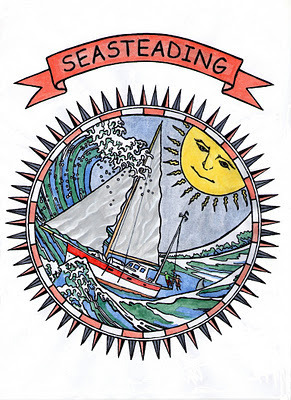 Yes, that's our boat, and yes, that's me and my wife hanging off the mizzen mast, and yes, that's a shark's fin in the water behind us. See if you can find the cat.
(For the strange people who believe "Seasteading" implies building private artificial islands for rich people to hide out on, and who might also think I am infringing on their trademark: in my case it is about selling t-shirts that happen to say "Seasteading" on them. We are in different industries, see?)
 Yes, that's our boat, and yes, that's me and my wife hanging off the mizzen mast, and yes, that's a shark's fin in the water behind us. See if you can find the cat.
 (For the strange people who believe "Seasteading" implies building private artificial islands for rich people to hide out on, and who might also think I am infringing on their trademark: in my case it is about selling t-shirts that happen to say "Seasteading" on them. We are in different industries, see?)
Occupy the Million Dollar View
 Now that the current phase of the Occupation movement—one that involved camping out in public places—is drawing to a close, thoughts turn to other, even more effective venues and exploits. Occupying the front lawns of mansions owned by the 1% would certainly send a message, although a very brief one, since trespassing happens to be illegal.
 And then it hit me: it just so happens that the 1% own, roughly speaking, 99% of the really desirable beachfront properties, while the 99% have to make do with the 1% or so of the coastline that is reserved for public use. The 1%ers really like that "million-dollar view," and the seaside mansion is one of their ultimate status symbols. Try to approach them from land, and you will quickly get spotted by vigilant local police and private security and won't make it very far—well shy of making any sort of statement, or even getting on the 1%er's radar.
But it just so happens that, according to US Federal law, they can only own property down to the low water line. In absence of specific regulations (marine sanctuary, public beach, municipal harbor, shipping lane, military reservation and so on) everything below the low water line is considered public anchorage. (It is everything below the high water line in Canada, which means that you can even occupy the beach at low tide and still not be trespassing.) Any vessel can anchor within a few meters of the 1%ers property, entirely spoiling their precious view, but if the boat is manned and is legal, then there is not a thing that they can do about it. On a calm evening, you can sail up, anchor, raft up, put up a big screen to use as a sail, and project a movie onto it. Eat the Rich, anyone? Then film their reaction, and project that next.
You might think that getting a sailboat flotilla together takes a lot of money. The boats that 1%ers such as Senator John Kerry prefer certainly are super-pricy, but then there are also many boats that can be had for free or for $1 (provided you agree to sail it away), or for a very small sum. If a sailboat is engineless or has an outboard engine of 9.9 horsepower or less (which doesn't count as a real engine) then it is automatically grandfathered in and doesn't even need to be registered: just paint a name and a port of call on the transom, and it is legal. Would you like a more permanent occupation? Rotate vessels through the anchorage, going on an overnight cruise to nowhere every fortnight or so, keep all of the boats occupied at all times, and you are still legal.
There are some safety requirements, but they are minimal: life jackets and life preservers, sanitation (a composting toilet), a marine VHF radio, functioning navigation lights, fire extinguishers and flares (unexpired ones). Land cops can't touch you. When hailed, you have to know radio protocol and marine terminology, and use it. If boarded, you have to cooperate. Some things are stricter than on land: get caught with any drugs, and the vessel gets arrested (as well as you). Neglect boat maintenance in a serious way, and it will be declared "manifestly unsafe" and scuttled, and you will be set ashore. But the water is generally free of riffraff as well as police brutality. Everyone tends to be polite, safety-conscious and just does their job.
You might have some issues with private security, who might not be particularly interested in following the law. But then sailors in pirate-infested waters have found a neat trick that really works: shooting skeet. It's quite challenging to hit a clay pigeon from a boat, so you will need to bring plenty of shotgun shells. It is good sport, and also a peaceful yet effective show of force that works on pirates, and will certainly make the private Mickey Mouse cops think twice about challenging you further.
For something more to do, why not join a yacht race? Yacht races are organized for and by some of the wealthiest 1%ers, who like to show off before each other. Join them just for the downwind leg (their fancy racing sloops are all about tacking upwind and actually don't do that well downwind) and unfurl a gigantic square sail with a protest sign painted on it. You might even win (that leg).
And so I hope that come next summer there will be Occupy flotillas floating up to crash swank exclusive seaside gatherings by planting themselves directly in the middle of the million dollar view and doing what Occupy already does very well: trolling the 1%ers really, really hard, 100% legally, and giving the 99%ers a chance to start thinking about getting out of that tired old pantomime sheep costume and into something a bit more fashionable.

November 27, 2011
A Million Gardens
 [Stan has graciously agreed to let me share this article with you. The solution he proposes is one that should be put into practice immediately: unlike other post-collapse solutions that will only become competitive after collapse has largely run its course, opting out of industrial agriculture is something that doesn't have to wait.]
 I love OWS and the Slogan "99%"
It is a great slogan that puts in bold relief the immense power of the one percent of humanity that exists parasitically on the rest. "We are the 99%." It is a declaration that in some significant way, people are more awake to their circumstances than they were. Around this slogan, we have seen courageous and principled people take to the streets in a great shout of "No!" at the powers and principalities of late neoliberalism; and we have seen that this outburst resonates with far more people than the ruling layer of society expected. We have seen the protestors demonstrate with their bodies that under their façade of civility, this ruling layer relies in the last instance on truncheons, teargas, guns and jails. This unmasking is more important in many ways than what will come afterward, because without it, we accommodate – and we all accommodate in one way or another, even those protesting – without any clarity. Let these thousand flowers bloom.
Still, the 99% are not actually protesting. 99% of the 99% are just doing what they do to get by in the world the best they know how, far from the demonstrations. We know this is true, and we know the reasons are as numerous as the people who do not protest in the street. And so we are required to acknowledge that the movement, such as it is, is representative of its claim, not the number 99's actualization. And therein is one seed of mischief.
In Latin, it was once said, perversio optima quae est pessima. The perversion of the best is the worst. Some protesters will come to believe they are representative of those they do not know. Some will try and formalize that representation as power. Many are already spinning out programs (God, save us from parties and programs!) that purport to represent the 99%, though they are mostly utopian projections cobbled together by handfuls of people who still believe something called the "future" can be subordinated to human management schemes. Some will begin to articulate what it means to be an "authentic" representative; and the divisions will begin. Nothing stays the same, and this won't either. Lord, have mercy.
I am one of the 99% of the 99% this time around. I had my day in the sun as a protestor; and if I'd have stayed a day longer, I would have taken up more room than one person should, because movements privilege clever talkers and angry writers more than they ought to. Now I am one of the 99% of the 99% who is restricted in my movements by personal duties and obligations, the lack of money, and the lack of time. I am far from any urban center, far from the big schools, far from the cohorts and committees, far from those places where people debate social theory and movement strategies. And I love it out here in the sticks.
I love the Occupy movement, too. I repost everything I see on Facebook that is not downright offensive (thickheaded sexism in this movement is alive and well, sorry to say). I promoted the movement in my church with a supportive article in the bulletin, which generated a whiff of controversy that promises a dialogue about this thing we have named "economic inequality." I attended a rally in Lansing, though the mayor there agreed with the protest, so we didn't generate any hostility from the police. Sherry sports bumper stickers that say "OWS" and "99%." This is what we can do right now, so we are glad the demonstrators (I like the Spanish term "manifestantes" better) are out there keepin' on. In so may ways, you are speaking for us. I get a little giddy at how long it has already lasted.
I love the movement's sense of satire. My favorite video was a bullfighting spoof around the Wall Street bull statue, with two capering clowns and a matador who mounted a police car and snapped his cape at the 7,100 pound bronze bovine.
I love the energy, and the courage, and the general understanding that the power of the movement is pacific. Movements succeed when they inspire violence, but only when they inspire the violence of the oppressor that accomplishes this unmasking.
Whether the vandalism and violence of a few protestors is from fools or police provocateurs (probably a measure of both), it has been thankfully minimal. Those youngsters who got pepper sprayed at UC Davis were more morally effective in their non-resistance than 10,000 macho-boys throwing rocks and setting fires.
I love the way OWS stays unpredictable. That is absolutely this occupy-thing's greatest strength.
I have questions, and ideas, however, about what happens next, about follow-up, about what the 99% of the 99% can do and, more importantly, should do. I'm not proposing, as many leftists will, that the movement "get itself organized," select leaders, develop a strategy, etc. In fact, I vigorously oppose strategies on principle, because I believe most of them are simply designed to put a few people in charge of a lot of people who are then charged to carry out the strategy. More on that further along.
Before I can explain myself, I need to at least describe the premise for these ideas.
Premise
The premise begins that all the changes that are implied in the demands – such as they are – of the movement are not applicable to all people in all places at all times. The greatest value of this movement is not in its ability to expose certain sufferings and change certain policies, but in its ability to expose – with no unified intention to do so – all the reasons we need to abandon the entire system of which "policy" is only one essential working component.
This is an argument that is not won in this movement yet, because many people who are supportive of OWS et al still maintain the sincere and good-willing belief that governments and other policy-making institutions are somehow independent of their actual actions, like machines, and they can be taken over – like exchanging a bad driver for a good one in an automobile.I respect that belief insofar as it is a belief people cleave to out of genuine good will. These people are not collaborators or sheep; and those who characterize them that way are both wrong and mean. I love the people who want to change the policies, because I am convinced that they want to do it out of a genuine sense of care about others.
My argument: Even machines cannot be made independent of their makers and users. The problem with the system is not the driver. It is the car.This is my premise. If I am wrong, then ignore everything hereafter.
Failure of the Future
I think this car that is breaking down might be named "The Future."The deeply-parasitic infrastructure of society is coming apart, not temporarily, but in the face of some real trends that put real limits not only on the autocratic futurism of the right, but the "progressive" futurism of the left, too. I ripped off Ivan Illich above with his reference to perversio optima quae est pessima. I'm quoting him again when he said, "To hell with the future. It is a man-eating idol."
I agree with that. A lot. This car is breaking down and there is going to be a wreck.
Illich wrote in 1973 about the energy infrastructure crisis. What he said has proven prophetic in both senses of the word. Prophets are wrongly believed to be people who simply foretell the future. In fact, prophets are those who speak truth to power and who have visions, not predictions, that forewarn us of dangerous possibilities in the future.
Every generation has some. Illich showed in 1973, in a pamphlet entitled "Energy and Equity," that our faith in technology as redeemer of humanity is a terrible mistake. Now we see the big secular trends that prefigure the collapse of many infrastructures. Climate change. Peak resource extractions. The very economic crisis that spawned OWS. War for the fuel to make war. That's next, and not far off either.
This crisis is not short-term, and it will force people to adopt new tactics for everyday life. It represents both a trauma and an opportunity; but that opportunity, in my opinion, is not available through policy. Policies may alter and change in response to material changes. What has to change is not policy, but our entire built environment based on some more personal and less abstract narratives than Progress and The Future.
This is where the 99% of the 99% can do something, and they can begin doing it right now, without leaving their hometowns. Let's put this in another context before explaining why and how the 99% of the 99% can make some of those changes.
Devolution & Design
All social orders eventually devolve and are forced to reorganize, and the globalized world we live in is witnessing the devolution of the social order. These periods of discontinuity never last forever, because society eventually self-organizes out of these devolutions, and a new order is established. When an order collapses, there is an accompanying crisis of ideas. More and more in our own period, we are seeing the de-legitimation of our ideas not only about capitalism and socialism, or their ugly merger into neoliberalism, but about what they held in common that have proven to be dangerous idols. Progress. The Future. Technological Salvation.
When I was part of the organized activist left, I cooked up an alliterated recipe for resistance: de-legitimate, disobey, disrupt. For the present, I will add a fourth D. Design.
We are not going to force policy-makers to remake the world. We have to do it ourselves. We have to take our entire built environment, one piece at a time, and re-design it. This will take everyone, because where you live is different than where I live; and there is no one-size-fits-all solution. To hell with policies. They are people-eating idols.
The Money Grid
One nub of the whole situation at the end of 2011 is a longstanding fact. People have been captured by their dependency upon a vast, technocratic apparatus that has de-skilled them and rendered them 100% (not 99%) dependent on money. The technocratic apparatus makes all our stuff, controls our climate, fixes our boo-boos, educates us, feeds us, moves us around, lights our homes, and puts us to work – all inside our most excellent technocratic life support system – and the only thing that makes the system respond… is money. As it is in 2011. As it was in 2010, 2000, 1990, 1980… it just got worse with time.
Money is generated by banks and printed by the government. It is designed to work a certain way to benefit governments and banks, which are run by the rich. Governments and banks are never going to be the ally of any movement like OWS, so there is little likelihood that activism will change the nature of money any time soon. Money is designed to transfer power; and it does it very well. Money is not a morally-neutral sign any more than a gun is a morally-neutral tool. Each is designed for a purpose. Guns are designed to kill. Money is designed to commodify, that is, to make everything into a thing for sale. Including you.
The anthropologist Alf Hornborg said that money dissolves cultural and natural systems in an ecosemiotic process. "Viewed from outer space," says Hornborg, "money is an ecosemiotic phenomenon that has very tangible effects on ecosystems and the biosphere as a whole. If it were not for money, nobody would be able to trade tracts of rain forest for Coca-Cola."That's a lot to think about. Think about it.
The Institutional Grid
Institutions are required to administer the technocracy upon which we all abjectly depend. Institutions are always somehow imbricated within the system of money that benefits banks and government. There is probably nothing controversial about saying that institutions can be corrupted by money. What I am about to say is that institutions – all of them, even your favorites – are inherently and unavoidably corruptible.
If OWS develops "lists of demands" and programs and the like, there will be predictable appeals to target institutions for particular policy changes. Money controls the institutions. Money controls the policies. Money will come to control the institutions that are created to fight the institutions. As it ever has been and ever shall be. The movement will become "focused," it will deploy a strategy, and let the games begin. The movement will be placed under management to oversee and coordinate the strategy. The movement will come to depend on money.
Policy games controlled by money will be able to frustrate the original objectives of activists, either by crushing them or co-opting them. Then the demoralization will start anew, amid more nihilism because the devolution will have advanced throughout the process.
If OWS itself begins to unravel over time, which it hasn't so far but certainly may eventually, the follow-up options may appear to be (1) play by the rules for scraps or (2) to argue for more direct force against the system. The latter will increase the probability of outright destruction, and the former might lead people to believe that nothing, in fact, can be done.
Welcome to the institutional grid.
Relations On and Off the Grid
I believe there is a way out of that impasse. To explain it, I need to make reference to an anthropologist named Robin Dunbar. He calculated that human beings have the cognitive capacity and the time to sustain a very finite number of caring relationships. His guess was around 150. I give this a lot of leeway, but I accept the general idea. Finite brain. Finite time. Finite capacity. Got it.
These primary relationships are built on trust and empathy, requiring no formal agreements, no contracts, no administration by a third party. Most close family relations fall into this category, as do friends. My own trick for categorizing these relations is to think of them as covenantal as opposed to casual or contractual. Your relation to your boss is contractual. Your relation to a grocery clerk you see once a week is casual. Your relation to your friend, lover, child, mother, etc, is covenantal. These covenantal relations are built on care, on trust and empathy. They imply certain non-monetized, highly personal duties and obligations to one another that are accepted out of love. These relations do not require formal rules; and in fact, formal rules would have a deleterious effect on these relations.
"A contract is an agreement made in suspicion. The parties do not trust each other, and they set "limits" to their own responsibility. A covenant is an agreement made in trust. The parties love each other and put no limits on their own responsibility."-Wambdi WicasaOnce a group exceeds this fuzzy cognitive limit, this "Dunbar's number," it begins to require third parties to administer, manage and resolve conflicts. This is the genesis of administration and management, and it becomes inevitable with greater scale, more people. This new layer of relations is more impersonal, first by some small degree. With more people and more administrators come greater degrees of impersonality. The uprooted impersonality of administration is inevitable. The tendency of these social formations is summed up in the way we can refer to administration as an "apparatus."
A remarkable moral shift occurs with the emergence of this apparatus. Doing the right thing because you care for someone is superseded by doing the correct or legal thing because of an impersonal rule. The rules are necessary because the third parties of these apparati have to be seen as disinterested parties. In this single moral shift, those who administer the rules gain a new kind of social power that makes them inherently corruptible.
This applies to a corporation, a club, a rifle platoon, a progressive non-profit, a church, a school, a hospital, a town, the water supply system, the food system, everything… because our technocratic society is administered by an apparatus that is approaching perfect impersonality. Plain size can begin this pernicious process, so small "organizations" beware. Simply calling yourself an organization carries this risk of impersonality. The corruptibility of these institutions inheres in the enormous power they accumulate purely through the authority to administer and manage.
The Fetishism of Bureaucratic Competence
So while we are unmasking ideologies – those constellations of ideas that simultaneously conceal and reproduce power – let's look at this ideology of "progress" and the "future." It is entirely built on force, and that power has accrued to the one percent, and we have not unmasked what Alasdair MacIntyre calls the "fetishism of bureaucratic skill," part of the ideology of progress that both reproduces and conceals this administrative power. Most of the left and the right have fallen prey to this fetishism.
"The modern American is culturally conditioned to think of nature as nothing more than matter-in-motion, as a standing reserve that through technological and entrepreneurial prowess is converted into a consumer's cornucopia."To this adds MacIntyre:
-Max Oelschlaeger
"The fetishism of commodities has been supplemented by another just as important fetishism, that of bureaucratic skills… the realm of managerial expertise is one in which what purport to be objectively grounded claims [e.g., to the knowledge of the good society and how to achieve it] function in fact an expression of arbitrary, but disguised, will and preference."Power. His qualification is at the heart of it, "to the knowledge of the good society and how to achieve it." This is a delusion of the ideology of progress, this notion that people can render the future predictable and manageable. Experts, managers and administrators take full advantage of this ideology to exert will and preference behind a mask of special competence.
MacIntyre continues, in 1984, that "we know of no organized movement towards power which is not bureaucratic and managerial in mode, and we know of no justifications for authority that are not Weberian."
As the power of administrators grows, an ethic of care becomes more and more antithetical to the rules-regime of administration. Impersonality metastasizes, and we wake up to find ourselves not living in the world but moving plugs around on a switchboard to get what we need from the technocratic grid.
Management makes rules that help management. Management is the administration of administrators. Administration makes rules that benefit administration. As Haitians say, ti tig se tig. "The child of a tiger is a tiger."The original purpose of a rule – often created out of good will – is subverted by the administrative application of the rule. In common parlance, "the tail starts to wag the dog." The letter of the law is administered against the spirit of the law. This dog-waggery leads to the incomprehensibility of the rules and resentment of administration and management, which in turn becomes defensive, setting up a power struggle in which administration is already advantaged by the growing dependency of the administered on administration. Remember that Stalin accrued his immense power through control of an administrative apparatus.
One of the reasons we have so little power to act creatively in the face of so many crises is not just that we are fragmented, but that we're cut off in a much deeper way by the lack of social cohesion that can only happen in the small, intimate group. Covenantal relations are strong bonds. Contractual relations are weak bonds.
Every infantry squad leader knows that. Every good mother knows it. The rest of us ought to, too.
Management is the enemy of social cohesion, because it substitutes secondary (weak) bonds for primary (strong) ones. By re-strengthening primary bonds, we develop a greater capacity to resist power, but also to creatively adapt to (without direct resistance) rapidly changing circumstances.
Strategy and Tactics
Strategy and tactics as they are commonly understood are war terms, and they can't escape their conflict implications. Michel De Certeau, however, draws a distinction between them that leaps over some of the martial interpretations of these ideas.
In military parlance, strategy is the identification of key campaigns that are necessary to accomplish the main objective – in most cases, winning the war. Operations is a level of planning that determines key battles necessary to win campaigns. Tactics are those techniques that are required to win battles. So the tactic is subordinate to the campaign, which is subordinate to the strategy. In other words, "In the beginning, there was Strategy, and without it the world was shapeless and void."
De Certeau wrote about people in their everyday lives, not conditions of extremity and conflict, in a book entitled oddly enough, The Practice of Everyday Life.
Strategy, notes De Certeau, is always the purview of power. Strategy presumes control. Strategy is self-segregating, in the same way administration and management is self-segregating, setting itself up as a barricaded insider. The strategic leaders become the Subject; and the led become — along with any enemies — the Objects. Strategy presumes an in-group that executes the Strategy.
"Strategy is the calculus of force-relationships; when a subject of will and power can be isolated from an environment."The financial masters of the universe at Wall Street oversee the strategy. They are the institutions. In many ways, the rest of us cannot escape their Grid. They are the subject, and the rest are the object. They are inside; and we are outside. They live behind guarded walls.
-De Certeau
De Certeau calls tactics, on the other hand, the purview of the non-powerful. His version of "tactics" is not as a subset of Strategy, but adaptation to the environment (which has been structured by A Strategy).
The city planning commission may determine what streets there will be, but the local cabbie will figure out how to take best advantage of lived reality of those streets. This making-do is what De Certeau calls bricolage, and it often implies cooperation with others as much as competition with others.While the masters of the financial universe at Wall Street protect their guarded walls and ensure the system keeps paying the imperial tribute, we are making do. We do things that they can't control or fully account for. We barter, clip coupons, work under the table, trade labor, share tasks and expenses with friends… all those little cheats to bypass the more disadvantageous routes along the Grid. Making do. Bricolage.Bricolage is so detailed, so numerous in instance, so adaptable, that much of it escapes the notice of the Big Strategists; more importantly, it is beyond their power to control.
Agility
Strategy makes two presumptions: control and an in-group. The contradiction of strategy is that the control is never perfect and the situation upon which the strategy was constructed is always changing, making aspects of the strategy obsolescent. The self-segregation of in-groups magnifies these myopic aspects of strategy, because the walls that keep others out also obscure their view of the outside. Strategy becomes self-referential.Tactics, on the other hand, or bricolage, is action in a constant state of reassessment and correction based directly on observations of the actual micro-environment. Tactical theorist John Boyd rather schematically diagrammed this process as an OODA-loop, meaning people observe their surroundings (O), orient on the most important developments in the environment (O), decide on an immediate course of action (D), take that action (A), then revert immediately to observation (O) of the environment to see how their last action might have changed it (orienting again, deciding again, acting again…and again). There is no presumption of how things will turn out, as there is in strategy. There is, in fact, readiness to take advantage of unpredictable changes; this is called tactical agility.
Ignore that Boyd studied aerial combat for a moment, and we see that this is sense in many other scenarios. It just requires recognizing the radical limits on our ability to control something called "the future." That future has always and always will remain unpredictable. As it should.
Strategies are undermined by unpredictability. Tactics (bricolage, OODA-loops) can make an ally of unpredictability.
The intrepid street manifestantes of the Occupy movement can benefit from the OODA-Loop. They are in a tactical contest with the authorities to perform their prophetic tasks. For those among the other 99%, what kinds of bricolage can begin to directly and intentionally reduce our degree of dependence on the technocratic grid?
Strategic Without Strategy
Nero – both an emperor and a sadistic misanthrope – is said to have wished humanity had one throat so he could have the pleasure of cutting it. This is the statement of a strategic principle. The centralized structures of one's enemy are considered strategic targets.
Sherman's great arson campaign was principally aimed at Atlanta, where both the railroads and telegraphs of the Confederate forces converged. His march to Atlanta prefigured what would later become strategic bombing.As the United States Armed Forces, to their chagrin, discovered in Iraq and Afghanistan is that when there were no longer centralized political structures to attack in Iraq, there was a complete loss of tactical initiative. The US forces were metaphorically reduced to fighting off a swarm of hornets. Their strategy became incoherent. The problem was further magnified in Afghanistan, because there even the material infrastructure lacked centralization. Rumsfeld's first complaint about Afghanistan, when the Bush administration was preparing its war, was that Afghanistan presented the US with "no good targets."
One thing this might be telling us, if we are listening, is that we are safer from the strategies of ill-wishers in decentralized groups. The more the merrier.
In nature, decentralized diversity generates resilience. Centralized monoculture, on the other hand, is vulnerable precisely because it is centralized. One electrical failure can plunge 50 million people into opaque helplessness. One new fungus can wipe out a monocropped food staple.I bring this up, because I want to suggest a mode of strategic decentralism. Being strategic without developing A Strategy. The 99% of the 99% need to have some answer to the question, "What can we do?" My answer is make new facts on the ground. Start re-designing the built environment, especially in those spaces that are being ignored or abandoned during the process of devolution.
I want to propose a strategic goal without any general staff, without any hierarchy of any kind, part of which almost anyone can accomplish. No requirement for management, and no implied requirement for conflict (some will always find you), and no one-size-fits-all instructions on how to get it done.
I want to propose that we begin a systematic effort to reduce our dependency on the technocratic grid, by a lot of people working at or near their homes. One of the most powerful dependencies we have on the grid is food. The power of the food institutions is already well known and well understood, from Monsanto, to ADM and Cargill, to the Food and Drug Administration. Our very survival has been lashed to this grid by food-production monopolies. The entire world is groaning under the depredations of the food giants.
I have witnessed food riots firsthand. It is an unforgettable experience. Our dependency on food is a terrible weapon in the hands of the one percent.I want to propose we build a million food gardens. Two million. However many. However many conditions. However many designs. There is the strategic direction: make food, and not just for the same reasons Gandhi made salt. Make food because it puts that much of our lives back into our own hands, and the hands of our communities. Into the hands of our friends, our families, our covenantal relations. We can meet one of our own needs without any bureaucratic apparatus.
Making Food
In the town where I live, with around 20,000 souls, we built a garden this year. A group of people built the first of several food donation gardens on what the city has called "orphaned properties." The city owns them, but they have no particular use for them during this devolutionary contraction. Next Spring, we want to make two more gardens. A friend from church just offered the use of a portion of her country property for garden cultivation. We have around a million maples worth of leaf mulch and compost, mountains of chipped wood (from ice storm damage last year), and those long Northern summer days of sun. We have barely begun to learn how much food we can grow here… off the commercial food Grid.
I, for one, do not intend this to be some strategy to force new policies into the commercial food grid. Speaking for me, I see this as a way of serving divorce papers on the commercial food grid. And no one has figured out a way to call helmeted, militarized police out to stop anyone working in the gardens. The cops I talked to this year said it was a good idea, the garden.Multiply this by a million, then instead of a quarter acre of re-designed facts on the ground, you have 250,000 acres of re-designed facts on the ground. These are easier to defend than a policy, and it presents no strategic targets. Certainly there are threats and potential threats, but there is no one neck so Nero can have the pleasure of cutting it. Instead there is an accumulation of intimate victories, accomplished by convenantal communities, communities made that much stronger by the reduction of their dependency on the technocratic grid and the recognition of their very personalized interdependency on each other.
Walking on Two Legs
Demonstrating in the street, this unmasking work that OWS has done so incredibly, inspiringly, lovingly well, is not done yet. I am not by any means arguing that anyone ought to return from the street. Those of us who can't be there do need you to represent. You are the allies of unpredictability, the agile OODA-artists of the street, the magicians who can abracadabra bits of stunning clarity out of your hats. Your job is exhilarating, exhausting and crazy risky sometimes. If you can do it, that is where you need to be.
There will never be more than a fraction who have the flexibility at a particular time to be manifestantes. We love you, and we want you to go on, and we have been both instructed and entertained by your courage, creativity and endurance.
When you can no longer do it, there is something you can do, and so can the 99% of the 99% who can't be those shock troop manifestantes, right now.What can be done, and without any strategies involved, is a straightforward and strenuous effort by 99% of the 99% who are at home to make food. If there are 500,000 OWS protestors, then there need to be 1,000,000 more people who are making food in their yards, their neighborhoods, their churches, temples and synagogues, their workplaces, their schools, their land trust plots, their fallow fields, their empty lots, their apartment decks, their patios and their kitchen windows.
Even when the demonstrations end – and they will end – we are not left with nothing to do to continue dissolving that power. Every square yard of land recovered for food is a material victory in the face of little resistance, and that same square yard is a square yard of independence from the Grid.Do not pit your weakness against their strength. Exercise your strengths where they are weakest, where you live. The system is falling apart, and nothing will stop that. More and more niches will appear.
Even more important to me personally: gardens are peacemaking. Peacemaking is still the most important form of resistance.Let a million gardens bloom.
Swadeshi.
Shanti.

Dmitry Orlov's Blog

- Dmitry Orlov's profile
- 48 followers
Dmitry Orlov isn't a Goodreads Author
(yet),
but they
do have a blog,
so here are some recent posts imported from
their feed.


![[image error]](http://1.bp.blogspot.com/-ZNRoT465SCg/TuafRp-03PI/AAAAAAAABws/kNoNuhPv0Mw/s1600/JohnCorzine.jpg)