
Dmitry Orlov's Blog, page 27
May 14, 2012
Down the Skyscraper
 Ben GrassoIt was Andrew Lawrence, the inventor of the skyscraper index, who pointed out that the building of the world’s tallest buildings is a good proxy for dating the onset of major economic downturns. His index has stood the test of time; the few times when it made an incorrect prediction can be adequately explained by exceptional circumstances, such as the onset of world wars. It is now being put to the test again, and we ignore its advice at our own peril.
In “Skyscrapers and Business Cycles” Mark Thornton writes:
“The ability of the index to predict economic collapse is surprising. For example, the Panic of 1907 was presaged by the building of the Singer Building (completed in 1908) and the Metropolitan Life Building (completed in 1909). The skyscraper index also accurately predicted the Great Depression with the completion of 40 Wall Tower in 1929, the Chrysler Building in 1930, and the Empire State Building in 1931.”
“The Petronas Towers were completed in Kuala Lumpur, Malaysia in 1997 setting a new record for the world’s tallest building at 1,483 feet [452m] beating the old record by 33 feet [10m] (the two towers were only 88 stories high compared with the 110 story giants built in the early 1970s). It marked the beginning of the extreme drop in Malaysia’s stock market, rapid depreciation of its currency, and wide-spread social unrest. Financial and economic problems spread to economies throughout the region, a phenomenon known as the “Asian Contagion.”
Thornton then goes on to elaborate why this might be so, based on economic theory:
“...the construction of the world’s tallest buildings [is] a salient marker of the twentieth-century’s business cycle; the reoccurring pattern of entrepreneurial error that takes place in the boom phase that is later revealed during the bust phase.”
“The world’s tallest buildings are generally built when there is a substantial and sustained divergence between the actual interest rate and the natural rate of interest, where the actual rate is below the natural rate as a result of government intervention. When the rate of interest increases, the financial effects all reduce the value of existing structures and the demand to build tall structures and when combined with depressed economic activity, the desire to build at all.”
In short, people are born stupid, and this results in a periodic divergence between one artificial parameter not observable in nature and some other artificial parameter not observable in nature. And then people lose the desire to build. If you aren't pleased with explanations of this sort, then here is an alternative one, using just words, without any of the statistical/mathematical hocus-pocus fetishized by the economics profession.
Skyscrapers occur during the terminal stage in the hypertrophy of financial and other control mechanisms. They are optimized for a single function: sucking resources out of the surrounding, low-rise economy, which is actually tied to the natural world in some way, through agriculture or resource extraction or the use of physical human labor. The appearance of very large skyscrapers signals the onset of a new kind of economic vampirism, in which the parasite outgrows the host, and then begins to starve.
Although it is easy to assume that the life blood being sucked out by the vampires is money, it is actually hope. In his novel Empire “V” (“V” stands for “vampire”) Viktor Pelevin describes an entire vampiric ecosystem: the imperial vampires feed not on money but on a metaphysical substance called bablos. Bablos is generated when people, multitudes of them, work for money in pursuit of their hopes and dreams. Bablos is harvested when these hopes and dreams are then shattered. The vampires' bag of tricks includes abstract disciplines such as Discourse and Glamor, which they use to optimize the metaphysical expropriation of the products of human greed and envy. Bablosis administered as part of a special ritual, during which bushels of worn-out currency are burned in a fireplace, but this is only done to symbolize that the money has served its purpose as a vehicle for harvesting hope via greed.
It is hardly unexpected that high belfries would be inhabited by large bats. Skyscrapers crop up when the economic vampires decisively gain the upper hand and feel exuberant about their ability to endlessly expand their numbers and their reach. But the moment at which they are at their strongest is precisely when their quarry—the base of natural resources made available by human labor—is, correspondingly, at its weakest, and can no longer support the ever-increasing load of parasites. The result is a downturn, or a crash, or a collapse.
The ascent to the top of a skyscraper is normally an exhilaratingly rapid ride in a high-speed lift, but, in an emergency, or a downturn/crash/collapse, the descent can be nothing of the sort. As John Michael Greer writes in The Long Descent :
“...as we've climbed from step to step on the ladder of progress, we've kicked out each rung under us as we've moved to the next. This is fine so long as the ladder keeps on going up forever. If you reach the top of the ladder unexpectedly, though, you're likely to end up teetering on a single rung with no other means of support—and if, for one reason or another, you can't stay on that one rung, it's a long way down. That's the situation we're in right now, with the rung of high-tech, high-cost, and high-maintenance technology cracking beneath us.” [p. 168]
Lofty and proud, often endowed with a literal pinnacle of human ingenuity and industrial might, a skyscraper has but two futures: as a smoldering pit produced by a controlled demolition, or as a rusting, teetering derelict, shed of its plate glass and overgrown with vine, serving as a bird rookery, with only an occasional visitor scaling its lofty heights, swatting away the birds, to scrape up some guano, perhaps pocketing a few eggs along the way. This is the career path of the skyscraper: from the lofty seat of the captains of industry to a mighty bird-shit factory in the sky; or is it bat-shit? Let's just call it “sky-scrapings.”
The prospect of collapse is built right into the very concept of the skyscraper. The best case scenario of a controlled demolition requires explosive charges and electronic sensors to be placed in key areas all along its steel frame. The explosions must be triggered in a specific sequence, precise to the millisecond and dynamically adjusted by a computer so as to steer the accumulating avalanche of rubble into the footprint of the skyscraper's basement, to be excavated using heavy machinery once the entire mass stops burning and cools down. Without such precise and active control, things are guaranteed to go sideways because errors multiply rather than cancel. The idea that a skyscraper can collapse down into its own footprint by itself has been disproved by every generation of little children who played with stacking up blocks and knocking them down: the blocks don't land on top of each other in an neat little pile; they scatter all over the living room floor. The worst case scenario is that the entire structure will eventually start to lean a bit, then a bit more, and eventually topple, forming a trench forced with twisted steel. Where the skyscrapers are packed close together, as they are in the many “downtowns” where skyscrapers are to be found, there is a chance of a domino effect, with one skyscraper knocking down others in a chain reaction.
What better metaphor is there for our entire collapse-prone, highly temporary living arrangement than a skyscraper? An update to the ancient Greek myth of Icarus who flew too close to the sun, which melted the wax holding together his wings, causing him to plummet into the sea and drown, the modern skyscraper—a phallic challenge to the heavens—is an object study in failed ambition. Perhaps most significantly, no other type of building intended for human use goes so quickly from comfortable and posh to potentially lethal. Having worked in many of them over the years, I have been forced to watch, and even to participate in, situations that have convinced me that I don't want to spend any significant amount of time either inside or near any skyscrapers.
While working at 100 State Street in Boston, I once witnessed an emergency involving a window washer. One of the two cables holding up the platform that travels up and down the side of the building, allowing the window washers to do their job, snapped. The platform then hung vertically, held by a single cable, with the window washer barely holding on. The various fashion victims who inhabited that floor of the tower (it was in an advertising agency) crowded next to the window and signaled their shock with theatrical gasps and pantomimes of horror. The fire department was called, and the following routine played itself out. First, the entire building was placed under lock-down: nobody could enter or exit the building. Second, a security perimeter was established around it; traffic was stopped and cars parked within the perimeter were towed away. Third, firemen used axes to smash the plate glass window next to the window washer from inside, sending a cascade of glass shards tumbling down to the now empty street below. It took a surprising amount of force to bash through the glass. It sounded like gunfire when it finally broke away in large, irregular-shaped pieces, which, after smashing into the pavement below (I went down to check) looked like coarse sand. Finally, two more firemen standing inside the building grabbed the window washer and pulled him in.
On another occasion, I was working across the street from 1 Broadway in Kendall Square, an MIT-owned building in Cambridge, when that building suffered a transformer explosion in its basement. “Workers described suffocating smoke that smelled like burnt rubber and was so thick in places it was hard to see even a few inches.” wrote the Boston Globe. Since lights went out in the entire area, our building was evacuated as well, and I went over to observe. I saw hundreds of people emerge from the building over a period of many minutes, at least a hundred of them bearing the telltale smoke inhalation soot marks under their noses. Some collapsed, some bent over retching, some just stood there trying to catch their breath. What they had inhaled was burned plastic from office carpeting, furniture and partitions (loaded with dioxins) and burned transformer oil (loaded with polychlorinated biphenyls). In a short period of time they had absorbed a load of toxic chemicals which, lodged in their lungs, will last them the rest of their life, hastening its end. Mercifully, this building had only 17 floors; had it been a scraper, more people—perhaps everyone in the building—would have been forced to breathe smoke for a longer period of time.
You see, skyscrapers are not really like other buildings. They are more like space capsules hanging in the sky, closer to ships and planes than to buildings. But ships have life rafts and lifeboats and planes have oxygen masks in case of decompression and inflatable chutes and life vests in case of a water landing, and buildings have fire escapes and windows reachable by the fire department's ladder trucks, while skyscrapers have... stairwells. These stairwells are some of the most frightening places in which you might find yourself: featureless, claustrophobic, and endless. Often these stairwells are not accessible from the elevator halls directly, but require going through areas secured by electronic access cards, which require electricity to work: if a power cut finds you in the elevator hall, that's where you will stay.
In an emergency, you and your co-workers, two-thirds of whom (in the US) are obese or have bad knees or a bad heart or are wheelchair-bound, are expected to giddily trot down tens of flights of stairs. Since such processions are only as fast as their slowest participants, they progress very slowly. If there is a fire, the stairwells can quickly fill with smoke. Panics, stampedes and jams are not uncommon; beyond a certain density, people form a solid plug of bodies, and then nobody can move. Efforts to simulate the behavior of crowds exiting a skyscraper using fluid dynamics, to try to find a better way, have run into a problem: in such situations, the crowd does not behave as a fluid should. It forms clumps. The state of the art is to simply try to hold people back until the stairwell clears.
What might trigger such an evacuation? There could be many reasons, but the two common ones are a fire and a power outage. A fire automatically triggers a power outage, to avoid the possibility of further fires started by electrical equipment that has been soaked by the sprinklers. Some skyscrapers are equipped with diesel power generators, which can provide emergency power, even in case of a fire, but then only to emergency systems.
 If the idea of slowly trudging down an endless stairwell while inhaling toxic smoke does not appeal to you, here are a couple of options. The first is to buy a “Personal Escape Device” (the base model is $500 down plus $50 a month with a 10-year commitment, according to the web site.) You will also need an axe to smash out the window, since in a skyscraper none of the windows open; good luck smuggling one past security.
 The other option is for the active and adventurous vampire bat: learn BASE jumping, and keep a chute and a wing-suit(and, of course, an axe) with you at all times. This may seem dangerous, but, given the nature of this sport, the list of known fatalities is actually fairly short. No self-respecting skyscraper-dwelling vampire bat should be without a bat-suit. Good luck!
 Gazprom TowerBut where is the skyscraper index pointing at the moment? One project worth watching is the Gazprom tower being planned in Lakhta-Center in St. Petersburg. This is the second attempt to get this project off the ground; the previous attempt was called Okhta-Center, and was sited in Krasnogvardeisky District, where I happened to have grown up. There, the residents proved far too combative for Gazprom's PR machine to handle. The public meetings went very badly, and Gazprom opted for a change of venue. The new site, in Primorsky District, is far on the outskirts, on the Gulf on Finland. Its centerpiece a 96-floor, 470m office tower, going up in a city where there are, at present, exactly zero skyscrapers. In fact, the existing height restriction in the zone of the planned construction site is 27m. The soil there is soft and boggy, land is still relatively cheap, and so building tall structures there is strictly for the foolish. Nevertheless the planning phase should be completed this year, and the project is to be completed by 2018. There is still hope that the unfolding economic debacle in the Eurozone, which is Gazprom's major export customer, will prompt Gazprom to rethink this vanity project. If the project does proceed, then the skyscraper index will come to point squarely at Gazprom, and at the Russian Federation, in an accusatory fashion.
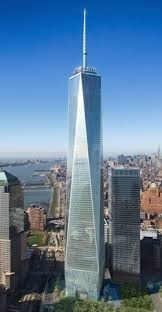 1 WTCThe other project worth watching is the so-called Freedom Tower, a.k.a. One World Trade Center, going up in lower Manhattan, on the site of the destroyed twin towers of the World Trade Center. It will be a symbol of your freedom to work an office job until you get laid off. It is going to be 541m tall, have 104 floors (plus 5 more underground), and will dwarf every other skyscraper in Manhattan. It is scheduled to reach full height this summer, and to open for business sometime next year. Given the unhappy history of the site, the project will include a massive blast wall. Security at this location is bound to be very tight; perhaps too tight for you to smuggle in your wing-suit, chute and axe.
Nervous watchers of the skyscraper index may wish to take this opportunity to consider strategies for geographic diversification: away from Manhattan, away from the United States, away from Western financial institutions. As for the rest of us, let us work to diversify away from all of them. Let us stop pinning our hopes and dreams on a paper currency which the vampire bats will use to light their fireplaces once we are done slaving for it.


May 8, 2012
Absolutely Positive
 With ClubOrlov just over four years old, I am publishing a "best of" book of essays. These are 30 of the most popular articles chosen from the ones that have been published on ClubOrlov.
A lot has changed during this time; four years ago this book would have been largely about the future, but now it is largely about the present. In preparing the manuscript for publication, I haven't found anything that I would want to change or retract.
This book is only going to be available via Amazon Kindle; I have no plans to produce a paper version. While not quite as long-lasting as a bound volume printed on acid-free paper, it is somewhat less ephemeral than a blog, and a lot easier on the eyes. It is also much cheaper: $4 gets you your own copy, which you can keep forever and lend to friends and family as many times as you like, because it doesn't get lost and doesn't fray.
The book's title should be self-explanatory. I am absolutely positive that collapse is underway. I am also absolutely positive that with a bit of preparation and adaptation, some physical, some mental, a lot of us can pull through if we really try. Lastly, I am absolutely positive in my overall outlook and disposition, and hopeful that a fast but thorough collapse will leave enough of the planet in a non-toxic, non-radioactive, non-strip-mined, non-cratered state to allow for our continued existence as a species.
To promote this virtual book, I am going to go on a virtual book tour. If you would like to interview me for your radio show, publication or podcast, please contact me at my first name dot my last name at gmail dot com. Furthermore, if you wish to invite my non-virtual, physical self to appear in person and give a talk, and can pay for my travel from/to Boston, please let me know and we will try to work something out.
Order this book from Amazon.com.

Shale Gas: The View from Russia
 The official shale gas story goes something like this: recent technological breakthroughs by US energy companies have made it possible to tap an abundant but previously inaccessible source of clean, environmentally friendly natural gas. This has enabled the US to become the world leader in natural gas production, overtaking Russia, and getting ready to end of Russia's gas monopoly in Europe. Moreover, this new shale gas is found in many parts of the world, and will, in due course, enable the majority of the world's countries to achieve independence from traditional gas producers. Consequently, the ability of those countries with the largest natural gas reserves—Russia and Iran—to control the market for natural gas will be reduced, along with their overall geopolitical influence.
 If this were the case, then we should expect the Kremlin, along with Gazprom, to be quaking in their boots. But are they? Here is what Gazprom's chairman, Alexei Miller, recently told Süddeutsche Zeitung: “Shale gas is a well-organized global PR-campaign. There are many of them: global cooling, biofuels.” He pointed out that the technology for producing gas from shale is many decades old, and suggested the US turned to it out of desperation. He dismissed it as an energy alternative for Europe. Is this just the other's sides propaganda, or could Miller be simply stating the obvious? Let's explore. I will base my exploration on Russian sources, which is why all the numbers are in metric units. If you want to convert to Imperial, 1 m3 = 35 cubic feet, 1 km2 = .38 square miles, 1 tonne = 1.1 short tons).
The best-developed shale gas basin is Barnett in Texas, responsible for 70% of all shale gas produced to date. By “developed” I mean drilled and drilled and drilled, and then drilled some more: just in 2006 there were about as many wells drilled into Barnett shale as are currently producing in all of Russia. This is because the average Barnett well yields only around 6.35 million m3 of gas, over its entire lifetime, which corresponds to the average monthly yield of a typical Russian well that continues to produce over a 15-20 year period, meaning that the yield of a typical shale gas well is at least 200 times smaller. This hectic activity cannot stop once a well has been drilled: in order to continue yielding even these meager quantities, the wells have to be regularly subjected to hydraulic fracturing, or "fracked": to produce each thousand m3 of gas, 100 kg of sand and 2 tonnes of water, combined with a proprietary chemical cocktail, have to be pumped into the well at high pressure. Half the water comes back up and has to be processed to remove the chemicals. Yearly fracking requirements for the Barnett basin run around 7.1 million tonnes of sand and 47.2 million tonnes of water, but the real numbers are probably lower, as many wells spend much of the time standing idle.
In spite of the frantic drilling/fracking activity, this is all small potatoes by Russian standards. Russia's proven reserves of natural gas amount to 43.3 trillion m3, which is about a third of the world's total. At current consumption rates, that's enough to last 72 years. Russian gas production is constrained by demand, not by supply; it is currently down simply because Eurozone is in the midst of an economic crisis. Meanwhile, US production has surged ahead, for no adequately explored reason, crashing the price and making much of it unprofitable.
Let's compare: Gazprom's price at the wellhead runs from US$3 to $50 per thousand m3, depending on the region. Compare that to shale gas in the US, which runs from $80 to $320 per thousand m3. At this price, the US cannot afford to sell shale gas on the European market. Moreover, the overall volume of shale gas being produced in the US, even given the feverish drilling rate of the past couple of years, if cleaned up, liquified, and shipped to Europe in LNG tankers, would not be enough to book up just the LNG terminal in Gdańsk, Poland, which is currently standing idle. It seems that Gazprom has little to worry about.
The US, on the other hand, does have plenty to worry about. There has been much talk already about groundwater pollution and other forms of environmental destruction that accompanies the production of shale gas, so I will not address these here. Instead, I will focus on two aspects that are just as important but have received scarcely any attention.
First, what is shale gas? Ask this question, and you will be told: “Shut up, it's methane.” But is it really? The composition of shale gas is something of a state secret in the US, but information about the gas produced from the nine Polish shale gas test projects did leak out, and it's not pretty: Polish shale gas turned out to be so high in nitrogen that it does not even burn. Technology exists to clean up gas that is, say, 6% nitrogen, but Polish shale gas is closer to 50% nitrogen, and, given high production costs, low yields, rapid depletion and low wellhead pressure, cleaning it up to bring it up to spec (which is 1% nitrogen) would most likely result in a net waste of energy.
Even if shale gas is low enough in nitrogen to burn, the problems do not end there. It may also contain hydrogen sulfide, which is toxic and corrosive and has to be removed before the gas can be stored or injected into a pipeline. It probably contains toluene and other organic solvents—ingredients in the fracking cocktails—which are carcinogenic. Lastly, it may be radioactive. All clays are mildly radioactive, and shale is a sort of heat-treated clay. While Barnett shale is not particularly radioactive, Marcellus shale, which has recently been the focus of frantic drilling activity, is. Thanks to Marcellus shale gas, radioactive radon gas is being delivered directly to your kitchen, via the burners of your stove, or to a power plant smokestack upwind from where you live. This is expected to result in increased lung cancer rates in the coming years.
Second, why is shale gas being produced at all? Natural gas prices have fallen through the roof, and are currently around $2 per thousand cubic feet. This works out to around $70 per thousand m3. If shale gas costs from $80 to $320 per thousand m3 to produce, it is unclear how one might make any money with it.
But perhaps making money with it is not the point. What if shale gas is just a PR campaign (with horrific environmental side effects)? Going back to what Alexei Miller said, what if the entire point of the exercise was to increase the capitalization of shale gas exploration and production companies? The number one company in shale gas is Chesapeake Energy, the owner of the Barnett basin and a major player in the Marcellus basin. This company almost went bankrupt in 2009, but then managed to claw its way back to profitability in 2010 and 2011 by drilling, and drilling, and drilling, and then drilling some more. Sixty percent of their revenue is from drilling operations. And now there is a scandal involving Chesapeake Energy's (former?) chairman, Aubrey K. McClendon, who apparently awarded himself a stake in each well his company drilled, used them as collateral for billions in loans, and used the loans to bet that natural gas prices will go up (they haven't). In the meantime, natural gas drilling rig count has dropped to a ten-year low. Given that shale gas wells deplete very quickly, it looks like the shale gas boom is over.
But now that it's over, what was it, exactly? It appears to have been something like the dot-com bubble: companies with no conceivable way of turning a profit using hype to attract investment and drive up their valuations. Since 2008, various kinds of hype-based market manipulations have become the staple of economic life in the US, and so this is nothing new or different.
One interesting question is, What sort of bubble will the US attempt to blow next, if any? There is the Facebook IPO coming up. Facebook is a ridiculous time-waster and, as such, seems a bit overpriced. Are we going to attempt blowing up another dot-com bubble? Another round of subprime mortgages does not seem to be in the works. What's a bubble boy to do? If there are no more bubbles to blow, then it's back to just plain printing money.
So this whole shale gas thing didn't work out as planned, did it? But could it have? Had it turned out to be much better in every way, could it have swung geopolitical influence away from Russia and Iran and back toward the US? Alas, no.
You see, there is no such thing as a global natural gas market. Yes, there are some LNG tankers sailing about, but that is very much a point-to-point trade. There is a closed North American market, a European market, and another market in the Asia-Pacific region. These markets do not interact. The North American market and the European market could have potentially shared just one producer: Qatar. Qatar once wanted to export LNG to the US, but then decided to export it to Europe instead, generating less of a loss, because European gas prices are substantially higher. And the reason Qatar is dumping natural gas in Europe is because it has gas to dump: its northern gas field is a very “wet” field, with a substantial percentage of natural gas condensate. Qatar's OPEC quota is 36-37 million tonnes of oil per year, but natural gas condensate is not considered to be oil and is not covered by OPEC quotas. Exploiting the condensate loophole allows Qatar to export 65.7 million tonnes: 77% over quota. The LNG is just concomitant production, and Qatar can afford to export LNG to Europe at a loss. This is a juicy bit of trivia, but really something of a footnote: an exception that proves the general case: there is no global natural gas market.
There is still, however, a global American disinformation and PR hype market, although this too is changing. The view from Russia is that it is pretty clear what this was all along: American propaganda and financial shenanigns. Nothing to see here, people, keep moving.

May 1, 2012
Making the Internet Safe for Anarchy
 Suppose you wanted to achieve some significant political effect; say, prevent or stop an unjust war. You could organize gigantic demonstrations, with hundreds of thousands of people marching in the streets, shouting slogans and waving anti-war banners. You could write angry editorials in newspapers and on blogs denouncing the falseness of the casus belli. You could write and phone and email your elected and unelected representatives, asking them to put a stop to it, and they would respond that they will of course try, and by the way could you please make a campaign contribution? You could also seethe and steam and lose sleep and appetite over the disgusting thing your country is about to do or is already doing. Would that stop the war? Alas, no. How many people protested the war in Iraq? And what did that achieve? Precisely nothing.
You see, the slogan “speak truth to power” has certain limitations. The trouble with this slogan is that it ignores the fact that power will not listen and the fact that the people already know the truth and even make jokes about it. Those in power may appear to be persuaded or dissuaded, but only if it is to their advantage to do so. They will also sometimes choose to co-opt, and then quietly subvert, popular movements, in order to legitimize themselves in the eyes of those who would otherwise oppose them. But, in general, they cannot be shifted from pursuing a course they see as advantageous by mere rhetoric from those outside their ranks. Some weaker regimes may be sensitive to embarrassment, provided the criticisms are voiced by high-profile individuals in internationally recognized positions of authority, but these same criticisms backfire when aimed at the stronger regimes, because they make those who voice them themselves appear ridiculous, engaged in something futile.
Using rhetoric to shift those in power from their positions is like trying to win at chess by persuading your opponent to sacrifice his pieces because it is a reasonable, just and fair thing for him to do. As with chess, victory is achieved by moving in a way that restricts your opponent's choices. And, as with chess, the winning strategy is neutralized if your opponent is aware of your strategy ahead of time. Thus, attempting to enter into a dialogue with your opponent is a sure way to weaken your position by giving away your game plan.
In confronting the powerful, the need for secrecy is strengthened by the fact that, unlike chess, which is an overt game, the game of shifting those in power from their positions is best played covertly: it is advantageous to make game-changing events appear as accidents or coincidences, spontaneous rather than organized, and difficult to pin on anyone. Since a scapegoat is always found anyway, it is advantageous if there isn't any identifiable organization with which he can be associated. Where an organization is required, it's best for it to be transitory, fluid and anarchic in nature, and to appear to be ineffectually engaged in some trivial, innocuous pursuit. In CIA parlance, it should at all times maintain plausible deniability.
Such a strategy just might be conceivable, provided the whole thing stays off the Internet. In previous, less networked eras, the work of the secret police was challenging and labor intensive, but the Internet has changed all that. Anything you say on the Internet, whether in a private email, an unpublished document, or posted to a blog, can now be used in evidence against you, or anyone else.
Back in the USSR, to spy on your conversations, the KGB had to come and install a bug in your apartment. That was quite a job in itself. One agent was assigned to track each of your family members, to find a time when there was nobody home. Another agent had to then stand watch, while a couple more would pick the lock, move a piece of furniture, neatly cut out a piece of wallpaper, drill a hole, install the bug, glue and retouch the wallpaper so that it looks undisturbed, and put the furniture back in place. Then the conversations overheard by this bug had to be recorded, and someone had to stand by to swap the bulky reel-to-reel magnetic tapes. Finally, somebody had to go through all the tapes, listening for seditious-sounding snippets of conversation. Often the entire eavesdropping mission failed because of some trivial oversight, such as a deadbolt locked one turn too many or a cigarette butt of the wrong brand left in an ashtray, because it would cause the quarry to suddenly become careful, turning up the radio or the television when discussing anything important. Even if something vaguely seditious could be discerned, it sometimes happened that the person charged with listening turned sympathetic toward his quarry, in a sort of reverse Stockholm syndrome, because the dissidents he was spying on turned out to be forthright, honorable, likeable people—unlike his own detestable superiors. If found, the seditious content had to be laboriously transcribed.
If it became necessary to map out the quarry's social connections, the process was, again, laborious. Transcripts of phone conversations and surveillance tapes had to be correlated against photographs of persons walking in and out of the apartment or seen talking to the quarry. Sometimes letters had to be steamed open and read to determine the nature of the relationships. If seditious documents were found, which were normally typed, then an attempt was made to determine their origin based on the ownership of the typewriter, which could be matched by comparing minor imperfections in characters and small deviations in their alignment against a library of typed samples maintained on file, except that the documents were often typed through five layers of carbon paper, making the characters too blurry to make such identification possible.
Compare that to the situation in the US today, where CIA/FBI/NSA/Homeland Security is quite far along in forming one giant security apparatus that dwarfs the quaint old KGB in both intrusiveness and scope, though probably not in effectiveness, even though modern technology makes their job trivial to the point where much of it can be automated. There used to exist privacy protections written into US law, but they are in the process of disappearing as a result of new legislation, such as the CISPA bill making its way through Congress now. But whether or not a sweeping abolition of privacy rights makes it into law, your online privacy is gone. Since the government can now detain you indefinitely without ever charging, trying or sentencing you, and has full access to your digital data, legal niceties make little difference. Nor does it matter any longer whether or not you are a US citizen: the firewall between CIA (which was supposed to only spy on foreigners) and FBI has disappeared following 9/11, and although this practice violates several acts of Congress, you would be foolish to wait for anyone to do anything about it.
People now tend to communicate via cell phone voice calls, text messages, emails, posts to Facebook and tweets, all of which are digital data, and all of which are saved. Relationships between people can be determined by looking at their Facebook profile, their email contacts, and their cell phone contacts. If your phone is GPS-enabled, your position can be tracked very precisely; if it isn't, your position can still be determined fairly accurately and tracked once your phone connects to a few different cell phone towers. All of this information can be continually monitored and analyzed without human intervention, raising red flags whenever some ominous pattern begins to emerge. We are not quite there yet, but at some point somebody might accidentally get blasted to bits by a drone strike while texting when a wrong T9 predictive text autocompletion triggers a particularly deadly keyword match.
A lot of commerce now happens online, while most retail point of sale systems are now computerized, and most people use credit/debit cards rather than cash and often use “rewards cards” even when paying cash. Thus, everything you buy can be traced to you, and your purchasing patterns can be analyzed to determine such things whether or not you are pregnant. In a recent scandal, the Target chain committed the faux pas of offering discounts on baby products to women who did not yet know they were pregnant, based on their recent purchases of such things as unscented face cream, larger-size bras and various soft, plush items.
Thanks to vastly increased computational power, the emphasis is now shifting from enforcing the law to flagging as aberrant any sort of behavior that the system does not quite understand. That is, it is not looking for violations of specific laws, but for unusual patterns. One such pattern might be an attempt by you and others to go electronically dark for a time. Suppose you are walking to a park, and, before getting there, you switch off your cell phone. And suppose several other people walk to that same park at the same time, and also switch off their cell phones before getting there. And suppose none of you called or texted each other beforehand. Well, that's an obvious red flag for conspiracy! Video from surveillance cameras installed in that park will be downloaded, fed through facial recognition software, and the faces matched up with the cell phones that were switched off. Now you are all connected and flagged as attempting to evade surveillance. If this aberrant behavior is observed during some future time of national emergency (as opposed to the usual permanent war on terror) drone aircraft might be dispatched to take you out. All of this might happen without any human intervention, under the control of a fully automated security threat neutralization system. It's a bit of a Catch22: stay off the Internet, and you are sure to be too socially isolated to organize anything; get on the Internet and you are immediately exposed; do a little of each, and you suddenly start looking very suspicious and invite additional scrutiny.
If you are a bit more savvy, you might be able to come up with ways to use the Internet anonymously. You buy a laptop with cash and don't register it, so that the MAC address can't be traced to you. You use Internet cafés that have open Internet access or pirate open wifi connections from somewhere. You connect to web sites outside of the US jurisdiction via SSL (HTTPS protocol) or use encrypted services such as Skype. You further attempt to anonymize your access using Tor. You think you are safe. But wait! Are you running a commercial operating system, like Windows or Mac OS? If so, it has a back door, added by the manufacturer based on a secret request from the US government. The back door allows someone (not necessarily the government, but anybody who knows about it) to install a keystroke logger that captures all your keystrokes and periodically uploads them to some server for analysis. Now all of your communications, and username/password combinations, are known to a third party.
Suppose you know about back doors in commercial operating systems, and so you compile your own OS (some flavor of Linux or BSD) from source code. You run it in ultra-secure mode, and nervously monitor all incoming and outgoing network connections for anything that shouldn't be there. You encrypt your hard drive. You do not store any contact information, passwords or, for that matter, anything else on your laptop. You run the browser in “private” mode so that it doesn't maintain a browsing history. You look quite fetching in your tin foil hat. You are not just a member of Anonymous, you are Anonymous! But do you realize how suspicious this makes you look? The haggard look from having to memorize all those URLs and passwords, the darting eye movements... Somebody is going to haul you in for questioning just for the hell of it. At that point, you represent a challenge to the surveillance team: a hard target, somebody they can use to hone their skills. This is not a good position to be in.
Internet anonymity doesn't have much of a future. It is already all but nonexistent in China. You land in Beijing, and need a cell phone. To purchase a SIM card for your cell phone, you need to show your passport. Now you SIM card is tied to your passport number. You go to an Internet café. There, Internet access is free, but to connect you need a password which is sent to your cell phone via SMS. Now your passport number is tied to everything you do while on the Internet. Can you remain anonymous? Not too much, I would think.
But even if you could remain anonymous, are you still rebellious enough to challenge the status quo through risky but effective covert action? My guess is that you are by now quite docile, thanks, again, to the Internet. You don't want to do anything that might jeopardize your access to it. You have your favorite music and books in the cloud, your online games, your Facebook friends, and you can't imagine life without them. For many people, Internet is also the way they get sex, either voyeuristically, through porn, or by finding people to have sex with. And I have observed that men, even if normally rebellious, become quite docile if they think that they might get to have sex. (Women tend to be more docile than men in any case.) Overall, there seems to be a taming effect associated with Internet access. People might still feel rage, but they rage by posting nasty comments on blogs or engaging in flame wars on newsgroups.
There is supposed to be such a thing as Internet activism, but a better term for it is “Slacktivism,” a term used by Evgeny Morozov in his book The Net Delusion, which is worth a look. He is a Belarussian activist whose work is funded by George Soros's Open Society Foundation, which I find creepy, plus he spends a lot of time trying to give policy advice to the US government on ways to promote democracy abroad—a funny-smelling subject as far as I am concerned, pots calling kettles black and so on. He does list a lot of amusing SNAFUs, such as the State Department spending money to train Iranian bloggers to use software that's been embargoed by the Treasury Department. But the point he makes about Internet activism is important: it is too easy, too low-risk (unless you happen to be in Iran or Syria or Belarus) and, in general, futile. Should it ever rise to the point of posing a threat to the status quo, it is easily neutralized by authoritarian governments, Western corporations, or a combination of both. The world's biggest censors are not China and Russia, says Morozov, they are Apple Computer and Facebook. In all, Internet activism is a powerful time-waster, a boon for repressive, authoritarian regimes, a tar pit for foreign Internet neophytes, and a delusion for Western politicians and activists.
Does the idea of achieving some significant political effect still seem interesting? What if I told you that you could achieve that same effect with just a bit of patience, sitting like a Buddha with your arms folded, a beatific smile on your face? The idea is not too far-fetched.
You see, the Internet is a very resilient system, designed to let packets flow around any obstruction. It is, to some extent, self-regulating and self-healing. But it depends on another system, which is not resilient at all: the electric grid. In the US, the grid is a creaking, aging system, which now exhibits an exponentially increasing rate of failure. It is susceptible to the phenomenon of cascaded failure, where small faults are magnified throughout the system. Since the money needed to upgrade the system no longer exists, blackouts will continue to proliferate. As the grid goes down, Internet access will be lost. Cell phone access is more likely to remain, but without the grid most people will lose the ability to recharge their mobile devices. Information technology may look shiny and new, but the fact remains that the Internet is around 40% coal-fired and around 20% nuclear-powered.
Beyond the purely technical issues with the electric grid, there is also a problem with finding enough energy to power it. About half the electricity comes from coal, which is of increasingly poor quality. The volumes of coal are staying more or less constant, but the energy density of the coal is decreasing over time. The anthracite that made the age of steam possible is all but gone. The lignite and brown coal that have replaced it are sometimes closer to dirt than to coal. At some point it will become a net waste of energy to mine them and transport them to a power plant. Already the inferior quality of coal is causing giant balls of clinker to accumulate in the power plant furnaces, causing extensive downtime and millions in damage. As for other sources of electricity, the aging nuclear power plants, many on their last legs and already unsafe, is a story for a separate article; likewise with the mirage of energy independence, to be achieved by “fracking” for shale gas and other equally ineffective dirty tricks. Moving forward, the amount of time the electric grid is available in any given place will dwindle, and with it the amount of Internet access.
As the electric grid goes down, there will be a great deal of economic disruption, which is enough material for yet another article. But in terms of the surveillance system, two effects are virtually guaranteed. First, people will once again become very expensive to track and monitor, as in the olden days of the KGB. Second, people will cease to be docile. What keeps people docile is access to the magic shiny world of television and the Internet. Their own lives might be dull, grey, hopeless, and filled with drudgery, but as long as they can periodically catch a glimpse of heaven inhabited by smooth-skinned celebrities with toned muscles sporting the latest fashions, listen to their favorite noise, watch a football game, and distract themselves with video games, blogs, or cute animals on Reddit's /r/aww, they can at least dream. Once they wake up from that dream, they look around, and then look around some more, and then they become seriously angry. This is why the many countries and regions that at one time or another ran short on energy, be it former Soviet Georgia or Bulgaria or the Russian far east, always tried to provide at least a few hours of electricity every day, usually in the evenings, during “prime time,” so that the populace could get its daily dose of fiction, because this was cheaper than containing a seriously angry populace by imposing curfews and maintaining around-the-clock military patrols and checkpoints.
And so, if you want to achieve a serious political effect, my suggestion is that you sit back Buddha-like, fold your arms, and do some deep breathing exercises. Then you should work on developing some interpersonal skills that don't need to be mediated by electronics. Chances are, you will get plenty of opportunities to practice them when the time comes, giving seriously angry people something useful to do. By then nobody will be watching you, because the watchers will have grown tired of looking at their persistently blank monitor screens and gone home. Then they too will become seriously angry—but not at you.
[Comment and discuss on reddit's /r/collapse]

April 24, 2012
Fundraising in Extremis
 Chen Wenling
Catch of the Day
<!-- @page { margin: 0.79in } P { margin-bottom: 0.08in } </style>There are some important projects that need to be up and running starting like yesterday, because they are key to human survival. Unfortunately, they cannot be funded in the usual ways because of the warped nature of market economics and global finance, which dictates that the only goal of investing money is to make more money. The project of averting disastrous outcomes is not a money-maker, per se, and does not get funded. But shipping in millions of plastic orange Halloween pumpkins from China every year is a sure bet, and so the free market prioritizes orange plastic pumpkins above doing what is essential to keep us all alive. The invisible hand of the free market, it turns out, is attached to an invisible idiot. <br /><div style="margin-bottom: 0in;"></div><div style="margin-bottom: 0in;"><br />A good example of this sort of project is shutting down nuclear power stations before the electric grid goes down and they all melt down à la Fukushima Daiichi, poisoning land and sea around them for thousands of years. The electric grid is indeed going down: the rate of power supply disruptions has been increasing exponentially in the US. Just recently a large and important piece of central Boston went dark because of a transformer explosion. The response was to roll in diesel generators to provide emergency power.</div><div style="margin-bottom: 0in;"></div><div style="margin-bottom: 0in;"><br />The transformers within the grid tend to be old, sometimes decades old, are at this point only built overseas, and, since they are expensive, there aren't too many spares sitting around. As this infrastructure ages (as it does, and will continue to do, since there is no money to update it) such incidents increase in frequency, putting greater and greater pressure on already scarce and expensive diesel supplies. Already in many places emergency diesel generators are run not just in emergencies, but to fill in gaps in the power supplied through the grid during peak load hours. Diesel is already used for sea and land freight, as well as for most other heavy machinery, and there is not much of it to spare anywhere in the world, so the idea of replacing the electric grid with local diesel generators runs into a very serious problem almost immediately. In fact, looking at the many reports of diesel shortages around the world, it already has.</div><div style="margin-bottom: 0in;"></div><div style="margin-bottom: 0in;"><br />An extended blackout is fatal to a nuclear power plant. Without a grid to power, the reactors have to be shut down, but they still need to be cooled in order to avoid a meltdown. The power to run the cooling pumps comes from the power plant itself, or the electric grid, or, if both are down, from, you guessed it, diesel generators. There is usually only a few days' worth of diesel on hand; beyond that, cooling water boils out, the zirconium cladding of the nuclear fuel assemblies catches on fire, and the whole thing melts down and becomes too radioactive to even go near, never mind clean up.</div><div style="margin-bottom: 0in;"></div><div style="margin-bottom: 0in;"><br />Worse yet, most of the 100 or so nuclear power plants in the US are full of spent fuel rods. The spent fuel is no longer potent enough to generate power, but a lot of it is still quite hot, and so the rods are kept in pools of water, which has to be circulated and cooled to keep it from boiling away. The spent fuel contains decay products that span the entire periodic table of elements, many of which are both radioactive and toxic. If the water boils away, the fuel rods spontaneously combust, blanketing the surrounding countryside with a plume of radioactive and toxic products of nuclear decay. The solution is to fish the rods out of the pools, put them into dry casks, and place the casks deep underground in geologically stable formations away from seismic zones. This is a slow and expensive process, for which there is currently no money.</div><div style="margin-bottom: 0in;"></div><div style="margin-bottom: 0in;"><br />Another, associated and equally important project, is in helping populations, especially those in developed countries, transition to a life without much electricity. In most places, some combination of technologies based on renewable sources of energy needs to be put into place to provide electricity for illumination and communications (the only uses for which electricity is critical). In addition, passive and concentrating solar installations can provide thermal energy for domestic and even some industrial uses. This, again, is a large-scale, expensive project, requiring a high level of funding over an extended period of time. It is also not expected to be any sort of money-maker: nobody will want to pay to have their multi-kilowatt domestic electric system replaced with a few LED lights and chargers for portable electronics, and go back to washing dishes and clothes by hand in solar-heated water. They'd rather just stay comfortable, and then, when that is no longer possible, just sit silently in the dark wearing dirty clothes.</div><div style="margin-bottom: 0in;"></div><div style="margin-bottom: 0in;"><br />And so, where would all of this money come from? Certainly not from governments: they are too busy bailing out the banks and finance companies that provide the politicians with their political campaign funds. That only leaves private individuals, so let's examine them as a potential source of this critical funding.</div><div style="margin-bottom: 0in;"></div><div style="margin-bottom: 0in;"><br />Taking the United States as an example, and going up the economic food chain starting from the bottom, we have the downtrodden: the various victims of slavery, genocide, economic exploitation and racial and ethnic discrimination that made this country great. Let's just call them “the poor people.” They serve a key function in society: that of making the slightly less downtrodden worker drones feel superior, thinking “at least we are better off than they are” and continuing to labor for a pittance. Funding large projects is not one of the functions of either of these population groups, although they may be tapped to provide labor, and they do buy an awful lot of lottery tickets. Most of them are either destitute, or poor, or surviving paycheck to paycheck, mired in debt.</div><div style="margin-bottom: 0in;"></div><div style="margin-bottom: 0in;"><br />Next we have the much smaller group of people who do have a non-negligible net worth. Since the term “middle class” has become all but meaningless, let's just call them “the rich people.” This group is shrinking every day, as more and more people come to measure their wealth not by how much then own but by how much they owe. If you think that savings and debt are diametrically opposed, you may be right, in a strict sense, but only if you ignore the essential purpose of money for the rich people, which is to make them feel rich. To feel rich, they need two things. The first includes all sorts of accoutrements of being rich: flashy cars and clothes, latest gadgets, women with large silicone breast implants, ski vacations and so on, and it doesn't matter too much whether these are procured by spending money or by running up debts; they feel rich either way, or at least richer than someone else they can look down upon, which is all that really matters. The second includes the abstract and addictive thrills of handling large sums of money, be they theirs or borrowed; the purpose of money is to make more money, and the purpose of debt is to make more debt. Parting with their savings to avert disaster and accept a more humble way of living will not make them feel rich in either of these ways.</div><div style="margin-bottom: 0in;"></div><div style="margin-bottom: 0in;"><br />Lastly, we have the über-rich: those who have simply too much money. People like George Soros or Bill Gates make a big deal of their philanthropy, promoting democracy or fighting malaria; couldn't they help? Theoretically they could (they certainly have the money) but we have to understand what they are. They are vampires. They suck not our blood, literally, but our time and our toil. We get a “living” and an increasingly empty promise of retirement (once we are too old to be useful to them) on an increasingly devastated planet; they get everything else. The way they confiscate our wealth varies—Soros stole people's savings by speculating in currency markets; Gates charged a “Microsoft tax” by foisting on the world a buggy, bloated and insecure operating system with the complicity of the US government; the Waltons who own Walmart did it by shipping US jobs to China while driving small businesses in the US out of business. But the way they extend their largess does not vary: its purpose is to make them look like they are good men. To gain some perspective on what that means, here is a poem by Bertolt Brecht, translated by Slavoj Žižek:<br /> </div><div style="margin-bottom: 0in;"></div><div style="margin-bottom: 0in; margin-left: 0.49in;"><b>The Interrogation of the Good</b></div><div style="margin-bottom: 0in; margin-left: 0.49in;"></div><div style="margin-bottom: 0in; margin-left: 0.49in;"><br />Step forward: we hear </div><div style="margin-bottom: 0in; margin-left: 0.49in;">That you are a good man. </div><div style="margin-bottom: 0in; margin-left: 0.49in;">You cannot be bought, but the lightning </div><div style="margin-bottom: 0in; margin-left: 0.49in;">Which strikes the house, also </div><div style="margin-bottom: 0in; margin-left: 0.49in;">Cannot be bought. </div><div style="margin-bottom: 0in; margin-left: 0.49in;">You hold to what you said. </div><div style="margin-bottom: 0in; margin-left: 0.49in;">But what did you say? </div><div style="margin-bottom: 0in; margin-left: 0.49in;">You are honest, you say your opinion. </div><div style="margin-bottom: 0in; margin-left: 0.49in;">Which opinion? </div><div style="margin-bottom: 0in; margin-left: 0.49in;">You are brave. </div><div style="margin-bottom: 0in; margin-left: 0.49in;">Against whom?</div><div style="margin-bottom: 0in; margin-left: 0.49in;">You are wise. </div><div style="margin-bottom: 0in; margin-left: 0.49in;">For whom? </div><div style="margin-bottom: 0in; margin-left: 0.49in;">You do not consider your personal advantages. </div><div style="margin-bottom: 0in; margin-left: 0.49in;">Whose advantages do you consider then? </div><div style="margin-bottom: 0in; margin-left: 0.49in;">You are a good friend. </div><div style="margin-bottom: 0in; margin-left: 0.49in;">Are you also a good friend of the good people? </div><div style="margin-bottom: 0in; margin-left: 0.49in;">Hear us then: we know </div><div style="margin-bottom: 0in; margin-left: 0.49in;">You are our enemy. </div><div style="margin-bottom: 0in; margin-left: 0.49in;">This is why we shall </div><div style="margin-bottom: 0in; margin-left: 0.49in;">Now put you in front of a wall. </div><div style="margin-bottom: 0in; margin-left: 0.49in;">But in consideration of your merits and good qualities </div><div style="margin-bottom: 0in; margin-left: 0.49in;">We shall put you in front of a good wall and shoot you </div><div style="margin-bottom: 0in; margin-left: 0.49in;">With a good bullet from a good gun and bury you </div><div style="margin-bottom: 0in; margin-left: 0.49in;">With a good shovel in the good earth.</div><div style="margin-bottom: 0in;"></div><div style="margin-bottom: 0in;"><br />The über-rich thus have two functions in society. The main function is to suck wealth out of the Earth and out of humanity as efficiently as possible. The ancillary function is to spit some of it back out in a way that makes them look like the Earth's and humanity's benefactors. But there is a problem with this balance of payments: in order for the Earth and humanity to derive a net benefit from their activities, they have to spit out as much, if not more, as they suck in. In the process, they would cease to be über-rich; in effect, they would cease to exist.</div><div style="margin-bottom: 0in;"></div><div style="margin-bottom: 0in;"><br />And here we come to the crux of the argument. The only possible sources of funding for our project of making the planet survivable for future generations are the über-rich, but in the process they have to cease to exist. Brecht's approach is both simple and dramatic, but a more humane option can be imagined. There is a certain point in time when people are particularly malleable when it comes to the question of disposing of their money: on their deathbed. Lying in extremis, one inevitably ponders the fact that “you can't take it with you,” thoughts of a potentially unpleasant world beyond death begin to bedevil the mind... With the right sort of persuasion, dramatic results are often achieved by priests, heads of nonprofits and other mendicants. It is at this point that a pitch for saving what's left of the planet may succeed.</div><div style="margin-bottom: 0in;"></div><div style="margin-bottom: 0in;"><br />Imagine our über-patriarch lying in extremis. Arrayed before him are his various (ex-) wives (in a Western harem the wives are spaced out in time as well as in space, to abide by the local bigamy laws) and their various children, all waiting for their bit of the legacy. There is the leathery old harpy who came first, the now wilted trophy wife who tried to hold it together with facelifts and implants and Botox, but now looks like a partially deflated balloon animal, and the pretty but sociopathic young nymphomaniac that's been keeping him (and his bodyguards) company of late. They are all hideous in their hypocritical concern for his well-being/wish for his speedy death. The children are hideous in their own way: all practiced at the healthy sibling rivalry in who can do the absolute least to appease the daddy-monster and avoid being disowned. Maybe somebody becomes suspicious that the old ogre will leave all the loot to his favorite, and the favorite is found in the wine cellar, choked to death with a silk scarf. There is a reason why posh English-language writers write so many murder mysteries, and it's the same reason that landscape painters paint so many trees: it's what grows there.</div><div style="margin-bottom: 0in;"></div><div style="margin-bottom: 0in;"><br />But then a group of dignified and austere gentlemen arrives and asks for an audience. They are all bona fide members of a secret society with which our ailing patriarch is well acquainted, and they lay out a plan: his legacy is to be added to their war chest, which will be used to wage total war to win a survivable future. He will die so that the Earth may live. The lawyer is summoned, the Last Will and Testament is hastily amended and signed, and the patriarch expires in bliss.</div><div style="margin-bottom: 0in;"></div><div style="margin-bottom: 0in;"><br />And if that doesn't work, then there's what Brecht suggests.</div></div><div class="blogger-post-footer"><img width='1' height='1' src='https://blogger.googleusercontent.com...' alt='' /></div>
April 19, 2012
The Strange Logic of Dreams
 Maria Rubinke Previously I have raised the question of why it is that, given compelling evidence that action is needed, we fail to act. Are we smarter than yeast? Perhaps not. But perhaps the problem is not with our inability to act but, more importantly, with our inability to think. We pay lip service to the power of reason, but by and large we choose to inhabit a fictional realm where we use abstract symbols to point at invisible objects, which we assign to one in the same realm of consciousness. Could it be that each of us inhabits, at the very least, a separate realm of consciousness, and, more radically, many different realms, in effect dreaming several different dreams, never fully waking up from any of them?
 Sigmund Freud conveyed the strange logic of dreams with the following joke:
I never borrowed a kettle from youI returned it to you unbrokenIt was already broken when I borrowed it from you.
This “enumeration of inconsistent arguments,” writes Slavoj Žižek in his Violence , “confirms by negation what it endeavors to deny—that I returned your kettle broken.”
Here is an entirely commonplace example: the canonic list of excuses made by a child who neglected to do her homework:
1. I lost it
2. My dog ate it
3. I didn't know it was assigned
A similar triad of counterfactuals seems to recur in many long-running, seemingly insoluble political conflicts. Each counterfactual inhabits a fictional realm of its own (it can be true only in its own parallel universe). The effect of the three disjoint statements taken together is to form a cognitive wedge, which blocks all further rational thought.
Here, for example, is how Žižek casts the way radical Islamists respond to the Holocaust:
The Holocaust did not happenIt did happen, but the Jews deserved itThe Jews did not deserve it, but they have lost the right to complain by doing to the Palestinians what the Nazis did to them
On the other side of the great Arab-Israeli divide, we have a similar triad
There is no God (Israelis are by and large atheists)We are God's chosen people; God gave Palestine to usPalestine is ours simply because centuries ago we used to lived there
Please note that I am not bringing this matter up to weigh in on the conflict, but to point out what makes it insoluble: both sides are dreaming not one but several contradictory dreams. No reconciliation is possible unless they awaken, but if they do they will have to abandon their strategic dream-positions and lose any standing they may have had to engage in negotiation. Some day they will awaken, not having noticed when the movie had ended, and their world will be gone.
Closer to home, last year, we were treated to the wonderful spectacle of Occupy Wall Street, with its incoherent “demands” and a lively cacophony of voices. The occupiers demonstrated quite forcefully that they exist, and that they stand apart. It was not a political revolt, but an ontological one: “we are not you.” Thus, making specific demands would have been superfluous. The occupiers could have achieved the same (perhaps even a greater) effect by chanting something rhythmic yet free of meaning:
Blah! Blah! Blah-blah-blah!Blah! Blah! Blah-blah-blah!
In response, the political chattering classes spewed forth the following triad:
The Occupiers lack specific demandsThe Occupiers' demands are unreasonableMeeting the Occupiers' demands would not solve the problem
They were asleep, you see, and dreaming of an occupation. Some day they will awaken, not having noticed when the movie had ended, and their world will be gone.
In the meantime, sweet dreams to you all!

April 16, 2012
Solo Sail Around the Americas
 [Update: He won. First ever non-stop single-handed circumnavigation of the Americas. 27,077 nautical miles in 309 days, 18 hours and 38 minutes.]
In case you didn't know... Matt Rutherford is about to complete a first ever solo non-stop circumnavigation of the Americas aboard a donated 27-foot Albin-Vega. It took him about a year to get up north, navigate the Northern Passage, sail down the Pacific coast, across Cape Horn, and back up the Atlantic coast. His arrival back in Annapolis is scheduled for April 21st.

April 2, 2012
Seasteading t-shirts

The Seasteading t-shirts are back! Here is your chance to support this blog. They are $12 each with free shipping within the US. There are still quite a few left, and all the remaining ones will go into the donations bin at the Goodwill Store by the end of May.
These shirts are printed on good quality cotton fabric using an advanced full-color digital process which looks good for a long time, even after many washes.
Depicted on the shirt is the boat on which we live, about to be swamped by a giant ocean wave, with us hanging off the mizzen mast, and yes, that's a shark's fin in the water behind us. See if you can find the cat.
Our boat is rather unique: it was designed and built by Chris Morejohn and is a flat-bottom, shoal-draft ocean-going sharpie. It's been to Maine and the Virgin Islands, and many points in between.
XXL XL L M S

April 1, 2012
Memorial Day Plans
 The Age of Limits: Conversations on the Collapse of The Global Industrial Model
Friday May 25th thru Monday May 28th, 2012
Memorial Day Weekend at the beautiful Four Quarters Interfaith Sanctuary. If you are in reasonable traveling distance of Artemas, PA, please join us.
There will be talks, workshops and moderated discussions on specific topics of interest with John Michael Greer, Carolyn Baker, Dmitry Orlov (that's me), Gail Tverberg, Thomas Whipple and others.

March 28, 2012
A Modest Health Care Proposal
 Paul Scott Thomas
Edge of the WorldThe US Supreme Court has taken up theissue of so-called ObamaCare: the controversial plan to extendprivate health insurance to all citizens, with a stiff tax penaltyfor those who refuse to purchase private health insurance. I knowsomething about it, since I live in Massachusetts, a state thatadopted so-called RomneyCare, after Mitt Romney, who was our governorat the time, and is now running for president. ObamaCare is modeledon RomneyCare.
The Supreme Court wasted a daydiscussing whether the tax penalty is a tax or a penalty, adistinction that's relevant only in the context of some arcane lawconcerning the litigation of unjust taxes, but lost on everyone,because the penalty shows up on one's tax bill. This point wasdiscussed ad nauseam, so I will not discuss it or any of the otherissues relating to ObamaCare that everyone banters about endlessly.Instead, I will say what no-one is saying: Obamacare (and Romneycare)invalidates the notion of health insurance.
First, let's make sure that we are all clear on the concept ofinsurance. Insurance is generally taken to mean a promise to pay outa settlement (or coverage) in case of a certain event (fire, flood,sickness), in exchange for a recurring cost (premium) and, usually, adeductible (or self-insurance). Insurers weigh the risk of the event against the amountof the settlement. Thus, if the policy is against your spontaneouscombustion, with a risk estimated as 1 chance in a billion per year,and you want to insure yourself for $1 billion, then yourpremium is $1 per year, plus whatever the insurance company wants tocharge you for writing the policy. If, however, you are currentlyengulfed in flames, then the risk goes up to 100% and the premiumwould theoretically be $1 billion, same as the settlement, but noinsurance company would ever write such a policy because the risk istoo high.
Now, health insurance is a strangeproposition to start with, because everyone dies, and nobody dieshealthy, so most people require medical treatment at some point. (A few people spontaneously combust, I suppose. They are still none too healthy during the few seconds before they die, but that's notlong enough for them to avail themselves of medical attention. Butthat's a very rare case.) The point is, if all houses burned down at some point,there would be no fire insurance, and if all houses flooded at some point, therewould be no flood insurance. But everyone dies, and yet there ishealth insurance. How is that?
ObamaCare introduces the provision thathealth insurers are not allowed to decline insurance coverage toindividuals with pre-existing health conditions. That is equivalentto mandating fire insurance for houses engulfed in flames, or floodinsurance for houses slowly sinking while floating downstream. Inreturn, insurance companies are assured that they will be able tospread the risk over the entire population, which will be coerced topurchase their product by being threatened with a stiff taxpenalty.
Some coercion is certainly required forpeople to accept such a faulty product. My family's health insurancebill comes to nearly $15,000 a year, with a $2,500 a year deductible.That is, we have to consume more than $2,500 a year in health carebefore the insurance pays anything. If I am employed, then theemployer has to pay 80% of the premium; if I become unemployedthrough no fault of my own, then the state picks up the 80% for a few months; after that, I have the option of paying even more foran individual insurance plan, or paying somewhat less for the tax penalty but then riskbeing bankrupted by a medical emergency.
Recently, I called my insurer to askhow much a certain elective procedure might cost. You see, under thissystem, the doctor bills the insurer, the ensurer "adjusts" theamount, and then I pay the adjusted amount. I wanted to know theadjusted price beforehand, but I was told that they do not give out thisinformation. The adjustments are generated by an inscrutable computerprogram, which determines the numbers on the spur of the moment basedon a set of formulas. Now, normally I don't do business withcompanies that refuse to quote a price before I place the order.That's where the tax penalty is most helpful to them: it leaves me no choicebut do business with, and get robbed by, this company.
As Vladimir Nabokov once pointed out,nothing breaks the human spirit more effectively than consistent badtreatment. To this end, forcing everyone to navigate an infuriatingbureaucratic maze with their very health held at ransom is quite aneffective strategy. Another is to force everyone to abide a blatantfalsehood, such as calling health insurance "insurance" (nowpreferring, I notice, the more abstract word "coverage") whereasit is definitely not insurance at all but a tax. Yet another is toforce people to make false choices, such as between Romney, author ofRomneyCare, and Obama, author of ObamaCare, which are very similar. At this point, theAmerican spirit seems very well broken, along with the economy andthe political system, and I do not advise you to squander yourprecious energies in trying to fix the latter two. I do, however, recommend that you mend your spirit, and stop thinking it necessary to abide a falsehood: health insurance is notinsurance.
What is it then? "Insurance" thateverybody is forced to buy as a legal precondition of citizenship? Where the risk pool includes theentire country? Where compliance is enforced by a federal agency, theInternal Revenue Service? (But where, if one does comply, the moneygoes to private entities, to pay other private entities.) What isthat? Why, of course, it's a private tax collection service!Under ObamaCare, medical insurance companies become private taxcollectors. Now, private tax collectors are not unprecedented in theannals of empire. The Roman senate bid tax collection contracts out to publicans, with mixed results: farmers often opted to abandon their land rather than farm it and have the grain confiscated to paytaxes. But ObamaCare takes private tax collection one step further:under it, the tax collectors not only collect the taxes, but also setthe level of taxation as they see fit. That is, the medical "insurance" companiesare allowed determine the "health tax."
What makes this complex scheme ofprivate tax collection so necessary? Its benefits include maximizinghealth industry profits, which can be recycled as electoral campaigncontributions to elected officials who then protect the prerogatives ofthe health industry, keeping this private tax collection schemerunning smoothly. But none of these benefits have much to do withkeeping the population healthy. On the other hand, it creates amassive perverse incentive to maximize health care costs, while at thesame time institutionalizing a private system of public robbery.
I therefore propose that the health tax be collected directly by the Internal Revenue Service.
Furthermore, in absence of anycompetent agency within the US that could be charged withadministering a public health care system, I propose that health carebe directly funded by the Internal Revenue Service as well, as partof an integrated strategy for maximizing tax revenue: the "KeepAmerican Taxpayer Healthy" plan.
The unambiguous mandate of the IRS is to maximizetax revenues. This it will do by making sure that taxpayers arehealthy, so that they can earn the maximum of income and pay themaximum of income tax. It will make it a priority to provide goodhealth care to all children, who are IRS's "seed stock"—thetaxpayers of the future. It will also make sure that the health needsof the working-age population are attended to, to make sure that theycontinue to work, earn, and pay taxes. It will also providepalliative care to the retirees, to keep up the morale, but certainlynothing as lavish as what is available to them now. Since theirtax-paying potential is negligible, keeping them alive as long aspossible is not a priority from a tax revenue maximizationperspective.
Not being specialists in the medicalfield, but realizing that basic and preventive care have the highesthealth care ROI and specialist care the lowest, the IRS wouldprobably want to dramatically simplify health care delivery. Huge hospitals and medical centers, with their teams ofspecialists, support staff, swarms of administrators,billing departments, medical labs, intensive care units and MRI machines, are too complexfor the IRS to even audit, never mind administer effectively. It isfar simpler to establish neighborhood clinics, and to provide themwith a fixed fee per patient per year, to spend in line with theoverall mandate.
Provisions would be made for somenumber of specialists, probably shared between clinics, but with theunderstanding that, from a tax revenue perspective, specialist carereaches diminishing returns rather quickly. For instance, a triplecoronary bypass is hard to justify financially, because the patient's earning potential,even after a full recovery, usually does not cover the cost of the operation.
Also, the IRS might consider actuallydenying health care to rich people (those with net worth over $5million) in order for the treasury to reap the windfall from estate taxes when they die. Such people (Mitt Romney is a goodexample) rarely pay their fair share of tax in any case, being ableto hire accountants and lawyers, who exploit every possible loophole. And so, there shouldn't be any free hearttransplants for Dick or free brain transplants for George.
Having the health care systemadministered by the Internal Revenue Service may seem rather inhumane to you.However, I hope I have succeeded in pointing out that doing so would still work betterthan ObamaCare. This health care system is so bad that improving itis not any sort of challenge at all: I submit to you that even theIRS would do a better job of it.

Dmitry Orlov's Blog

- Dmitry Orlov's profile
- 48 followers
Dmitry Orlov isn't a Goodreads Author
(yet),
but they
do have a blog,
so here are some recent posts imported from
their feed.

