
Dmitry Orlov's Blog, page 24
October 30, 2012
Due to circumstances under control...
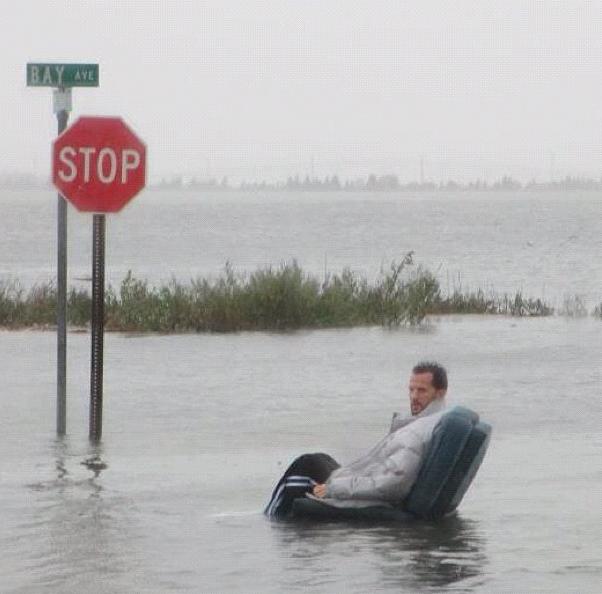 The time allotted to thinking deeply about the regularly scheduled blog post was consumed by Hurricane Sandy, so that's what I will write about now, just in case anyone is interested in the exotic subject of riding out hurricanes aboard sailboats at the dock. It's not as exciting as the subject of riding out hurricanes aboard sailboats at sea, but I haven't done that in a while. Nor do I wish that I have. I have a confession to make: I don't like hurricanes very much. Read more »


October 23, 2012
The Limits of Language
 Pawel KuczynskiSince this is the height of the political season, I have decided that it would make sense for me to say something about politics which, of course, doesn't matter. And that, obviously, is a political statement.
 Last night was the third and final round of what are commonly believed to be debates involving the two presidential candidates. What was said is not very interesting or surprising at all, except in one respect: the two contestants played their role in accordance with a certain unwritten and unexpressed rule of discourse. This rule requires them to strictly adhere to a fictional, toy version of the world and of the role of the President of the US within it. We did not see two candidates campaigning to be elected into a position of leadership, but two actors auditioning for the role of President in a play that takes place strictly in the past. Now, in a normal course of events, if one candidate started carrying on like that, the other candidate would be a fool to not try to score points by pointing this fact out to the electorate. But this situation is different: here, both candidates know with absolute clarity that they are auditioning for a ceremonial role, nothing more, and that bringing even the tiniest bit of reality into it would only jeopardize their chances of being elected.
You see, they are auditioning for the role of someone who pretends to be “running” a country (whatever that means) that is itself not exactly running. It is by now defined by just two things: unstoppable inertia in the wrong direction, and a long list of broken promises. The federal government over which, if elected, they will pretend to “preside” (whatever that means) has two remaining choices: continue with the strategy of hemorrhaging debt and collapse in a few years once that strategy stops working, or don't continue with that strategy, and collapse now.
The topic of last night's get-together was foreign policy. And so here is a country whose diplomats cower behind blast walls afraid for their lives (which they sometimes lose). A country that has lost (in the sense of losing the peace) two major conflicts (Iraq and Afghanistan) and a few smaller ones, and where its efforts in places such as Libya and Syria have only succeeded in destabilizing them. A country whose very expensive military has highest suicide rates in the world and has not been able to pacify any place, even a place that was weak, disorganized, backward or pre-destroyed by other militaries. A country whose main tool of foreign policy is political assassination using Predator drones. From the point of view of electoral politics, it should be clear by now what the goal of foreign policy should be: the goal of foreign policy should be to avoid discussing it, and in this both of the candidates have succeeded admirably.
How did they do it? At first it seems difficult to understand how these two relatively well-informed individuals could navigate such a minefield of dangerous facts without stepping on a single one. At first, I thought that this must take a lot of training, some creativity, and even some luck. But then I realized that there might be a new rule operating at the level of language that makes the entire operation perfectly safe and risk-free.
We tend to automatically assume that human language—any human language—can (with the help of a trained translator if necessary) be made to express any thought; that there exists a universal, innate human capacity for language, and that language is a universal tool. Noam Chomsky is the undisputed champion of Universal Grammar, which is an attempt to formalize this capacity as a set of universal, abstract syntactic rules, but he has recently conceded that his creation is a mere potentiality that may not be fully realized in any given language. What caused Chomsky to qualify his claim to linguistic universality was the recent research into Pirahã, a language spoken by a small group of hunter-gatherers in the Amazon. Pirahã is a highly unusual language. For one thing, its form is highly redundant, allowing it to be either whispered or hummed without any loss of meaning. But most notably, it lacks recursion—the ability to say things like “This is the cat that killed the rat that ate the malt that lay in the house that Jack built.” Since recursion is considered to be a key element of Universal Grammar, this was taken by some to mean that Pirahã is not a complete language, possessing, as it does, a finite set of possible phrases rather than an infinite set of possible sentences. Another notable feature is that rules of evidence are wired right into the grammar: in Pirahã the source of information is obligatorily marked with reference to known individuals using a specific set of verb suffixes. Taken together with the impossibility of saying something like “Jesus said that...” this feature makes the Pirahã immune to proselytizing by missionaries: spiritual evidence is ruled inadmissible on a technicality. Lastly, Pirahã lack the ability to count, and, in spite of wanting very much to learn to use numbers, to avoid being cheated when trading other tribes, have been unable to do so. Pirahã appear to have one word to signify quantity, which can mean both “few” and “many,” the gradation between the two being a subtle tonal difference. It is not that they don't have the concept of quantity, but their experience of quantity is similar to how we perceive quality: it is analog rather than digital. In spite of these linguistic limitations, the Pirahã are a carefree, thriving little tribe who get on splendidly with each other and seem quite happy with their lot in life.
The Pirahã are definitely a linguistic outlier, but once you get used to the idea that human languages are not all that universal but are all limited in one way or another in what they are capable of expressing, you begin to see all around you linguistic limitations, be they evolved or self-imposed, standing in the way of cognition. And this includes the presidential debates. Here, the new rule is not a grammatical rule but a discourse rule. Discourse does have rules, covered by a branch of Linguistics called Pragmatics. An instance of discourse is a single conversation, but it can also apply to an entire national political conversation in the course of a campaign. A discourse contains a certain set of discourse antecedents, which are elements that have previously been introduced into the discourse as new topics. The process by which new topics may be introduced into a discourse varies, and may be more or less difficult. But whenever a new topic is introduced into a conversation, that act must have some motivation behind it. The new rule is simple: play with the discourse antecedents—the kit of parts of contemporary political dialogue—and don't try to introduce new ones. The reason for the rule is obvious: any one of these new bits of information might turn out to be booby-trapped—tainted with the unspeakable reality of the country's true predicament.

October 16, 2012
Over Three Million Served
Just noticed this...
Pageviews all time history: 3,000,423
Pageviews all time history: 3,000,423
In Praise of Anarchy, Part III
 Laurent Chehere[Part I] [Part II]
 Kropotkin worked within the framework of 19th century natural science, but his results are just as relevant today as they were then. Moreover, the accuracy of his insights is vindicated by the latest research into complexity theory. Geoffrey West, who was a practicing particle physicist for forty years and is now distinguished professor at the Santa Fe Institute, has achieved some stunning breakthroughs in complexity theory and the mathematical characterization of scaling of biological systems. Looking at animals big and small, from the tiny shrew to the gigantic blue whale, he and his collaborators were able to determine that all these animals obey a certain power law: their metabolic cost scales with their mass, and the scaling factor is less than one, meaning that the larger the animal, the more effective its resource use and, in essence, the more effective the animal—up to a certain optimum size for each animal. The growth of every animal is characterized by a bounded, sigmoidal curve: growth accelerates at first, then slows down, reaching a steady state as the animal matures.
Read more »

October 9, 2012
In Praise of Anarchy, Part II
 Pawel Kuczyński[Part I]
 When confronted with an increasingly despotic régime, the good people of almost any nation will cower in their homes and, once they are flushed out, will allow themselves to be herded like domesticated animals. They will gladly take orders from whoever gives them, because their worst fear is not despotism—it is anarchy. Anarchy! Are you afraid of anarchy? Or are you more afraid of hierarchy? Color me strange, but I am much more afraid of being subjected to a chain of command than of anarchy (which is a lack of hierarchy). Read more »

October 2, 2012
Browser Issues
 Update: apparently the latest IE can deal with the brokenness of Blogger. I just went through and pruned the HTML by hand for the last month's worth of posts. I hope it helps. From now on I am not trusting Blogger's "Compose" mode and will craft the HTML by hand. Sigh.
 I keep hearing from people who say that the blog is not showing up in their browser, by which I think they mean the ridiculous thing that is Microsoft's Internet Explorer. Apparently, Blogger has done something that doesn't work with IE. I have tested it in Firefox, Chrome and Safari and saw no issues, and getting things to work with IE is a waste of time. So, don't use IE. It's broken.

In Praise of Anarchy, Part I
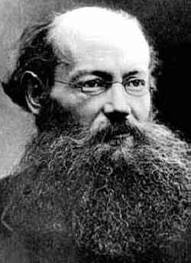 Once upon a time there lived a prince. Not a fairytale prince, but a real one, his bloodline extending back to the founder of Russia's first dynasty. It was his bad luck that his mother died when he was young and his father, a military officer who paid little attention to his children, remarried a woman who also took no interest in him or his brother. And so our prince was brought up by the peasants attached to his father's estate (he was born 20 years before Russia abolished serfdom). The peasants were the only ones who took an interest in him or showed him affection, and so he bonded with them as with his family. And so our prince became a traitor to his own class.
Read more »

September 25, 2012
Meanwhile in Oklahoma
 Pawel Kuczyński <!-- @page { margin: 0.79in } P { margin-bottom: 0.08in } </style> [<i>This is a guest post from Bonnie.</i>]<br><div style="margin-bottom: 0in;"><br></div><div style="margin-bottom: 0in;">Here in Oklahoma what you have been predicting for some time is here already, with exception to the full brunt of the collapse. The grocery still has food, the system is still operating, but we are all essentially indigent. For example, I am now out of dishwashing liquid and running low on laundry detergent; they are right there within walking distance and cost less than six dollars for both, but I cannot purchase them. But we will find a way... I am bilingual and educated and skilled in more than one trade, but while visiting Walmart last month my children and I sat on the bench in the entry waiting for my husband and someone handed each of my children one dollar out of pity. I was devastated. We have everything we need. We're financially poor with no need for vanity. We are educated and self-sufficient and can make most everything we need, but until the majority of the population comes down to our level this ability holds no real value. All it means is that we are already running low on supplies but have no cash to reacquire them, while others still have some cash left. And this makes feel lonely.<br> </div></div><a href="http://cluborlov.blogspot.com/2012/09... more »</a><div class="blogger-post-footer"><img width='1' height='1' src='https://blogger.googleusercontent.com...' alt='' /></div>
September 17, 2012
Le Vieillard Gros
 Gelii Korzhev
1925-2012My doctor wants me to live to be a hundred. During a recent check-up she asked me how long I want to live, probably as a way of telling me that I should listen to her more carefully. I said eighty, because that's how long men in my family generally live (unless there is a revolution or a world war); the women live a bit longer than that. She then said that eighty used to be considered good longevity, but that one hundred is the new eighty. Well, that certainly explains all the old people I saw in her waiting room! I told her that I do not view aging as a competitive sport, and that I do not aspire to smashing any records in the longevity department. She seemed a bit confused by this response and changed the subject.
I had a neighbor once, who was perhaps just over a hundred years old, perhaps just under—it doesn't really matter, because he himself probably couldn't remember how old he was, so why should anyone else care? On warm sunny days he would sometimes stand on his porch, squinting at the sun through dark glasses, wobbling and shaking. The rest of the time he lurked inside, doing who knows what. Eventually I found out what he was doing there: he was growing mushrooms. He was growing mushrooms on his person. When he finally died and his possessions were disgorged onto the sidewalk in front of his house for the neighbors to pick through, there were boxes and boxes of antifungals (Miconazole, Clotrimazole, etc.)—enough to treat an entire football team for both jock itch and athlete's foot. I specifically don't want to turn out to be like that man. I am much more afraid of becoming like that man than I am afraid of death.
I understand that there is a certain large number of people who aspire to being “forever young.” This seems like a truly bizarre aspiration. There is a certain symmetry between the young and the old: both tend to be stupid, the young—from inexperience, the old—from being old. In the bygone days when a spade was called a spade they were called “a young fool” and “an old fool,” respectively. These concepts could be dressed up with scientificky-sounding words like immaturity and senility, for the sake of the scientifcky-minded. Nowadays the term Alzheimer's gets thrown around a lot, and is being researched at great expense in search of a cure. But it was previously well known that “There is no fool like an old fool,” and the treatment was to ignore him. That's because a young fool might grow up and stop being a fool, whereas an old fool would eventually just stop being. The aspiration to be “forever young” is, to my mind, equivalent to wishing to remain “forever stupid”—to never grow up.
But if I am expected to reconcile myself to growing old and stupid, I might as well start now. I am already quite excellent at forgetting birthdays and anniversaries, with little room for improvement. I have also never been particularly good at remembering names, but I still remember a few, so I can improve on that. I'll start asking “What's your name again?”—of people whom I've known for years. I could also develop some annoying old man mannerisms, such as insisting on returning things I hadn't borrowed while calling everyone “kid.” This may surprise them at first, but then later they won't realize that my mind is gone, because I'll just be acting as peculiarly as ever. It takes time to adjust to being stupid, and the older one is, the harder it becomes to make the adjustment, so I better start practicing while I still have my wits about me. “Hi mom, what's your name again?” Now that is sure to produce a reaction!
I suppose I should also start thinking about a new career suitable for an old fool. Since retirement is quickly becoming a thing of the past, anyone who wants to live to be a hundred will also have to continue working all the way until death. But since people who are that old aren't capable of much physical or mental exertion, the work would have to be dead (no pun intended) easy. Perhaps I could start a chain of fashion boutiques that cater to centenarians. It would sell specialty items such as rainbow-colored ear tufts and nose-hair extensions. While there, you could pick up a packet of liver spots, some pants that you can pull up all the way to your armpits, and, pièce de résistance, a bottle of our special eau de cologne, Old Man Smell. There would be commemorative plaques for customers who dropped dead right inside the store. The chain would have to have a fashionable-sounding French name... how about Le Vieillard Gros?
But maybe, just maybe, none of this will be necessary. Just imagine, half a century from now: the fossil fuels are gone, the oceans are too acidic for shellfish, the icecaps have largely melted and coastal cities are under water, and the entire continental interior is a parched desert. It is unbearably hot and ridiculously stormy all the time, and the surviving humans, now numbering well under a billion, are all preoccupied with trying to gather or grow enough food to survive. And there I am, deep in my dotage, proudly mouldering with my rainbow-colored ear tufts and nose-hair extensions, smelling of Old Man Smell, calling everyone “kid” and trying to return a book I hadn't borrowed? If that happens, then just bury me, preferably at sea. Put me in a dinghy, hand me a bottle of rum, and set me off on the tide. I promise I won't protest.

Extraenvironmentalist Episode #49: Developing Breakdown
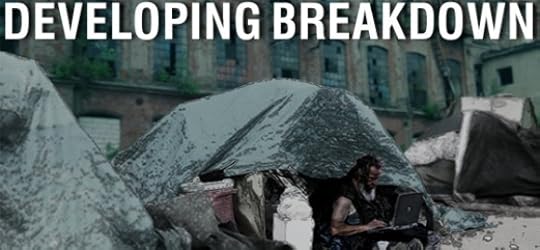
Central banks are undertaking unprecedented actions to keep the monetary system from unraveling. Despite unlimited Quantitative Easing and wealth transfers between Europe’s economies, growth has yet to return and debt is demanding to be serviced. This process is stretching the banking system to its limit. What happens when the pretense is dropped and money loses its full faith and credit? As the global economy continues its slowdown, are there people preparing for life after the global credit system falls apart?
In Extraenvironmentalist #49 we speak with Dmitry Orlov about the developing systemic breakdown threatening to destroy the global credit system. Dmitry describes his view of the mortal blow to globalized trading and discusses ideas of how society would transform after it evaporates. We ask Dmitry about those who may be best prepared for the financial system to go broke. To find out more about people prepared for a world without money, we speak with photographer Lucas Foglia [1h 19m] who tells us what it was like to capture the lives of those dropping out of society for his book A Natural Order. After we hear from the people in Lucas’ work, we play a discussion from CNBC with Marc Faber [1h 52m] where he echoes the sentiments of Dmitry and those living off the grid.
And remember: Listening to XE #49 is the perfect way to celebrate the launch of QE ∞
Podcast: Play in new window | Download (Duration: 2:14:47 — 185.2MB)
Podcast (96kbps): Play in new window | Download (Duration: 2:14:59 — 92.8MB)

Dmitry Orlov's Blog

- Dmitry Orlov's profile
- 48 followers
Dmitry Orlov isn't a Goodreads Author
(yet),
but they
do have a blog,
so here are some recent posts imported from
their feed.

