
Dmitry Orlov's Blog, page 21
April 17, 2013
Organizational Stupidity is Behind the Boston Marathon Disaster
 Kaboom!P { margin-bottom: 0.08in; }
 I was in Boston when it happened, but nowhere near the event: I was across the harbor, in the boatyard, painting a boat, when I heard the news on the radio. Yesterday I walked past the “crime scene,” as it is being called, which was crawling with police and national guard troops, as if there was anything there for them to do. Later I met a friend, and, over a beer, he pointed out a very obvious reason for why the disaster took place.
Read more »


April 15, 2013
Understanding Organizational Stupidity
P { margin-bottom: 0.08in; }A:link { }
 Shintaro KagoIs it morning in America again, or is the bubble that is the American economy about to pop (again), this time perhaps tipping it into full-blown collapse in five stages with symphonic accompaniment and fireworks? A country blowing itself up is quite a sight to behold, and it makes us wonder about lots of things. For instance, it makes us wonder whether the people who are doing the blowing up happen to be criminals. (Sure, they may be in a manner of speaking—as a moral judgment passed on the powerful by the powerless—but since none of them are likely to see the inside of a jail cell or even a courtroom any time soon, the point is moot. Let's be sure to hunt them down once they try to run and hide, though.) But at a much more basic and fundamental level, a better question to ask is this one:
Read more »
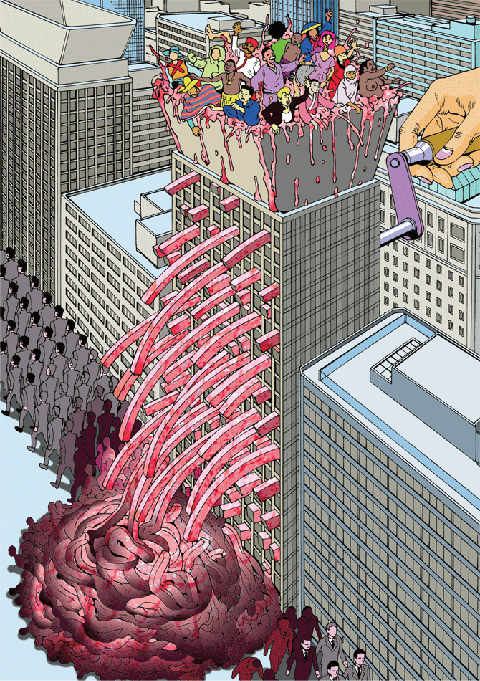 Shintaro KagoIs it morning in America again, or is the bubble that is the American economy about to pop (again), this time perhaps tipping it into full-blown collapse in five stages with symphonic accompaniment and fireworks? A country blowing itself up is quite a sight to behold, and it makes us wonder about lots of things. For instance, it makes us wonder whether the people who are doing the blowing up happen to be criminals. (Sure, they may be in a manner of speaking—as a moral judgment passed on the powerful by the powerless—but since none of them are likely to see the inside of a jail cell or even a courtroom any time soon, the point is moot. Let's be sure to hunt them down once they try to run and hide, though.) But at a much more basic and fundamental level, a better question to ask is this one:
 Read more »
April 8, 2013
The Five Stages Of Collapse reviewed By Carolyn Baker
 Many of us who have been researching collapse for a decade or more repeatedly use the word in writing, speaking, and daily conversation, but few of us have the opportunity to define it with such precision or personal experience as one finds in Dmitry Orlov’s forthcoming book Five Stages of Collapse: Survivors
’
Toolkit (New Society Publishers, 281 pages). I first heard of Dmitry when I was writing for From The Wilderness in 2005 after FTW published “Post-Soviet Lessons For A Post-American Century,” one of Orlov’s first articles in the United States naming our predicament and likely outcome.
Many of us who have been researching collapse for a decade or more repeatedly use the word in writing, speaking, and daily conversation, but few of us have the opportunity to define it with such precision or personal experience as one finds in Dmitry Orlov’s forthcoming book Five Stages of Collapse: Survivors
’
Toolkit (New Society Publishers, 281 pages). I first heard of Dmitry when I was writing for From The Wilderness in 2005 after FTW published “Post-Soviet Lessons For A Post-American Century,” one of Orlov’s first articles in the United States naming our predicament and likely outcome. Since then I have been a huge fan of Dmitry’s work, and I must concur with Richard Heinberg who says, “Even if I believed collapse were impossible I’d still read everything Dmitry Orlov writes: he’s that entertaining.” Incisive articulation of reality tempered with irrepressible humor and sarcasm define his writing style and not only compel us to stay with what some describe as a “dark Russian perspective,” but reveal a man who has found a way to live with what is so and navigate it with buoyant humanity.
Read more »
2013 Second Annual Age of Limits Conference
[Guest post from Orren. I’ll be there. Hope you can make it.]
Thursday May 23 through Monday May 24
The Four Quarters Interfaith Sanctuary, Artemas, Pennsylvania
Dedicated to the pioneering work of Donella Meadows, Jorgen Randers and Dennis Meadows and their epochal 1972 report The Limits to Growth.
Hello! Orren Whiddon here with a reminder of what we are planning for this years 2013 Age of Limits conference, and our new Sustainable Life Skills Intensive.
• This year we have extended Age of Limits to a full three days of content, beginning Thursday evening May 23rd and ending Monday Noon May 27th. With this expanded schedule we will not have to “double-book” two presentations at the same time, allowing for for 1½ hour major presentations each day. In between we will host numerous one hour workshop and networking opportunities, expanding the time available to continue the conversation—person to person, face to face.
Read more »
Thursday May 23 through Monday May 24
The Four Quarters Interfaith Sanctuary, Artemas, Pennsylvania
Dedicated to the pioneering work of Donella Meadows, Jorgen Randers and Dennis Meadows and their epochal 1972 report The Limits to Growth.
Hello! Orren Whiddon here with a reminder of what we are planning for this years 2013 Age of Limits conference, and our new Sustainable Life Skills Intensive.
• This year we have extended Age of Limits to a full three days of content, beginning Thursday evening May 23rd and ending Monday Noon May 27th. With this expanded schedule we will not have to “double-book” two presentations at the same time, allowing for for 1½ hour major presentations each day. In between we will host numerous one hour workshop and networking opportunities, expanding the time available to continue the conversation—person to person, face to face.
Read more »
April 4, 2013
KunstlerCast #223: Rappin’ with Dmitry Orlov
 James Howard Kunstler raps with Dmitry Orlov, author of Reinventing Collapse and the forthcoming new book, The Five Stages of Collapse. We delve into some heretofore unpublicized details of Mr. Orlov’s personal history as a young émigré from the old Soviet Union in the 1970s, and his journeys back to Russia (both Soviet and post-Soviet) since then.
Listen to it here .
Direct Download: KunstlerCast_223.mp3
April 2, 2013
Interview on Voice America Business Matters with Jay Taylor
 Jay and I discuss how the USA is following in the footsteps of the USSR, how financial collapse is progressing, how the various stages of collapse relate and what's in my new book. You can listen to it here or download the mp3 here.
 On this week's episode of the radio program, Ellen Hodgson Brown and Dmitry Orlov discuss the continuing collapse of western society thanks to the parasitic behavior of our banking establishment.
With outright confiscation of depositor money in Cyprus, parasitic elite is no longer robbing us in the night through the hidden tax of inflation but now robs people through outright confiscation of deposits. How long yet before Robert Prechter's next “dark age” arrives? Orlov gives us an idea of which of the five Stages of Collapse the U.S. is now in, as he compares our demise to that of the former Soviet Union's collapse.
April 1, 2013
The Untrustworthy and the Trustful
 Aaron Jasinski[This is an excerpt from The Five Stages of Collapse which seems quite topical given the new banking rules being set down in Europe and the US, according to which your bank deposits will no longer be guaranteed. With the precedent being set in Cyprus, bank deposits are being turned into unsecured loans, and when the bank folds you might get some bank stock, which you may or may not be able to sell, or you might get nothing at all. Now that large cash transactions and stockpiles are illegal, bank deposits liable to evaporate without notice, and gold likely to be re-regulated and re-confiscated before too long, what's your plan for opposing financial tyranny? I believe that before you can hatch any such plan, you must first decide: Who do you trust?]
Within a modern, highly financialized economy, most interactions are impersonal, based on purchase and sale within a market system. If you are the loser in any one transaction, it is your fault, because you chose to deal with people you had no particular reason to trust, and therefore it is your mistake. If the swindle is not illegal, you have no legal recourse. You can, of course, complain to a few friends, perhaps even blog or tweet about it, but then, in a market economy, more of a stigma attaches to being swindled than to swindling, and most people are reticent when it comes to telling the whole world that they let someone take advantage of them.
Once the financial sector goes through its inevitable deflationary collapse followed by a bout of hyperinflation, financial arrangements unravel precisely due to mistrust: nobody, from the largest banks to the humblest private individuals, knows who to trust—who is still “good for it.” Whatever transactions are still possible tend to be conducted in a furtive, suspicious, streetwise manner:“Show me the goods!”—“Show me the money!” Whatever business reputations people had in the financialized economy are either ruined or simply fade away. New reputations are established based on readiness to resort to violence or ability to oppose violence. For an individual who is not backed by a criminal organization, the chances of getting robbed go up appreciably. Instead of advertising, businessmen hide, afraid to expose either their product inventory or their wealth. For many, dealing with strangers becomes simply too dangerous.
A cultural flip is needed to change from impersonal, commercial relationships to personal relationships based on trust, and the first hurdle, for many people, is in understanding what trust actually is, because there is no innate human quality called trustworthiness, possessed by some people, lacking in others. Rather, it is more along the lines of a generalization concerning a given individual’s behavior over time, within a given relationship. Trust is transactional: a person needs a reason to trust you, and you need a reason to trust that person. There is, however, such a quality as trustfulness: this is the property of small children, tame animals and, most unfortunately for them, many regular, salt-of-the-earth, mainstream Americans. It is of negative survival value in the context of financial collapse. It is being exhibited for all to see by some of the people who recently lost money when MF Global stole it to cover some private bets it had made. They licked their wounds, complained bitterly, and then...went looking for another financial company—to be taken advantage of again. Since the head of MF Global wasn’t punished, why wouldn’t another company do the same to them, knowing that it can do so with impunity?
There also seems to be a certain set of traits possessed in abundance by a category of highly effective American financial operators that makes it easy for them to prey on trustful people. It may be the suits they wear, or the English they speak or their general demeanor—let us call it “trustiness,” to go along with the “truthiness” of their financial disclosures. Deep down, trustful people feel privileged to be robbed by such superior specimens. The predator-prey relationship has been honed to the fine point of a pen: told to sign their life away on the dotted line, the besotted, trustful American gulps quietly—and signs.
Clearly, whenever there is an asymmetry between trustfulness and trustworthiness, the trustful party loses. Trust is not the property of one individual but the property of the relationship between individuals, and it must be balanced. There are roughly three types of trust. The first and best kind is trust borne of friendship, sympathy and love. People simply do not want to lose the trust of those they care about, and will do anything they can to make good on their promises. The second type of trust is based on reputation. It is not quite as solid, because someone’s reputation can be ruined without you knowing it. People who realize that their reputation has been ruined tend to stop being trustworthy rather suddenly, because they see that they have nothing left to lose in the trust game. Rather, they try to salvage whatever residual value their formerly trustworthy reputation still holds by taking full advantage of anyone who is still trustful through force of habit, lack of up-to-date information, inattention or sheer inertia. The last category of trust, the worst kind, is coerced: it is a matter of making it too expensive or too unpleasant for someone to break your trust. If you are forced to do business with someone you don’t trust at all, trade hostages for the duration of the transaction or come to some other arrangement that compels good behavior from both sides.
The people most deserving of trust are usually one’s own relatives— provided the family is a close-knit one and that it has an internal reputation for being trustworthy, which it values. This is especially the case in societies where putting a stain on the family honor is considered to be a cardinal sin. The next tier of trust is generally reserved for one’s close neighbors, if the neighborhood is a relatively static, close-knit and mutually supportive one; if it is not, then neighbors can make the worst sorts of strangers—ones you can’t avoid dealing with even though you don’t trust them. The last tier of trust consists of complete and total strangers. Here, trust has to be tested before it can be established, by taking small risks: offering small but thoughtful gifts and seeing whether there is reciprocation; putting oneself temporarily in a weakened position (perhaps even on purpose) and seeing whether the other person offers help freely, refuses to come to your aid or attempts to take advantage. At the end of the process, either the stranger ceases to be a stranger, or he is excluded.
Obviously, it is never smart to signal your lack of trust, except in confidence. But for social interactions based on trust to work well, society as a whole must have a way of excluding those who are found to be untrustworthy. In a healthy community in which people normally cooperate or trust each other, there may be a few episodes where someone breaks the trust and is expelled or shunned. In a sick community where neighbors are alienated, combative and mistrustful of each other, you are better off shunning the entire community—by relocating. Sick communities of this sort—and I have seen a few—become sick quickly and take a long time to heal, if they ever do. A certain network effect makes a degenerate condition far more durable than a healthy one. In a friendly, cooperative community, the trust is between each individual and the community as a whole: n individuals—n relationships of trust. In a broken, mistrustful community, each individual or group mistrusts every other individual or group: that’s n! (n-factorial, or 2·3·4·5· . . . ·n). A healthy community of ten individuals has ten healthy, trustful relationships. A sick community of ten individuals has 10! or 3,628,800 broken, mistrustful relationships. It seems like a better idea to try to establish and maintain the former rather than attempting to fix the latter.
It may be helpful to put the concept of normal, cooperative human relationships based on trust into a wider context. Humans are a social species, and thrive through cooperation. Opposing groups of humans often fight: the bigger the group, the bigger the war, all the way to world war and, if we ever achieve a unified world government, perhaps to spontaneous self-annihilation. But within smaller groups—small enough to avoid the pitfall of self-annihilation through major conflict— cooperation prevails. The great Russian scientist and anarchist revolutionary Peter Kropotkin, in his 1902 book Mutual Aid: A Factor in Evolution, argued that it was cooperation rather than competition that made advanced species, including humans, successful. An emphasis on competition, on setting people against each other, on forcing them to struggle against each other economically, may benefit the community if it is viewed as a machine of expansion and domination, but only for short periods of time, and to the detriment of most of its members. An inevitable holdover from this bout of over-competitiveness is that the mindset of social Darwinism and a Hobbesian “war of all against all” remains prevalent, with people deriving their sense of self-worth from their individual, personal achievements and superiority rather than from their often unstated and informal membership in various groups without which they would have surely failed. This mindset is diseased and contagious, and there may not be time to cure it. When time is short and resources scarce, a better response to those who favor competition over cooperation is to give them more of their own medicine: no cooperation at all.
Please order your copy of The Five Stages of Collapse: Survivors' Toolkit for shipment in May.
Regular price $18.00 USD Autographed, numbered copy $28.00 USD
(Although the order is placed through PayPal, you don't need to have a PayPal account; just click "Don't have a PayPal Account?" during check-out and enter a credit or debit card number. If you do have a PayPal account, please make extra-double-sure that the shipping address associated with it is up-to-date and correct, and will remain that way through May.)
March 25, 2013
Bangs and Whimpers
 Anatol Knotek[Update:
The Five Stages of Collapse
has finally been sent to the printer. May delivery is now guaranteed. Please place your order below.]
Anatol Knotek[Update:
The Five Stages of Collapse
has finally been sent to the printer. May delivery is now guaranteed. Please place your order below.]Quite a few people wrote to me over the past week asking about all the noise coming out of Cyprus. If you haven't heard, there is a financial collapse that is unfolding there: banks are closed and people can't get at their money. The Cypriot banks are insolvent. This is no surprise: all banks everywhere are insolvent, and would fail immediately were the various types of ongoing bailouts to suddenly stop. These bailouts include an ever-longer list of annoying financial jargon—liquidity injections, quantitative easing, toxic-asset-purchasing by central banks, accounting tricks such as “mark-to-fantasy,” which allows them to make bogus claims as to the value of their assets, yadda-yadda. The point is, the financial system failed in 2008, and stayed that way. The faulty formula behind all modern finance is debt raised to the power of time, and only works when there is exponential growth in economic activity and energy. Energy's exponential growth stopped in 2005 due to resource depletion; three years later finance collapsed. Permanently. Since then we have been witnessing a global game of “extend and pretend,” which cannot be played indefinitely. If something can't go on forever, it doesn't.
Perhaps you have also heard about the nasty Russian oligarchs who used Cyprus as an offshore to launder their ill-gotten gains. Russian interests stand to lose tens of billions of dollars on the Cyprus fiasco. They were going to use that money to put their young idiots through Harvard, snap up Miami real estate, cruise the Mediterranean in megayachts and so on, and they probably still will. But they are not at all happy, still sore from what happened in that other EU offshore, Iceland, and thinking of something to do about it—something painful, embarrassing, or both. By the way, the money-laundering charge is just anti-Russian bigotry, which is a hold-over from the Cold War. You see, when Apple Computer parks its cash offshore, that's called “minimizing international tax exposure.” But when a Russian company does it, it's called “international money-laundering.” Cheating and stealing are the last two competencies left in modern finance, yet when Russians do it it's somehow considered bad? That is just hypocrisy pure and simple.
In case anyone wants a solution to the Cyprus crisis, I have a modest proposal. Take Cyprus out of the Eurozone and make it part of the Ruble Zone. Pay depositors in full, in Russian Rubles. Now reprice and sell Russia's natural gas exports to Europe in Rubles. Eurozone would still be insolvent, but Cyprus would be fine and the Russian depositors would be happy. Of course, Germany et al. would have to start exporting products to Russia at a steep discount to earn the Rubles to pay for the gas. Failing that, they could buy Rubles using Euros, and then Russia would turn around and use them to buy gold.
What the Cyprus crisis exposes is just the tip of the financial collapse iceberg. Cyprus is small, far away, and by itself unlikely to crash the entire system, but you never know—icebergs are known to flip and crumble unexpectedly. But taking a slightly longer view, the experience the Cypriots are going through exposes the risk of having all of your eggs in the one basket labeled “finance.” If you want to maximize your stupidity, keep your money in a bank or any other financial institution. A slightly less stupid strategy is to hold wastebaskets full of physical Dollars or Euros (which will eventually be worth their weight in recycled paper). Less stupid still is the strategy of holding precious metals (which will probably be confiscated once governments become sufficiently desperate). There are some non-stupid options as well, but if you want to learn about those you will have to read my book (which is going to press this week).
Speaking of which, here is this week's excerpt:
A likely endgame
Here is a likely endgame for the finance and import-driven global economy. Supposing global finance suffers another “whoopsie” à la 2008: a “credit event,” money markets lock up and so on... This scenario has been rehearsed once already, and nothing has been done to prevent it from happening again except for some temporary stopgaps consisting of national governments sopping up all the bad debt. What is different now is that all the governments have already shot all of their magic bailout bullets. The guilty parties are still at large, richer than they were before this crisis and probably thinking that the next crisis will make them even richer. The last time it happened, President Bush the younger famously declared: “If money isn’t loosened up, this sucker could go down,” and money was indeed loosened up, and is getting looser all the time. But how loose is too loose? At some point we are bound to hear, from across two oceans, the shocking words “Your money is no good here.”
Fast forward to a week later: banks are closed, ATMs are out of cash, supermarket shelves are bare and gas stations are starting to run out of fuel. Nothing useful happens when people swipe their credit cards at the few stores that remain open (not that anyone is shopping, except for food and ammo). And then something happens: the government announces that they have formed a crisis task force, and will nationalize, recapitalize and reopen the banks, restoring confidence. In short, the government will attempt to single-handedly operate their corner of the global economy by other means. The banks reopen, under heavy guard, and thousands of people get arrested for attempting to withdraw their savings. Banks close, riots begin. Next, the government decides that, to jump-start commerce, it will honor deposit guarantees and simply hand out cash. They print and arrange for the cash to be handed out. Now everyone has plenty of cash, but there is still no food in the supermarkets or gasoline at the gas stations because by now the international supply chains have broken down and the delivery pipelines are empty. Restarting them requires international credit, which requires commercial banks to start operating normally, and that in turn requires functioning supply chains and retail.
If you are still wondering what keeps this blog going, it is still just you. If you haven't done so yet, please pre-order your copy of The Five Stages of Collapse: Survivors' Toolkit. The off-press date is May 1st, and it will ship shortly thereafter.
Regular price $18.00 USD Autographed, numbered copy $28.00 USD
(Although the order is placed through PayPal, you don't need to have a PayPal account; just click "Don't have a PayPal Account?" during check-out and enter a credit or debit card number. If you do have a PayPal account, please make extra-double-sure that the shipping address associated with it is up-to-date and correct, and will remain that way through May.)
March 18, 2013
Open Thread
 The book is going to press next Monday and, having edited it and proofread it and fact-checked it relentlessly for weeks now, I am in no mood to churn out another weekly essay. There are 30 thousand of you out there! Can't some of you write something interesting yourselves, for once? Just this once? Thank you!
March 11, 2013
The proliferation of defunct states
 [Another excerpt from The Five Stages of Collapse.]
 The triumph of the nation-state was made possible by the triumph of industry over artisanal production, especially in the area of weaponry. Industrialization gave the larger nations the means to produce vast quantities of war matériel, in turn giving them the impetus to homogenize and standardize the population by imposing a single language and educational system in order to be able to field a unified fighting force. The transformation was profound: at the time of the French Revolution only 10-12 percent of the French population could be said to speak French; in Italy the number of people who could be said to speak Italian was even lower. It allowed a handful of European nation-states to conquer the entire planet, before suffering the successive paroxysms of the two world wars. As they retreated, they did their best to carve up the planet into patches that, they hoped, would emerge as nation-states in their own right. Read more »
Dmitry Orlov's Blog

- Dmitry Orlov's profile
- 48 followers
Dmitry Orlov isn't a Goodreads Author
(yet),
but they
do have a blog,
so here are some recent posts imported from
their feed.

