Dan Jorgensen's Blog, page 478
May 27, 2016
Discovering one's 'usefulness'
“The need to write comes from the need to make sense of one's life and discover one's usefulness.” – John Cheever
Born on this date in 1912, American novelist and short story writer John Cheever has been recognized as one of the most important short fiction writers of the 20th century. A compilation of his mid-life writing, The Stories of John Cheever, won the 1979 Pulitzer Prize for Fiction and a National Book Critics Circle Award, and its first paperback edition in 1981 was named for the National Book Award.
A “natural” writer, he wrote his first short story and was published while still in his teens in New York City. After dropping out of high school, he took a job as a caretaker at a New York artist’s colony, continued writing and had a number of works published in prominent magazines like The New Yorker. In the late ‘30s he worked for the government’s Writer’s Project before enlisting in the Army during World War II, when he had his first book of short stories published. Ultimately he became a chronicler of both his times and the people he encountered, and was lauded for his keen, often critical, view of the American middle class.
His stories are characterized by his attention to detail, his careful writing, and his ability to find the extraordinary in the ordinary.
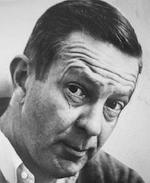 Always cognizant of his reading public and what they liked, he once said, “I can't write without a reader. It's precisely like a kiss - you really can't do it alone.”
Share A Writer’s Moment with a friend by clicking g+1 below.


May 26, 2016
Taking an instant out of time
“Photography takes an instant out of time, altering life by holding it still. The visual life is an enormous undertaking.”– Dorothea Lange
Born on this day in 1895, Lange influenced generations of Americans with her poignant photographic images that remain icons of the Great Depression. Her photographs and accompanying writing about what she saw humanized the Depression’s consequences and influenced the development of documentary photography.
Her own pathway in life was hindered by two traumatic events, the first being the victim of polio at age 7, a disease that left her partially crippled for life. Then Lange and her family were abandoned by her father when she was 12, spiraling them into poverty and forcing her to start working as a young teen, including a part-time job as a photographer’s assistant. Simultaneously continuing her studies, she earned her high school diploma and enrolled at Columbia University where she formally studied photography. In 1918, she found a job as a photo finisher in San Francisco and embarked on the pathway to her eminent career.
In 1933, she was signed by the Roosevelt administration to begin documenting the lives of ordinary Americans and what they were going through to survive the Depression. Her photos are still keys to our understanding of what many Americans endured.
Often exposed to harsh and unforgiving environmental conditions, she contracted esophogeal cancer and died in 1965. But her work continues to be studied by generations of young photographers. “A camera,” she said, “is a tool for learning how to see without a camera.” Thanks to Dorothea Lange, we’ve been able to see deeply into America’s history and its soul.
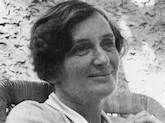
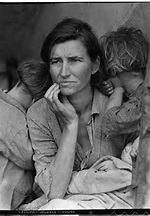 Lange (left) and her award-winning photo of a migrant mom and kids in California in 1935
A PBS “American Masters” show on Lange, “Grab A Hunk of Lightning,” can be found at: http://www.pbs.org/wnet/americanmasters/dorothea-lange-about-the-film/3096/
Share A Writer’s Moment with a friend by clicking g+1 below.
May 25, 2016
Inventing a field of dreams
“Most people write a lot of autobiography, but when I came to write autobiography I discovered that nothing interesting had ever happened to me. So I had to take the situation and invent stories to go with it.”– W. P. Kinsella
William Patrick Kinsella, born on this date in 1935, is a Canadian novelist and short story writer whose work usually focuses on baseball, First Nations people, and other Canadian issues. For a truly wonderful read about life on the First Nations’ Reserve in Kinsella’s home province of Alberta, check out Kinsella's book of short stories Dance Me Outside, his very first book from 1977. Narrated by a young Cree named Silas Ermineskin, it is a remarkable look at Reserve life, love, sorrow and triumph.
But while he writes poignantly and with great detail about the First Nations, it is for his 1982 baseball novel Shoeless Joe that he gained international acclaim. Kinsella
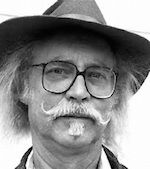
The book was mildly controversial in that it used the reclusive (and still living at the time) author J.D. Salinger as one of its main characters, even though Kinsella had never met him. "I made sure to make him a nice character so that he couldn’t sue me.” Kinsella said. The best-selling book was later adapted into the wonderful 1989 Kevin Costner movie Field of Dreams, further cementing Kinsella’s reputation and making Costner a star.
“Most writers are unhappy with film adaptations of their work, and rightly so,” Kinsella said. “But Field of Dreams caught the spirit and essence of Shoeless Joe while making the necessary changes to make the work more visual.” Primarily set in Iowa it has one of the great literary exchanges when one of the old-time “spirit” ballplayers he creates emerges from a cornfield and asks the main character Ray if this is Heaven? “No,” Ray answers. “This is Iowa.”
If you haven’t read the book or seen the movie, I commend both to you – in that order. You won’t be disappointed. It's also a salute to the imagination and the creativity we have to make fields of dreams.
Share A Writer’s Moment with a friend by clicking g+1 below.
May 24, 2016
Free air, fresh writing
“Every individual ought to know at least one poet from cover to cover: if not as a guide through the world, then as a yardstick for the language.”– Joseph Brodsky
Born this date in 1940 in Leningrad, Brodsky first started writing at age 15, and getting published by the underground journal Sintakss (Syntax) before he was out of high school. Those early works got him in deep trouble with both Stalin and his successor Nikita Khrushchev as being “anti-Soviet,” and by his late 20s he had been jailed, “confined” to a mental institution, and finally expelled from his homeland. Luckily for the writing world, he came to live in the United States thanks to the help of poet W. H. Auden.
From that point until his death in 1996, he taught writing and poetry at many different U.S. universities, including such institutions as Yale, Columbia and Michigan before becoming a full-time faculty member at Mount Holyoke College in Massachusetts.
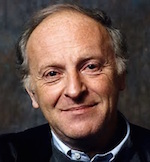 In 1987, Brodsky was awarded the Nobel Prize in Literature "for an all-embracing authorship, imbued with clarity of thought and poetic intensity.” And in 1991, he was appointed United States Poet Laureate, the first naturalized citizen to be so honored.
He said coming to America was the best thing that could have happened to him. After living under totalitarianism and oppression, America was a breath of fresh air that renewed his spirit and belief in his fellow human beings. “Cherish your human connections: your relationships with friends and family,” he advised his students. “Know how delightful it is to find a friend in everyone you meet.”
Share A Writer’s Moment with a friend by clicking g+1 below.
May 23, 2016
A hero for anti-bullying
“I hid my heart under my bed because my mother said if you're not careful someday somebody's going to break it. Take it from me, under the bed is not a good hiding spot.” – Shane Koyczan
Born on this date in Yellowknife, Northwest Territories, Koyczan grew up in British Columbia and in 2000 became the first Canadian to win the U.S. Individual Championship title at the National Poetry Slam.
A spoken word poet, writer, and member of the group Tons of Fun University, he is best known for writing about issues like bullying, cancer, death, and eating disorders and internationally famous for his anti-bullying poem To This Day
(Check out this link: https://www.youtube.com/watch?v=sa1iS1MqUy4to see him “perform” it at his TED talk).
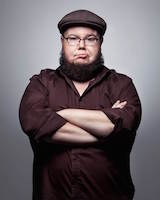
Also the author of 4 books of poetry and many essays – both written and spoken – Koyczan said he’s interested in pursuing opera next. “Opera is the original marriage of words and music, and there's a theatre element, a dramatic element,” he said. “It's right up my alley.”
Share A Writer’s Moment with a friend by clicking the g+1 button below.
May 22, 2016
Praise for 'And The Wind Whispered'
And The Wind Whispered, my historical fiction novel set in 1894 in Hot Springs in the southern Black Hills, was honored yesterday by the Colorado Division for the Humanities and Center for the Book as a Colorado Book Awards finalist in Historical Fiction.
Yesterday was a full day of readings and presentations, including a visit with a book club, reading at a
Reading at The Book Bar in Denver
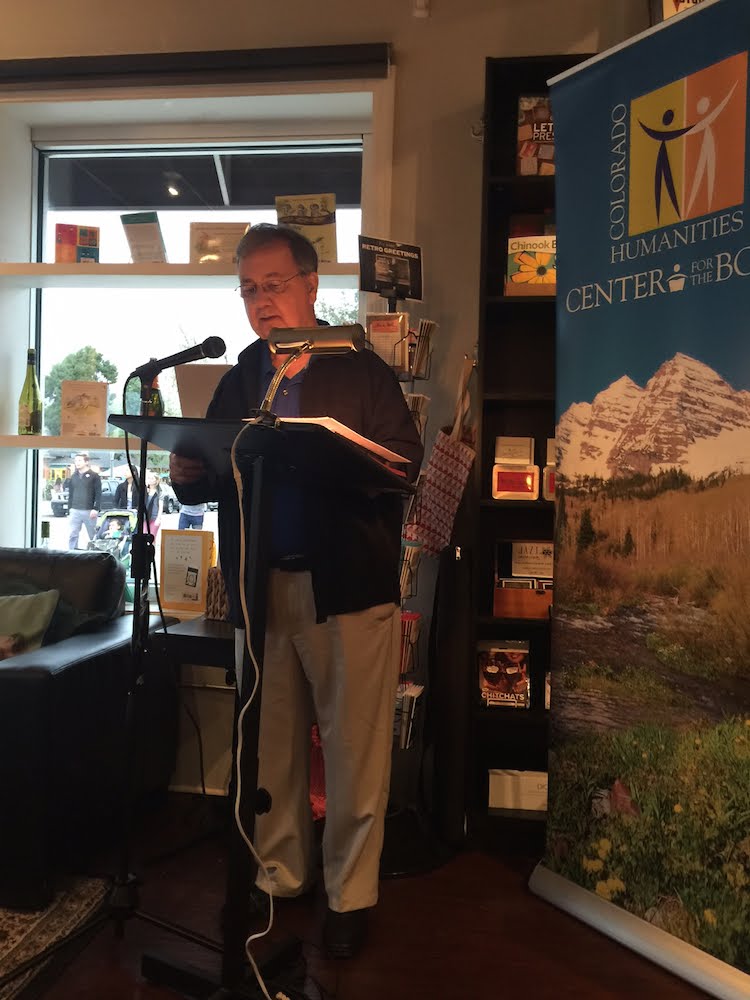
bookstore and the awards ceremony in Denver (actually the suburb of Parker) last evening where the book earned the Silver (runner-up) Award. With my wife Susan on stage at the Awards

It was an honor to be in the Final Three in the Historical Fiction category and meet so many other great authors, editors and illustrators from the other various categories.
Recently there's been quite a bit of praise for the book, so since I'm making today my own Writer's Moment, here are some of those reviewers' comments. Hope you'll look for And The Wind Whispered in a bookstore, through Amazon, or on any e-book site. Happy Reading and thanks!
Praise forAnd The Wind Whispered
2016 Colorado Book Award Finalist
From recent reviews:
“Buffalo Bill, Bat Masterson, Nellie Bly. A minstrel show with an attitude. Big crowds, intriguing plot twists, and powerful female personalities that do far more than swoon and simper. There's trouble in Hot Springs - and it's about to get a lot hotter before some of the protagonists achieve resolution. “It's rare to find a work that is a real delight in its uniformly feisty, believable protagonists who work within a plot that holds no boundaries. And The Wind Whispered is a remarkable achievement, no matter what genre you're partial to.” – Diane Donovan, Midwest Book Review*****
“And the Wind Whispered begins as any good murder mystery should, with a body. Throw in a dark cave and three snoopy kids, and you've a good story - if you know how to write it. Dan Jorgensen knows how. The book mixes in historical characters and accounts … tied together in a web of intrigue.” – Kevin Woster, KELO (CBS) Television News.******
“And the Wind Whispered by Dan Jorgensen contains several scenes that are so exciting that they become almost impossible to put down. … The mystery of who killed Alexander Previn, and why, forms the basic plot of the novel. Along the way, readers are put in contact with multiple characters from Old West lore — Bat Masterson, “Buffalo Bill” Cody, reporter Nellie Bly, Annie Oakley, Theodore “Teddy” Roosevelt, even a young Will Rogers, among others - who get involved in helping to deal with the McCarty-Curley outlaw gang and working to solve the mystery.
Jorgensen keeps his characters in plenty of danger throughout, making it easy for readers to keep turning the pages. Set in 1894, the novel deals with a time period too often neglected by Western novel writers, that is, the final decade of the 19th century when the Old West was disappearing and the ‘New West’ was emerging. Also, the novel is set in the Black Hills of South Dakota, an exciting area too often neglected by writers of Western novels.
“And the Wind Whispered represents refreshing new ground in Western novel writing.” – Paul F. Murray (Reader’s Favorite)
******
“Jorgensen fills his story with humor and plot twists and manages to keep everything moving along while also working in a good deal of interesting ‘Wild West’ lore. Western fans will feel at ease with the adventures of the novel’s three young heroes, but the story’s wider cast will make it interesting even to readers who tend to avoid historical or western novels.” – Lynette Olson, Emporia (Kan.) Gazette
*********“Author Dan Jorgensen assembles an all-star cast of famous names from the American West in his historical whodunit/adventure tale And the Wind Whispered.
“Set in 1894 in and around the boom town of Hot Springs, South Dakota, Jorgensen’s novel starts with a train ride, expands to include a dead body, and eventually numbers such iconic figures as Nellie Bly, Bat Masterson, Deadwood Sheriff Seth Bullock, Will Rogers, Annie Oakley, Buffalo Bill, and even Theodore Roosevelt among its cast of characters.
“Jorgensen stuffs his narrative with salty humor and plot twists. The author manages to keep everything bubbling along while also unobtrusively working in a good deal of interesting local Wild West lore. A very spirited outing.” – Historical Novel Society Review
May 21, 2016
No promises, but hope - Saturday's Poem
“The moment of change is the only poem.” – Adrienne Rich
Adrienne Cecile Rich, born in May 1929, was an American poet, essayist and feminist called "One of the most widely read and influential poets of the second half of the 20th century” in text accompanying the prestigious MacArthur (Genius) Fellowship, awarded to her in 1994.
Her works span 7 decades, including dozens of poetry collections, a dozen nonfiction books, and a huge number of essays. Rich’s collection Diving into the Wreck: Poems 1971-1972 won the National Book Award. She also was awarded the Frost Medal and the Lifetime Recognition Award from the Griffin Poetry Prize.
 In the mid-1990s she famously refused the National Medal for the Arts in protest of the failure of Congress to provide funding for the arts.
Rich frequently spoke and wrote on behalf of the oppressed and on the plight of immigrants. Here, for Saturday’s Poem is her short piece,
Prospective Immigrants, Please NoteEither you will
go through this door
or you will not go through.
If you go through
there is always the risk
of remembering your name.
Things look at you doubly
and you must look back
and let them happen.
If you do not go through
it is possible
to live worthily
to maintain your attitudes
to hold your position
to die bravely
but much will blind you,
much will evade you,
at what cost who knows?
The door itself
makes no promises.
It is only a door.
Share A Writer’s Moment with a friend by clicking g+1 below.
May 20, 2016
Transported through the imagination
“With my writing, I can still play inside an enchanted castle or live inside an old fort. I can run from ghosts or ride dolphins any day of the week.”– Mary Pope Osborne
Almost every 5 to 10 year old knows definitively who Jack and Annie are, and as my 6-year-old grandson Teo told me, “They go everywhere and do everything, and we do too.” Jack and Annie are the brother-and-sister protagonists created by Osborne, who was born on this day in 1949 and is best known for her award-winning, bestselling Magic Tree Houseseries, translated into some 30 languages in 130 million copies worldwide.
The daughter of a career military man, Osborne lived in 13 houses around the globe before age 15 when her dad retired. "Moving was never traumatic for me, but staying in one place was. When my dad finally retired to a small town in North Carolina, I nearly went crazy with boredom." That led her to try Community Theater to rekindle that sense of adventure that she was missing.
“I continued to visit imaginary places … whether I acted in a play or worked backstage, the world of Tennessee Williams or Shakespeare always seemed more real to me than the dreary life of high school.” In her early 30s, “one day, out of the blue” she started writing a story that she had been thinking about. “It just came to me,” she said. The result was her first best-seller, the semi-autobiographical Run, Run As Fast As You Can, and she has never looked back. The first of her Magic Tree Housebooks, Dinosaurs Before Dark, followed, introducing Jack and Annie who, with the help of magical books and their tree house, are transported to places and times different from their own.
Kids, of course, not only love the adventures but also are subliminally introduced to events, animals and people worldwide and from throughout history. “I discovered writing children's books was a way to keep living in my imagination like a child,” Osborne said. “ I could be somewhere different in every single book.”
Share A Writer’s Moment with a friend by clicking g+1 below.
May 19, 2016
Any news outlet will do
“People can get their news any way they want. What I love about what's happened is that there are so many different avenues, there are so many different outlets, so many different ways to debate and discuss and to inquire about any given news story.” – Jim Lehrer
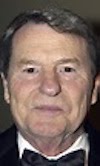
Born this day in 1934, Lehrer is the former news anchor of PBS Newshour and known for his role as a debate moderator for a number of U.S. presidential elections. He’s also author of numerous fiction and non-fiction books, which draw upon his experience as a newsman, his interests in history and politics, and his love a good adventure or mytery story. “My writing is extremely important, so I write every day,” Lehrer said. “I just enjoy it. I get a kick out of it.”
Lehrer's career in journalism, which started as a reporter for the Dallas Morning News, has been recognized through numerous awards and honors. These include several Emmys, the George Foster Peabody Broadcast Award, the University of Missouri School of Journalism’s Medal of Honor, and the William Allen White Foundation Award for Journalistic Merit. He said he’s especially proud of the White Award, named for the great newspaper editor from Emporia – not too far from Lehrer’s hometown of Wichita, Kansas.
 (A side note: The young William Allen White and his wife Sallie are key characters in my novel And The Wind Whispered).
Lehrer said he’s pleased for his journalistic recognition because he’s always prided himself on the fairness of his reporting. “I know for certain that it's always possible for a professional journalist who understands what he or she's up to to be fair, and that's the key word. Fairness to individuals, fairness to ideas, and to issues and whatever - that is critical, and that is also part and parcel of what the job is all about.”
Share A Writer’s Moment with a friend by clicking the g+1 button below.
May 18, 2016
Key to success? Well, there's that 'talent' thing
“If people ask me for the ingredients of success, I say one is talent, two is stubbornness or determination, and third is sheer luck. You have to have two out of the three. Any two will probably do.” – Fred Saberhagen
Born on this day in 1930, Saberhagen wrote science fiction and fantasy, and is most famous for his Berserker series of short stories and novels. He also was one of the first writers to put together a series of vampire novels in which the vampires (including the famous Dracula) are the “good guys.” “I used the same tools that make any writer good,” he said, “plus a cheerful willingness to suspend belief.” A native of Chicago and a Korean War veteran, Saberhagen went to work for Motorola after the war and where he was at when he started writing fiction seriously at the age of about 30. His first novel The Golden People came out in 1964 following a series of successes with magazine articles and short stories. He said he was “filled with ideas” and just felt the urge to write every day. “Ideas are everywhere,” he said. “It's the paperwork, that is, sitting down and thinking them into a coherent story, trying to find just the right words that can, and usually does, get to be a writer’s labor.”
Still writing “serious science,” too, he served as editor and writer for all Chemistry articles in the Encyclopædia Britannica from the late 1960s through
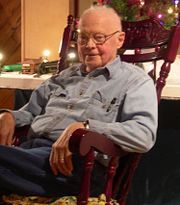 the mid-‘70s. But, from that point until his death in 2007 he only wrote science fiction.
As for advice to aspiring science fiction writers, he said, “The advice would be the same as for any kind of fiction. Keep writing, and keep sending things out, not to friends and relatives, but to people who have the power to buy. A lot of additional, useful tips could be added, but this is fundamental.”
Share A Writer’s Moment with a friend by clicking g+1 below.