Dan Jorgensen's Blog, page 477
June 6, 2016
It's about what you want to know
“The one thing that makes writing a better pastime than reading is that you can make things turn out the way you want in the end!” – Geraldine McCaughrean
British children's novelist McCaughrean, born on this date in 1951, has written more than 160 books and her work has been translated into 45 languages worldwide. But despite all that success, she may be known best for writing the authorized sequel to Peter Pan in 2006.Beloved by kids everywhere, she said she appeals to kids because she empowers them. “The chief thing is to make children feel good about themselves,” she said. “They want to step into the shoes of a hero who is bigger and stronger, to face tremendous dangers and come home safely for tea.”
Intending to be a teacher, this London native instead found her true vocation in writing while still debating where to go to school and for what major. She claims that what makes her love writing is the desire to escape from an unsatisfactory world. Her motto: Do not write about what you know, write about what you want to know.

“I never dreamt I could be an author when I grew up,” she said. “It just didn't occur to me, because I thought you had to be a) academic, so go to university, things like that, and I didn't think I was clever, or b) dead because I just assumed all the authors in the library were dead.”
Share A Writer’s Moment with a friend by clicking g+1 below.


June 5, 2016
Focused through a child's eyes
“I believe that imagination is stronger than knowledge. That myth is more potent than history. That dreams are more powerful than facts. That hope always triumphs over experience. That laughter is the only cure for grief. And I believe that love is stronger than death.”– Robert Fulghum
When I give talks on writing I like to reference Fulghum, who celebrated his 79th birthday yesterday and continues to be as inspiring as always in his thoughts on life, learning and paying attention to the world around us. I’ve had a couple of occasions to see and hear him speak and he has the ability to mesmerize his audience with his downhome maxims and life lessons.

I especially like his tale of an old Greek sage who finds a piece of broken mirror, shapes and polishes it, and then spends time reflecting light into previously darkened or unseen places. “Reflecting light on the unseen is not only worthwhile, but it really should be the meaning of life,” says the old sage. And, Fulghum adds, the goal of every writer.
Author of the international best-seller, Everything I need to know I learned in Kindergarten, Fulghum finds uncommon ideas and actions in common, everyday things. His books have been published in 27 languages in 103 countries with a prose style that is simple, direct and life affirming. And, Fulghum – a Universalist Unitarian minister and says that his writing is a key part of his ministry – said that everyone can learn more about the world through the eyes of a child. “Don't worry that children never listen to you,” Fulghum said. “Worry that they are always watching you.”
Share A Writer’s Moment with a friend by clicking the g+1 button below.
June 4, 2016
Common sense, uncommon words
“Poetry is a mixture of common sense, which not all have, with an uncommon sense, which very few have.” – John Masefield
I wrote of Masefield, longtime Poet Laureate of Great Britain, earlier this week on the occasion of what would have been his 138th birthday. He was and remains one of those poets who have the uncommon sense to take every ordinary thing and make it shine.
Masefield loved the sea, lived for years on the sea (aboard the HMS Conway) and wrote of it often in both prose and poetry. His “Sea Fever” with the famous line “I must go down to the sea again, to the lonely sea and the sky” is probably known by all, and I commend it to you again for your reading pleasure. But for Saturday’s Poem, I give you another of Masefield’s terrific short poems,
The Wanderer
A WIND'S in the heart of me, a fire's in my heels, I am tired of brick and stone and rumbling wagon-wheels; I hunger for the sea's edge, the limit of the land, Where the wild old Atlantic is shouting on the sand.
Oh I'll be going, leaving the noises of the street, To where a lifting foresail-foot is yanking at the sheet; To a windy, tossing anchorage where yawls and ketches ride, Oh I'll be going, going, until I meet the tide.
And first I'll hear the sea-wind, the mewing of the gulls, The clucking, sucking of the sea about the rusty hulls, The songs at the capstan at the hooker warping out, And then the heart of me'll know I'm there or thereabout.
Oh I am sick of brick and stone, the heart of me is sick, For windy green, unquiet sea, the realm of Moby Dick; And I'll be going, going, from the roaring of the wheels, For a wind's in the heart of me, a fire's in my heels.
Share A Writer’s Moment with a friend by clicking g+1 below.
June 3, 2016
Nourishing our imagination
“You expect far too much of a first sentence. Think of it as analogous to a good country breakfast: what we want is something simple, but nourishing to the imagination.” – Larry McMurtry
Born on this date in 1936, McMurtry is the consummate writer of “the perfect first sentence,” and readers have rewarded him for it with multiple bestselling novels. And, viewers have been equally appreciative, flocking to the movie adaptations of his many works.
Among his dozens of best-sellers are Horseman, Pass By, The Last Picture Show, Terms of Endearment, and Lonesome Dove. His movies have earned a remarkable 26 Academy Award nominations (10 wins), and Lonesome Dove, adapted into a television miniseries, earned 18 Emmy nominations (seven wins) and a Pulitzer Prize for literature.
While he is known as a rugged “Old West He-Man,” McMurtry has not been afraid to write sentimental tomes like Terms of Endearment or stories about alternative lifestyles, like his Academy Award-winning (with co-writer Diana Ossana) screenplay for Brokeback Mountain.
A rancher’s son, McMurtry got his first taste of storytelling sitting on his parents’ porch
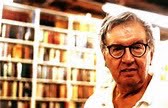 in the evening and listening to them and ranchhands telling tales. That storytelling, he said, made him enamored with the heritage of his native Texas and, ultimately, the nation, and he said he is sometimes discouraged when Americans’ fail to embrace our nation’s history.
“Backward is just not a natural direction for Americans to look,” he said. “Historical ignorance remains a national characteristic.”
Share A Writer’s Moment with a friend by clicking g+1 below.
June 2, 2016
Emotion for the ages
“My opinion is that a poet should express the emotion of all the ages and the thought of his own.” – Thomas Hardy
While Hardy wrote poetry throughout his life and regarded himself primarily as a poet, his first collection was not published until 1898 on his 58th birthday. Born on this day in 1840, he initially gained fame as the author of novels, including many that we still study, and which are still being made into modern day movies, like last year’s Far from the Madding Crowd. Tess of the d'Urbervilles, and Jude the Obscure are two of his other better-known works.
Considered a Victorian realist, Hardy wrote to examine and challenge the social constraints on the lives of those living in Victorian England. He criticized those beliefs, especially the ones relating to marriage, education and religion that limited people's lives and caused unhappiness. That made him popular among ordinary people, especially the middle class.
A prolific writer, he produced 20 novels, dozens and dozens of short stories, several plays, and 15 volumes of poetry – a medium in which he could share ideas and explore new causes even in his later years. He literally composed poetry until his final breath, dictating his last poem to his wife while on his death bed in 1928. Hardy around his 70thbirthday.
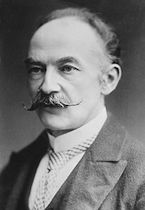
Time changes everything,” Hardy wrote about his willingness to try new things, “except something within us which is always surprised by change.”
Share A Writer’s Moment with a friend by clicking the g+1 button below.
June 1, 2016
Beauty in the plain speech of life
“I must go down to the sea again, to the lonely sea and the sky; and all I ask is a tall ship and a star to steer her by.” – John Masefield
Born on this date in 1878, English poet and writer John Masefield not only wrote the line that so many feel compelled to recite, but also “lived” on the sea, which compelled him to write it in the first place. Beginning at age 14, he was sent to the HMS Conway, both to train for a life at sea, and to break what his aunt (with whom he lived) called “an addiction to reading.” She thought he was wasting away his time with his nose buried in books and that time at sea would bring him back to reality. But, after several years aboard ship, Masefield found that he could spend even more time reading and writing, and his love for books and story telling grew. He listened to the stories told about the sea, continued to read, and ultimately became a great writer and storyteller himself.
He is best remembered as the author of the classic children's novels The Midnight Folk and The Box of Delights, and of course for his poems, including "The Everlasting Mercy" and "Sea-Fever,” from which the line above originates.
After years of writing and teaching writing, in 1930 he was the surprise selection for Poet Laureate of the United Kingdom. Many felt that Rudyard Kipling was a likely choice; but King George V appointed Masefield, who remained in office until his death in 1967. The only person to hold the office longer was Alfred, Lord Tennyson. John Masefield
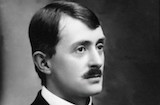
On his appointment The Timesof London wrote: "... his poetry could touch to beauty the plain speech of everyday life.” A renowned essayist and descriptive writer, too, Masefield’s “way with words” was never more evident than when asked to describe why he enjoyed university teaching. “There are few earthly things more beautiful than a university,” he said. “It is a place where those who hate ignorance may strive to know, and where those who perceive truth may strive to make others see.”
Share A Writer’s Moment with a friend by clicking g+1 below.
May 31, 2016
Exercising that 'writing muscle'
“Writing is a muscle that needs to be exercised every day: The more you write, the easier it becomes.” – Jane Green
A cancer survivor who now lives in Connecticut, Green was born in London on this date in 1968 and has become one of the world's leading authors in commercial women's fiction, with millions of books in print and translations in over 25 languages.
A journalist by training, she worked as a feature writer for several London-based newspapers, including The Daily Mail, before writing her first novel, Straight Talking, which went right to bestseller lists in 1995. Since then she’s had 15 additional bestsellers.
Frequent themes in her books include cooking, class wars, children, infidelity, and female friendship. She says she does not necessarily write about her own life, but is inspired by the themes of her life. She made the move from journalistic writing to creative writing with a unique writing regimen that sounds like a great plan to an old journalist like myself. “I treated my books as a very long journalistic exercise. I thought of every chapter as an article that needed to be finished (on a deadline).”

Her journalism training also taught her that writing is a job, and that you must write, whether you are inspired or not. “The only way to unlock creativity," she said, "is to write through it.”
Share A Writer’s Moment with a friend by clicking g+1 below.
May 30, 2016
A time to remember
 On Memorial Day, it’s fitting that we all take a few minutes to both remember loved ones who have died, and to show our appreciation to and remember those who risked their lives for the greater good of our nation. So many men and women went above and beyond to ensure that our country remains safe and free.
 I like this Memorial Day quote that relates, of course, to those who write.
“On Memorial Day, I don't want to only remember the combatants. There were also those who came out of the trenches to become writers and poets, who started preaching peace; men and women who have made this world a kinder place to live.” – Eric Burdon
Happy Memorial Day!
Share A Writer’s Moment with a friend by clicking g+1 below.
May 29, 2016
Exploring the power of words
“I think the reason I'm a writer is because first, I was a reader. I loved to read. I read a lot of adventure stories and mystery books, and I have wonderful memories of my mom reading picture books aloud to me. I learned that words are powerful.” – Andrew Clements
Born this date in 1949, Clements has written dozens of children's books, beginning with his novel Frindle, which won the award writers most care about – the award of favorable public opinion from those you hope will read your book. In Clements’ case, of course, that was school kids, who voted overwhelmingly that his book was the one they all liked best.
Not honored by the writing community at the time, it came back 20 years later to win the 2016 Phoenix Award as “the best book that did not win a major award when it was published in 1996.” Frindle gives us a different way to look at dictionaries and how words are developed and used, and also one of the most interesting explanations I’ve read:
“The dictionary is like a time capsule of all of human thinking ever since words began to be written down,” Clements said. “Exploring where words have come from can increase your understanding of the words themselves and expand your understanding of how to use the words.”
It’s Clements’ use of words that has set his writing at the forefront as far as kids – particularly“Tweens”
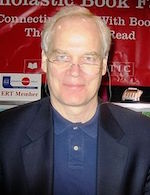 – are concerned. That, and his ability to “get into the personnas” that he is creating. For a terrific read (and don’t be embarrassed about reading a kids’ book), read his compelling Things Not Seen. It will open your eyes (no pun intended).
“Part of being a fiction writer is being able to imagine how someone else is thinking and feeling,” he said. “I think I've always been good at that.”
Share A Writer’s Moment with a friend by clicking the g+1 button below.
May 28, 2016
A thank you for the music
Daniel Grayling Fogelberg was born in 1951 in Peoria, IL, where his father was an established musician, teacher, and bandleader. His first instrument was the piano, but he gravitated to the guitar in high school and became one of the nation’s pre-eminent singer-songwriters during his lifetime. He died in 20007, living in Colorado, also my adopted state.
"Leader of the Band" is from his 1981 album The Innocent Age. The song was written as a tribute to his father, Lawrence Fogelberg, who was still alive at the time the song was released but died in 1982.
On this Memorial Day weekend it seemed fitting for Saturday’s Poem. Widely available in Fogelberg’s and other versions on YouTube, this one is from 2003: https://www.youtube.com/watch?v=lYFVEB4j6zI
And here are the words to
Leader of the BandBy Dan Fogelberg
An only child alone and wild, a cabinet maker's son
His hands were meant for different work
And his heart was known to none
He left his home and went his lone and solitary way
And he gave to me a gift I know I never can repay
A quiet man of music denied a simpler fate
He tried to be a soldier once, but his music wouldn't wait
He earned his love through discipline, a thundering velvet hand
His gentle means of sculpting souls took me years to understand
The leader of the band is tired and his eyes are growing old
But his blood runs through my instrument and his song is in my soul
My life has been a poor attempt to imitate the man
I'm just a living legacy to the leader of the band
My brother's lives were different for they heard another call
One went to Chicago and the other to St Paul
And I'm in Colorado when I'm not in some hotel
Living out this life I've chose and come to know so well
I thank you for the music and your stories of the road
I thank you for the freedom when it came my time to go
I thank you for the kindness and the times when you got tough
And papa, I don't think I said I love you near enough
The leader of the band is tired and his eyes are growing old
But his blood runs through my instrument and his song is in my soul
My life has been a poor attempt to imitate the man
I'm just a living legacy to the leader of the band
I am a living legacy to the leader of the band
Share A Writer’s Moment with a friend by clicking g+1 below.