
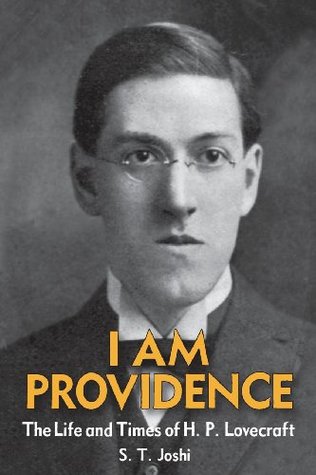
More on this book


Kindle Notes & Highlights
by
S.T. Joshi
Read between
October 19 - November 2, 2023

Lovecraft’s. He admits as much when he says: “Regarding the scheduled ‘Out of the Æons’—I should say I did have a hand in it . . . I wrote the damn thing!”[75]
realistic supernaturalism of Lovecraft’s
One other amateur task unexpectedly falling on Lovecraft’s lap was caused by the death on June 8, 1934, of the amateur Edith Miniter. Although Lovecraft had not met Miniter since 1928, he always retained respect for her and did not wish her role as amateur, novelist, and folklore authority to be forgotten. On September 10 he wrote an uninspired poetic elegy, “Edith Miniter” (published in Tryout in an issue—seriously delayed, clearly—dated August 1934), then, on October 16, wrote the much more significant prose memoir, “Edith Miniter—Estimates and Recollections.” Like “Some Notes on a
...more
In the summer of 1936 Lovecraft made an interesting admission: I used to be a hide-bound Tory simply for traditional and antiquarian reasons—and because I had never done any real thinking on civics and industry and the future. The depression—and its concomitant publicisation of industrial, financial, and governmental problems—jolted me out of my lethargy and led me to reëxamine the facts of history in the light of unsentimental scientific analysis; and it was not long before I realised what an ass I had been. The liberals at whom I used to laugh were the ones who were right—for they were
...more
Hoover was, however, not an evil man but merely a basically timid politician who did not realise the extraordinary difficulties into which the country had fallen and did not have the flexibility of imagination to propose radical solutions for them. Even Roosevelt was only just radical enough to advocate policies that kept the country from total economic collapse, and everyone knows that it was really World War II that pulled the United States and the world out of the depression.
As for prohibition, I was originally in favour of it, & would still be in favour of anything which could make intoxicating liquor actually difficult to get or retain. I see absolutely no good, & a vast amount of social harm, in the practice of alcohol drinking. It is clear, however, that under the existing governmental attitude (i.e., in the absence of a strong fascistic policy) prohibition can scarcely be enforced, & can scarcely be even imperfectly half-enforced, without an altogether disproportionate concentration of energy & resources—so that the repeal of the 18th amendment at this trying
...more
As for the Republicans—how can one regard seriously a frightened, greedy, nostalgic huddle of tradesmen and lucky idlers who shut their eyes to history and science, steel their emotions against decent human sympathy, cling to sordid and provincial ideals exalting sheer acquisitiveness and condoning artificial hardship for the non-materially-shrewd, dwell smugly and sentimentally in a distorted dream-cosmos of outmoded phrases and principles and attitudes based on the bygone agricultural-handicraft world, and revel in (consciously or unconsciously) mendacious assumptions (such as the notion
...more

One of my favorite HPL quotes.
The greatest peril to civilised progress—aside from an annihilative war—is some kind of basically reactionary system with enough grudging concessions to the dispossessed to make it really work after a fashion, and thus with the capacity to postpone indefinitely the demand of the masses for their real rights—educational, social, and economic—as human beings in a world where the great resources should be cornered by none. . . . Unsupervised capitalism is through. But various Nazi and fascist compromises can be cooked up to save the plutocrats most of their spoils while lulling the growing army
...more
Did Lovecraft really fancy that such a Utopia of a broadly educated populace that was willing or able to enjoy the aesthetic fruits of civilisation would actually come about? It certainly seems so; and yet, we cannot hold Lovecraft responsible for failing to predict either the spectacular recrudescence of capitalism in the generations following his own or the equally spectacular collapse of education that has produced a mass audience whose highest aesthetic experiences are pornography, television miniseries, and sporting events.
As it is, the chief contemporary novelist of the day, for Lovecraft, was neither American nor British but French—Marcel Proust. Although he never read more than the first two volumes in English (Swann’s Way and Within a Budding Grove) of Remembrance of Things Past, he nevertheless doubted that “the 20th century has so far produced anything to eclipse the Proustian cycle as a whole.”[57] Proust occupied the ideal middle ground between stodgy Victorianism and freakish modernism; and Lovecraft’s fondness for Derleth’s mainstream work rested in large part on his belief that it reflected that sense
...more
This surprises me.
“Generally speaking, the cinema always cheapens & degrades any literary material it gets hold of—especially anything in the least subtle or unusual.”[71] I believe that last utterance still carries a good deal of truth.
Although Lovecraft occasionally listened to the radio for news and liked to “fish” for distant channels for imaginative stimulation, he had little respect for radio shows as an art form, specifically horror programs. What the public consider “weirdness” in drama is rather pitiful or absurd—according to one’s perspective. As a thorough soporific I recommend the average popularly “horrible” play or cinema or radio dialogue. They are all the same—flat, hackneyed, synthetic, essentially atmosphereless jumbles of conventional shrieks and mutterings and superficial, mechanical situations.
Lovecraft does indeed seem to be among the most asexual individuals in human history, and I do not think this was a mere façade: certainly his letter to Sonia prior to his marriage (published as “Lovecraft on Love”) evokes only snickers today, and would probably have seemed extreme in its asceticism even in its own day; but there is every reason to believe that Lovecraft himself abided by its precepts, to the point that it surely became one (if only one) cause of his wife’s refusal to continue the marriage.
“Art, then, is really very important . . . though it abrogates its function and ceases to be art as soon as it becomes self-conscious, [or] puffed with illusions of cosmic significance, (as distinguished from local, human, emotional significance) . . .”[81] The distinction between cosmic and human significance is critical: we may not matter a whit to the cosmos, but we matter sufficiently to ourselves to fashion the fairest political and economic system that we can.
I think a passage like this, personal and even mystical in its way, gets closer to what Lovecraft was all about; for this is an honest and sincere exposure of his imaginative life, and—while there is nothing here that contradicts his general metaphysics and ethics—it humanises Lovecraft and shows that, beyond the cold rationalism of his intellect, he was a man whose emotions responded deeply to many of the varied phenomena of life. Persons may not have moved him—he may have genuinely loved no one in his life but his closest family members—but he felt intensely and profoundly many things that
...more
But, as we have seen earlier, Lovecraft in the course of time was forced to back down increasingly from his claims to the superiority of the Aryan (or Nordic or Teuton) over other groups aside from blacks and aborigines:
every other aspect of his thought—metaphysics, ethics, aesthetics, politics—Lovecraft was constantly digesting new information (even if only through newspaper reports, magazine articles, and other second-hand sources) and readjusting his views accordingly. Only on the issue of race did his thinking remain relatively static. He never realised that his beliefs had been largely shaped by parental and societal influence, early reading, and outmoded late nineteenth-century science. The mere fact that he had to defend his views so vigorously and argumentatively in letters—chiefly to younger
...more
And yet, ugly and unfortunate as Lovecraft’s racial views are, they do not materially affect the validity of the rest of his philosophical thought. They may well enter into a significant proportion of his fiction (miscegenation and fear of aliens are clearly at the centre of such tales as “The Lurking Fear,” “The Horror at Red Hook,” and “The Shadow over Innsmouth”), but I cannot see that they affect his metaphysical, ethical, aesthetic, or even his late political views in any meaningful way. These views do not stand or fall on racialist assumptions. I certainly have no desire to brush
...more
On racism
We know so much about the relationship between Conover and Lovecraft—which is, in all frankness, a fairly minor one in the totality of Lovecraft’s life, although clearly it was significant to Conover—not only because Lovecraft’s letters to him survive, but because of the volume Conover published in 1975 entitled Lovecraft at Last. This book is not only one of the finest examples of modern book design, but a poignant, even wrenching testimonial to the friendship between a middle-aged—and dying—man and a young boy who idolised him.
he did not write any original stories in the last six months of his life).
Leiber has testified frequently and eloquently to the importance of his brief but intense relationship with Lovecraft. Writing in 1958, he confessed: “Lovecraft is sometimes thought of as having been a lonely man. He made my life far less lonely, not only during the brief half year of our correspondence but during the twenty years after.”[39] Elsewhere he has even stated that Lovecraft was “the chiefest influence on my literary development after Shakespeare”[40]—a statement I shall want to examine more detailedly later. Here it can be said that Leiber is the one colleague of Lovecraft’s who
...more
About three months later he was telling Barlow: “I find my list has grown to 97 now—which surely calls for some pruning. . . . but how the hell can one get out of epistolary obligations without becoming snobbish & uncivil?”[43] No greater testimonial to Lovecraft’s flexibility of mind, openness to new information and new impressions, and gentlemanliness of behaviour is required than these two quotations. He was dying, but he was still seeking to learn and still adhering to the standards of civilised discourse.
As early as February 1936—three months after the writing of his last original tale, “The Haunter of the Dark,” and several months before the contretemps over his stories in Astounding—he was already admitting: [At the Mountains of Madness] was written in 1931—and its hostile reception by Wright and others to whom it was shewn probably did more than anything else to end my effective fictional career. The feeling that I had failed to crystallise the mood I was trying to crystallise robbed me in some subtle fashion of the ability to approach this kind of problem in the same way—or with the same
...more
In early January, however, Lovecraft admitted to feeling poorly—“grippe” and bum digestion, as he put it. By the end of the month he was typing his letters—always a bad sign.
Howard Phillips Lovecraft died early in the morning of March 15, 1937. He was pronounced dead at 7.15 A.M.
It took forty years for Lovecraft and his mother to receive separate headstones.
W. Paul Cook. Cook’s piece was an early version of his full-length memoir, In Memoriam: Howard Phillips Lovecraft: Recollections, Appreciations, Estimates (1941), which remains the finest memoir ever written about Lovecraft.
And yet thou art not gone Nor given wholly unto dream and dust: For, even upon This lonely western hill of Averoigne Thy flesh had never visited, I meet some wise and sentient wraith of thee, Some undeparting presence, gracious and august. More luminous for thee the vernal grass, More magically dark the Druid stone And in the mind thou art for ever shown As in a wizard glass; And from the spirit’s page thy runes can never pass.[5]
Also in 1945 the World Publishing Company issued Derleth’s compilation of Lovecraft’s Best Supernatural Stories.
I own an original edition of this book.
In 1945 Derleth published another volume, The Lurker at the Threshold—“by H. P. Lovecraft and August Derleth.” This volume is the first of his sixteen “posthumous collaborations” with Lovecraft, and opens up what is perhaps the most disreputable phase of Derleth’s activities: his promulgation of the “Cthulhu Mythos.”
It is not that de Camp violated the canons of “objectivity” by passing value judgments—this is the proper function of any biographer;
Interesting. Joshi certainly passes judgment in this biography.
There is no question that Lovecraft is now a figure in world literature, and is likely to remain there for some time.
Lovecraft is remarkable in continuing to appeal on both a scholarly and a popular level. One sign of the latter is the widespread distribution of a role-playing game, The Call of Cthulhu, first issued by Chaosium, Inc. in 1981 and continuing to the present day with many additions and modifications.
There will scarcely be anyone who will not disagree with one or the other component of Lovecraft’s philosophical thought. Some will be offended by his atheism; others by his “fascism”; others by his emphasis on cultural traditionalism; and so on. But few can deny that Lovecraft’s views were well conceived, modified by constant reading and observation, and sharpened by vigorous debates with correspondents. No one wishes to claim for Lovecraft a leading place among philosophers—he remained, by his own admission, a layman in this discipline. But he pondered philosophical issues more rigorously
...more
His philosophy.
It can scarcely be denied that cultural conservatism was a large factor in his racism. This is, without question, the one true black mark on his character; and it is so not because he was morally wrong (there might be some debate on this point) but intellectually wrong.
Where Lovecraft erred was in conceiving that his simple-minded stereotypes were the product of scientific study of racial distinctions and in believing that different races and cultures were unalterably opposed and could not mix without disaster. It is possible that the highly developed aesthetic sensibility I mentioned earlier—a sensibility that craved harmony and stability—had much to do with his racial theories, or at least had much to do with the sense of discomfort he felt around racial and cultural aliens; but whatever the case, his views on the subject are embarrassing and contemptible.
...more
What makes Lovecraft’s style so distinctive is its mingling of scientific precision and lush Poe-esque rhetoric. Whether
What is remarkable about Lovecraft is that, in spite of his prodigal invention of “gods” in his fiction, his is among the most secular temperaments in all human history. Religion has no place in his world view except as a sop to the ignorant and timid. The “gods” in his tales are symbols of all that lies unknown in the boundless cosmos, and the randomness with which they can intrude violently into our own realm is a poignant reflection of the tenuousness of our fleeting and inconsequential existence.
We are not the centre of the universe; we do not have a special relationship with God (because there is no God); we will vanish into oblivion upon our deaths. It is scarcely to be wondered that many readers and writers have been unable to endure these withering conceptions.
Lovecraft was, of course, an uneven writer, as all writers are. In the works of his first decade of fiction writing there are many mediocrities, some outright failures, and some genuine triumphs (“The Rats in the Walls” being perhaps the most notable of them). But in the last decade the triumphs far outweigh the failures and mediocrities. And yet, it is still remarkable that Lovecraft’s entire fictional corpus (exclusive of revisions) can be accommodated comfortably into three large volumes. No writer in the field of weird or science fiction, save Poe, has achieved such distinction and
...more
Of Lovecraft’s poetry little need be said. Even the best of it—the late verse, including Fungi from Yuggoth, “The Ancient Track,” “The Messenger,” and others—is only an adjunct to his fiction.
There is, finally, the very real possibility that Lovecraft’s letters will come to be recognised as his greatest literary and personal achievement. It is not simply the sheer quantity of letters he wrote (no more than 10% of which probably survive) that is important, but their intellectual breadth, rhetorical flourish, emotional intimacy, and unfailing courtesy that make them among the most remarkable literary documents of their time.
Agreed.
As one matures, one sees different things in Lovecraft the man and writer—the philosophical depth underlying the surface luridness of his work; the dignity, courtesy, and intellectual breadth of his temperament; his complex role in the political, economic, social, and cultural trends of his age. Perhaps it is useless, and foolish, to deny that Lovecraft is an oddity—neither he nor his work is “normal” in any conventional sense, and much of the fascination that continues to surround him resides exactly in this fact. But both his supporters and his detractors would do well to examine the facts
...more
