
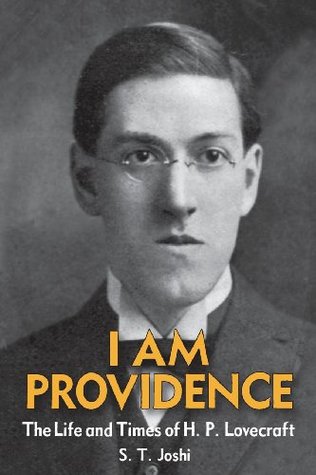
More on this book


Kindle Notes & Highlights
by
S.T. Joshi
Read between
October 19 - November 2, 2023

In 1929 Lovecraft made the following evaluation of the progression of his aesthetic thought: “I can look back . . . at two distinct periods of opinion whose foundations I have successively come to distrust—a period before 1919 or so, when the weight of classic authority unduly influenced me, and another period from 1919 to about 1925, when I placed too high a value on the elements of revolt, florid colour, and emotional extravagance or intensity.”[60] Simply put, these two phases (which would then be followed by a third and final phase combining the best features of both the previous two, and
...more
Specifically, Lovecraft was attempting to come to terms with certain findings in the sciences that might have grave effects upon artistic creation, in particular the work of Sigmund Freud. One of Lovecraft’s first references to Freud occurs only a week after his mother’s death: Dr. Sigmund Freud of Vienna, whose system of psycho-analysis I have begun to investigate, will probably prove the end of idealistic thought. In details, I think he has his limitations; and I am inclined to accept the modifications of Adler, who in placing the ego above the eros makes a scientific return to the position
...more
A somewhat more revealing statement occurs in “The Defence Reopens!” (January 1921): Certainly, they [Freud’s doctrines] reduce man’s boasted nobility to a hollowness woeful to contemplate. . . . we are forced to admit that the Freudians have in most respects excelled their predecessors, and that while many of Freud’s most important details may be erroneous—one should not be too hasty in substituting any single or simple instinct for the complex and dominant Wille zur Macht as the explanation of man’s motive force—he has nevertheless opened up a new path in psychology, devising a system whose
...more
The interesting thing is that Lovecraft’s new Decadent aesthetic fitted very well with a tendency he had long exhibited, and one that linked him significantly to the intelligentsia of his time: scorn of the nineteenth century. The little boy who had insensibly absorbed the prose and poetry of the Augustans and found only tedium in the great nineteenth-century authors (Dickens is despised for maudlin sentimentality, and Thackeray “induceth drowsiness”[63]) found himself entirely in sympathy with the repudiation of Victorianism that many of the poets and critics of the late nineteenth and early
...more
White’s article really is a piece of ham-fisted asininity,
An artist must always be a child . . . and live in dreams and wonder and moonlight. He must think of the lives and colours of things—of life itself—and never stop to pick the glittering fabric to pieces.
Poe’s beauty/truth distinction (beauty is the province of art, truth is the province of science)
Lovecraft’s other response to The Waste Land—the exquisite parody “Waste Paper: A Poem of Profound Insignificance”—merits much greater attention; for this is his best satiric poem.
Lovecraft’s reserved approach to Modernism might perhaps be thought to have been vindicated by time. To what degree, really, does modernist prose continue to be the guiding light of contemporary writing? While Lovecraft would probably have had even less sympathy with certain aspects of postmodernism, conventional narrative made a quick recovery after World War II; very few writers use stream-of-consciousness much anymore.
one wonders whether there has been any genuine poetry written at all after the death of Frost, Auden, and Robert Lowell. The fact that contemporary poetry has dropped utterly out of the intellectual lives of even well-educated people may suggest that Lovecraft’s warnings against too radical a departure from tradition may not have been entirely unsound.
I could not write about “ordinary people” because I am not in the least interested in them. Without interest there can be no art. Man’s relations to man do not captivate my fancy. It is man’s relation to the cosmos—to the unknown—which alone arouses in me the spark of creative imagination. The humanocentric pose is impossible to me, for I cannot acquire the primitive myopia which magnifies the earth and ignores the background. This is Lovecraft’s first explicit expression of the view he would later call “cosmicism.”
Cosmicism is at once a metaphysical position (an awareness of the vastness of the universe in both space and time), an ethical position (an awareness of the insignificance of human beings within the realm of the universe), and an aesthetic position (a literary expression of this insignificance, to be effected by the minimising of human character and the display of the titanic gulfs of space and time).
In so doing he evolved a metaphysical and ethical system not at all dissimilar to that of his two later philosophical mentors, Bertrand Russell and George Santayana.
Was this another visit of longer or shorter duration, as the two New York trips of 1922 had been? Not exactly. On March 3, at St Paul’s Chapel at Broadway and Vesey Streets in lower Manhattan, H. P. Lovecraft had married Sonia Haft Greene.
New York in 1924 was an extraordinary place. Far and away the largest city in the country, its five boroughs totalled (in 1926) 5,924,138 in population, of which Manhattan had 1,752,018 and Brooklyn (then and now the largest of the boroughs both in size and in population) had 2,308,631.
(Skyscrapers cannot be built everywhere in Manhattan, since the schist foundation is not uniform; there are strict regulations governing the height and size of buildings in every portion of the island.)
There is no question that, at least for the first few months, the euphoria both of his marriage and of his residence in the nation’s centre of publishing, finance, art, and general culture helped to ward off any doubts about the precipitancy of his departure from Providence. With a new wife, many friends, and even reasonably good job prospects Lovecraft had reason to believe that a promising new phase of his life was beginning.
It is as if Lovecraft is regarding the whole thing as a lark; and indeed, we will see increasing evidence that he was quite taken with the charm and novelty of being married but was simply not aware of the amount of effort it takes to make a marriage actually work. Lovecraft was, in all honesty, not emotionally mature enough for such an undertaking.
Sonia had, incidentally, declared that a civil service would have been quite sufficient, but Lovecraft insisted on a church wedding.

Surprising for an atheist such as HPL.
“Under the Pyramids” is quite an able piece of work, and it remains a much undervalued tale.
in what can only be a tart spoof of one of the most physically robust individuals of his day, he faints on three different occasions during the entire escapade.
Harry Houdini as depicted by HPL.
This is one of the most striking examples of a tendency we will see in much of Lovecraft’s later fiction—the implication that myths and legends are imperfectly preserved memories of real, but loathsome, events or entities.
It is a brutal fact that the overwhelming amount of material published in Weird Tales is, on the literary scale, complete rubbish, although this seems to matter little to those misguided souls who continue up to the present day to wax nostalgic about the magazine.
(Lovecraft had a violent antipathy to games and sports of any kind, feeling them an utter waste of time. In speaking years later of puzzles, he remarked to Morton: “After I solve the problems—if I do—I don’t know a cursed thing more about nature, history, and the universe than I did before.”[82]
I can relate. As an adult I dislike games. Unfortunately, nearly everyone in my social circle loves games, especially complicated board games with large amounts of rules. Funny how much of Lovecraft fandom is based around board and card games.
Frank Long provides a piquant glimpse at Lovecraft’s conduct at these meetings: Almost invariably . . . Howard did most of the talking, at least for the first ten or fifteen minutes. He would sink into an easy chair—he never seemed to feel at ease in a straight-backed chair on such occasions and I took care to keep an extremely comfortable one unoccupied until his arrival—and words would flow from him in a continuous stream. He never seemed to experience the slightest necessity to pause between words. There was no groping about for just the right term, no matter how recondite his conversation
...more
This may be as good a place as any to explore the question of Lovecraft’s voice, since several of Lovecraft’s New York colleagues have given us their impressions of it. I will later quote Hart Crane’s reference to Sonia’s “piping-voiced husband,” and there seems general consensus that his voice was indeed somewhat high-pitched. Sonia has the most detailed discussion: His voice was clear and resonant when he read or lectured but became thin and high-pitched in general conversation, and somewhat falsetto in its ring, but when reciting favorite poems he managed to keep his voice on an even keel
...more
His voice had that flat and slightly nasal quality that is sometimes stereotyped as a New England characteristic. When he laughed aloud, a harsh cackle emerged that reversed the impression of his smile and to the uninitiated might be considered a ham actor’s version of a hermit’s laughter. Companions avoided any attempt to achieve more than a smile in conversation with him, so unbecoming was the result.[113] One wonders on what occasion Talman heard Lovecraft laugh, since in 1934 Lovecraft himself declared that he had laughed out loud only once in the previous twenty years.[114]
Crane notes Loveman’s arrival in the city but says that he has not spent much time with him because he has been occupied with his many friends—“Miss Sonia Green [sic] and her piping-voiced husband, Howard Lovecraft,
The former “invalid” Lovecraft had already become famous for outwalking all his friends!
“The Shunned House” is a dense, richly textured story with convincing historical background and a fine sense of cumulative horror.
meeting at Trinity about noon, paying our respects to [Alexander] Hamilton’s grave,
Love the idea of Lovecraft and friends honoring Alexander Hamilton.
Lovecraft was much taken with Philadelphia: None of the crude, foreign hostility & underbreeding of New York—none of the vulgar trade spirit & plebeian hustle. A city of real American background—an integral & continuous outgrowth of a definite & aristocratic past instead of an Asiatic hell’s huddle of the world’s cowed, broken, inartistic, & unfit. What a poise—what a mellowness—what a character in the preponderantly Nordic faces![143]
There is scarcely a day in the entire year when Lovecraft did not meet with one or the other of his friends—either as they came over to his place or as they met at various cafeterias in Manhattan or Brooklyn or at the formal Wednesday meetings, which still alternated between McNeil and Leeds gatherings because of the ongoing unresolved dispute between these two individuals. So much for Lovecraft the “eccentric recluse”!
The final insult came on the morning of Sunday, May 24, when, while Lovecraft was sleeping on the couch after an all-night writing session, his dressing alcove was broken into from the connecting apartment and he was robbed of nearly all his suits, along with sundry other abstractions. The thieves had rented the adjoining apartment
The final poem, “The Cats” (February 15), is an entirely different proposition. This daemoniac six-stanza poem in quatrains is one of his most effective weird verses—a wild, uncontrolled spasm bringing out all the shuddersome mystery of the feline species: Legions of cats from the alleys nocturnal, Howling and lean in the glare of the moon, Screaming the future with mouthings infernal, Yelling the burden of Pluto’s red rune.
Another thing Lovecraft and Sonia liked to do was to attend movies. Probably she was more interested in this form of entertainment than he was, but on occasion Lovecraft could become genuinely enthusiastic about a film that suited his tastes, either antiquarian or horrific.
In September he reports seeing The Phantom of the Opera: . . . what a spectacle it was!! It was about a presence haunting the great Paris opera house . . . but developed so slowly that I actually fell asleep several times during the first part. Then the second part began—horror lifted its grisly visage—& I could not have been made drowsy by all the opiates under heaven! Ugh!!! The face that was revealed when the mask was pulled off . . . & the nameless legion of things that cloudily appeared beside & behind the owner of that face when the mob chased him into the river at the last![54]
Here, in essence, is the heart of the story; for “The Horror at Red Hook” is nothing but a shriek of rage and loathing at the “foreigners” who have taken New York away from the white people to whom it presumably belongs.
“The Horror at Red Hook” presents as good an opportunity as any for discussing the development (if it can be called that) of Lovecraft’s racial attitudes during this period. There is no question that his racism flared to greater heights at this time—at
I have already remarked that the seeming paradox of Lovecraft’s marrying a Jewess when he exhibited marked anti-Semitic traits is no paradox at all, for Sonia in his mind fulfilled his requirement that aliens assimilate themselves into the American population, as did other Jews such as Samuel Loveman.
Sonia speaks at length about Lovecraft’s attitudes on this subject. One of her most celebrated comments is as follows: “Although he once said he loved New York and that henceforth it would be his ‘adopted state’, I soon learned that he hated it and all its ‘alien hordes’. When I protested that I too was one of them, he’d tell me I ‘no longer belonged to these mongrels’. ‘You are now Mrs. H. P. Lovecraft of 598 Angell St., Providence, Rhode Island!’”
A later remark is still more telling: “Soon after we were married he told me that whenever we have company he would appreciate it if there were ‘Aryans’ in the majority.”[67]
Sonia claims that part of her desire to have Lovecraft and Loveman meet in 1922 was to “cure” Lovecraft of his bias against Jews by actually meeting one face to face. She continues: Unfortunately, one often judges a whole people by the character of the first ones he meets. But H. P. assured me that he was quite “cured”; that since I was so well assimilated into the American way of life and the American scene he felt sure our marriage would be a success. But unfortunately (and here I must speak of something I never intended to have publicly known), whenever he would meet crowds of people—in the
...more
it seems clear to me that Lovecraft may have at least considered taking more forceful action against foreigners than merely fulminating against them in letters, as a startling remark made six years later attests: “The population [of New York City] is a mongrel herd with repulsive Mongoloid Jews in the visible majority, and the coarse faces and bad manners eventually come to wear on one so unbearably that one feels like punching every god damn bastard in sight.”[75]
Possibly the most hateful, vile thing he ever wrote.
And if the above description sounds autobiographical, it is by design; for “He,” while much superior to “The Horror at Red Hook,” is as heart-wrenching a cry of despair as its predecessor—quite avowedly so. Its opening is celebrated: I saw him on a sleepless night when I was walking desperately to save my soul and my vision. My coming to New York had been a mistake; for whereas I had looked for poignant wonder and inspiration in the teeming labyrinths of ancient streets that twist endlessly from forgotten courts and squares and waterfronts to courts and squares and waterfronts equally
...more
he had noted when refusing the offer to edit Weird Tales in Chicago, “it is colonial atmosphere which supplies my very breath of life.”[103]
his greatest achievement, perhaps, was to designate Machen, Dunsany, Blackwood, and M. R. James as the four “modern masters” of the weird tale; a judgment that, in spite of the carpings of Edmund Wilson and others, has been justified by subsequent scholarship. Indeed, the only “master” lacking from this list is Lovecraft himself.
It so happens that I am unable to take pleasure or interest in anything but a mental re-creation of other & better days—for in sooth, I see no possibility of ever encountering a really congenial milieu or living among civilised people with old Yankee historic memories again—so in order to avoid the madness which leads to violence & suicide I must cling to the few shreds of old days & old ways which are left to me. Therefore no one need expect me to discard the ponderous furniture & paintings & clocks & books which help to keep 454 always in my dreams. When they go, I shall go, for they are all
...more
“I am essentially a recluse who will have very little to do with people wherever he may be,” and then, in words both poignant and a little sad, made a plea for residing in Providence: To all intents & purposes I am more naturally isolated from mankind than Nathaniel Hawthorne himself, who dwelt alone in the midst of crowds, & whom Salem knew only after he died. Therefore, it may be taken as axiomatic that the people of a place matter absolutely nothing to me except as components of the general landscape & scenery. . . . My life lies not among people but among scenes—my local affections are not
...more
elsewhere in this same letter, while defending marriage as an institution, he virtually ruled it out for himself: . . . I’ve no fault to find with the institution, but think the chances of success for a strongly individualised, opinionated, and imaginative person are damn slender. It’s a hundred to one shot that any four or five consecutive plunges he might make would turn out to be flivvers equally oppressive to himself and to his fellow-victim, so if he’s a wise guy he “lays off” after the collapse of venture #1 . . . or if he’s very wise he avoids even that! Matrimony may be more or less
...more
