
David Allen Sibley's Blog, page 6
July 8, 2015
A very young sandpiper
This image is for sale in an auction here Identification of downy young sandpipers can be a real challenge in the arctic, where multiple species occur, but I saw and sketched this one on Great Gull Island, New York, last weekend. At that latitude only a few other species are possible, and most are easily eliminated […]
The post A very young sandpiper appeared first on Sibley Guides.


July 3, 2015
Juvenile chickadees
The artwork shown here is available for sale, click here to view current auctions After being nearly invisible for weeks, the local chickadees here in Massachusetts are suddenly everywhere. This is their typical pattern, and it’s common to many species. Nesting pairs become very quiet and secretive while they have eggs and young in the […]
The post Juvenile chickadees appeared first on Sibley Guides.
July 1, 2015
‘Tis the season for baby birds
Birds are busy this time of year, trying to raise a family (or two or three) and then get ready for fall migration, and it all goes so fast. The young birds are full-grown just a few weeks after they hatch, and the opportunity to see them at these early stages are limited. In one […]
The post ‘Tis the season for baby birds appeared first on Sibley Guides.
May 28, 2015
An interesting warbler
On my usual birding circuit on the morning of 26 May 2015, along the Assabet River in Concord, MA, I heard the distinctive song of a Mourning Warbler. This species is a rare but regular migrant through the area, so finding one is a highlight any day, and I set to work to try to […]
The post An interesting warbler appeared first on Sibley Guides.
April 21, 2015
Finding hawks by watching doves
No matter how serious you are about birding, or how much you want to see hawks, a Mourning Dove will always have a stronger interest in spotting them. Birds that are in mortal danger of hawk attacks have excellent eyesight and are constantly alert to any potential threat. It’s a safe bet that they will spot […]
The post Finding hawks by watching doves appeared first on Sibley Guides.
April 20, 2015
Quiz on estimating numbers – flocks in flight
Clicking on any image will open the full size image in a new window, so you can study the larger size and then return to the quiz – still in progress – in this window. Thanks to Martin Reid for allowing the use of his photos (and for counting the birds in each one!).
The post Quiz on estimating numbers – flocks in flight appeared first on Sibley Guides.
April 16, 2015
The mysterious sounds of the American Woodcock
Download a free one-page guide to American Woodcock display The flight display of the male American Woodcock has to be one of the most remarkable avian performances in the world. And yet, despite the fact that countless ornithologists and birders have marveled at this spring spectacle, some very basic questions are still unanswered, including this […]
The post The mysterious sounds of the American Woodcock appeared first on Sibley Guides.
April 3, 2015
A quiz on dabbling ducks
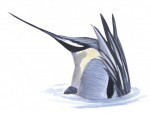 Below are six ducks in a typical foraging posture, with their heads underwater. See if you can identify the species by their back ends. (All paintings by David Sibley)
Duck ends
Please wait while the activity loads. If this activity does not load, try refreshing your browser. Also, this page requires javascript. Please visit using a browser with javascript enabled.
If loading fails, click here to try again
Question 1
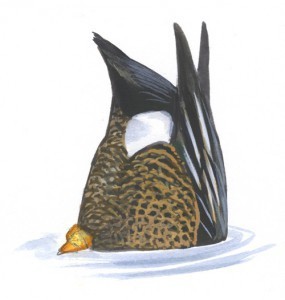 ABlue-winged TealBGreen-winged TealCMallardDNorthern ShovelerEAmerican WigeonQuestion 2
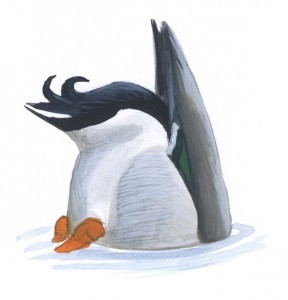 AMallardBNorthern ShovelerCAmerican WigeonDNorthern PintailEGreen-winged TealQuestion 3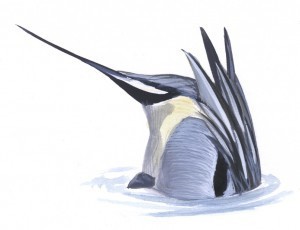
AGadwallBBlue-winged TealCNorthern PintailDLong-tailed DuckEMallardQuestion 4
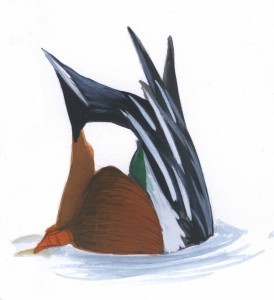 AGreen-winged TealBNorthern ShovelerCMallardDBlue-winged TealEAmerican WigeonQuestion 5
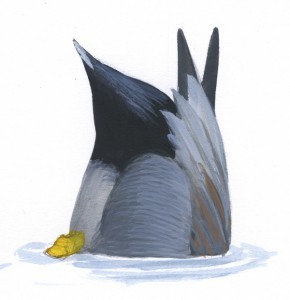 AMallardBGadwallCGreen-winged TealDAmerican Black DuckEAmerican WigeonQuestion 6
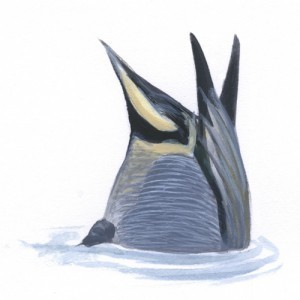 AAmerican WigeonBGadwallCMallardDGreen-winged TealEBlue-winged Teal
 There are 6 questions to complete.
You have completed
questions
question
Your score is
Correct
Wrong
Partial-Credit
You have not finished your quiz. If you leave this page, your progress will be lost.
Correct Answer
You Selected
Not Attempted
Final Score on Quiz
Attempted Questions Correct
Attempted Questions Wrong
Questions Not Attempted
Total Questions on Quiz
Question Details
Results
Date
Score
Hint
Time allowed
minutes
seconds
Time used
Answer Choice(s) Selected
Question Text
All doneNeed more practice!Keep trying!Not bad!Good work!Perfect!
April 2, 2015
Comparing the songs of Willet subspecies
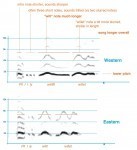 The Eastern and Western subspecies of Willet are often mentioned as likely candidates for splitting into two species. They differ in size, proportions, details of plumage, migration pattern, and have no overlap in breeding range and very little in winter range. There is a lot of good information in print about how to identify them visually, but very little about how to distinguish them by sound.
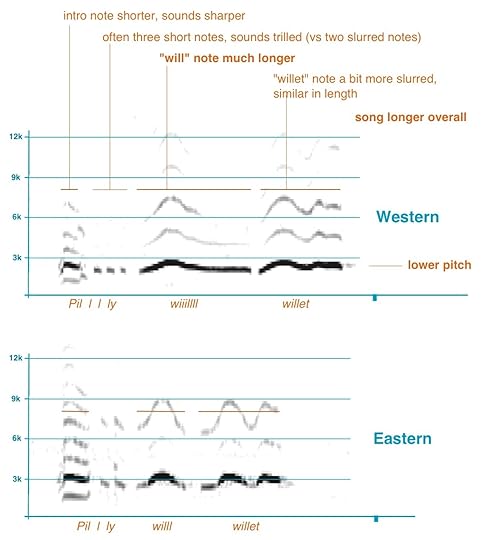
The sonagrams below compare the territorial display songs of Western (upper) and Eastern (lower). Differences are obvious in the sonagram and can easily be heard in the recordings linked below.
The song of Western is longer overall, and a little lower-pitched. The difference that is easiest to hear seems to be the length of the “will” phrase in the middle of the song. In Western birds this is much longer, easily determined to be the longest single phrase of the song, while in Eastern birds this phrase is slightly shorter than the final “willet” phrase.
This makes the western song sound slower and more relaxed overall, while the eastern song sounds rushed.
Of course, the only place you are likely to hear these sounds is on the breeding grounds, where the two are easily and reliably identified by range, but it does add more weight to the idea that these are two species.
March 30, 2015
Why are they called goatsuckers?
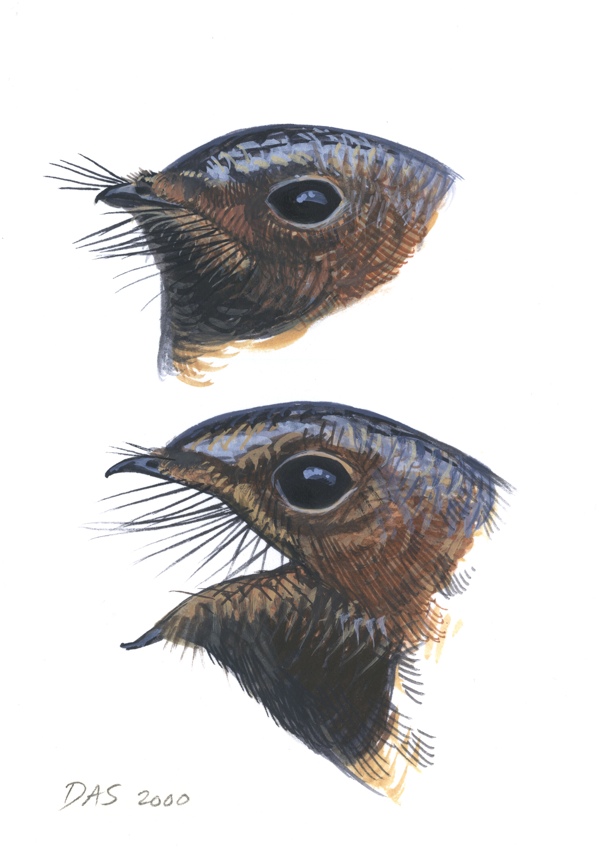
Eastern Whip-poor-will head. Original gouache painting © David Sibley, published in the Sibley Guide to Bird Life and Behavior 2001
Birds in the family Caprimulgidae, which includes Eastern Whip-poor-will (shown here), have been referred to as “goatsuckers” based on a superstition that goes back well over 2000 years. They all have tiny beaks that open to reveal an impressively large mouth used to catch flying insects, and they are active mainly at night. Their nocturnal habits made them mysterious, and their bizarre appearance required an explanation, and as early as the 300s BC Aristotle wrote about the trouble these birds could cause with goats. Four hundred years later not much had changed, and in 77 AD Pliny passed along the prevailing wisdom:
The Caprimulgi (so called of milking goats) are like the bigger kind of Owsels [Thrush]. They bee night-theeves; for all the day long they see not. Their manner is to come into the sheepeheards coats and goat-pens, and to the goats udders presently they goe, and suck the milke at their teats. And looke what udder is so milked, it giveth no more milke, but misliketh and falleth away afterwards, and the goats become blind withall. (from the 1601 translation)
Ernie Choate’s entertaining 1973 book – The Dictionary of American Bird Names – includes another quote from Pliny:
When I was in Switzerland I saw an aged man, who fed his goats upon the mountain, which I had gone up in search for plants: I asked him whether he knew of a bird the size of a Merula [Eurasian Blackbird], blind in the day-time, keen of sight at night, which in the dark is wont to suck goats udders, so that afterwards the animals go blind. Now he replied… that he had suffered many losses from those very birds; so that he had once had six she-goats blinded…. But possibly that aged man was jesting with me.
It’s not clear how many people ever believed this. It sounds like Pliny may have had some doubts, and the superstition faded away centuries ago. We still use the name but the “goatsuckers” eat nothing but flying insects and have no interest in, or effect on, goats.
David Allen Sibley's Blog

- David Allen Sibley's profile
- 151 followers

