
Greg Ross's Blog, page 11
September 1, 2025
Second Senses
Entries from the Complete Uxbridge English Dictionary:
beehive: what Australian teachers tell you to do
blistering: someone you enjoy calling on the phone
cannelloni: Scots refusal to give one an overdraft
cherish: rather like a chair
colliery: sort of like a collie but even more so
emboss: to promote to the top
female: chemical name for Iron Man
flatulence: an emergency vehicle that picks you up after you have been run over by a steamroller
Icelander: to tell lies about Apple
ivy: the Roman for four
lamb shank: Sean Connery’s sheep has drowned
laundress: grass skirt
pastrami: the art of meat folding
quick: noise made by a New Zealand duck
splint: to run very fast with a broken leg
Venezuela: a gondola with a harpoon
wisteria: a nostalgic form of panic
xylophone: the Greek goddess of Scrabble
A foible is “something coughed up by a New York cat.”


August 30, 2025
Retro Cinema
The 1984 action comedy Top Secret! contains an odd sequence set in a Swedish bookstore. Val Kilmer, Lucy Gutteridge, and Peter Cushing acted the entire scene backward, and the filmmakers then reversed this performance to produce a dreamlike atmosphere in which impossible things happen.
The scene required 17 takes and four dogs, co-director Jim Abrahams told ScreenCrush. “Each dog stopped being hungry.”
August 29, 2025
A Pretty Find
Write the word CESAROLITE in a circle and then trace out the letters in its anagram ESOTERICAL — the result is a perfect 10-pointed star:
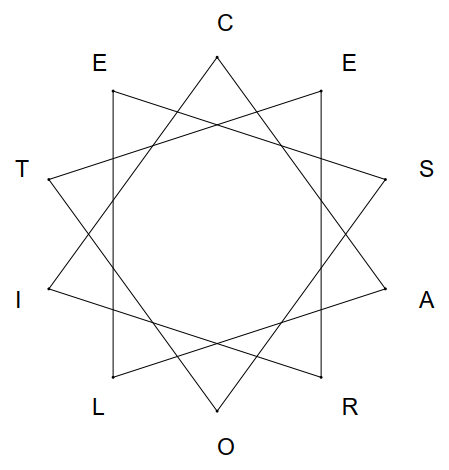 Image: RMM
Only 5.7 percent of anagrams in English are “maximally shuffled,” meaning that no letter retains its original neighbors. And even those rarely produce such pleasing symmetry when they’re diagramed like this. This is the largest “perfect” star anagram found in a systematic search by Jason Parker and Dan Barker; for more, see the link below.
(Jason Parker and Dan Barker, “Star Anagram Detection and Classification,” Recreational Mathematics Magazine 12:20 [June 2025], 19-40.)
“In Memoriam: Dizzy Gillespie and Rudolf Nureyev”
So. Farewell
Then
Dizzy Gillespie
Famous jazz
Trumpeter.
You were known
For your
Bulging cheeks.
Rudolf Nureyev
So were
You.
— E.J. Thribb
August 28, 2025
The Positivist Calendar
In 1849, to serve as “an introduction to the abstract worship of Humanity,” Auguste Comte proposed a new calendar with 13 months of 28 days. A festival day commemorating the dead brought the total to 365 days, but the extra day fell outside the regular cycle of days of the week, so the first of each month always fell on a Monday. Months were named after great figures in the history of Western Europe:
MosesHomerAristotleArchimedesCaesarSaint PaulCharlemagneDanteGutenbergShakespeareDescartesFrederickBichatTo keep things on track, leap years added a second festival day, commemorating holy women. The calendar “contains the names of 558 great men of all periods, classified according to their field of activity,” and villains of history, notably Napoleon, were held up to “perpetual execration.”
The scheme has a pleasing mathematical tidiness: Each year contains exactly 52 weeks falling into 13 months, and each month has exactly 28 days comprising four weeks. The whole thing remains consistent from year to year — if you were born on a Wednesday, your birthday would always fall on a Wednesday. And since all months contain the same number of business days and weekends, statistical comparisons by month are more accurate.
It never caught on, in part because of those month names. Science writer Duncan Steel notes that “it would seem strange to give the date as the third day of Homer, and with a month named for the bard a reference to ‘Shakespeare’s Twelfth Night’ would be ambiguous.”
The Three Utilities Problem
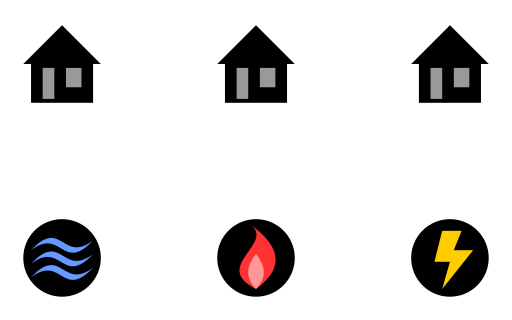 Image: Wikimedia Commons
Each of three houses must receive water, gas, and electricity. Is it possible to arrange the connections so that no lines cross?
No, it ain’t. Remove one house and draw connections to the other two:
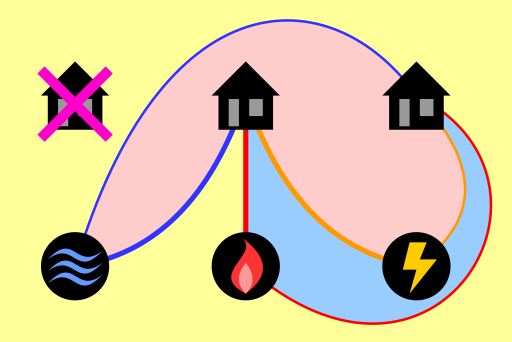 Image: Wikimedia Commons
This divides the plane into three regions, here colored red, yellow, and blue. Placing the third house into any of these regions denies it access to the correspondingly colored utility. So the task is impossible.
Pleasingly, the task can be accomplished on a Möbius strip:
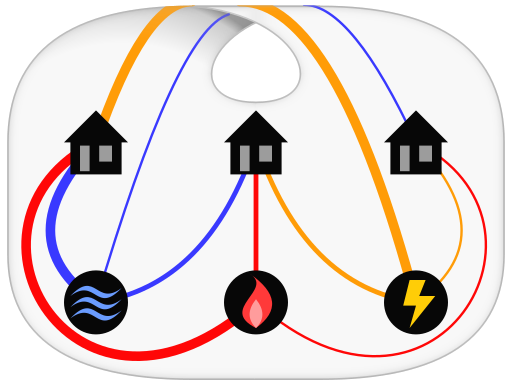 Image: Wikimedia Commons
And a torus can accommodate four houses and four utilities:
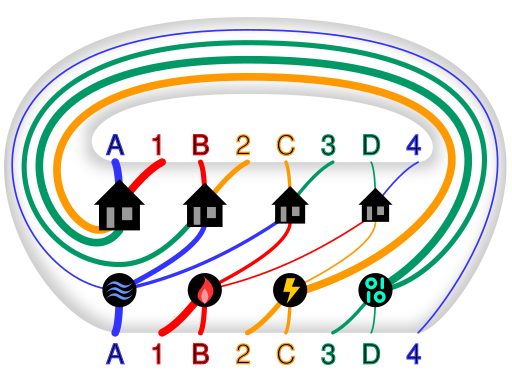 Image: Wikimedia Commons
(By Wikimedia user CMG Lee.)
August 27, 2025
Quickie
What’s the final digit in the product of all the odd numbers from 1 to 99?
5.
Commemoration
Working in the Indian Medical Service in 1897, British physician Ronald Ross discovered a malarial parasite in the gastrointestinal tract of a mosquito, proving that these insects transmitted the disease. He sent a poem to his wife that’s now inscribed on a monument in Kolkata:
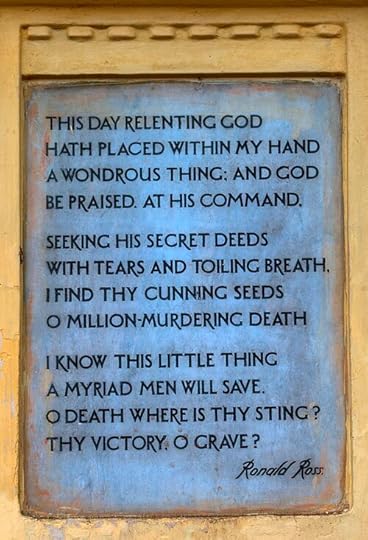 Image: Wikimedia Commons
He won the Nobel Prize for Physiology or Medicine in 1902, the first British Nobel laureate.
August 26, 2025
A Magnet Motor
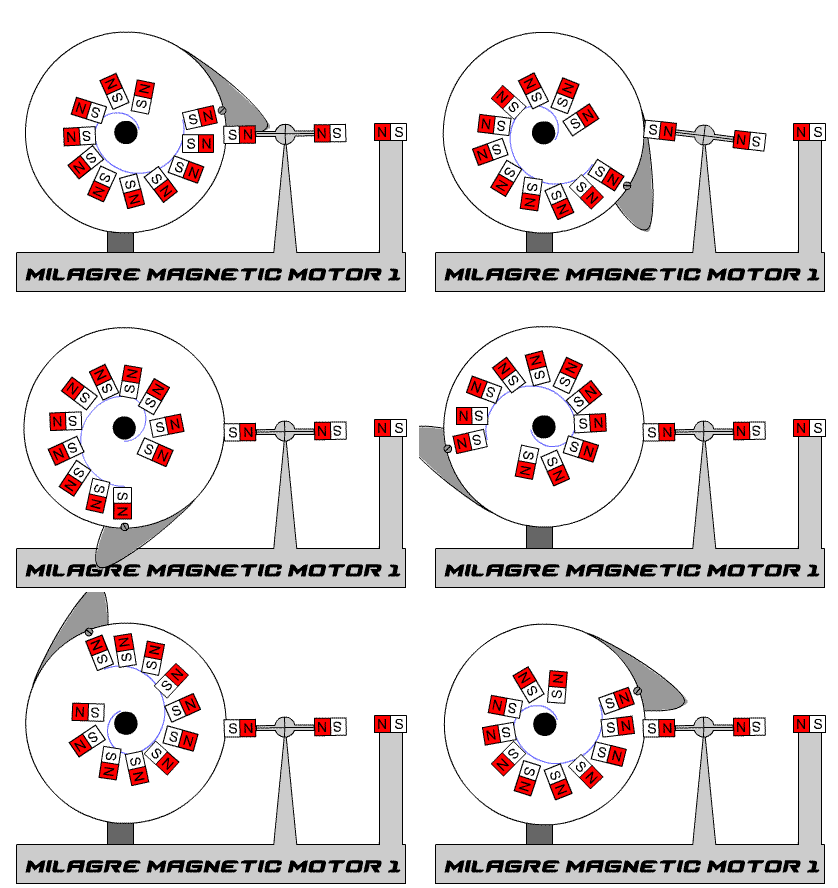
This is clever — a perpetual motion machine driven by magnets.
Unfortunately, such a machine simply doesn’t work — without an external energy supply, it quickly stops moving.
Olbers’ Paradox
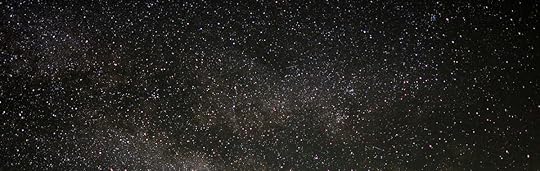
Why is the night sky dark? If the universe is static and infinitely old, with an infinite number of stars distributed homogeneously in an infinitely large space, then, whatever direction we look in the night sky, our line of sight should end at a star. The sky should be filled with light.
This puzzle is most often associated with the German astronomer Heinrich Wilhelm Olbers, but Edgar Allan Poe made a strikingly similar observation in his 1848 prose poem Eureka:
Were the succession of stars endless, then the background of the sky would present us a uniform luminosity, like that displayed by the Galaxy — since there could be absolutely no point, in all that background, at which would not exist a star.
Poe suggested that the universe isn’t infinitely old: “The only mode, therefore, in which, under such a state of affairs, we could comprehend the voids which our telescopes find in innumerable directions, would be by supposing the distance of the invisible background so immense that no ray from it has yet been able to reach us at all.” We now know that the sky is dark because the universe is expanding, which increases the wavelength of visible light until it appears dark to our eyes.



_of_Ronald_Ross_Memorial,_Kolkata.jpg)