Greg Ross's Blog, page 10
September 7, 2025
The Münchhausen Trilemma
Commonly we demonstrate the truth of a proposition by providing proof. But our doubter might then turn his skepticism on the proof in its turn. It seems there are only three ways to reach the end of the business:
by a circular argument, in which the proof of a proposition presupposes its truthby a regressive argument, in which each proof requires a further proof, and so on foreverby a dogmatic argument, in which precepts are asserted rather than defendedThis is called the Münchhausen trilemma after Baron Münchhausen, who tried to lift himself and his horse out of a mire by pulling on his own hair. Any attempt to justify knowledge must start from a position of ignorance. Without firm ground to stand on, it seems, there’s no way to “bootstrap” ourselves into confident assertions.


The Math of Christmas
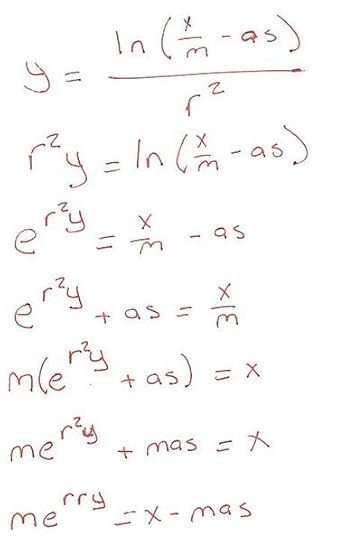
I know this is early, but I just bumbled into it on the Wikimedia Commons (by user GB fan):
September 5, 2025
Unquote
“In science one tries to tell people, in such a way as to be understood by everyone, something that no one ever knew before. But in the case of poetry, it’s the exact opposite!” — Paul Dirac
Translation Table
“A Glossary for Research Reports,” by C.D. Graham Jr., from Metal Progress, May 1957:
It has long been known that … I haven’t bothered to look up the original reference … of great theoretical and practical importance … interesting to me While it has not been possible to provide definite answers to these questions … The experiments didn’t work out, but I figured I could at least get a publication out of it The W-Pb system was chosen as especially suitable to show the predicted behaviour … The fellow in the next lab had some already made up High-purity …Very high purity …
Extremely high purity …
Super-purity …
Spectroscopically pure … Composition unknown except for the exaggerated claims of the supplier A fiducial reference line … A scratch Three of the samples were chosen for detailed study … The results on the others didn’t make sense and were ignored … accidentally strained during mounting … dropped on the floor … handled with extreme care throughout the experiments … not dropped on the floor Typical results are shown … The best results are shown Although some detail has been lost in reproduction, it is clear from the original micrograph that … It is impossible to tell from the micrograph Presumably at longer times … I didn’t take time to find out The agreement with the predicted curve is excellent … fair … good … poor … satisfactory … doubtful … fair … imaginary … as good as could be expected … non-existent These results will be reported at a later date I might possibly get around to this sometime The most reliable values are those of Jones He was a student of mine It is suggested that …
It is believed that …
It may be that … I think It is generally believed that … A couple of other guys think so too It might be argued that … I have such a good answer to this objection that I shall now raise it It is clear that much additional work will be required before a complete understanding … I don’t understand it Unfortunately, a quantitative theory to account for these effects has not been formulated Neither does anybody else Correct within an order of magnitude Wrong It is to be hoped that this work will stimulate further work in the field This paper isn’t very good, but neither are any of the others in this miserable subject Thanks are due to Joe Glotz for assistance with the experiments and to John Doe for valuable discussions Glotz did the work and Doe explained what it meant
See Progress.
September 4, 2025
In a Word
zetetic
adj. proceeding by inquiry
astucious
adj. subtle; cunning; astute
consectary
adj. following logically
‘Who did you pass on the road?’ the King went on, holding out his hand to the Messenger for some more hay.
‘Nobody,’ said the Messenger.
‘Quite right,’ said the King: ‘this young lady saw him too. So of course Nobody walks slower than you.’
‘I do my best,’ the Messenger said in a sulky tone. ‘I’m sure nobody walks much faster than I do!’
‘He can’t do that,’ said the King, ‘or else he’d have been here first.’
— Lewis Carroll, Through the Looking-Glass, 1871
A Second Try
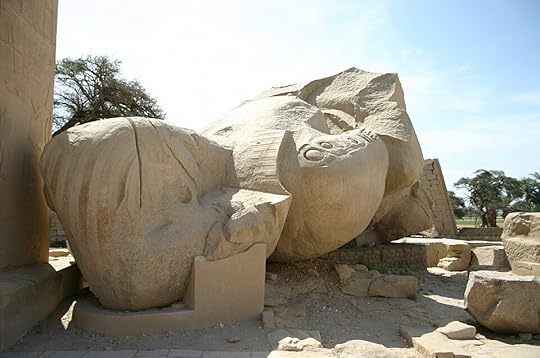 Image: Wikimedia Commons
In a 1977 letter to Nature, University of Malaya geologist N.S. Haile observed the poor quality of an 1818 paper by one P.B. Shelley and presented this improvement:
Twin limb-like basalt columns (‘trunkless legs’) near Wadi Al-Fazar, and their relationship to plate tectonics
Ibn Batuta and P.B. Shelley
In a recent field trip to north Hadhramaut, the first author observed two stone leg-like columns 14.7 m high by 1.8 m in diameter (medium vast, ASTM grade scale for trunkless legs) rising from sandy desert 12.5 km southwest of Wadi Al-Fazar (Grid 474 753). The rock is a tholeiitic basalt (table 1); 45 analyses by neutron activation technique show that it is much the same as any other tholeiitic basalt (table 2). A large boulder 6 m southeast of the columns has been identified as of the ‘shattered visage’ type according to the classification of Pettijohn (1948, page 72). Granulometric analysis of the surrounding sand shows it to be a multimodal leptokurtic slightly positively skewed fine sand with a slight but persistent smell of camel dung. Four hundred and seventy two scanning electron photomicrographs were taken of sand grains and 40 are reproduced here; it is obvious from a glance that the grains have been derived from pre-cambrian anorthosite and have undergone four major glaciations, two subductions, and a prolonged dry spell. One grain shows unique lozenge-shaped impact pits and heart-like etching patterns which prove that it spent some time in upstate New York.
There is no particular reason to suppose that the columns do not mark the site of a former hotspot, mantle plume, triple junction, transform fault, or abduction zone (or perhaps all of these).
Haile added, “I pass this on in the hope that it will be of value to authors in preparing papers for publication.”
September 3, 2025
Doubly True
Leonard J. Gordon discovered this remarkable cryptarithm in 1990 — each letter corresponds to a digit:
NINE × FOUR + FIVE = FORTYONE
9895 × 3074 + 3865 = 30421095
(Leonard J. Gordon, “Literary Cryptarithmetic by Computer,” Word Ways 23:2 [May 1990], 67-70.)
Turnabout
-ESS changes POET to POETESS, -ETTE changes BACHELOR to BACHELORETTE, -INA changes CZAR to CZARINA, and -INE changes HERO to HEROINE. What suffix changes a word from feminine to masculine?
-ER changes WIDOW to WIDOWER.
September 2, 2025
In Other Words
Lexicon Recentis Latinitas, published by the Vatican, invents Latin versions of modern words and phrases, so students can refer to items that didn’t exist in the ancient world:
bestseller: liber maxime divenditus
car wash: autocinetorum lavatrix
Christmas tree: arbor natalicia
disc brakes: sufflamen disci forma
dishwasher: escariorum lavator
to flirt: lusorie amare
leased property: locatio in emptionem convertibilis
pinball machine: sphaeriludium electricum nomismate actum
refrigerator: cella frigorifera
to slack off on the job: neglegenter operor
television: instrumentum televisificum
traffic jam: fluxus interclusio
washing machine: machina linteorum lavatoria
These examples are from a selection published in 1991 in Harper’s, which said that 75 percent of the 18,000 entries in that year’s edition were terms that had never had Latin equivalents. I can’t find the whole book, but the Vatican website offers an Italian-Latin glossary with some entries in English (hot pants are brevíssimae bracae femíneae).
Black and White
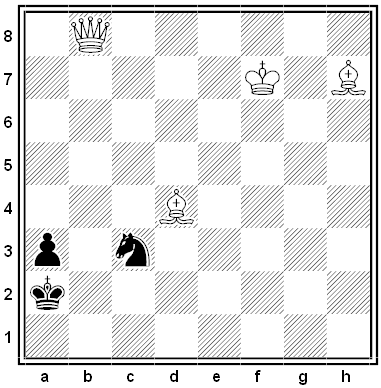
By Edgar Holladay, British Chess Magazine, 1978. White to mate in two moves.
1. Kg7!, waiting:
1. … Ka1 2. Qb1#
1. … Nb5 2. Qg8#
1. … Ne4 2. Bg8#
Note that the king can’t choose any other square. The eighth rank must remain free for the queen; e7 and f6 are vulnerable to knight checks; 1. Ke6 would block the queen’s check in the second variation; and 1. Kg6 would block the bishop’s diagonal in the first and second.