Greg Ross's Blog, page 2
November 17, 2025
Roundabout
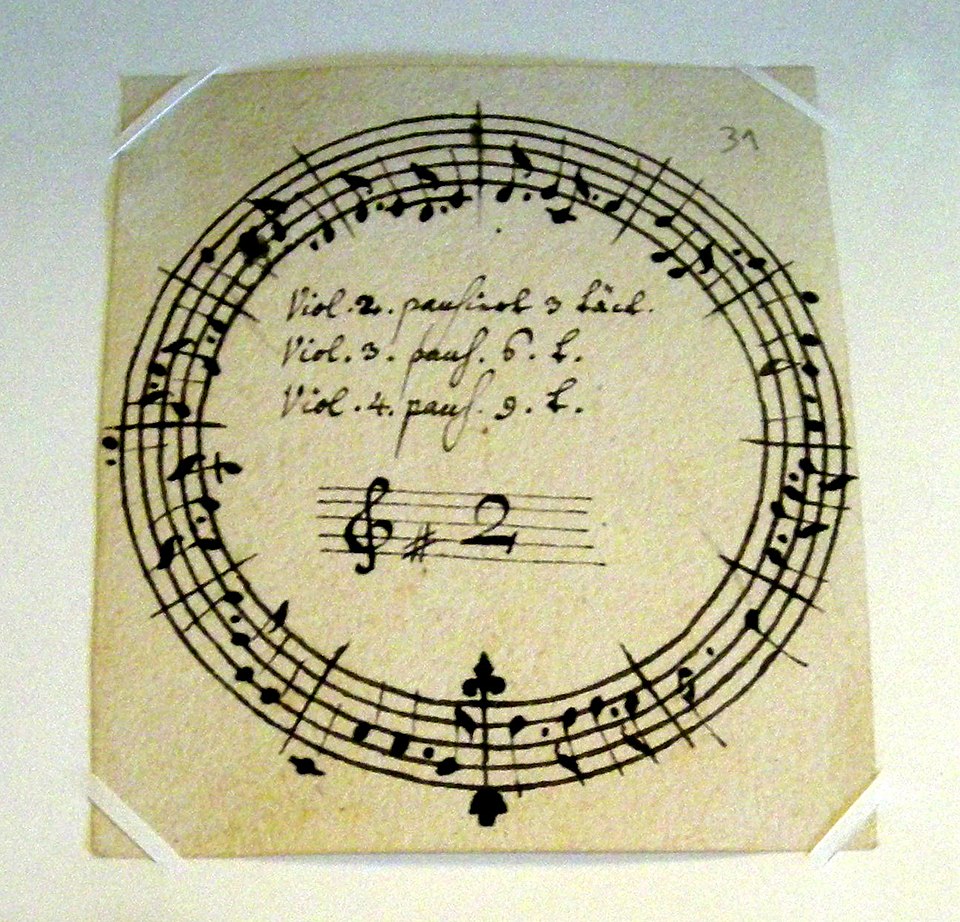
Alsatian pastor J.G. Stuber composed this puzzle canon in the late 18th century.
“It was always a great delight to me, in riding my horse from one village to another, to hear in the fields and among the heights the melodies which I had taught,” he wrote. “I could often distinguish very beautiful and harmonious voices.”


November 16, 2025
Home Again
As Governor of Mauritius, [Theodore] Hook ruled for five years before being accused of embezzling 12,000 pounds of public funds. He was dismissed from his post and returned to England, where he told friends that his dismissal was ‘on account of a disorder in my chest.’
— Victor Margolin, “The Pun Is Mightier Than the Sword: A Short History of Paronomasia,” Verbatim, Summer 1980
All the Way Down

The infinite series 1/4 + 1/16 + 1/64 + 1/256 + … was one of the first to be summed in the history of mathematics; Archimedes had found by 200 BC that it totals 1/3. There are two neat visual demonstrations that make this fact immediately apparent. In the unit square above, the largest black square has area 1/4, the next-largest black square has area 1/16, and so on. Regions of black, white, and gray make up equal areas in the total figure, so the black squares, taken together, must have area 1/3.
The same argument can be made using triangles (below). If the area of the largest triangle is 1, then the largest black triangle has area 1/4, the next-largest 1/16, and so on. Areas of black, white, and gray make up equal parts of the total figure, so the black regions must total 1/3.
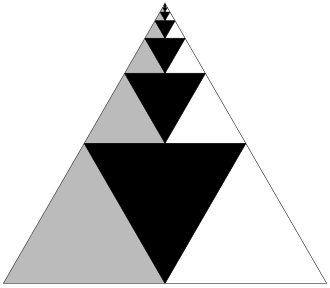 Image: Wikimedia Commons
November 15, 2025
Briefly
Asked whether he could summarize the lessons of history in a short book, Columbia historian Charles Beard said he could do it in four sentences:
Whom the gods would destroy, they first make mad with power.The mills of God grind slowly, but they grind exceeding small.The bee fertilizes the flower it robs.When it is dark enough, you can see the stars.Misc

“No general proposition is worth a damn.” — Oliver Wendell Holmes Jr. (a general proposition)
November 14, 2025
In a Word
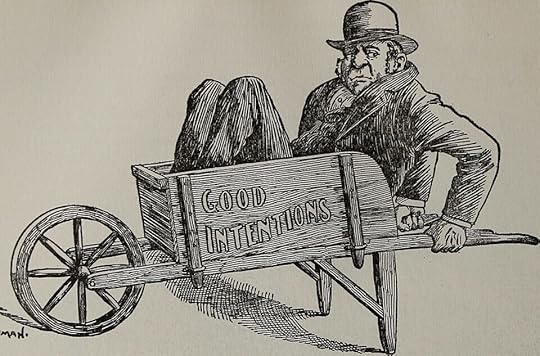
trusatile
adj. that may be pushed; worked or driven by pushing
“His Mother-in-Law”
He stood on his head by the wild seashore,
And danced on his hands a jig;
In all his emotions, as never before,
A wildly hilarious grig.
And why? In that ship just crossing the bay
His mother-in-law had sailed
For a tropical country far away,
Where tigers and fever prevailed.
Oh, now he might hope for a peaceful life
And even be happy yet,
Though owning no end of neuralgic wife,
And up to his collar in debt.
He had borne the old lady through thick and thin,
And she lectured him out of breath;
And now as he looked at the ship she was in
He howled for her violent death.
He watched as the good ship cut the sea,
And bumpishly up-and-downed,
And thought if already she qualmish might be,
He’d consider his happiness crowned.
He watched till beneath the horizon’s edge
The ship was passing from view;
And he sprang to the top of a rocky ledge
And pranced like a kangaroo.
He watched till the vessel became a speck
That was lost in the wandering sea;
And then, at the risk of breaking his neck,
Turned somersaults home to tea.
November 13, 2025
Noted
Went yesterday to Cambridge and spent most of the day at Mount Auburn; got my luncheon at Fresh Pond, and went back again to the woods. After much wandering and seeing many things, four snakes gliding up and down a hollow for no purpose that I could see — not to eat, not for love, but only gliding.
— Emerson, Journals, April 11, 1834
Close Enough
In 1977 Jay Ames found he could approximate nursery rhymes :
Barr Barre Black Shipp
Haff Yew Anney Wool
Yetts Herr, Yetts Herr
Three Baggs Voll
Wan Farr Durr Master
Won Forder Dame
An Wun Varder Littleboys
Watt Lief Sinne Allain.
In 1963 the TV show I’ve Got A Secret searched the phone books of New York City to find residents whose names, in order, approximated the lyrics to “In the Good Old Summertime”:
November 12, 2025
Midy’s Theorem
The decimal expansion of 1/7 is
0.142857142857 …
Interestingly, if you split the repeating decimal period in half and add the two complements, you get a string of 9s:
142 + 857 = 999
It turns out this is true for every fraction with a prime denominator and a repeating decimal period of even length:
1/11 = 0.090909 …
0 + 9 = 9
1/13 = 076923 …
076 + 923 = 999
1/17 = 0.0588235294117647 …
05882352 + 94117647 = 99999999
1/19 = 0.052631578947368421 …
052631578 + 947368421 = 999999999