
Jane Brocket's Blog, page 50
November 8, 2011
limitations
David Hockney believes that limitations have their advantages when it comes to making and creating. In A Bigger Message (interesting, balanced review) he describes how the limitations of various materials and media (types of paint, photography, collage, iPads and iPhones) can be good for a body, making you seek ways round problems and shortcomings.
Reading this has made me realise that the reasons why I take the style of photos I do are not exactly deliberate but are shaped by the limitations I encounter.
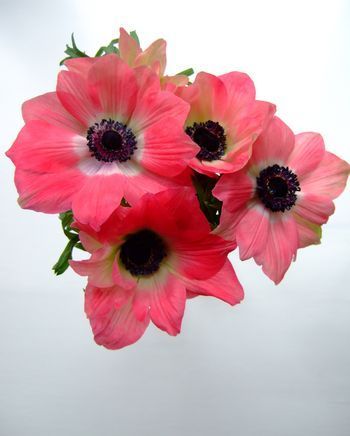
Firstly, I really have very little idea of the possibilities of modern cameras. Years ago, I tried to learn all about f-stops and exposures on an SLR camera, but always went back to point and shoot cameras, and rolls and rolls of wasted film. I still haven't read the entire contents of the instructions booklets for the two cameras I use, and they stay on the same setting all the time. Which explains why my photos don't have a deep depth of field but do have a consistent level of colour and focus. (Having said that, I like the blurring on the flowers in the top photo which was completely unintentional - I have no idea how to do it again.)
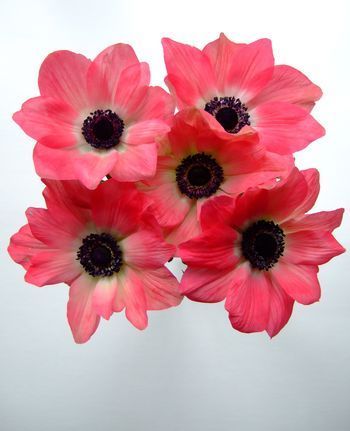
Secondly, my cameras are very small and have just one zoom in and out lens. This means I can either take really simple shots which include all the stuff I don't want in the picture or I can be creative about how I frame something in order to exclude the unwanted bits. Which explains why I rarely take full-on, face-on photos, and usually end up kneeling, crouching, standing under or over, or climbing on things in an ungainly way.
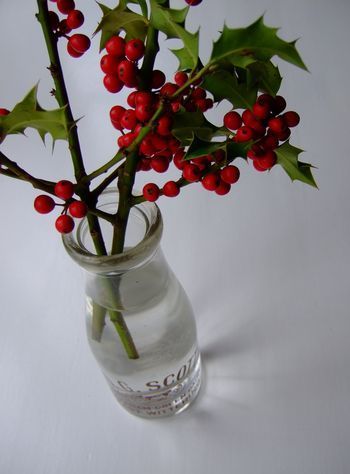
Thirdly, I know nothing about editing and photoshopping. This is not a genuine limitation though, more a total lack of interest in altering my photos because I stick to a 'what I see is what you see' philosophy of photography. You could call it laziness or a philosophical/creative limitation. This is why there are no whizz-bang effects and very little moodiness.
And finally, I am forever limited by the light. I don't like taking photos in electric light so I have to go where there is natural light without too much direct sunshine. The bedroom windowsill is still the best place in winter, and I know the days are getting shorter when I find myself clambering up onto it (it's quite deep) on a regular basis. And this explains why there is so often a white background in my autumn/winter photos.
Of course, David Hockney is really only limited by his materials and media, and not by his talent, as there's not much he can't do that he wants to do in the way of painting, drawing and photography. The rest of us can only pretend it's all down to our tools.
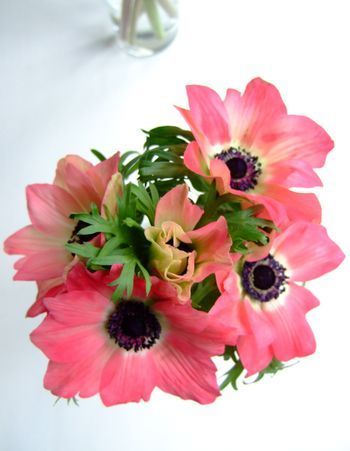
[Photos of anemones from my favourite garden centre plus holly from the garden taken today, a day of utterly gloomy light.]


November 4, 2011
loud and clear
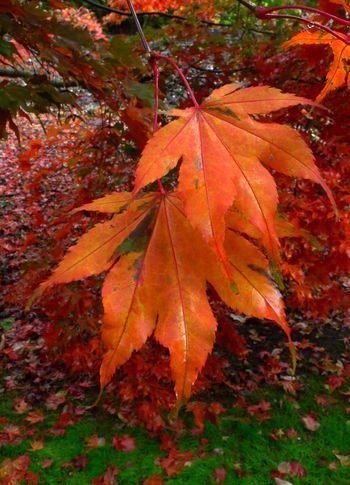
Why are bright colours often described as 'loud' with the implied subtext that are shouty, vulgar, brash, showing off and lacking gravitas? Because all the bright colours I found today are loud in a wonderfully positive way: clear, confident, rich, vibrant, and proud of their brightness.
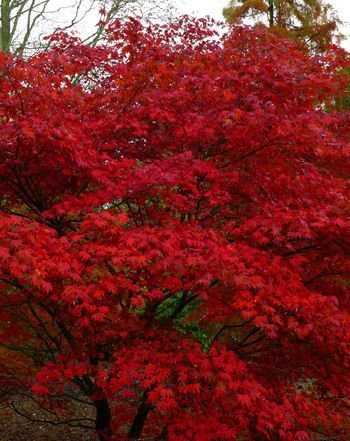
It's not been a marvellous autumn from the point of view of loud colours. So many trees have simply lost their leaves without going through a loud phase while others are still green. But there are bright spots of loudness here and there that need to be appreciated before the whole landscape turns drippily brown.
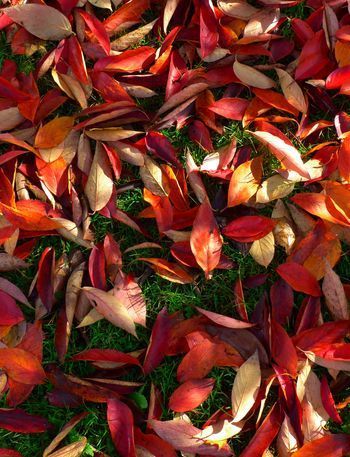
Some are dotted about in the Savill Garden (although even here there isn't the usual amazing show of colour), and some are to be found in our own garden (below).
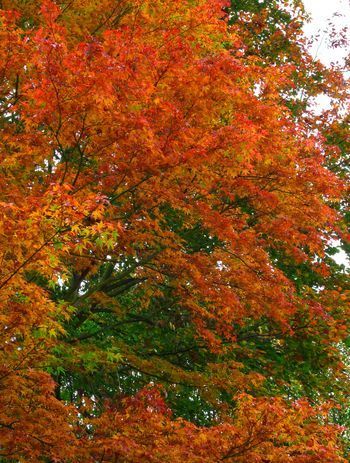
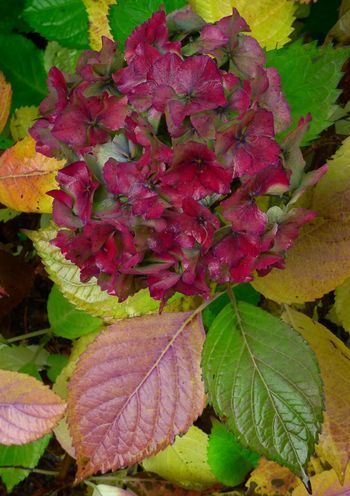
It's been such an odd autumn that there are still a few hydrangeas out,
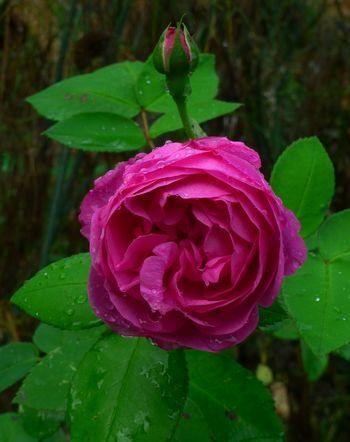
and a couple of roses ('Gertrude Jekyll') at home.
It won't be long before this unautumnal autumn loses all its colour.
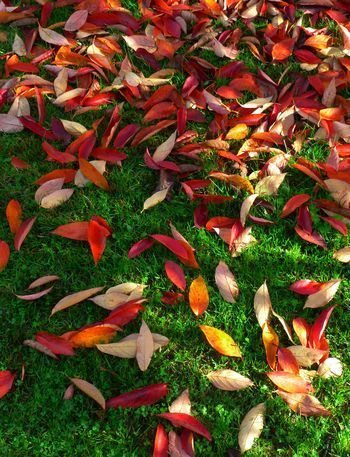
Then we'll be into whispering colours. Don't put your ear plugs in too soon.
November 1, 2011
saturday treats
Saturday mornings were full of little treats when I was at junior school. My favourite comic, Jackie, would be delivered with the newspaper, and I'd jump back into bed to read it, savouring every page and every story. A little later, armed with my 'spends' (pocket money), I'd walk up to the newsagent's, buy Princess Tina, and agonise over the decision whether to buy a packet of Opal Fruits or Fruit Pastilles. More often than not, my brother and I, with Peter from across the road, would then get on a number 9 bus to the Reddish swimming baths* and spend a happy hour or so in the ear-splitting atmosphere created by zillions of local children all squashed into a pool of water.
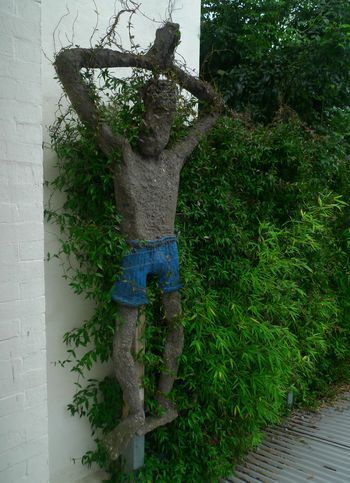
When I was older I had a part-time job in a fish and chip shop, and one of my shifts was Saturday lunch-time. Although it was frantic and I came out smelling to high heaven of chip fat, I still managed to keep the Saturday treat routine. A lie-in with Petticoat or Honey to read, free fish-and-chips-and-curry-sauce-and-scratchings after work plus a Creme Egg in season (ah, the joys of a balanced diet), a quick cup of tea and a change of clothes, and a bus into Manchester to see the smock-tops in Chelsea Girl and the groovy cafe in Way In.
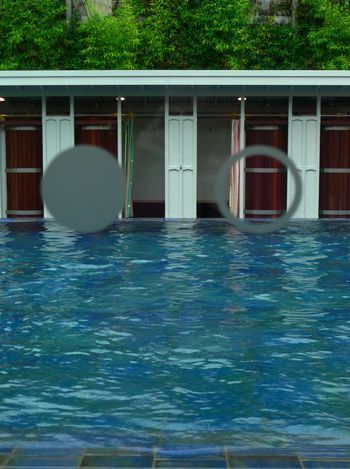
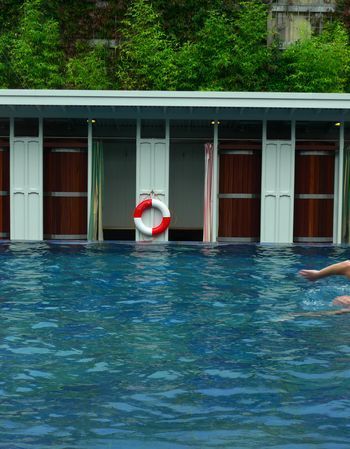
Saturdays are still my favourite treat day. These days the big treat is having the time and space to enjoy tea and newspapers in bed, but this last Saturday we were lucky to be able to spend the afternoon around and in the pool at the fantastic Clifton Lido. This is very far from the screaming, jumping, pushing, diving, noisy atmosphere of Saturdays I remember. It's a fabulously calming, peaceful place for real swimming. And real eating. The Lido has an excellent cafe (plus a restaurant): there may not be fish and chips and Opal Fruits, but the bread is out of this world, the tapas are delicious, and there are piles of newspapers to read. A very modern take on all my favourite Saturday treats.
[There's a beautifully made short film that was made to support the campaign to save the Lido, and it shows just how derelict and sad the place had become before it was rescued.]
*A friend tells me no-one south of Watford talks about swimming 'baths' - it's all pools, she says.
October 31, 2011
bath
[Royal Crescent]
There are plenty of good things in Bath. Baths. Bath buns. Books. (Topping & Company is one of the best bookshops we've ever visited. Packed with good books, beautifully laid out, and a fine pot of tea for customers who are clearly going to be in there for a while.)
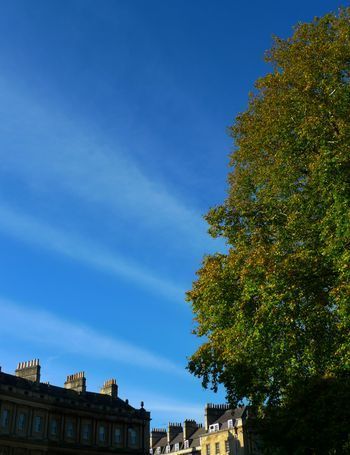
[The Circus]
We've just had a few days strengthening our leg muscles with plenty of urban hill-walking, going from amazing Georgian crescent to amazing Georgian crescent, via the amazing Georgian Circus.
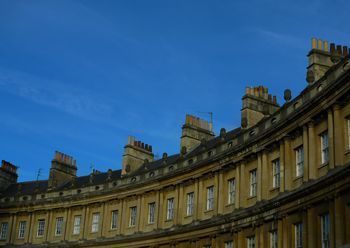
[The Circus - chimney pots]
I read The Sack of Bath and pointed out to Simon the desecrations of the 1970s Bath town-planners, while marvelling at what is left. I was also set to read Northanger Abbey for the first time since I yawned my way through it at school when I was 12 (as a newly formed feminist, I couldn't understand why Catherine put up with all the restrictions placed on women, and didn't just break out of polite society and make her own way in the world without kowtowing to the social expectations of her time and milieu).
[The Circus]
But I was completely waylaid by David Hockney thanks to Topping, and Bath which is surrounded by wonderful landscape and boasts some spectacular trees, proved to be a good place to read about Hockney's paintings of and views on trees and landscape. It's a fascinating book with beautiful illustrations and great colour quality (just found this interesting review by Margaret Drabble). So I only read the first chapter of Northanger Abbey, but can confirm it's a lot better and funnier than I remember.
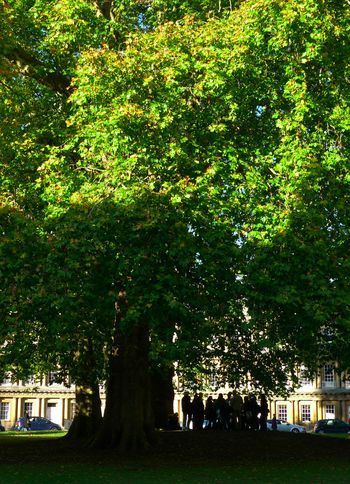
[enormous trees in the centre of The Circus, dwarfing the guided tour group]
I still have no idea, though, how the sedan chair carriers coped on those hills, ferrying ladies in sprigged muslin gowns up and down between the Pump Room, Upper Rooms, and the high houses of of the high society. I imagine they must all have had legs like Sir Chris Hoy. I'm very thankful we can all just walk now.
October 29, 2011
capital cake: newens/the original maids of honour
10. The Original Maids of Honour
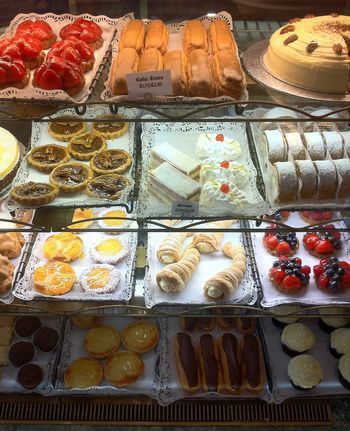
Although we live in an age of cool cafés with sleek surfaces, minimal decor, and delicious but downplayed cake, there is still a place for the unchanged, unapologetically and charmingly chintzy tea room done with panache and very good cakes.
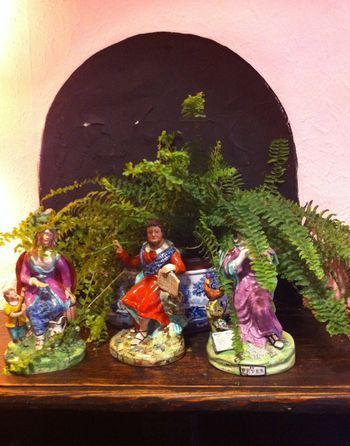
The Original Maids of Honour Cafe opposite Kew Gardens is one such place. Named after the historical local speciality - a small custardy, flaky pastry tart (£2.80, worth tasting even though they disappear in two or, at most, three bites) which dates back to King Henry VIII's time - it is a marvellous cafe-cum-bakery which flaunts its olde worlde style with dark wooden furniture, swirling carpets, rose-patterned curtains, copper kettles, and plenty of knick-knacks.
Customers come here for the showy cakes and treats they might have read about in books starring Billy Bunter and William Brown, or perhaps dreamed of eating while on a strict diet. There are cream buns, cream slices, cream horns, éclairs, fruit tarts, meringues, and plenty of cakes by the slice (coffee and walnut, orange, lemon, chocolate, fruit), all of which are made on the premises and have a good, old-fashioned taste and solidity. The waitresses' black and white uniforms, and the indestructible, sturdy metal Kardomah/Lyon's Corner House-style tea and coffee pots tell you that this place isn't planning on change.
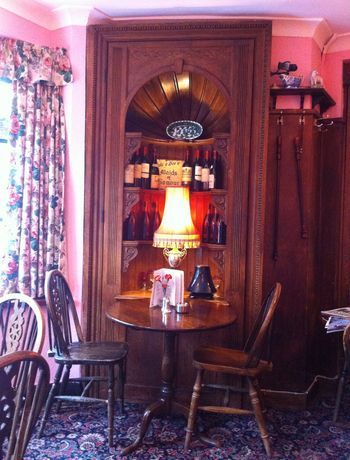
The customers are a mixed bunch of locals and tourists, young and old, and it's all rather genteel and pleasant. It is deservedly popular at weekends when the very good value, 'full English' breakfasts are served. The only gripe is with the very steep mark-ups; the price difference on cakes and food sold in the bakery section and served in the cafe may make some visitors think twice before eating in. This is a shame, as there is nowhere else in Kew/Richmond with such character, history, and huge cream buns, but of course you can always take a big box of cakes home with you.
Cake: £2.80 - £3.95 (eat in)
Cup of tea: £2.00 (pot £3.20)
Coffee: £2.00 (pot £3.20)
Afternoon tea: from £6.95 per person for a Cream Tea
288 Kew Road
Surrey
TW9 3DU
Tel: 0208 940 2752
Website: www.theoriginalmaidsofhonour.co.uk
Open: Mon to Fri 9 – 6, Sat and Sun 8.30 – 6
And a slice of culture: the cafe is opposite Kew Gardens. It is not far from Tikki, and is pretty close to London Welsh rugby ground in one direction and Kew Bridge Steam Museum in the other. Richmond, with its park, riverside, cinemas, theatre, and Virginia Woolf connections, is a short bus ride away.
October 27, 2011
phoebecakes
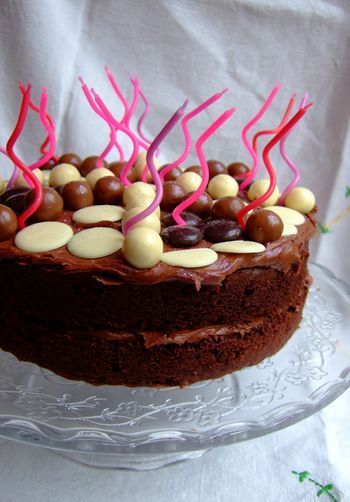
When you get to my age and someone calls you 'babycakes', it's bound to make you laugh, even though you know it's just the tiniest bit patronising. Especially in a text from Alice or Phoebe saying something like 'thanks, babycakes' or 'see you later, babycakes'. The first time I received a babycakes text, I did the classic Travis Bickle 'you talkin' to me?' reply as it's it not a term that is commonly used in messages to mums. Now, I love it.
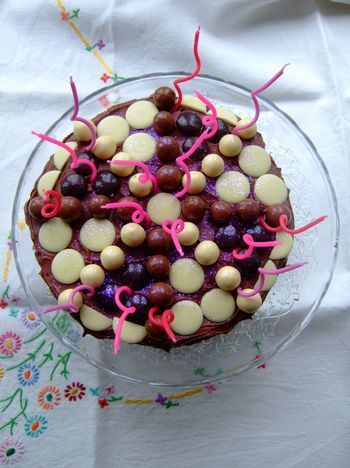
So there was only one possible title for this post.
Happy birthday, Phoebecakes.
[Cake made by Phoebe, whirly candles from Lola's in Topshop]
October 26, 2011
google gugel
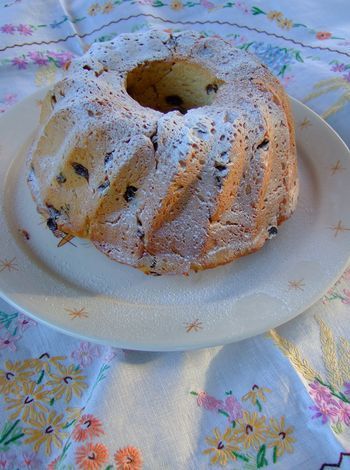
My first ever Kugelhopf. Or Gugelhopf. Or Kougelhopf. Or Gouglof. Or any number of regional German, Austrian, and French variations. I'm calling it a Googlegugelhopf as I found a basic recipe on the internet, compared it to a couple more in my recipe books, and made what I hoped would be a reasonably authentic version.
It's a cake-bread in which yeast is the raising agent, but due to plenty of butter, sugar and eggs, it tastes more cakey than bready. It's absolutely delicious, and has a lovely texture - not as dry as some of the shop/cafe Kugelgooglegugelhopfs I've eaten in Germany and France. It also has a subtle but distinctive flavour that comes from raisins soaked in brandy (kirsch is also an option) - it's amazing just how much difference 125g/4oz of alcoholic dried fruit can make.
It's baked in a traditional 'gugel' tin (these days we generally call them Bundt tins) and the icing sugar is crucial in enhancing the ridges and swirls as well as the taste. This first attempt may be blessed with beginner's luck, so I'll make sure I eat plenty of it, just in case. (Simon is in New York at the moment so can't help.)
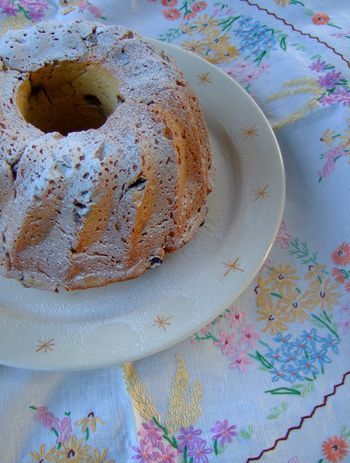
[There wasn't much light in the house when I came to take a photograph, so I took it outside and found there was just enough low, pale, cake-flattering light.]
October 25, 2011
tawny
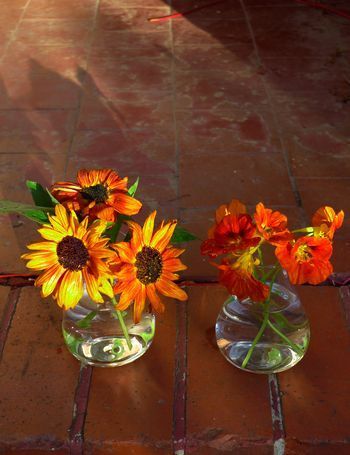
[8.45 today]
Tawny, butterscotch, bronze, sepia, caramel, copper, rust, and bronze are the colours of the moment. Not just on the trees and in the landscape, but in garden fashion. I'm probably a few seasons behind, but I am seeing coppery-tawny tulips for sale and, according to the gardening pages, everyone who's anyone in the gardening world seems to be planting T. 'Cairo', T. 'Brown Sugar', and T. 'Burnished Bronze' this year.
So it is with great satisfaction that I picked some truly tawny flowers this morning - I never knew I could be 'on trend', as they say. The autumnal sunflowers are getting smaller and smaller, but they are very 'now' in their colour. And hidden away, tangled up in other plants, I found a long length of trailing nasturtiums with the most toffee-coloured petals I have ever seen. As usual, I have no idea of their name because I was so late with seeds (again) that I just opened all the packets I hadn't sown, mixed them up in a bowl, and broadcast them around the garden. The nasturtiums (definitely not 'Tip Top Mahognay' or 'Mahogany Jewel', I know that much) are distinctly brown and plain in the shade, but burst into a fiery copper when the sun catches them.
I'm taken by the fact that these colours are different, but I'm not too sure they won't just be a passing fad. Although there have always been bronze and copper chrysanths, I'm not convinced these colours will last longer than a fashion season or two on spring and summer flowers. (It's not that long ago that the trend was for deep purple, blackish plum, and aubergine shades that were great novelties at first, but can look funereal when planted too enthusiastically.)
But for today, tawny can be my favourite colour.
October 24, 2011
footnotes
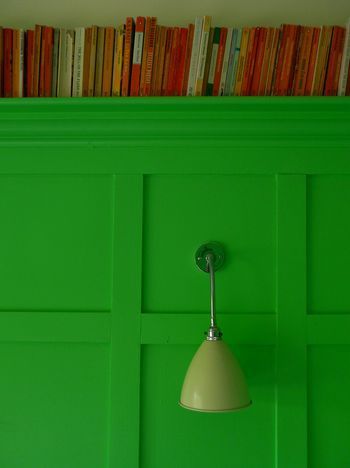
[books downstairs - very sorted]
The title is ironic, especially after my recent thoughts on the complexities of academic writing. I always think that one of the great joys of blogs (as both a reader and a writer) is that you don't need abstracts, footnotes, bibliographies, and appendices. (I'm wondering if anyone knows of any good blogs that are literary, written from an academic standpoint, but without the impenetrable vocabulary and extra bits and pieces?)
:: A couple of postscripts on my 'What the Dickens' posts. Chloe of Oxslip kindly sent me a link to the Penguin Classics Charles Dickens readathon, which sounds like a literary decathlon with a pentathlon, marathon, and heptathlon thrown in for good measure. I really hope they make it to the last page of The Mystery of Edwin Drood. What's refreshing about the readathon posts so far, is that the responses are so enthusiastic and natural - no hint of posturing or point-scoring, just honest-to-goodness gut reactions.
:: Just when I was beginning to wonder if anyone would get round to it, Philip Dodd on Radio 3's excellent Night Waves (anything with Matthew Sweet, who often presents this, is worth listening to), cheered me up enormously by asking Claire Tomalin some of the questions that have been floating around in my mind. Thank goodness someone has at last broached the question of the dark side.
:: I wrote and published a post about nostalgia last week, prompted by seeing Midnight in Paris, a film about the pleasures and pitfalls of nostalgia. However, when I was in the middle of re-editing it, I pressed 'cut' instead of 'copy', and lost seven-eighths of the post. In the spirit of the subject, I decided not to regret something that was now in the past. But I was still cross with myself. The film is pure escapism - Paris never looked lovelier etc etc - but it's also funny and clever, and a lot more nuanced and layered than more recent WA films. WA also manages to remain ambivalent about nostalgia, rather than wallowing in it.
:: Downton Abbey has gone barmy. By the end of last night's episode, I was beginning to expect French and Saunders or Victoria Wood and Julie Walters (or all four) to wander in and send the whole thing up. It might have been better if they had.
:: And I'm still wondering why chefs feel they have to pose for photographs like this.
October 21, 2011
readability
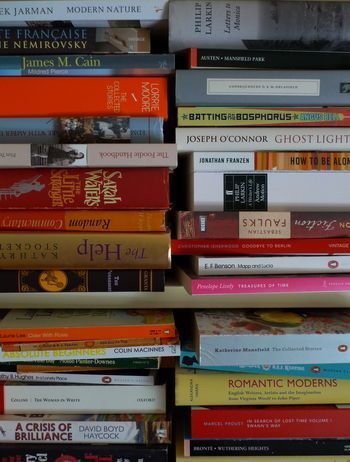
[bookshelves in the hall - awaiting sorting]
Another year, another Booker brouhaha. Another fuss about who wins, who judges, who argues with whom. But who cares? It's a well known fact that most of the novels on the list will only sell a few hundred copies - maybe more if they make the short list - and that only the winner will ever sell in its thousands. This year, however, the proceedings have been enlivened by a debate about 'readability' and whether it is compatible with literary excellence.
Well, of course it is. As if impenetrability, convolution, obfuscation, and verbal posturing could ever trump clarity, fluency, subtlety, and deft use of language (not to mention those old-fashioned virtues of plot and characterisation). I don't subscribe the Clever, Clever School of Novel-Writing, but I do like a really clever novel, one that demands and holds my attention, that opens up a new world and a new way of thinking and seeing. It doesn't have to be over-researched (you can see where the joins are when a novelist won't let go of hard-earned historical details) or under-written (so many modern novels are cool to point of frigidity), but anything that has come from a fertile, flexible imagination and is written in a continuous stream of creativity will always be more readable than a piece of prose that tries too hard.
I think some on the Booker panel are confusing readability with low-brow. It's as if anything that is easy can't have any artisitic or literary merit. It's an opinion that is influenced by academic criticism which is couched in language that is used to impress but not elucidate. It must be much harder to write a really convincing and illuminating piece of serious literary criticism in simple, direct language, which is why we have this mad lexicon, most of which no-one truly understands (hermeneutics, exegesis, diagesis, mimesis all have everyday substitutes).
It has become a sign of weakness to admit to liking readable books. We are supposed to put away our childish, Enid Blyton reading habits, and move away from books that suck us in on the first page and hold us in their thrall until we reach the last. Yet there are plenty of readable books that are also 'hard' and 'difficult' which succeed in doing this. And there are many wonderful, not-so-difficult books that are the epitome of readability, yet I would never class them as less worthy or less excellent, simply because the prose flows and we are swept along by it.
People really do care about readability. They also care about good books, and want to read the best of contemporary fiction. But we are being short-changed by literary snobs who think they know better and encourage this elitist nonsense. Give me a Dorothy Whipple or an Elizabeth Taylor any day while I wait for more literary prize-winners to become readable.
Jane Brocket's Blog

- Jane Brocket's profile
- 27 followers

