
Jane Brocket's Blog, page 54
August 17, 2011
anxiety
What makes us anxious, keeps us awake at night, and leads us question our judgements and our lifestyles is of enormous interest to academics, politicians, sociologists. We often allow ourselves to be made anxious by all sorts of bodies, often those that have a vested interest in our maintaining those anxieties: the media, politicians, big businesses, cultural figures. One example is the pernicious current anxiety about physical appearance (dear me, if I believed what I see and read, I'd think that it' s an act of daring to go grey instead of part of the very natural, unavoidable, and irreversible process of ageing). The very prevalent anxiety about teenagers worries me even more, and I could name dozens more current anxieties which are far more damaging than the subjects themselves. But I never thought there would be cultural anxiety about baking.
Last year I started watching the Great British Bake-Off but stopped very quickly because I couldn't bear to see grown men and women crying about cakes or, more to the point, being reduced to tears by 'judges'. To tell the truth, I was shocked. I'd spent many years naively baking for enjoyment, for relaxation, for the pleasure having something nice to eat with friends and family. And all the time, it never once crossed my mind that my amateur efforts could be classed as not good enough, that there might be a correct form of homely, gratifying, domestic baking. So to watch people who clearly enjoy baking for pleasure (and have many appreciative takers) being made to look like sad failures in the name of TV entertainment really isn't my idea of a good night in.
Last night the new series started, and I watched to see if anything had changed. Well, it seems to me that even more than last year the programme-makers have chosen a mix of people more for their personal variety and telegenic qualities than for their baking skills. So you know straightaway that there are going to be disasters, wrecks, novelty for the sake of novelty, and plenty of humiliating results. And sure enough, there's a grown man in tears about a chocolate cake, a sniffy judge telling someone their creation tastes 'disgusting', and the overriding impression that there is a correct way of making a Mary Berry Battenburg recipe (and the underlying message that Mary Berry herself is correct about everything to do with cakes).
It's all too predictably judgemental and laugh-at-them-talent-showish. Home-baking was never meant to be treated this way. I know the contestants have gone in with their eyes wide open, but why do programme makers think that the only way to have an entertaining programme about British baking is to make it a competition? Baking is one of the last bastions of gentle and creative domesticity, and even this is being turned into a heart-pounding, anxiety-inducing, competitive activity in which you can be judged a failure.
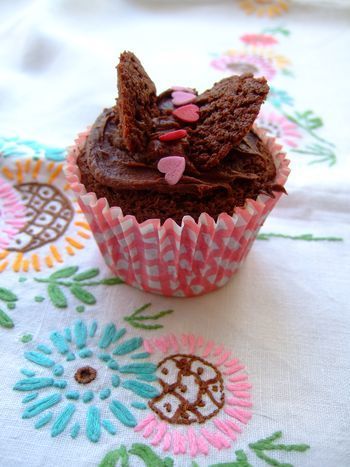
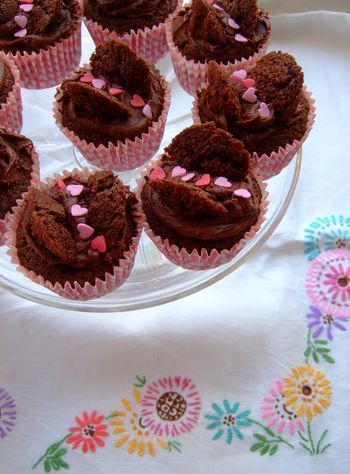
I'd rather be in the kitchen making anxiety-free butterfly cakes, especially today when there is understandable, inevitable teenage anxiety (have you seen the papers today??) about A level results and futures tomorrow.


August 16, 2011
classics
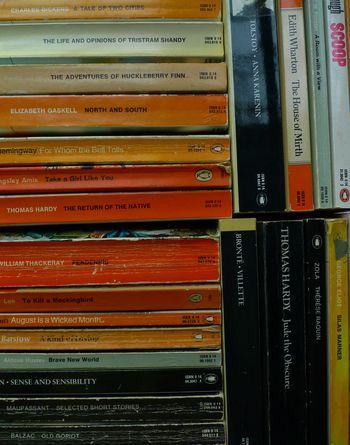
[classic Penguin classics]
Apart from the fact that so much of it is bleak, depressing, and soulless, one of the reasons I don't read a great deal of contemporary fiction is that I feel the classics are classics for a reason. I often find myself waiting a couple of years after publication before picking up a 'new' book, almost to allow it time to prove itself. But the wonderful thing about true classics is that they have already stood the test of time, risen above the era in which they were written, and still speak to us across the decades or centuries.
I was so dedicated to reading when I was a teenager and student, that in my free time I pretty much only read the classics, although these did span several centuries from Austen to Amis, Waugh, Greene, Steinbeck, and Hemingway. I read Thomas Hardy in Biology lessons, William Makepeace Thackeray after exams, and DH Lawrence in private. I just couldn't see the point of reading fly-by-night books when there are so many genius books to be tackled before I die/give up and turn to Barbara Cartland.
I still struggle with most modern novels, which is why I was so delighted to make a new classic discovery on holiday. I hadn't read any Edith Wharton before, knew virtually nothing about her and, crucially, had no idea of the plots of her books. What a reading treat, therefore, to be engrossed in The House of Mirth and not know what happens to Lily Bart. Or to enter the world of Fifth Avenue in The Age of Innocence with no clue as to Ellen Olenska's fate. The problem with so many classics is that the endings are so well known (Anna Karenina, Oliver Twist) and have been used so often in popular culture (films, musicals, plays) that it's hard to read them in the same way they were read when first published (if in instalments, even the author him/herself often didn't know the ending). So I revelled in a reading experience I hadn't had for years, in the not knowing, in the sheer delight of turning pages to find out what happens.
And my goodness, are these good endings. Edith Wharton is such a brilliant writer and these two novels must be her masterpieces (I have yet to read the Old New York Stories) as I can't imagine anything better. She is undoubtedly grand American but with touches of Zola, Balzac,and the great C19 Russian writers which is why the stories of these phenomenally rich and rigid New Yorkers still have something to say about society, snobbery and, most forcefully, about women's lives. Her style is beautiful, amazingly visual and textural, and she weaves her themes and sustained but subtle metaphors with a very sure and elegant touch.
I also hadn't realised quite how grand a grande dame she was, and how influential in the world of interiors and gardens. I took Hermione Lee's biography with me on holiday, read The House of Mirth (1905) first, then up to 1905 in her life, then The Age of Innocence, then almost the rest of her life - although I did fade towards the end as this is a huge biography and the descriptions of her later years (all the lists of books, plants, wines, petty quarrels) began to wear me down. So I stopped before I was disillusioned, and now have the memory of reading two crystalline, classic novels and an equally classic life story imprinted on my brain.
August 12, 2011
summer in the city
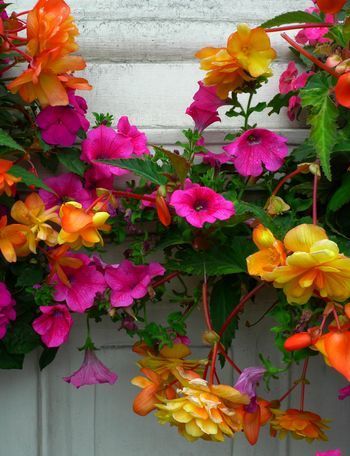
I really don't like begonias, with their watery fleshiness and oversized blooms, but they seem to be the staple pub window-box plant in London, and at least they boast make-up counter colours that draw attention away from the grimy exteriors of pubs (this one is just by London Bridge).
I've been studying pub window boxes on walks because, yes, we had booked to spend a few nights this week of all weeks in a Landmark Trust property in London. Indeed, with the rain and the riots, this was much more our usual type of holiday (Spain was an aberration, we decided).
We were fortunate to be in an area where there weren't problems, although the trouble wasn't far away in various directions which meant that most teenage friends weren't allowed to come and stay with us. So instead of having a house packed with clubbers, we had just Phoebe and a friend who made a bee-line for the centre and the cinema.
While they did that, Simon and I walked and looked and stopped and tasted. We found beautiful Wren and Hawksmoor churches, amazing C18 warehouses, challenging modern architecture, great Mexcian food, excellent tapas, and the best Eccles cakes ever (and seriously wonderful bread there, too).

We found colour and exuberance everywhere. Because despite the appalling events of the week, London will always be wonderfully colourful, exuberant, and resilient.
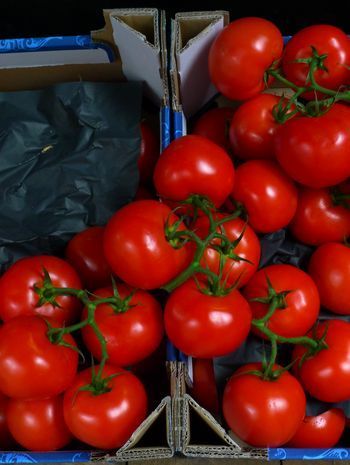
From cheeky graffiti in and around Brick Lane to London-bus red tomatoes at Brough Market,
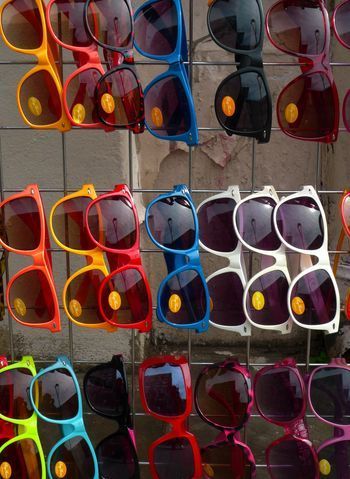
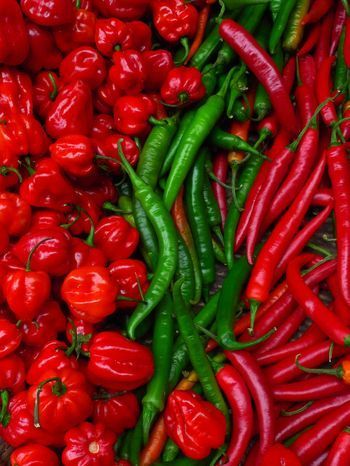
from cheap and cheerful sunglasses for grey days to all shapes and sizes of chillis ( very Tessa Traeger arrangement) for cool, wet days, London in the summer is just as richly diverse as ever.
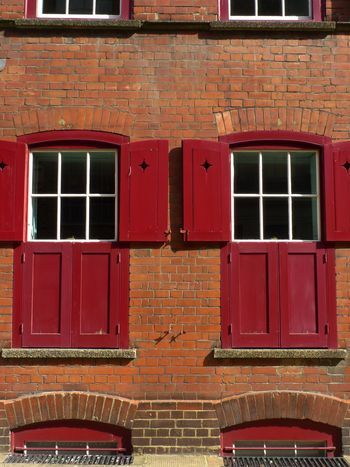
And if we needed any more convincing of London's layered history, the early C18 house with its ketchup-red shutters and wonky staircases, was an example of what will survive all sorts of history, changes and fortunes.
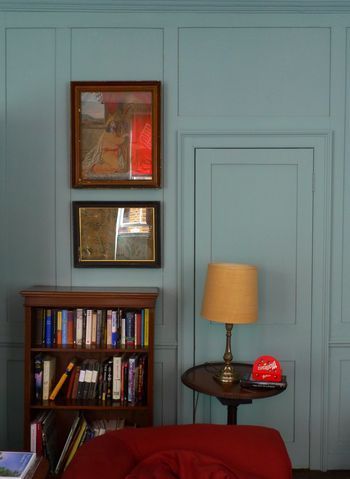
The evenings were quiet - even where we were the shutters came down early and restaurants were desreted. This is where we sat and listened to the sirens and helicopters, played cards and ate Maltesers, and yesterday read with relief that things were calming down. We are home again now, but wondering how it all happened and what will come of it all.
August 8, 2011
simple
It's years since we have had unbroken good weather on holiday. That's not to say we haven't had the occasional day or two of nice weather and some great holidays, but our ability in the past to seek out bad spells of weather even in places like Majorca has, together with the astronomical cost for a family of five, put us off holidays abroad for quite a few years. At least if you stay in Britain, you know exactly what to expect, and a week's rain in Suffolk is par for the course.
But this time we got it right and the weather was fabulously hot and sunny (with just one cloudy morning). It made me realise just how good sunlight and warmth can be for bodies used to draughts and winds and rain and grey skies. And, when you have teenagers who can cope with heat, are happy to slow down to 0 mph, and who can apply their own sun lan lotion, it makes things very simple indeed.
When you have got sun and slothfulness, there's not a lot more that's needed apart from:
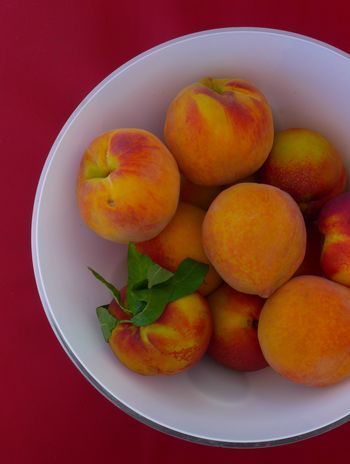
huge, fresh, fuzzy peaches
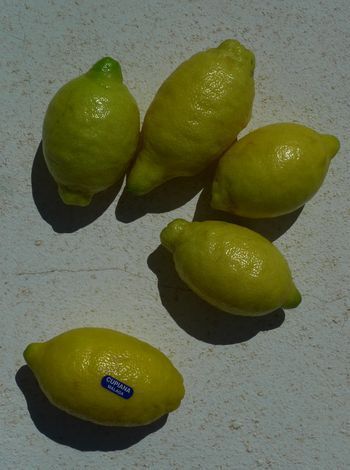
and huge, fresh, local lemons
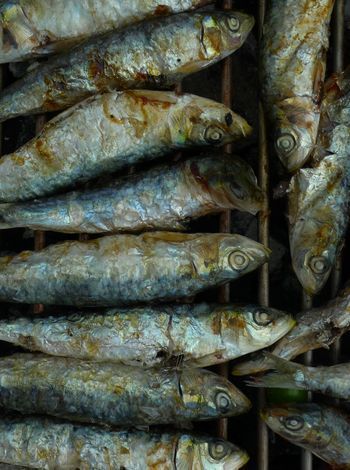
and huge, fresh, silvery sardines
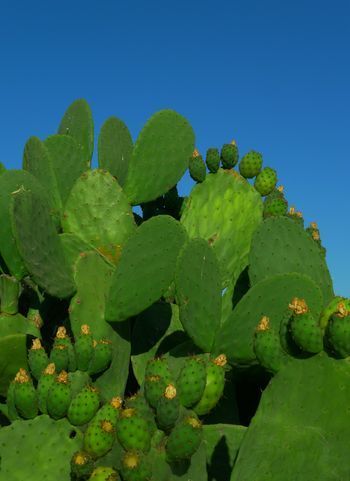
and huge, monumental cacti
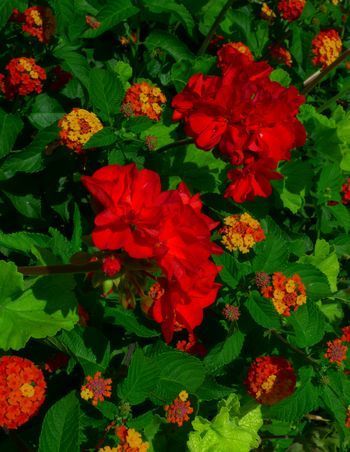
and hugely colourful geraniums and lantana
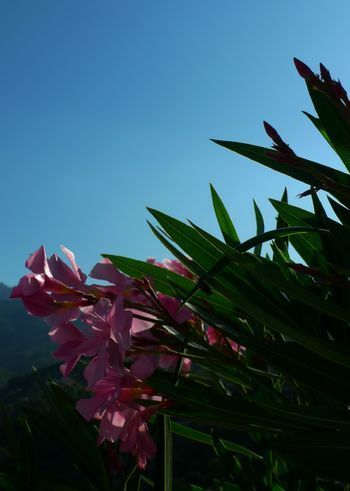
and huge bushes of pink oleander

and huge blue skies as seen from a gently rocking hammock (shared with Edith Wharton).
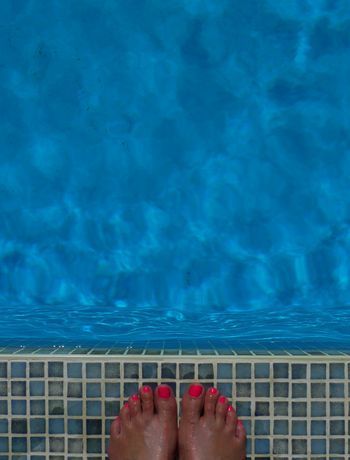
From neon-pink fingertips (not mine) to neon-pink toes, every fibre in the body feels warm and rested.
Then we come home.
(Some of us are going away again today until the end of the week. Various combinations of teengers will be staying with us, but this will be a less sunny and less slothful break.)
August 7, 2011
family holiday
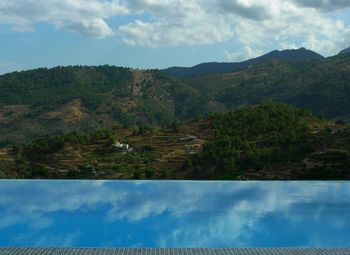
[our daily view with rare cloud]
We are at the stage in our family's evolution where holiday expectations vary wildly. I have no illusions about teenagers wanting to go on holiday with parents (my very last family holiday was when I was 13 or 14), so planned a week which might possibly appeal to everyone. And it wasn't that difficult to get takers because it was such a simple proposition: a week in Spain (they are all studying Spanish) with sun, swimming, sardines, and scenery, but no sight-seeing.
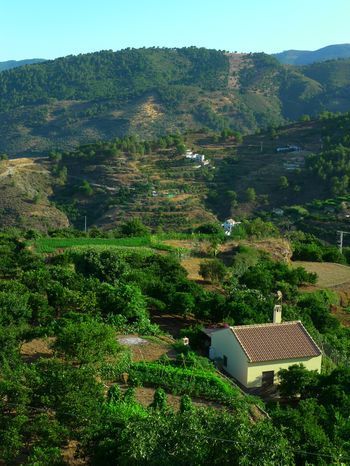
[favourite finca]
We rented a villa on the very edge of Yunquera, a very traditional, very undiscovered white hill town up in the mountains of Andalucia, surrounded by olive trees and orange groves and spectacular views of terraced slopes. Within yards of our house, we could pick olives, oranges, limes, lemons, figs, and pomegranates (not all ripe at the moment). We could see little fincas with neat patchworks of beans and tomatoes and fruit trees, donkeys doing donkey-work, horses being washed in the incredibly narrow and steep streets, hear the goats' bells as they came home in the evening to be milked, and watch morning mists dissipate below us and sun sets above us.

[sunset above town]
Yunquera is pretty much self-sufficient, which meant we were too. Once we tuned into the life of the town, we found all we needed within it. No newspapers or internet, but all the just-picked peaches we could eat, fresh bread every morning, and shady cafes for little glasses of cafe con leche. It is an astonishingly cheap place to stay (prices are vastly below those in most touristy parts of France and Spain), and in many ways feels like the Spain before the tourist boom that I'd read about but never experienced.
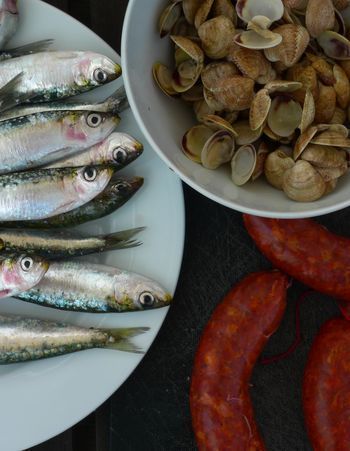
[clams, sardines, chorizo]
We took plenty of books and not a lot else, and we basked in the glorious heat, the kind that allows you to be outside all day long without so much as a single shiver.
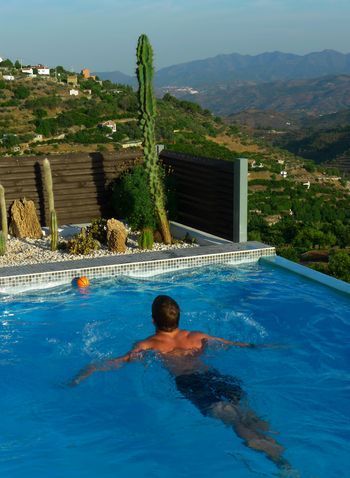
[pool game]
We read, we had every kind of swimming contest we could think of, we cooked and ate well, we sat and looked at the view for hours on end, we laughed, and we had a wonderful family holiday.
July 28, 2011
leftovers
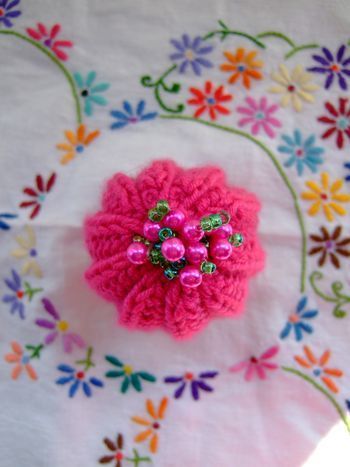
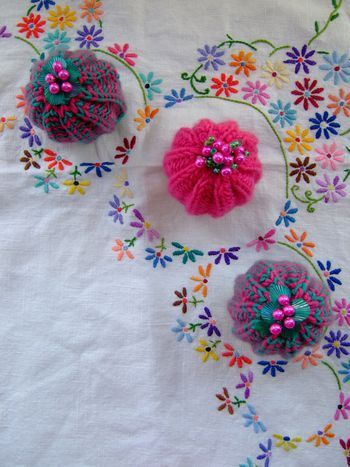
'Fabergé egg cosies' (pattern in the book) made with small amounts of leftover yarns, and embellished with beads and sequins. Because if I can't afford a real Fabergé egg, I can at least afford a Fabergé egg cosy or two.
That's the fun of leftovers: it's worth keeping them as you never know what they can be turned into. And if you keep enough, they accumulate until you have enough to make something quite sizeable. Like this post, which is a collection of various leftovers that haven't made it into recent posts, but need tidying up before we go on holiday this weekend.
:: How to Be Alone had me completely engrossed. It's not an easy read (one of the essays is about 'difficult' books) but it's a very thought-provoking one, and I think Franzen is spot-on and ahead of his time in his analysis of contemporary reading and culture (this was published in 2002 and most of the essays were published in the 90s). Plus, the cover sold me the books before I'd even opened it. What a beautiful, evocative photo taken in this book store - enough to make you want to be a solitary, winter-evenings-in-the-city-reader for ever. (It must also qualify as one of the best books to read in public on your own if you don't want to be bothered.)
:: I've now moved onto The House of Mirth by Edith Wharton, at the suggestion of Rachel. But I'm not putting in a link as I really don't want to know how it ends, and am sure I'll peek at any review. I'm hooked.
:: One thing I meant to do before the holiday is organise my bulb order. Now is the time to get hold of the catalogues and spend an hour or so in a tulip reverie. When I get round to it, I'm buying mostly from Peter Nyssen (plus a few varieties from Bloms).
:: The Glamour of the Gods exhibition at the NPG is full of fabulous black & white portraits but feels a little hollow. All that air-brushing; I think I prefer Joan Crawford with her freckles and tiny wrinkles than with a Plasticene-smooth brow and porcelain skin (I suppose air-brushing is better than Botox, although both conspire to leave the viewer with a sense of unreality and manipulation). The portraits I liked most were the ones that made me swoon (Robert Taylor, Rock Hudson, Gary Cooper), just as the Hollywood studios intended.
:: I shall be taking part in the Warwick Words literary festival on Tuesday 4th October. (Great programme.)
:: On Saturday we are going away for the best part of two weeks. I have a fine pile of books left over from the last twelve months of good-but-failed intentions to take with me, and absolutely no plans other than to read and have a good time.
Thank you for the comments on Capital Cake. (Just to clarify, a book deal didn't fall through.) I'll be posting more reviews when I get back (and have eaten some more cake).
July 27, 2011
capital cake: gail's (notting hill)
For the third and final review of the week, I've moved across town from Soho to Notting Hill.
3. Gail's (Notting Hill branch)
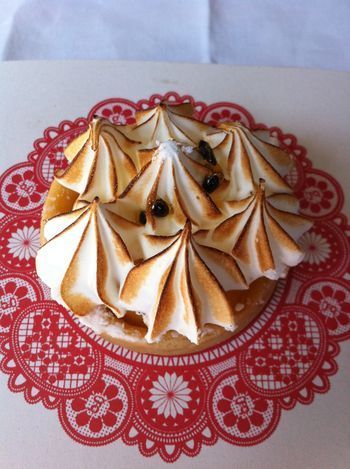
Gail's styles itself as a 'local' and 'artisan' bakery, and the world would undoubtedly be a better place if we all had a Gail's on our doorstep. This branch on Portobello Road, in the heart of Notting Hill, is a gift for locals and visitors alike, and there's a good mix on busy Saturday mornings when the market is in full swing outside. The café is a good size and exemplifies the current trend in café-bakery style of what could be termed 'rustic-moderne', with solid wooden tables and exposed brick walls, plenty of seating, a pleasant atmosphere, and smiling and helpful staff.
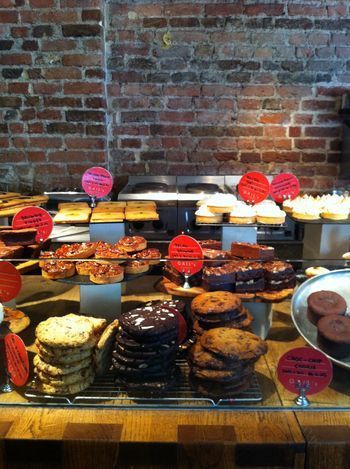
But the real draw is the integrity and quality of the baking. One large counter is devoted to a huge selection of cakes, small cakes, cheesecakes, tarts and tartlets, fondants and brownies. It's a baking tour de force with all sorts of international influences and it creates anxious moments of indecision and mind-changing for non-locals overwhelmed by the choice.
So if you aren't a local, the best way to have your cake here is to not hold back. When we visited, a maple finger cake (soft, moist, deliciously sweet and pecan-nutty, £2.70), a passion fruit meringue tart (crisp pastry shell, sweetly rich curd, and perfectly judged lightly toasted meringue peak, £3.95), a chocolate toffee mini tart (chocolate pastry, gooey filling with a tiny, crunch chocolate Florentine on top, £3.50) and a sticky, spicy, fresh and bready hot cross bun (£1.50) seemed as good a way as any to tackle Gail's best. Future visits are based on the need to try the adorable mini kugelhofs, sludgy pecan brownies, a pale and interesting ricotta tart, a tiny dolls' house raspberry and corn cake, and a slice of the spectacularly engineered, layered carrot cake.
Any bakery such as this is to be cherished, but there is major one problem with the 'local' ethos and that's that there are no customer toilet facilities on the premises (do they really think that everyone has a loo round the corner to nip home to?). There is a free public toilet just outside Gail's, but on market days the queue can be distressingly long.
NOTE: Mark-ups on the prices for eating in are high, so you might want to go for the take-home option or one of the 'moveable feast' lunch boxes.
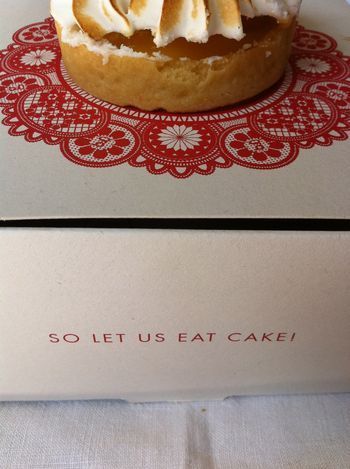
Various cakes: £2.25 - £4.50
Tea: £1.75 (take out), £2.35 (in cafe)
Coffee: £2.10 (take out), £2.50 (in cafe)
138 Portobello Road
London W11 2DZ
Tel: 020 7460 0766
Website: www.gailsbread.co.uk
Branches: nine in total (not all the bakeries have a café), check website for details and opening times
Open: Mon to Sat: 7 am - 7.30 pm, Sun & Bank Hols: 8 am - 7.30 pm
Also offers: catering service for picnics, parties, and 'relaxed feasts'
And a slice of culture: Portobello Market, Portobello Road antiques shops, Electric Cinema (most comfy seats ever), legendary Books for Cooks, Piers Gough's 'Turquoise Island' which houses public toilets/Wild at Heart flowers, colourful Notting Hill terraced houses, various classic NH film locations.
July 26, 2011
capital cake: cox cookies and cake
Still in Soho but very different to yesterday's cake destination.
2. Cox Cookies and Cake
We all know the old adage that 'sex sells', but it's not often you find it applied to cakes. CCC is undeniably all about sex, so if you are a puritanical cake-eater (surely a contradiction in terms), look away now.
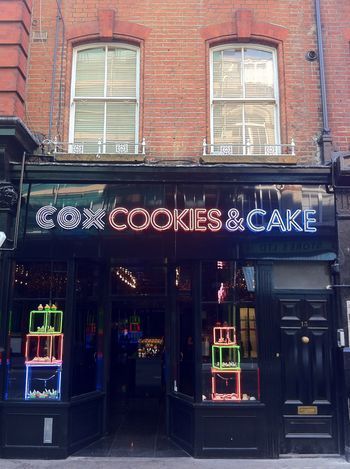
The louchely-named Cox Cookies & Cake takes its cues from the surrounding, traditional businesses of Soho and is all flashing neon lights, night-club-style black interior, spotlights and suggestiveness (the staff wear studded black leather aprons). In different hands this could all go horribly wrong, and be tacky and seedy, but former shoe-designer Patrick Cox and 'Cake Boy' Eric Lanlard (who runs the baking business in Vauxhall where these cakes are baked) have done it with such panache and style that it's not difficult to see why this new business is such a hit in Soho.
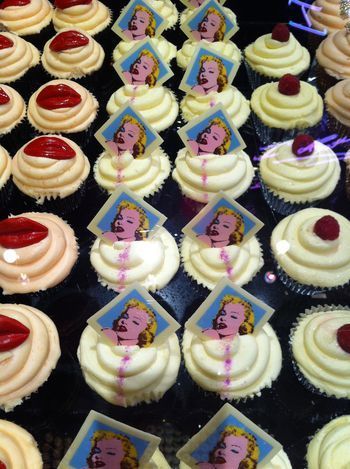
The cakes are high-camp versions of the often over-twee 'cupcake', and are the type of thing that will either delight or startle your grandmother, depending on her level of open-mindedness. There is a 'classics' range (£2.50) of standard flavours such as chocolate, cherry, red velvet, lemon and carrot, all beautifully presented in bright metallic paper cases, and generously and expertly topped with perfectly piped fluffy buttercream and pretty sprinkles and goodies. The next range up is a selection of speciality cakes (£4.00), supplemented by seasonal specials, which include 'Bling' (raspberry and sugar 'diamonds'), 'Kiss' (vanilla with red lips that Salvador Dali would appreciate), and 'Pop' (vanilla and a Warhol Marilyn Monroe printed on white chocolate).
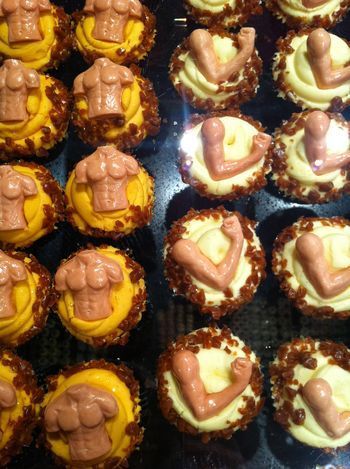
Full-on, top-grade cake lasciviousness comes in the form of 'Beef' and 'Man' cakes in the Coxxx range (£4.00) featuring buff male torsos and bulging biceps (and more) fashioned out of flesh-coloured chocolate, looking just like Action Man body parts. It's all cleverly and carefully detailed – a far cry from your average fairy cake.
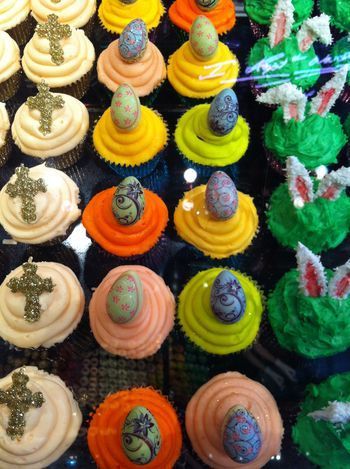
Cakes can be personalised, and full size cakes ordered for special occasions which makes this the place for all your party and rude cakey food fantasies.
And how do they taste? The answer is: good. They are sweet, rich, well-flavoured, suitably messy to eat, and comically unsubtle. As for the cookies, they don't get a look-in.
Business is mostly takeaway, although there are some seats in dark corners for cake and other assignations.
Tea: £1.45
Coffee: £2.00
Cupcake: £2.50 - £4.00
13 Brewer Street
London W1F 0RH
Tel: 020 7434 0242
Website@ www.coxcookiesandcake.com
Open: Sun to Thurs 11 – 8, Fri and Sat 11 – 11
Commissions taken
And a slice of culture: walking distance to the Royal Academy, the National Gallery, the National Portrait Gallery, Hatchard's bookshop on Piccadilly, Foyles bookshop on Charing Cross Road, Fortnum & Mason, the multifarious delights of Soho (night and day), Marshall Street Baths, fabric shops on Berwick Street, Liberty of London.
July 25, 2011
capital cake: fernandez & wells
You know me. I like to have my cake and eat it, most often in London. It's a city crammed with cafes, tea rooms, bakeries, hotels, food halls and stalls selling amazing cakes and baked treats. We have a brilliant baking tradition here and, as I have discovered recently, London has more than its fair share of passionate, independent bakers.
Never tiring of London or of cake, I decided a while ago that a guide to the capital's best cakes would be worth researching and writing, and the publishing side was sorted out. So I went looking in earnest for London's best cakes (I was always keen, but this was with even more determination) and found some fantastic places. The only trouble is that the planned guide has now stalled for various reasons, and I find myself with a stack of cake reviews and an album of cakey photos which will all go to waste if I don't use them somewhere. So this blog is now that somewhere, and I'll be posting the reviews here.
I had fun with the title. It could have been Have Your Cake and Eat It in London, or just Have Your Cake: London. But today I've decided on a new title: Capital Cake. Because that's what it is.
(All the photos are taken with an iPhone, for a specific reason.)
1. Fernandez & Wells
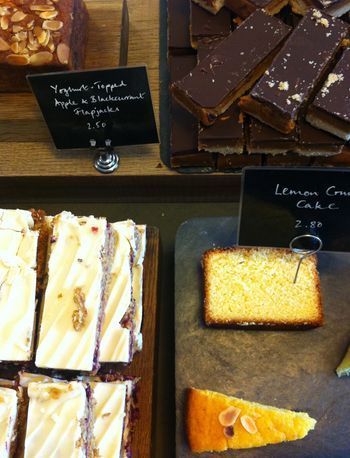
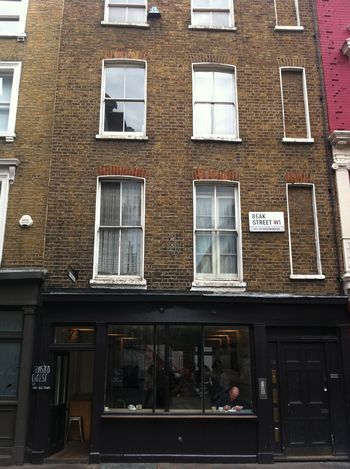
Although Fernandez & Wells has a wonderful deli/sandwich shop round the corner on Lexington Street, this is the F&W place for cake. In fact, it's one of the places for cake in London. Behind an unassuming black wood and glass facade is a light and airy, plain and simple, long and narrow cafe with a long counter filled with generous arrangements of utterly delicious-looking cakes and baked goods on simple slate trays. There is good coffee and newspapers and scrubbed wooden counters and tables to sit at with your chosen cake .
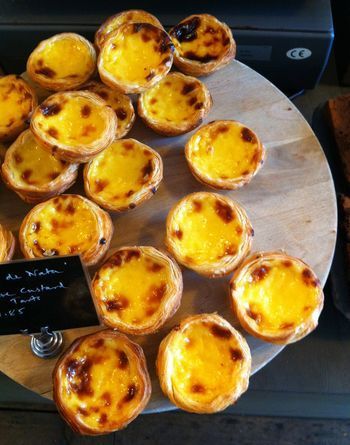
And herein lies the problem, as this the kind of place that places you in a major dilemma. Do you come back many times to work your way through the cakes, go all out for a one-off grande bouffe, or turn up with a crowd of friends and family so that you can order one of everything and share?
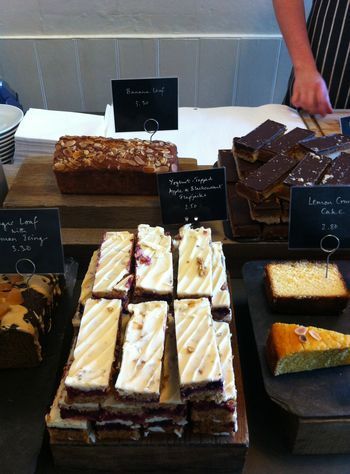
Whatever your chosen solution to dealing with such temptation, you can't go wrong. There are loaf cakes, sliced cakes, little cakes, biscuits and the best pasteis de nata (Portuguese custard tarts) this side of Lisbon. Cakes are classic (coffee and walnut, carrot, lemon polenta) or novel and intriguing (Amalfi orange, pear, buttermilk and lavender, chocolate and brandy), and there are big, fluffy croissants, pale buttery shortbread, generous bars of flapjack and thick bars of millionaire's shortbread that don't cost a fortune. Prices are fair, the staff are friendly, and the location is close to all the attractions of Soho. And it sells Barry's Irish tea in proper tea pots. A true gem.
Slice of cake: £3.20 - £3.50
Tea: £2.00
Coffee: £2.50
73 Beak Street
London W1F 9SR
Tel: 020 7287 8124
Website: www.fernandezandwells.com
Open: Mon – Fri 7.30 – 6, Sat 9 – 6, Sun 9 - 5
And a slice of culture: F&W is in walking distance of the Royal Academy, Shaftesbury Ave theatres, Curzon Cinema, Liberty of London, Berwick Street fabric shops, the Marshall Street Baths, and the delights of Soho.
July 21, 2011
summery
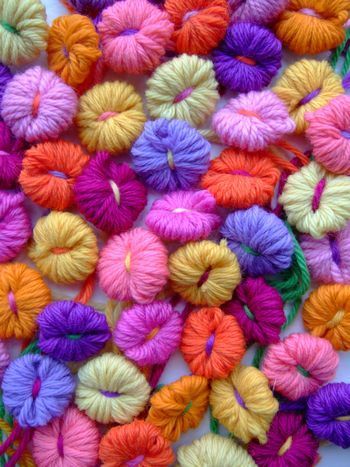
Little wool flowers in summery colours. I made these to decorate a tea cosy in the knitting book, and may just have got carried away with quantities as they looked so nice, scattered like flower heads, on the carpet.
Cascade 220 yarn, instructions in book (see sidebar as TypePad won't let me create links at the moment.)
Jane Brocket's Blog

- Jane Brocket's profile
- 27 followers

