
Jane Brocket's Blog, page 46
February 19, 2012
last words
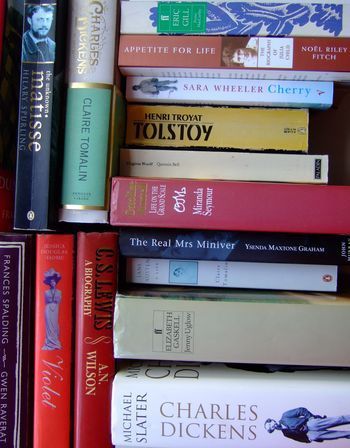
[interesting lives]
I can still recall the warmth, the stillness, the hush in the senior library every morning before the school bell rang. It was clean and quiet and empty, and I could read the obituaries in The Times without being disturbed.
Yes, I started reading obituaries when I was sixteen, and I have been fascinated by them ever since. I like the way they are still just before the sports section, so I know I have something to look forward to towards the end of the paper after the boring business bits (although when I first started working from home, I developed a sudden interest in the sports pages - anything to avoid getting to my desk).
I think my interest in the arcs, trajectories, narratives of people's lives first came with a fictional character, Doctor Zhivago (the book hero, not the Omar Sharif version). As a relatively young reader, I was shocked that so much youthful, gilded beauty, intelligence, and promise could be so painfully and tragically eroded by life, history, and mistakes. I just wanted Dr Z to stay gloriously attractive and fulfill his incredible potential. But this story would not have made much of a novel (even though I know Mills & Boon makes a fortune out of Dr Z Does It Right stories), and it would certainly never have got me hooked on obituaries.
So I went to the library to find out how others' lives turned out, if and how they managed to fulfill their potential, make good despite unpromising starts, go off the rails spectacularly, or change the world in some significant way. I realised early on though, that wives and children (and at that time it was mostly wives and children and very few husbands and partners) were usually consigned to a short, penultimate paragraph, and often wanted to know more about the subject's domestic lives. I aslo saw that there was an accepted format for obituaries, a concentration on the public rather than the private life, and that there was, and is, an unspoken code which helps in reading between the lines.
These days, the obituaries pages include a much wider range of lives, and this makes them even more interesting than in the days when they tended to feature politicians, soldiers, lords and ladies, eminent surgeons, pillars of the establishment, and plant breeders. They are also a little - but not a lot - more open and transparent so it's easier to gauge a person's true temperament and foibles. After all, they are full of great stories, great hopes, great achievements as well as sad stories, dashed hopes, and failures. In fact, they are absolutely full of life.
I suppose that what I really learned in the school library is that there are so many different ways to live a life, that it's possible to change direction at any time, that a privileged start in life guarantees nothing, that charm and crime get you only so far, that domestic life deserves more than a footnote, and that no-one gets the last word on their life.
Good obituaries here, here, and in The Times. And Radio 4 has a very good obituary programme which often includes good anecdotes and laughter.


February 15, 2012
cakes galore
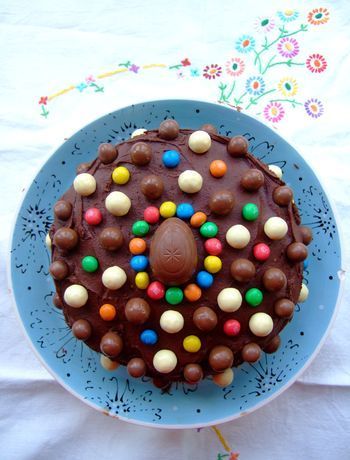
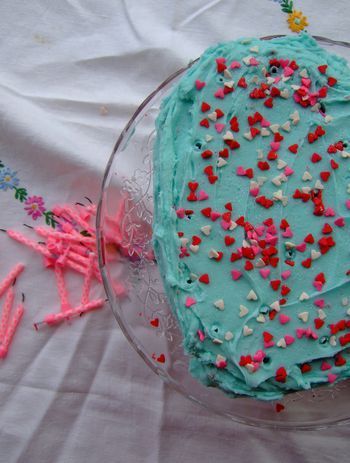
Last cake for this week. This was made by Phoebe for Tom.
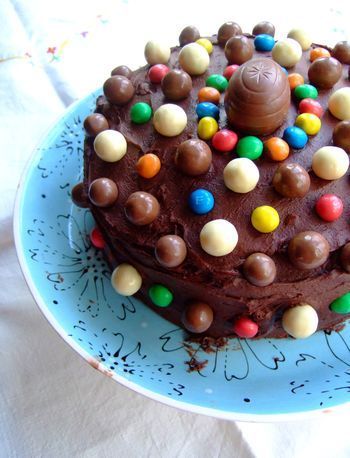
I was happy to hand the kitchen over to her for this and Alice's cake yesterday, as I have just come to end of baking cakes for a book which will come out in September. I have lost count of how many cakes I made in the end (there are over 90 in the book), how many eggs, bags of sugar, flour, almonds, tubs of baking powder and bicarbonate of soda, how much butter, icing sugar, spice I have been though in the last few months. The only thing that was used in moderation was food colouring paste which explains the blast of colour here this week.
I love cake, I love making cakes, but if I crave anything now, it's a big bag of smoky bacon crisps.
February 14, 2012
my funny valentine(s)
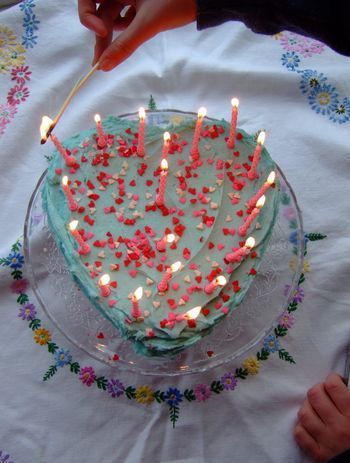
Phoebe who made a heart-shaped cake for Alice* for her birthday today.
Alice who got up at 6am to go to work, but who will be making up for today's lack of birthday excitement at the weekend.
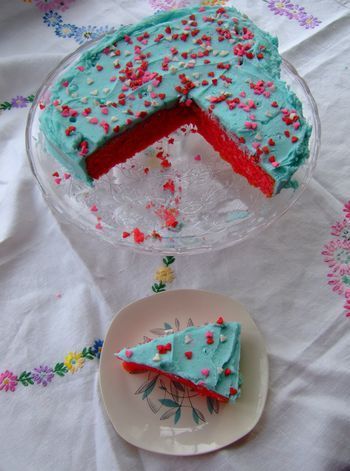
Tom* who is back from university tomorrow for his birthday cake (chocolate) a day late.
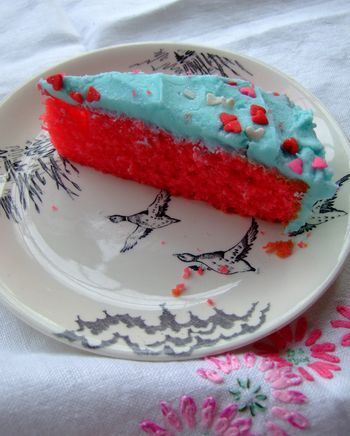
The colouring pastes came out in force and I should never have doubted whether pale blue buttercream would work with shocking pink sponge. Of course it does. While Phoebe baked, we listened to various people singing 'My Funny Valentine'. My favourite version is by Elvis Costello (weirdly), while Phoebe's is by Frank Sinatra.
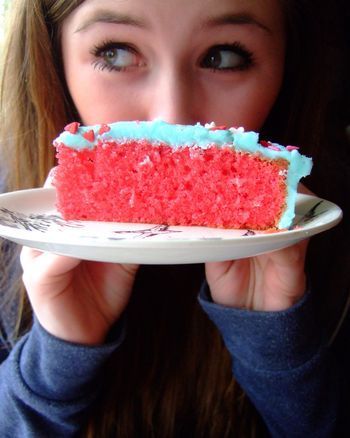
But this, from a contrastingly pale album, is for Simon.
*Our funny Valentine twins, nineteen today.
February 13, 2012
suburban myth
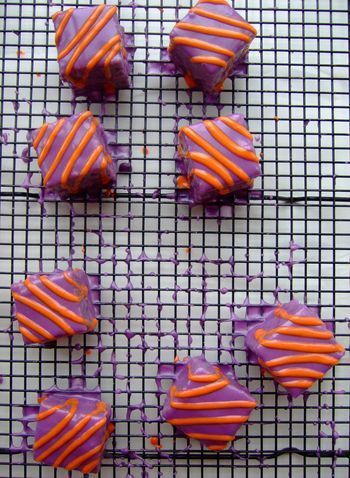
It's half-term. Phoebe is at home. So it's time to get out the food colouring pastes.
Actually, I was trying a recipe and fancied making the fondant fancies fancier than the usual pink, blue, and yellow varieties. The recipes I have found for fondant fancies (aka French fancies) make light of the faffy business of icing them, to the point where you begin to wonder if the people who wrote them actually ever made the cakes themselves. The one that made us laugh the most told us to use 100g of icing sugar to ice a batch of 20-25 fancies. Well, we would have laughed if we hadn't had every surface, finger, bowl, and wire rack in the kitchen covered in fondant icing instead of our 25 sponge cubes. In the end we iced 16 fancies and used 880g of fondant icing sugar in the process, and the place looked as though Jackson Pollock had just had a fight with Wayne Thiebaud.
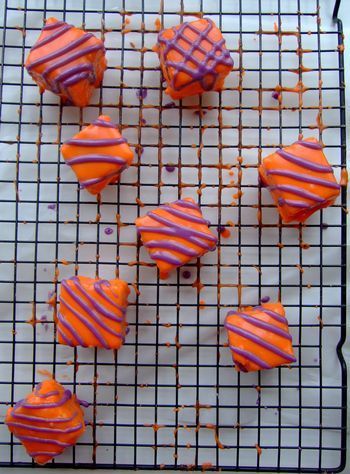
I've always considered the fondant fancy to be the epitome of the dainty, suburban cake. But it's a suburban myth that they require dainty quantities of sugar. And another that they have to be in tasteful colours.
February 11, 2012
like riding a bicycle
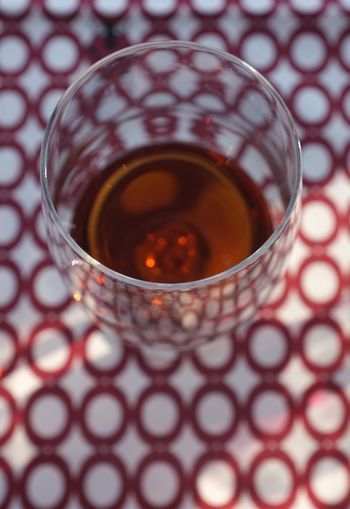
I did wonder on my way there whether spitting was a little like cycling which, people say, is once learned, never forgotten. I'd planned to practice in the bath, aiming at my toes as I used to do when I was learning how to spit (because I'd never done so in my chidlhood), but it slipped my mind. So when I got to the wine tasting (wearing dark clothes, because I did remember that you should never wear pale clothes to taste dark wine, no matter how good a spitter you are), I made sure I started with the champagne as the fizz ensures a better aim and more stylish spitting-out.
By the second table (wines from Alsace), I was spitting just as I did during my many years of working in the wine trade, and writing tasting notes, and forming opinions on wines, and questioning winemakers and, best of all, seeing many old friends. It was all like riding a bicycle, as though I'd never got off and put it away in the garage for a while. In a way I hadn't, as I've always maintained a healthy interest in wine, tasting for enjoyment, and assessing the bottles we buy. I say 'I', but it's 'we' really, as Simon has always been just as enthusiastic about wine (we've had some amazing holidays in wine regions) and is a dab-hand with a corkscrew.
Sometimes when you move away from a part of your life, you tend to forget it exists without you. Going into the tasting today reminded me that these wine events have been carrying on all the time I've been absent, and it was like stepping back into a scene that had been playing on a loop, with the latest vintages being the only way of knowing that time has passed. I'd also forgotten how the wine trade picks some of the best places in London to hold its tastings, which is how I've seen inside many otherwise closed-off locations. Today's tasting was in a swish hotel ballroom, with a suitably swish lunch buffet (another thing to remember: people who deal with wine usually like good food) and was a haven of warmth, excellent wines, and a huge amount of bonhomie.
All this reminded me why I enjoyed working in the wine trade for so long, why I felt at home there, and why I love wine itself. This was a tasting organised by a group of family-owned businesses*, and the wines all had personality and integrity. Favourites included the Hugel Pinot Gris Tradition 2008, Perrin Gigondas 2009, Pol Roger Pure NV, and to finish on a high note, Graham's 20 Year Old Tawny Port.
I spit, I spat, and I didn't fall off the bicycle, but it might have been a bit wobbly on the way home.
February 8, 2012
ufo
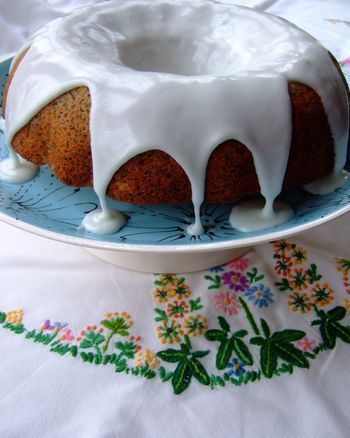
This morning, I made the lemon icing for this poppy seed bundt cake very carefully, aiming for an artistic/scallopy/swag curtains effect. But it was thinner than I'd planned, and the cake turned out looking like a flying saucer or UFO, the type that rests big suckers or stabilisers when it lands on Earth or a far-flung planet, or appears in a Smash advert.
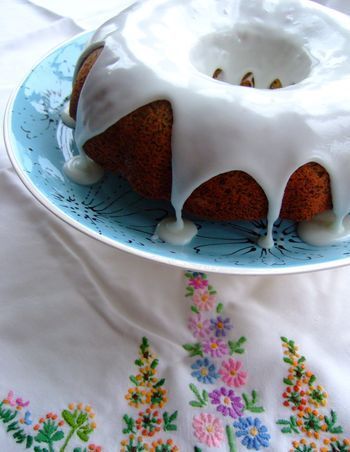
Except I just can't find a photo of the kind of UFO I'm thinking of. Which makes this an unidentified UFO cake.
February 5, 2012
in passing
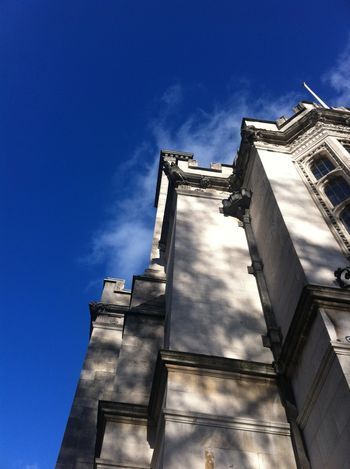
[an apparently smoking Two Temple Place where a friend and I saw a William Morris exhibition and gawped at the Astor interior]
I don't take many photos with my iPhone, but when I do and I look through them a while later, I am always surprised by them. It's not that they are marvellous or anything, but they capture passing moments in a way that takes me by surprise. I'm still amazed in a very old-fashioned way that something so small can do so many things, and do them well. I can't quite believe that I can video a minute of Phoebe drumming in a concert then watch it on a train. Or that I can photograph Alice in her smart work uniform and send it to her Nana in a matter of seconds. Or that I can snap a scrum-half at a rugby match and let Tom know which team we are watching even though he's in a library, writing an essay.
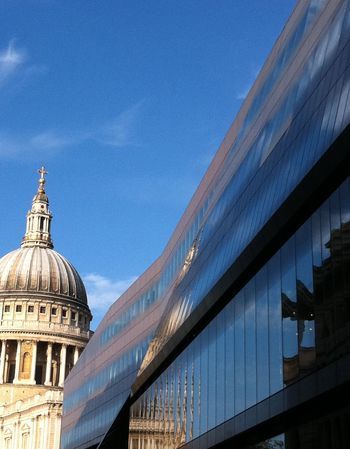
[old meets new near St Paul's]
I don't always bother or remember to carry a camera when I go to London and I often regret this omission until I realise that I am carrying a camera - in my phone. So if I am passing something that catches my eye, I can still take a photo. The thing is, I'm not always quite sure what I'm doing; hence the surprise when a photo turns out OK.

[passing Maison Bertaux]
The iPhone seems to do blue particularly well, and it's so fast and quiet, it can be used on the move with the minimum of fuss (but with a sad proportion of badly composed shots).
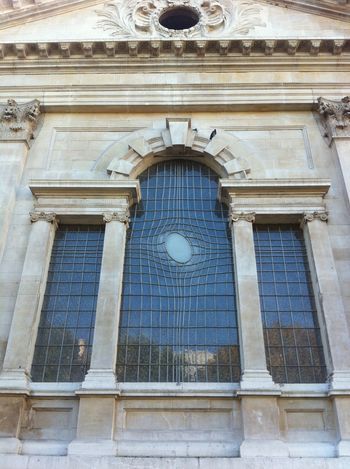
[passing St Martin's-in-the-Fields' intriguing modern window]
It's great for when I'm walking past London landmarks,
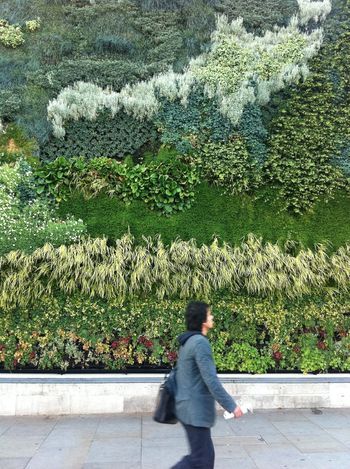
['living wall' outside to the National Gallery]
or when someone else is walking past the Van Gogh 'living wall' last year.

Or when we have a very laid-back snowman made at midnight last night by Phoebe and Eloise. He's just passing, too.
[all photos taken with my iPhone]
February 2, 2012
feeling the cold
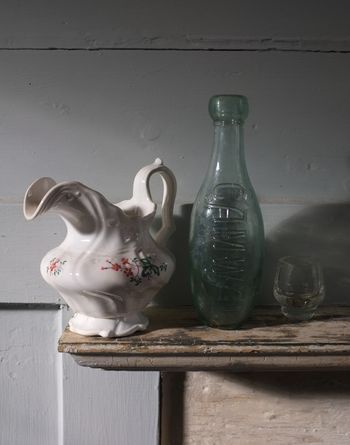
The old-fashioned British attitude to the cold weather still baffles me. Why on earth did/do we struggle on in unheated houses and flats when even the poor Russians in the nineteenth century knew how to keep their wooden houses warm, and a visit to a Scandinavian country in winter makes you realise that it's not absolutely necessary to suffer in winter?
We live in a draughty house (it was built in 1929) and we do our best to keep it warm. But yesterday I went to an amazing location in London for a photoshoot for my book, and it made our house feel like an overheated sauna. It was beautiful, atmospheric, layered with history, full of original features (it was built in the early eighteenth century) and bloody freezing. There were draughts that were more like Arctic winds, and a chilliness that felt like the inside of a fridge. It was authentically cold; poeple lived here for several centuries and didn't bother to install any form of heating other than small, open fires that had to be lit every morning.

In the first room we used there was a copy of the book I am reading, and it couldn't have been more apposite. This house was in Spitalfields, one of the parts of London Dickens wrote about, and it's recently been used as a location for the TV adaptation of The Mystery of Edwin Drood and the film version of Great Expectations and, a while ago, for the BBC's Bleak House. Dickens is just as good on feeling the cold as he is on the jolly warmth of the hearth, but I'm still wondering how any of the characters who lived in similar places (and the actors playing them in this house) could speak without their teeth chattering permanently.
[By coincidence, this morning I saw this beautiful shawl knitted by Suse. Clearly this is what I need to be knitting to combat the cold.]
January 30, 2012
sensory overload
I've just been to the Hockney exhibition. The colours are brilliant. The canvases are enormous. The exhibition is enormous. The crowds are thick. It's everything they say it is in the reviews. It's great. It's limited. It's full of meaning. It's empty of meaning. It's all about looking. It's repetitive. Its repetitiveness is its strength. It's shallow. It's deep. It's a joy to behold.

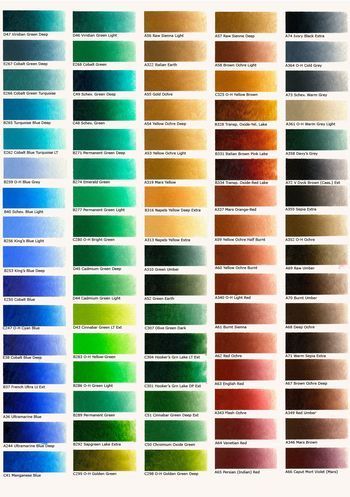
I loved being immersed in that much colour, wandering through a gloriously bright landscape. And at some point I began to wonder just how much oil paint Hockney used to paint the pictures here. Does he order his supplies by the tube, by the tin, by the bucket, or does he have oil paints delivered by his own personal paint pipeline? When he turns on the taps in the studio, do gallons of emerald green and shocking pink, lemon and turquoise, scarlet and viridian pour out? How does he write his shopping lists? Does he have Cadmium Yellow, Prussian Blue, Sap Green and Magenta where we have bread, milk, and baked beans? Because I tell you, there are acres of Yorkshire in there, all painted in huge, fluid, exuberant, confident brush strokes which probably each use up a little tube at a time, and it's not just a celebration of landscape, it's a celebration of a spectacularly rich and expressive medium.
[colour charts for Old Holland oil paints, although Hockney - and Howard Hodgkin who is also very generous with paint - has been known to use Michael Harding's paints]
January 27, 2012
sensory balance
Ever since reading DH Lawrence's novels in my teens, I've been confused about the difference between 'sensual' and 'sensuous'. I've now given up trying to remember, as I think both are pretty good, quite like the mix of the two anyway, and am always keen to keep up levels of one or the other or both in my life. However, much as I enjoy a good dose of sensory overload from time to time (I'm going to the Hockney exhibition next week for precisely that), I like to keep some semblance of sensory balance. Looking back over the last week or so, I find it's been pretty much evenly spread out, ready for the scales to be tipped by Hockney. So here are the ingredients to be weighed:
Sight
Seeing The Artist made me realise how little we 'read' the cinema screen these days. With so many fast, noisy, spectacular films that blast your senses, it's no longer necessary to keep your eyes fixed on the picture, and it's too easy to let your attention wander without losing the plot. But this film demands that you look for, and take notice of, every detail, expression, background prop for visual clues, hints, jokes, and silent narrative devices. Look down or away, and you could miss something very important. It's beautiful, clever, creative, and as demanding as reading a book.
I couldn't go any amount of time without using my eyes to read words. The Pickwick Papers (with the bonus of illustrations by Seymour, Buss, and Phiz) requires very good use my 'optics' as they say in the book. Much as I like the idea of audio-books, I prefer to read Dickens on my own and in silence as his characters seem to bring out the worst tendencies in so many otherwise good actors/readers.
Alain de Botton's latest book also requires much focussing of eyes and brain on words and pictures. I'm not so sure this is a keenly thought-out as some of his previous books, and begs as many questions as it asks. But maybe that's the point.
Sound
The Artist: not silent at all, with sound used to great effect.
Me, laughing at Mr Pickwick, Mr Jingle, and the Fat Boy.
Alain de Botton speaking to a packed Conway Hall, where you could have heard a pin drop if there had been any pauses in his fast, fluent, articulate Sunday 'sermon'. And listening to him again on Night Waves on Radio 3.
Silence - while I read (see above).
Smell
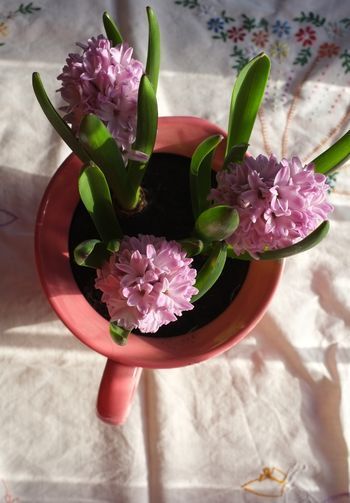
Another batch of hyacinths, this time in a cracked jug that I bought years ago and have filled with bulbs each winter ever since.
Grated nutmeg - the smell of wobbly custard puddings, rock buns, and childhood. Just grating one makes make me think of Peggotty in David Copperfield when David describes her finger as being 'roughened by needlework, like a pocket nutmeg-grater'. Perfect. It would be very useful to have such a finger of one's own as it would save on the washing-up. It could also be used for zesting lemons, another smell in the kitchen this week (and every week).
Touch
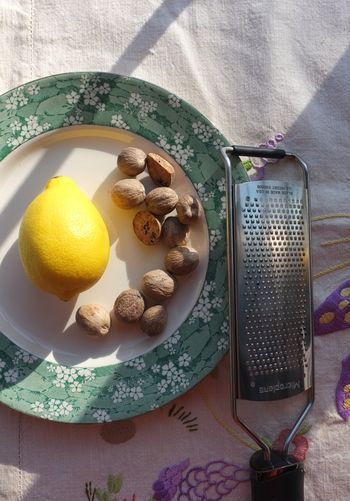
Whole smooth nutmegs, waxy lemons, and thoughts of Peggoty's personal nutmeg grater (see Touch, above).
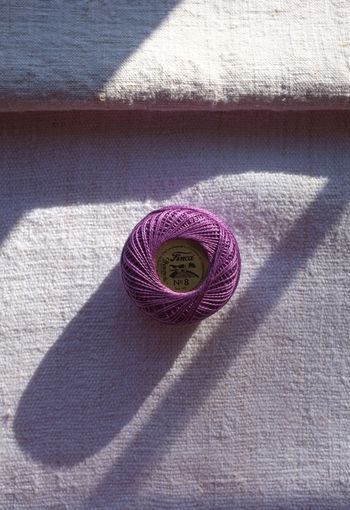
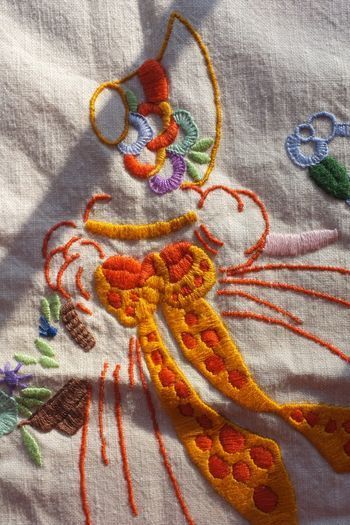
Soft, nubbly, vintage linen waiting to be turned into something and stitched with smooth cotton perlé threads. I have pretty much abandoned quilting cottons in favour of more textured threads. If I am taking the time to hand-sew, I want to be able to see and feel the stitches.
Hand-stitching on old tablecloths.
Taste
Nutmeg cake (see above).
Spicy, aromatic noodles with ginger, chilli, lime, lemongrass, coriander, and the quite disgusting but essential Thai fish sauce nam pla (see also Smell above) made to a family-favourite Nigel Slater recipe in Appetite. Comfort food, guaranteed to get everyone sitting round the table and talking (see Sound, above).
Port to go with Pickwick. It should of course be Mr Pickwick's Particular Port [sic] made by Saltram (a company I used to work with years ago - Pickwick was one of the particular perks of the job). But I make do with Graham's LBV. Everyone in The Pickwick Papers drinks so much it would be rude not to join them.
Result
All things weighed, quite a satisfactory balance, I think.
Jane Brocket's Blog

- Jane Brocket's profile
- 27 followers

