
Jane Brocket's Blog, page 44
March 29, 2012
eyes screwed up
I still don't know if she was being patronising or sincere. I was staying with friend who was at university with me at the time, as we both had interviews in London the next day. At dinner her mother asked me where I was from. I told her Stockport, but went on to say how much I liked Manchester and other northern cities. 'Ah, yes,' she said, 'If I screw up my eyes when I am in Bradford, I could almost believe I was in Florence'. Everyone else round the table nodded sagely. Well, she had a point. Some of the C19 warehouses in Manchester are certainly Italianate in style, and I had to take her word for it that Bradford's are the same. But still, I couldn't quite decide.
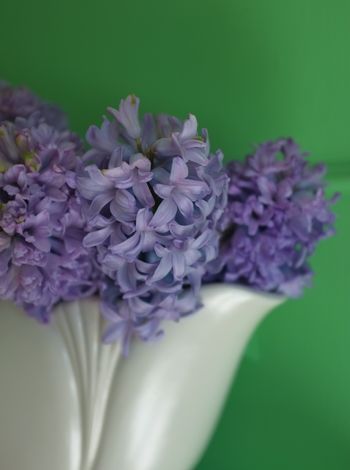
Any mention of Bradford always stirs up this memory. I'm thinking about it today because I've just been in the garden to pick a big bag's worth of hyacinths which are perfectly open and beautiful this morning. They are called 'City of Bradford', but do you know, if I screw up my eyes, they could just as easily be called something more rarefied, like 'Cambridge Blue'. (The underside of each flower is the exact colour.)
The funny thing about the visit to my friend was that I was totally unaware at the time that she lived in Highpoint, which was designed by Berthold Lubetkin and is one of the masterpieces of 1930s Modernism. If you'd asked me then, I could have screwed up my eyes and said that that it was just a block of flats. I've never forgotten this useful little lesson in the various forms of snobbery, inverted, perceived, or otherwise.
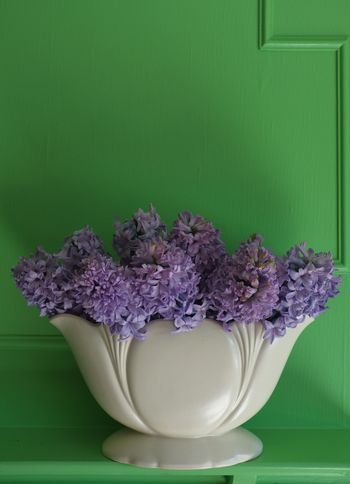
[The flowers are in a Dartmouth Pottery 'mantle vase', ie designed to sit on a mantlepiece. It's very Constance Spry, who designed some beautiful mantle vases for the Fulham pottery.]


March 28, 2012
national treasures
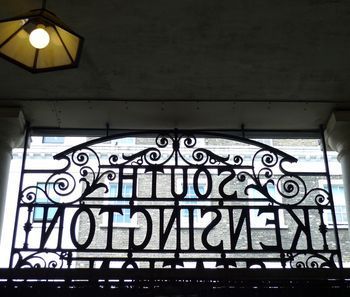
[South Ken tube station as you arrive to visit the various museums in the area]
I would imagine that having the title 'national treasure' conferred upon you is something of a burden - just one small outburst or late night out in the wrong company or whiff of something less than cuddly and teddy-bearish about your previous life, and whoosh, you're out of favour. Alan Bennett, Judi Dench, the Queen, David Attenborough, Stephen Fry, Cliff Richard must all sometimes wish the press would scrap this 'honour'.
Especially when we have some real national treasures, the sort that sit quietly in galleries and museums, waiting to be discovered. The blockbuster exhibitions are all well and good - I revisited the Royal Academy's heaving Hockney exhibition with Phoebe at the weekend ( Hockney is a National Treasure who refuses to play the game and fires off pro-smoking letters to The Guardian on what seems like a weekly basis) - but sometimes the best treasures are in smaller exhibitions and collections, sometimes on show all the time, but generally don't attract fanfare or fuss.
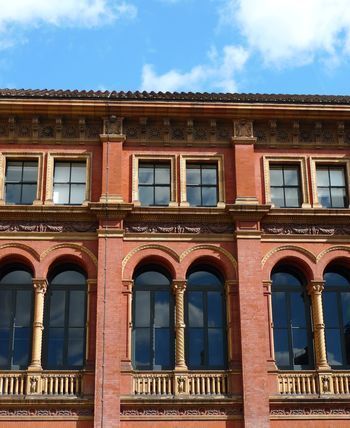
[V&A]
Like the jewels in the V&A. I'd never been in this gallery until last week and was astounded by the collection which inclused spectacular tiaras and emeralds, beautiful modern necklaces, and gorgeous grapevine earrings. (Free)
Or the incredible Ceramic Staircase, and the Ceramic Galleries which house the V&A's collection of silver. (Free)
Or the small but beautifully selected exhibition of post-1945 British photography. (Free)
[Natural History Museum]
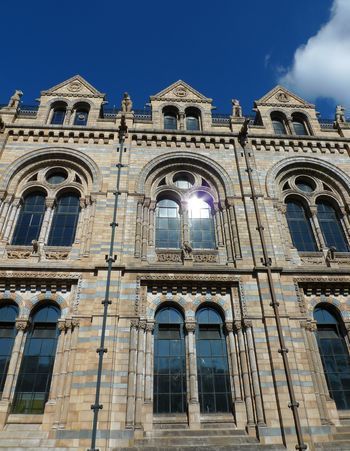
Then there's the exterior of the Natural History Museum, and the stuffed animals and dinosaur skeletons inside. (Free). There is also currently a Scott exhibition which is full of things like sleeping bags and tins of pemmican and the specially designed expedition cutlery. (They had different sets for the men and the officers - the officers had fish knives but the men didn't. In the Antarctic.) It's very much aimed at children and isn't free.
But the exhibition at the Scott Polar Research Station in Cambridge is absolutely free. It has much of what the NHS has (pemmican, sleeping bags, sledges, boots) but is less grand and more heart-breaking (some paper party hats they took for celebrations are in there); it's hard to look at the sketchbooks and diaries and last letters written in pencil without feeling directly connected to the events and the men who wrote them.
The Fitzwilliam is also free - I'd go just to see this painting.
And in Edinburgh, the newly restored Scottish National Portrait Gallery contains many treasures including some wonderful black & white C20 photography. But the best thing of all is the short film made by some teachers in the early 1950s of young girls singing and skipping their way round the streets of Edinburgh. The cinematography has echoes of Henri Cartier-Bresson, and it's hard to believe the film isn't better known. Also free. (You can see it here.)
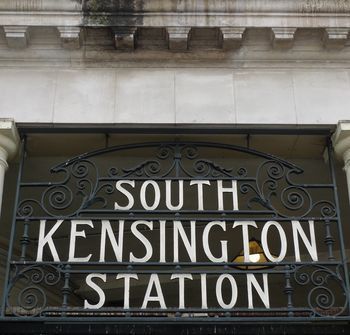
[South Ken station as you leave, culturally full]
March 26, 2012
selling from home

Years ago, Tom, Alice & Phoebe used to sit in the kitchen which has a large, wide window, and discuss their plans for 'Jane Brocket Stores'. They decided that we should alter the window so it could open fully and be turned into serving window, a little like a catering or ice-cream van, for my very own shop. Through it, I would sell cakes and biscuits and drinks on a very casual basis (something like the story in which a 'lady cyclist' stops to buy a glass of milk from Muvver in a Milly-Molly-Mandy story), and it would have the best advertising campaign ever. (By Tom, aspiring copywriter & creative director, aged I don't know what but a lot younger than he is now.)
It turns out theirs wasn't such a new and original idea, as I read yesterday about the closure of the last 'hole in the wall' oatcake shop in Hanley in Staffordshire. (More here, about 2 mins in.)
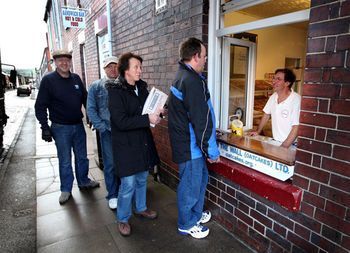
Such shame that it's due to redevelopment rather than business failure, because this looks like a fantastic, sociable way to sell and buy fresh, home-made oatcakes. It makes me think there is now more reason than ever for opening Jane Brocket Stors [sic].
March 21, 2012
natural chandeliers
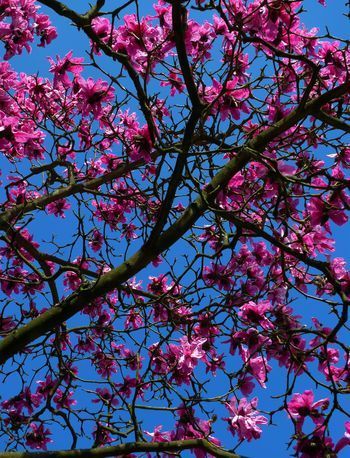
I drove Phoebe to school this morning (she normally gets the school bus) and the price she paid was having to put up with me pointing out all the magnolias on the way. There are some in the small front gardens that line the road to the school, and they are having an explosively gorgeous moment, as all magnolias do. Even by tomorrow they may not look the same.
I like all magnolias, but my favourite is the one you see all over the place, the one that is currently erupting in pale pink and cream flowers against an Edwardian red-brick house a short distance from Phoebe's school. It's Magnolia x soulangeana, and it's a beauty. When you plant a magnolia, you are creating a legacy; it can take years for them to grow tall and wide and they aren't for gardeners who like a quick return. When I see a magnolia in full flower, I often think that someone has been very generous to subsequent generations of passers-by.
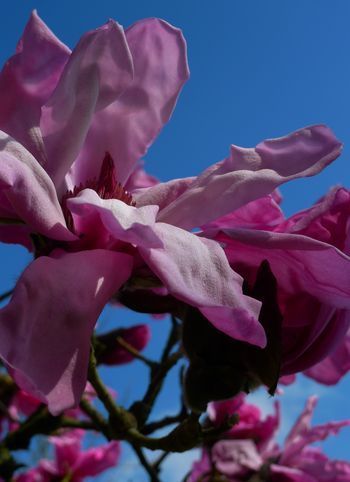
Pointing out the specimens en route to school made me think I should get out and see a few more before the flowers drop and the show is over. The Savill Garden is too much of a plantsman's garden to have bog-standard Magnolia x soulangeana, but it does have some spectacular species that I could get close to without trespassing.

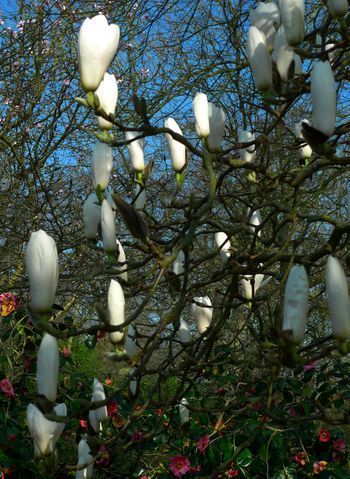
The flowers are enormous, thick and waxy, and when they emerge from the fuzzy buds, they look for all the world like candles in chandeliers, especially as the leafless branches seem to curve down and then up.
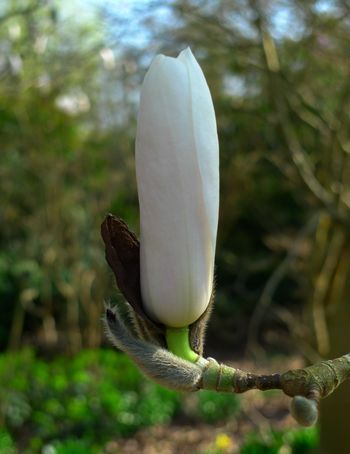
I'd never before thought of magnolias as nature's chandeliers, but I've always known that they brighten up the suburban landscape.
March 20, 2012
the sense of an ending and a beginning
I read Julian Barnes' book The Sense of an Ending yesterday. To quote the main character, 'I didn't get it.'
When did unlikeable characters start to people modern novels? I remember not enjoying Emma because I really didn't like Emma herself, but she is positively delightful (and corrigible) when compared to the selfish, self-centred, miserable characters that appear in so many contemporary novels (I'm thinking One Day, How to be Good, Arlington Park, The Finkler Question). Even Jane Austen's anti-heroes and heroines have an attractive warmth and full-bodiedness, whereas today's versions are self-absorbed, unreliable, and scarily unemotional. Thank goodness for the world of Persephone and books that are full of interesting characters who may be weak and fallible and contemptible, but never this detached, cold, and flatly drawn.
There's another sense of an ending for me as well at the moment, a more uplifting one this time. After six years of non-stop work, I'm giving myself a break. I have a book to write by the end of the year, but as that won't take up all my time, I'm going to do a few other things like taste wine, wonder whether the website is worth the time and money and, if so, do something about it, consider a few new ways of using my material, do some different writing. I've got a long list of films to see, books to read, and I want to get back to creating for the fun of it. So as the deadlines are met, and pressures lift, I have a very pleasant sense of an ending - and an even more pleasant sense of a beginning.
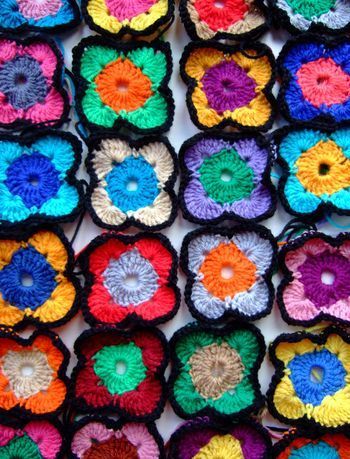
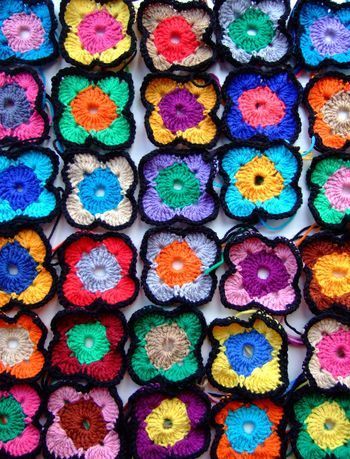
[I've just picked up my crochet hook again, and am at the beginning of a blanket - only a couple of hundred more squares to go. The yarn is Biggan Design DK which is wonderful but, alas, no longer available in the UK.]
March 18, 2012
pontefract sweets

[Haribo snake plait]
I've always liked liquorice (never been able to understand how it could be pronounced 'lickrish'), and like it all the more for the fact that it's historically associated with Pontefract, or 'Ponty' as we always used to call it, as this is where the other half of my small family lived when I was growing up.

[Haribo fried eggs]
In fact, my auntie and a cousin still live there, but now instead of the old-fashioned, teeth-blackening, chewy Pontefract Cakes that I loved so much, these days it's nearly all soft Haribo stuff, because Ponty is home to a huge Haribo factory.
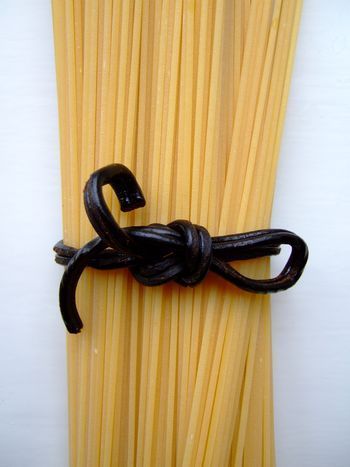
[pasta with liquorice ribbon]
It's not a very romantic place; besides liquorice, I always associate it with coal mining, horse racing, and rugby league, but John Betjeman wrote a poem about Pontefract, and the novel/film This Sporting Life was set/filmed in Wakefield which is the next-door town, which now has the stunning Hepworth (which I haven't yet visited but very much want to).

[pasta with Haribo snake tie]
But nowadays it's the centre of chewy, flexible sweets that have all sorts of applications, as I found out when I had a play with the contents of a few bags a while ago.
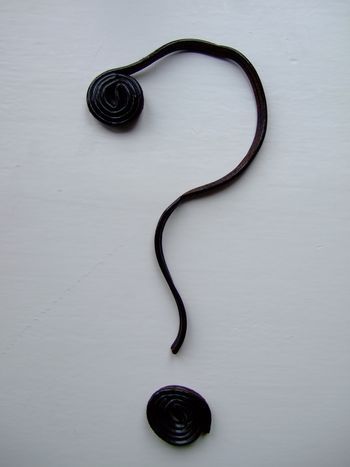
[existential liquorice]
However, some things never change and there are still plenty of things you can do with a liquorice wheel.
March 14, 2012
cause for celebration

I've just read Northanger Abbey all the way to the end.
Only the third attempt, but some books just don't click first time...or the second time. I had the luxury of being able to read it undisturbed by family life while I was Edinburgh, reading and reading until I reached the last page late at night. And I really enjoyed it. It made me laugh - I thought John Thorpe was brilliantly drawn and he reminded me of the boorish bloke in Four Weddings and a Funeral who calls all women 'fillies'. It is far less subtle and controlled than, say, Sense and Sensibility and Pride and Prejudice, but is energetic, natural, and funny. It has its plot deficiencies, and the character of Henry Tilney seems to change from rather high camp gossip at first to solid Austen hero later, but it has so much else that I can overlook the shortcomings.
We had to read NA at school when we were about 13, and I understood nothing of it (I'm not sure I ever read it from start to finish), and I can just remember being utterly bored by Bath and the C18 male/female roles. I had absolutely no idea that it parodies Gothic novels, and that in the course of the book Catherine learns how to read people/life/books properly rather than through the prism of melodramatic and romantic stories. Reading it now makes me realise what a bad choice it was for young teenage girls who were no better than Catherine when it came to reading on different levels; we were all Catherines struggling to make sense of a wiser, wittier world. Thank goodness novels can wait for readers to mature. Now it's time to tackle Mansfield Park (again).
[Celebratory cake made by Phoebe. Not because I'd read the book, but for a friend's birthday]
March 13, 2012
how not to force a hyacinth
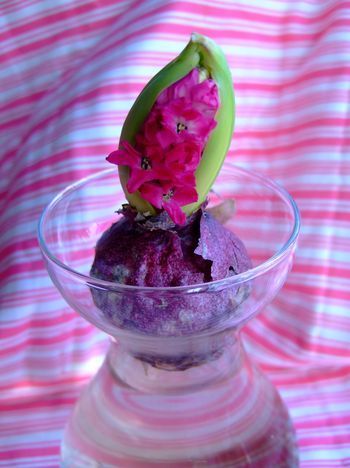
1. Start the bulb off in the vase in late January, just as all the correctly forced indoor hyacinths are finishing.
2. Keep it in a semi-dark rather than dark place.
3. Leave it there much longer than you should, and realise your error only when you see that all the other hyacinths started off at the same time have bolted for the square of sunlight and are pale, lanky, tiolated, and have a few, sparse flowers instead of generous clusters.
4. Leave the stunted hyacinth in the semi-dark even when you have taken the others out into the daylight, in the mistaken belief that you can force this flower out of the bulb.
5. Finally realise on March 12 that this is as good as it's going to get. Take it out of the porch, and call it a bonsai bulb. Claim this is the result you were aiming for all along.
March 12, 2012
soon
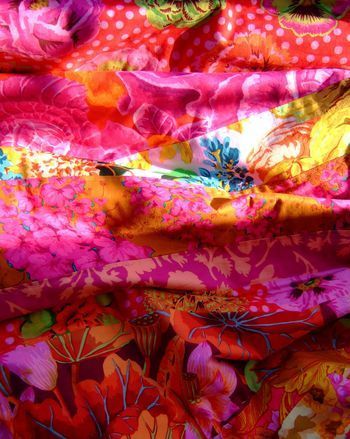
Soon is the word I've been waiting for, for a long time. Soon I will have met the deadlines that have been pressing down on me, soon the tulips will be out, soon I shall have more time to read, soon I shall be tasting lots of wine, soon I shall be able to get on with new things.
There are also a couple of things coming up soon. This is my 'Tulip Fields' quilt, ready to go Cambridge on Friday 16 March when I shall be talking to a meeting of the Cambridge Quilters, and
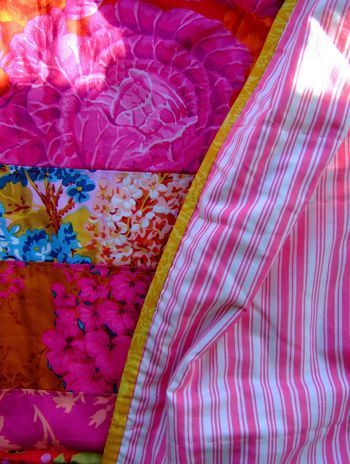
on Sunday 18 March from 11.30 to 13.30 I shall be on the Mollie Makes stand at the Stitch & Craft Show. Do come and say hello if you are visiting.
Soon sounds so good.
March 11, 2012
pottering
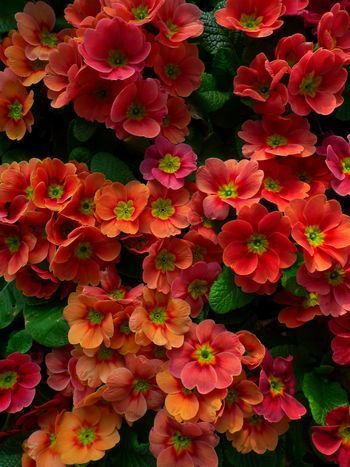
Pottering with pots of primulas.
Jane Brocket's Blog

- Jane Brocket's profile
- 27 followers


