
Jane Brocket's Blog, page 45
March 9, 2012
black and white
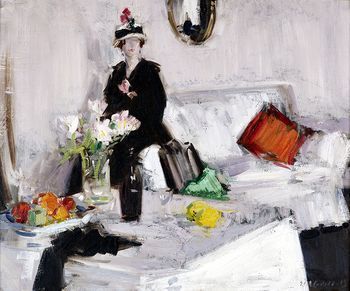
['The White Room', FCB Cadell, 1915]
The Gallery of Modern Art in Edinburgh has a wonderful FCB Cadell exhibition until 18 March. The walls have been painted a pale lilac, the colour of Cadell's Edinburgh studio in the 1920s, and this shade sets off the cool, controlled, beautifully composed paintings.
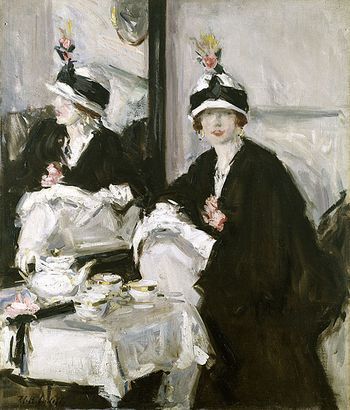
['Reflections', FCB Cadell, c1915]
Cadell was one of the 'Colourists', an informal grouping of four artists who were associated with Edinburgh in the early C20. All four moved away from the typically subdued nothern palette, and used colour in a way that was unsual and ground-breaking at that time. But what always strikes me about Cadell is the way he uses the so-called non-colours, black and white, to such remarkable effect. Many of his titles include the words 'black' and 'white', and a room full of his paintings is an amazing meditation on the role the two colours can play in art.
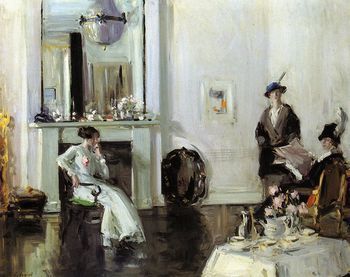
['Afternoon', FCB Cadell, 1913]
He is also brilliant with reflections and shiny surfaces (silver tea pots, glass vases, chandeliers), and a master at placing small, bright spots and flashes of colour; his interiors and still lifes in particular frequently include details of floppy pink roses, tangerine cushions, scarlet chairs, emerald bowls, and fresh lemons, al of which leap out of the large areas of black and white.
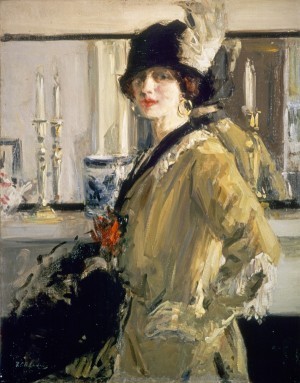
['The Black Hat', FCB Cadell, 1914]
Cadell's later life is a sad story, and much remains unknown and unsaid. The empty rooms, the empty chairs, the extreme contrasts of black and white, could all be seen as stylishly aloof and sophisticated, but could also be construed as somewhat distanced and melancholy. But this is an undeniably uplifting exhibition which also includes a room full of landscapes painted on Iona, and some of the cartoons (which hint at his well-known wit). But what I liked most was the fact that the two colours you would most expect to be thrown out of the so-called Colourists' paintbox are the ones that make Cadell's exploration of colour so engrossing and enthralling.


March 8, 2012
faster than fairies

[Berwick, from a railway carriage]
When I was seventeen, I travelled by train from Stockport to Cap d'Agde in the south of France, to work as an au pair for eight weeks. It was my first big journey on my own, and I was practically hanging out of the train most of the time, watching the landscape change, trying to read the names of stations as we zoomed through them. I was enthralled by the ferry train to Dover, the flat north of France, the huge, glamorous Paris termini, the increasingly dry and dusty south, and the idea of waking up in Béziers after a night's travel (bolt upright, packed carriage, constant Gitanes/Gauloises smoke, no sleep - not as delightful as I'd imagined). But it converted me to train travel (not that I needed much persuading), and prepared me for travelling up and down India in third class, and for many overnight train journeys in the Soviet Union.

[Newcastle, whistling by]
But it's been a while since I sat on a train for a long time. So when I had a horrible flying experience in December which involved engine difficulties and a rapid return to Heathrow, I decided this was the perfect excuse to re-book my trip to Edinburgh, but this time by train. I'd never been beyond Durham (on the train) and I've been wanting to see the north east for some time. So I reserved a window seat, read until York (beautiful, curving station), then put down my book, and stared out of the window all the way to Edinburgh.
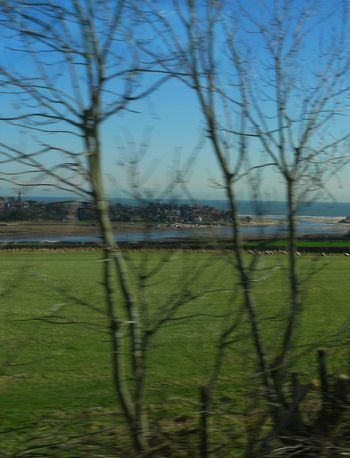
[Alnmouth, in the wink of an eye]
Seeing towns and fields flash by reminded me of the RL Stevenson poem 'From a Railway Carriage', which I used to read to the children; we had a lovely illustrated edition with the horses, cattle, crossings and embankments, bridges and waving boys, all beautifully drawn. The rhythm of the poem is mesmerising (very similar to Night Mail by WH Auden) and as we moved through the landscape I realised how little has changed in the rhythms of, and the views from, the train, particularly in more rural parts. It still feels as though you are going faster than fairies and faster than witches, and 'all the sights' are still there.
But if I were adding to RLS's list on the northern part of the journey, there'd be plenty more to look out for. They may not rhyme or scan, but I'd include fields of cabbages and ruined castles, deep red, sandstone churches in Scotland and tall, fine church steeples in England, the cathedral at Durham, the multiple bridges over the Tyne in Newcastle, the spectacular views of Berwick-upon-Tweed and the shockingly close-up glimpses of the steep drops down to the sea along the wild coast there, the unfeasibly out-on-a-limb Alnmouth and Bamburgh Castle, the glorious, cathedral-like train shed at Darlington, the welcoming, benevolent Angel of the North, spring lambs, chimneys, and the many silver birches which line the tracks. And at either end you have the historic Waverley Station and the stunning, Cubitt-designed King's Cross which should be marvellous punctuation marks in a great journey, but are both currently in a state of utter confusion and chaos due to various works taking place. But you can't have everything, and the bits inbetween are worth the ride.
March 6, 2012
capital cake: princi
Princi
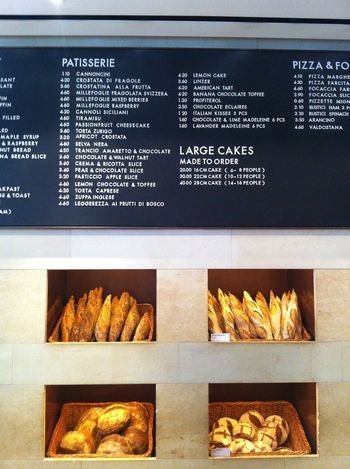
This place comes as quite a surprise in central Soho, the spiritual home of the tiny, steamy, cramped, and much-loved family-run café. By contrast, Princi is large, expansively minimalist, sleek and shiny, with clean lines of slate counters, stone floors, cool metal tables, and marble surfaces. On one side of the large, double glass-fronted interior is smart, spacious bakery, and on the other is a cafe serving food all day which is reminiscent of a upmarket canteen in a spa (there's even a trough of running water along the full length of one wall) or a cavernous cafe in a grand railway station on the Rome to Milan line.
It's modern, noisy, relaxed, informal but stylish, continental in feel, and appropriately multi-lingual. There's the choice of standing for a fast espresso, or taking your time with latte, cake and newspaper (provided) at one of the large communal tables, or perching on a stool for a tea and tiny lavender madeleine or two, all served from proper china. It's big enough for meetings and gatherings, and such is the buzzy atmosphere that if you are on your own, you certainly won't feel alone.
Cakes and sweet treats are cut from huge baking trays, fresh ones being brought out all the time. They are fresh, good and down-to-earth rather than anything fancy or sophisticated, with a solidity and squareness that matches the interior decor. They are not cheap at around £4.20, but portions are generous, flavours varied (lemon, lime, chocolate, pear, toffee or combinations thereof), and all are freshly baked each day on the premises. The lemon cake is crumbly, rustic and hearty, the chocolate cake with a generous slathering of ganache topping is rich, moist and moreish, and a quiveringly creamy strawberry millefeuille is suitably difficult to bite or cut into without squirting cream everywhere. The only quibble is with the complicated and confused queuing and paying system (queue once for food, pay, queue again for drinks), but if you aren't in a rush even this could be construed as charmingly Italian.
What a treat and delight to find somewhere where you have your cake and eat it in London from 7am till midnight, should you wish, although Princi also sells all sorts of baked goods such as seriously good bread and pizza to eat in or take out.
Piece of cake: £3.60 - £4.60
Tea: £1.80
Coffee: £2.30
135 Wardour Street
London W1F 0UT
Tel: 020 7488 8888
Website: www.princi.co.uk
Open: Mon-Sat 7.00 – 00.00, Sun 9.00 – 22.00
March 5, 2012
a few more slices of capital cake
I realise I haven't posted all the Capital Cake reviews I have in my virtual filing cabinet, so I'll be posting a few more. This realisation was prompted last week when I walked past a very closed-down Cox Cookies and Cake in Soho, having just a few days before seen that Mrs Marengo's (also in Soho) is no more. I did wonder how long sex could successfully sell cakes, and the baking landscape is poorer for the loss of such outrageous creations. It's a real shame that Mrs M's is no more as it was a good bolt-hole for more than just cake and coffee - the recession is certainly taking its toll on small businesses. It also makes me wonder if, like shoulder pads after the 80s boom, cupcakes will now start to shrink and become less powerful.
So I have deleted the relevant reviews and hope very much that they will be replaced by new, capital cake places. I've also removed the review of Bea's of Bloomsbury after a couple of disappointing visits to the Bloomsbury cafe, and a quite awful visit to the St Paul's branch.
capital cake: st john hotel
St John Hotel
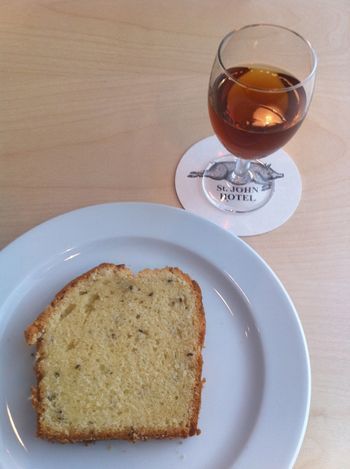
It might be stretching it to include a place purely on the basis of its single cake offering, but this is no ordinary cake.
St John Hotel owner Fergus Henderson has long championed elevenses, the highly civilised mid-morning break that offers a chance for a drink and something fortifying to see one through to lunch. He practices what he preaches, and was to be seen in the simply furnished bar (so simple it could be accused of being antiseptic) soon after 11.00 partaking of a little 'something to keep you steady', as he puts it on the very succinct menu. The 'little something' in this case is the most delicious seed cake (£3), fresh from the oven in the hotel kitchen, thickly sliced and served with a glass of Madeira - a taste of a more leisured, less hurried way of life.
The idea of a cake is as important as the cake itself, and seed cake comes laden with nostalgia and allusions to a different time and culture. It has been scorned for its dryness and plainness, but in a gifted baker's hands these shortcomings are turned into virtues. Unlike the economical seed cake of yesteryear, which was too often made with cheap ingredients and overkill with the caraway seeds, the St John seed cake is a gently flavoured, eggy-buttery dense sponge that belies its plain appearance. Madeira at eleven in the morning may be the height of indulgence, but it is undoubtedly the ideal partner for seed cake, and a lovely way to reclaim a moment in the day that is all too often lost.
Fergus Henderson and his master baker, Justin Piers Gellatly, are to be applauded for reviving a special cake moment.
[Elevenses are also served in the St John restaurants in Smithfield and Spitalfields (see website) where the unbelievably brilliant St John Eccles cakes are also available. These are solid Eccles cakes, the like of which you won't find anywhere else, and the textbook buttery flaky pastry is densely packed with black, sweet currants. They are a meal in themselves, and would certainly keep you going till lunch which at St John could include made-to-order with tiny madeleines served, like oysters, by the half-dozen and dozen, or even until the St John Hotel mid-afternoon 'little bun moment' when 'warm little buttock-like buns' come out of the oven.]
1 Leicester Street
London
WC2H 7BL
Tel: 0203 301 8020
Website: www.stjohnhotellondon.com
Elevenses served from 11.00
Little Bun Moment 3-5pm
March 2, 2012
patterns
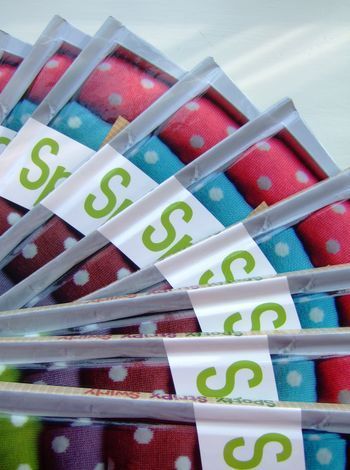
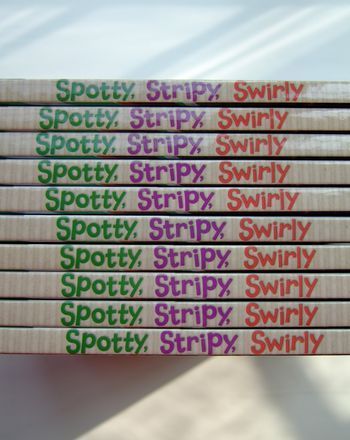
My four children's books are being published in a neat alternating spring/autumn pattern. I've noticed this because I've been noticing lots of different patterns since writing the new title, Spotty, Stripy, Swirly: What are Patterns? which was published yesterday.
It took me a long time to be actively conscious of my interest in patterns; it was Linda Miller who pointed out the obvious when she saw me making machine embroideries of rows of fruit and veg at one of her workshops. But once she'd done that, I started to see patterns everywhere, and not just in tangible objects. I began to recognise patterns in behaviour, speech, and natural cycles, and suddenly many things made sense, and if this book helps any child to develop their powers of observation and prediction, I shall be very pleased.
My editor, Carol, and the designer, Danielle, have done another fantastic job with the book, and I have to say I'm really proud of it. It looks amazing inside.
There's a review here and this review appeared in School Library Journal:
As she did in Ruby, Violet and Lime: Looking for Color and Spiky, Slimy, Smooth: What Is Texture? (both Millbrook, 2011), Brocket has taken a concept and given it the full treatment. Using crisp, bright photographs reminiscent of the work of Tana Hoban and clearly written text in playful fonts, she examines patterns from almost every conceivable angle. There are patterns determined sometimes by shape, sometimes by color, sometimes by object. They run the gamut from simple to quite complex. There are man-made patterns such as brickwork or quilts, and patterns that occur in nature, such as geranium leaves. The author explains their various purposes and encourages children to "look up and down and all around" to try and find them. This book is a visual treat that could be used by teachers looking for ways to introduce the topic, and it will attract browsers as well. A first purchase.—Grace Oliff, Ann Blanche Smith School, Hillsdale, NJ

And this review is in the February 15 issue of Booklist:
The third book in the Jane Brocket's Clever Concepts series presents patterns. While the large-print text explains what patterns are, how they vary, and why they are useful to people, the large, colorful illustrations steal the show. Heightening viewers' awareness of the patterns around them, the photos focus attention on subjects that vary from the print on new sneakers to the geometric arrangement of old ceramic tiles, from the creative plantings of dark and light lettuces to the glass-and-steel triangles that make up a distinctive skyscraper. Like Spiky, Slimy, Smooth: What Is Texture? (2011) and Ruby, Violet, Lime: Looking for Color (2012), this volume offers plenty of textures and colors to enjoy as well. Parents and teachers looking for a concept book on patterns will find this a rich collection of photos that can spark any number of discussions around the subject. — Carolyn Phelan
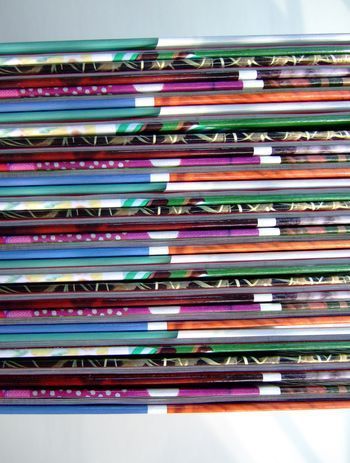
(The tops of the books make an interesting pattern, too.)
February 29, 2012
bff pansies
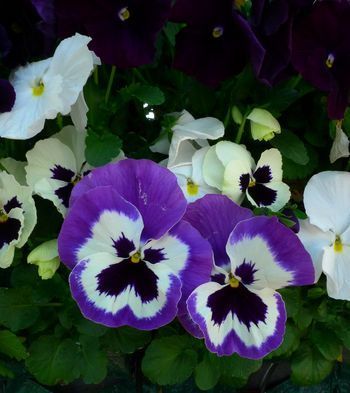
I took this photo last spring, but whenever I see it in my photo album, it amuses me because it looks as though the pansies are posing for the camera. It also makes me think of wedding photos and Facebook photos - there there must be millions of them like this, two smiling friends posing with their heads tilted towards each other, bff and all that.
February 26, 2012
sunday morning
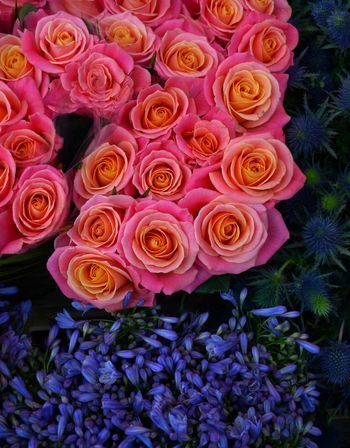
My taste in music is all over the place. Frank Sinatra. Bluegrass. The Beatles. Elvis. Everything But The Girl. James Taylor. UB40. Johnny Cash. Motown. Bob Dylan. I can even admit to liking three or four Andy Williams songs. And now Lou Reed and the Velvet Underground.
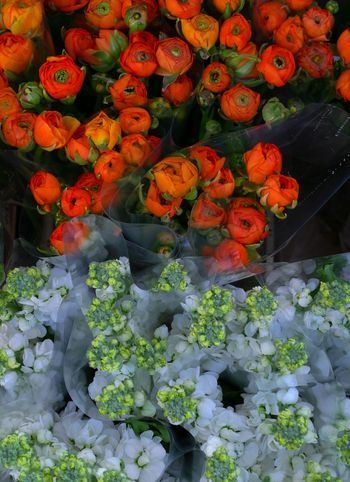
I never liked Lou Reed when I was growing up. Too seedy, too druggy, too thin. But now I'm past the age of being worried about adverse influences, his music is one of the soundtracks to my car journeys. I love the the way he pronounces 'femme' in 'Femme Fatale', the way he can barely articulate the separate words in 'Pale Blue Eyes', the way he threads his way delicately through 'Stephanie Says', the way he makes drinking 'sangria in the park' seem like the best way to achieve a Perfect Day, and the way he makes 'Sunday Morning' the obvious accompaniment to a lie-in with newspapers, or a drive to Columbia Road flower market.
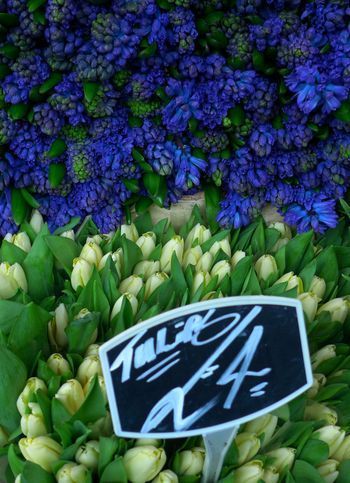
The market was sunny and friendly, with plenty of sellers out-shouting each other with promises of the cheapest spring flowers ever, anywhere. We went for tulips (very cheap, very good, some fantastic, cheerful mixed bunches of 50 tulips for £10) and breakfast at the Albion Caff (sufficient newspapers to keep me happy), and came back with photos and enough flowers to fill four vases. And Lou keeping us spaced out in the car.
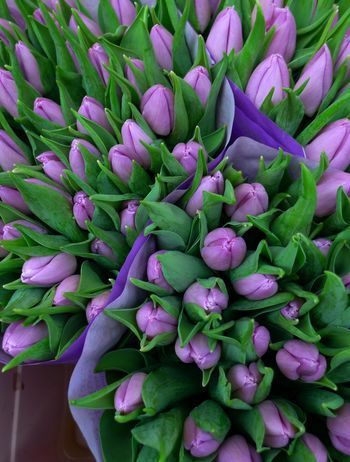
[all photos taken this morning]
February 23, 2012
seven years

[knitting, where it all began]
It's a long time, seven years. It's how long many people spend at senior school, in Tibet, or working up an itch. It's the gap that Michael Apted uses, it's the run of bad luck you'll get (allegedly) if you break a mirror, it's how long they say it takes Jesuits to turn a boy into a man. It's even longer for dogs (7 x7) and, I would argue, in blogland where every day, month, year is concentrated and full.
Seven years ago Tom and Alice were twelve, Phoebe was nine, I was less lined, and Simon had more hair.
Seven years ago I'd just finished my MA in Victorian Art & Literature. I'd discovered Dickens and fat, theatrical fairies, and a new world of imaginative creativity. I'd begun a PhD and was researching an aspect of Dickens' work that hadn't (and hasn't) been covered in any great depth, and which continues to fascinate me. But I'd grown tired of libraries and very small words in very thick books.
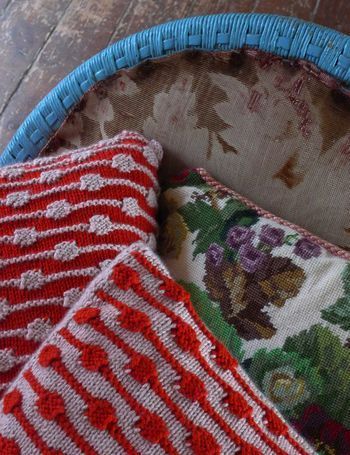
Seven years ago I discovered blogs, and a new world of real creativity. For six weeks I thought about what I'd write if I had a blog, and then in February 2005, I decided to stop thinking and start writing. I can still remember the moment when I thought up the name 'yarnstorm' and suggested it to Simon. Poor Simon; when he nodded, he had no idea what was starting.
Seven years on, Tom is at university, Alice is working, both can drive, stay out late, be laws unto themselves, and Phoebe is not far behind. I've lost count of how many inches they have grown between them, how many exams they have taken, how many new things they have done. They have changed, developed, and are moving on.
Seven years on, Simon has ridden thousands of miles on his bike, been around the world in planes, but remains unchanged, and as supportive, good-natured, funny, and as enthusiastic about raisins and sausages as ever.
Seven years on, I'm still sitting in the same chair. Still dealing with books and words, cakes and fabric, yarn and colour, films and paintings. But now I take photos to illustrate my own words, choose my subjects, make cakes for books as well as for pleasure, digest films, paintings, books, ideas, in a very different way to the way I used to, all filtered through different lenses and prisms.
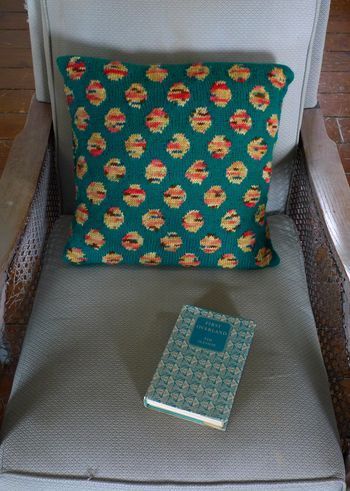
Seven years on I simply can't believe I am still blogging. I gave myself six weeks max., and if it didn't work out, I would retire, gracefully or otherwise. I reckoned I wouldn't be able to knit fast enough to maintain a blog anyway. But instead of seeing that as a failing, I realised it was an opportunity to write about other subjects equally dear to me. And, seven years on, I am always delighted when I discover that these interests are shared by others.
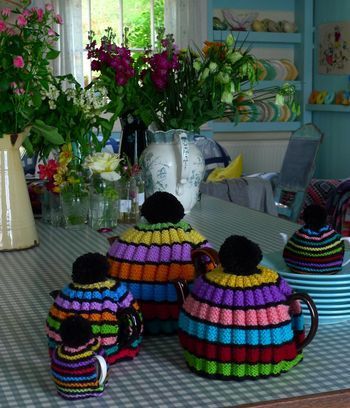
The seven years have been crammed, busy, always fascinating and thought-provoking, never dull. As well being the catalyst for quite a few things I never imagined I would do, the blog has also enabled me to make connections. I don't mean connections in the networking sense, but in the sense of making genuine connections with creative, thoughtful, generous, people who share, suggest, enthuse, encourage and make me laugh, here, by email, and in person. I've said it before many times in the last seven years, but I'll say it again: thank you for reading.
[I knitted all the projects in the photos for my book, which is where the patterns can be found.]
February 21, 2012
just
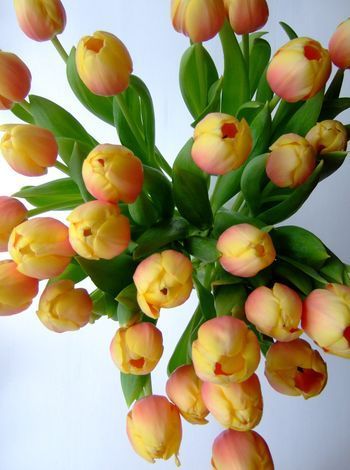
[garden centre tulips, just beautiful]
Just discovered Joel and Son Fabrics (not far from wonderful Marylebone Railway Station) and just visited it for the first time. Not a cotton quilting fabric in sight, but just about every other kind of upmarket fabric you could think of, from wafty chiffons to sparkly lace, cashmere checks to embroidered silks. I don't think the word 'emporium' is used enough these days, but this is a wonderful fabric emporium.
Just read A Card from Angela Carter, a book the size of a postcard and just about as economical with words, too. Much as I am interested in Angela Carter's amazing imagination and her retelling of fairy takes, this is such a slight book it almost slipped through my fingers and mind.
And just finished Mildred Pierce. It's a stroke of genius to have delicious home-baked pies running all the way through such a hard-boiled story. This will not slip my mind easily.
Just been to a tasting of Portuguese wines at Lord's cricket ground. No tall men in whites around, but plenty of good wines. Because Portugal is full of interesting, off-beat, slightly unusual, thought-provoking wines that don't fit neatly into any category, and the wines are getting better and better. They are simpler to understand, easier to drink, more modern than they were even a few years ago, and yet they retain a sense of place, a sense of being different to the crowd. Duas Pedras 2010 will be lovely, lightly chilled, when it's summertime, the living is easy, and there's the smell of flowers in the glass and, with luck, all around as well.
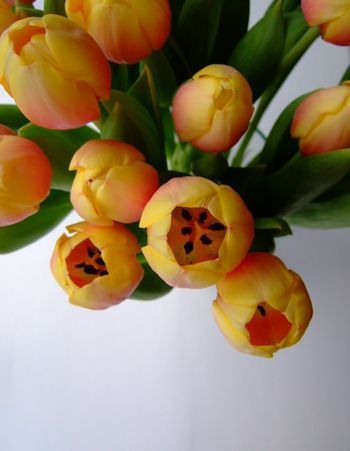
By coincidence, I have just started to get excited about tulips because the tulips in the shops are getting better and better by the day which means that the tulips in the garden won't be far behind. I'm just trying to book a visit to the Dutch tulip fields but I need a tulip-shaped crystal ball to tell me when the tulips will be at their best. Too early and it'll be just crocuses and hyacinths, too late and the tulips will have gone over. It's testing my (weak) power of long-range weather forecasting to the very limit.
Just finished writing a book. Just delighted.
Jane Brocket's Blog

- Jane Brocket's profile
- 27 followers

