
Jane Brocket's Blog, page 47
January 24, 2012
delicate little flower
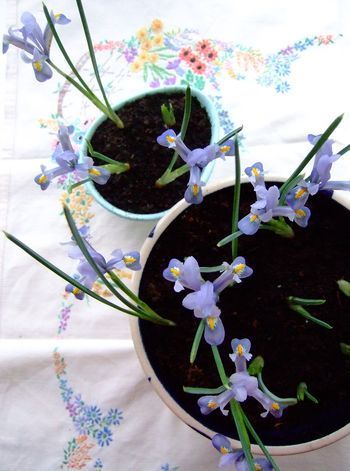
Whenever I hear someone (or myself) describing a person as a 'delicate little flower', it always makes me smile because more often than not it's a phrase that's used ironically. And these species irises (iris reticulata 'Cantab') bear this out. They look very much like delicate little flowers, yet they are remarkably undelicate in constitution, and flower outside in horribly cold conditions that would deter all but the hardiest plants.
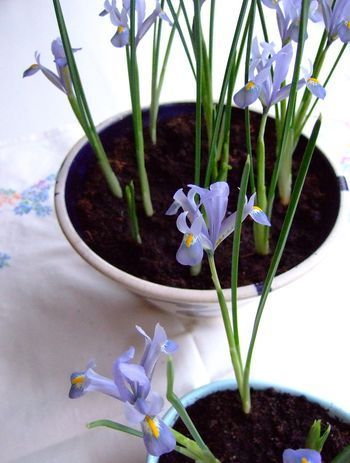
Ironically, it's when you force them and bring them indoors, that they turn into delicate little flowers. They are sensitive to the high temperatures so they burst open, quickly lose all their energy, and go over in two or three days.
In comparison to these small, sturdy irises, I feel very delicate, like a large hothouse plant that can't bear draughts and icy winds and freezing mornings. But I like bringing them indoors because, as a very nesh* northener, I know that it's the only way I'll be able to contemplate their shapes, colours, and markings for any length of time.
*nesh: northern term of mild abuse when growing up if you didn't want to go outside when it was brass monkey weather.
[Bulbs from Peter Nyssen, planted in bowls in multi-purpose compost in mid-November, kept in a cold, dark garage, brought into the warmth about a week ago.]


January 19, 2012
the plate's mine oyster*
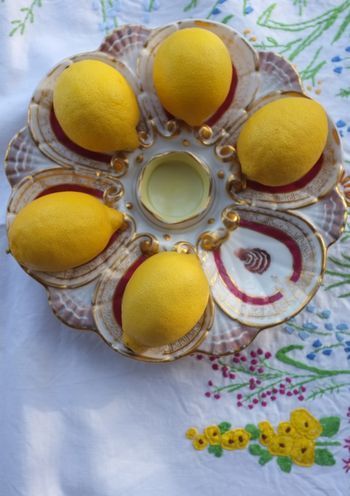
Simon likes oysters. He really, really likes them; while others dither and squirm, he's busy shucking and slurping. His perfect holiday destination is the Ile de Ré where he can combine cycling and shellfish, and buy oysters which get cheaper and cheaper the more dozens you buy.
Just before Christmas I bought him an oyster plate for a couple of quid. We haven't yet eaten any oysters from it, but it turns out to be a brilliant plate for keeping lemons and ideal for ripening avocados.
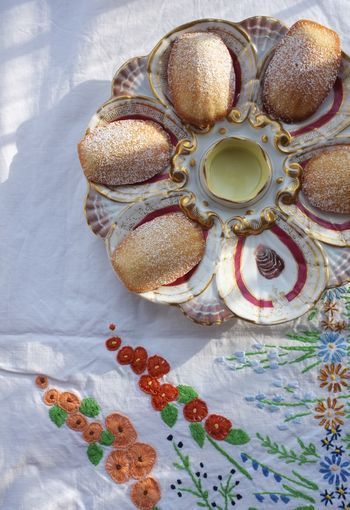
The closest we have come to anything in a shell are shell-shaped madeleines, so now it's also a cake serving plate.
I knew nothing about oyster plates until I started writing this post. My plate is unmarked and no doubt worthless, but there are some very beautiful antique oyster plates which can set you back £600 or £700. They are made by companies such as Minton, Wedgwood, Gien, and Limoges and like all well-designed practical objects, they combine function with beauty (and wit and colour).
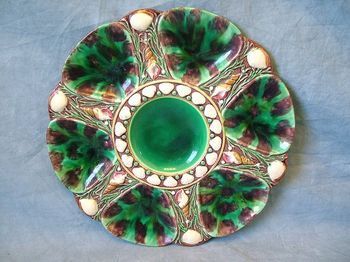
[Minton]
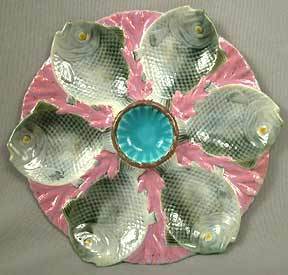
[Minton, $4,300]
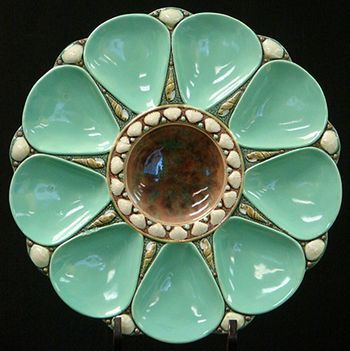
[Minton]
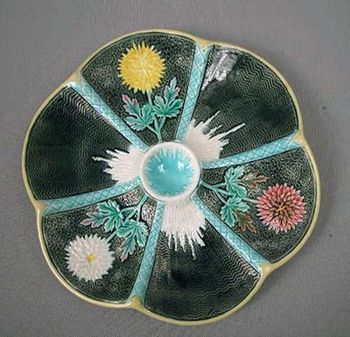
[majolica]
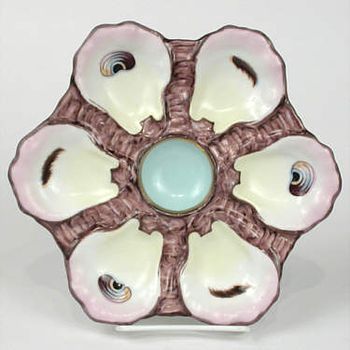
[hand-painted]
There's even a book on the subject. I should have known. I could become an oyster plate collector and ripen a whole Chilean valley's-worth of avocados on my windowsill, because I certainly wouldn't be able to afford the oysters as well as the plates.
*Apologies to Shakespeare and The Merry Wives of Windsor Act II, scene ii
January 17, 2012
economies of scale
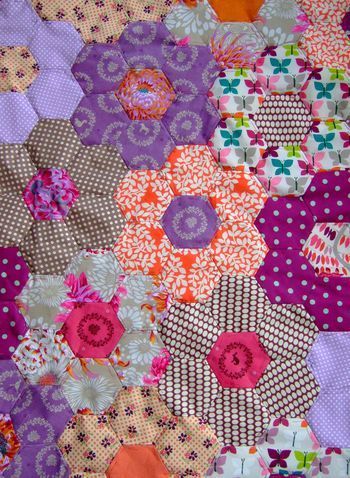
Through empirical research I have discovered that it needn't take a lifetime to make a hand-stitched hexagon quilt top. No indeed, it can be done in four weeks, and this top is proof of the matter.
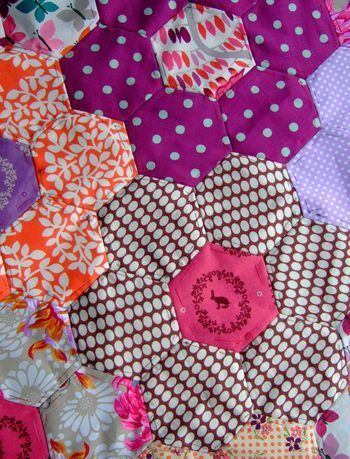
It's not that I have super-fast stitching skills, or a little Rumpelstiltskin tucked away somewhere busily turning fabric into hexagons while I sleep, or even all the time in the world.
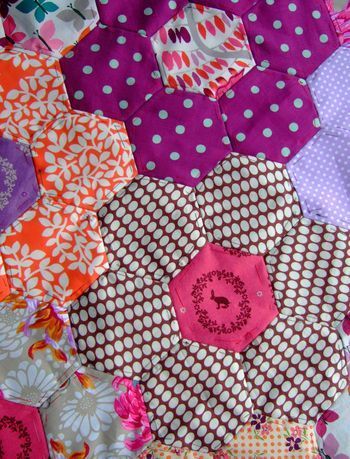
It's much simpler than that: I used large hexagons.
I don't know why small hexagons are the norm in patchwork when they clearly send people round the bend with their size and fiddliness and slow rate of growth. Why not just blow them up, think big, and work on a scale that gives economies of scale and time?
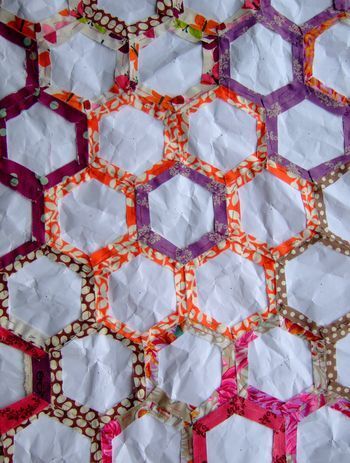
I printed off the largest hexagons I could fit, two at a time, onto A4 sheets of paper - a single hexagon per sheet would have been possible, but I needed some sort of economy of paper, even though I printed on the back of used sheets.
I aimed to make a daisy a day, ie cutting out, pinning, basting then stitching together seven hexagons into a simple flower shape. Then I had three or four evenings of sewing the whole lot together to make the top. My only problem now is that I really like it with the papers left in; it gives the top a certain stiffness, and a sound that is really appealing.
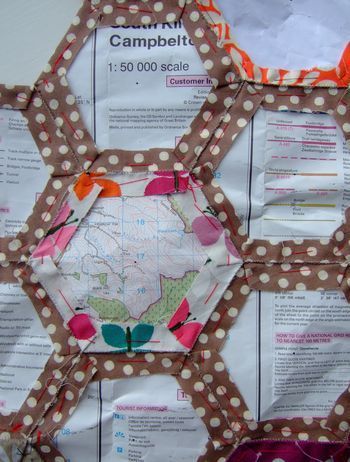
Plus I am tempted to leave in the pieces of the old OS map I used for one of the flowers, as it's there that I saw the solution to the hexagon problem stitched into the top itself.
January 15, 2012
overwintering
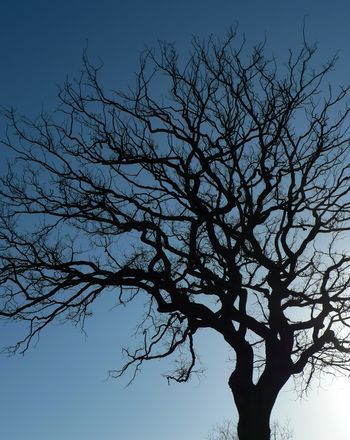
Twisted, gothic trees that wouldn't look out of place on Pendle Hill or Haworth Moor.

Prairie grasses with a winter crew cut.
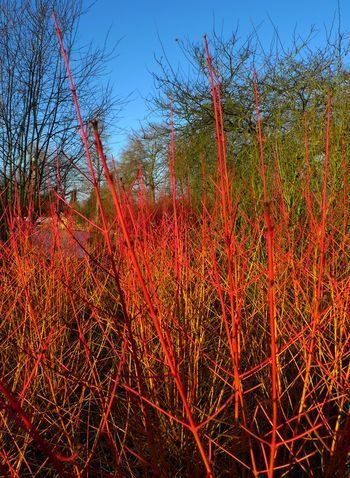
Red-hot dogwood.
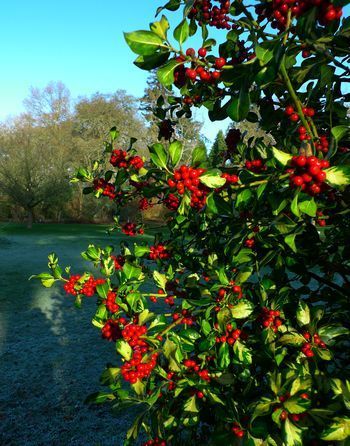
Merry berry holly.
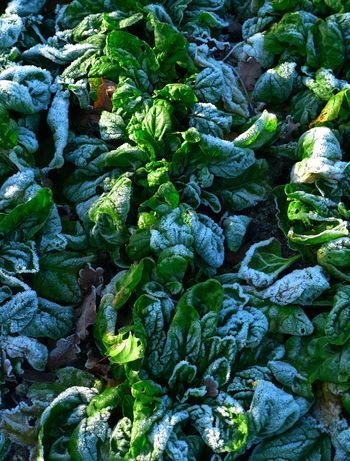
Crinkly, wrinkly, frosty spinach.
It's amazing how much natural activity there is, how many plants simply, silently, spectacularly keep going all winter.
January 14, 2012
more than just a doughnut
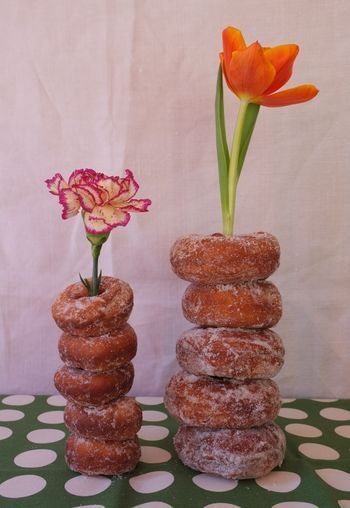
We made more doughnuts yesterday. Phoebe is chief fryer (I told her she should include this valuable experience in her CV - it could stand her in good stead when looking for summer jobs in holiday resorts) and I am chief kitchen ventilator and monitor of oil temperature (see post below).
We made mini rings, large rings, and more jam-filled round doughnuts. We have a lot left over today, but they have lost their freshness (they lose it very quickly) and aren't nice to eat. But I can't bear to throw them out immediately, not when they still look so very appealing and misleadingly fresh.
But I have discovered that there are things that you can do with day-old doughnuts besides wishing they were fresh enough to eat.
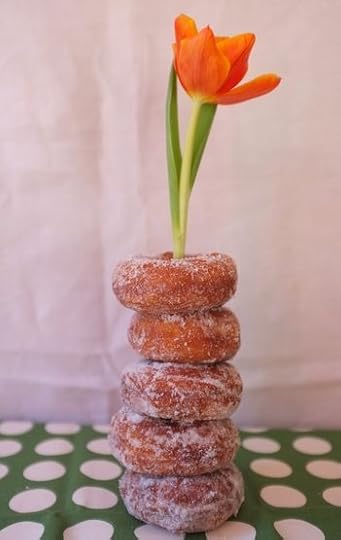
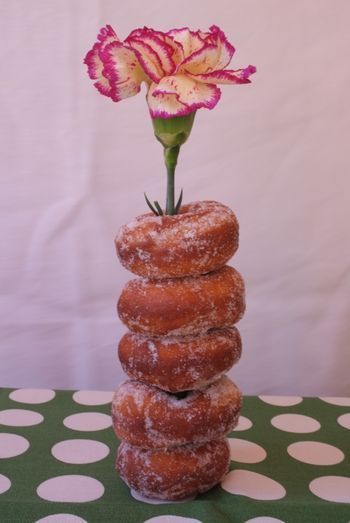
You can make them into vases to hold single stems.
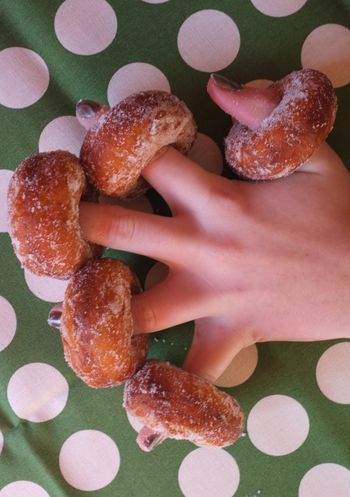
You can give them to a girl who likes rings on her fingers and bells on her toes.
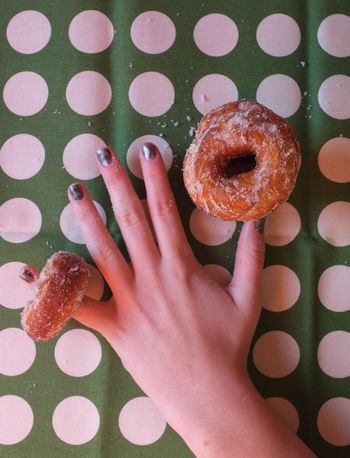
You can use one to propose to or marry someone.
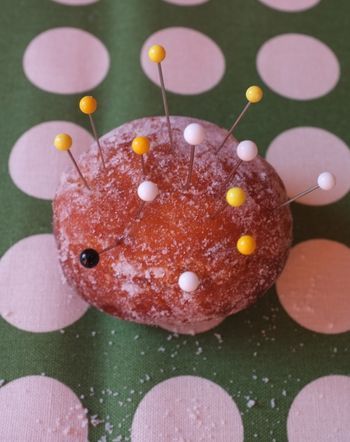
And you can use one as a sticky pincushion.
Then you can use them as food for birds to get sleek and fat on.
January 12, 2012
jan bos
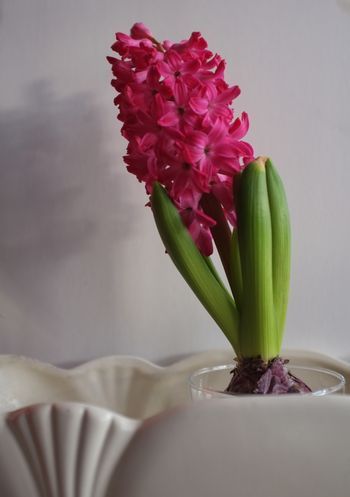
Introduced in 1927. Deep rose colour. Very fragrant, reliable, compact. Stunning at any time of the year, but quite magical in January.
January 10, 2012
flaubert's macaroon
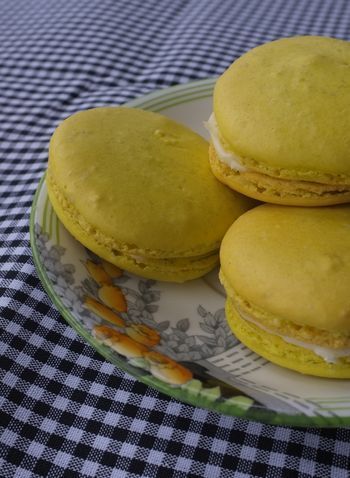
{not Flaubert's}
Gustave Flaubert was a perfectionist. His attention to detail and his search for 'le mot juste' in every sentence are legendary. He agonised over his work, often completing just a few lines per day, or a single page in a week. I thought about his perfectionism today as I was making macaroons (macarons) at home for the first time. I've made them once before, but never tried chez moi because I have been put off by the enormous amount of detailed instructions and finger-wagging dos and don'ts that I have come across while looking for a simple, practical, doable recipe.
I feel Flaubert would be in his element making macaroons.* He could age his egg whites correctly, weigh them out to the nearest gram, debate whether or not to oven-dry his almonds before grinding (he would never buy ready-ground). Then he could enervate himself by fussing over the ideal bowl (spotless stainless steel), the doubling up of baking trays, the optimum oven temperature. He could debate the merits of baking parchment vs silicon sheets, reusable vs disposable (preferably hand-rolled) piping bags, 1/2" nozzle vs 3/8" nozzle, and even whether the weather is right (he would know all about the potentially deleterious effects of humidity on macaroons). And this is without stressing over batter consistency, how long to leave the piped macaroons to dry before baking, how to avoid macaroon disasters such as hollow shells, cracked shells, pointy shells, warped shells, bumpy shells, and burst or substandard 'feet'. Even when he'd made his macaroons, he wouldn't be free of anxiety; he'd still have to worry about how long to keep them before filling (and, of course, he'd have to decide on the best filling), at what temperature they should then be stored, and where best to store them, .
And finally, after all that, he would have to choose the ideal moment to eat them. By which time he might very well be lying down with a cold compress on his forehead, with a single perfect macaroon on a little table next to him, having thrown away the rest for failing to meet his criteria. The macaroon would be the baking equivalent of Madame Bovary: exquisite, subtle, elegant, layered, and textured. But he wouldn't be able to contemplate another macaroon or novel for a few years.
Or he could take a deep breath and decide that any home-made macaroons, no matter how imperfect or bumpy, lumpy, footloose and fancy-free, would be better than no macaroons at all. Which is the approach I took.
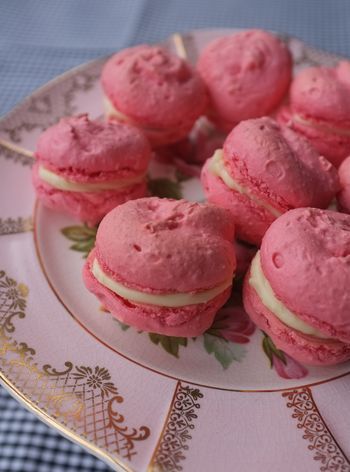
I picked two different recipes, shut down the blogs with fabulous-looking macaroons embedded in about thirty pages of instructions, and had a go. The shells are plain - no flavouring, but I couldn't pass up a chance to get out the food colouring - and filled with white chocolate ganache. One recipe made rather flat macaroons (top) and the other created puffy, grainy little semi-spheres which would fail the Flaubert test. But when I take off my glasses they look fine, and if I eat one, I know that there's a lot more to a macaroon than good looks.
* He does mention macarons in L'Education Sentimentale.
January 7, 2012
vintage flowers
Another of the joys of January, apart from the fact it means December is over, is the arrival and the prospect of more fresh flowers. I know the gardening writers and die-hard enthusiasts will insist that flowers are available all year round if you count twiggy things and prickly things and things that shouldn't really be brought indoors (and I am aware that Charlotte can easily prove me wrong with her very pretty December flowers), but there's no getting away from the fact that the end of the year coincides with the end of lovely, old-fashioned seasonal flowers.
So when I see the first bunches of Dutch hyacinths and tulips, the tight, muddly sheaves of daffodils, and even greenhouse, frilly-knicker carnations appearing in the shops, I know it's the start of a fresh floral new year.
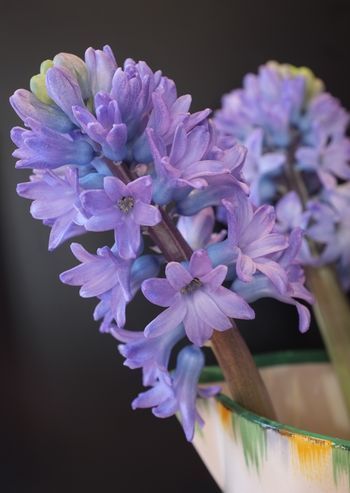
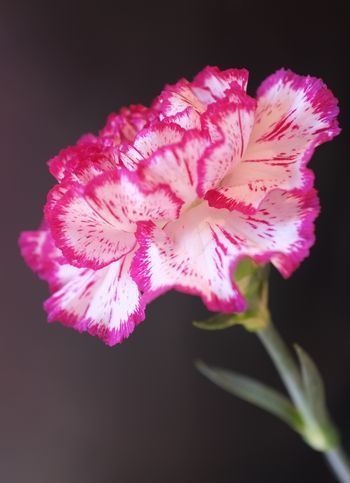
My hyacinths are coming indoors in batches, surprising me with their limpid, watercolour shades (I forget which bulbs are in which vases), and I have bought some cut hyacinths and completely out-of-season but irresistible magenta-edged carnations to brighten up both me and the kitchen.
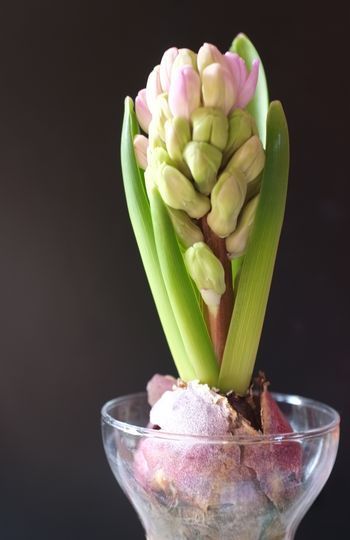
But these are small fry when you look at Vintage Flowers which is one of the most stunningly beautiful books I have read in a long time. It's written by Vic Brotherson who owns the spectacular-looking Scarlet & Violet (I'd love to have this as my local flower shop: just imagine having an Elton John-style account there and taking delivery of fabulous flowers every week). Someone or some people have had enormous fun putting this together, I should think, as the book design, the typography, the photography, the props, and the flowers themselves are utterly gorgeous. It's exuberant, expressive, colourful floristry from someone who clearly adores and knows her flowers very well. Although there are some instructions, it's not a how-to book, but more an indulge-and-enjoy book, a book that delights in and appreciates the wonders of flower-growers and sellers.
My new year flowers are just the beginning. I can't wait for the rest.
[Photographs taken with new camera, Fujifilm X100. Background is the back of a computer in the kitchen. Wish I could say it was something more fancy and technical, but making do takes a lot less time.]
January 4, 2012
golden silence
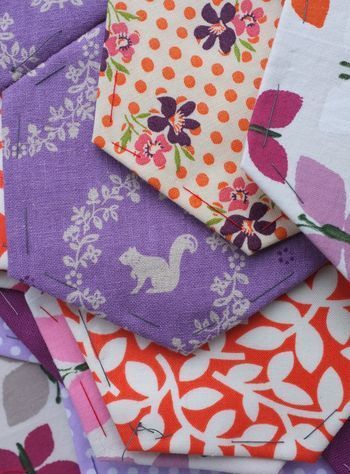
It's not as though I'd be over-using it, bending everyone's ears back or shouting for a fortnight, but my voice has gone. It's due to some virus or other and if I do speak it's against doctor's orders (total voice-rest for 48 hours) and I sound wheeeeeeezy like Muttley or grrrrrrravelly like Colin in the wonderful Rev. The teenagers think the enforced maternal silence is a late Christmas gift, while I am coming to realise just how little feedback teenagers want or need. I haven't spoken properly for four days, and it's becoming a habit. Not that I'm likely to take a vow of silence or anything, but it is peaceful, even for me. And I am enjoying the obvious internal theme tune to this interlude: Silence is Golden (one of my favourite songs when little - oh, the irony - I was always in trouble at school for talking in lessons.).
So I am looking for speechless activities. Going to the theatre works well: other people can do the loud voices. Phoebe and I went to see Matilda last night - what an amazingly inventive, creative, imaginative production. It's full of wonderful verbal cleverness, the children are like little cartoon characters (not in the slightest bit 'annoying', as Phoebe put it), and the whole thing is so meticulously timed and choreographed that you hold your breath and wonder at it all. Last night's Matilda (there are four) was simply incredible (she even delivered a few lines in perfect Russian), and the star turn of Bertie Carvel as Miss Trunchbull takes the idea of the pantomime dame to a very different level.
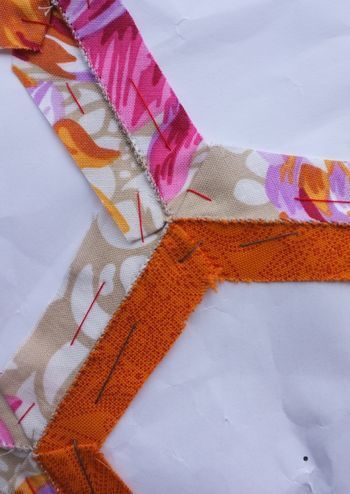
And making hexagon flowers is a quiet pastime. I've found a rhythm now, and have got over the fact that everything has to be done by hand. I've made all the indvidual flowers and am now at the stage of sewing them into one piece. I find it hard to believe, but I actually enjoy making all the little stitches along the edges, turning corners, going down new lines, like an ant, hell-bent on following the pre-set route. I'm leaving all the papers in for the time being (it does make sewing edges together easier) and then I'll have a major pulling-out party at the end.
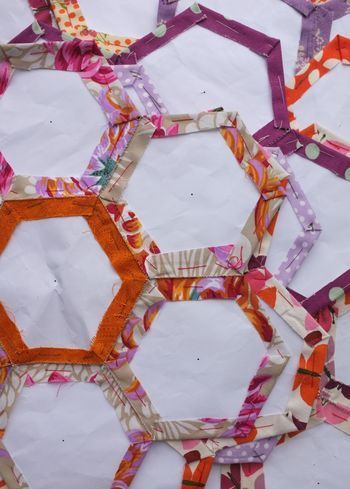
By which time I'm hoping I'll be able to shout 'yippee' very loudly.
January 3, 2012
new food iii

Once upon a time, I think I must have had a bad doughnut experience in Blackpool, as the smell of them frying still triggers a negative, nauseous response. That, or I realised that doughnuts are basically balls of deep-fried sweetened bread dough filled with oozing jam and smothered in crunchy sugar, and it had the same effect. For me, a pan full of hot oil whether in a shop or a home (most houses had a chip pan where I grew up) was for making wonderfully fresh chips to go with eggs, fish fingers, and fried eggs, and not for sweet stuff.
Despite my love of home-made chips, I've never had access to a chip pan since I left home, and have never really wanted a deep-fat fryer of my own. I haven't missed one, either, except when I was making onion bhajis last Christmas - and then again this last weekend, when we decided to make doughnuts after years of talking about making them.
The teenagers thought I was mad issuing all the warnings about hot oil and spontaneous combustion etc, but as they've not grown up with a chip-pan on the stove, I felt they might have missed something out of their kitchen education. As with anything mildly dangerous, they clamoured to help, testing the temperature by dropping in little cubes of bread and watching them sizzle and turn brown, standing over the doughnuts as they bobbed up, puffed up, and turned brown, tossing them in caster sugar, and injecting them with jam (the jammy doughnuts ended up looking as though they'd sustained flesh wounds and were bleeding jam).
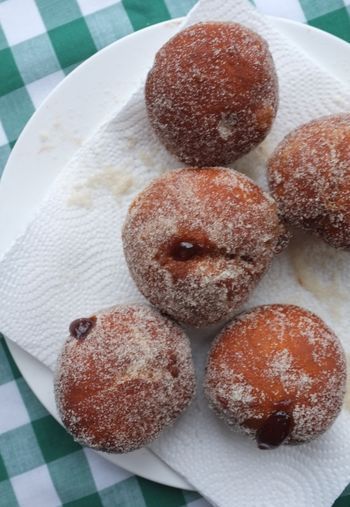
The smell of the doughnuts frying reminded them all of Legoland (so much more upmarket than Blackpool Pleasure Beach) and although it had a predictably Proustian effect on me and brought back the usual feeling of nausea, the taste and texture were a revelation to someone who has lumped all doughnuts in the same Krispy Kreme/supermarket bracket. While I may never be able to eat a whole one unless it was very small (next time we fancy making mini doughnuts), I was amazed at just how delicious a bite of a fresh, home-made doughnut can be. A doughnut definitely needs raspberry jam in the centre, and a light coating of caster sugar, but it is the rich, soft, lightly sweetened and ultra-fresh breadiness that is the best part.
After this happy experience with a pan of oil, I can only hope that in the future the smell of doughnuts frying will bring back good memories of cooking with teenagers rather than bad memories of a tummy-turning experience on the promenade.
Jane Brocket's Blog

- Jane Brocket's profile
- 27 followers

